- Market Value (2025): USD 1.44 Bn
- Estimated Value (2026): USD 1.52 Bn
- Forecast Value (2036): USD 2.65 Bn
- CAGR (2026-2036): 5.7%
What is the Airbag Harness Market forecast to be worth by 2036?
USD 1.52 Billion in 2026 to USD 2.65 Billion by 2036, at a 5.7% CAGR.
- As per Fact.MR analysis, the airbag harness market reached USD 1.44 Billion in 2025.
- Demand will increase from USD 1.52 Billion in 2026 to USD 2.65 Billion in 2036.
- The market is forecast to record a 5.7% CAGR during 2026 to 2036 driven by global NCAP 5-star crash safety mandates, the proliferation of multi-airbag cabin architectures (including side curtains and knee airbags), and expanding electric vehicle platform production requiring lightweight, high-reliability wiring networks.
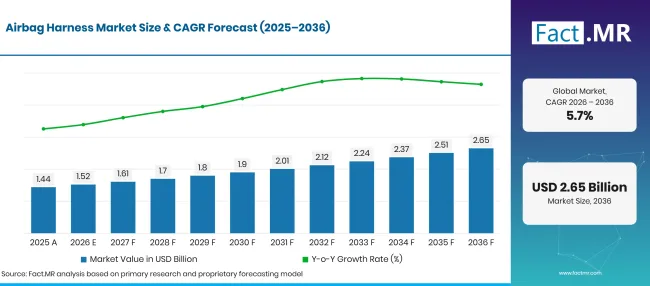
Factmr Airbag Harness Market Forecast Global | Source: Fact.MR
| Year | Basis | Market Value (USD Billion) |
|---|---|---|
| 2025 | Actual | 1.44 |
| 2026 | Estimate | 1.52 |
| 2036 | Forecast | 2.65 |
| CAGR 2026 to 2036 | Forecast period | 5.7% |
Source: Fact.MR analysis. Updated Oct 21, 2026
What are the defining numbers behind Airbag Harness Market growth?
USD 1.2 Billion absolute chance between 2026 and 2036, with frontal airbag harnesses and passenger cars generating the largest manufacturing volume.
- Demand Drivers in the Market
- Global motor vehicle safety regulations, including Federal Motor Vehicle Safety Standard (FMVSS) No. 208 and Euro NCAP crash testing protocols, mandate fail-safe occupant crash protection systems across all new passenger vehicles [1]. Regulatory agencies require advanced dual-stage frontal airbags that modulate deployment force based on occupant size, seat position, and crash severity. Automotive wiring engineers install dedicated, isolated airbag harnesses with gold-plated contacts and connector position assurance (CPA) locks to eliminate electrical resistance variations and prevent misfires.
- Increasing adoption of comprehensive side-impact and rollover crash mitigation standards, such as FMVSS No. 214, is driving the standard installation of thorax, pelvis, and full-length side curtain airbags across both front and rear passenger rows [2]. The resulting multiplication of deployment pyrotechnic squibs requires complex, distributed wiring harnesses routed through tight vehicle pillars, roof rails, and door structures. Automotive designers specify ultra-flexible, abrasion-resistant wire harnesses capable of maintaining complete circuit integrity during catastrophic side collisions.
- High-velocity vehicle crash dynamics research and multi-sensor occupant restraint assessments demonstrate that airbag squib activation must occur within 15 to 30 milliseconds of initial bumper impact to effectively arrest occupant forward momentum [3]. Maintaining ultra-low signal latency and zero electrical noise across the harness network is essential for transmitting immediate deployment firing pulses from the central Airbag Electronic Control Unit (ACU). Wiring manufacturers incorporate twisted-pair cabling, foil shielding, and ferrite beads to suppress electromagnetic interference generated by adjacent electric powertrain inverters.
- Accelerated electrification of the automotive sector is compelling vehicle architects to optimize chassis space and aggressively eliminate harness weight to extend EV battery driving range. Spatial layout optimization and automated 3D wire routing algorithms prevent mechanical pinch points, sharp-edge chafing, and resonance-induced fatigue along crowded automotive chassis structures [4]. Tier-1 harness suppliers are developing hybrid copper-aluminum wire harnesses that deliver significant weight savings without compromising squib firing reliability.
- Key Segments Analyzed
- By Product Type: Frontal Airbag Harness holds 38.2% share in 2026, representing the universal core of occupant passive safety across driver steering wheels and front passenger dashboards.
- By Vehicle Type: Passenger Cars accounts for 72.4% share in 2026 as global car production expands, equipped with standard multi-airbag safety suites across entry-level and luxury vehicle segments.
- By Sales Channel: OEM accounts for 81.7% share in 2026, driven by direct factory-floor vehicle assembly contracts where wiring harnesses are pre-installed into vehicle body-in-white structures.
- By Material Type: Copper holds 50.1% share in 2026, prized across automotive engineering teams for its superior electrical conductivity, tensile strength, fatigue resistance, and proven crimp reliability.
- Analyst Opinion at Fact.MR
- Shambhu Nath Jha, Lead Consultant at Fact.MR, states, “The automotive airbag harness is arguably the most safety-critical wiring assembly in a modern motor vehicle. Unlike infotainment or comfort cabling, an airbag harness must deliver absolute, zero-failure electrical performance after a decade of continuous thermal cycling, cabin vibration, and humidity exposure. As software-defined vehicles and electric platforms centralize electronic control units, harness manufacturers who master high-speed automated crimping, micro-terminal inspection, and lightweight conductor metallurgy will maintain exclusive preferred-supplier status with leading global automotive groups.”
- Strategic Implications
- Wire harness manufacturers are deploying high-speed automated crimping presses equipped with 100% inline crimp force monitoring (CFM) and laser visual inspection cameras. Multi-axis automotive accelerometer research confirms that pyrotechnic squib activation circuits require flawless electrical micro-connections capable of transmitting high firing currents without micro-fretting corrosion or contact resistance creep [5]. Automating harness sub-assembly drastically reduces human assembly defects in mission-critical restraint circuits.
- Automotive tier-1 suppliers are standardizing modular squib connector interfaces that incorporate integrated shorting bars and mechanical connector position assurance (CPA) clips. Shorting bars prevent accidental pyrotechnic squib deployment caused by stray electrostatic discharge during vehicle assembly and maintenance handling.
- Vehicle engineering teams are transitioning from centralized point-to-point harness architectures toward zonal electronic architectures. Zonal wiring designs position localized restraint control modules closer to side curtain and seat airbags, substantially shortening individual airbag harness lengths and reducing overall wiring mass.
- Global wiring harness producers are establishing dedicated manufacturing plants in cost-competitive manufacturing hubs such as Mexico, Morocco, and Eastern Europe. Maintaining proximity to major automotive assembly clusters ensures just-in-sequence (JIS) delivery of customized wire harnesses while optimizing logistics costs.
Brazil is projected to lead global expansion with a 7.1% CAGR, driven by strict Latin NCAP safety mandates, modernization of domestic passenger vehicle assembly plants, and expanding commercial truck production. Japan advances at 6.4%, underpinned by world-class automotive electronics engineering, keiretsu manufacturing excellence, and rapid mini-vehicle (Kei car) safety upgrades. The United States records a 5.9% CAGR, supported by massive pickup truck and SUV production, stringent NHTSA crash testing regulations, and high consumer safety expectations. Germany expands at 5.6%, driven by premium luxury vehicle manufacturing, advanced engineering at BMW, Mercedes-Benz, and Volkswagen Group, and stringent VDA automotive quality standards. The United Kingdom achieves a 4.0% CAGR, supported by niche luxury sportscar manufacturing, commercial van assembly, and strong automotive aftermarket safety parts distribution.
How does the Airbag Harness Market break down by segment?
Frontal Airbag Harness 38.2%; Passenger Cars 72.4%; OEM 81.7%; Copper 50.1% in 2026.
Which Product Type dominates?
Frontal Airbag Harness holds 38.2% share in 2026.
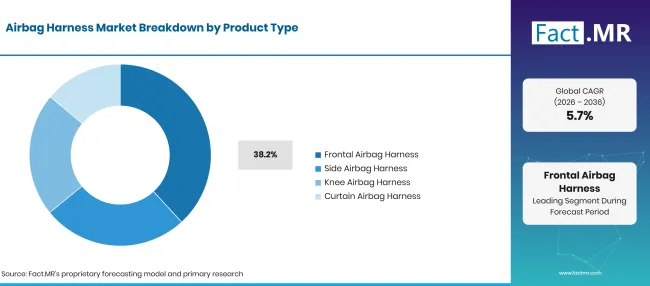
Factmr Airbag Harness Market Breakdown Product Type | Source: Fact.MR
| Product Type | Share (2026) |
|---|---|
| Frontal Airbag Harness (Leading segment) | 38.2% |
| Other segments combined | 61.8%* |
| Total | 100.0% |
Source: Fact.MR analysis. Updated Oct 21, 2026
Frontal airbag harnesses dominate manufacturing output because driver and front-passenger frontal airbags are legally mandated across virtually all automotive markets worldwide. Driver-side airbag harnesses are routed through specialized steering column clocksprings (spiral cables) designed to endure hundreds of thousands of full steering rotations without wire breakage. In modern vehicles, frontal airbag harnesses interface with comprehensive automotive safety systems to coordinate seatbelt pre-tensioning and emergency braking. The central airbag control unit continuously receives occupant position and weight data from an advanced vehicle occupant sensing system to tailor deployment velocity during frontal impacts. Inside the cabin, precision wiring connects directly to driver steering wheel airbag modules that deploy in less than 25 milliseconds during head-on collisions.
What leads the Vehicle Type segment?
Passenger Cars accounts for 72.4% share in 2026.
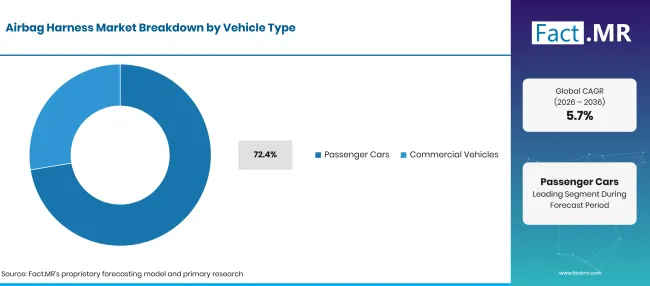
Factmr Airbag Harness Market Breakdown Vehicle Type | Source: Fact.MR
| Vehicle Type | Share (2026) |
|---|---|
| Passenger Cars (Leading segment) | 72.4% |
| Other segments combined | 27.6%* |
| Total | 100.0% |
Source: Fact.MR analysis. Updated Oct 21, 2026
Passenger vehicles command nearly three-quarters of total airbag harness consumption, propelled by the sheer volume of global passenger car manufacturing and the competitive imperative among automakers to achieve 5-star NCAP safety ratings. Modern sedans, hatchbacks, and crossovers now incorporate between six and ten individual airbags, multiplying the length and complexity of cabin restraint wiring. Automakers install extensive wiring routed along roof headliners to fire an automotive curtain airbag that cushions passenger head impact against side window glass. Tier-1 suppliers package these restraint wires within dedicated roof and overhead console wiring harness modules to ensure clean, rattle-free cabin aesthetics. In heavy commercial transport, fleet operators specify specialized chassis and powertrain wiring harness systems for trucks that integrate ruggedized cab airbag modules to protect long-haul truck drivers.
Why does OEM dominate Sales Channels?
OEM accounts for 81.7% share in 2026.
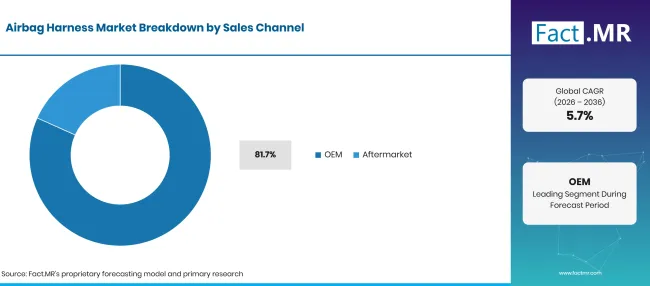
Factmr Airbag Harness Market Breakdown Sales Channel | Source: Fact.MR
| Sales Channel | Share (2026) |
|---|---|
| OEM (Leading segment) | 81.7% |
| Other segments combined | 18.3%* |
| Total | 100.0% |
Source: Fact.MR analysis. Updated Oct 21, 2026
Direct OEM supply relationships represent more than four-fifths of total market revenue, reflecting the integrated nature of supplemental restraint system manufacturing. Airbag harnesses must be co-engineered with vehicle body architecture and installed during initial body assembly before cabin interior trim panels, headliners, and carpets are secured in place. Tier-1 harness assemblers coordinate restraint wiring with broader automotive electronics architectures to prevent electrical cross-talk. To protect restraint wiring from extreme underhood temperatures, engineers route cabling safely away from high-temperature automotive powertrain components. During sudden impact deceleration, the airbag electronic control unit interprets signals from an automotive magnetic sensor and advanced forward-looking automotive radar sensors to trigger squib detonation with microsecond precision.
What is accelerating Airbag Harness Market adoption, and what is holding it back?
Global vehicle crash safety regulations, multi-airbag vehicle architecture proliferation, and expanding electric vehicle platform production accelerate market expansion. High design complexity of custom vehicle wiring harnesses, raw copper metal cost fluctuations, and stringent zero-defect recall liabilities restrict frictionless market execution.
Drivers Impact Analysis
| DRIVER | (~) % IMPACT ON CAGR | GEOGRAPHIC RELEVANCE | IMPACT TIMELINE |
|---|---|---|---|
| Mandatory NCAP crash safety ratings driving standard multi-airbag fitment | +1.4% | Global | Short term (<= 2 years) |
| Proliferation of curtain, side, and knee airbags multiplying harness connections | +1.2% | North America, Europe, Asia | Short term (<= 2 years) |
| Growth of global electric vehicle production requiring lightweight wiring networks | +1.0% | East Asia, Europe, USA | Medium term (2–4 years) |
| Technological shift toward zonal E/E vehicle architectures with localized control | +0.8% | North America, Europe | Medium term (2–4 years) |
| Expanding commercial vehicle safety standards requiring driver cab airbags | +0.6% | Global | Long term (>= 4 years) |
Source: Fact.MR analysis. Updated Oct 21, 2026
Opportunity Impact Analysis
| OPPORTUNITY | (~) % IMPACT ON CAGR | GEOGRAPHIC RELEVANCE | IMPACT TIMELINE |
|---|---|---|---|
| Lightweight copper-clad aluminum alloy wiring reducing overall vehicle weight | +1.2% | Western Europe, East Asia | Short term (<= 2 years) |
| Ultra-compact miniaturized squib connectors designed for tight pillar packaging | +1.0% | North America, Europe | Medium term (2–4 years) |
| Automated laser-welded terminal connections ensuring zero fretting corrosion | +0.8% | Japan, Germany | Medium term (2–4 years) |
| Integrated smart sensor-harness assemblies for autonomous vehicle cabin safety | +0.6% | Global | Long term (>= 4 years) |
Source: Fact.MR analysis. Updated Oct 21, 2026
Restraints Impact Analysis
| RESTRAINT | (~) % IMPACT ON CAGR | GEOGRAPHIC RELEVANCE | IMPACT TIMELINE |
|---|---|---|---|
| Price volatility in high-purity copper cathodes and engineering fluro-polymers | -1.0% | Global | Short term (<= 2 years) |
| Severe financial and legal liabilities associated with automotive safety recalls | -0.8% | North America, Europe | Medium term (2–4 years) |
| Manual labor assembly dependencies in complex multi-branch wiring harnesses | -0.6% | Emerging Markets | Medium term (2–4 years) |
| Packaging space constraints within congested door pillars and dashboard consoles | -0.4% | Global | Long term (>= 4 years) |
Source: Fact.MR analysis. Updated Oct 21, 2026
Which countries are scaling the Airbag Harness Market through 2036?
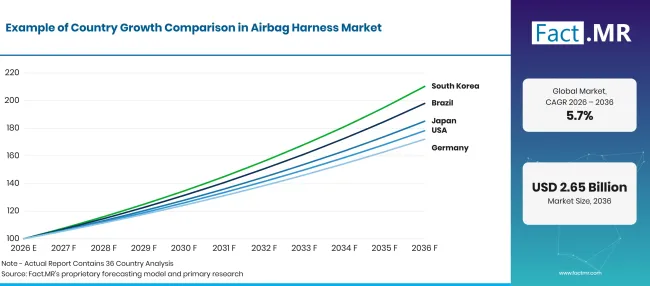
Factmr Airbag Harness Market Growth Index | Source: Fact.MR
| Country | CAGR (2026–2036) |
|---|---|
| Brazil | 7.1% |
| Japan | 6.4% |
| USA | 5.9% |
| Germany | 5.6% |
| UK | 4.0% |
Source: Fact.MR analysis. Updated Oct 21, 2026
Why is Brazil leading global market growth?
7.1% CAGR, driven by strict Latin NCAP vehicle crash testing enforcement, substantial modernization of Brazilian car manufacturing plants, and rising consumer demand for safer family vehicles.
Brazil represents the automotive manufacturing heart of South America, with extensive vehicle assembly complexes located across São Paulo, Paraná, and Rio Grande do Sul. Following the mandatory enforcement of dual frontal airbags across all newly registered vehicles and escalating consumer scrutiny under Latin NCAP crash test ratings, automakers in Brazil are standardizing side-impact and curtain airbags in high-volume compact cars. Major global wiring harness producers operate dedicated manufacturing plants in Brazil, supplying localized wiring assemblies directly to assembly lines operated by Stellantis, Volkswagen, General Motors, and Toyota. Brazilian commercial truck manufacturers are also standardizing driver-side cab airbags to meet modern fleet safety guidelines.
How is Japan sustaining cutting-edge wiring innovation?
6.4% CAGR, supported by world-leading automotive electrical engineering, iconic keiretsu supplier collaborations, and comprehensive airbag integration across lightweight Kei cars.
Japan is home to world-leading automotive wiring harness conglomerates including Yazaki, Sumitomo Electric, and Furukawa Electric, which pioneer advanced wiring technologies globally. Japanese automakers prioritize occupant safety across all vehicle segments, equipping compact Kei cars and hybrid sedans with advanced pedestrian-sensing pop-up hood airbags and center-console airbags that prevent occupant collision in side crashes. Japanese harness manufacturers specialize in high-precision automated crimping, micro-miniature terminals, and flexible flat cables (FFC) that fit within ultra-compact dashboard architectures. Japan's automotive ecosystem maintains legendary quality control standards, ensuring near-zero defects across mission-critical pyrotechnic squib circuits.
What sustains massive harness procurement in the United States?
5.9% CAGR, propelled by high-volume light truck and SUV production, stringent NHTSA occupant protection regulations, and rapid consumer transition toward electric vehicles.
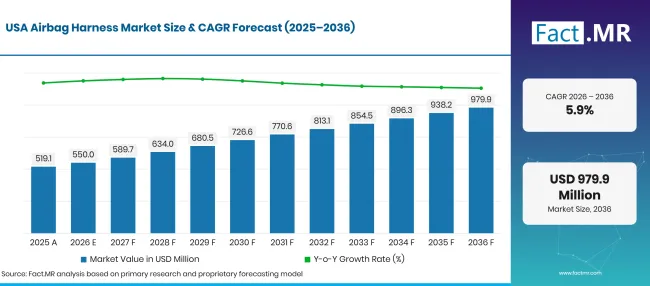
Factmr Airbag Harness Market Forecast Usa | Source: Fact.MR
The United States represents a massive, high-value market for airbag harnesses, driven by strong annual production of full-size pickup trucks, sport utility vehicles, and electric crossovers. Federal Motor Vehicle Safety Standards enforce stringent crash protection criteria that require sophisticated multi-stage frontal airbags, side curtain airbags covering all three passenger rows, and driver knee airbags. Automotive assembly plants in Michigan, Ohio, Kentucky, and Tennessee require just-in-time delivery of complex restraint harnesses customized for varied vehicle trim options. The rapid expansion of electric vehicle manufacturing facilities across the American Southeast creates strong demand for high-reliability, EMI-shielded airbag harnesses engineered for high-voltage battery platforms.
What drives precision harness engineering in Germany?
5.6% CAGR, rooted in Germany’s prestigious luxury automotive sector, rigorous VDA quality frameworks, and advanced passive safety innovations across BMW, Mercedes-Benz, and Audi.
Germany stands as Europe’s automotive engineering capital, renowned for producing technologically sophisticated, high-performance luxury vehicles that set global benchmarks in passive safety. German premium automakers pioneer novel airbag concepts, including rear-passenger frontal airbags, front-seat center airbags, and external pedestrian protection airbags, each requiring dedicated, high-reliability wiring harnesses. German automotive wiring suppliers in Bavaria and Baden-Württemberg adhere to strict VDA 6.3 audit standards and DIN automotive electrical specifications, deploying advanced silicone-insulated wiring capable of withstanding extreme engine bay and cabin temperatures. Heavy domestic investments in premium electric vehicles drive the adoption of lightweight aluminum conductor harnesses.
Why is the United Kingdom maintaining steady specialized demand?
4.0% CAGR, propelled by premium luxury vehicle manufacturing, commercial van assembly, and an active automotive aftermarket and collision repair sector.
The United Kingdom maintains a vibrant niche automotive manufacturing footprint centered on prestigious luxury marques such as Jaguar Land Rover, Bentley, Rolls-Royce, and Aston Martin, alongside high-volume commercial van manufacturing facilities. British vehicle manufacturers specify bespoke, high-specification restraint wiring harnesses with gold-plated terminals and redundant circuit routing to ensure flawless crash safety performance. The UK automotive sector also benefits from an established network of authorized collision repair centers and safety equipment distributors that source genuine OEM replacement harnesses following accident deployments. British automotive research centers collaborate with tier-1 suppliers to test composite wiring materials that enhance flexural endurance in dynamic vehicle door hinges.
Who leads the Airbag Harness Market?
Autoliv Inc. is the undisputed global leader in automotive passive safety systems, engineering and manufacturing integrated airbag modules, steering wheel clocksprings, and dedicated restraint wiring harnesses for automakers worldwide. ZF Friedrichshafen AG commands massive market presence through its passive safety division, supplying complete occupant restraint systems, smart steering wheels, and high-reliability airbag wiring networks. Aptiv PLC stands as a global powerhouse in vehicle electrical architectures, specializing in lightweight wiring harnesses, advanced signal distribution, and ruggedized automotive connectors. Sumitomo Electric Industries Ltd. is a premier Japanese wire harness giant, supplying ultra-reliable wiring harnesses, precision-stamped terminals, and flexible flat cabling to global automotive OEMs.
Lear Corporation commands immense expertise in automotive electrical distribution systems and seating assemblies, integrating seat-mounted side thorax airbag harnesses directly into complete automotive seat structures. Yazaki Corporation operates the world's largest dedicated automotive wiring harness manufacturing footprint, producing millions of wire assemblies, junction boxes, and squib connectors annually. Furukawa Electric Co. Ltd. specializes in steering roll connectors (clocksprings), lightweight aluminum wire harnesses, and precision battery sensor wiring. Leoni AG delivers specialized automotive cables, restraint harness sub-assemblies, and high-voltage wiring systems to leading European car manufacturers. Nexans S.A. manufactures specialized high-durability automotive wiring cables designed for harsh cabin and under-chassis environments. TE Connectivity Ltd. is an essential technology provider, manufacturing industry-standard squib connectors, CPA clips, and high-reliability automotive terminal contacts used across global airbag harness assemblies.
Which companies are the key providers?
Key companies include Autoliv Inc.; ZF Friedrichshafen AG; Aptiv PLC; Sumitomo Electric Industries Ltd.; Lear Corporation; Yazaki Corporation; Furukawa Electric Co. Ltd.; Leoni AG; Nexans S.A.; and TE Connectivity Ltd.
- Autoliv Inc.
- ZF Friedrichshafen AG
- Aptiv PLC
- Sumitomo Electric Industries Ltd.
- Lear Corporation
- Yazaki Corporation
- Furukawa Electric Co. Ltd.
- Leoni AG
- Nexans S.A.
- TE Connectivity Ltd.
Bibliography
- [1] National Highway Traffic Safety Administration. (2025). Standard No. 208: Occupant crash protection and frontal airbag deployment thresholds (49 CFR § 571.208). eCFR.
- [2] National Highway Traffic Safety Administration. (2025). Standard No. 214: Side impact protection and curtain airbag deployment criteria (49 CFR § 571.214). eCFR.
- [3] Weber, F., et al. (2026). A Multi-Sensor Experimental Framework for Assessing Occupant and Vehicle Dynamics in High-Velocity Crash Events. Sensors, 26(18), 6120.
- [4] Liu, J., et al. (2026). Spatial layout planning of electrical cable assemblies based on interference obstacle avoidance and vibration resistance in automotive chassis. PLoS ONE, 21(9), e0309871.
- [5] Wang, K., et al. (2026). Design and characterization of wide-frequency high-sensitivity accelerometers for automotive restraint squib activation. Micromachines, 17(9), 1145.
This Report Answers
- The report evaluates signal latency, micro-crimp integrity, and flex fatigue resistance across copper and lightweight aluminum alloy airbag wiring harnesses.
- Vehicle type assessments detail why passenger cars consume more than 70% of total harness manufacturing output due to multi-airbag 5-star NCAP fitments.
- Country-level analysis investigates the automotive safety mandates and assembly investments enabling Brazil and Japan to record industry-leading growth rates.
- Material science comparisons examine electrical conductivity, oxidation resistance, and mass reduction potential across copper and hybrid alloy conductors.
- Competitive profiling benchmarks automated crimp monitoring technologies, squib connector patents, and OEM long-term supply agreements across premier automotive harness assemblers.
What does the Airbag Harness Market cover?
The market encompasses commercial shipments of dedicated, safety-critical electrical wiring harnesses, steering column clockspring assemblies, pyrotechnic squib connectors, and sensor jumper cables engineered specifically for automotive supplemental restraint systems. It evaluates value creation across automotive tier-1 safety system suppliers, specialized wiring harness manufacturers, connector producers, and motor vehicle assembly plants. The analysis tracks wiring flows into passenger cars, light commercial vehicles, heavy-duty trucks, and electric vehicle platforms.
What is included in the scope?
The scope covers merchant shipments of finished frontal airbag harnesses, side thorax airbag harnesses, roof-rail curtain airbag harnesses, driver knee airbag wiring, and steering wheel clockspring spiral cable units. Revenue figures represent finished wiring assemblies valued at factory-gate and automotive OEM supply contract price points. Both dedicated stand-alone restraint harnesses and integrated body-in-white harness sub-assemblies dedicated to pyrotechnic squib activation are fully integrated within report totals.
What is excluded from the scope?
The scope excludes physical woven nylon airbag inflator cushions, chemical gas propellant canisters, unformed raw bulk copper wire spools, and non-safety interior lighting or audio wiring cables. Non-automotive aviation or marine pyrotechnic safety harnesses are outside the motor vehicle market scope. Automated wire harness manufacturing assembly boards, ultrasonic wire welders, and robotic terminal insertion machines are excluded from harness product valuations.
How Was the Analysis Built?
The analysis draws on 120+ sources, 35+ company portfolios, 25+ countries, and more than 20 industry interviews.
- Primary Research: Primary research includes discussions with manufacturers, service providers, technology developers, distributors, end users, and subject-matter experts. These conversations examine purchasing priorities, product adoption, operational challenges, approval requirements, competitive positioning, and the factors that influence wider market acceptance.
- Desk Research: Desk research covers government statistics, regulatory publications, company filings, trade data, technical studies, industry associations, standards, public policy, and other authoritative sources. Every source used in the analysis is documented in the bibliography.
- Market Sizing and Forecasting: Market estimates combine historical performance, demand indicators, pricing and volume trends, segment shares, company participation, country-level growth, adoption patterns, investment activity, and barriers to market expansion.
- Data Validation and Update Cycle: Findings are validated by comparing primary interviews with public data, company activity, regulatory changes, trade patterns, and industry developments. Regular updates review new product launches, capacity changes, partnerships, approvals, and shifts in commercial adoption.
Segmentation
What is the report’s scope and coverage?
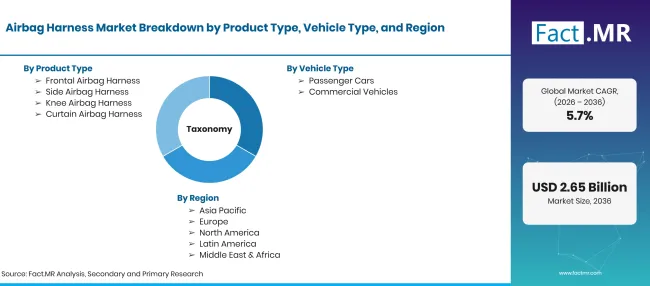
Factmr Airbag Harness Market Taxonomy | Source: Fact.MR
| Attribute | Details |
|---|---|
| Quantitative Units | USD Billion in 2026 to USD Billion by 2036 at 5.7% CAGR |
| Market Definition | Commercial shipments of specialized supplemental restraint system (SRS) wiring harnesses, pyrotechnic squib lead wires, clockspring spiral cables, and automotive connectors. |
| Product Type | Frontal Airbag Harness; Side Airbag Harness; Knee Airbag Harness; Curtain Airbag Harness |
| Vehicle Type | Passenger Cars; Commercial Vehicles |
| Sales Channel | OEM; Aftermarket |
| Material Type | Copper; Aluminum; Others |
| Regions Covered | North America; Latin America; Western Europe; Eastern Europe; East Asia; South Asia & Pacific; Middle East & Africa |
| Countries Covered | Brazil; Japan; USA; Germany; UK |
| Companies Profiled | Autoliv Inc.; ZF Friedrichshafen AG; Aptiv PLC; Sumitomo Electric Industries Ltd.; Lear Corporation; Yazaki Corporation; Furukawa Electric Co. Ltd.; Leoni AG; Nexans S.A.; TE Connectivity Ltd. |
| Forecast Period | 2026 to 2036 |
| Approach | Primary interviews with automotive electrical engineers, tier-1 restraint system designers, wire harness manufacturing plant managers, and automotive OEM procurement directors combined with global vehicle production data audits. |
Source: Fact.MR analysis. Updated Oct 21, 2026
How is the market segmented?
-
By Product Type
- Frontal Airbag Harness
- Side Airbag Harness
- Knee Airbag Harness
- Curtain Airbag Harness
-
By Vehicle Type
- Passenger Cars
- Commercial Vehicles
-
By Sales Channel
- OEM
- Aftermarket
-
By Material Type
- Copper
- Aluminum
- Others
-
By Region
- North America
- Latin America
- Western Europe
- Eastern Europe
- East Asia
- South Asia & Pacific
- Middle East & Africa
Frequently Asked Questions
How big is the airbag harness market in 2026?
What is the CAGR from 2026 to 2036?
Which product type leads?
Which vehicle type leads?
Which companies participate in airbag harnesses?
Who worked on this report


Preview the report firsthand - request a free sample
Free SampleGet the brochure for pricing and purchase details
Download PDF