- Market Value (2025): USD 2.53 Bn
- Estimated Value (2026): USD 2.76 Bn
- Forecast Value (2036): USD 649 Bn
- CAGR (2026-2036): 8.9%
What is the Vehicle Occupant Sensing System Market forecast to be worth by 2036?
USD 2.8 billion in 2026 to USD 6.5 billion by 2036, at an 8.9% CAGR.
- The vehicle occupant sensing system market reached USD 2.53 billion in 2025.
- As per Fact.MR analysis, demand will increase from USD 2.76 billion in 2026 to USD 649 billion in 2036.
- The market is forecast to record an 8.9% CAGR during 2026 to 2036 as manufacturers update airbag and seatbelt-related systems.
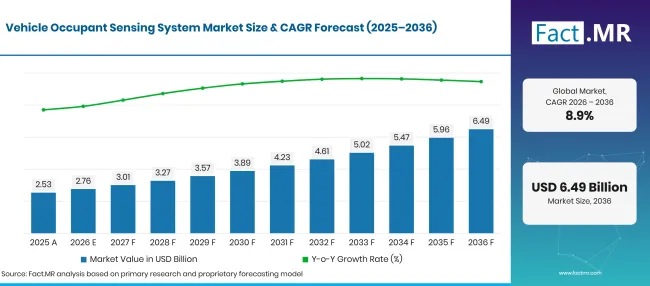
Factmr Vehicle Occupant Sensing System Market Forecast Global | Source: Fact.MR
| Year | Basis | Market Value (USD billion) |
|---|---|---|
| 2025 | Actual | 2.53 |
| 2026 | Estimate | 2.8 |
| 2036 | Forecast | 6.5 |
| CAGR 2026 to 2036 | Forecast period | 8.9% |
Source: Fact.MR analysis. Updated Oct 17, 2026
What are the defining numbers behind Vehicle Occupant Sensing System Market growth?
USD 3.7 billion of additional annual market value between 2026 and 2036, with passenger cars and OEM installation forming the main sales base.
- Demand Drivers in the Market
- Airbag engineers depend on reliable seat-occupancy information to select the appropriate restraint response in different seating conditions. Pressure sensors help identify whether a seat is occupied and provide information that can be used by the safety controller.
- Vehicle safety teams use occupant signals to support seatbelt reminders and passenger detection.
- Passenger-car manufacturers prefer sensors that fit established seat designs and work with their electronic controls. Clear connections between components reduce the time needed to adapt a sensing system across different versions of the same vehicle.
- Automakers assessing child-presence functions examine whether the detection method can recognize a person who remains inside a parked cabin.
- Key Segments Analyzed
- By Sensor Type: Pressure Sensors hold 38.2% share in 2026 because seat-based sensing can support occupancy classification.
- By Vehicle Type: Passenger Cars represent 73.4% share in 2026, reflecting their place in high-volume vehicle assembly.
- By Application: Airbag Deployment account for 42.8% share in 2026 as passenger classification informs restraint control.
- By Sales Channel: OEM holds 82.6% share in 2026 because sensors are commonly engineered into the vehicle before delivery.
- Analyst Opinion at Fact.MR
- Shambhu Nath Jha, Principal Consultant at Fact.MR, states, “Vehicle makers first need to confirm that occupant sensors work with the wider safety system before choosing individual components. Engineers assess how accurately a sensor detects different seating conditions and whether its signals match the restraint-control software.”
- Strategic Implications
- Sensor makers should demonstrate stable readings during seat-cushion wear and varying cabin temperatures so automotive engineers can assess longer-term measurement quality.
- Seat suppliers should review mounting space and wire routing early in platform design because changes after tooling approval raise integration effort.
- Safety-system suppliers should connect occupant classification decisions to documented restraint behavior so the vehicle maker can review the complete response.
- Vehicle manufacturers should compare pressure-based occupancy information with radar or camera monitoring where child-presence coverage needs a broader view of the cabin.
Germany is forecast to post a 10.1% CAGR by 2036 as occupant monitoring receives attention in vehicle design. The USA follows at 8.7% amid continued restraint-system development. Brazil is projected at 8.2% alongside light-vehicle assembly, while Japan records 7.3%. The UK is expected to advance at 6.5% as vehicle platforms incorporate cabin safety features.
How does the Vehicle Occupant Sensing System Market break down by segment?
Pressure Sensors lead with 38.2% share, while Passenger Cars account for 73.4% share in 2026.
Which Sensor Type accounts for the main share?
Pressure Sensors holds 38.2% share in 2026.
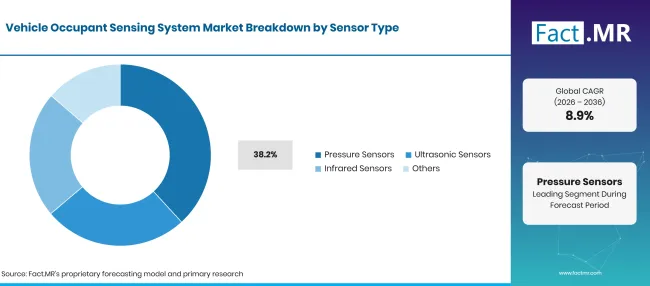
Factmr Vehicle Occupant Sensing System Market Breakdown Sensor Type | Source: Fact.MR
| Which Sensor Type accounts for the main share | Share (2026) |
|---|---|
| Pressure Sensors (Leading segment) | 38.2% |
| Other segments combined | 61.8% |
| Total | 100.0% |
Source: Fact.MR analysis. Updated Oct 17, 2026
Pressure sensors are installed within seat structures to determine load and occupancy patterns. Their commercial appeal rests on being close to the seating surface and linking to established restraint controls. Ultrasonic sensors can sense changes within a monitored area while infrared sensing uses thermal or optical information depending on the design.
System selection depends on what the vehicle must distinguish, including occupied seats and items left on a seat. A pressure-based system is usually assessed as part of the full seat and restraint assembly. Bosch describes cabin radar and occupant monitoring cameras as complementary ways to provide seating-position information for safety features [3].
What leads the Vehicle Type segment?
Passenger Cars holds 73.4% share in 2026.
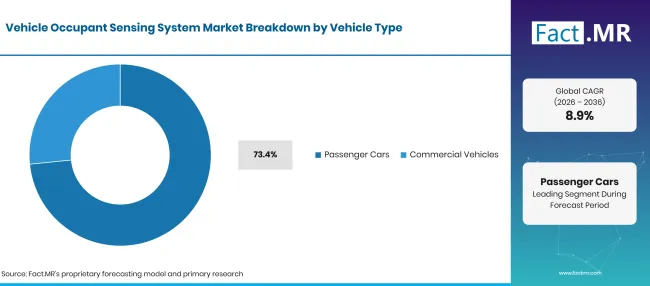
Factmr Vehicle Occupant Sensing System Market Breakdown Vehicle Type | Source: Fact.MR
| What leads the Vehicle Type segment | Share (2026) |
|---|---|
| Passenger Cars (Leading segment) | 73.4% |
| Other segments combined | 26.6% |
| Total | 100.0% |
Source: Fact.MR analysis. Updated Oct 17, 2026
Passenger cars form the largest segment because manufacturers install occupant sensing in many vehicle and seat configurations. Suppliers must show that the system works consistently across different versions of a model.
Commercial vehicles also require dependable occupancy information, although cab design and operating conditions differ from passenger cars. In 2025, the German automotive association VDA reported that Germany produced about 4.15 million passenger cars [4]. The volume illustrates the scale at which automotive component approval can influence supplier sales.
Which Application receives the greatest share?
Airbag Deployment leads with 42.8% share in 2026.
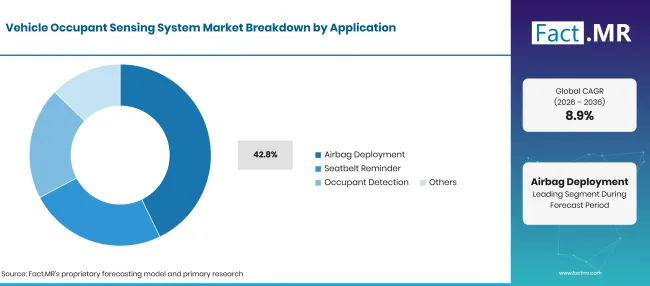
Factmr Vehicle Occupant Sensing System Market Breakdown Application | Source: Fact.MR
| Which Application receives the greatest share | Share (2026) |
|---|---|
| Airbag Deployment (Leading segment) | 42.8% |
| Other segments combined | 57.2% |
| Total | 100.0% |
Source: Fact.MR analysis. Updated Oct 17, 2026
Airbag deployment systems rely on the vehicle’s assessment of seat occupancy and passenger conditions. Occupant information helps the restraint controller interpret a crash event in the context of who is sitting in the vehicle.
Seatbelt Reminder and Occupant Detection represent other application categories. Reminder systems require a clear distinction between an occupied seat and an empty one. Cabin monitoring can also support child-presence assessment when the sensor design is able to detect movement or breathing within a parked car.
How does Sales Channel influence purchasing?
OEM accounts for 82.6% share in 2026.
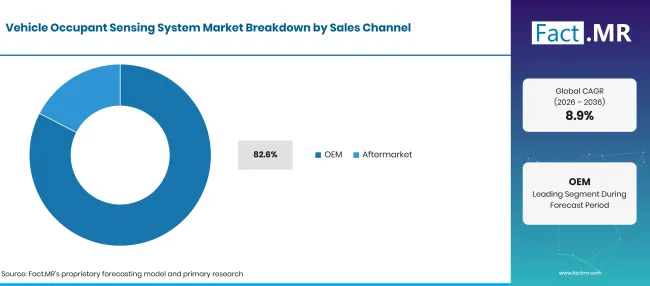
Factmr Vehicle Occupant Sensing System Market Breakdown Sales Channel | Source: Fact.MR
| How does Sales Channel influence purchasing | Share (2026) |
|---|---|
| OEM (Leading segment) | 82.6% |
| Other segments combined | 17.4% |
| Total | 100.0% |
Source: Fact.MR analysis. Updated Oct 17, 2026
OEM installation accounts for most sales because occupant sensors are often embedded in seats or connected to factory-installed safety electronics. Qualification involves the automotive manufacturer and the supplier responsible for the overall restraint function.
Aftermarket offerings face a different practical setting. Installation must work within an existing seat and electronic control system, and product compatibility can narrow the suitable vehicle range. Automotive equipment suppliers generally favor validated factory integration for systems tied to the airbag controller.
What is accelerating Vehicle Occupant Sensing System Market adoption, and what is holding it back?
Seat-specific airbag decisions and broader cabin safety functions support integration. Complex qualification and electronic compatibility can lengthen development schedules.
Drivers Impact Analysis
| DRIVER | (~) % IMPACT ON CAGR | GEOGRAPHIC RELEVANCE | IMPACT TIMELINE |
|---|---|---|---|
| Restraint system integration | +1.0% | Global | Medium term (2–4 years) |
| Child-presence assessment | +0.8% | Europe, Japan | Medium term (2–4 years) |
| Platform-wide seat design | +0.7% | Germany, USA | Short term (<= 2 years) |
| Seatbelt reminders | +0.5% | Global | Short term (<= 2 years) |
| Cabin sensing upgrades | +0.4% | Europe, Asia | Long term (>= 4 years) |
Source: Fact.MR analysis. Updated Oct 17, 2026
Opportunity Impact Analysis
| OPPORTUNITY | (~) % IMPACT ON CAGR | GEOGRAPHIC RELEVANCE | IMPACT TIMELINE |
|---|---|---|---|
| Integrated seat modules | +0.8% | Global | Medium term (2–4 years) |
| Cabin-wide sensing | +0.6% | Europe, Japan | Medium term (2–4 years) |
| Commercial-vehicle platforms | +0.5% | Brazil, USA | Long term (>= 4 years) |
| Common vehicle architectures | +0.4% | Global | Medium term (2–4 years) |
Source: Fact.MR analysis. Updated Oct 17, 2026
Restraints Impact Analysis
| RESTRAINT | (~) % IMPACT ON CAGR | GEOGRAPHIC RELEVANCE | IMPACT TIMELINE |
|---|---|---|---|
| Vehicle-level validation | -0.8% | Global | Short term (<= 2 years) |
| Calibration under varied loads | -0.6% | Global | Medium term (2–4 years) |
| Seat design changes | -0.5% | Germany, Japan | Medium term (2–4 years) |
| Replacement compatibility | -0.4% | Global | Long term (>= 4 years) |
Source: Fact.MR analysis. Updated Oct 17, 2026
Which countries are scaling the Vehicle Occupant Sensing System Market through 2036?
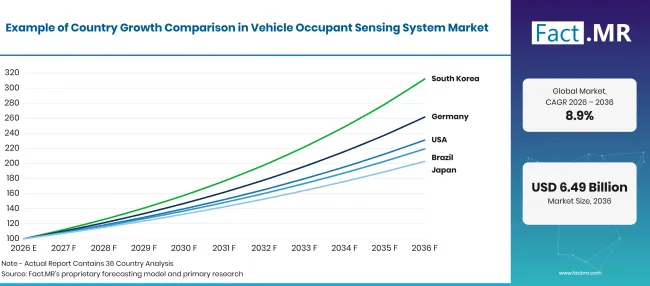
Factmr Vehicle Occupant Sensing System Market Growth Index | Source: Fact.MR
| Country | CAGR (2026–2036) |
|---|---|
| Germany | 10.1% |
| USA | 8.7% |
| Brazil | 8.2% |
| Japan | 7.3% |
| UK | 6.5% |
Source: Fact.MR analysis. Updated Oct 17, 2026
Why is Germany expanding occupant sensing integration?
10.1% CAGR, linked to safety testing across German vehicle platforms.
German carmakers work with seat and safety electronics specialists during platform design. The German Association of the Automotive Industry reported 2,857,600 new passenger-car registrations in Germany during 2025 [6]. These vehicles form part of the domestic market for factory-installed occupant detection and restraint equipment. Euro NCAP child-presence assessments encourage engineering teams to test cabin coverage on qualifying new designs [2]. Passenger-car programmes give suppliers repeated chances to qualify pressure sensors within seat assemblies.
What supports occupant sensing integration in the United States?
8.7% CAGR, led by restraint system design and occupant monitoring.
The American market places close attention on occupant classification and correct seatbelt reminders. NHTSA publishes national seatbelt-use monitoring and guidance for vehicle safety equipment [1]. Passenger vehicles remain an important installation route because sensors are commonly integrated with seat and airbag controls at the factory.
U.S. carmakers use occupant classification signals when setting restraint responses for specific seating positions. Seatbelt reminders rely on dependable occupied-seat identification. Standard parts across vehicle models can support longer supplier programmes. Cabin monitoring creates a separate engineering path for detecting passengers beyond pressure measurements.
How is Brazil expanding occupant sensing integration?
8.2% CAGR, driven by passenger-car assembly and factory safety equipment.
Brazilian vehicle programmes create opportunities for occupant sensors that are integrated during factory assembly with seats, airbags, and other restraint electronics. Suppliers need systems that can fit different passenger-car platforms while maintaining consistent occupant classification and compatibility with existing vehicle controls. Local assembly programmes can support repeat component orders once a sensing system has completed the required vehicle-level validation.
How is Japan developing passenger detection functions?
7.3% CAGR, supported by compact cabin design and seat sensor integration.
Japanese vehicle manufacturers place strong attention on accurate passenger detection within compact cabin layouts. Pressure sensors need to work consistently with different seating positions, while broader cabin-monitoring technologies can support child-presence and occupant-detection functions beyond the seat cushion. Suppliers therefore compete on sensor accuracy, compact integration, calibration quality, and compatibility with established safety electronics.
What defines the United Kingdom outlook?
6.5% CAGR, shaped by safety electronics across local and imported vehicle models.
British vehicle programmes involve both local production and imported passenger cars. The Department for Transport reported 2,617,000 first vehicle registrations in the UK during 2025. The same release counted 42.3 million licensed vehicles at year-end [5]. Safety electronics suppliers must meet the vehicle maker’s original specification.
New-model programmes give seat suppliers opportunities to fit sensing parts during factory assembly. Replacement sales follow the needs of existing vehicle platforms. Occupant classification remains connected to restraint-system calibration. Child-presence assessment creates interest in cabin monitoring methods suited to the full passenger area.
Who leads the Vehicle Occupant Sensing System Market?
Denso Corporation, Autoliv Inc., Magna International Inc., Lear Corporation and Valeo SE participate in different parts of the automotive safety, electronics or seating supply chain.
The offerings are best compared by the occupant-sensing function and vehicle programme, since supplying seats or restraints alone does not establish a share of standalone occupant sensors. Automotive buyers assess accuracy and qualification evidence at the system level.
Which companies are the key providers?
Key companies include Robert Bosch GmbH; Denso Corporation; Magna International Inc.; Lear Corporation; and Valeo SE.
- Robert Bosch GmbH
- Denso Corporation
- Magna International Inc.
- Lear Corporation
- Valeo SE
Bibliography
- [1] National Highway Traffic Safety Administration. (n.d.). Seat belts.
- [2] Euro NCAP. (n.d.). Child Occupant Protection.
- [3] Robert Bosch GmbH. (n.d.). Interior sensing solutions.
- [4] German Association of the Automotive Industry. (2026, January 5). Passenger car production in 2025 slightly above previous year's level.
- [5] Department for Transport. (2026, April 29). Vehicle licensing statistics, United Kingdom: 2025.
- [6] German Association of the Automotive Industry. (2026, January 5). Passenger car production in 2025 slightly above previous year's level.
- [7] Statistisches Bundesamt (Destatis). (2026, February 6). Production in December 2025: -1.9% on the previous month.
- [8] Statistisches Bundesamt (Destatis). (2025, November 19). Production of passenger cars: International statistics.
This Report Answers
- The report examines how occupant-sensing signals are used in seat classification and restraint-related safety functions.
- Segment analysis compares pressure sensing with other detection methods and explains why passenger cars account for much of OEM use.
- Country coverage assesses separate vehicle manufacturing settings in Germany, Brazil, the USA, the UK and Japan.
- The competitive discussion distinguishes documented interior sensing from wider automotive seating and restraint activities.
- The sales-channel assessment considers why factory-installed systems require vehicle-level approval.
What does the Vehicle Occupant Sensing System Market cover?
The market covers sensors and associated electronic modules designed to determine whether vehicle seating positions are occupied or to support an intended passenger detection function. It includes systems used to inform airbag operation and seatbelt reminders. The boundary focuses on occupant sensing rather than unrelated vehicle electronics.
What is included in the scope?
Included products cover pressure-based occupancy sensors and other sensor technologies designed for passenger detection in vehicles.
OEM-installed systems make up the principal channel. A separately sold replacement product is included where its function is occupant detection and its vehicle compatibility can be established. The analysis considers sensor type, vehicle type and intended safety application.
What is excluded from the scope?
The scope excludes general parking sensors and exterior object detection when those products do not measure vehicle occupants.
Standalone airbag inflators, seat frames and seatbelt assemblies are excluded unless sold as part of a defined occupant-sensing package. General-purpose cabin entertainment cameras also remain outside the sensing boundary.
How Was the Analysis Built?
The analysis draws on 120+ sources, 35+ company portfolios, 25+ countries, and more than 20 industry interviews.
- Primary Research: Primary research includes discussions with manufacturers, service providers, technology developers, distributors, end users, and subject-matter experts. These conversations examine purchasing priorities, product adoption, operational challenges, approval requirements, competitive positioning, and the factors that influence wider market acceptance.
- Desk Research: Desk research covers government statistics, regulatory publications, company filings, trade data, technical studies, industry associations, standards, public policy, and other authoritative sources. Every source used in the analysis is documented in the bibliography.
- Market Sizing and Forecasting: Market estimates combine historical performance, demand indicators, pricing and volume trends, segment shares, company participation, country-level growth, adoption patterns, investment activity, and barriers to market expansion.
- Data Validation and Update Cycle: Findings are validated by comparing primary interviews with public data, company activity, regulatory changes, trade patterns, and industry developments. Regular updates review new product launches, capacity changes, partnerships, approvals, and shifts in commercial adoption.
Segmentation
What is the report’s scope and coverage?
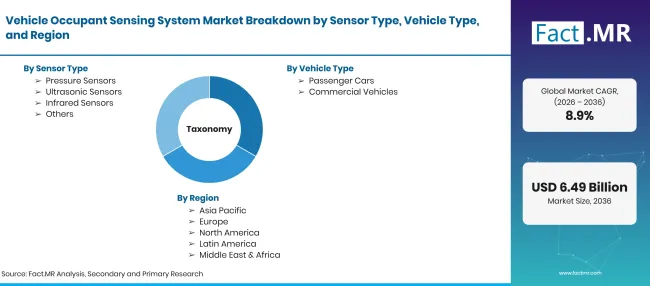
Factmr Vehicle Occupant Sensing System Market Taxonomy | Source: Fact.MR
| Attribute | Details |
|---|---|
| Quantitative Units | USD billion |
| Market Definition | Vehicle-installed sensors and associated electronic modules used to identify occupant presence or characteristics for passenger-safety functions |
| Sensor Type | Pressure Sensors; Ultrasonic Sensors; Infrared Sensors; Others |
| Vehicle Type | Passenger Cars; Commercial Vehicles |
| Application | Airbag Deployment; Seatbelt Reminder; Occupant Detection; Others |
| Sales Channel | OEM; Aftermarket |
| Regions Covered | North America; Latin America; Western Europe; Eastern Europe; East Asia; South Asia & Pacific; Middle East & Africa |
| Countries Covered | Germany; Brazil; United States; United Kingdom; Japan |
| Companies Profiled | Robert Bosch GmbH; Denso Corporation; Magna International Inc.; Lear Corporation; Valeo SE |
| Forecast Period | 2026 to 2036 |
| Approach | Assessment of sensor technologies, vehicle platforms, safety applications, OEM integration, country outlook, official safety information, and relevant automotive supplier activity |
Source: Fact.MR analysis. Updated Oct 17, 2026
How is the market segmented?
-
By Sensor Type
- Pressure Sensors
- Ultrasonic Sensors
- Infrared Sensors
- Others
-
By Vehicle Type
- Passenger Cars
- Commercial Vehicles
-
By Application
- Airbag Deployment
- Seatbelt Reminder
- Occupant Detection
- Others
-
By Sales Channel
- OEM
- Aftermarket
-
By Region
- North America
- Latin America
- Western Europe
- Eastern Europe
- East Asia
- South Asia & Pacific
- Middle East & Africa
Frequently Asked Questions
How big is the Vehicle Occupant Sensing System Market in 2026?
What is the CAGR of the Vehicle Occupant Sensing System Market from 2026 to 2036?
Which sensor type leads the Vehicle Occupant Sensing System Market?
Which vehicle type leads the Vehicle Occupant Sensing System Market?
Who are the leading companies in the Vehicle Occupant Sensing System Market?
Who worked on this report


Preview the report firsthand - request a free sample
Free SampleGet the brochure for pricing and purchase details
Download PDF