Ground Support Equipment Tires Market Size, Share, Growth and Forecast (2026 - 2036)
Ground Support Equipment Tires Market is segmented by Product (Aircraft Towable Tires, Cargo Handling Tires, Ground Power Unit Tires, Aircraft Maintenance Vehicle Tires), Application (Airport Ground Operations, Cargo Handling Operations, Ground Power Operations, Airport Service Operations), End Use (Airports, Airline Operators, Ground Handling Companies, Defense & Military Aviation), and Region. Forecast for 2026 to 2036.
Ground Support Equipment Tires Market Analysis and Forecast by Fact.MR
Aircraft towable tires account for 74.3% share, while airports contribute 68.9% end-use share as operators prioritize uptime, tire durability, and maintenance cost reduction.
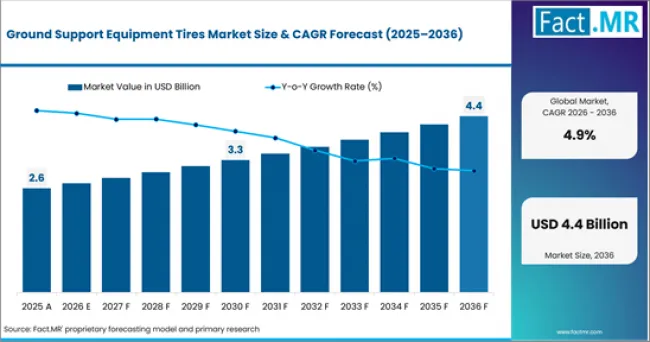
- The Ground Support Equipment Tires Market is expected to grow from USD 2.7 billion in 2026 to USD 4.4 billion by 2036, at a 4.9% CAGR.
- Demand is driven by airport infrastructure expansion, larger ground handling fleets, adoption of solid and foam-filled tire technologies for electric GSE platforms, and replacement demand from airports operating under continuous high-load duty cycles.
Summary of Ground Support Equipment Tires Market
- Market Snapshot
- In 2025, the global Ground Support Equipment Tires Market was valued at approximately USD 2.6 billion.
- The market is estimated to reach USD 2.7 billion in 2026 and is projected to attain USD 4.4 billion by 2036.
- The ground support equipment tires market is likely to expand at a CAGR of 4.9% during the forecast period.
- The market is anticipated to create an absolute dollar opportunity of USD 1.7 billion between 2026 and 2036.
- Aircraft towable tires account for 74.3% of product segment share in 2026.
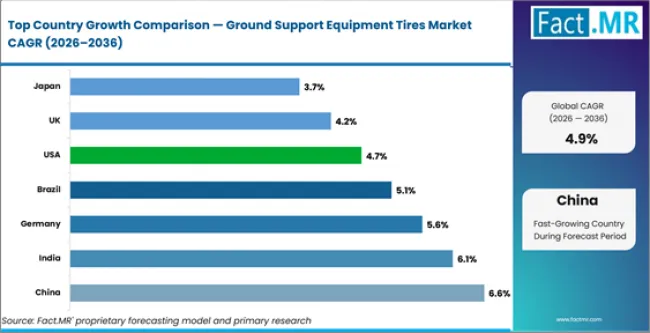
- China (6.6%) and India (6.1%) are the key growth markets during the forecast period.
- Demand and Growth Drivers
- Global air passenger volume recovery and continued cargo growth are expanding the operational intensity of ground handling at commercial airports, increasing the number of GSE duty cycles per day and accelerating tire wear and replacement frequency.
- Airport infrastructure expansion programs in Asia Pacific, the Middle East, and Africa are commissioning new terminals, runways, and apron areas that require fresh GSE fleets equipped with specification-compliant tires from initial operation.
- The transition to electric ground support equipment is creating demand for solid and foam-filled tire technologies that match the lower maintenance and higher uptime requirements of battery-powered platforms without the puncture risks associated with pneumatic alternatives.
- Tightening airport safety and operational efficiency standards are shortening acceptable tire wear thresholds, increasing replacement frequency and raising demand for higher-durability compounds that extend service intervals between changes.
- Product and Segment View
- Aircraft towable tires account for 74.3% of the product segment in 2026, supported by the high-volume procurement requirements of pushback tractors, aircraft tow vehicles, and heavy-duty towing equipment that operate under extreme load and torque conditions at commercial airports.
- Airports represent 68.9% of end-use demand in 2026, reflecting the concentration of GSE tire procurement among commercial airports, international hubs, domestic terminals, and regional facilities that operate large ground handling fleets under continuous duty conditions.
- High durability rubber compounds lead the formulation segment with 77.6% share in 2026, as ground handling operators prioritize heat resistance, load-bearing capacity, and extended wear life over lower-cost compound alternatives.
- Key segmentation includes:
- Product Type: Aircraft Towable Tires, Cargo Handling Tires, Ground Power Unit Tires, Aircraft Maintenance Vehicle Tires
- End Use: Airline Operators, Ground Handling Companies, Defense & Military Aviation
- Tire Type: High Durability Rubber Compounds, Solid Rubber Tires, Foam-filled Tires, Pneumatic Tires
- These systems enable:
- High-load bearing capacity for aircraft pushback and towing operations involving commercial widebody and narrowbody aircraft across varied apron surface conditions.
- Puncture and debris resistance for continuous operation across airport ramp environments where FOD exposure, surface irregularities, and temperature extremes are constant operational hazards.
- Extended service life under repetitive stop-start, high-torque duty cycles that characterize ground support equipment usage at commercial airports operating 18 to 24 hours per day.
- Geography and Competitive Outlook
- North America holds a significant market share, supported by high air traffic volumes, established airport infrastructure, large commercial airline fleets, and consistent replacement demand at hub airports across the United States and Canada.
- Europe maintains steady growth, with the United Kingdom (4.2%) and Germany (5.6%) supported by Heathrow, Frankfurt, and other major hub airport operations, safety regulation compliance, and growing demand for electric GSE tire solutions.
- Asia Pacific is the fastest-growing region, with China (6.6%) and India (6.1%) expanding through large-scale airport construction programs, civil aviation fleet growth, and rising air passenger volumes driving GSE fleet expansion.
- Michelin, Continental AG, Sterling Solid Tires, MAXAM Tire International, APEXWAY Products, Super Grip Corporation, Emerald Tyres, and Ground Support Products are among the key companies competing across product and regional segments.
- Analyst Opinion
- Shambhu Nath Jha, Principal Consultant at Fact.MR, says "The ground support equipment tires market is fundamentally driven by two factors: air traffic growth and the tire replacement cycle. As global passenger volumes continue to expand and cargo operations intensify, the duty cycles imposed on GSE tires are increasing in both frequency and severity. The shift toward electric GSE platforms is adding a technology layer to procurement decisions, as battery-powered equipment requires tire solutions optimized for different weight distributions, torque profiles, and maintenance expectations compared to diesel-powered predecessors. Airports investing in sustainability-linked fleet transitions are simultaneously upgrading their tire specifications."
Key Growth Drivers, Constraints, and Opportunities

Key Factors Driving Growth
- Airport expansion programs across Asia Pacific, the Middle East, and Africa are commissioning new terminal infrastructure that requires complete GSE fleet procurement, including specification-compliant tires for every ground handling vehicle from pushback tractors to baggage carts, creating concentrated demand spikes aligned with facility commissioning timelines.
- The transition from diesel to electric ground support equipment is requiring tire solutions optimized for the different weight distribution, torque delivery, and operational profiles of battery-powered platforms, as electric GSE typically operates at higher start-stop frequencies with different axle loading characteristics compared to combustion-powered predecessors.
- Rising air passenger volumes and cargo throughput at major hub airports are intensifying GSE utilization rates, with some equipment operating 20+ hours per day and requiring tire replacement every 12 to 18 months compared to the 24 to 36 month cycles typical at lower-traffic facilities.
Key Market Constraints
- Raw material price volatility in natural rubber, synthetic rubber, and carbon black creates cost uncertainty for tire manufacturers and complicates long-term supply contract pricing for airport procurement departments.
- Airport procurement bureaucracy and long tender cycles delay tire specification updates, as ground handling contract structures and safety certification requirements can take 6 to 12 months to process even for straightforward tire replacement orders.
- Limited product differentiation in commodity tire categories creates intense price competition among manufacturers, compressing margins on standard pneumatic and solid tire products used in high-volume baggage and cargo handling applications.
Key Opportunity Areas
- Sustainable tire compound development using recycled rubber, bio-based materials, and reduced rolling resistance formulations creates differentiation opportunities as airports adopt environmental performance targets under carbon neutrality commitments.
- The growing installed base of electric GSE platforms requires tire products specifically validated for electric drivetrain characteristics, creating a premium specification tier that can command higher average selling prices compared to standard GSE tire products.
- Airport privatization and concession model expansion in emerging markets is professionalizing ground handling procurement, creating more structured and specification-driven tire purchasing processes that favor established manufacturers with global certification and service capabilities.
Segment-wise Analysis of the Ground Support Equipment Tires Market
- Aircraft towable tires hold 74.3% of the product segment in 2026, reflecting the high-volume procurement requirements of pushback tractors and aircraft towing vehicles that operate under extreme load conditions at every commercial airport.
- Airports account for 68.9% of end-use demand in 2026, with procurement concentrated at commercial and international hub facilities that operate large GSE fleets under continuous duty cycles requiring regular tire replacement.
- Solid and foam-filled tire formats are gaining share as electric GSE adoption increases, driven by their puncture resistance, maintenance reduction, and compatibility with the higher start-stop duty profiles of battery-powered ground handling equipment.
The ground support equipment tires market is segmented by product type, end use, tire type, and region. By product type, the market covers aircraft towable tires, baggage and cargo handling tires, passenger boarding equipment tires, and refueling and maintenance vehicle tires.
Which Product Segment Dominates the Ground Support Equipment Tires Market?

Aircraft towable tires account for 74.3% of the product segment in 2026.
Baggage and cargo handling tires hold a supporting position, serving the high-volume fleet of baggage carts, cargo dollies, and belt loaders that operate continuously at hub airports. These tires face different wear patterns characterized by constant low-speed rolling, frequent directional changes, and exposure to terminal area debris, requiring compound formulations optimized for cut and tear resistance rather than the extreme load bearing of towable applications.
Which End-Use Segment Dominates the Ground Support Equipment Tires Market?
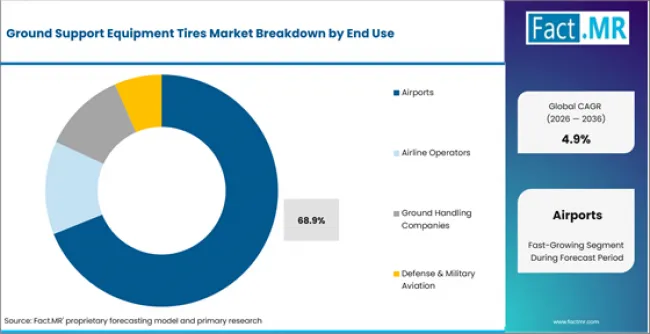
Airports are expected to lead the end-use segment with a 68.9% share in 2026.
Military airbases and MRO facilities hold smaller but specialized positions. Military applications require tires meeting defense procurement specifications for extreme temperature, terrain, and load conditions.
Which Product Trend is Shaping the Next Phase of Growth in the Ground Support Equipment Tires Market?
The transition to electric ground support equipment is the most significant product trend shaping GSE tire demand. As airports pursue carbon neutrality targets and ground handling operators seek to reduce fuel costs, electric pushback tractors, baggage tugs, and cargo loaders are replacing diesel-powered predecessors across hub airports in North America, Europe, and Asia Pacific.
This transition is creating demand for tire products specifically validated for electric drivetrain profiles. Solid and foam-filled tire formats are gaining preference for electric GSE applications because they eliminate puncture risks that would cause downtime in fleets operating without backup tire inventory, and because their consistent load-bearing characteristics complement the stable weight profile of battery-powered platforms.
Regional Outlook Across Key Markets
- China leads growth at 6.6%, driven by large-scale airport construction under the 14th Five-Year Plan targeting 450 civil airports, increasing domestic air travel volumes, and strong GSE manufacturing capability supporting competitive tire procurement pricing.
- India follows at 6.1%, supported by airport modernization under the UDAN regional connectivity scheme, greenfield airport construction projects, and rising air passenger volumes creating demand for expanded GSE fleets with compliant tire installations.
- North America maintains a large market share, with demand concentrated at high-traffic US hub airports where intensive GSE utilization and safety-driven replacement schedules sustain consistent tire procurement volumes.
- Germany leads European growth at 5.6%, supported by Frankfurt, Munich, and other major hub airport operations, EU environmental standards driving electric GSE adoption, and preference for high-durability tire specifications from European manufacturers.
.webp)
CAGR Table
| Country | CAGR (%) |
|---|---|
| China | 6.6% |
| India | 6.1% |
| Germany | 5.6% |
| United Kingdom | 4.2% |
| USA | 4.7% |
Source: Fact MR analysis, based on proprietary forecasting model and primary research.
Ground Support Equipment Tires Demand Trends in the United States
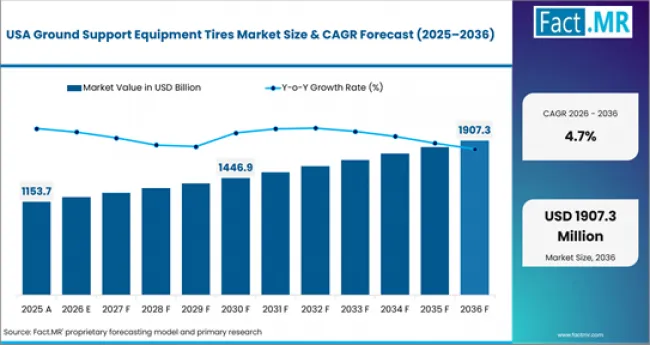
The USA ground support equipment tires market is projected to grow at a CAGR of 4.7% through 2036. The installed base of GSE at hub airports including Atlanta, Chicago, Dallas, and Los Angeles sustains high-volume replacement procurement.
- High-traffic hub airports sustain intensive GSE utilization rates that drive consistent annual tire replacement procurement across pushback, baggage, and cargo handling fleets.
- Electric GSE fleet transitions supported by IRA sustainability provisions are creating premium tire specification demand for solid and foam-filled products validated for battery-powered equipment.
China Ground Support Equipment Tires Growth Assessment
Airport construction scale under the 14th Five-Year Plan is the primary structural driver. With targets for continued airport expansion and growing domestic air travel demand from a population exceeding 1.4 billion, China is creating sustained demand for GSE tire procurement.
- New airport commissioning under the Five-Year Plan creates concentrated GSE fleet procurement demand including full tire outfitting for pushback, baggage, and cargo handling equipment.
- Domestic tire manufacturing capacity provides cost advantages that support both airport procurement pricing and competitive export positioning across regional markets.
India Ground Support Equipment Tires Market Opportunity Outlook
UDAN regional connectivity scheme expansion and greenfield airport construction are the defining demand drivers for GSE tires in India. Rising air passenger volumes at existing airports are increasing GSE utilization intensity and accelerating tire replacement cycles, while new airport construction projects create concentrated procurement demand for complete GSE fleet outfitting.
- Greenfield airport construction under UDAN and state-level programs creates bulk GSE fleet procurement requirements including tire specifications for all ground handling equipment categories.
- Rising passenger volumes at established airports intensify GSE duty cycles, shortening replacement intervals and increasing annual tire procurement volumes per facility.
Germany Ground Support Equipment Tires Demand Analysis
Frankfurt, Munich, and Dusseldorf hub airport operations create structured tire procurement pipelines governed by EU aviation safety standards and ground handling contract specifications. EU environmental regulations supporting electric GSE fleet transitions are adding a sustainability dimension to procurement criteria, as German airport operators increasingly specify tire products with recycled content, reduced rolling resistance, and validated electric GSE compatibility alongside traditional durability and load-bearing requirements.
- EU aviation safety standards and ground handling contract specifications create structured procurement frameworks that favor certified manufacturers with documented quality systems.
- Electric GSE fleet transitions driven by EU environmental standards are adding sustainable compound and electric-validated specifications to airport tire procurement requirements.
Competitive Benchmarking and Company Positioning
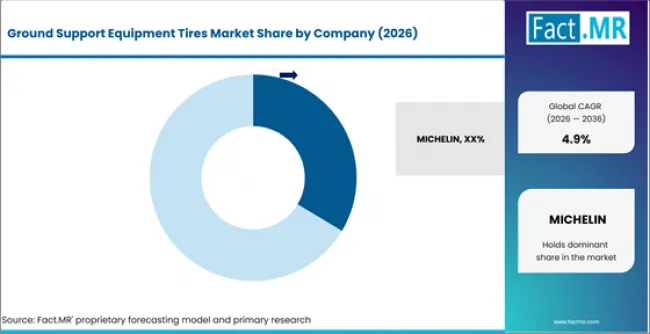
Ground Support Equipment Tires Market Analysis By Company
- Michelin and Continental AG hold leading positions through comprehensive GSE tire portfolios, global distribution networks, established airport procurement relationships, and sustained investment in sustainable compound development and electric GSE tire validation.
- MAXAM Tire International, Sterling Solid Tires, and APEXWAY Products compete across specific product categories and regional markets, with differentiation driven by pricing, solid tire specialization, and targeted distribution in high-growth airport construction markets.
- The shift toward electric GSE is creating a competitive layer where manufacturers that validate tire products for battery-powered platform specifications can establish premium positioning and preferred supplier status within airport sustainability procurement frameworks.
The competitive landscape is moderately consolidated, with Michelin and Continental AG holding combined market share exceeding 50% through extensive GSE tire portfolios, global airport distribution networks, and decades of procurement relationships with major ground handling operators. These manufacturers compete on compound technology, durability validation, and service support capability across all tire types and GSE application categories.
Below the leading manufacturers, MAXAM Tire International, Sterling Solid Tires, APEXWAY Products, Super Grip Corporation, and Emerald Tyres compete through focused product categories, regional pricing advantages, and specialization in solid and foam-filled tire formats that serve growing electric GSE demand. Ground Support Products and Royal Tyres maintain positions in specific regional markets and application niches.
Strategic priorities across the market include developing sustainable tire compounds using recycled rubber and bio-based materials, validating product lines for electric GSE platform specifications, expanding distribution reach in high-growth Asia Pacific and Middle East airport markets, and improving tire lifecycle economics through extended wear formulations that reduce total cost of ownership for airport operators.
Key Companies in the Ground Support Equipment Tires Market
- Michelin and Continental AG are the leading participants in the ground support equipment tires market globally, supported by comprehensive product portfolios, global distribution networks, and established airport procurement relationships spanning commercial, cargo, and military aviation facilities.
- MAXAM Tire International, Sterling Solid Tires, and APEXWAY Products hold meaningful positions across solid tire, foam-filled, and value-oriented pneumatic categories, with growing presence in Asia Pacific and Middle East airport construction markets.
- Super Grip Corporation, Emerald Tyres, Ground Support Products, Royal Tyres Private, Industrial Rubber, and SUN Tyre and Wheel Systems compete through regional focus, application specialization, and pricing strategies that serve price-sensitive procurement in emerging aviation markets.
Recent Industry Developments
- Michelin, Ground Support Equipment Tire Portfolio Documentation (2025)
- Michelin continued to market specialized aircraft ground support equipment tires for airport tractors, aircraft towing, baggage handling, and terminal applications. The portfolio includes MICHELIN XZM, MICHELIN XZR, and MICHELIN X TERMINAL T tires for ground handling operations.
Leading Companies Shaping the Ground Support Equipment Tires Market
- Michelin
- Continental AG
- MAXAM Tire International
- Sterling Solid Tires
- APEXWAY Products
- Super Grip Corporation
- Emerald Tyres
- Ground Support Products
- Royal Tyres Private
- SUN Tyre and Wheel Systems
Sources and Research References
- Michelin North America, Inc. (n.d.). Aircraft ground support equipment tires. Michelin Commercial.
- Airports Council International. (2025). Annual World Airport Traffic Report, 2025. ACI World.
- International Air Transport Association. (2025, June). IATA annual review 2025.
- Continental AG. (2026). 2025 annual report: Development of the group sectors.
This bibliography is provided for reader reference and is not exhaustive. The full report contains the complete reference list and detailed citations.
Key Questions This Report Addresses
- What is the current and future size of the Ground Support Equipment Tires Market?
- How fast is the GSE tires market expected to grow between 2026 and 2036?
- Which product type is likely to lead the market by 2026?
- Which end-use segment accounts for the highest demand in 2026?
- What factors are driving tire replacement demand at airports?
- How is the transition to electric GSE influencing tire specifications?
- Why are China and India emerging as the fastest-growing markets?
- How are airport expansion programs supporting tire demand?
- Which countries are projected to show the fastest growth through 2036?
- Who are the key companies active in the Ground Support Equipment Tires Market?
- How does Fact.MR estimate and validate the market forecast?
Ground Support Equipment Tires Market Definition
The Ground Support Equipment Tires Market covers specialized tires designed for ground handling vehicles and equipment used at airports, military airbases, and MRO facilities, including tires for aircraft tow tractors, baggage carts, cargo loaders, refueling vehicles, passenger boarding bridges, and maintenance platforms.
Ground Support Equipment Tires Market Inclusions
- The scope covers global and regional market size and forecasts for 2026 to 2036 across product type, end use, tire type, and region.
- It includes pneumatic, solid, and foam-filled tires for all categories of ground support equipment operated at airports and aviation facilities.
- The report covers technology trends in tire compound formulation, sustainable material integration, and tire performance optimization for electric GSE platforms.
- It includes pricing and cost analysis across tire types, competitive landscape assessment, and distribution channel evaluation for airport-focused tire supply.
Ground Support Equipment Tires Market Exclusions
- The scope excludes aircraft tires used for landing gear, runway operations, and in-flight wheel assemblies, as these serve a different operational function and procurement channel.
- It excludes general-purpose industrial tires, forklift tires used in warehouse and logistics facilities outside airports, and passenger vehicle or commercial truck tires.
- The report excludes tire retreading and reconditioning services, tire pressure monitoring systems, and standalone wheel assemblies sold without tires.
Ground Support Equipment Tires Market Research Methodology
- The methodology combines secondary research, primary interviews, and forecast modelling.
- It draws on 85+ secondary sources and benchmarks 40+ company product portfolios.
- Market sizing covers 30+ countries through a demand-side model, supported by top-down validation.
- Key inputs include air passenger volumes, cargo throughput, airport construction programs, GSE fleet sizes, electric GSE adoption rates, and tire replacement cycle data.
- The model cross-checks demand with manufacturer production volumes, distributor sales data, and airport procurement records.
- Primary validation includes 20+ interviews across tire manufacturers, airport ground handling operators, GSE OEMs, and aviation procurement specialists.
- Final estimates go through fleet-utilization checks, replacement-cycle modeling, and sensitivity testing.
Scope of Analysis

| Parameter | Details |
|---|---|
| Quantitative Units | USD 2.7 billion to USD 4.4 billion, at a CAGR of 4.9% |
| Market Definition | The Ground Support Equipment Tires Market covers specialized tires for ground handling vehicles and equipment used at airports, airbases, and aviation facilities including tow tractors, baggage carts, cargo loaders, and maintenance platforms. |
| Regions Covered | North America, Latin America, Europe, East Asia, South Asia and Pacific, Middle East and Africa |
| Countries Covered | USA, Canada, UK, Germany, China, India, 30 plus countries |
| Key Companies | Michelin, Continental AG, MAXAM Tire International, Sterling Solid Tires, APEXWAY Products, Super Grip Corporation, Emerald Tyres, Ground Support Products, Royal Tyres Private, SUN Tyre and Wheel Systems |
| Forecast Period | 2026 to 2036 |
| Approach | Hybrid demand-side and top-down methodology built on air passenger volume analysis, airport construction program tracking, GSE fleet size estimation, electric GSE adoption rates, tire replacement cycle modeling, and primary interviews across tire manufacturers, airport operators, GSE OEMs, and procurement specialists. |
Ground Support Equipment Tires Market Segmentation
-
Ground Support Equipment Tires Market Segmented by Product:
- Aircraft Towable Tires
- Heavy Duty Tow Tires
- Wide Tread Tow Tires
- Reinforced Sidewall Tow Tires
- Standard Tow Tires
- Airport Tug Compatible Tires
- Low Speed Tow Tires
- Heavy Duty Tow Tires
- Cargo Handling Tires
- Baggage Cart Tires
- Polyurethane Filled Tires
- Pneumatic Cargo Tires
- Container Dolly Tires
- High Load Dolly Tires
- Multi Axle Dolly Tires
- Baggage Cart Tires
- Ground Power Unit Tires
- GPU Support Tires
- Electric GPU Mobility Tires
- Hybrid GPU Transport Tires
- Diesel GPU Tires
- Heavy Load Power Unit Tires
- High Torque Mobility Tires
- GPU Support Tires
- Aircraft Maintenance Vehicle Tires
- Maintenance Stand Tires
- Hydraulic Lift Support Tires
- Mobile Maintenance Platform Tires
- Service Vehicle Tires
- Fuel Truck Support Tires
- Catering Vehicle Tires
- Maintenance Stand Tires
- Aircraft Towable Tires
-
Ground Support Equipment Tires Market Segmented by Application:
- Airport Ground Operations
- Aircraft Movement Operations
- Aircraft Towing Operations
- Pushback Operations
- Apron Handling Operations
- Gate Positioning Support
- Stand Allocation Movement
- Aircraft Movement Operations
- Cargo Handling Operations
- Freight Loading Operations
- Unit Load Device Handling
- Freight Container Transport
- Baggage Handling Operations
- Conveyor Loading Systems
- Baggage Cart Movement
- Freight Loading Operations
- Ground Power Operations
- Aircraft Power Supply Operations
- Pre Flight Power Systems
- Auxiliary Power Handling
- Maintenance Operations
- Line Maintenance Support
- Heavy Maintenance Dock Operations
- Aircraft Power Supply Operations
- Airport Service Operations
- Refueling Operations
- Fuel Truck Movement
- Aircraft Refueling Support
- Catering Operations
- In Flight Catering Transport
- Service Vehicle Logistics
- Refueling Operations
- Airport Ground Operations
-
Ground Support Equipment Tires Market Segmented by End Use:
- Airports
- Commercial Airports
- International Airports
- Domestic Airports
- Regional Airports
- Small Civil Airports
- Private Airfields
- Commercial Airports
- Airline Operators
- Passenger Airlines
- Full Service Carriers
- Low Cost Carriers
- Cargo Airlines
- Freight Operators
- Express Cargo Airlines
- Passenger Airlines
- Ground Handling Companies
- Third Party Ground Handlers
- Airport Service Contractors
- Fleet Management Providers
- In House Airport Operators
- Airport Authority Operations
- Integrated Ground Service Units
- Third Party Ground Handlers
- Defense & Military Aviation
- Air Force Bases
- Military Air Transport Units
- Defense Logistics Airports
- Naval Air Stations
- Carrier Support Airfields
- Military Maintenance Bases
- Air Force Bases
- Airports
-
Ground Support Equipment Tires Market Segmented by Technology:
- Pneumatic Tire Technology
- Radial Tire Systems
- High Load Radial Tires
- Reinforced Cord Radial Tires
- Bias Ply Tire Systems
- Heavy Duty Bias Tires
- Impact Resistant Bias Tires
- Radial Tire Systems
- Solid Tire Technology
- Polyurethane Solid Tires
- Non Pneumatic Tire Systems
- Flat Proof Tire Systems
- Foam Filled Tires
- Shock Absorbing Foam Tires
- Maintenance Free Tire Systems
- Polyurethane Solid Tires
- Smart Tire Monitoring Technology
- Sensor Integrated Tires
- Pressure Monitoring Systems
- Wear Detection Systems
- IoT Enabled Tires
- Fleet Connected Tire Systems
- Predictive Maintenance Tires
- Sensor Integrated Tires
- Runway Optimized Tire Design
- Low Rolling Resistance Tires
- Fuel Efficiency Optimized Tires
- Heat Resistant Tire Compounds
- High Friction Grip Tires
- Wet Surface Grip Tires
- Anti Skid Ground Tires
- Low Rolling Resistance Tires
- Pneumatic Tire Technology
-
Ground Support Equipment Tires Market Segmented by Formulation:
- High Durability Rubber Compounds
- Natural Rubber Based Formulations
- Elasticity Optimized Rubber
- Heat Resistant Rubber Compounds
- Synthetic Rubber Formulations
- SBR Based Tire Compounds
- Nitrile Enhanced Rubber Blends
- Natural Rubber Based Formulations
- Reinforced Structural Formulations
- Steel Belt Reinforced Tires
- Multi Layer Cord Reinforcement
- High Tensile Strength Layers
- Fiber Reinforced Compounds
- Aramid Fiber Reinforced Tires
- Composite Structural Tire Blends
- Steel Belt Reinforced Tires
- Temperature Resistant Formulations
- High Heat Stability Compounds
- Airport Surface Heat Resistant Tires
- Brake Heat Dissipation Formulations
- Cold Climate Tire Formulations
- Low Temperature Elastic Compounds
- Anti Crack Cold Weather Tires
- High Heat Stability Compounds
- High Durability Rubber Compounds
-
Ground Support Equipment Tires Market Segmented by Distribution Channel:
- Direct OEM Supply
- Aircraft OEM Partnerships
- Aircraft Manufacturer Supply Deals
- Ground Equipment OEM Integration
- Airport Authority Contracts
- Government Airport Procurement
- Private Airport Supply Agreements
- Aircraft OEM Partnerships
- Tire Manufacturers Network
- Authorized Dealers
- Regional Tire Distributors
- Industrial Equipment Dealers
- Global Distribution Partners
- Multi Country Tire Suppliers
- Aviation Equipment Distributors
- Authorized Dealers
- Online Industrial Sales
- B2B Procurement Platforms
- Aviation Supply Marketplaces
- Digital Equipment Ordering Portals
- Manufacturer E Commerce
- Direct Tire Ordering Systems
- Fleet Subscription Supply Models
- B2B Procurement Platforms
- Direct OEM Supply
-
Ground Support Equipment Tires Market by Region:
- North America
- USA
- Canada
- Mexico
- Latin America
- Brazil
- Chile
- Rest of Latin America
- Western Europe
- Germany
- UK
- Italy
- Spain
- France
- Nordic
- BENELUX
- Rest of Western Europe
- Eastern Europe
- Russia
- Poland
- Hungary
- Balkan & Baltic
- Rest of Eastern Europe
- East Asia
- China
- Japan
- South Korea
- South Asia and Pacific
- India
- ASEAN
- Australia & New Zealand
- Rest of South Asia and Pacific
- Middle East & Africa
- Kingdom of Saudi Arabia
- Other GCC Countries
- Turkiye
- South Africa
- Other African Union
- Rest of Middle East & Africa
- North America
- Frequently Asked Questions -
How big is the ground support equipment tires market in 2026?
The global ground support equipment tires market is estimated to be valued at USD 2.7 billion in 2026.
What will be the size of the ground support equipment tires market in 2036?
The market size for the ground support equipment tires market is projected to reach USD 4.4 billion by 2036.
How fast will the ground support equipment tires market grow between 2026 and 2036?
The ground support equipment tires market is expected to grow at a 4.9% CAGR between 2026 and 2036.
What are the key products in the ground support equipment tires market?
The key products in the ground support equipment tires market are Aircraft Towable Tires, Cargo Handling Tires, Ground Power Unit Tires and Aircraft Maintenance Vehicle Tires.
Which application segment is expected to contribute a significant share in the ground support equipment tires market in 2026?
In terms of application, airport ground operations segment is expected to command 43.7% share in the ground support equipment tires market in 2026.
Table of Content
- Key Takeaways
- Market Size and CAGR
- Top Growth Driver
- Fastest Growing Segment
- Leading Region
- Key Companies
- Emerging Opportunities
- Executive Summary
- Global Market Outlook
- Demand-side Trends
- Supply-side Trends
- Technology Roadmap Analysis
- Analysis and Recommendations
- Analyst Perspective (What is happening? Why now? What should investors know?)
- Key Questions Answered
- How large is the market?
- What is the CAGR?
- What are key trends?
- Which region dominates?
- Who are the leaders?
- Market Overview
- Market Coverage / Taxonomy
- Market Definition / Scope / Limitations
- Research Methodology
- Chapter Orientation
- Analytical Lens and Working Hypotheses
- Market Structure, Signals, and Trend Drivers
- Benchmarking and Cross-market Comparability
- Market Sizing, Forecasting, and Opportunity Mapping
- Research Design and Evidence Framework
- Desk Research Programme (Secondary Evidence)
- Expert Input and Fieldwork (Primary Evidence)
- Tooling, Models, and Reference Databases
- Data Engineering and Model Build
- Quality Assurance and Audit Trail
- Market Background
- Market Dynamics (Drivers, Restraints, Opportunity, Trends)
- Scenario Forecast (Optimistic, Likely, Conservative)
- Impact Analysis
- AI Impact
- Sustainability Impact
- Regulatory Impact
- Technology Impact
- Consumer / Buyer Analysis
- Purchase Drivers
- Adoption Barriers
- Buyer Journey
- Opportunity Map Analysis
- Product Life Cycle Analysis
- Supply Chain Analysis
- Investment Feasibility Matrix
- Value Chain Analysis
- PESTLE and Porter's Analysis
- Regulatory Landscape
- Regional Parent Market Outlook
- Production and Consumption Statistics
- Import and Export Statistics
- Global Market Analysis and Forecast, 2021 to 2036
- Historical Market Size Value (USD Million) Analysis, 2021 to 2025
- Current and Future Market Size Value (USD Million) Projections, 2026 to 2036
- Y-o-Y Growth Trend Analysis
- Absolute $ Opportunity Analysis
- Global Market Pricing Analysis, 2021 to 2036
- Global Market Analysis and Forecast, By Product, 2021 to 2036
- Introduction / Key Findings
- Historical Market Size Value (USD Million) Analysis By Product, 2021 to 2025
- Current and Future Market Size Value (USD Million) Analysis and Forecast By Product, 2026 to 2036
- Aircraft Towable Tires
- Heavy Duty Tow Tires
- Standard Tow Tires
- Cargo Handling Tires
- Baggage Cart Tires
- Container Dolly Tires
- Ground Power Value (USD Million) Tires
- GPU Support Tires
- Diesel GPU Tires
- Aircraft Maintenance Vehicle Tires
- Maintenance Stand Tires
- Service Vehicle Tires
- Aircraft Towable Tires
- Y-o-Y Growth Trend Analysis By Product, 2021 to 2025
- Absolute $ Opportunity Analysis By Product, 2026 to 2036
- Global Market Analysis and Forecast, By Application, 2021 to 2036
- Introduction / Key Findings
- Historical Market Size Value (USD Million) Analysis By Application, 2021 to 2025
- Current and Future Market Size Value (USD Million) Analysis and Forecast By Application, 2026 to 2036
- Airport Ground Operations
- Aircraft Movement Operations
- Apron Handling Operations
- Cargo Handling Operations
- Freight Loading Operations
- Baggage Handling Operations
- Ground Power Operations
- Aircraft Power Supply Operations
- Maintenance Operations
- Airport Service Operations
- Refueling Operations
- Catering Operations
- Airport Ground Operations
- Y-o-Y Growth Trend Analysis By Application, 2021 to 2025
- Absolute $ Opportunity Analysis By Application, 2026 to 2036
- Global Market Analysis and Forecast, By End Use, 2021 to 2036
- Introduction / Key Findings
- Historical Market Size Value (USD Million) Analysis By End Use, 2021 to 2025
- Current and Future Market Size Value (USD Million) Analysis and Forecast By End Use, 2026 to 2036
- Airports
- Commercial Airports
- Regional Airports
- Airline Operators
- Passenger Airlines
- Cargo Airlines
- Ground Handling Companies
- Third Party Ground Handlers
- In House Airport Operators
- Defense & Military Aviation
- Air Force Bases
- Naval Air Stations
- Airports
- Y-o-Y Growth Trend Analysis By End Use, 2021 to 2025
- Absolute $ Opportunity Analysis By End Use, 2026 to 2036
- Global Market Analysis and Forecast, By Technology, 2021 to 2036
- Introduction / Key Findings
- Historical Market Size Value (USD Million) Analysis By Technology, 2021 to 2025
- Current and Future Market Size Value (USD Million) Analysis and Forecast By Technology, 2026 to 2036
- Pneumatic Tire Technology
- Radial Tire Systems
- Bias Ply Tire Systems
- Solid Tire Technology
- Polyurethane Solid Tires
- Foam Filled Tires
- Smart Tire Monitoring Technology
- Sensor Integrated Tires
- IoT Enabled Tires
- Runway Optimized Tire Design
- Low Rolling Resistance Tires
- High Friction Grip Tires
- Pneumatic Tire Technology
- Y-o-Y Growth Trend Analysis By Technology, 2021 to 2025
- Absolute $ Opportunity Analysis By Technology, 2026 to 2036
- Global Market Analysis and Forecast, By Formulation, 2021 to 2036
- Introduction / Key Findings
- Historical Market Size Value (USD Million) Analysis By Formulation, 2021 to 2025
- Current and Future Market Size Value (USD Million) Analysis and Forecast By Formulation, 2026 to 2036
- High Durability Rubber Compounds
- Natural Rubber Based Formulations
- Synthetic Rubber Formulations
- Reinforced Structural Formulations
- Steel Belt Reinforced Tires
- Fiber Reinforced Compounds
- Temperature Resistant Formulations
- High Heat Stability Compounds
- Cold Climate Tire Formulations
- High Durability Rubber Compounds
- Y-o-Y Growth Trend Analysis By Formulation, 2021 to 2025
- Absolute $ Opportunity Analysis By Formulation, 2026 to 2036
- Global Market Analysis and Forecast, By Distribution Channel
- Introduction / Key Findings
- Historical Market Size Value (USD Million) Analysis By Distribution Channel, 2021 to 2025
- Current and Future Market Size Value (USD Million) Analysis and Forecast By Distribution Channel, 2026 to 2036
- Direct OEM Supply
- Aircraft OEM Partnerships
- Airport Authority Contracts
- Tire Manufacturers Network
- Authorized Dealers
- Global Distribution Partners
- Online Industrial Sales
- B2B Procurement Platforms
- Manufacturer E Commerce
- Direct OEM Supply
- Y-o-Y Growth Trend Analysis By Distribution Channel, 2021 to 2025
- Absolute $ Opportunity Analysis By Distribution Channel, 2026 to 2036
- Global Market Analysis and Forecast, By Region, 2021 to 2036
- Introduction
- Historical Market Size Value (USD Million) Analysis By Region, 2021 to 2025
- Current Market Size Value (USD Million) Analysis and Forecast By Region, 2026 to 2036
- North America
- Latin America
- Western Europe
- Eastern Europe
- East Asia
- South Asia and Pacific
- Middle East & Africa
- Market Attractiveness Analysis By Region
- North America Market Analysis and Forecast, By Country, 2021 to 2036
- Historical Market Size Value (USD Million) Trend Analysis By Market Taxonomy, 2021 to 2025
- Market Size Value (USD Million) Forecast By Market Taxonomy, 2026 to 2036
- By Country
- USA
- Canada
- Mexico
- By Product
- By Application
- By End Use
- By Technology
- By Formulation
- By Distribution Channel
- By Country
- Market Attractiveness Analysis
- By Country
- By Product
- By Application
- By End Use
- By Technology
- By Formulation
- By Distribution Channel
- Key Takeaways
- Latin America Market Analysis and Forecast, By Country
- Historical Market Size Value (USD Million) Trend Analysis By Market Taxonomy, 2021 to 2025
- Market Size Value (USD Million) Forecast By Market Taxonomy, 2026 to 2036
- By Country
- Brazil
- Chile
- Rest of Latin America
- By Product
- By Application
- By End Use
- By Technology
- By Formulation
- By Distribution Channel
- By Country
- Market Attractiveness Analysis
- By Country
- By Product
- By Application
- By End Use
- By Technology
- By Formulation
- By Distribution Channel
- Key Takeaways
- Western Europe Market Analysis and Forecast, By Country
- Historical Market Size Value (USD Million) Trend Analysis By Market Taxonomy, 2021 to 2025
- Market Size Value (USD Million) Forecast By Market Taxonomy, 2026 to 2036
- By Country
- Germany
- UK
- Italy
- Spain
- France
- Nordic
- BENELUX
- Rest of Western Europe
- By Product
- By Application
- By End Use
- By Technology
- By Formulation
- By Distribution Channel
- By Country
- Market Attractiveness Analysis
- By Country
- By Product
- By Application
- By End Use
- By Technology
- By Formulation
- By Distribution Channel
- Key Takeaways
- Eastern Europe Market Analysis and Forecast, By Country
- Historical Market Size Value (USD Million) Trend Analysis By Market Taxonomy, 2021 to 2025
- Market Size Value (USD Million) Forecast By Market Taxonomy, 2026 to 2036
- By Country
- Russia
- Poland
- Hungary
- Balkan & Baltic
- Rest of Eastern Europe
- By Product
- By Application
- By End Use
- By Technology
- By Formulation
- By Distribution Channel
- By Country
- Market Attractiveness Analysis
- By Country
- By Product
- By Application
- By End Use
- By Technology
- By Formulation
- By Distribution Channel
- Key Takeaways
- East Asia Market Analysis and Forecast, By Country
- Historical Market Size Value (USD Million) Trend Analysis By Market Taxonomy, 2021 to 2025
- Market Size Value (USD Million) Forecast By Market Taxonomy, 2026 to 2036
- By Country
- China
- Japan
- South Korea
- By Product
- By Application
- By End Use
- By Technology
- By Formulation
- By Distribution Channel
- By Country
- Market Attractiveness Analysis
- By Country
- By Product
- By Application
- By End Use
- By Technology
- By Formulation
- By Distribution Channel
- Key Takeaways
- South Asia and Pacific Market Analysis and Forecast, By Country
- Historical Market Size Value (USD Million) Trend Analysis By Market Taxonomy, 2021 to 2025
- Market Size Value (USD Million) Forecast By Market Taxonomy, 2026 to 2036
- By Country
- India
- ASEAN
- Australia & New Zealand
- Rest of South Asia and Pacific
- By Product
- By Application
- By End Use
- By Technology
- By Formulation
- By Distribution Channel
- By Country
- Market Attractiveness Analysis
- By Country
- By Product
- By Application
- By End Use
- By Technology
- By Formulation
- By Distribution Channel
- Key Takeaways
- Middle East & Africa Market Analysis and Forecast, By Country
- Historical Market Size Value (USD Million) Trend Analysis By Market Taxonomy, 2021 to 2025
- Market Size Value (USD Million) Forecast By Market Taxonomy, 2026 to 2036
- By Country
- Kingdom of Saudi Arabia
- Other GCC Countries
- Turkiye
- South Africa
- Other African Union
- Rest of Middle East & Africa
- By Product
- By Application
- By End Use
- By Technology
- By Formulation
- By Distribution Channel
- By Country
- Market Attractiveness Analysis
- By Country
- By Product
- By Application
- By End Use
- By Technology
- By Formulation
- By Distribution Channel
- Key Takeaways
- Key Countries Market Analysis
- USA
- Pricing Analysis
- Market Share Analysis, 2025
- By Product
- By Application
- By End Use
- By Technology
- By Formulation
- By Distribution Channel
- Canada
- Pricing Analysis
- Market Share Analysis, 2025
- By Product
- By Application
- By End Use
- By Technology
- By Formulation
- By Distribution Channel
- Mexico
- Pricing Analysis
- Market Share Analysis, 2025
- By Product
- By Application
- By End Use
- By Technology
- By Formulation
- By Distribution Channel
- Brazil
- Pricing Analysis
- Market Share Analysis, 2025
- By Product
- By Application
- By End Use
- By Technology
- By Formulation
- By Distribution Channel
- Chile
- Pricing Analysis
- Market Share Analysis, 2025
- By Product
- By Application
- By End Use
- By Technology
- By Formulation
- By Distribution Channel
- Germany
- Pricing Analysis
- Market Share Analysis, 2025
- By Product
- By Application
- By End Use
- By Technology
- By Formulation
- By Distribution Channel
- UK
- Pricing Analysis
- Market Share Analysis, 2025
- By Product
- By Application
- By End Use
- By Technology
- By Formulation
- By Distribution Channel
- Italy
- Pricing Analysis
- Market Share Analysis, 2025
- By Product
- By Application
- By End Use
- By Technology
- By Formulation
- By Distribution Channel
- Spain
- Pricing Analysis
- Market Share Analysis, 2025
- By Product
- By Application
- By End Use
- By Technology
- By Formulation
- By Distribution Channel
- France
- Pricing Analysis
- Market Share Analysis, 2025
- By Product
- By Application
- By End Use
- By Technology
- By Formulation
- By Distribution Channel
- India
- Pricing Analysis
- Market Share Analysis, 2025
- By Product
- By Application
- By End Use
- By Technology
- By Formulation
- By Distribution Channel
- ASEAN
- Pricing Analysis
- Market Share Analysis, 2025
- By Product
- By Application
- By End Use
- By Technology
- By Formulation
- By Distribution Channel
- Australia & New Zealand
- Pricing Analysis
- Market Share Analysis, 2025
- By Product
- By Application
- By End Use
- By Technology
- By Formulation
- By Distribution Channel
- China
- Pricing Analysis
- Market Share Analysis, 2025
- By Product
- By Application
- By End Use
- By Technology
- By Formulation
- By Distribution Channel
- Japan
- Pricing Analysis
- Market Share Analysis, 2025
- By Product
- By Application
- By End Use
- By Technology
- By Formulation
- By Distribution Channel
- South Korea
- Pricing Analysis
- Market Share Analysis, 2025
- By Product
- By Application
- By End Use
- By Technology
- By Formulation
- By Distribution Channel
- Russia
- Pricing Analysis
- Market Share Analysis, 2025
- By Product
- By Application
- By End Use
- By Technology
- By Formulation
- By Distribution Channel
- Poland
- Pricing Analysis
- Market Share Analysis, 2025
- By Product
- By Application
- By End Use
- By Technology
- By Formulation
- By Distribution Channel
- Hungary
- Pricing Analysis
- Market Share Analysis, 2025
- By Product
- By Application
- By End Use
- By Technology
- By Formulation
- By Distribution Channel
- Kingdom of Saudi Arabia
- Pricing Analysis
- Market Share Analysis, 2025
- By Product
- By Application
- By End Use
- By Technology
- By Formulation
- By Distribution Channel
- Turkiye
- Pricing Analysis
- Market Share Analysis, 2025
- By Product
- By Application
- By End Use
- By Technology
- By Formulation
- By Distribution Channel
- South Africa
- Pricing Analysis
- Market Share Analysis, 2025
- By Product
- By Application
- By End Use
- By Technology
- By Formulation
- By Distribution Channel
- USA
- Market Structure Analysis
- Competition Dashboard
- Competition Benchmarking
- Market Share Analysis of Top Players
- By Regional
- By Product
- By Application
- By End Use
- By Technology
- By Formulation
- By Distribution Channel
- Emerging Startups
- Innovation Benchmarking
- Competition Analysis
- Competition Deep Dive
- MICHELIN
- Overview
- Product Portfolio
- Profitability by Market Segments (Product/Age /Sales Channel/Region)
- Sales Footprint
- Strategy Overview
- Marketing Strategy
- Product Strategy
- Channel Strategy
- Continental AG
- Sterling Solid Tires
- MAXAM Tire International
- APEXWAY PRODUCTS
- Super Grip Corporation
- Emerald Tyres
- Ground Support Products
- Royal Tires Private
- Industrial Rubber
- SUN TYRE & WHEEL SYSTEMS
- MICHELIN
- Competition Deep Dive
- Case Studies
- Success Stories
- Recent Developments
- Assumptions & Acronyms Used
List Of Table
- Table 1: Global Market Value (USD Million) Forecast by Region, 2021 to 2036
- Table 2: Global Market Value (USD Million) Forecast by Product, 2021 to 2036
- Table 3: Global Market Value (USD Million) Forecast by Application, 2021 to 2036
- Table 4: Global Market Value (USD Million) Forecast by End Use, 2021 to 2036
- Table 5: Global Market Value (USD Million) Forecast by Technology, 2021 to 2036
- Table 6: Global Market Value (USD Million) Forecast by Formulation, 2021 to 2036
- Table 7: Global Market Value (USD Million) Forecast by Distribution Channel, 2021 to 2036
- Table 8: Global Market rma_anu Forecast by rma_anu, 2021 to 2036
- Table 9: North America Market Value (USD Million) Forecast by Country, 2021 to 2036
- Table 10: North America Market Value (USD Million) Forecast by Product, 2021 to 2036
- Table 11: North America Market Value (USD Million) Forecast by Application, 2021 to 2036
- Table 12: North America Market Value (USD Million) Forecast by End Use, 2021 to 2036
- Table 13: North America Market Value (USD Million) Forecast by Technology, 2021 to 2036
- Table 14: North America Market Value (USD Million) Forecast by Formulation, 2021 to 2036
- Table 15: North America Market Value (USD Million) Forecast by Distribution Channel, 2021 to 2036
- Table 16: Latin America Market Value (USD Million) Forecast by Country, 2021 to 2036
- Table 17: Latin America Market Value (USD Million) Forecast by Product, 2021 to 2036
- Table 18: Latin America Market Value (USD Million) Forecast by Application, 2021 to 2036
- Table 19: Latin America Market Value (USD Million) Forecast by End Use, 2021 to 2036
- Table 20: Latin America Market Value (USD Million) Forecast by Technology, 2021 to 2036
- Table 21: Latin America Market Value (USD Million) Forecast by Formulation, 2021 to 2036
- Table 22: Latin America Market Value (USD Million) Forecast by Distribution Channel, 2021 to 2036
- Table 23: Western Europe Market Value (USD Million) Forecast by Country, 2021 to 2036
- Table 24: Western Europe Market Value (USD Million) Forecast by Product, 2021 to 2036
- Table 25: Western Europe Market Value (USD Million) Forecast by Application, 2021 to 2036
- Table 26: Western Europe Market Value (USD Million) Forecast by End Use, 2021 to 2036
- Table 27: Western Europe Market Value (USD Million) Forecast by Technology, 2021 to 2036
- Table 28: Western Europe Market Value (USD Million) Forecast by Formulation, 2021 to 2036
- Table 29: Western Europe Market Value (USD Million) Forecast by Distribution Channel, 2021 to 2036
- Table 30: Eastern Europe Market Value (USD Million) Forecast by Country, 2021 to 2036
- Table 31: Eastern Europe Market Value (USD Million) Forecast by Product, 2021 to 2036
- Table 32: Eastern Europe Market Value (USD Million) Forecast by Application, 2021 to 2036
- Table 33: Eastern Europe Market Value (USD Million) Forecast by End Use, 2021 to 2036
- Table 34: Eastern Europe Market Value (USD Million) Forecast by Technology, 2021 to 2036
- Table 35: Eastern Europe Market Value (USD Million) Forecast by Formulation, 2021 to 2036
- Table 36: Eastern Europe Market Value (USD Million) Forecast by Distribution Channel, 2021 to 2036
- Table 37: East Asia Market Value (USD Million) Forecast by Country, 2021 to 2036
- Table 38: East Asia Market Value (USD Million) Forecast by Product, 2021 to 2036
- Table 39: East Asia Market Value (USD Million) Forecast by Application, 2021 to 2036
- Table 40: East Asia Market Value (USD Million) Forecast by End Use, 2021 to 2036
- Table 41: East Asia Market Value (USD Million) Forecast by Technology, 2021 to 2036
- Table 42: East Asia Market Value (USD Million) Forecast by Formulation, 2021 to 2036
- Table 43: East Asia Market Value (USD Million) Forecast by Distribution Channel, 2021 to 2036
- Table 44: South Asia and Pacific Market Value (USD Million) Forecast by Country, 2021 to 2036
- Table 45: South Asia and Pacific Market Value (USD Million) Forecast by Product, 2021 to 2036
- Table 46: South Asia and Pacific Market Value (USD Million) Forecast by Application, 2021 to 2036
- Table 47: South Asia and Pacific Market Value (USD Million) Forecast by End Use, 2021 to 2036
- Table 48: South Asia and Pacific Market Value (USD Million) Forecast by Technology, 2021 to 2036
- Table 49: South Asia and Pacific Market Value (USD Million) Forecast by Formulation, 2021 to 2036
- Table 50: South Asia and Pacific Market Value (USD Million) Forecast by Distribution Channel, 2021 to 2036
- Table 51: Middle East & Africa Market Value (USD Million) Forecast by Country, 2021 to 2036
- Table 52: Middle East & Africa Market Value (USD Million) Forecast by Product, 2021 to 2036
- Table 53: Middle East & Africa Market Value (USD Million) Forecast by Application, 2021 to 2036
- Table 54: Middle East & Africa Market Value (USD Million) Forecast by End Use, 2021 to 2036
- Table 55: Middle East & Africa Market Value (USD Million) Forecast by Technology, 2021 to 2036
- Table 56: Middle East & Africa Market Value (USD Million) Forecast by Formulation, 2021 to 2036
- Table 57: Middle East & Africa Market Value (USD Million) Forecast by Distribution Channel, 2021 to 2036
List Of Figures
- Figure 1: Global Market Pricing Analysis
- Figure 2: Global Market Value (USD Million) Forecast 2021 to 2036
- Figure 3: Global Market Value Share and BPS Analysis by Product, 2026 and 2036
- Figure 4: Global Market Y-o-Y Growth Comparison by Product, 2026 to 2036
- Figure 5: Global Market Attractiveness Analysis by Product
- Figure 6: Global Market Value Share and BPS Analysis by Application, 2026 and 2036
- Figure 7: Global Market Y-o-Y Growth Comparison by Application, 2026 to 2036
- Figure 8: Global Market Attractiveness Analysis by Application
- Figure 9: Global Market Value Share and BPS Analysis by End Use, 2026 and 2036
- Figure 10: Global Market Y-o-Y Growth Comparison by End Use, 2026 to 2036
- Figure 11: Global Market Attractiveness Analysis by End Use
- Figure 12: Global Market Value Share and BPS Analysis by Technology, 2026 and 2036
- Figure 13: Global Market Y-o-Y Growth Comparison by Technology, 2026 to 2036
- Figure 14: Global Market Attractiveness Analysis by Technology
- Figure 15: Global Market Value Share and BPS Analysis by Formulation, 2026 and 2036
- Figure 16: Global Market Y-o-Y Growth Comparison by Formulation, 2026 to 2036
- Figure 17: Global Market Attractiveness Analysis by Formulation
- Figure 18: Global Market Value Share and BPS Analysis by Distribution Channel, 2026 and 2036
- Figure 19: Global Market Y-o-Y Growth Comparison by Distribution Channel, 2026 to 2036
- Figure 20: Global Market Attractiveness Analysis by Distribution Channel
- Figure 21: Global Market Value (USD Million) Share and BPS Analysis by Region, 2026 and 2036
- Figure 22: Global Market Y-o-Y Growth Comparison by Region, 2026 to 2036
- Figure 23: Global Market Attractiveness Analysis by Region
- Figure 24: North America Market Incremental Dollar Opportunity, 2026 to 2036
- Figure 25: Latin America Market Incremental Dollar Opportunity, 2026 to 2036
- Figure 26: Western Europe Market Incremental Dollar Opportunity, 2026 to 2036
- Figure 27: Eastern Europe Market Incremental Dollar Opportunity, 2026 to 2036
- Figure 28: East Asia Market Incremental Dollar Opportunity, 2026 to 2036
- Figure 29: South Asia and Pacific Market Incremental Dollar Opportunity, 2026 to 2036
- Figure 30: Middle East & Africa Market Incremental Dollar Opportunity, 2026 to 2036
- Figure 31: North America Market Value Share and BPS Analysis by Country, 2026 and 2036
- Figure 32: North America Market Value Share and BPS Analysis by Product, 2026 and 2036
- Figure 33: North America Market Y-o-Y Growth Comparison by Product, 2026 to 2036
- Figure 34: North America Market Attractiveness Analysis by Product
- Figure 35: North America Market Value Share and BPS Analysis by Application, 2026 and 2036
- Figure 36: North America Market Y-o-Y Growth Comparison by Application, 2026 to 2036
- Figure 37: North America Market Attractiveness Analysis by Application
- Figure 38: North America Market Value Share and BPS Analysis by End Use, 2026 and 2036
- Figure 39: North America Market Y-o-Y Growth Comparison by End Use, 2026 to 2036
- Figure 40: North America Market Attractiveness Analysis by End Use
- Figure 41: North America Market Value Share and BPS Analysis by Technology, 2026 and 2036
- Figure 42: North America Market Y-o-Y Growth Comparison by Technology, 2026 to 2036
- Figure 43: North America Market Attractiveness Analysis by Technology
- Figure 44: North America Market Value Share and BPS Analysis by Formulation, 2026 and 2036
- Figure 45: North America Market Y-o-Y Growth Comparison by Formulation, 2026 to 2036
- Figure 46: North America Market Attractiveness Analysis by Formulation
- Figure 47: North America Market Value Share and BPS Analysis by Distribution Channel, 2026 and 2036
- Figure 48: North America Market Y-o-Y Growth Comparison by Distribution Channel, 2026 to 2036
- Figure 49: North America Market Attractiveness Analysis by Distribution Channel
- Figure 50: Latin America Market Value Share and BPS Analysis by Country, 2026 and 2036
- Figure 51: Latin America Market Value Share and BPS Analysis by Product, 2026 and 2036
- Figure 52: Latin America Market Y-o-Y Growth Comparison by Product, 2026 to 2036
- Figure 53: Latin America Market Attractiveness Analysis by Product
- Figure 54: Latin America Market Value Share and BPS Analysis by Application, 2026 and 2036
- Figure 55: Latin America Market Y-o-Y Growth Comparison by Application, 2026 to 2036
- Figure 56: Latin America Market Attractiveness Analysis by Application
- Figure 57: Latin America Market Value Share and BPS Analysis by End Use, 2026 and 2036
- Figure 58: Latin America Market Y-o-Y Growth Comparison by End Use, 2026 to 2036
- Figure 59: Latin America Market Attractiveness Analysis by End Use
- Figure 60: Latin America Market Value Share and BPS Analysis by Technology, 2026 and 2036
- Figure 61: Latin America Market Y-o-Y Growth Comparison by Technology, 2026 to 2036
- Figure 62: Latin America Market Attractiveness Analysis by Technology
- Figure 63: Latin America Market Value Share and BPS Analysis by Formulation, 2026 and 2036
- Figure 64: Latin America Market Y-o-Y Growth Comparison by Formulation, 2026 to 2036
- Figure 65: Latin America Market Attractiveness Analysis by Formulation
- Figure 66: Latin America Market Value Share and BPS Analysis by Distribution Channel, 2026 and 2036
- Figure 67: Latin America Market Y-o-Y Growth Comparison by Distribution Channel, 2026 to 2036
- Figure 68: Latin America Market Attractiveness Analysis by Distribution Channel
- Figure 69: Western Europe Market Value Share and BPS Analysis by Country, 2026 and 2036
- Figure 70: Western Europe Market Value Share and BPS Analysis by Product, 2026 and 2036
- Figure 71: Western Europe Market Y-o-Y Growth Comparison by Product, 2026 to 2036
- Figure 72: Western Europe Market Attractiveness Analysis by Product
- Figure 73: Western Europe Market Value Share and BPS Analysis by Application, 2026 and 2036
- Figure 74: Western Europe Market Y-o-Y Growth Comparison by Application, 2026 to 2036
- Figure 75: Western Europe Market Attractiveness Analysis by Application
- Figure 76: Western Europe Market Value Share and BPS Analysis by End Use, 2026 and 2036
- Figure 77: Western Europe Market Y-o-Y Growth Comparison by End Use, 2026 to 2036
- Figure 78: Western Europe Market Attractiveness Analysis by End Use
- Figure 79: Western Europe Market Value Share and BPS Analysis by Technology, 2026 and 2036
- Figure 80: Western Europe Market Y-o-Y Growth Comparison by Technology, 2026 to 2036
- Figure 81: Western Europe Market Attractiveness Analysis by Technology
- Figure 82: Western Europe Market Value Share and BPS Analysis by Formulation, 2026 and 2036
- Figure 83: Western Europe Market Y-o-Y Growth Comparison by Formulation, 2026 to 2036
- Figure 84: Western Europe Market Attractiveness Analysis by Formulation
- Figure 85: Western Europe Market Value Share and BPS Analysis by Distribution Channel, 2026 and 2036
- Figure 86: Western Europe Market Y-o-Y Growth Comparison by Distribution Channel, 2026 to 2036
- Figure 87: Western Europe Market Attractiveness Analysis by Distribution Channel
- Figure 88: Eastern Europe Market Value Share and BPS Analysis by Country, 2026 and 2036
- Figure 89: Eastern Europe Market Value Share and BPS Analysis by Product, 2026 and 2036
- Figure 90: Eastern Europe Market Y-o-Y Growth Comparison by Product, 2026 to 2036
- Figure 91: Eastern Europe Market Attractiveness Analysis by Product
- Figure 92: Eastern Europe Market Value Share and BPS Analysis by Application, 2026 and 2036
- Figure 93: Eastern Europe Market Y-o-Y Growth Comparison by Application, 2026 to 2036
- Figure 94: Eastern Europe Market Attractiveness Analysis by Application
- Figure 95: Eastern Europe Market Value Share and BPS Analysis by End Use, 2026 and 2036
- Figure 96: Eastern Europe Market Y-o-Y Growth Comparison by End Use, 2026 to 2036
- Figure 97: Eastern Europe Market Attractiveness Analysis by End Use
- Figure 98: Eastern Europe Market Value Share and BPS Analysis by Technology, 2026 and 2036
- Figure 99: Eastern Europe Market Y-o-Y Growth Comparison by Technology, 2026 to 2036
- Figure 100: Eastern Europe Market Attractiveness Analysis by Technology
- Figure 101: Eastern Europe Market Value Share and BPS Analysis by Formulation, 2026 and 2036
- Figure 102: Eastern Europe Market Y-o-Y Growth Comparison by Formulation, 2026 to 2036
- Figure 103: Eastern Europe Market Attractiveness Analysis by Formulation
- Figure 104: Eastern Europe Market Value Share and BPS Analysis by Distribution Channel, 2026 and 2036
- Figure 105: Eastern Europe Market Y-o-Y Growth Comparison by Distribution Channel, 2026 to 2036
- Figure 106: Eastern Europe Market Attractiveness Analysis by Distribution Channel
- Figure 107: East Asia Market Value Share and BPS Analysis by Country, 2026 and 2036
- Figure 108: East Asia Market Value Share and BPS Analysis by Product, 2026 and 2036
- Figure 109: East Asia Market Y-o-Y Growth Comparison by Product, 2026 to 2036
- Figure 110: East Asia Market Attractiveness Analysis by Product
- Figure 111: East Asia Market Value Share and BPS Analysis by Application, 2026 and 2036
- Figure 112: East Asia Market Y-o-Y Growth Comparison by Application, 2026 to 2036
- Figure 113: East Asia Market Attractiveness Analysis by Application
- Figure 114: East Asia Market Value Share and BPS Analysis by End Use, 2026 and 2036
- Figure 115: East Asia Market Y-o-Y Growth Comparison by End Use, 2026 to 2036
- Figure 116: East Asia Market Attractiveness Analysis by End Use
- Figure 117: East Asia Market Value Share and BPS Analysis by Technology, 2026 and 2036
- Figure 118: East Asia Market Y-o-Y Growth Comparison by Technology, 2026 to 2036
- Figure 119: East Asia Market Attractiveness Analysis by Technology
- Figure 120: East Asia Market Value Share and BPS Analysis by Formulation, 2026 and 2036
- Figure 121: East Asia Market Y-o-Y Growth Comparison by Formulation, 2026 to 2036
- Figure 122: East Asia Market Attractiveness Analysis by Formulation
- Figure 123: East Asia Market Value Share and BPS Analysis by Distribution Channel, 2026 and 2036
- Figure 124: East Asia Market Y-o-Y Growth Comparison by Distribution Channel, 2026 to 2036
- Figure 125: East Asia Market Attractiveness Analysis by Distribution Channel
- Figure 126: South Asia and Pacific Market Value Share and BPS Analysis by Country, 2026 and 2036
- Figure 127: South Asia and Pacific Market Value Share and BPS Analysis by Product, 2026 and 2036
- Figure 128: South Asia and Pacific Market Y-o-Y Growth Comparison by Product, 2026 to 2036
- Figure 129: South Asia and Pacific Market Attractiveness Analysis by Product
- Figure 130: South Asia and Pacific Market Value Share and BPS Analysis by Application, 2026 and 2036
- Figure 131: South Asia and Pacific Market Y-o-Y Growth Comparison by Application, 2026 to 2036
- Figure 132: South Asia and Pacific Market Attractiveness Analysis by Application
- Figure 133: South Asia and Pacific Market Value Share and BPS Analysis by End Use, 2026 and 2036
- Figure 134: South Asia and Pacific Market Y-o-Y Growth Comparison by End Use, 2026 to 2036
- Figure 135: South Asia and Pacific Market Attractiveness Analysis by End Use
- Figure 136: South Asia and Pacific Market Value Share and BPS Analysis by Technology, 2026 and 2036
- Figure 137: South Asia and Pacific Market Y-o-Y Growth Comparison by Technology, 2026 to 2036
- Figure 138: South Asia and Pacific Market Attractiveness Analysis by Technology
- Figure 139: South Asia and Pacific Market Value Share and BPS Analysis by Formulation, 2026 and 2036
- Figure 140: South Asia and Pacific Market Y-o-Y Growth Comparison by Formulation, 2026 to 2036
- Figure 141: South Asia and Pacific Market Attractiveness Analysis by Formulation
- Figure 142: South Asia and Pacific Market Value Share and BPS Analysis by Distribution Channel, 2026 and 2036
- Figure 143: South Asia and Pacific Market Y-o-Y Growth Comparison by Distribution Channel, 2026 to 2036
- Figure 144: South Asia and Pacific Market Attractiveness Analysis by Distribution Channel
- Figure 145: Middle East & Africa Market Value Share and BPS Analysis by Country, 2026 and 2036
- Figure 146: Middle East & Africa Market Value Share and BPS Analysis by Product, 2026 and 2036
- Figure 147: Middle East & Africa Market Y-o-Y Growth Comparison by Product, 2026 to 2036
- Figure 148: Middle East & Africa Market Attractiveness Analysis by Product
- Figure 149: Middle East & Africa Market Value Share and BPS Analysis by Application, 2026 and 2036
- Figure 150: Middle East & Africa Market Y-o-Y Growth Comparison by Application, 2026 to 2036
- Figure 151: Middle East & Africa Market Attractiveness Analysis by Application
- Figure 152: Middle East & Africa Market Value Share and BPS Analysis by End Use, 2026 and 2036
- Figure 153: Middle East & Africa Market Y-o-Y Growth Comparison by End Use, 2026 to 2036
- Figure 154: Middle East & Africa Market Attractiveness Analysis by End Use
- Figure 155: Middle East & Africa Market Value Share and BPS Analysis by Technology, 2026 and 2036
- Figure 156: Middle East & Africa Market Y-o-Y Growth Comparison by Technology, 2026 to 2036
- Figure 157: Middle East & Africa Market Attractiveness Analysis by Technology
- Figure 158: Middle East & Africa Market Value Share and BPS Analysis by Formulation, 2026 and 2036
- Figure 159: Middle East & Africa Market Y-o-Y Growth Comparison by Formulation, 2026 to 2036
- Figure 160: Middle East & Africa Market Attractiveness Analysis by Formulation
- Figure 161: Middle East & Africa Market Value Share and BPS Analysis by Distribution Channel, 2026 and 2036
- Figure 162: Middle East & Africa Market Y-o-Y Growth Comparison by Distribution Channel, 2026 to 2036
- Figure 163: Middle East & Africa Market Attractiveness Analysis by Distribution Channel
- Figure 164: Global Market - Tier Structure Analysis
- Figure 165: Global Market - Company Share Analysis