- Market Value (2025): USD 680.9 Mn
- Estimated Value (2026): USD 714.3 Mn
- Forecast Value (2036): USD 1233.1 Mn
- CAGR (2026-2036): 4.9%
What is the Almond Paste Market forecast to be worth by 2036?
USD 714.3 million in 2026 to USD 1233.1 million by 2036 at 4.9% CAGR.
- The almond paste market surpassed a value of USD 680.9 million in 2025 as bakery and dessert applications kept repeat purchasing steady.
- Demand is projected to increase from USD 714.3 million in 2026 to USD 1233.1 million by 2036.
- The market is forecast to record 4.9% CAGR from 2026 to 2036.
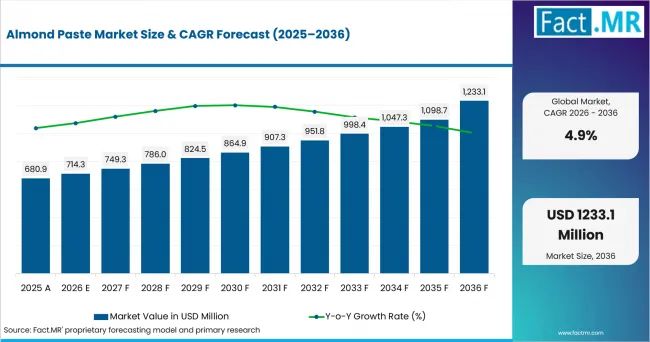
Almond Paste Market Value Analysis | Source: Fact.MR
What are the defining numbers behind Almond Paste Market growth?
USD 518.8 million absolute opportunity is expected between 2026 and 2036.
- Demand Drivers in the Market
- Food manufacturers need almond paste with stable texture because moisture balance affects finished dessert quality.
- Bakery applications are expected to support repeat use when almond flavor must hold through baking or decorative handling.
- Retail and foodservice channels are anticipated to widen access as packaged baking ingredients reach more purchase occasions.
- Sourcing discipline is expected to matter as almond availability shapes price talks before annual contracts are finalized.
- Application testing is expected to influence repeat orders because buyers usually approve paste after trial batches.
- Key Segments Analyzed
- By Type: Organic Type is expected to hold 34.1% share in 2026 because certified ingredient claims support premium bakery lines.
- By Application: Ice-creams are projected to account for 28.8% share in 2026 as frozen dessert makers need stable almond flavor.
- Analyst Opinion at Fact.MR
- Shambhu Nath Jha, Principal Consultant at Fact.MR, states, “Almond paste demand is expected to depend on how well producers match ingredient quality with application performance. Customers compare almond content with texture stability. Certification fit and supply reliability are checked before paste enters repeat production.”
- Strategic Implications
- Food manufacturers can test almond paste in the final product before approving large-volume purchases.
- Ingredient companies need clear application guidance so customers understand texture and label positioning before trials begin.
- Channel planning must separate industrial accounts from retail baking users because pack-size requirements differ across these routes.
The UK leads the listed country set at 6.3% CAGR through premium bakery use and organic positioning. Australia follows at 6.8% as retail baking formats support demand. The USA records 6.3% through broad food manufacturing use. Canada advances at 6.1% as premium dessert use holds steady. Germany expands at 4.1% through established bakery demand.
How does the Almond Paste Market break down by segment?
Organic Type leads Type with 34.1% share in 2026. Ice-creams lead Application with 28.8% share in 2026.
Why does Organic Type lead Type?
Organic Type is projected to account for 34.1% share in 2026.
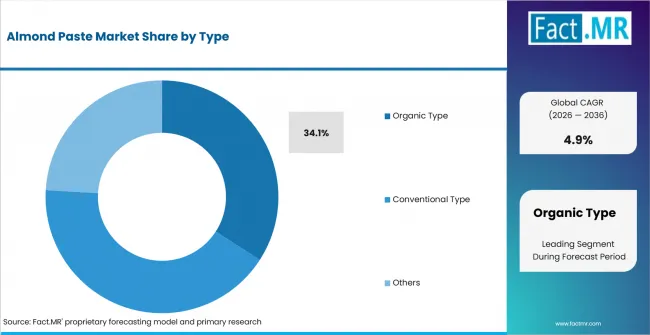
Almond Paste Market Analysis By Type | Source: Fact.MR
Organic Type represents the largest recorded type in the assessed market because it gives food brands a clear ingredient claim. This matters most in premium bakery and dessert products. Buyers are expected to favor paste that supports simple labels and certified sourcing without changing the core eating experience.
Why does Ice-creams lead Application?
Ice-creams hold 28.8% share in 2026.
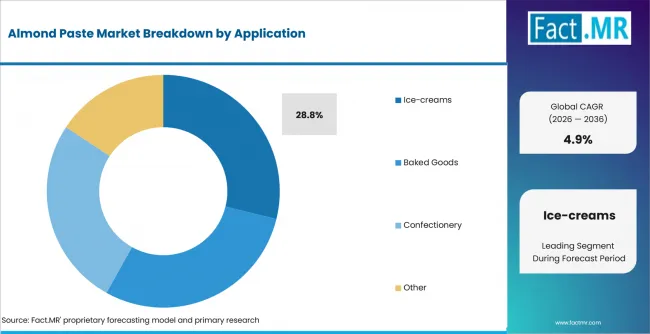
Almond Paste Market Analysis By Application | Source: Fact.MR
Ice-creams account for the largest application share because almond paste helps frozen desserts carry nut flavor through cold storage. Producers are expected to value paste that blends cleanly. Fact.MR coverage of ice cream formulations shows how flavor stability affects launch planning.
What is accelerating Almond Paste Market adoption, and what is holding it back?
Demand is expected to rise through bakery and dessert uses that need almond flavor in a stable paste format. Adoption is expected to stay measured because customers must balance certification and price before replacing existing ingredients. That buying path keeps adoption gradual even when the product solves a clear formulation need.
Drivers Impact Analysis
| DRIVER | (~) % IMPACT ON CAGR | GEOGRAPHIC RELEVANCE | IMPACT TIMELINE |
|---|---|---|---|
| Premium bakery formulation | +1.4% | UK; Germany; USA | Short term (<= 2 years) |
| Ice-cream inclusion use | +1.1% | USA; Canada; Australia | Short term (<= 2 years) |
| Organic type positioning | +0.9% | UK; Australia; Canada | Medium term (2-4 years) |
| Retail baking channel reach | +0.8% | North America and Europe | Medium term (2-4 years) |
| Foodservice dessert use | +0.7% | Bakery markets | Long term (>= 4 years) |
Source: Fact.MR analysis. Updated Aug 4, 2026
- Premium bakery formulation: Bakeries are expected to use almond paste when fillings need steady flavor after baking.
- Ice-cream inclusion use: Frozen dessert producers are anticipated to select paste that blends cleanly across repeat batches.
- Organic type positioning: Certified products are expected to support premium launches that need clear ingredient claims.
Opportunity Impact Analysis
| OPPORTUNITY | (~) % IMPACT ON CAGR | GEOGRAPHIC RELEVANCE | IMPACT TIMELINE |
|---|---|---|---|
| Clean-label dessert launches | +1.0% | UK and Canada | Medium term (2-4 years) |
| Industrial pack-size customization | +0.8% | USA and Germany | Medium term (2-4 years) |
| Premium confectionery filling use | +0.7% | Europe and North America | Long term (>= 4 years) |
| Online specialty ingredient retail | +0.5% | Australia and Canada | Long term (>= 4 years) |
Source: Fact.MR analysis. Updated Aug 4, 2026
- Clean-label dessert launches: Food brands are expected to use almond paste when premium desserts need a recognizable ingredient.
- Industrial pack-size customization: Larger tubs and pails are expected to reduce handling work for commercial kitchens.
- Premium confectionery filling use: Almond paste is expected to gain use when denser nut texture improves bars and pastries.
Restraints Impact Analysis
| RESTRAINT | (~) % IMPACT ON CAGR | GEOGRAPHIC RELEVANCE | IMPACT TIMELINE |
|---|---|---|---|
| Almond input cost variability | -1.1% | Global | Short term (<= 2 years) |
| Certification and labeling complexity | -0.8% | Organic retail markets | Short term (<= 2 years) |
| Application-specific texture limits | -0.6% | Ice cream and bakery processors | Medium term (2-4 years) |
| Established recipe lock-in | -0.5% | Mature bakery markets | Long term (>= 4 years) |
Source: Fact.MR analysis. Updated Aug 4, 2026
- Almond input cost variability: Purchase decisions are expected to stay cautious when crop pricing changes before finished product pricing.
- Certification and labeling complexity: Organic claims are expected to need tighter documentation before new accounts approve paste use.
- Application-specific texture limits: Some recipes are expected to resist reformulation when existing pastes already meet process needs.
Which countries are scaling the Almond Paste Market fastest?
- The country comparison spans 2.1 percentage points across three growth bands.
- The UK records 0.3 percentage point above Australia through stronger premium bakery positioning.
- Australia records 0.4 percentage point above the USA as specialty retail baking supports demand.
- The USA records 0.3 percentage point above Canada through larger food manufacturing use.
- Canada records 1.1 percentage points above Germany as premium dessert use scales faster.
- Germany closes the displayed range through established bakery and confectionery demand.
Comparable CAGRs create different entry conditions because each country reaches almond paste demand through a different channel mix. Full report coverage includes North America; Latin America; Europe; East Asia; South Asia and Pacific; Middle East and Africa.
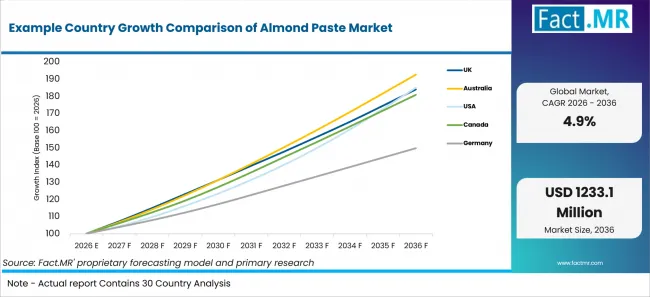
Example Country Growth Comparison Of Almond Paste Market | Source: Fact.MR
| Country | CAGR (2026-2036) |
|---|---|
| UK | 6.3% |
| Australia | 6.8% |
| USA | 6.3% |
| Canada | 6.1% |
| Germany | 4.1% |
Source: Fact.MR analysis. Updated Aug 4, 2026
What supports UK adoption?
6.3% CAGR, supported by premium bakery demand and organic product positioning.
The UK’s growth reflects rising use of almond paste in premium pastries and dessert fillings. Organic variants are expected to gain preference where certified ingredient claims support shelf placement. Foodservice operators may also increase repeat orders when almond paste delivers consistent flavor across dessert menus.
How is Australia scaling demand?
6.8% CAGR, supported by specialty retail baking and dessert channel expansion.
Australia’s growth is tied to wider product visibility across retail baking aisles and specialty ingredient stores. Cafes and dessert chains are expected to use almond paste in seasonal products that require repeatable flavor. Online distribution can further improve access for small bakeries and independent food businesses.
What is driving the USA from 2026 to 2036?
6.3% CAGR, backed by food manufacturing scale and broad dessert application use.
The USA’s growth reflects strong demand from large food manufacturers that require reliable batch control. Ice cream and frozen desserts are expected to remain important applications because almond paste provides stable flavor and texture. Private-label dessert brands may also test the ingredient to strengthen premium product positioning.
How is Canada developing demand?
6.1% CAGR, supported by retail baking and premium dessert usage.
Canada’s growth is shaped by household demand for packaged baking ingredients and wider use in seasonal desserts. Foodservice dessert makers are expected to value almond paste for consistent pastry flavor. Cross-border brand availability can also help customers compare different paste types, pack sizes and application formats.
How does Germany perform?
4.1% CAGR, led by established bakery and confectionery demand.
Germany’s growth reflects steady use of almond paste in traditional pastries and confectionery fillings. Producers are expected to value consistent texture and flavor across festive and premium products. Industrial bakeries may favor formats that reduce preparation work and support efficient large-scale production.
Who leads the Almond Paste Market?
Boxon Food and Barry Callebaut show the clearest direct relevance, while SOKOL CUSTOM FOODS, LLC and Mandelin strengthen the wider almond ingredient and specialty filling landscape.
Boxon Food supports the market through almond paste products used in bakery and confectionery applications. Barry Callebaut adds broader expertise in chocolate, fillings and premium food ingredients. SOKOL CUSTOM FOODS, LLC contributes custom bakery fillings and nut-based ingredient solutions. Mandelin strengthens regional supply through almond ingredients for commercial food production. Solo Foods supports retail and foodservice demand through ready-to-use almond paste products. Edde Almond Paste completes the provider set with specialized almond paste offerings.
Which companies are the key providers?
Key companies include Boxon Food; Barry Callebaut; SOKOL CUSTOM FOODS, LLC; Mandelin; Solo Foods; Edde Almond Paste.
- Boxon Food
- Barry Callebaut
- SOKOL CUSTOM FOODS, LLC
- Mandelin
- Solo Foods
- Edde Almond Paste
Bibliography
- National Agricultural Statistics Service. (2025). 2025 California almond forecast. U.S. Department of Agriculture.
- Economic Research Service. (2025). Fruit and tree nuts data. U.S. Department of Agriculture.
- U.S. Food and Drug Administration. (2025, January). Guidance for industry: Questions and answers regarding food allergen labeling (Edition 5).
This Report Answers
- The report provides strategic intelligence on the Almond Paste Market across Type and Application choices that shape bakery demand.
- Segment analysis covers Organic Type and Ice-creams as the share leaders within the 2026 market.
- Country outlook evaluates the UK and Australia. The USA, Canada and Germany complete the listed growth comparison.
- Competitive analysis profiles Boxon Food and Barry Callebaut. SOKOL CUSTOM FOODS, LLC and Mandelin add further provider coverage. Solo Foods and Edde Almond Paste complete the provider set.
- Demand assessment covers organic positioning and application fit. Pack format and channel reach complete the market view.
What does the Almond Paste Market cover?
Almond paste products are used in bakery and frozen dessert applications. They matter when almond flavor and texture must stay steady during processing.
The Almond Paste Market covers organic and conventional type offerings used by food manufacturers. It includes bakeries, dessert producers and retail ingredient brands. Coverage extends to Ice-creams and Baked Goods. Confectionery and Other applications are included when paste use affects the finished product.
What is included in the scope?
Almond paste products are included when they are sold as ingredients or ready-to-use paste formats.
The scope includes Type, Application and Region. Organic Type and Conventional Type define the type view. Ice-creams and Baked Goods define the primary end-use view. Confectionery and Other applications complete the application view. Country coverage includes the UK and Australia. The USA, Canada and Germany complete the country set.
What is excluded from the scope?
Unprocessed almonds and unrelated nut products remain outside the scope unless demand depends on almond paste use.
The scope excludes whole almonds and almond milk. Loose almond flour and almond oil are excluded when they are not sold or used as almond paste. Marzipan is excluded unless the product is assessed as paste for further processing. The scope is kept narrow so adjacent almond categories do not overstate paste demand.
How Was the Analysis Built?
The analysis draws on 120+ sources and 35+ company portfolios. It also covers 25+ countries and more than 20 industry interviews.
- Primary Research: Primary research includes discussions with manufacturers and service providers. It also covers technology developers and distributors. End users and subject-matter experts complete the interview scope.
- Desk Research: Desk research covers government statistics and regulatory publications. It also reviews company filings and trade data. Technical studies and industry associations complete the evidence base.
- Market Sizing and Forecasting: Market estimates combine historical performance and demand indicators. Pricing trends and segment shares are reviewed together. Company participation and country-level growth complete the forecast view.
- Data Validation and Update Cycle: Findings are checked against public data and company activity. Regulatory changes, trade patterns and industry developments are reviewed during updates.
Segmentation
What is the report's scope and coverage?
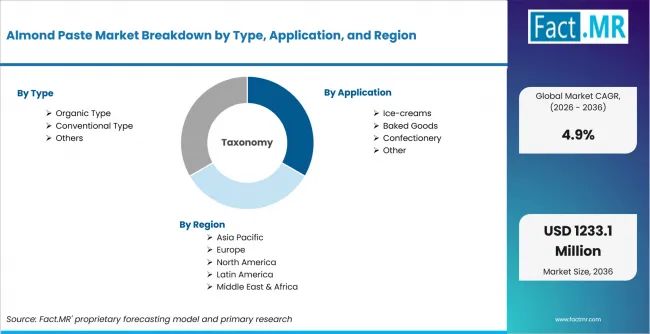
Almond Paste Market Breakdown By Type, Application, And Region | Source: Fact.MR
| Attribute | Details |
|---|---|
| Quantitative Units | USD million in 2026 to USD million by 2036 at CAGR |
| Market Definition | Almond paste products used by bakeries, confectionery makers, ice cream producers and retail brands where stable texture, almond flavor, application fit and processing performance influence product selection |
| Type | Organic Type; Conventional Type |
| Application | Ice-creams; Baked Goods; Confectionery; Other |
| End User | Bakeries; Confectionery manufacturers; Ice cream producers; Food manufacturers; Foodservice dessert makers; Retail baking brands |
| Pack Format | Retail packs; Foodservice packs; Industrial tubs and pails |
| Distribution Channel | Industrial supply; Specialty retail; Online specialty ingredient stores; Foodservice distribution |
| Regions Covered | North America; Latin America; Europe; East Asia; South Asia and Pacific; Middle East and Africa |
| Countries Covered | UK; Australia; USA; Canada; Germany |
| Key Companies Profiled | Boxon Food; Barry Callebaut; SOKOL CUSTOM FOODS, LLC; Mandelin; Solo Foods; Edde Almond Paste |
| Forecast Period | 2026 to 2036 |
| Approach | Hybrid top-down and bottom-up approach using bakery and dessert demand; almond input availability; organic certification requirements; application-specific texture performance; ice cream and confectionery use; pack-size requirements; retail and foodservice channel reach; country growth patterns; pricing trends; company participation and portfolio review |
Source: Fact.MR analysis. Updated Aug 4, 2026
How is the market segmented?
-
By Type:
- Organic Type
- Conventional Type
-
By Application:
- Ice-creams
- Baked Goods
- Confectionery
- Other
-
By Region:
- North America
- Latin America
- Europe
- East Asia
- South Asia and Oceania
- Middle East and Africa
Frequently Asked Questions
Which Type leads the market?
Which Application leads the market?
What was the market value in 2025?
What is the primary driver in this market?
What is the main restraint?
Why does Organic Type lead demand?
Why do Ice-creams use almond paste?
Who worked on this report


Preview the report firsthand - request a free sample
Free SampleGet the brochure for pricing and purchase details
Download PDF