- Base Value(2025): 18.5 Bn
- Estimated Value(2026): 19.3 Bn
- Forecast Value (2036): 30.2 Bn
- CAGR (2026 - 2036): 4.5%
Ammoniacal Nitrogen Market Forecast and Outlook By FACT.MR
In 2025, the ammoniacal nitrogen market was valued at USD 18.5 billion. Based on Fact.MR analysis, demand for ammoniacal nitrogen is estimated to grow to USD 19.3 billion in 2026 and USD 30.2 billion by 2036. FACT.MR projects a CAGR of 4.5% during the forecast period.
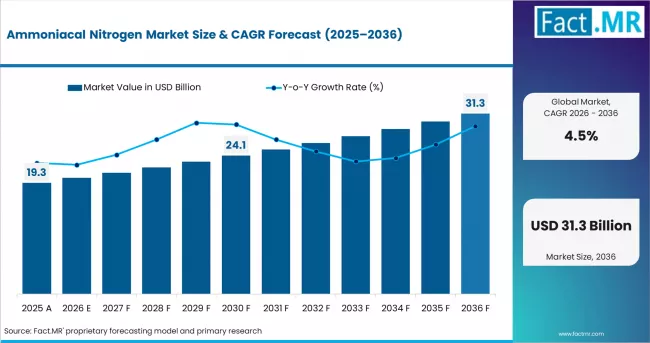
Ammoniacal Nitrogen Market Market Value Analysis | Source: Fact.MR
| Metric | Value |
|---|---|
| Estimated Value in 2026 | USD 19.3 billion |
| Forecast Value in 2036 | USD 30.2 billion |
| Forecast CAGR (2026 to 2036) | 4.5% |
Source: Fact.MR analysis. Updated Apr 11, 2026
Summary of Ammoniacal Nitrogen Market
- Market Definition
- The market includes anhydrous ammonia, aqueous ammonia, ammonium nitrate, and ammonium sulfate used as nitrogen sources in agricultural, industrial, and environmental treatment applications across global supply chains.
- Demand Drivers
- Fertilizer subsidy expansion in India and Brazil is increasing ammoniacal nitrogen consumption in staple crop and oilseed production.
- Urbanisation-driven wastewater treatment infrastructure investment is raising aqueous ammonia demand in Asia and Latin America.
- Industrial chemical and mining sector procurement is sustaining ammonium nitrate demand across resource-rich economies.
- Key Segments Analyzed
- By Type: Anhydrous Ammonia leads with 45% share in 2026. Highest nitrogen concentration per unit drives agricultural and industrial procurement preference.
- By Application: Agriculture leads with 60% share in 2026. Driven by nitrogen fertilizer consumption in staple crop, oilseed, and horticultural production globally.
- By End Use: Fertilizers lead with 50% share in 2026. Underpinned by government subsidy programmes and food security mandates in developing economies.
- By Geography: India leads 5.0% CAGR. Supported by fertilizer subsidy expansion and domestic ammonia production capacity investment.
- Analyst Opinion at FACT.MR
- Shambhu Nath Jha, Principal Consultant at Fact.MR, opines, CXOs will find the ammoniacal nitrogen market is splitting into two distinct segments. High-volume fertilizer demand in emerging markets remains price-sensitive. Industrial and European buyers are shifting toward green ammonia. These segments require environmental compliance and premium pricing.
- Strategic Implications
- Invest in green ammonia production capacity and certification to qualify for European industrial chemical and wastewater treatment procurement programmes subject to EU nitrogen emission compliance requirements.
- Expand ammonium sulfate production and distribution infrastructure in sulfur-deficient agricultural zones of South Asia and Sub-Saharan Africa where dual-nutrient demand is growing.
- Secure long-term natural gas supply contracts with price escalation clauses to stabilise feedstock cost exposure and maintain margin predictability across conventional ammonia production operations.
- Methodology
- Market sizing based on ammonia production capacity utilisation and nitrogen application rates by crop type and region. Validated with 2024–2025 producer revenue and agricultural procurement data.
- FAO fertilizer consumption statistics, IEA ammonia energy data, and regional agricultural policy frameworks supported demand and country analysis.
- Forecasts incorporate food security programme spending, wastewater treatment infrastructure trends, and green ammonia adoption data from primary research.
The market is expected to generate USD 10.9 billion in absolute opportunity. Growth is supported by rising fertilizer demand in Asia and Latin America. Wastewater treatment demand is also increasing with urbanisation. However, natural gas price volatility impacts production costs. Nitrogen emission regulations are also tightening. These factors are moderating margins and influencing production patterns.
Agricultural and industrial buyers are differentiating product grades. Anhydrous ammonia commands premium pricing due to high nitrogen content. Ammonium sulfate is gaining traction in sulfur-deficient soils. Buyers in India and Brazil are diversifying sourcing strategies. Contract durations are becoming shorter due to feedstock price uncertainty.
India leads growth at 5.0% CAGR through 2036. Subsidy programmes and domestic production support demand. China follows at 4.5% driven by industrial demand and green ammonia pilots. Brazil grows at 4.2% due to expanding agriculture. The United States records 3.5% supported by fertilizer and industrial demand. Germany grows at 3.2% driven by wastewater treatment and specialty chemicals. Europe faces constraints from emission regulations and high energy costs.
Segmental Analysis
Ammoniacal Nitrogen Market Analysis by Type
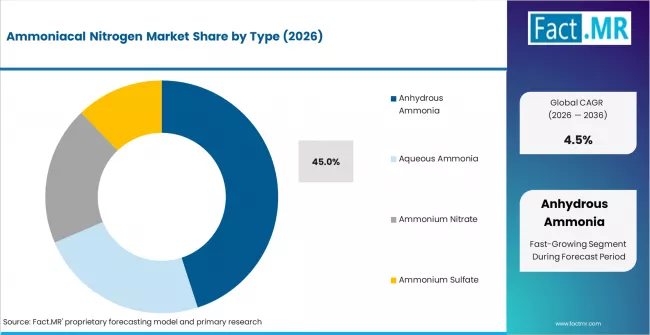
Ammoniacal Nitrogen Market Analysis By Type | Source: Fact.MR
Based on FACT.MR's ammoniacal nitrogen market report, consumption of anhydrous ammonia is estimated to hold 45% share in 2026. Anhydrous ammonia dominates due to its highest nitrogen content by weight among all ammoniacal nitrogen forms, making it the most cost-efficient nitrogen delivery mechanism for large-scale grain and cereal fertilizer programmes
-
Yara Investment: Yara International announced a capacity expansion investment at its Sluiskil ammonia production facility in the Netherlands in Q2 2024, targeting increased supply of anhydrous and aqueous ammonia to European agricultural and industrial buyers while advancing low-carbon ammonia production integration. [1]
-
CF Industries Development: CF Industries launched a blue ammonia production programme at its Donaldsonville Louisiana complex in 2024, targeting production of low-carbon anhydrous ammonia for domestic fertilizer markets and export to industrial decarbonisation buyers in Europe and Asia. [2]
-
Type Demand Trend: The International Fertilizer Association reported in 2024 that anhydrous ammonia represented the largest traded nitrogen intermediate globally, with demand concentrated in U.S. Corn Belt direct application and Asian urea synthesis feedstock procurement channels. [3]
Ammoniacal Nitrogen Market Analysis by Application
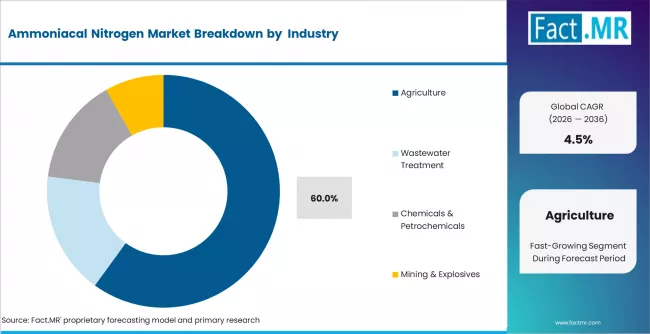
Ammoniacal Nitrogen Market Analysis By Application | Source: Fact.MR
Based on FACT.MR's ammoniacal nitrogen market report, agriculture is estimated to hold 60% share in 2026. Agriculture leads because ammoniacal nitrogen is the foundational reactive nitrogen source for synthetic fertilizer production, directly underpinning global staple crop yield requirements for food security in population-dense economies.
- Nutrien Expansion: Nutrien expanded its nitrogen solution distribution network across the U.S. Corn Belt and Canadian Prairie regions in 2024, adding terminal capacity to support pre-season agricultural ammonia procurement and reducing lead times for large farming operations requiring just-in-time nitrogen delivery. [4]
- Koch Fertilizer Initiative: Koch Fertilizer disclosed a product development programme in 2025 for enhanced efficiency ammonium nitrate formulations with controlled-release nitrogen targeting precision agriculture markets in the United States and Brazil seeking lower nitrogen loss rates per application cycle. [5]
- Agriculture Demand Trend: FAO data from 2024 indicated nitrogen fertilizer consumption in Asia-Pacific grew 3.8% year-on-year, with India and China accounting for over 60% of regional agricultural ammoniacal nitrogen demand driven by government-subsidised crop production support programmes. [6]
Drivers, Restraints, and Opportunities
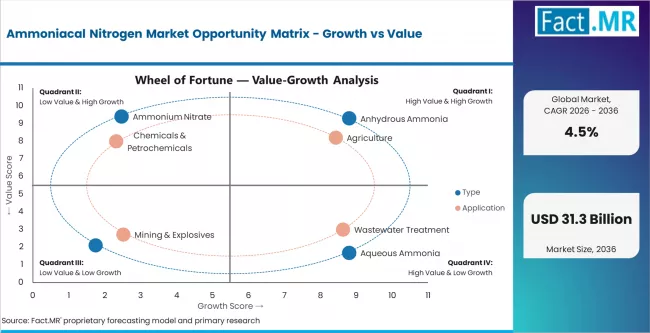
Ammoniacal Nitrogen Market Opportunity Matrix Growth Vs Value | Source: Fact.MR
FACT.MR analysts observe that the ammoniacal nitrogen market is a large-volume, structurally stable commodity driven by agricultural demand inelasticity. Global food production requirements anchor demand at scale, making this one of the few chemical markets where volume growth is directly linked to population and caloric intake expansion.
- Conventional fossil-derived ammonia holds the dominant volume share. It remains the primary source across fertilizer and industrial applications. Green ammonia is entering commercial volumes. It is produced using electrolysis and renewable energy. However, it remains 2–3x higher in cost than conventional supply. In fertilizers, cost economics favour conventional ammonia. Volume demand continues to rely on low-cost supply.
- India Food Security Demand: India's government allocated INR 1.64 trillion in FY2024-25 for fertilizer subsidies, sustaining domestic ammonia-based fertilizer demand at scale. Ammoniacal nitrogen procurement by state-owned fertilizer companies grew 4.2% in 2024 per Department of Fertilizers data.
- EU Nitrogen Emission Regulation: The European Commission's revised National Emission Ceilings Directive (EU) 2016/2284, with 2025 compliance review milestones, is tightening ammonia emission limits from agricultural application.
- Brazil Soy Expansion: Brazil's agricultural land under soy cultivation expanded by 2.1 million hectares in the 2024-25 planting season per CONAB data, directly increasing nitrogen fertilizer import requirements.
Regional Analysis
The ammoniacal nitrogen market is assessed across Asia Pacific, North America, Europe, Latin America, and Middle East and Africa, covering 40+ countries with demand profiles shaped by agricultural production scale, industrial chemical sector development, and nitrogen regulatory frameworks. The full report provides detailed market attractiveness analysis by region and country.
.webp "Top Country Growth Comparison Ammoniacal Nitrogen Market Cagr (2026 2036)")
Top Country Growth Comparison Ammoniacal Nitrogen Market Cagr (2026 2036) | Source: Fact.MR
| Country | CAGR (2026 to 2036) |
|---|---|
| India | 5.0% |
| China | 4.5% |
| Brazil | 4.2% |
| United States | 3.5% |
| Germany | 3.2% |
Source: Fact.MR analysis. Updated Apr 11, 2026
Source: Fact.MR (FACT.MR) analysis, based on proprietary forecasting model and primary research
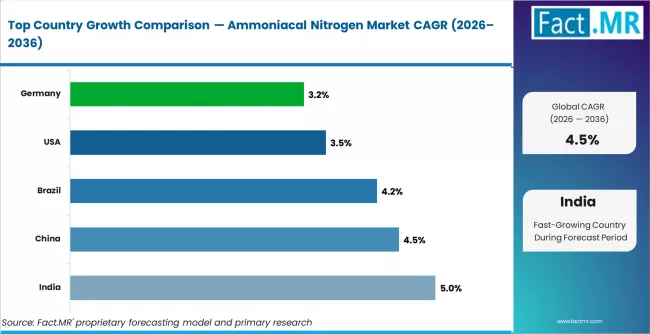
Ammoniacal Nitrogen Market Cagr Analysis By Country | Source: Fact.MR
Asia Pacific Ammoniacal Nitrogen Market Analysis
Asia Pacific is the largest consumption region. Demand is driven by fertilizer subsidies and large agricultural output. Government-linked procurement ensures volume stability. Yara International, EuroChem, and Indian Farmers Fertiliser Cooperative anchor supply networks.
- India: Subsidy-driven demand and domestic capacity expansion define growth. Demand is projected at 5.0% CAGR through 2036. Fertilizer subsidies in FY2024–25 continue to sustain consumption. PM-PRANAM promotes balanced nitrogen use while expanding acreage coverage. Investments by Indian Farmers Fertiliser Cooperative and RCF improved domestic ammonia production. Growth remains policy-led and volume stable.
- China: Dual demand from agriculture and industry shapes market expansion. Demand is projected at 4.5% CAGR through 2036. Updated fertilizer guidelines promote precision nitrogen use. Industrial ammonia demand is increasing with petrochemical expansion. Green ammonia pilots are progressing under national policy frameworks. Growth combines agricultural scale with industrial demand.
FACT.MR covers India, China, Japan, South Korea, ASEAN, and ANZ. Includes policy data, fertilizer trends, and demand forecasts.
Latin America Ammoniacal Nitrogen Market Analysis
Latin America is a high-growth import market. Demand is driven by large-scale agriculture expansion. Procurement is linked to global price benchmarks. Nutrien and Yara International lead distribution networks.
- Brazil: Crop expansion and import dependency are key growth drivers. Demand is projected at 4.2% CAGR through 2036. Soy cultivation expansion is increasing fertilizer consumption. Import volumes are rising through major ports. Government credit programmes are supporting bulk procurement. Growth is agribusiness-driven and volume intensive.
FACT.MR covers Brazil, Argentina, Mexico, and Chile. Includes crop data, import trends, and credit policy insights.
North America Ammoniacal Nitrogen Market Analysis
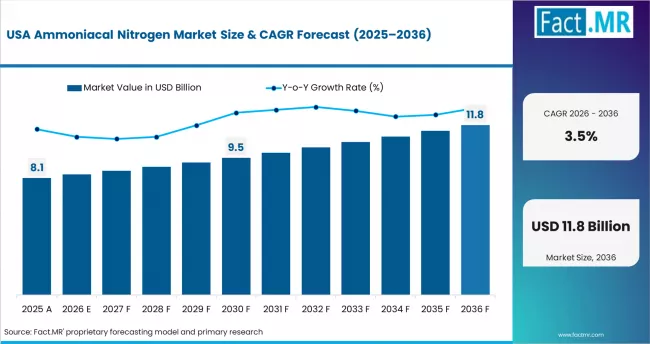
Ammoniacal Nitrogen Market Country Value Analysis | Source: Fact.MR
North America is the largest production region. Demand is stable and linked to large-scale agriculture. Infrastructure ensures efficient distribution. CF Industries and Koch Fertilizer dominate supply.
-
United States: Established agriculture and industrial demand sustain the market. Demand is projected at 3.5% CAGR through 2036. Corn Belt fertilizer use remains the primary driver. Blue ammonia investments are expanding under policy incentives. Regulatory requirements are increasing documentation but not reducing volume. Growth is stable and replacement-driven.
FACT.MR covers the U.S., Canada, and Mexico. Includes production data and regulatory impacts.
Europe Ammoniacal Nitrogen Market Analysis
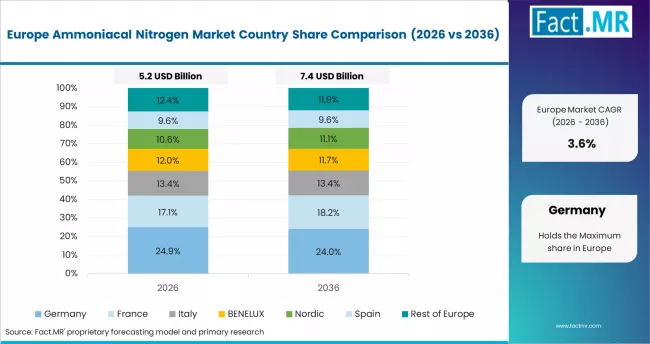
Ammoniacal Nitrogen Market Europe Country Market Share Analysis, 2026 & 2036 | Source: Fact.MR
Europe is a regulation-constrained market. Demand is influenced by emission targets and energy costs. Supply is shifting toward low-carbon ammonia. Yara International and OCI N.V. lead the transition.
- Germany: Regulatory pressure and industrial demand define market structure. Demand is projected at 3.2% CAGR through 2036. Emission targets are tightening nitrogen application standards. BASF continues large-scale ammonia procurement for industrial use. Wastewater treatment demand is also increasing. Growth remains compliance-driven and industrially anchored.
FACT.MR covers Germany, France, the UK, Italy, Spain, and the Netherlands. Includes emission data, industrial demand, and transition trends.
Competitive Aligners for Market Players
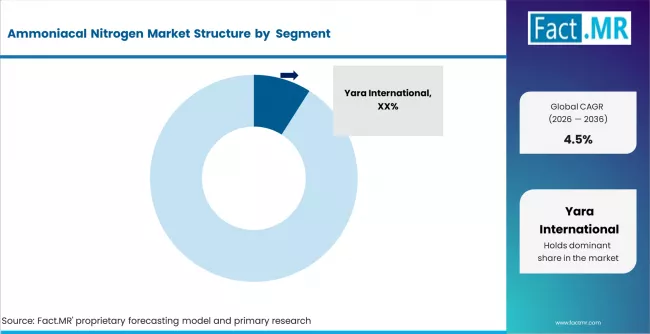
Ammoniacal Nitrogen Market Analysis By Company | Source: Fact.MR
The ammoniacal nitrogen market operates with a relatively concentrated global supply base. A few large producers such as Yara International, CF Industries, Nutrien, and EuroChem control a significant share of production and distribution. Despite this concentration, competition is not about product differentiation. Ammoniacal nitrogen remains a commodity. Instead, success depends on cost efficiency, access to natural gas, and strong logistics networks that connect producers to agricultural markets.
Cost structure plays a central role in competitive positioning. Natural gas accounts for the majority of ammonia production costs. Companies with secure and low-cost gas access hold a clear advantage. CF Industries benefits from U.S. gas pricing, enabling competitive exports. Yara International leverages its global distribution footprint to reach over 150 countries. EuroChem has invested upstream to secure feedstock supply. Meanwhile, OCI N.V. is investing in green ammonia to reduce dependence on fossil fuel pricing.
On the demand side, buyers take a cautious and structured approach. Large agricultural and industrial customers typically avoid reliance on a single supplier. They adopt multi-source procurement strategies to manage risk. Pricing is often tied to global benchmarks, especially natural gas and ammonia indices. Once supply relationships are established, they tend to remain stable. Infrastructure such as pipelines and terminals creates high switching costs. Changing suppliers is not just a pricing decision. It involves logistics, timing, and operational risks. This results in long-term contracts and predictable supply flows. Even in a commodity market, these structural factors help producers maintain relatively stable margins over time.
Key Players
- Yara International
- CF Industries
- Nutrien
- Koch Fertilizer
- EuroChem
- OCI N.V.
- Saudi Basic Industries Corporation
Bibliography
- [1] Yara International. (Q2 2024). Operations Update: Capacity Expansion Investment at Sluiskil Ammonia Production Facility Targeting Increased Anhydrous and Aqueous Ammonia Supply to European Agricultural and Industrial Buyers and Advancement of Low-Carbon Ammonia Production Integration. 2024. yara.com/investor-relations
- [2] CF Industries. (2024). Blue Ammonia Programme Launch: Low-Carbon Anhydrous Ammonia Production at Donaldsonville Louisiana Complex Targeting Domestic Fertilizer Markets and Export to Industrial Decarbonisation Buyers in Europe and Asia. 2024. cfindustries.com/investor-relations
- [3] International Fertilizer Association. (2024). Global Nitrogen Fertilizer Market Report 2024: Anhydrous Ammonia as Largest Traded Nitrogen Intermediate with Demand Concentrated in U.S. Corn Belt Direct Application and Asian Urea Synthesis Feedstock Procurement Channels. 2024. fertilizer.org
- [4] Nutrien. (2024). Distribution Network Expansion: Nitrogen Solution Terminal Capacity Addition Across U.S. Corn Belt and Canadian Prairie Regions Supporting Pre-Season Agricultural Ammonia Procurement and Reducing Lead Times for Large Farming Operations. 2024. nutrien.com/investor-relations
- [5] Koch Fertilizer. (2025). Product Development Programme: Enhanced Efficiency Ammonium Nitrate Formulations with Controlled-Release Nitrogen Targeting Precision Agriculture Markets in the United States and Brazil Seeking Lower Nitrogen Loss Rates per Application Cycle. January 2025. kochfertilizer.com
- [6] Food and Agriculture Organization of the United Nations. (2024). Fertilizer Consumption Data 2024: Nitrogen Fertilizer Use Growth of 3.8% Year-on-Year in Asia-Pacific with India and China Accounting for Over 60% of Regional Agricultural Ammoniacal Nitrogen Demand. 2024. fao.org/faostat
This Report Addresses
- Market sizing and quantitative forecast metrics detailing global and regional ammoniacal nitrogen demand from USD 19.3 billion in 2026 to USD 30.2 billion by 2036.
- Segmentation analysis evaluating consumption patterns across type (anhydrous ammonia, aqueous ammonia, ammonium nitrate, ammonium sulfate), application, and end use categories.
- Regional deployment intelligence comparing growth trajectories, agricultural policy environments, and competitive dynamics across Asia Pacific, North America, Europe, Latin America, and Middle East and Africa.
- Regulatory compliance assessment analysing how EU nitrogen emission directives, India fertilizer subsidy frameworks, and U.S. EPA clean air requirements shape procurement specifications and production strategy.
- Competitive landscape evaluation tracking market structure, producer positioning, feedstock strategies, and green ammonia transition plans among leading industry participants.
- Strategic investment guidance defining feedstock sourcing, capacity allocation, and green ammonia certification decisions required for market positioning through the forecast period.
- Supply chain risk analysis identifying natural gas price exposure, production concentration vulnerabilities, and logistics dependencies affecting ammonia trade flows globally.
- Custom data delivery formats encompassing interactive dashboards, raw Excel datasets, and comprehensive PDF narrative reports.
Ammoniacal Nitrogen Market Definition
The ammoniacal nitrogen market comprises inorganic nitrogen compounds including anhydrous ammonia, aqueous ammonia, ammonium nitrate, and ammonium sulfate derived from the Haber-Bosch process and related synthesis routes.
Ammoniacal Nitrogen Market Inclusions
Includes global and regional market forecasts from 2026 to 2036 by type, application, and end use. Covers anhydrous and aqueous ammonia, ammonium nitrate, and ammonium sulfate across agricultural, industrial, and environmental treatment applications. The study includes pricing trends, feedstock dynamics, and trade flow analysis.
Ammoniacal Nitrogen Market Exclusions
Excludes finished nitrogen fertilizer blends and NPK compound products not classified as ammoniacal nitrogen compounds. Omits ammonia used in refrigeration and cleaning product applications. Also excludes downstream finished agricultural or industrial chemical products sold at consumer or end-user price points.
Ammoniacal Nitrogen Market Research Methodology
- Primary Research: Interviews with ammonia producers, fertilizer distributors, agricultural chemical buyers, and wastewater treatment operators in Asia, North America, Europe, and Latin America.
- Desk Research: Analysis of FAO fertilizer statistics, IEA ammonia production data, and regional agricultural policy frameworks from 2024–2025.
- Market-Sizing and Forecasting
- Hybrid top-down and bottom-up model using ammonia production capacity, nitrogen application rates by crop, and industrial consumption benchmarks by region.
- Data Validation and Update Cycle
- Validated through producer financial disclosures, trade association data, and expert interviews with periodic updates.
Segmentation
Scope of Report
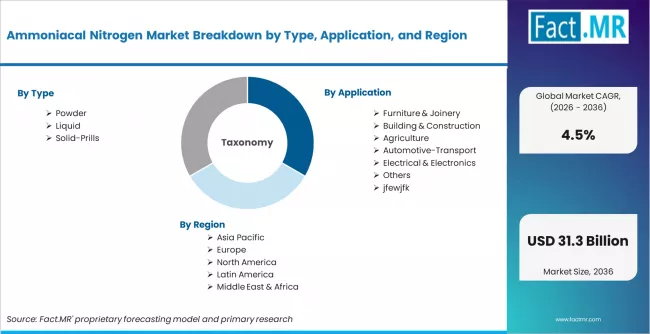
Ammoniacal Nitrogen Market Breakdown By Type, Application, And Region | Source: Fact.MR
| Attribute | Details |
|---|---|
| Quantitative Units | USD 19.3 billion (2026) to USD 30.2 billion (2036), at a CAGR of 4.5% |
| Market Definition | Anhydrous ammonia, aqueous ammonia, ammonium nitrate, and ammonium sulfate used as nitrogen sources for agricultural fertilizer, industrial chemical synthesis, wastewater treatment, and mining applications globally. |
| Type Segmentation | Anhydrous Ammonia, Aqueous Ammonia, Ammonium Nitrate, Ammonium Sulfate |
| Application Segmentation | Agriculture, Wastewater Treatment, Chemicals & Petrochemicals, Mining & Explosives |
| End Use Segmentation | Fertilizers, Industrial Chemicals, Environmental Treatment |
| Application Coverage | Nitrogen fertilizer crop production, ammoniacal nitrogen wastewater removal, ammonia synthesis feedstock supply, industrial explosive precursor procurement, and environmental treatment nitrogen dosing. |
| Regions Covered | North America, Europe, Asia Pacific, Latin America, Middle East and Africa |
| Countries Covered | USA, Canada, Mexico, Germany, UK, France, Italy, Spain, Nordic, BENELUX, Netherlands, China, Japan, South Korea, India, ASEAN, Australia and New Zealand, Brazil, Argentina, Chile, Saudi Arabia, GCC, Turkey, South Africa, Rest of MEA |
| Key Companies Profiled | Yara International, CF Industries, Nutrien, Koch Fertilizer, EuroChem, OCI N.V., Saudi Basic Industries Corporation |
| Forecast Period | 2026 to 2036 |
| Approach | Hybrid top-down and bottom-up model using ammonia production capacity utilisation, nitrogen application rates by crop and region, industrial consumption benchmarks, natural gas price sensitivity analysis, and primary interviews with ammonia producers, fertilizer distributors, and agricultural chemical buyers. |
Source: Fact.MR analysis. Updated Apr 11, 2026
Ammoniacal Nitrogen Market by Segments
-
By Type:
- Anhydrous Ammonia
- Aqueous Ammonia
- Ammonium Nitrate
- Ammonium Sulfate
-
By Application:
- Agriculture
- Wastewater Treatment
- Chemicals & Petrochemicals
- Mining & Explosives
-
By End Use:
- Fertilizers
- Industrial Chemicals
- Environmental Treatment
-
By Region:
-
North America
- United States
- Canada
- Mexico
-
Latin America
- Brazil
- Mexico
- Argentina
- Chile
- Rest of Latin America
-
Western Europe
- Germany
- United Kingdom
- France
- Italy
- Spain
- Nordic Countries
- BENELUX
- Netherlands
- Rest of Western Europe
-
Eastern Europe
- Russia
- Poland
- Hungary
- Balkan and Baltic
- Rest of Eastern Europe
-
East Asia
- China
- Japan
- South Korea
-
South Asia and Pacific
- India
- ASEAN
- Australia and New Zealand
- Rest of South Asia and Pacific
-
Middle East and Africa
- Kingdom of Saudi Arabia
- Other GCC Countries
- Turkey
- South Africa
- Rest of Middle East and Africa
-
Frequently Asked Questions
How large is the ammoniacal nitrogen market in 2026?
What will the ammoniacal nitrogen market size be by 2036?
What is the expected CAGR for the ammoniacal nitrogen market between 2026 and 2036?
Which type segment is poised to lead in 2026?
Which application segment holds the largest share?
Which country is the fastest-growing market?
What is the absolute dollar opportunity in this market?
What factors are driving market growth?
What are the major restraints?
What methodology does Fact.MR use for this forecast?
Who worked on this report


Preview the report firsthand - request a free sample
Free SampleGet the brochure for pricing and purchase details
Download PDF