The In-Season Foliar Nitrogen Fine-Tuning Blend Market is analyzed across its key product, application and end-use segments, with regional trends and demand outlook, forecast 2026 to 2036.
By Fact.MR Chemical & Materials DeskLead analyst:
S.N. JhaPublished :
Updated :
9 min read
Fact-checked under the Fact.MR editorial process
In-Season Foliar Nitrogen Fine-Tuning Blend Market Forecast and Outlook 2026 to 2036
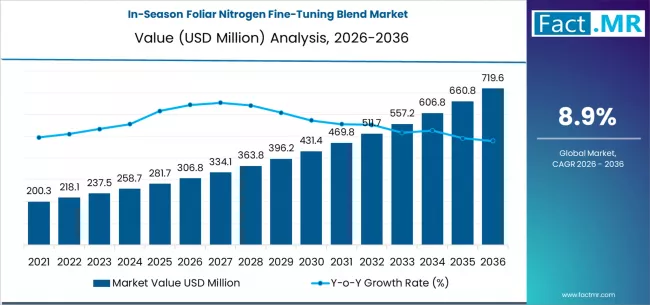
The global market for in-season foliar nitrogen fine-tuning blends is projected to grow from USD 306.77 million in 2026 to USD 719.60 million by 2036, advancing at a CAGR of 8.9%. This growth reflects the increasing integration of precision nutrient management strategies that extend beyond base soil fertilization. These specialized blends are formulated for application directly to crop foliage during critical growth stages, allowing farmers to correct deficiencies, overcome soil constraints, and respond to real-time plant needs, thereby optimizing yield and quality.
In Season Foliar Nitrogen Fine Tuning Blend Market Market Value Analysis | Source: Fact.MR
Summary of In-Season Foliar Nitrogen Fine-Tuning Blend Market
Market Snapshot
Global in-season foliar nitrogen fine-tuning blend market is valued at USD 306.77 million in 2026 and is projected to reach USD 719.60 million by 2036.
The market is expected to grow at aCAGRof 8.9% during 2026-2036.
Growth reflects increasing adoption of precision nutrient management strategies, particularly solutions that extend beyond traditional soil fertilization.
These blends are applied directly to crop foliage during key growth stages, enabling real-time correction of nitrogen deficiencies and optimization of crop yield and quality.
Demand and Growth Drivers
Rising adoption of precision agriculture tools (satellite imagery, drones, crop sensing) is enabling detection of in-season nitrogen variability, driving demand for corrective foliar solutions.
Increasing need to maximize nitrogen use efficiency within a single growing cycle is supporting adoption of foliar fine-tuning practices.
Soil-applied nitrogen losses (immobilization, leaching) are creating demand for direct nutrient delivery through foliage.
Strong economic incentive in high-value cropping systems, where marginal yield improvements translate into significant returns.
Integration with data-driven crop management practices is strengthening adoption across commercial farming operations.
Product and Segment View
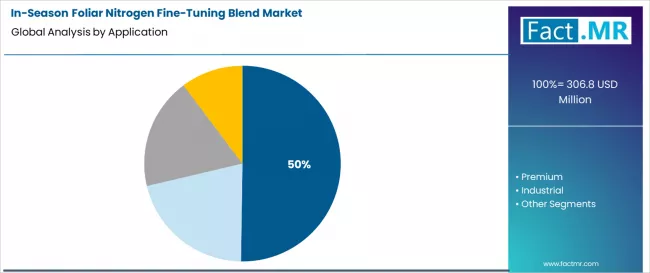
Standard application blends hold50% share in 2026, emerging as the leading segment due to reliability and cost-effectiveness.
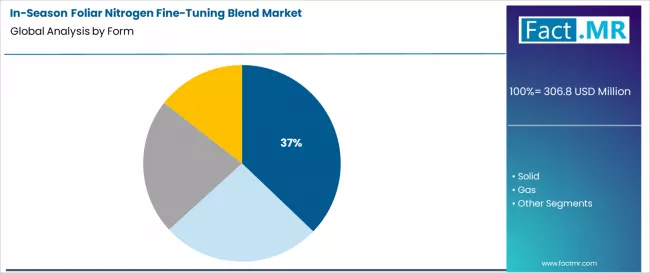
Liquid formulations account for 37.2% share in 2026, leading the form segment due to ease of spraying and rapid leaf absorption.
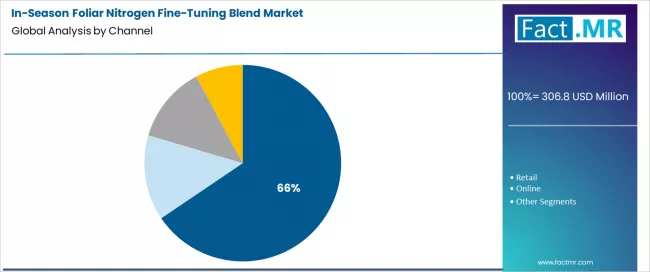
Direct sales channel dominates with 66% share in 2026, reflecting the need for technical agronomic support and customized recommendations.
Product segmentation includes:
Application: Standard, Premium, Industrial, Other
Form: Liquid, Solid, Gas, Gel
Channel: Direct, Retail, Online, Distributor
Geography and Competitive Outlook
Growth is supported across global agricultural regions, driven by adoption of precision farming and nutrient optimization practices.
Key high-growth countries include:
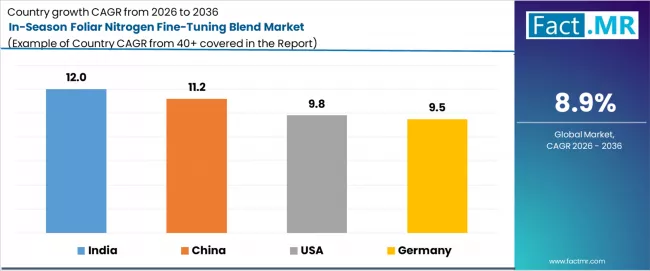
India (12.0%)
China (11.2%)
United States (9.8%)
Germany (9.5%)
Growth in India is driven by intensive cropping systems and smallholder efficiency requirements, while China benefits from high-value crop production and precision nutrition practices.
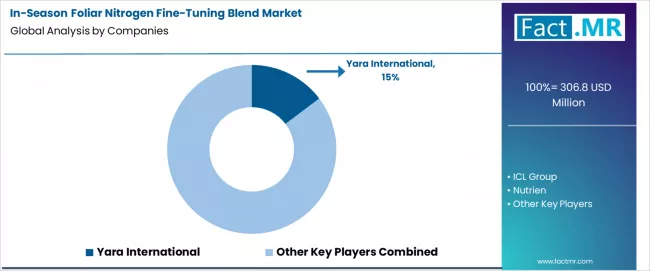
Key companies active in this market includeYaraInternational,ICLGroup,Nutrien, Haifa Group,EuroChem, andUPL.
In-Season Foliar Nitrogen Fine-Tuning Blend Market — At a Glance
Attribute
Details
Market Value 2026
USD 306.77 million
Market Value 2036
USD 719.60 million
Absolute Dollar Opportunity
USD 412.83million
CAGR2026-2036
8.9%
Growth Multiple
2.3x
Key Demand Theme
Precision nutrient management and in-season nitrogen optimization
Leading Segment by Application
Standard
Application Share
50%
Leading Segment by Form
Liquid
Form Share
37.2%
Leading Segment by Channel
Direct
Channel Share
66%
Key Regions
Global (incl. India, China, USA, Germany)
CountryCAGRs
India 12.0%, China 11.2%, USA 9.8%, Germany 9.5%
Top Companies
Yara,ICL,Nutrien, Haifa,EuroChem,UPL
Segmentation
Application, Form, Channel, Region
Source: Fact.MR analysis. Updated Apr 1, 2026
Standard application blends dominate the market, commanding a 50% share, as they provide a reliable and cost-effective solution for common mid-season nitrogen boosting. Liquid formulations are the leading product form, holding a 37% share, prized for their ease of application, rapid leaf absorption, and compatibility with existing sprayer systems. Direct sales account for 66% of the market, as the technical nature of these products necessitates close collaboration between manufacturers, agronomists, and large farming operations to ensure correct timing and formulation. Market expansion is driven by the need to maximize nitrogen use efficiency within a single growing season. Soil-applied nitrogen can be subject to losses or immobilization, leaving crops deficient during peak demand periods like grain fill or fruit set. Foliar application provides a rapid corrective mechanism, delivering nutrients directly into the plant's physiological system. This practice is particularly valuable in high-value cropping systems, where marginal yield or quality improvements generate significant economic returns, and in regions where soil conditions limit nutrient availability.
Category
Category
Segments
Application
Standard, Premium, Industrial, Other
Form
Liquid, Solid, Gas, Gel
Channel
Direct, Retail, Online, Distributor
Region
North America, Latin America, Western Europe, Eastern Europe, East Asia, South Asia & Pacific, MEA
Source: Fact.MR analysis. Updated Apr 1, 2026
Segmental Analysis
By Application, Which Program Serves the Broadest Need?
In Season Foliar Nitrogen Fine Tuning Blend Market Analysis By Application | Source: Fact.MR
The standard application tier leads with a 50% share. This category encompasses balanced nitrogen blends, often combined with key micronutrients like sulfur or zinc, designed for a wide array of field crops such as corn, wheat, and soybeans.
Their purpose is to provide a general mid-season nutritional boost to support grain development or vegetative growth. The reliability and proven return on investment of these standard blends make them the foundational product for widespread adoption of foliar fine-tuning practices.
By Form, Which is Optimal for Foliar Uptake?
In Season Foliar Nitrogen Fine Tuning Blend Market Analysis By Form | Source: Fact.MR
Liquid formulations are predominant, holding a 37% share. For foliar application, liquids are essential as they can be easily diluted and sprayed, ensuring uniform coverage of the leaf surface, a prerequisite for effective nutrient absorption.
Advanced liquid formulations include surfactants and adjuvants that enhance droplet retention, spread, and penetration of the leaf cuticle, maximizing the efficiency of the applied nitrogen and minimizing washoff.
By Channel, How is Technical Expertise Delivered?
In Season Foliar Nitrogen Fine Tuning Blend Market Analysis By Channel | Source: Fact.MR
The direct channel is the most significant, controlling 66% of the market. Effective in-season fine-tuning requires precise agronomic judgment regarding crop stage, deficiency symptoms, and environmental conditions.
Manufacturers and their technical teams work directly with large farms, cooperatives, and professional crop advisors to provide soil and tissue test interpretation, recommend specific blend formulations, and advise on optimal application timing. This direct relationship ensures the technology is used correctly to achieve the desired yield or quality outcome.
What are the Drivers, Restraints, and Key Trends of the Market?
A primary market driver is the rising adoption of precision agriculture tools, such as satellite imagery and drone-based sensors, which can identify in-season nitrogen variability and deficiency zones within fields. This diagnostic capability creates a direct demand for corrective foliar applications. The economic pressure to maximize yield potential from high-cost hybrid seeds further incentivizes investments in precision nutrition. Additionally, the limitations of soil-applied nitrogen in dry conditions or cold soils make foliar feeding an attractive supplemental strategy.
A key restraint is the relatively high cost per unit of nutrient delivered via foliar application compared to soil application. The risk of leaf burn (phytotoxicity) from improper formulation, concentration, or application under high temperatures can deter users. The practice also requires specialized sprayer equipment and favorable weather conditions for application, adding operational complexity. The effect is often subtler than a soil-applied response, making it harder for some farmers to quantify the immediate benefit.
Significant trends include the development of highly specialized "Premium" and "Industrial" blends tailored for specific crops (e.g., high-nitrogen blends for cotton at square set or low-biuret urea for citrus). There is growing integration of nitrogen with other bioactive ingredients, such as amino acids, plant hormones, or stress mitigants, creating multi-functional foliar products. The market is also moving toward digital prescription platforms, where tissue test or sensor data automatically generates a recommended foliar blend and application map.
Analysis of the In-Season Foliar Nitrogen Fine-Tuning Blend Market by Key Countries
In Season Foliar Nitrogen Fine Tuning Blend Market Cagr Analysis By Country | Source: Fact.MR
Country
CAGR (2026-2036)
India
12.0%
China
11.2%
USA
9.8%
Germany
9.5%
Source: Fact.MR analysis. Updated Apr 1, 2026
Why does India Exhibit the Highest Growth Rate amid the Presence of Intensive Cropping Systems?
India's leading CAGR of 12.0% is driven by intensive cropping systems, small landholdings where input efficiency is critical, and increasing awareness of micronutrient deficiencies. Foliar application is a practical method for smallholders to correct nutrient issues without major infrastructure.
Government extension programs often promote foliar feeding as a yield-enhancing practice, particularly in horticulture and high-value field crops, accelerating market education and adoption.
Will China’s Market depend on Output Maximization with Emphasis on Efficient Nutrient Delivery Methods?
China's 11.2% growth is linked to its massive output of fruits, vegetables, and tea, where quality parameters are highly influenced by precise nutrition. The practice of foliar feeding is deeply embedded in Chinese high-value agriculture.
National soil testing campaigns and Zero-Growth fertilizer policies are pushing farmers toward more efficient nutrient delivery methods, making in-season foliar fine-tuning a strategic tool to maintain yields while optimizing input use.
What Characterizes the USA’s Market for In-Season Foliar Nitrogen Fine-Tuning Blends?
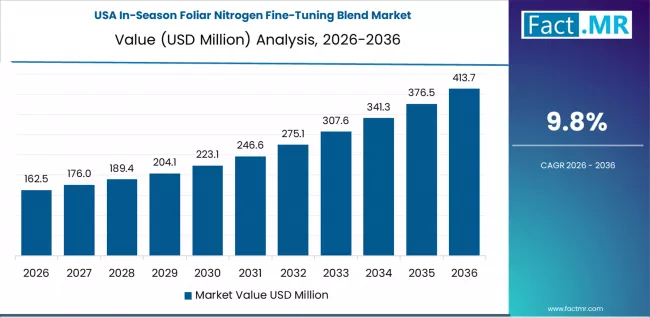
In Season Foliar Nitrogen Fine Tuning Blend Market Country Value Analysis | Source: Fact.MR
The USA's 9.8% CAGR reflects a sophisticated market where growth is driven by data-informed decision-making. Widespread use of tissue testing and crop modeling by large-scale farmers identifies exact in-season nitrogen needs.
Foliar blends are increasingly used as a standard component of crop management protocols, especially in wheat, cotton, and specialty crops. The growth is in more precise, data-driven application rather than blanket adoption.
How will Precision Farming Ethos elevate Prospects for Growth in Germany?
Germany's 9.5% growth stems from its high-value horticulture and precision farming ethos, combined with stringent regulations on nitrogen balance. German farmers utilize foliar applications to precisely meet crop demand without exceeding legal nitrogen surplus limits.
The focus on quality, such as high protein content in wheat, and elevated sugar content in beets, and the need for very targeted applications in sensitive environmental zones drive demand for advanced, research-backed foliar blend solutions.
Competitive Landscape of the In-Season Foliar Nitrogen Fine-Tuning Blend Market
In Season Foliar Nitrogen Fine Tuning Blend Market Analysis By Company | Source: Fact.MR
The competitive landscape features global specialty nutrition companies competing on formulation science, agronomic research, and technical service. Differentiation is achieved through proprietary nutrient complexes, enhanced uptake technology, and a deep library of crop-specific trial data.
Success hinges on the strength of direct agronomic support teams and the ability to integrate foliar recommendations into broader digital farming platforms offered by partners or developed in-house. Building a reputation for consistent, measurable crop response is paramount.
Key Players in the In-Season Foliar Nitrogen Fine-Tuning Blend Market
Physiology of foliar nutrient uptake and translocation; formulation chemistry for minimizing phytotoxicity; correlation between tissue testing and foliar prescription; economic threshold for foliar nitrogen application; role of adjuvants and surfactants in efficacy; environmental fate of foliar-applied nutrients.
Source: Fact.MR analysis. Updated Apr 1, 2026
Market by Segments
Application :
Standard
Premium
Industrial
Other
Form :
Liquid
Solid
Gas
Gel
Channel :
Direct
Retail
Online
Distributor
Region :
North America
USA
Canada
Latin America
Brazil
Mexico
Argentina
Rest of Latin America
Western Europe
Germany
UK
France
Spain
Italy
BENELUX
Rest of Western Europe
Eastern Europe
Russia
Poland
Czech Republic
Rest of Eastern Europe
East Asia
China
Japan
South Korea
Rest of East Asia
South Asia & Pacific
India
ASEAN
Australia
Rest of South Asia & Pacific
MEA
Saudi Arabia
UAE
Turkiye
Rest of MEA
Questions Answered
Frequently Asked Questions
How big is the in-season foliar nitrogen fine-tuning blend market in 2026?
The global in-season foliar nitrogen fine-tuning blend market is estimated to be valued at USD 306.8 million in 2026.
What will be the size of in-season foliar nitrogen fine-tuning blend market in 2036?
The market size for the in-season foliar nitrogen fine-tuning blend market is projected to reach USD 719.6 million by 2036.
How much will be the in-season foliar nitrogen fine-tuning blend market growth between 2026 and 2036?
The in-season foliar nitrogen fine-tuning blend market is expected to grow at a 8.9% CAGR between 2026 and 2036.
What are the key product types in the in-season foliar nitrogen fine-tuning blend market?
The key product types in in-season foliar nitrogen fine-tuning blend market are standard, premium, industrial and other.
Which form segment to contribute significant share in the in-season foliar nitrogen fine-tuning blend market in 2026?
In terms of form, liquid segment to command 37.2% share in the in-season foliar nitrogen fine-tuning blend market in 2026.