- Market Value (2025): USD 72.7 Bn
- Estimated Value (2026): USD 77.5 Bn
- Forecast Value (2036): USD 130.2 Bn
- CAGR (2026-2036): 6.6%
What is the Ancient Grain Market forecast to be worth by 2036?
USD 77.5 billion in 2026 to USD 130.2 billion by 2036 at 6.6% CAGR.
- The ancient grain market was valued at USD 72.7 billion in 2025 as food brands used older grain varieties for texture and nutrition positioning.
- Demand is projected to increase from USD 77.5 billion in 2026 to USD 130.2 billion by 2036.
- The market is forecast to record 6.6% CAGR from 2026 to 2036.
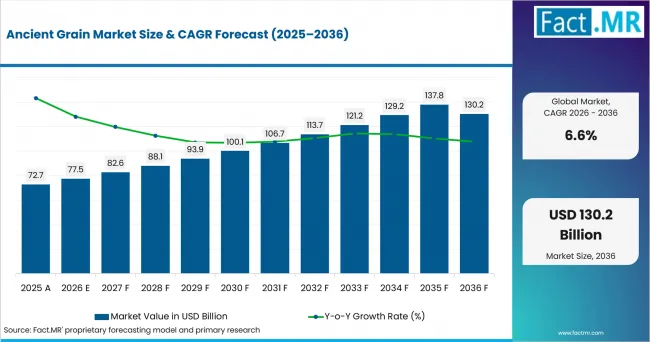
Ancient Grain Market Value Analysis | Source: Fact.MR
What are the defining numbers behind Ancient Grain Market growth?
USD 52.6 billion absolute opportunity is expected between 2026 and 2036.
- Demand Drivers in the Market
- Ancient grain demand is supported by shoppers who associate older grains with simple labels and familiar nutrition claims.
- Food manufacturers use ancient grains when a product needs texture and taste along with a clearer ingredient story.
- Retail access helps packaged products reach daily buyers without depending only on specialty-store discovery.
- Sourcing discipline is important since grain consistency affects taste and repeat purchase after the first trial.
- Key Segments Analyzed
- By Type: Gluten Free Ancient Grain is expected to hold 53.7% share in 2026 since it fits allergen-aware and gluten-free product lines.
- By Application: Bakery and Confectionery Products is projected to account for 30.8% share in 2026 as bakery products create repeat ingredient use.
- Analyst Opinion at Fact.MR
- Shambhu Nath Jha, Senior Consultant at Fact.MR, states, “Buyer decisions in the ancient grain market depend on how well grain type fits the finished product. Suppliers gain preference when they explain texture and processing behavior in simple terms. Supply reliability then becomes the proof point that turns a product idea into repeat orders. The buying discussion is practical because brands need grains that work inside existing recipes.”
- Strategic Implications
- Food brands need to match grain selection with finished-product use instead of treating ancient grains as a broad health label.
- Ingredient suppliers can strengthen proposals by showing how flavor and particle size affect baking or snack performance.
- Retail and foodservice teams benefit from pack formats that make the value clear for repeat purchase and menu use.
The UK records 9.1% CAGR and leads the country set. Canada advances at 7.5%. Australia records 7.3% and the USA records 8.1%. Germany is forecast to expand at 6.2% by 2036.
How does the Ancient Grain Market break down by segment?
How does the Ancient Grain Market break down by segment?
Gluten Free Ancient Grain leads Type with 53.7% share in 2026. Bakery and Confectionery Products leads Application with 30.8% share in 2026.
Why does Gluten Free Ancient Grain lead Type?
Gluten Free Ancient Grain is projected to account for 53.7% share in 2026.
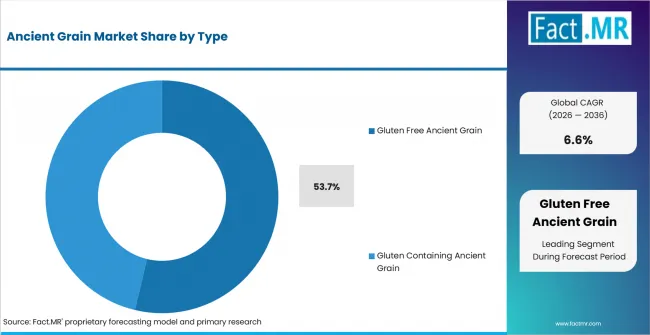
Ancient Grain Market Analysis By Type | Source: Fact.MR
Gluten-free demand gives this type a clear buying route because brands can use the grain identity in allergen-aware products. Gluten Containing Ancient Grain serves food makers that want taste and texture without gluten-free positioning. This split helps suppliers choose whether to sell on claim value or product performance.
Why does Bakery and Confectionery Products lead Application?
Bakery and Confectionery Products is expected to hold 30.8% share in 2026.
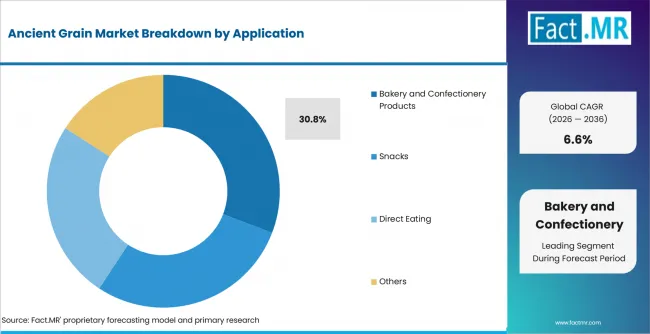
Ancient Grain Market Analysis By Application | Source: Fact.MR
Bakery use creates repeat ordering because flour blends and inclusions are bought across regular production cycles. Snacks and direct eating formats add separate demand when texture and grain identity matter at the point of purchase. Other uses are smaller but can support portfolio breadth for suppliers.
What is accelerating Ancient Grain Market adoption, and what is holding it back?
Demand is expected to rise through better product fit across packaged food and direct eating formats. Growth may be limited by sourcing variability and price pressure. Flavor consistency shapes repeat buying after first product trials. The same restraint affects buyer reviews because a poor first formulation can delay wider product rollout.
Drivers Impact Analysis
| DRIVER | (~) % IMPACT ON CAGR | GEOGRAPHIC RELEVANCE | IMPACT TIMELINE |
|---|---|---|---|
| Gluten-free positioning | +2.2% | UK; USA; Canada | Short term (<= 2 years) |
| Bakery formulation use | +1.7% | Europe; North America | Short term (<= 2 years) |
| Snack and direct eating formats | +1.2% | Australia; USA | Medium term (2-4 years) |
| Retail and online access | +0.9% | Developed retail markets | Medium term (2-4 years) |
| Sourcing consistency | +0.6% | Supplier-driven markets | Long term (>= 4 years) |
Source: Fact.MR analysis. Updated Aug 4, 2026
- Gluten-free positioning: Ancient grains are expected to gain shelf space when brands need recognizable ingredients for allergen-aware product lines.
- Bakery formulation use: Repeated use in breads and sweet baked products is expected to support stable ingredient ordering.
- Retail and online access: Wider store listings and online grocery access are expected to improve product discovery.
Opportunity Impact Analysis
| OPPORTUNITY | (~) % IMPACT ON CAGR | GEOGRAPHIC RELEVANCE | IMPACT TIMELINE |
|---|---|---|---|
| Clean-label packaged food | +1.4% | UK; USA; Canada | Short term (<= 2 years) |
| Plant-based ingredient positioning | +1.1% | Europe; North America | Medium term (2-4 years) |
| Premium snack formats | +0.8% | Australia; USA | Medium term (2-4 years) |
| Foodservice menu use | +0.5% | Urban retail and restaurant clusters | Long term (>= 4 years) |
Source: Fact.MR analysis. Updated Aug 4, 2026
- Clean-label packaged foods: Suppliers can position ancient grains around simple labels when buyers want a clear product story.
- Plant-based ingredient claims: Ancient grains can support plant-based positioning when brands want grain identity over synthetic-sounding language.
- Premium snack formats: Product developers are expected to use ancient grains in snack formats where texture supports premium pricing.
Restraints Impact Analysis
| RESTRAINT | (~) % IMPACT ON CAGR | GEOGRAPHIC RELEVANCE | IMPACT TIMELINE |
|---|---|---|---|
| Input price variability | -1.2% | Global sourcing routes | Short term (<= 2 years) |
| Taste and texture adjustment | -0.9% | Bakery and snack producers | Short term (<= 2 years) |
| Labeling and compliance variation | -0.7% | Export-oriented suppliers | Medium term (2-4 years) |
| Limited mainstream switching | -0.5% | Price-sensitive applications | Long term (>= 4 years) |
Source: Fact.MR analysis. Updated Aug 4, 2026
- Input price variability: Ancient grain costs can move with harvest quality and supply availability. This makes margin planning harder for packaged food producers.
- Taste and texture adjustment: Formulators may need trial work before ancient grains match the mouthfeel expected in mainstream bakery products.
- Labeling and compliance variation: Suppliers entering several markets must adjust documentation when ingredient or allergen rules differ.
Which countries are scaling Ancient Grain Market fastest?
- The country comparison spans 2.9 percentage points and forms three practical growth bands across the forecast period.
- The UK leads the country set at 9.1% CAGR through retail product breadth and better-for-you positioning.
- Canada records 7.5% CAGR as bakery and snack makers compare grain claims with sourcing reliability.
- Australia reaches 7.3% CAGR with packaged food experimentation and retail shelf discovery shaping trial.
- The USA records 8.1% CAGR as gluten-free product lines and broad packaged food use support adoption.
- Germany reaches 6.2% CAGR through mature bakery demand and careful review of formulation fit.
Comparable CAGRs can create different entry conditions due to price tolerance and channel structure. Full report coverage includes North America and Latin America. Europe and East Asia are part of coverage. South Asia and Pacific and Middle East and Africa complete the regional scope.
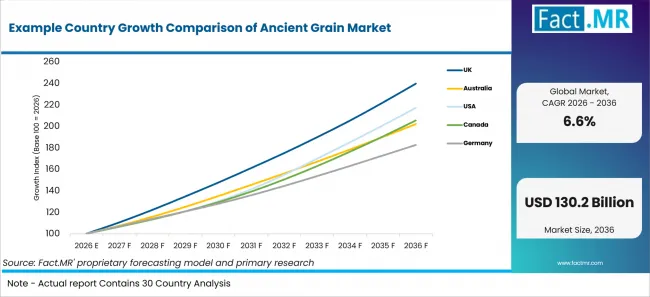
Example Country Growth Comparison Of Ancient Grain Market | Source: Fact.MR
| Country | CAGR (2026-2036) |
|---|---|
| UK | 9.1% |
| Canada | 7.5% |
| Australia | 7.3% |
| USA | 8.1% |
| Germany | 6.2% |
Source: Fact.MR analysis. Updated Aug 4, 2026
What is driving the UK's growth through 2036?
9.1% CAGR, supported by retail product breadth and better-for-you positioning.
UK growth is shaped by shoppers who compare grain claims across bread and breakfast products. This buying behavior gives ancient grains a path through familiar supermarket categories. Suppliers must keep preparation simple so that the product feels easy to use beyond specialty diets. Pack clarity and retailer education can help convert trial into routine purchase.
What is driving Canada's growth through 2036?
7.5% CAGR, backed by bakery application fit and ingredient familiarity.
Canada advances faster than the global rate because bakery and snack producers can test ancient grains without changing the full product concept. The market rewards clear sourcing language and steady quality. Brands are expected to widen orders only after ingredient consistency protects taste and margin. Supplier review is therefore centered on performance in the finished product.
How is Australia scaling demand?
7.3% CAGR, driven by channel expansion and packaged food experimentation.
Australia’s route to demand is centered on products that explain use quickly on the shelf. Retail visibility matters because trial often starts with packaged foods. Suppliers that support simple formulation work are better placed when brands test bars and baked snacks. Clear taste cues can reduce hesitation among first-time buyers.
What supports USA adoption?
8.1% CAGR, supported by gluten-free positioning and broad packaged food use.
USA adoption is supported by a wide packaged food base that can use ancient grains in bakery items and snacks. Buyers compare label value with ingredient cost before they approve broader sourcing. Larger brands may need scale proof before ancient grains move into regular production. Supplier depth becomes important when a product moves from trial to national listing.
How does Germany perform?
6.2% CAGR, led by mature food demand and careful supplier review.
Germany’s forecast pace is close to the global rate because buyers review taste and processing performance carefully. Established bakery habits make switching slower when price or mouthfeel creates risk. Suppliers that provide quality proof can improve access to product development teams. This creates a measured route to adoption instead of a quick shift.
Who leads the Ancient Grain Market?
Saco Foods, LLC (Ancient Harvest) and Ardent Mills show the direct relevance in the assessed company set. Kamut International Ltd. and ADM strengthen the wider food ingredients and grain supply landscape.
Saco Foods, LLC (Ancient Harvest) supports the field through established consumer food exposure. Ardent Mills contributes grain milling and ingredient capability. Kamut International Ltd. and ADM add scale across agricultural sourcing and food ingredients. Healthy Food Ingredients LLC gives the provider set a closer fit with specialty grain supply. The competitive question is not company size alone. Buyers need proof that supply quality can hold across repeat orders.
Which companies are the key providers?
Key companies include Saco Foods, LLC (Ancient Harvest); Ardent Mills; Kamut International Ltd.; ADM; Healthy Food Ingredients LLC; Nature's Path; Sunnyland Mills; Manini's; Wehah Farm, Inc. d/b/a Lundberg Family Farms; Bob's Red Mill; Scoular; Nature Bio Foods; Terra Ingredients; Grand Teton Ancient Grains; Forest Whole Foods; Shanxi Jiaqi Quinoa Development Co., Ltd.; Qinghai Sanjiang Wotu.
- Saco Foods, LLC (Ancient Harvest)
- Ardent Mills
- Kamut International Ltd.
- ADM
- Healthy Food Ingredients LLC
- Nature's Path
- Sunnyland Mills
- Manini's
- Wehah Farm, Inc. d/b/a Lundberg Family Farms
- Bob's Red Mill
- Scoular
- Nature Bio Foods
- Terra Ingredients
- Grand Teton Ancient Grains
- Forest Whole Foods
- Shanxi Jiaqi Quinoa Development Co., Ltd.
- Qinghai Sanjiang Wotu
Bibliography
- U.S. Food and Drug Administration. (2025, January). Guidance for industry: Questions and answers regarding food allergen labeling (Edition 5).
- U.S. Food and Drug Administration. (2025, January 6). FDA releases allergen, food safety, and plant-based alternative labeling guidances.
- National Agricultural Statistics Service. (2026, January). Crop production 2025 summary. U.S. Department of Agriculture.
This Report Answers
- The report provides strategic intelligence on the Ancient Grain Market across Type and Application choices that shape product development and sourcing decisions.
- Segment analysis covers Gluten Free Ancient Grain and Bakery and Confectionery Products as the share leaders within the 2026 market.
- Country outlook evaluates the UK and Canada alongside Australia and the USA. Germany completes the growth comparison across the profiled markets.
- Competitive analysis profiles Saco Foods, LLC (Ancient Harvest) and Ardent Mills alongside Kamut International Ltd. and ADM. Healthy Food Ingredients LLC adds specialty grain relevance.
- Channel assessment covers retail and foodservice menus. Online grocery access shapes how ancient grain products move from trial into repeat buying.
What does the Ancient Grain Market cover?
Ancient grain products are used across type and application categories when product fit determines buying decisions.
The Ancient Grain Market covers products and related offerings based on ancient grain use in gluten-free and gluten-containing formats. Coverage extends to bakery and confectionery products. Snacks and direct eating formats are included when grain identity affects product choice.
What is included in the scope?
Ancient grain products are included when they are sold or used within the defined Type and Application categories.
The scope includes Gluten Free Ancient Grain and Gluten Containing Ancient Grain. It covers Bakery and Confectionery Products along with Snacks and Direct Eating. Regional coverage follows the listed country and regional structure.
How Was the Analysis Built?
The analysis draws on structured desk review and company portfolio mapping. Country comparison and demand-side checks cover major regions. The method is built to test whether product fit can turn into repeat buying.
- Primary Research: Primary research includes discussions with buyers and suppliers. The discussion covers distributors and product developers. Procurement teams and subject-matter experts add buying context. These conversations examine purchase priorities and product adoption. The review covers operating limits and approval needs.
- Desk Research: Desk research covers public regulatory material and company literature. Product information and trade context support the market boundary review. Every source used for publication must be verified before it is retained in the bibliography. Source review is separated from market sizing to reduce weak evidence carryover.
- Market Sizing and Forecasting: Market estimates combine historical performance and demand indicators. Segment shares and company participation are reconciled with country-level growth. Adoption patterns and barriers are reviewed before the forecast is finalized. This step protects the forecast from relying on a single demand signal.
- Data Validation and Update Cycle: Findings are validated by comparing demand signals with company activity. Product launches and sourcing changes are reviewed during updates. Channel shifts and regional adoption patterns are checked when they affect pricing or availability. This cycle keeps the market view aligned with practical buying behavior.
Segmentation
What is the report’s scope and coverage?
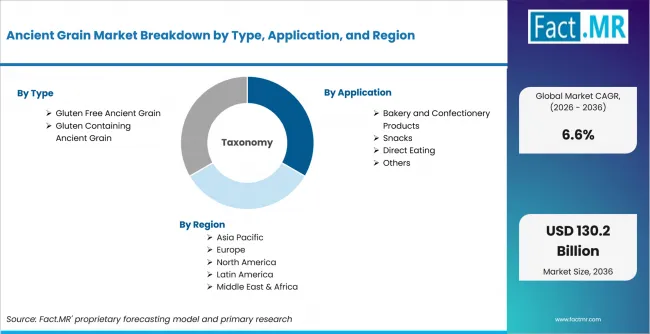
Ancient Grain Market Breakdown By Type, Application, And Region | Source: Fact.MR
| Attribute | Details |
|---|---|
| Quantitative Units | USD billion in 2026 to USD billion by 2036 at CAGR |
| Market Definition | Ancient grain products and related offerings across the assessed Type, Application, and Region categories |
| Type | Gluten Free Ancient Grain; Gluten Containing Ancient Grain |
| Application | Bakery and Confectionery Products; Snacks; Direct Eating; Others |
| Regions Covered | North America; Latin America; Europe; East Asia; South Asia and Pacific; Middle East and Africa |
| Countries Covered | UK; Canada; Australia; USA; Germany |
| Key Companies Profiled | Saco Foods, LLC (Ancient Harvest); Ardent Mills; Kamut International Ltd.; ADM; Healthy Food Ingredients LLC; Nature's Path; Sunnyland Mills; Manini's; Wehah Farm, Inc. d/b/a Lundberg Family Farms; Bob's Red Mill; Scoular; Nature Bio Foods; Terra Ingredients; Grand Teton Ancient Grains; Forest Whole Foods; Shanxi Jiaqi Quinoa Development Co., Ltd.; Qinghai Sanjiang Wotu |
| Forecast Period | 2026 to 2036 |
| Approach | Hybrid top-down and bottom-up approach using product type demand; application fit; bakery and snack use; direct eating patterns; regional distribution; sourcing consistency; supplier participation; country adoption patterns and company portfolio review |
Source: Fact.MR analysis. Updated Aug 4, 2026
How is the market segmented?
-
By Type
- Gluten Free Ancient Grain
- Gluten Containing Ancient Grain
-
By Application
- Bakery and Confectionery Products
- Snacks
- Direct Eating
- Others
-
By Region
- North America
- Latin America
- Europe
- East Asia
- South Asia and Oceania
- Middle East and Africa
Frequently Asked Questions
Which type leads the Ancient Grain Market?
Which application leads the market?
Which country records the fastest growth?
Which companies are included in the market assessment?
What is the primary driver in this market?
What is the main restraint?
Who worked on this report


Preview the report firsthand - request a free sample
Free SampleGet the brochure for pricing and purchase details
Download PDF