Anti-Static PCR Resin Solutions for Cleanroom Manufacturing Market
Anti-Static PCR Resin Solutions for Cleanroom Manufacturing Market Size and Share Forecast Outlook 2026 to 2036
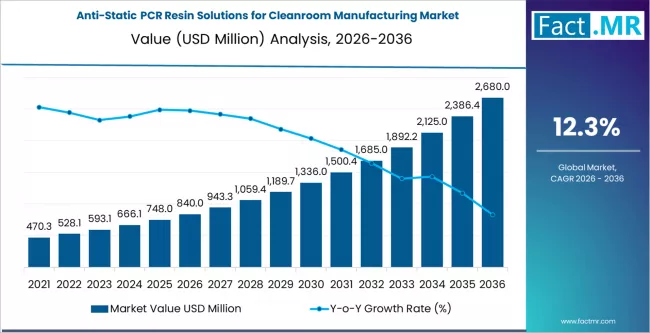
Anti-static pcr resin solutions for cleanroom manufacturing market is projected to grow from USD 840.0 million in 2026 to USD 2,680.0 million by 2036, at a CAGR of 12.3%. Semiconductor or medical cleanrooms will dominate with a 45.0% market share, while permanent anti-static resins will lead the resin solution segment with a 41.0% share.
Anti-Static PCR Resin Solutions for Cleanroom Manufacturing Market Forecast and Outlook 2026 to 2036
The anti-static PCR resin solutions for cleanroom manufacturing market is likely to be valued at USD 840 million in 2026 and is expected to reach USD 2.68 billion by 2036, growing at a CAGR of 12.3%. Demand in this market is characterized by high stability and repeat usage, driven by the ongoing need for cleanroom environments across industries like semiconductors, pharmaceuticals, and biotechnology.
Key Takeaways from Anti-Static PCR Resin Solutions for Cleanroom Manufacturing Market
- Anti-Static PCR Resin Solutions for Cleanroom Manufacturing Market Value (2026): USD 840 million
- Anti-Static PCR Resin Solutions for Cleanroom Manufacturing Market Forecast Value (2036): USD 2,680 million
- Anti-Static PCR Resin Solutions for Cleanroom Manufacturing Market Forecast CAGR 2026 to 2036: 12.3%
- Leading Segment in Anti-Static PCR Resin Solutions for Cleanroom Manufacturing Market: PCR-ABS or PCR-PC (55%)
- Key Growth Region in Anti-Static PCR Resin Solutions for Cleanroom Manufacturing Market: Asia Pacific
- Key Players in Anti-Static PCR Resin Solutions for Cleanroom Manufacturing Market: SABIC, Avient, Toray, Kingfa, BASF, Celanese, Asahi Kasei
Unlike volatile, short-term demand spikes, buyers tend to commit to long-term procurement agreements, reflecting a strong focus on reliability and material performance over time. The consistency of buyer commitment indicates a preference for established suppliers who can ensure compliance with stringent cleanroom standards and provide assurance in product quality.
This quality-driven demand reflects an industry more focused on long-term operational reliability and consistent material characteristics, rather than one reliant on fluctuating market conditions or speculative growth.
Anti-Static PCR Resin Solutions for Cleanroom Manufacturing Market
| Metric | Value |
|---|---|
| Estimated Value in (2026E) | USD 840 million |
| Forecast Value in (2036F) | USD 2,680 million |
| Forecast CAGR (2026 to 2036) | 12.3% |
Category
| Category | Segments |
|---|---|
| End-Use | Semiconductor & medical cleanrooms; Pharma & electronics manufacturing; Precision cleanrooms; Electronics fabs; Display fabs; Pharma manufacturing |
| Resin Solution | Permanent anti-static resins; ESD-safe compounds; Low-outgassing resins; Anti-static ABS; Others |
| Polymer Type | PCR-ABS / PCR-PC; PCR engineering plastics; PCR-PC; PCR-ABS; Others |
| Technology | Controlled surface resistivity compounding; Carbon-based conductive systems; Ultra-low particulate control; Cost-efficient ESD systems; Others |
| Region | North America; Europe; Asia Pacific; Latin America; Middle East & Africa |
Segmental Analysis
What Is the Impact of Polymer Type on the Anti-Static PCR Resin Solutions for Cleanroom Manufacturing Market?
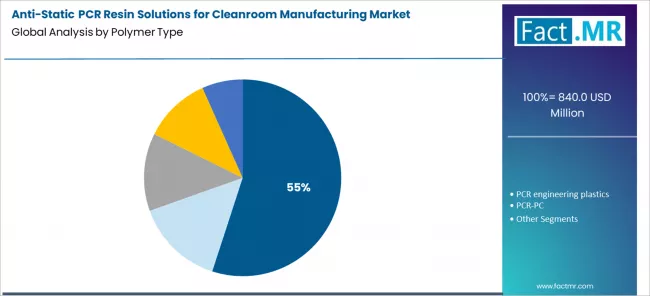
In the anti-static PCR resin solutions for cleanroom manufacturing market, polymer type is essential in determining the material's suitability for various cleanroom applications. PCR-ABS or PCR-PC leads the market with a 55% share, providing a strong combination of durability, chemical resistance, and static dissipation properties. These polymers are commonly used in cleanrooms where electrostatic control is crucial, such as in semiconductor and medical device manufacturing. As the need for reliable and eco-friendly materials in cleanroom environments continues to grow, PCR-ABS and PCR-PC are expected to maintain their dominant position, offering both performance and sustainability.
How Does End-Use Influence the Anti-Static PCR Resin Solutions for Cleanroom Manufacturing Market?
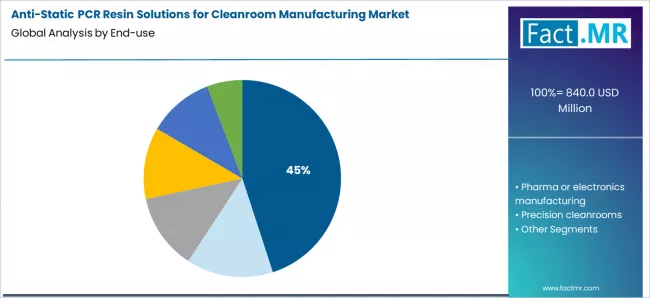
End-use plays a significant role in shaping the demand for anti-static PCR resin solutions, with semiconductor or medical cleanrooms holding a 45% share. Cleanrooms in these sectors require stringent control over particulate contamination and electrostatic discharge, making anti-static resins a key component in their operations. As industries like semiconductors, pharmaceuticals, and electronics seek to enhance production environments, the demand for anti-static PCR resins will grow, ensuring that cleanroom materials meet the highest standards of safety and performance. The expanding need for precision in manufacturing and assembly processes will continue to drive the adoption of these specialized resin solutions.
What are the Principal Drivers, Constraints, and Evolving Dynamics of the AntiStatic PCR Resin Solutions for Cleanroom Manufacturing Market?
Demand for antistatic postconsumer recycled (PCR) resin solutions has been influenced by requirements for particulate control in cleanroom environments. Manufacturers of medical devices, semiconductors, and precision instruments seek materials that resist static buildup while meeting recycled content expectations. Standards for electrostatic discharge performance have guided specifications for PCR resin grades used in trays, containers, and noncritical components.
Variability in PCR feedstock properties has affected consistency of anti static performance. Some formulations have required additional processing to achieve target surface resistivity.
Limited availability of validated material grades has constrained adoption in highly regulated cleanroom sectors. Work on establishing test methods and characterizing long term stability of anti static PCR resins is underway. Partnerships among resin suppliers, recyclers, and cleanroom manufacturers aim to expand usable material options and define application criteria.
Analysis of the Anti-Static PCR Resin Solutions for Cleanroom Manufacturing Market by Key Country
| Country | CAGR (2026-2036) |
|---|---|
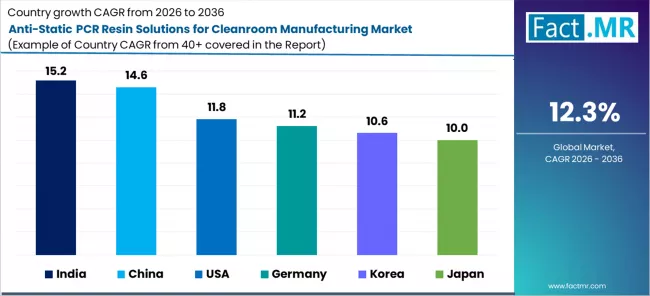
| Germany | 11.2% |
| USA | 11.8% |
| Japan | 10% |
| China | 14.6% |
| Korea | 10.6% |
| India | 15.2% |
The report covers an in-depth analysis of 40+ countries; top-performing countries are highlighted below.
What is the Growth Outlook for Anti-Static PCR Resin Solutions in Germany?
Germany’s anti-static PCR resin solutions for cleanroom manufacturing market is projected to grow at a CAGR of 11.2% from 2026 to 2036. As Germany remains a leader in precision manufacturing, particularly in industries such as pharmaceuticals, biotechnology, and electronics, the demand for cleanroom-compatible materials, including anti-static PCR resins, is increasing. With the country’s ongoing commitment to sustainability and efficient resource management, the adoption of PCR resins is expected to rise. The focus on high-performance materials and stricter industry regulations will support the steady growth of this market.
How is the Anti-Static PCR Resin Solutions Market Performing in the USA?
The USA’s anti-static PCR resin solutions for cleanroom manufacturing market is expected to grow at a CAGR of 11.8% from 2026 to 2036. The USA’s advanced cleanroom manufacturing sector, particularly in the pharmaceutical and semiconductor industries, is driving the demand for materials that ensure both environmental sustainability and operational safety. Anti-static PCR resins are increasingly preferred in cleanroom environments due to their ability to reduce static buildup while maintaining eco-friendly standards. The USA’s regulatory environment and industry innovations in sustainability will continue to support market expansion.
What is the Market Outlook for Anti-Static PCR Resin Solutions in Japan?
Japan’s anti-static PCR resin solutions for cleanroom manufacturing market is forecast to grow at a CAGR of 10% from 2026 to 2036. Japan’s robust cleanroom manufacturing industry, particularly in electronics and healthcare sectors, creates a steady demand for high-performance, sustainable materials. Anti-static PCR resins offer the necessary properties to meet strict cleanroom standards, and their adoption is expected to rise as the demand for eco-friendly materials grows. Japan’s technological advancements and strong focus on sustainability will contribute to continued market growth, albeit at a slower rate compared to other regions.
What is the Growth Potential for Anti-Static PCR Resin Solutions in China?
China is expected to see significant growth in the anti-static PCR resin solutions for cleanroom manufacturing market, with a projected CAGR of 14.6% from 2026 to 2036. As China continues to expand its cleanroom manufacturing capabilities, particularly in the electronics and pharmaceutical industries, the demand for anti-static PCR resins is rising. The country’s rapid industrialization and focus on green manufacturing are driving the adoption of sustainable materials in cleanroom environments. With government support for green technologies and increased industry standards for safety and sustainability, China’s market is set for substantial expansion.
What is the Demand for Anti-Static PCR Resin Solutions in Korea?
Korea’s anti-static PCR resin solutions for cleanroom manufacturing market is forecast to grow at a CAGR of 10.6% from 2026 to 2036. Korea’s cleanroom manufacturing sector, especially in the semiconductor and biotechnology industries, is increasingly adopting eco-friendly materials to meet industry safety and sustainability requirements. Anti-static PCR resins, which help maintain strict cleanroom conditions, are well-suited for these industries. The market growth will be supported by Korea’s technological advancements and regulatory pressures for more sustainable manufacturing processes, contributing to steady demand for anti-static PCR resins.
What is the Market Expansion Outlook for Anti-Static PCR Resin Solutions in India?
India’s anti-static PCR resin solutions for cleanroom manufacturing market is set to grow at a robust CAGR of 15.2% from 2026 to 2036. The country’s cleanroom manufacturing sector is expanding, driven by growth in industries such as pharmaceuticals, biotechnology, and electronics. As India increasingly prioritizes sustainability in its manufacturing processes, anti-static PCR resins are gaining traction due to their eco-friendly properties and their effectiveness in cleanroom environments. With a growing focus on environmental compliance and operational safety, India’s market for anti-static PCR resins is poised for strong growth.
How is Competition Structured in the AntiStatic PCR Resin Solutions for Cleanroom Manufacturing Market?
Competition in this market is guided by resin performance, static dissipative properties, and compliance with cleanroom standards. SABIC and BASF focus on broad resin platforms that integrate post consumer recycled (PCR) content with reliable anti static performance. These firms support technical documentation and cleanroom qualification data for regulated environments. Avient and Toray compete with tailored masterbatch and compound solutions that balance static control and processing ease for precision manufacturing.
Kingfa and Celanese emphasize engineered polymers designed for consistent conductivity and minimal particle generation. Asahi Kasei positions its offerings through specialized resin systems that align with stringent manufacturing protocols. Differentiation arises from proprietary additive packages, verified surface resistivity ranges, and the ability to meet industry specific cleanliness requirements. Buyers evaluate suppliers based on material data, compatibility with cleanroom classes, and supply continuity.
Key Players in the AntiStatic PCR Resin Solutions for Cleanroom Manufacturing Market
- SABIC
- Avient
- Toray
- Kingfa
- BASF
- Celanese
- Asahi Kasei
Scope of the Report
| Items | Values |
|---|---|
| Quantitative Units (2026) | USD Million |
| End-use | Semiconductor & medical cleanrooms, Pharma & electronics manufacturing, Precision cleanrooms, Electronics fabs, Display fabs, Pharma manufacturing |
| Resin Solution | Permanent anti-static resins, ESD-safe compounds, Low-outgassing resins, Anti-static ABS, Others |
| Polymer Type | PCR-ABS / PCR-PC, PCR engineering plastics, PCR-PC, PCR-ABS, Others |
| Technology | Controlled surface resistivity compounding, Carbon-based conductive systems, Ultra-low particulate control, Cost-efficient ESD systems, Others |
| Regions Covered | North America, Europe, Asia Pacific, Latin America, Middle East & Africa |
| Countries Covered | United States, Canada, Mexico, Brazil, Germany, United Kingdom, France, Italy, Spain, China, Japan, South Korea, India, Australia & New Zealand |
| Key Companies Profiled | SABIC, Avient, Toray, Kingfa, BASF, Celanese, Asahi Kasei |
| Additional Attributes | Dollar revenue by end-use, resin solution, polymer type, and technology; regional demand trends, competitive landscape, technological advancements in anti-static PCR resin solutions for cleanrooms, and innovations in ESD-safe systems |
Anti-Static PCR Resin Solutions for Cleanroom Manufacturing Market Key Segments
-
End-use :
- Semiconductor & medical cleanrooms
- Pharma & electronics manufacturing
- Precision cleanrooms
- Electronics fabs
- Display fabs
- Pharma manufacturing
-
Resin Solution :
- Permanent anti-static resins
- ESD-safe compounds
- Low-outgassing resins
- Anti-static ABS
- Others
-
Polymer Type :
- PCR-ABS / PCR-PC
- PCR engineering plastics
- PCR-PC
- PCR-ABS
- Others
-
Technology :
- Controlled surface resistivity compounding
- Carbon-based conductive systems
- Ultra-low particulate control
- Cost-efficient ESD systems
- Others
-
Region :
- North America
- USA
- Canada
- Mexico
- Europe
- Germany
- UK
- France
- Italy
- Spain
- Nordic Countries
- BENELUX
- Rest of Europe
- Asia Pacific
- China
- Japan
- South Korea
- India
- Australia
- Rest of Asia Pacific
- Latin America
- Brazil
- Argentina
- Rest of Latin America
- Middle East and Africa
- Kingdom of Saudi Arabia
- United Arab Emirates
- South Africa
- Rest of Middle East and Africa
- Other Regions
- Oceania
- Central Asia
- Other Markets
- North America
Bibliographies
- International Organization for Standardization. (2023). ISO 14644-1: Cleanrooms and associated controlled environments-Classification of air cleanliness by particle concentration. ISO.
- International Electrotechnical Commission. (2023). IEC 61340: Electrostatics-Methods of test and requirements for materials and products used in ESD-controlled areas. IEC.
- European Commission. (2024). Good manufacturing practice (GMP) requirements for cleanroom materials and electrostatic control in pharmaceutical and medical device production. European Union Publications.
- United Nations Industrial Development Organization. (2023). Clean manufacturing systems: Materials selection, contamination control, and circular polymer use in high-precision industries. UNIDO.
Table of Content
- Executive Summary
- Global Market Outlook
- Demand to side Trends
- Supply to side Trends
- Technology Roadmap Analysis
- Analysis and Recommendations
- Market Overview
- Market Coverage / Taxonomy
- Market Definition / Scope / Limitations
- Market Background
- Market Dynamics
- Drivers
- Restraints
- Opportunity
- Trends
- Scenario Forecast
- Demand in Optimistic Scenario
- Demand in Likely Scenario
- Demand in Conservative Scenario
- Opportunity Map Analysis
- Product Life Cycle Analysis
- Supply Chain Analysis
- Investment Feasibility Matrix
- Value Chain Analysis
- PESTLE and Porter’s Analysis
- Regulatory Landscape
- Regional Parent Market Outlook
- Production and Consumption Statistics
- Import and Export Statistics
- Market Dynamics
- Global Market Analysis 2021 to 2025 and Forecast, 2026 to 2036
- Historical Market Size Value (USD Million) Analysis, 2021 to 2025
- Current and Future Market Size Value (USD Million) Projections, 2026 to 2036
- Y to o to Y Growth Trend Analysis
- Absolute $ Opportunity Analysis
- Global Market Pricing Analysis 2021 to 2025 and Forecast 2026 to 2036
- Global Market Analysis 2021 to 2025 and Forecast 2026 to 2036, By End-use
- Introduction / Key Findings
- Historical Market Size Value (USD Million) Analysis By End-use, 2021 to 2025
- Current and Future Market Size Value (USD Million) Analysis and Forecast By End-use, 2026 to 2036
- Semiconductor or medical cleanrooms
- Pharma or electronics manufacturing
- Precision cleanrooms
- Electronics fabs
- Display fabs
- Pharma manufacturing
- Semiconductor or medical cleanrooms
- Y to o to Y Growth Trend Analysis By End-use, 2021 to 2025
- Absolute $ Opportunity Analysis By End-use, 2026 to 2036
- Global Market Analysis 2021 to 2025 and Forecast 2026 to 2036, By Resin Solution
- Introduction / Key Findings
- Historical Market Size Value (USD Million) Analysis By Resin Solution, 2021 to 2025
- Current and Future Market Size Value (USD Million) Analysis and Forecast By Resin Solution, 2026 to 2036
- Permanent anti-static resins
- ESD-safe compounds
- Low-outgassing resins
- Anti-static ABS
- Others
- Permanent anti-static resins
- Y to o to Y Growth Trend Analysis By Resin Solution, 2021 to 2025
- Absolute $ Opportunity Analysis By Resin Solution, 2026 to 2036
- Global Market Analysis 2021 to 2025 and Forecast 2026 to 2036, By Polymer Type
- Introduction / Key Findings
- Historical Market Size Value (USD Million) Analysis By Polymer Type, 2021 to 2025
- Current and Future Market Size Value (USD Million) Analysis and Forecast By Polymer Type, 2026 to 2036
- PCR-ABS or PCR-PC
- PCR engineering plastics
- PCR-PC
- PCR-ABS
- Others
- PCR-ABS or PCR-PC
- Y to o to Y Growth Trend Analysis By Polymer Type, 2021 to 2025
- Absolute $ Opportunity Analysis By Polymer Type, 2026 to 2036
- Global Market Analysis 2021 to 2025 and Forecast 2026 to 2036, By Technology
- Introduction / Key Findings
- Historical Market Size Value (USD Million) Analysis By Technology, 2021 to 2025
- Current and Future Market Size Value (USD Million) Analysis and Forecast By Technology, 2026 to 2036
- Controlled surface resistivity compounding
- Carbon-based conductive systems
- Ultra-low particulate control
- Cost-efficient ESD systems
- Others
- Controlled surface resistivity compounding
- Y to o to Y Growth Trend Analysis By Technology, 2021 to 2025
- Absolute $ Opportunity Analysis By Technology, 2026 to 2036
- Global Market Analysis 2021 to 2025 and Forecast 2026 to 2036, By Region
- Introduction
- Historical Market Size Value (USD Million) Analysis By Region, 2021 to 2025
- Current Market Size Value (USD Million) Analysis and Forecast By Region, 2026 to 2036
- North America
- Latin America
- Western Europe
- Eastern Europe
- East Asia
- South Asia and Pacific
- Middle East & Africa
- Market Attractiveness Analysis By Region
- North America Market Analysis 2021 to 2025 and Forecast 2026 to 2036, By Country
- Historical Market Size Value (USD Million) Trend Analysis By Market Taxonomy, 2021 to 2025
- Market Size Value (USD Million) Forecast By Market Taxonomy, 2026 to 2036
- By Country
- USA
- Canada
- Mexico
- By End-use
- By Resin Solution
- By Polymer Type
- By Technology
- By Country
- Market Attractiveness Analysis
- By Country
- By End-use
- By Resin Solution
- By Polymer Type
- By Technology
- Key Takeaways
- Latin America Market Analysis 2021 to 2025 and Forecast 2026 to 2036, By Country
- Historical Market Size Value (USD Million) Trend Analysis By Market Taxonomy, 2021 to 2025
- Market Size Value (USD Million) Forecast By Market Taxonomy, 2026 to 2036
- By Country
- Brazil
- Chile
- Rest of Latin America
- By End-use
- By Resin Solution
- By Polymer Type
- By Technology
- By Country
- Market Attractiveness Analysis
- By Country
- By End-use
- By Resin Solution
- By Polymer Type
- By Technology
- Key Takeaways
- Western Europe Market Analysis 2021 to 2025 and Forecast 2026 to 2036, By Country
- Historical Market Size Value (USD Million) Trend Analysis By Market Taxonomy, 2021 to 2025
- Market Size Value (USD Million) Forecast By Market Taxonomy, 2026 to 2036
- By Country
- Germany
- UK
- Italy
- Spain
- France
- Nordic
- BENELUX
- Rest of Western Europe
- By End-use
- By Resin Solution
- By Polymer Type
- By Technology
- By Country
- Market Attractiveness Analysis
- By Country
- By End-use
- By Resin Solution
- By Polymer Type
- By Technology
- Key Takeaways
- Eastern Europe Market Analysis 2021 to 2025 and Forecast 2026 to 2036, By Country
- Historical Market Size Value (USD Million) Trend Analysis By Market Taxonomy, 2021 to 2025
- Market Size Value (USD Million) Forecast By Market Taxonomy, 2026 to 2036
- By Country
- Russia
- Poland
- Hungary
- Balkan & Baltic
- Rest of Eastern Europe
- By End-use
- By Resin Solution
- By Polymer Type
- By Technology
- By Country
- Market Attractiveness Analysis
- By Country
- By End-use
- By Resin Solution
- By Polymer Type
- By Technology
- Key Takeaways
- East Asia Market Analysis 2021 to 2025 and Forecast 2026 to 2036, By Country
- Historical Market Size Value (USD Million) Trend Analysis By Market Taxonomy, 2021 to 2025
- Market Size Value (USD Million) Forecast By Market Taxonomy, 2026 to 2036
- By Country
- China
- Japan
- South Korea
- By End-use
- By Resin Solution
- By Polymer Type
- By Technology
- By Country
- Market Attractiveness Analysis
- By Country
- By End-use
- By Resin Solution
- By Polymer Type
- By Technology
- Key Takeaways
- South Asia and Pacific Market Analysis 2021 to 2025 and Forecast 2026 to 2036, By Country
- Historical Market Size Value (USD Million) Trend Analysis By Market Taxonomy, 2021 to 2025
- Market Size Value (USD Million) Forecast By Market Taxonomy, 2026 to 2036
- By Country
- India
- ASEAN
- Australia & New Zealand
- Rest of South Asia and Pacific
- By End-use
- By Resin Solution
- By Polymer Type
- By Technology
- By Country
- Market Attractiveness Analysis
- By Country
- By End-use
- By Resin Solution
- By Polymer Type
- By Technology
- Key Takeaways
- Middle East & Africa Market Analysis 2021 to 2025 and Forecast 2026 to 2036, By Country
- Historical Market Size Value (USD Million) Trend Analysis By Market Taxonomy, 2021 to 2025
- Market Size Value (USD Million) Forecast By Market Taxonomy, 2026 to 2036
- By Country
- Kingdom of Saudi Arabia
- Other GCC Countries
- Turkiye
- South Africa
- Other African Union
- Rest of Middle East & Africa
- By End-use
- By Resin Solution
- By Polymer Type
- By Technology
- By Country
- Market Attractiveness Analysis
- By Country
- By End-use
- By Resin Solution
- By Polymer Type
- By Technology
- Key Takeaways
- Key Countries Market Analysis
- USA
- Pricing Analysis
- Market Share Analysis, 2025
- By End-use
- By Resin Solution
- By Polymer Type
- By Technology
- Canada
- Pricing Analysis
- Market Share Analysis, 2025
- By End-use
- By Resin Solution
- By Polymer Type
- By Technology
- Mexico
- Pricing Analysis
- Market Share Analysis, 2025
- By End-use
- By Resin Solution
- By Polymer Type
- By Technology
- Brazil
- Pricing Analysis
- Market Share Analysis, 2025
- By End-use
- By Resin Solution
- By Polymer Type
- By Technology
- Chile
- Pricing Analysis
- Market Share Analysis, 2025
- By End-use
- By Resin Solution
- By Polymer Type
- By Technology
- Germany
- Pricing Analysis
- Market Share Analysis, 2025
- By End-use
- By Resin Solution
- By Polymer Type
- By Technology
- UK
- Pricing Analysis
- Market Share Analysis, 2025
- By End-use
- By Resin Solution
- By Polymer Type
- By Technology
- Italy
- Pricing Analysis
- Market Share Analysis, 2025
- By End-use
- By Resin Solution
- By Polymer Type
- By Technology
- Spain
- Pricing Analysis
- Market Share Analysis, 2025
- By End-use
- By Resin Solution
- By Polymer Type
- By Technology
- France
- Pricing Analysis
- Market Share Analysis, 2025
- By End-use
- By Resin Solution
- By Polymer Type
- By Technology
- India
- Pricing Analysis
- Market Share Analysis, 2025
- By End-use
- By Resin Solution
- By Polymer Type
- By Technology
- ASEAN
- Pricing Analysis
- Market Share Analysis, 2025
- By End-use
- By Resin Solution
- By Polymer Type
- By Technology
- Australia & New Zealand
- Pricing Analysis
- Market Share Analysis, 2025
- By End-use
- By Resin Solution
- By Polymer Type
- By Technology
- China
- Pricing Analysis
- Market Share Analysis, 2025
- By End-use
- By Resin Solution
- By Polymer Type
- By Technology
- Japan
- Pricing Analysis
- Market Share Analysis, 2025
- By End-use
- By Resin Solution
- By Polymer Type
- By Technology
- South Korea
- Pricing Analysis
- Market Share Analysis, 2025
- By End-use
- By Resin Solution
- By Polymer Type
- By Technology
- Russia
- Pricing Analysis
- Market Share Analysis, 2025
- By End-use
- By Resin Solution
- By Polymer Type
- By Technology
- Poland
- Pricing Analysis
- Market Share Analysis, 2025
- By End-use
- By Resin Solution
- By Polymer Type
- By Technology
- Hungary
- Pricing Analysis
- Market Share Analysis, 2025
- By End-use
- By Resin Solution
- By Polymer Type
- By Technology
- Kingdom of Saudi Arabia
- Pricing Analysis
- Market Share Analysis, 2025
- By End-use
- By Resin Solution
- By Polymer Type
- By Technology
- Turkiye
- Pricing Analysis
- Market Share Analysis, 2025
- By End-use
- By Resin Solution
- By Polymer Type
- By Technology
- South Africa
- Pricing Analysis
- Market Share Analysis, 2025
- By End-use
- By Resin Solution
- By Polymer Type
- By Technology
- USA
- Market Structure Analysis
- Competition Dashboard
- Competition Benchmarking
- Market Share Analysis of Top Players
- By Regional
- By End-use
- By Resin Solution
- By Polymer Type
- By Technology
- Competition Analysis
- Competition Deep Dive
- SABIC
- Overview
- Product Portfolio
- Profitability by Market Segments (Product/Age /Sales Channel/Region)
- Sales Footprint
- Strategy Overview
- Marketing Strategy
- Product Strategy
- Channel Strategy
- Avient
- Toray
- Kingfa
- BASF
- Celanese
- Asahi Kasei
- SABIC
- Competition Deep Dive
- Assumptions & Acronyms Used
- Research Methodology
List Of Table
- Table 1: Global Market Value (USD Million) Forecast by Region, 2021 to 2036
- Table 2: Global Market Value (USD Million) Forecast by End-use, 2021 to 2036
- Table 3: Global Market Value (USD Million) Forecast by Resin Solution, 2021 to 2036
- Table 4: Global Market Value (USD Million) Forecast by Polymer Type, 2021 to 2036
- Table 5: Global Market Value (USD Million) Forecast by Technology, 2021 to 2036
- Table 6: North America Market Value (USD Million) Forecast by Country, 2021 to 2036
- Table 7: North America Market Value (USD Million) Forecast by End-use, 2021 to 2036
- Table 8: North America Market Value (USD Million) Forecast by Resin Solution, 2021 to 2036
- Table 9: North America Market Value (USD Million) Forecast by Polymer Type, 2021 to 2036
- Table 10: North America Market Value (USD Million) Forecast by Technology, 2021 to 2036
- Table 11: Latin America Market Value (USD Million) Forecast by Country, 2021 to 2036
- Table 12: Latin America Market Value (USD Million) Forecast by End-use, 2021 to 2036
- Table 13: Latin America Market Value (USD Million) Forecast by Resin Solution, 2021 to 2036
- Table 14: Latin America Market Value (USD Million) Forecast by Polymer Type, 2021 to 2036
- Table 15: Latin America Market Value (USD Million) Forecast by Technology, 2021 to 2036
- Table 16: Western Europe Market Value (USD Million) Forecast by Country, 2021 to 2036
- Table 17: Western Europe Market Value (USD Million) Forecast by End-use, 2021 to 2036
- Table 18: Western Europe Market Value (USD Million) Forecast by Resin Solution, 2021 to 2036
- Table 19: Western Europe Market Value (USD Million) Forecast by Polymer Type, 2021 to 2036
- Table 20: Western Europe Market Value (USD Million) Forecast by Technology, 2021 to 2036
- Table 21: Eastern Europe Market Value (USD Million) Forecast by Country, 2021 to 2036
- Table 22: Eastern Europe Market Value (USD Million) Forecast by End-use, 2021 to 2036
- Table 23: Eastern Europe Market Value (USD Million) Forecast by Resin Solution, 2021 to 2036
- Table 24: Eastern Europe Market Value (USD Million) Forecast by Polymer Type, 2021 to 2036
- Table 25: Eastern Europe Market Value (USD Million) Forecast by Technology, 2021 to 2036
- Table 26: East Asia Market Value (USD Million) Forecast by Country, 2021 to 2036
- Table 27: East Asia Market Value (USD Million) Forecast by End-use, 2021 to 2036
- Table 28: East Asia Market Value (USD Million) Forecast by Resin Solution, 2021 to 2036
- Table 29: East Asia Market Value (USD Million) Forecast by Polymer Type, 2021 to 2036
- Table 30: East Asia Market Value (USD Million) Forecast by Technology, 2021 to 2036
- Table 31: South Asia and Pacific Market Value (USD Million) Forecast by Country, 2021 to 2036
- Table 32: South Asia and Pacific Market Value (USD Million) Forecast by End-use, 2021 to 2036
- Table 33: South Asia and Pacific Market Value (USD Million) Forecast by Resin Solution, 2021 to 2036
- Table 34: South Asia and Pacific Market Value (USD Million) Forecast by Polymer Type, 2021 to 2036
- Table 35: South Asia and Pacific Market Value (USD Million) Forecast by Technology, 2021 to 2036
- Table 36: Middle East & Africa Market Value (USD Million) Forecast by Country, 2021 to 2036
- Table 37: Middle East & Africa Market Value (USD Million) Forecast by End-use, 2021 to 2036
- Table 38: Middle East & Africa Market Value (USD Million) Forecast by Resin Solution, 2021 to 2036
- Table 39: Middle East & Africa Market Value (USD Million) Forecast by Polymer Type, 2021 to 2036
- Table 40: Middle East & Africa Market Value (USD Million) Forecast by Technology, 2021 to 2036
List Of Figures
- Figure 1: Global Market Pricing Analysis
- Figure 2: Global Market Value (USD Million) Forecast 2021 to 2036
- Figure 3: Global Market Value Share and BPS Analysis by End-use, 2026 and 2036
- Figure 4: Global Market Y to o to Y Growth Comparison by End-use, 2026 to 2036
- Figure 5: Global Market Attractiveness Analysis by End-use
- Figure 6: Global Market Value Share and BPS Analysis by Resin Solution, 2026 and 2036
- Figure 7: Global Market Y to o to Y Growth Comparison by Resin Solution, 2026 to 2036
- Figure 8: Global Market Attractiveness Analysis by Resin Solution
- Figure 9: Global Market Value Share and BPS Analysis by Polymer Type, 2026 and 2036
- Figure 10: Global Market Y to o to Y Growth Comparison by Polymer Type, 2026 to 2036
- Figure 11: Global Market Attractiveness Analysis by Polymer Type
- Figure 12: Global Market Value Share and BPS Analysis by Technology, 2026 and 2036
- Figure 13: Global Market Y to o to Y Growth Comparison by Technology, 2026 to 2036
- Figure 14: Global Market Attractiveness Analysis by Technology
- Figure 15: Global Market Value (USD Million) Share and BPS Analysis by Region, 2026 and 2036
- Figure 16: Global Market Y to o to Y Growth Comparison by Region, 2026 to 2036
- Figure 17: Global Market Attractiveness Analysis by Region
- Figure 18: North America Market Incremental Dollar Opportunity, 2026 to 2036
- Figure 19: Latin America Market Incremental Dollar Opportunity, 2026 to 2036
- Figure 20: Western Europe Market Incremental Dollar Opportunity, 2026 to 2036
- Figure 21: Eastern Europe Market Incremental Dollar Opportunity, 2026 to 2036
- Figure 22: East Asia Market Incremental Dollar Opportunity, 2026 to 2036
- Figure 23: South Asia and Pacific Market Incremental Dollar Opportunity, 2026 to 2036
- Figure 24: Middle East & Africa Market Incremental Dollar Opportunity, 2026 to 2036
- Figure 25: North America Market Value Share and BPS Analysis by Country, 2026 and 2036
- Figure 26: North America Market Value Share and BPS Analysis by End-use, 2026 and 2036
- Figure 27: North America Market Y to o to Y Growth Comparison by End-use, 2026 to 2036
- Figure 28: North America Market Attractiveness Analysis by End-use
- Figure 29: North America Market Value Share and BPS Analysis by Resin Solution, 2026 and 2036
- Figure 30: North America Market Y to o to Y Growth Comparison by Resin Solution, 2026 to 2036
- Figure 31: North America Market Attractiveness Analysis by Resin Solution
- Figure 32: North America Market Value Share and BPS Analysis by Polymer Type, 2026 and 2036
- Figure 33: North America Market Y to o to Y Growth Comparison by Polymer Type, 2026 to 2036
- Figure 34: North America Market Attractiveness Analysis by Polymer Type
- Figure 35: North America Market Value Share and BPS Analysis by Technology, 2026 and 2036
- Figure 36: North America Market Y to o to Y Growth Comparison by Technology, 2026 to 2036
- Figure 37: North America Market Attractiveness Analysis by Technology
- Figure 38: Latin America Market Value Share and BPS Analysis by Country, 2026 and 2036
- Figure 39: Latin America Market Value Share and BPS Analysis by End-use, 2026 and 2036
- Figure 40: Latin America Market Y to o to Y Growth Comparison by End-use, 2026 to 2036
- Figure 41: Latin America Market Attractiveness Analysis by End-use
- Figure 42: Latin America Market Value Share and BPS Analysis by Resin Solution, 2026 and 2036
- Figure 43: Latin America Market Y to o to Y Growth Comparison by Resin Solution, 2026 to 2036
- Figure 44: Latin America Market Attractiveness Analysis by Resin Solution
- Figure 45: Latin America Market Value Share and BPS Analysis by Polymer Type, 2026 and 2036
- Figure 46: Latin America Market Y to o to Y Growth Comparison by Polymer Type, 2026 to 2036
- Figure 47: Latin America Market Attractiveness Analysis by Polymer Type
- Figure 48: Latin America Market Value Share and BPS Analysis by Technology, 2026 and 2036
- Figure 49: Latin America Market Y to o to Y Growth Comparison by Technology, 2026 to 2036
- Figure 50: Latin America Market Attractiveness Analysis by Technology
- Figure 51: Western Europe Market Value Share and BPS Analysis by Country, 2026 and 2036
- Figure 52: Western Europe Market Value Share and BPS Analysis by End-use, 2026 and 2036
- Figure 53: Western Europe Market Y to o to Y Growth Comparison by End-use, 2026 to 2036
- Figure 54: Western Europe Market Attractiveness Analysis by End-use
- Figure 55: Western Europe Market Value Share and BPS Analysis by Resin Solution, 2026 and 2036
- Figure 56: Western Europe Market Y to o to Y Growth Comparison by Resin Solution, 2026 to 2036
- Figure 57: Western Europe Market Attractiveness Analysis by Resin Solution
- Figure 58: Western Europe Market Value Share and BPS Analysis by Polymer Type, 2026 and 2036
- Figure 59: Western Europe Market Y to o to Y Growth Comparison by Polymer Type, 2026 to 2036
- Figure 60: Western Europe Market Attractiveness Analysis by Polymer Type
- Figure 61: Western Europe Market Value Share and BPS Analysis by Technology, 2026 and 2036
- Figure 62: Western Europe Market Y to o to Y Growth Comparison by Technology, 2026 to 2036
- Figure 63: Western Europe Market Attractiveness Analysis by Technology
- Figure 64: Eastern Europe Market Value Share and BPS Analysis by Country, 2026 and 2036
- Figure 65: Eastern Europe Market Value Share and BPS Analysis by End-use, 2026 and 2036
- Figure 66: Eastern Europe Market Y to o to Y Growth Comparison by End-use, 2026 to 2036
- Figure 67: Eastern Europe Market Attractiveness Analysis by End-use
- Figure 68: Eastern Europe Market Value Share and BPS Analysis by Resin Solution, 2026 and 2036
- Figure 69: Eastern Europe Market Y to o to Y Growth Comparison by Resin Solution, 2026 to 2036
- Figure 70: Eastern Europe Market Attractiveness Analysis by Resin Solution
- Figure 71: Eastern Europe Market Value Share and BPS Analysis by Polymer Type, 2026 and 2036
- Figure 72: Eastern Europe Market Y to o to Y Growth Comparison by Polymer Type, 2026 to 2036
- Figure 73: Eastern Europe Market Attractiveness Analysis by Polymer Type
- Figure 74: Eastern Europe Market Value Share and BPS Analysis by Technology, 2026 and 2036
- Figure 75: Eastern Europe Market Y to o to Y Growth Comparison by Technology, 2026 to 2036
- Figure 76: Eastern Europe Market Attractiveness Analysis by Technology
- Figure 77: East Asia Market Value Share and BPS Analysis by Country, 2026 and 2036
- Figure 78: East Asia Market Value Share and BPS Analysis by End-use, 2026 and 2036
- Figure 79: East Asia Market Y to o to Y Growth Comparison by End-use, 2026 to 2036
- Figure 80: East Asia Market Attractiveness Analysis by End-use
- Figure 81: East Asia Market Value Share and BPS Analysis by Resin Solution, 2026 and 2036
- Figure 82: East Asia Market Y to o to Y Growth Comparison by Resin Solution, 2026 to 2036
- Figure 83: East Asia Market Attractiveness Analysis by Resin Solution
- Figure 84: East Asia Market Value Share and BPS Analysis by Polymer Type, 2026 and 2036
- Figure 85: East Asia Market Y to o to Y Growth Comparison by Polymer Type, 2026 to 2036
- Figure 86: East Asia Market Attractiveness Analysis by Polymer Type
- Figure 87: East Asia Market Value Share and BPS Analysis by Technology, 2026 and 2036
- Figure 88: East Asia Market Y to o to Y Growth Comparison by Technology, 2026 to 2036
- Figure 89: East Asia Market Attractiveness Analysis by Technology
- Figure 90: South Asia and Pacific Market Value Share and BPS Analysis by Country, 2026 and 2036
- Figure 91: South Asia and Pacific Market Value Share and BPS Analysis by End-use, 2026 and 2036
- Figure 92: South Asia and Pacific Market Y to o to Y Growth Comparison by End-use, 2026 to 2036
- Figure 93: South Asia and Pacific Market Attractiveness Analysis by End-use
- Figure 94: South Asia and Pacific Market Value Share and BPS Analysis by Resin Solution, 2026 and 2036
- Figure 95: South Asia and Pacific Market Y to o to Y Growth Comparison by Resin Solution, 2026 to 2036
- Figure 96: South Asia and Pacific Market Attractiveness Analysis by Resin Solution
- Figure 97: South Asia and Pacific Market Value Share and BPS Analysis by Polymer Type, 2026 and 2036
- Figure 98: South Asia and Pacific Market Y to o to Y Growth Comparison by Polymer Type, 2026 to 2036
- Figure 99: South Asia and Pacific Market Attractiveness Analysis by Polymer Type
- Figure 100: South Asia and Pacific Market Value Share and BPS Analysis by Technology, 2026 and 2036
- Figure 101: South Asia and Pacific Market Y to o to Y Growth Comparison by Technology, 2026 to 2036
- Figure 102: South Asia and Pacific Market Attractiveness Analysis by Technology
- Figure 103: Middle East & Africa Market Value Share and BPS Analysis by Country, 2026 and 2036
- Figure 104: Middle East & Africa Market Value Share and BPS Analysis by End-use, 2026 and 2036
- Figure 105: Middle East & Africa Market Y to o to Y Growth Comparison by End-use, 2026 to 2036
- Figure 106: Middle East & Africa Market Attractiveness Analysis by End-use
- Figure 107: Middle East & Africa Market Value Share and BPS Analysis by Resin Solution, 2026 and 2036
- Figure 108: Middle East & Africa Market Y to o to Y Growth Comparison by Resin Solution, 2026 to 2036
- Figure 109: Middle East & Africa Market Attractiveness Analysis by Resin Solution
- Figure 110: Middle East & Africa Market Value Share and BPS Analysis by Polymer Type, 2026 and 2036
- Figure 111: Middle East & Africa Market Y to o to Y Growth Comparison by Polymer Type, 2026 to 2036
- Figure 112: Middle East & Africa Market Attractiveness Analysis by Polymer Type
- Figure 113: Middle East & Africa Market Value Share and BPS Analysis by Technology, 2026 and 2036
- Figure 114: Middle East & Africa Market Y to o to Y Growth Comparison by Technology, 2026 to 2036
- Figure 115: Middle East & Africa Market Attractiveness Analysis by Technology
- Figure 116: Global Market - Tier Structure Analysis
- Figure 117: Global Market - Company Share Analysis
- FAQs -
How big is the anti-static pcr resin solutions for cleanroom manufacturing market in 2026?
The global anti-static pcr resin solutions for cleanroom manufacturing market is estimated to be valued at USD 840.0 million in 2026.
What will be the size of anti-static pcr resin solutions for cleanroom manufacturing market in 2036?
The market size for the anti-static pcr resin solutions for cleanroom manufacturing market is projected to reach USD 2,680.0 million by 2036.
How much will be the anti-static pcr resin solutions for cleanroom manufacturing market growth between 2026 and 2036?
The anti-static pcr resin solutions for cleanroom manufacturing market is expected to grow at a 12.3% CAGR between 2026 and 2036.
What are the key product types in the anti-static pcr resin solutions for cleanroom manufacturing market?
The key product types in anti-static pcr resin solutions for cleanroom manufacturing market are semiconductor or medical cleanrooms, pharma or electronics manufacturing, precision cleanrooms, electronics fabs, display fabs and pharma manufacturing.
Which resin solution segment to contribute significant share in the anti-static pcr resin solutions for cleanroom manufacturing market in 2026?
In terms of resin solution, permanent anti-static resins segment to command 41.0% share in the anti-static pcr resin solutions for cleanroom manufacturing market in 2026.