Free Trade Zone and Bonded Warehouse Logistics Services Market Size, Share, Growth and Forecast (2026 - 2036)
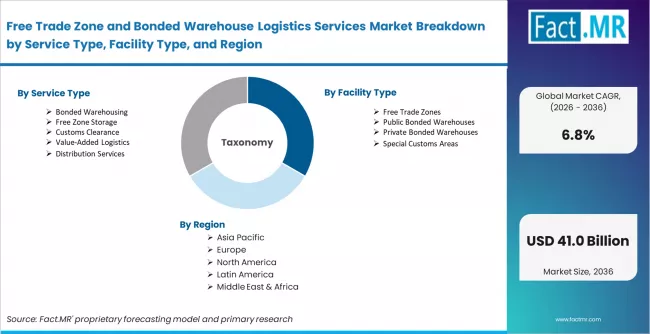
The Free Trade Zone and Bonded Warehouse Logistics Services Market is segmented by Service Type (Bonded Warehousing, Free Zone Storage, Customs Clearance, Value-Added Logistics, and Distribution Services), Facility Type (Public Bonded Warehouses, Private Bonded Warehouses, Free Trade Zones, and Special Customs Areas), End Use (E-Commerce, Automotive, Electronics, Pharmaceuticals, Consumer Goods, and Others), Client Type (Importers, Exporters, Manufacturers, and Third-Party Logistics Providers), and Region. Forecast for 2026 to 2036.
Fact.MR analysis indicates that the free trade zone and bonded warehouse logistics services market is experiencing a compliance-versus-speed dynamic. Cross-border shippers are trying to move inventory faster, defer duties more effectively, and keep distribution options flexible across multiple markets. At the same time, trade facilitation frameworks are designed to expedite the movement, release, and clearance of goods, while customs-controlled inventory handling remains valuable for operators that can combine storage with documentation discipline and customs execution.
Free Trade Zone and Bonded Warehouse Logistics Services Market Forecast By Fact.MR
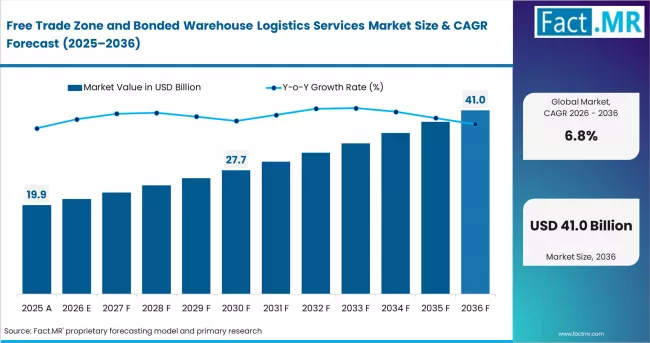
In 2025, the free trade zone and bonded warehouse logistics services market was valued at USD 18.6 billion. Based on Fact.MR analysis, demand for free trade zone and bonded warehouse logistics services is estimated to grow to USD 19.9 billion in 2026 and USD 38.4 billion by 2036. Fact.MR projects a CAGR of 6.8% during the forecast period.
| Metric | Details |
|---|---|
| Industry Size (2026) | USD 19.9 billion |
| Industry Value (2036) | USD 38.4 billion |
| CAGR (2026 to 2036) | 6.8% |
Summary of Free Trade Zone and Bonded Warehouse Logistics Services Market
- Market Definition
- The market includes customs-controlled warehousing and related logistics services used to defer duties, support re-export, improve inventory flexibility, and maintain customs compliance in cross-border trade.
- Demand Drivers
- Importers want more control over duty timing and inventory release in volatile trade conditions.
- Regional distribution models increasingly depend on customs-managed inventory positioned close to trade gateways.
- Operators that can combine storage with customs handling gain an advantage as trade processes place more emphasis on faster release and clearance.
- Key Segments Analyzed
- By Service Type, Bonded Warehousing is expected to hold 31.4% share in 2026, supported by its role in duty deferral and controlled customs storage.
- By Facility Type, Free Trade Zones are projected to account for 34.8% share in 2026 because they support wider handling, redistribution, and value-added logistics activity.
- By End Use, Electronics is likely to capture 24.6% share in 2026 due to high-value inventory and strong need for import-flexibility.
- Analyst Opinion at Fact.MR
- Shambhu Nath Jha, Senior Analyst at Fact.MR, states that this market is not won by warehouse capacity alone. It is won by how well an operator controls the point where customs procedure, inventory timing, and commercial responsiveness meet. Shippers can replace storage vendors more easily than they can replace a provider that already knows how to move goods through a controlled customs environment without slowing release or compromising documentation quality.
- Strategic Implications
- Operators need to bundle customs handling, bonded storage, and distribution execution more tightly.
- Import-heavy sectors should prioritize providers that can delay duties without weakening service responsiveness.
- Logistics companies with FTZ and customs-facing depth are better positioned to capture higher-value regional distribution mandates.
- Methodology
- Focus on decision-makers controlling bonded inventory, customs handling, and cross-border distribution.
- Uses trade facilitation rules and current operator service models rather than commercial report estimates.
- Connects trade-linked warehousing demand with customs-controlled storage intensity and service-value layering.
The market is projected to generate USD 18.5 billion in absolute opportunity between 2026 and 2036. Growth is steady but structurally selective. Demand is strongest where importers need deferred-duty storage, controlled customs handling, and the option to redirect, consolidate, or release inventory according to market timing. Operators increasingly win business when they connect bonded capacity with customs support, distribution planning, and inventory visibility rather than offering storage space alone. That logic aligns with the WTO’s emphasis on faster release and clearance of goods and with operator positioning from DHL and CEVA around customs-managed storage and FTZ services. [1]
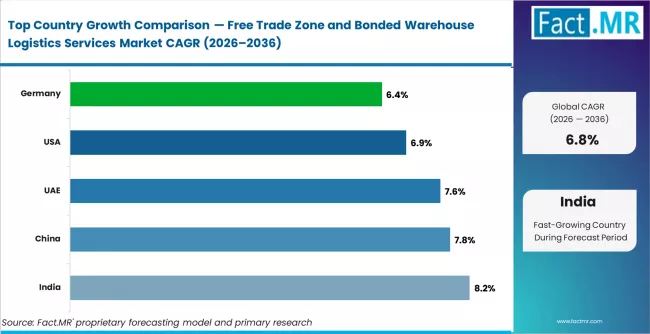
India leads with a projected CAGR of 8.2% through 2036, driven by stronger adoption of customs-managed logistics and rising need for duty deferral and inventory flexibility near major trade gateways. China follows at 7.8%, supported by large-scale manufacturing trade and deeply integrated cross-border distribution networks. The United Arab Emirates grows at 7.6%, underpinned by re-export activity and the operational role of free-zone ecosystems in regional distribution. The United States records 6.9%, with growth anchored in established FTZ frameworks and consistent demand for customs-managed inventory handling. Germany grows at 6.4%, driven by compliance-focused logistics execution and industrial trade requirements.
Segmental Analysis
Free Trade Zone and Bonded Warehouse Logistics Services Market Analysis by Service Type
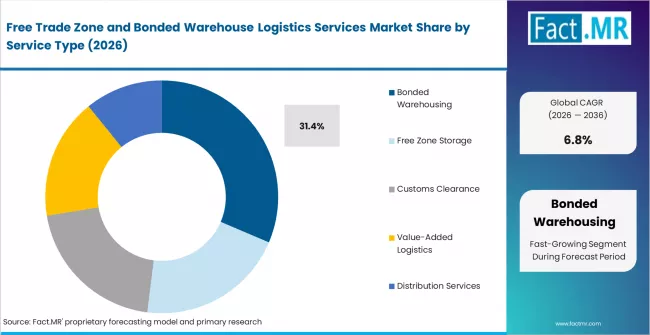
Bonded warehousing is expected to account for 31.4% share in 2026. Its lead comes from the direct financial and operational utility of keeping imported goods under customs control until release timing becomes commercially favorable. A bonded warehouse does more than hold stock. It allows importers to defer duties, split consignments, redirect goods, and manage customs exposure with greater precision. That creates value in sectors where inventory timing and duty treatment can materially affect working capital and order fulfillment. CEVA describes bonded warehousing in terms of delayed payment of customs duties and taxes until goods are released, while DHL positions FTZ solutions around reduced customs costs, improved cash flow, and more flexible inventory control. [2]
- Duty timing: Bonded warehousing helps importers delay customs payments until inventory is actually needed in the local market.
- Release control: Goods can be held, consolidated, or redirected before final clearance, which supports multi-market inventory planning.
- Execution value: Operators with cleaner customs handling turn bonded storage into a service advantage instead of a space-only offering.
Free Trade Zone and Bonded Warehouse Logistics Services Market Analysis by Facility Type
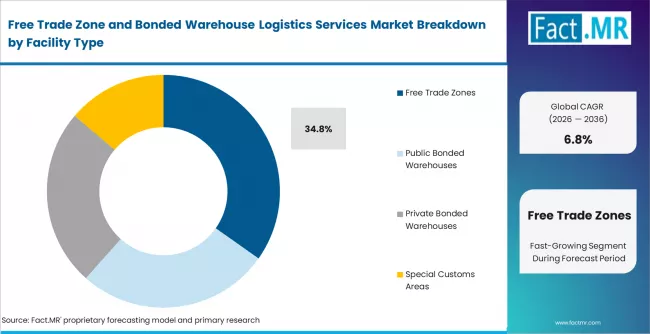
Free trade zones are projected to reach 34.8% share in 2026. Their lead reflects the broader operating environment they provide around cross-border goods handling. A bonded warehouse usually serves a focused customs-storage function. A free trade zone supports a wider logistics model that can include storage, consolidation, value-added handling, repacking, and redistribution within a customs-managed framework. That gives shippers more freedom to decide when and where goods should enter a domestic market. DHL’s FTZ positioning shows how operators frame these environments around flexibility, cash flow, and customs efficiency, which supports the logic behind this segment’s lead.
- Zone leverage: Free trade zones support more service layers than storage alone, which increases their commercial relevance.
- Inventory flexibility: Shippers gain room to stage, relabel, and reposition goods before domestic release.
- Corridor value: Zones near ports and airports strengthen the role of customs-managed logistics in regional distribution networks.
Free Trade Zone and Bonded Warehouse Logistics Services Market Analysis by End Use
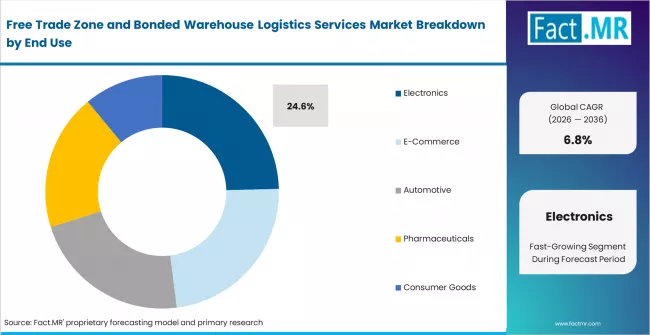
Electronics is likely to account for 24.6% share in 2026, as it combines high-value inventory, import dependence, short product cycles, and frequent need for regional redistribution. Those traits make customs-managed storage particularly useful. Electronics supply chains often need to hold imported goods near end markets without committing to immediate customs release. That makes bonded and free-zone logistics attractive because the inventory can be positioned early while the final commercial decision is taken later. In practice, the value lies in keeping allocation options open while maintaining documentation accuracy and product traceability.
- Value density: High-value goods benefit more from duty deferral and controlled release timing.
- Allocation agility: Electronics distributors often need to redirect inventory quickly across markets as demand shifts.
- Traceability needs: Customs-managed handling supports tighter documentation control for imported technology products.
Drivers, Restraints, and Opportunities
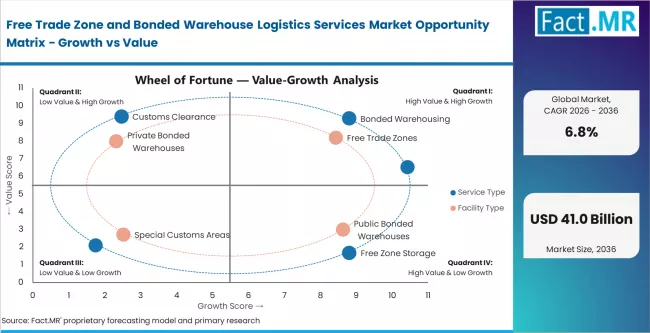
A key driver is the structural value of trade facilitation. The WTO’s Agreement on Trade Facilitation is explicitly designed to expedite the movement, release, and clearance of goods, including goods in transit. That matters directly to this market because bonded warehousing and FTZ logistics become more valuable when customs-facing processes can support faster, cleaner handling of controlled inventory. Operators that align storage with documentation discipline and release efficiency are therefore better positioned to capture trade-linked logistics demand. [5]
The main restraint is not a lack of storage demand. It is procedural complexity. Bonded and free-zone logistics depends on country-specific customs rules, licensing conditions, documentation requirements, and process discipline. That slows market expansion compared with ordinary warehousing because service quality depends on regulatory execution as much as on physical capacity. A provider can have available space and still fail to win or keep business if customs performance is inconsistent.
Opportunities in the Free Trade Zone and Bonded Warehouse Logistics Services Market
- Regional hubs: Operators can create stronger value where clients want one customs-managed inventory base serving several destination markets.
- Documentation integration: Providers that connect bonded storage with cleaner customs workflow and release support can win higher-value mandates.
- Sector specialization: Electronics, pharmaceuticals, and automotive logistics create room for more differentiated FTZ and bonded service models.
Regional Analysis
Based on the regional analysis, the Free Trade Zone and Bonded Warehouse Logistics Services Market is segmented into Asia Pacific, North America, Europe, Latin America, and Middle East & Africa across 40 plus countries.
.webp)
| Country | CAGR (2026 to 2036) |
|---|---|
| India | 8.2% |
| China | 7.8% |
| United Arab Emirates | 7.6% |
| United States | 6.9% |
| Germany | 6.4% |
Source: Fact.MR analysis, based on proprietary forecasting model and primary research.
Asia Pacific Free Trade Zone and Bonded Warehouse Logistics Services Market Analysis
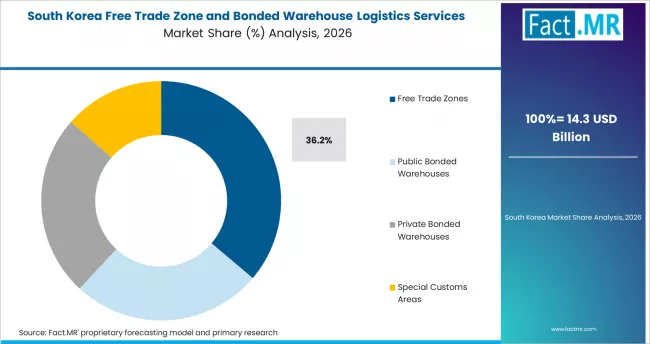
Asia Pacific leads global growth due to its combination of manufacturing scale, trade volume, and expanding need for structured logistics networks. The region’s high export-import activity makes bonded and FTZ services essential for managing inventory near major ports while preserving flexibility over final release. Growth is also supported by increasing adoption of organized logistics models and supply chain optimization strategies.
- India: Demand for free trade zone and bonded warehouse logistics services in India is projected to grow at 8.2% CAGR, supported by trade diversification and expanding industrial activity. Importers and manufacturers are increasingly using bonded warehousing to manage duty timing and optimize regional inventory positioning. Growth is further supported by logistics infrastructure development and policy initiatives aimed at simplifying trade processes.
- China: The China market is expected to advance at 7.8% CAGR, driven by large-scale industrial output and deeply integrated cross-border trade networks. Bonded warehouses play a critical role in managing import-export flows, particularly in major port cities where inventory staging and customs control are essential. High trade volumes continue to sustain demand.
- United Arab Emirates: The UAE is likely to record 7.6% CAGR, supported by strong re-export activity and its role as a global trade hub. Free-zone ecosystems enable efficient redistribution of goods across the Middle East, Africa, and South Asia, reinforcing demand for bonded logistics services.
Fact.MR’s regional analysis also considers ASEAN and other Gulf economies, where customs-managed storage remains closely tied to gateway logistics and cross-border inventory mobility.
North America Free Trade Zone and Bonded Warehouse Logistics Services Market Analysis
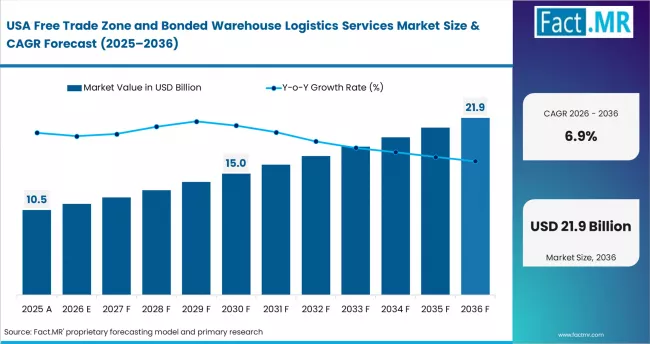
North America remains structurally important due to established FTZ frameworks, large import volumes, and a mature logistics outsourcing environment. Demand is driven by the need to manage import complexity, optimize duty payments, and improve supply chain efficiency.
- United States: The U.S. market is expected to expand at 6.9% CAGR, supported by steady import flows and widespread use of FTZ and bonded warehousing. Businesses across manufacturing, retail, and electronics sectors rely on these services to improve cash flow and streamline inventory release. Operators actively position FTZ solutions around efficiency and cost management benefits.
Mexico also contributes to regional relevance through its role in integrated supply chains, particularly in manufacturing-linked trade, where customs-managed storage supports cross-border operations.
Europe and Latin America Free Trade Zone and Bonded Warehouse Logistics Services Market Analysis
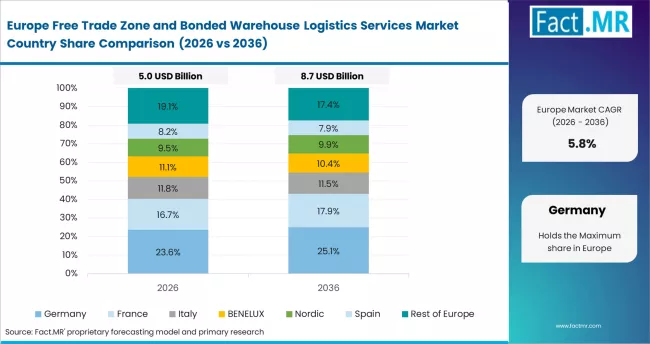
Europe reflects a compliance-driven environment where demand is shaped by customs accuracy, documentation standards, and industrial trade requirements. Latin America, in contrast, grows through operational need, where logistics complexity increases the value of bonded services.
- Germany: The Germany market is likely to grow at 6.4% CAGR, supported by its strong industrial base and advanced logistics infrastructure. Bonded warehousing plays a key role in managing import-intensive distribution and ensuring compliance with strict customs regulations. Demand remains steady due to consistent industrial activity.
Latin America shows a different operating profile, with Brazil emerging as a key market where bonded logistics services help manage import handling, documentation complexity, and release timing. Businesses rely on these services to improve operational efficiency and navigate regulatory requirements.
Competitive Aligners for Market Players
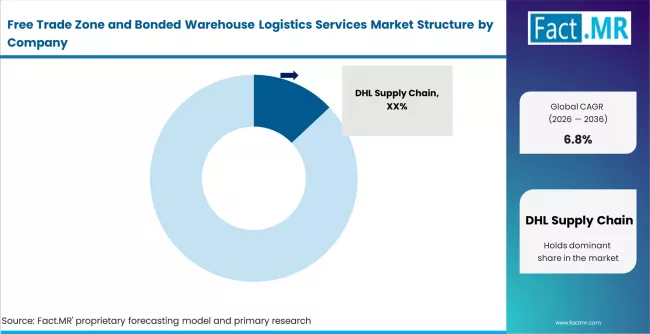
The market is moderately fragmented. Large global operators hold an advantage because bonded and FTZ logistics works best when warehousing, customs handling, freight coordination, and distribution can be offered together. DHL, CEVA Logistics, A.P. Moller - Maersk, Kuehne+Nagel, DSV, GXO Logistics, and DB Schenker remain visible players in this space because they already operate across customs-facing logistics functions. DHL’s FTZ solution positioning and CEVA’s bonded warehouse framing both show how operators compete on customs-aware execution rather than on capacity alone. [4]
Competitive advantage is defined by procedural control. Buyers want providers that can keep goods moving through customs-managed environments without weakening documentation quality or release reliability. That pushes the market toward operators that can bundle customs knowledge, inventory visibility, and controlled-storage execution into one operating model. Storage still matters, though execution quality matters more.
Key Players in Free Trade Zone and Bonded Warehouse Logistics Services Market
- DHL Supply Chain
- CEVA Logistics
- A.P. Moller - Maersk
- Kuehne+Nagel
- DSV
- GXO Logistics
- DB Schenker
Bibliography
- [1] World Trade Organization. (n.d.). Agreement on Trade Facilitation. World Trade Organization.
- [2] DHL Global Forwarding. (n.d.). Foreign trade zone solutions. DHL.
- [3] CEVA Logistics. (n.d.). Customs/bonded warehouse. CEVA Logistics.
- [4] U.S. Customs and Border Protection. (n.d.). Bonded warehouses. U.S. Department of Homeland Security.
- [5] International Trade Administration. (n.d.). Foreign-trade zones. U.S. Department of Commerce.
This Report Addresses
- Strategic outlook for customs-controlled warehousing and FTZ-linked logistics demand.
- Forecast trajectory for bonded and free-zone service value through 2036.
- Role of duty deferral in shaping service demand.
- Service-type and facility-type leadership patterns.
- Demand from electronics and other import-intensive sectors.
- Role of specialist 3PLs in customs-managed execution.
- Regional divergence in trade-linked warehousing demand.
- Competitive positioning of global logistics operators.
Free Trade Zone and Bonded Warehouse Logistics Services Market Definition
The market covers logistics services performed within free trade zones, bonded warehouses, and related customs-controlled storage environments where imported or export-bound goods can be stored, handled, processed, or redistributed under regulated duty and customs conditions. It includes service providers that support inventory control, customs-facing execution, and controlled release of goods for domestic entry, onward distribution, or re-export. [4]
Free Trade Zone and Bonded Warehouse Logistics Services Market Inclusions
Market scope includes bonded warehousing, free zone storage, customs-supervised inventory handling, customs documentation support, clearance coordination, relabelling, postponement packaging, and related distribution services tied to customs-controlled goods flows. It covers both public and private bonded facilities as well as zone-based logistics services linked to ports, airports, and regional trade corridors.
Free Trade Zone and Bonded Warehouse Logistics Services Market Exclusions
The scope excludes standard domestic warehousing without bonded or customs-controlled functionality. It excludes pure freight forwarding where no customs-managed storage service is involved, and it excludes software-only customs platforms sold without physical logistics execution. It also excludes manufacturing-zone revenue where warehousing and logistics service value cannot be clearly separated.
Free Trade Zone and Bonded Warehouse Logistics Services Market Research Methodology
- Primary Research:
- Interviews with bonded warehouse operators, customs brokers, FTZ administrators, regional distribution heads, import compliance managers, and contract logistics executives.
- Desk Research
- Review of WTO trade facilitation texts, operator service disclosures, and customs-managed storage descriptions from global logistics providers.
- Market-Sizing and Forecasting
- Hybrid model based on cross-border warehousing demand, customs-controlled storage intensity, duty-deferral service value, and contract logistics exposure in trade-heavy sectors.
- Data Validation and Update Cycle
- Validation against operator offerings, customs-handling models, and the structural role of FTZ and bonded warehousing in multi-country inventory control.
Scope of the Report

| Attribute | Details |
|---|---|
| Quantitative Units | USD 19.9 billion (2026) to USD 38.4 billion (2036), at a CAGR of 6.8% |
| Market Definition | Customs-controlled logistics services performed in bonded warehouses, free trade zones, and related special customs areas for storage, handling, release coordination, and distribution of cross-border inventory |
| Service Type Segmentation | Bonded Warehousing, Free Zone Storage, Customs Clearance, Value-Added Logistics, Distribution Services |
| Facility Type Segmentation | Public Bonded Warehouses, Private Bonded Warehouses, Free Trade Zones, Special Customs Areas |
| End Use Segmentation | E-Commerce, Automotive, Electronics, Pharmaceuticals, Consumer Goods, Others |
| Client Type Segmentation | Importers, Exporters, Manufacturers, Third-Party Logistics Providers |
| Regions Covered | Asia Pacific, North America, Europe, Latin America, Middle East & Africa |
| Countries Covered | India, China, United Arab Emirates, United States, Germany, Mexico, Brazil, and 40+ countries |
| Key Companies Profiled | DHL Supply Chain, CEVA Logistics, A.P. Moller - Maersk, Kuehne+Nagel, DSV, GXO Logistics, DB Schenker |
| Forecast Period | 2026 to 2036 |
| Approach | Hybrid sizing based on trade-linked warehousing demand, customs-controlled storage intensity, duty-deferral service value, and operator service validation |
Free Trade Zone and Bonded Warehouse Logistics Services Market Analysis by Segments
-
By Service Type:
- Bonded Warehousing
- Free Zone Storage
- Customs Clearance
- Value-Added Logistics
- Distribution Services
-
By Facility Type:
- Public Bonded Warehouses
- Private Bonded Warehouses
- Free Trade Zones
- Special Customs Areas
-
By End Use:
- E-Commerce
- Automotive
- Electronics
- Pharmaceuticals
- Consumer Goods
- Others
-
By Client Type:
- Importers
- Exporters
- Manufacturers
- Third-Party Logistics Providers
-
By Region:
- Asia Pacific
- India
- China
- Rest of Asia Pacific
- North America
- United States
- Mexico
- Rest of North America
- Europe
- Germany
- Rest of Europe
- Latin America
- Brazil
- Rest of Latin America
- Middle East & Africa
- United Arab Emirates
- Rest of Middle East & Africa
- Asia Pacific
- Frequently Asked Questions -
What is the size of the Free Trade Zone and Bonded Warehouse Logistics Services Market in 2026?
The market is estimated to reach USD 19.9 billion in 2026.
What is the projected market value by 2036?
The market is expected to grow to USD 38.4 billion by 2036.
What is the expected CAGR for the market between 2026 and 2036?
The market is projected to expand at a CAGR of 6.8% during the forecast period.
What are free trade zone and bonded warehouse logistics services?
These are customs-controlled logistics services that allow storage, handling, and redistribution of goods with deferred duties and regulated customs processing.
What is driving demand in this market?
Demand is driven by the need for duty deferral, faster customs clearance, and flexible cross-border inventory management.
Which service type holds the largest share?
Bonded warehousing leads the market with a 31.4% share in 2026 due to its role in duty deferral and controlled storage.
Which facility type dominates the market?
Free trade zones are expected to dominate with a 34.8% share in 2026.
Which end-use industry generates the highest demand?
The electronics sector leads with a 24.6% share due to high-value inventory and import dependency.
Who are the primary clients of these services?
Key clients include importers, exporters, manufacturers, and third-party logistics providers.
Why are third-party logistics providers significant in this market?
They dominate due to their expertise in customs compliance, bonded operations, and integrated logistics execution
What is the main challenge in this market?
Procedural complexity related to customs regulations, documentation, and licensing requirements remains a major restraint.
What opportunities exist for market players?
Opportunities include building regional distribution hubs, improving customs-documentation integration, and specializing in high-value sectors.
Which region shows the fastest growth?
Asia Pacific leads growth due to high trade volumes, manufacturing scale, and demand for structured logistics networks.
Why are bonded warehouses important for importers?
They allow importers to delay duty payments, manage inventory release timing, and optimize working capital.
Who are the key companies operating in this market?
Major players include DHL Supply Chain, CEVA Logistics, A.P. Moller - Maersk, Kuehne+Nagel, DSV, GXO Logistics, and DB Schenker.
Table of Content
- Executive Summary
- Global Market Outlook
- Demand to side Trends
- Supply to side Trends
- Technology Roadmap Analysis
- Analysis and Recommendations
- Market Overview
- Market Coverage / Taxonomy
- Market Definition / Scope / Limitations
- Research Methodology
- Chapter Orientation
- Analytical Lens and Working Hypotheses
- Market Structure, Signals, and Trend Drivers
- Benchmarking and Cross-market Comparability
- Market Sizing, Forecasting, and Opportunity Mapping
- Research Design and Evidence Framework
- Desk Research Programme (Secondary Evidence)
- Company Annual and Sustainability Reports
- Peer-reviewed Journals and Academic Literature
- Corporate Websites, Product Literature, and Technical Notes
- Earnings Decks and Investor Briefings
- Statutory Filings and Regulatory Disclosures
- Technical White Papers and Standards Notes
- Trade Journals, Industry Magazines, and Analyst Briefs
- Conference Proceedings, Webinars, and Seminar Materials
- Government Statistics Portals and Public Data Releases
- Press Releases and Reputable Media Coverage
- Specialist Newsletters and Curated Briefings
- Sector Databases and Reference Repositories
- Fact.MR Internal Proprietary Databases and Historical Market Datasets
- Subscription Datasets and Paid Sources
- Social Channels, Communities, and Digital Listening Inputs
- Additional Desk Sources
- Expert Input and Fieldwork (Primary Evidence)
- Primary Modes
- Qualitative Interviews and Expert Elicitation
- Quantitative Surveys and Structured Data Capture
- Blended Approach
- Why Primary Evidence is Used
- Field Techniques
- Interviews
- Surveys
- Focus Groups
- Observational and In-context Research
- Social and Community Interactions
- Stakeholder Universe Engaged
- C-suite Leaders
- Board Members
- Presidents and Vice Presidents
- R&D and Innovation Heads
- Technical Specialists
- Domain Subject-matter Experts
- Scientists
- Physicians and Other Healthcare Professionals
- Governance, Ethics, and Data Stewardship
- Research Ethics
- Data Integrity and Handling
- Primary Modes
- Tooling, Models, and Reference Databases
- Desk Research Programme (Secondary Evidence)
- Data Engineering and Model Build
- Data Acquisition and Ingestion
- Cleaning, Normalisation, and Verification
- Synthesis, Triangulation, and Analysis
- Quality Assurance and Audit Trail
- Market Background
- Market Dynamics
- Drivers
- Restraints
- Opportunity
- Trends
- Scenario Forecast
- Demand in Optimistic Scenario
- Demand in Likely Scenario
- Demand in Conservative Scenario
- Opportunity Map Analysis
- Product Life Cycle Analysis
- Supply Chain Analysis
- Investment Feasibility Matrix
- Value Chain Analysis
- PESTLE and Porter’s Analysis
- Regulatory Landscape
- Regional Parent Market Outlook
- Production and Consumption Statistics
- Import and Export Statistics
- Market Dynamics
- Global Market Analysis 2021 to 2025 and Forecast, 2026 to 2036
- Historical Market Size Value (USD Million) Analysis, 2021 to 2025
- Current and Future Market Size Value (USD Million) Projections, 2026 to 2036
- Y to o to Y Growth Trend Analysis
- Absolute $ Opportunity Analysis
- Global Market Pricing Analysis 2021 to 2025 and Forecast 2026 to 2036
- Global Market Analysis 2021 to 2025 and Forecast 2026 to 2036, By Service Type
- Introduction / Key Findings
- Historical Market Size Value (USD Million) Analysis By Service Type , 2021 to 2025
- Current and Future Market Size Value (USD Million) Analysis and Forecast By Service Type , 2026 to 2036
- End-to-End Project Management
- Transport Engineering
- Route Survey & Planning
- Heavy Lift Handling
- Chartering
- End-to-End Project Management
- Y to o to Y Growth Trend Analysis By Service Type , 2021 to 2025
- Absolute $ Opportunity Analysis By Service Type , 2026 to 2036
- Global Market Analysis 2021 to 2025 and Forecast 2026 to 2036, By Cargo Type
- Introduction / Key Findings
- Historical Market Size Value (USD Million) Analysis By Cargo Type, 2021 to 2025
- Current and Future Market Size Value (USD Million) Analysis and Forecast By Cargo Type, 2026 to 2036
- Oversized Static Cargo
- Heavy Lift Modules
- Breakbulk Equipment
- Rolling Project Cargo
- Oversized Static Cargo
- Y to o to Y Growth Trend Analysis By Cargo Type, 2021 to 2025
- Absolute $ Opportunity Analysis By Cargo Type, 2026 to 2036
- Global Market Analysis 2021 to 2025 and Forecast 2026 to 2036, By Transport Mode
- Introduction / Key Findings
- Historical Market Size Value (USD Million) Analysis By Transport Mode, 2021 to 2025
- Current and Future Market Size Value (USD Million) Analysis and Forecast By Transport Mode, 2026 to 2036
- Sea Freight
- Road Freight
- Rail Freight
- Air Freight
- Multimodal
- Sea Freight
- Y to o to Y Growth Trend Analysis By Transport Mode, 2021 to 2025
- Absolute $ Opportunity Analysis By Transport Mode, 2026 to 2036
- Global Market Analysis 2021 to 2025 and Forecast 2026 to 2036, By Region
- Introduction
- Historical Market Size Value (USD Million) Analysis By Region, 2021 to 2025
- Current Market Size Value (USD Million) Analysis and Forecast By Region, 2026 to 2036
- North America
- Latin America
- Western Europe
- Eastern Europe
- East Asia
- South Asia and Pacific
- Middle East & Africa
- Market Attractiveness Analysis By Region
- North America Market Analysis 2021 to 2025 and Forecast 2026 to 2036, By Country
- Historical Market Size Value (USD Million) Trend Analysis By Market Taxonomy, 2021 to 2025
- Market Size Value (USD Million) Forecast By Market Taxonomy, 2026 to 2036
- By Country
- USA
- Canada
- Mexico
- By Service Type
- By Cargo Type
- By Transport Mode
- By Country
- Market Attractiveness Analysis
- By Country
- By Service Type
- By Cargo Type
- By Transport Mode
- Key Takeaways
- Latin America Market Analysis 2021 to 2025 and Forecast 2026 to 2036, By Country
- Historical Market Size Value (USD Million) Trend Analysis By Market Taxonomy, 2021 to 2025
- Market Size Value (USD Million) Forecast By Market Taxonomy, 2026 to 2036
- By Country
- Brazil
- Chile
- Rest of Latin America
- By Service Type
- By Cargo Type
- By Transport Mode
- By Country
- Market Attractiveness Analysis
- By Country
- By Service Type
- By Cargo Type
- By Transport Mode
- Key Takeaways
- Western Europe Market Analysis 2021 to 2025 and Forecast 2026 to 2036, By Country
- Historical Market Size Value (USD Million) Trend Analysis By Market Taxonomy, 2021 to 2025
- Market Size Value (USD Million) Forecast By Market Taxonomy, 2026 to 2036
- By Country
- Germany
- UK
- Italy
- Spain
- France
- Nordic
- BENELUX
- Rest of Western Europe
- By Service Type
- By Cargo Type
- By Transport Mode
- By Country
- Market Attractiveness Analysis
- By Country
- By Service Type
- By Cargo Type
- By Transport Mode
- Key Takeaways
- Eastern Europe Market Analysis 2021 to 2025 and Forecast 2026 to 2036, By Country
- Historical Market Size Value (USD Million) Trend Analysis By Market Taxonomy, 2021 to 2025
- Market Size Value (USD Million) Forecast By Market Taxonomy, 2026 to 2036
- By Country
- Russia
- Poland
- Hungary
- Balkan & Baltic
- Rest of Eastern Europe
- By Service Type
- By Cargo Type
- By Transport Mode
- By Country
- Market Attractiveness Analysis
- By Country
- By Service Type
- By Cargo Type
- By Transport Mode
- Key Takeaways
- East Asia Market Analysis 2021 to 2025 and Forecast 2026 to 2036, By Country
- Historical Market Size Value (USD Million) Trend Analysis By Market Taxonomy, 2021 to 2025
- Market Size Value (USD Million) Forecast By Market Taxonomy, 2026 to 2036
- By Country
- China
- Japan
- South Korea
- By Service Type
- By Cargo Type
- By Transport Mode
- By Country
- Market Attractiveness Analysis
- By Country
- By Service Type
- By Cargo Type
- By Transport Mode
- Key Takeaways
- South Asia and Pacific Market Analysis 2021 to 2025 and Forecast 2026 to 2036, By Country
- Historical Market Size Value (USD Million) Trend Analysis By Market Taxonomy, 2021 to 2025
- Market Size Value (USD Million) Forecast By Market Taxonomy, 2026 to 2036
- By Country
- India
- ASEAN
- Australia & New Zealand
- Rest of South Asia and Pacific
- By Service Type
- By Cargo Type
- By Transport Mode
- By Country
- Market Attractiveness Analysis
- By Country
- By Service Type
- By Cargo Type
- By Transport Mode
- Key Takeaways
- Middle East & Africa Market Analysis 2021 to 2025 and Forecast 2026 to 2036, By Country
- Historical Market Size Value (USD Million) Trend Analysis By Market Taxonomy, 2021 to 2025
- Market Size Value (USD Million) Forecast By Market Taxonomy, 2026 to 2036
- By Country
- Kingdom of Saudi Arabia
- Other GCC Countries
- Turkiye
- South Africa
- Other African Union
- Rest of Middle East & Africa
- By Service Type
- By Cargo Type
- By Transport Mode
- By Country
- Market Attractiveness Analysis
- By Country
- By Service Type
- By Cargo Type
- By Transport Mode
- Key Takeaways
- Key Countries Market Analysis
- USA
- Pricing Analysis
- Market Share Analysis, 2025
- By Service Type
- By Cargo Type
- By Transport Mode
- Canada
- Pricing Analysis
- Market Share Analysis, 2025
- By Service Type
- By Cargo Type
- By Transport Mode
- Mexico
- Pricing Analysis
- Market Share Analysis, 2025
- By Service Type
- By Cargo Type
- By Transport Mode
- Brazil
- Pricing Analysis
- Market Share Analysis, 2025
- By Service Type
- By Cargo Type
- By Transport Mode
- Chile
- Pricing Analysis
- Market Share Analysis, 2025
- By Service Type
- By Cargo Type
- By Transport Mode
- Germany
- Pricing Analysis
- Market Share Analysis, 2025
- By Service Type
- By Cargo Type
- By Transport Mode
- UK
- Pricing Analysis
- Market Share Analysis, 2025
- By Service Type
- By Cargo Type
- By Transport Mode
- Italy
- Pricing Analysis
- Market Share Analysis, 2025
- By Service Type
- By Cargo Type
- By Transport Mode
- Spain
- Pricing Analysis
- Market Share Analysis, 2025
- By Service Type
- By Cargo Type
- By Transport Mode
- France
- Pricing Analysis
- Market Share Analysis, 2025
- By Service Type
- By Cargo Type
- By Transport Mode
- India
- Pricing Analysis
- Market Share Analysis, 2025
- By Service Type
- By Cargo Type
- By Transport Mode
- ASEAN
- Pricing Analysis
- Market Share Analysis, 2025
- By Service Type
- By Cargo Type
- By Transport Mode
- Australia & New Zealand
- Pricing Analysis
- Market Share Analysis, 2025
- By Service Type
- By Cargo Type
- By Transport Mode
- China
- Pricing Analysis
- Market Share Analysis, 2025
- By Service Type
- By Cargo Type
- By Transport Mode
- Japan
- Pricing Analysis
- Market Share Analysis, 2025
- By Service Type
- By Cargo Type
- By Transport Mode
- South Korea
- Pricing Analysis
- Market Share Analysis, 2025
- By Service Type
- By Cargo Type
- By Transport Mode
- Russia
- Pricing Analysis
- Market Share Analysis, 2025
- By Service Type
- By Cargo Type
- By Transport Mode
- Poland
- Pricing Analysis
- Market Share Analysis, 2025
- By Service Type
- By Cargo Type
- By Transport Mode
- Hungary
- Pricing Analysis
- Market Share Analysis, 2025
- By Service Type
- By Cargo Type
- By Transport Mode
- Kingdom of Saudi Arabia
- Pricing Analysis
- Market Share Analysis, 2025
- By Service Type
- By Cargo Type
- By Transport Mode
- Turkiye
- Pricing Analysis
- Market Share Analysis, 2025
- By Service Type
- By Cargo Type
- By Transport Mode
- South Africa
- Pricing Analysis
- Market Share Analysis, 2025
- By Service Type
- By Cargo Type
- By Transport Mode
- USA
- Market Structure Analysis
- Competition Dashboard
- Competition Benchmarking
- Market Share Analysis of Top Players
- By Regional
- By Service Type
- By Cargo Type
- By Transport Mode
- Competition Analysis
- Competition Deep Dive
- DHL Global Forwarding Industrial Projects
- Overview
- Product Portfolio
- Profitability by Market Segments (Product/Age /Sales Channel/Region)
- Sales Footprint
- Strategy Overview
- Marketing Strategy
- Product Strategy
- Channel Strategy
- deugro
- Kuehne+Nagel
- DB Schenker
- CEVA Logistics
- DSV
- Mammoet
- DHL Global Forwarding Industrial Projects
- Competition Deep Dive
- Assumptions & Acronyms Used
List Of Table
- Table 1: Global Market Value (USD Million) Forecast by Region, 2021 to 2036
- Table 2: Global Market Value (USD Million) Forecast by Service Type, 2021 to 2036
- Table 3: Global Market Value (USD Million) Forecast by Cargo Type, 2021 to 2036
- Table 4: Global Market Value (USD Million) Forecast by Transport Mode, 2021 to 2036
- Table 5: North America Market Value (USD Million) Forecast by Country, 2021 to 2036
- Table 6: North America Market Value (USD Million) Forecast by Service Type, 2021 to 2036
- Table 7: North America Market Value (USD Million) Forecast by Cargo Type, 2021 to 2036
- Table 8: North America Market Value (USD Million) Forecast by Transport Mode, 2021 to 2036
- Table 9: Latin America Market Value (USD Million) Forecast by Country, 2021 to 2036
- Table 10: Latin America Market Value (USD Million) Forecast by Service Type, 2021 to 2036
- Table 11: Latin America Market Value (USD Million) Forecast by Cargo Type, 2021 to 2036
- Table 12: Latin America Market Value (USD Million) Forecast by Transport Mode, 2021 to 2036
- Table 13: Western Europe Market Value (USD Million) Forecast by Country, 2021 to 2036
- Table 14: Western Europe Market Value (USD Million) Forecast by Service Type, 2021 to 2036
- Table 15: Western Europe Market Value (USD Million) Forecast by Cargo Type, 2021 to 2036
- Table 16: Western Europe Market Value (USD Million) Forecast by Transport Mode, 2021 to 2036
- Table 17: Eastern Europe Market Value (USD Million) Forecast by Country, 2021 to 2036
- Table 18: Eastern Europe Market Value (USD Million) Forecast by Service Type, 2021 to 2036
- Table 19: Eastern Europe Market Value (USD Million) Forecast by Cargo Type, 2021 to 2036
- Table 20: Eastern Europe Market Value (USD Million) Forecast by Transport Mode, 2021 to 2036
- Table 21: East Asia Market Value (USD Million) Forecast by Country, 2021 to 2036
- Table 22: East Asia Market Value (USD Million) Forecast by Service Type, 2021 to 2036
- Table 23: East Asia Market Value (USD Million) Forecast by Cargo Type, 2021 to 2036
- Table 24: East Asia Market Value (USD Million) Forecast by Transport Mode, 2021 to 2036
- Table 25: South Asia and Pacific Market Value (USD Million) Forecast by Country, 2021 to 2036
- Table 26: South Asia and Pacific Market Value (USD Million) Forecast by Service Type, 2021 to 2036
- Table 27: South Asia and Pacific Market Value (USD Million) Forecast by Cargo Type, 2021 to 2036
- Table 28: South Asia and Pacific Market Value (USD Million) Forecast by Transport Mode, 2021 to 2036
- Table 29: Middle East & Africa Market Value (USD Million) Forecast by Country, 2021 to 2036
- Table 30: Middle East & Africa Market Value (USD Million) Forecast by Service Type, 2021 to 2036
- Table 31: Middle East & Africa Market Value (USD Million) Forecast by Cargo Type, 2021 to 2036
- Table 32: Middle East & Africa Market Value (USD Million) Forecast by Transport Mode, 2021 to 2036
List Of Figures
- Figure 1: Global Market Pricing Analysis
- Figure 2: Global Market Value (USD Million) Forecast 2021-2036
- Figure 3: Global Market Value Share and BPS Analysis by Service Type , 2026 and 2036
- Figure 4: Global Market Y-o-Y Growth Comparison by Service Type , 2026 to 2036
- Figure 5: Global Market Attractiveness Analysis by Service Type
- Figure 6: Global Market Value Share and BPS Analysis by Cargo Type, 2026 and 2036
- Figure 7: Global Market Y-o-Y Growth Comparison by Cargo Type, 2026 to 2036
- Figure 8: Global Market Attractiveness Analysis by Cargo Type
- Figure 9: Global Market Value Share and BPS Analysis by Transport Mode, 2026 and 2036
- Figure 10: Global Market Y-o-Y Growth Comparison by Transport Mode, 2026 to 2036
- Figure 11: Global Market Attractiveness Analysis by Transport Mode
- Figure 12: Global Market Value (USD Million) Share and BPS Analysis by Region, 2026 and 2036
- Figure 13: Global Market Y-o-Y Growth Comparison by Region, 2026 to 2036
- Figure 14: Global Market Attractiveness Analysis by Region
- Figure 15: North America Market Incremental Dollar Opportunity, 2026 to 2036
- Figure 16: Latin America Market Incremental Dollar Opportunity, 2026 to 2036
- Figure 17: Western Europe Market Incremental Dollar Opportunity, 2026 to 2036
- Figure 18: Eastern Europe Market Incremental Dollar Opportunity, 2026 to 2036
- Figure 19: East Asia Market Incremental Dollar Opportunity, 2026 to 2036
- Figure 20: South Asia and Pacific Market Incremental Dollar Opportunity, 2026 to 2036
- Figure 21: Middle East & Africa Market Incremental Dollar Opportunity, 2026 to 2036
- Figure 22: North America Market Value Share and BPS Analysis by Country, 2026 and 2036
- Figure 23: North America Market Value Share and BPS Analysis by Service Type , 2026 and 2036
- Figure 24: North America Market Y-o-Y Growth Comparison by Service Type , 2026 to 2036
- Figure 25: North America Market Attractiveness Analysis by Service Type
- Figure 26: North America Market Value Share and BPS Analysis by Cargo Type, 2026 and 2036
- Figure 27: North America Market Y-o-Y Growth Comparison by Cargo Type, 2026 to 2036
- Figure 28: North America Market Attractiveness Analysis by Cargo Type
- Figure 29: North America Market Value Share and BPS Analysis by Transport Mode, 2026 and 2036
- Figure 30: North America Market Y-o-Y Growth Comparison by Transport Mode, 2026 to 2036
- Figure 31: North America Market Attractiveness Analysis by Transport Mode
- Figure 32: Latin America Market Value Share and BPS Analysis by Country, 2026 and 2036
- Figure 33: Latin America Market Value Share and BPS Analysis by Service Type , 2026 and 2036
- Figure 34: Latin America Market Y-o-Y Growth Comparison by Service Type , 2026 to 2036
- Figure 35: Latin America Market Attractiveness Analysis by Service Type
- Figure 36: Latin America Market Value Share and BPS Analysis by Cargo Type, 2026 and 2036
- Figure 37: Latin America Market Y-o-Y Growth Comparison by Cargo Type, 2026 to 2036
- Figure 38: Latin America Market Attractiveness Analysis by Cargo Type
- Figure 39: Latin America Market Value Share and BPS Analysis by Transport Mode, 2026 and 2036
- Figure 40: Latin America Market Y-o-Y Growth Comparison by Transport Mode, 2026 to 2036
- Figure 41: Latin America Market Attractiveness Analysis by Transport Mode
- Figure 42: Western Europe Market Value Share and BPS Analysis by Country, 2026 and 2036
- Figure 43: Western Europe Market Value Share and BPS Analysis by Service Type , 2026 and 2036
- Figure 44: Western Europe Market Y-o-Y Growth Comparison by Service Type , 2026 to 2036
- Figure 45: Western Europe Market Attractiveness Analysis by Service Type
- Figure 46: Western Europe Market Value Share and BPS Analysis by Cargo Type, 2026 and 2036
- Figure 47: Western Europe Market Y-o-Y Growth Comparison by Cargo Type, 2026 to 2036
- Figure 48: Western Europe Market Attractiveness Analysis by Cargo Type
- Figure 49: Western Europe Market Value Share and BPS Analysis by Transport Mode, 2026 and 2036
- Figure 50: Western Europe Market Y-o-Y Growth Comparison by Transport Mode, 2026 to 2036
- Figure 51: Western Europe Market Attractiveness Analysis by Transport Mode
- Figure 52: Eastern Europe Market Value Share and BPS Analysis by Country, 2026 and 2036
- Figure 53: Eastern Europe Market Value Share and BPS Analysis by Service Type , 2026 and 2036
- Figure 54: Eastern Europe Market Y-o-Y Growth Comparison by Service Type , 2026 to 2036
- Figure 55: Eastern Europe Market Attractiveness Analysis by Service Type
- Figure 56: Eastern Europe Market Value Share and BPS Analysis by Cargo Type, 2026 and 2036
- Figure 57: Eastern Europe Market Y-o-Y Growth Comparison by Cargo Type, 2026 to 2036
- Figure 58: Eastern Europe Market Attractiveness Analysis by Cargo Type
- Figure 59: Eastern Europe Market Value Share and BPS Analysis by Transport Mode, 2026 and 2036
- Figure 60: Eastern Europe Market Y-o-Y Growth Comparison by Transport Mode, 2026 to 2036
- Figure 61: Eastern Europe Market Attractiveness Analysis by Transport Mode
- Figure 62: East Asia Market Value Share and BPS Analysis by Country, 2026 and 2036
- Figure 63: East Asia Market Value Share and BPS Analysis by Service Type , 2026 and 2036
- Figure 64: East Asia Market Y-o-Y Growth Comparison by Service Type , 2026 to 2036
- Figure 65: East Asia Market Attractiveness Analysis by Service Type
- Figure 66: East Asia Market Value Share and BPS Analysis by Cargo Type, 2026 and 2036
- Figure 67: East Asia Market Y-o-Y Growth Comparison by Cargo Type, 2026 to 2036
- Figure 68: East Asia Market Attractiveness Analysis by Cargo Type
- Figure 69: East Asia Market Value Share and BPS Analysis by Transport Mode, 2026 and 2036
- Figure 70: East Asia Market Y-o-Y Growth Comparison by Transport Mode, 2026 to 2036
- Figure 71: East Asia Market Attractiveness Analysis by Transport Mode
- Figure 72: South Asia and Pacific Market Value Share and BPS Analysis by Country, 2026 and 2036
- Figure 73: South Asia and Pacific Market Value Share and BPS Analysis by Service Type , 2026 and 2036
- Figure 74: South Asia and Pacific Market Y-o-Y Growth Comparison by Service Type , 2026 to 2036
- Figure 75: South Asia and Pacific Market Attractiveness Analysis by Service Type
- Figure 76: South Asia and Pacific Market Value Share and BPS Analysis by Cargo Type, 2026 and 2036
- Figure 77: South Asia and Pacific Market Y-o-Y Growth Comparison by Cargo Type, 2026 to 2036
- Figure 78: South Asia and Pacific Market Attractiveness Analysis by Cargo Type
- Figure 79: South Asia and Pacific Market Value Share and BPS Analysis by Transport Mode, 2026 and 2036
- Figure 80: South Asia and Pacific Market Y-o-Y Growth Comparison by Transport Mode, 2026 to 2036
- Figure 81: South Asia and Pacific Market Attractiveness Analysis by Transport Mode
- Figure 82: Middle East & Africa Market Value Share and BPS Analysis by Country, 2026 and 2036
- Figure 83: Middle East & Africa Market Value Share and BPS Analysis by Service Type , 2026 and 2036
- Figure 84: Middle East & Africa Market Y-o-Y Growth Comparison by Service Type , 2026 to 2036
- Figure 85: Middle East & Africa Market Attractiveness Analysis by Service Type
- Figure 86: Middle East & Africa Market Value Share and BPS Analysis by Cargo Type, 2026 and 2036
- Figure 87: Middle East & Africa Market Y-o-Y Growth Comparison by Cargo Type, 2026 to 2036
- Figure 88: Middle East & Africa Market Attractiveness Analysis by Cargo Type
- Figure 89: Middle East & Africa Market Value Share and BPS Analysis by Transport Mode, 2026 and 2036
- Figure 90: Middle East & Africa Market Y-o-Y Growth Comparison by Transport Mode, 2026 to 2036
- Figure 91: Middle East & Africa Market Attractiveness Analysis by Transport Mode
- Figure 92: Global Market - Tier Structure Analysis
- Figure 93: Global Market - Company Share Analysis