- Market Value (2025): USD 145.8 Mn
- Estimated Value (2026): USD 160.0 Mn
- Forecast Value (2036): USD 403.8 Mn
- CAGR (2026-2036): 9.7%
Antimicrobial Edible Barriers Market Forecast and Outlook 2026 to 2036
According to the Fact.MR analysis, the antimicrobial edible barriers market crossed a valuation of USD 145.8 million is projected to grow from USD 160.0 million in 2026 to USD 403.8 million by 2036. Demand for antimicrobial edible barriers is likely to grow at a CAGR of 9.7% over the forecast period.
Demand for antimicrobial edible barriers is rising as meat, cheese, bakery and produce companies apply thin coatings that carry organic acids, chitosan, plant extracts or bacteriocins to slow spoilage and pathogens on food surfaces. These barriers act where contamination usually starts. For example, in 2024 a Listeria outbreak linked to Boar's Head deli meats led to ten deaths in the United States and a large recall. Similar food safety incidents are projected to drive sales of antimicrobial edible barriers through 2036.
Key Takeaways from the Antimicrobial Edible Barriers Market
- Antimicrobial Edible Barriers Market Value (2025): USD 145.8 million
- Antimicrobial Edible Barriers Market Value (2026): USD 160.0 million
- Antimicrobial Edible Barriers Market Forecast Value (2036): USD 403.8 million
- Antimicrobial Edible Barriers Market Forecast CAGR (2026-2036): 9.7%
- Leading Antimicrobial active: Organic acids (27.8%)
- Key Market Participants: Apeel Sciences, Mori, Sufresca, Xampla, Mantrose-Haeuser, Akorn Technology
- Key Growth Regions: India, Spain, Netherlands, United States, China
The European Food Safety Authority has reported rising listeriosis cases in the EU in recent years, keeping pressure on ready-to-eat food makers. Demand for antimicrobial edible barriers is growing as processors add surface hurdles to complement cooking and sanitation. Suppliers are offering clean-label antimicrobial coatings based on fermentates, acids and plant extracts. Similar regulatory attention is projected to drive sales of antimicrobial edible barriers in Europe and North America.
Antimicrobial Edible Barriers Market
| Metric | Value |
|---|---|
| Estimated Value in (2026) | USD 160.0 million |
| Forecast Value in (2036) | USD 403.8 million |
| Forecast CAGR (2026 to 2036) | 9.7% |
Source: Fact.MR analysis. Updated Nov 18, 2026
Source: Fact.MR analysis.
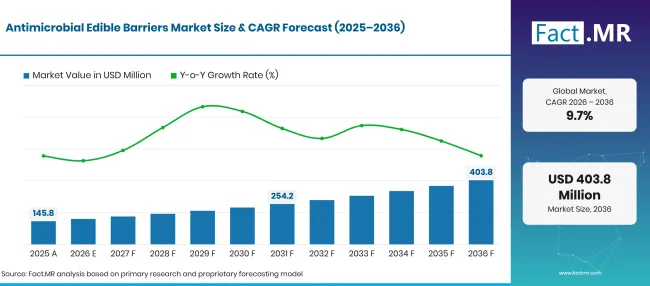
Antimicrobial Edible Barriers Forecast Global | Source: Fact.MR
Category
| Category | Segments |
|---|---|
| Antimicrobial active | Chitosan, Essential oils, Organic acids, Bacteriocins, Plant polyphenols |
| Commercial form | Powder, Liquid concentrate, Granulate, Encapsulated bead, Ready-to-use premix |
| Food application | Bakery, Dairy / alternatives, Beverage, Meat / savory, Confectionery / snacks |
| Primary function | Shelf-life, Texture / rheology, Taste / color, Nutritional functionality, Processing stability |
| Region | India; Spain; Netherlands; United States; China |
Source: Fact.MR analysis. Updated Nov 18, 2026
Source: Fact.MR analysis.
Segmental Analysis
What makes organic acids the leading active ingredient in the Antimicrobial Edible Barriers Market?
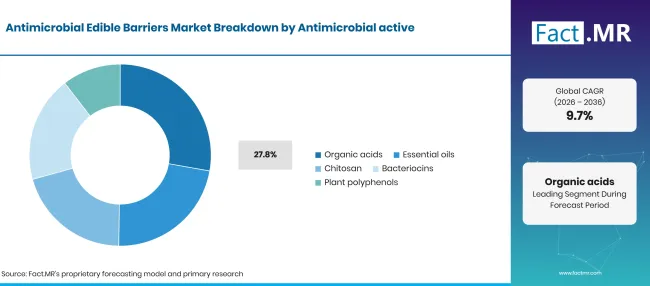
Antimicrobial Edible Barriers Breakdown Antimicrobial Active | Source: Fact.MR
Sales of organic acids account for 27.8% of market revenue in 2026, about USD 44.5 million, as food processors favor established antimicrobial ingredients such as lactic, acetic and propionic acids and their salts. Their recognized applications in microbial control and pH regulation make them suitable for edible coatings used on meat, dairy and other perishable foods. The U.S. FDA identifies lactic acid, acetic acid and propionic acid as antimicrobial agents in its food-substance inventory and lists their applicable food-additive regulations. This regulatory recognition supports their use in food-preservation formulations. Plant polyphenols and chitosan follow, while suppliers are developing buffered acid coatings to improve formulation stability and antimicrobial performance.
Which factors make meat and savory products the largest application segment?
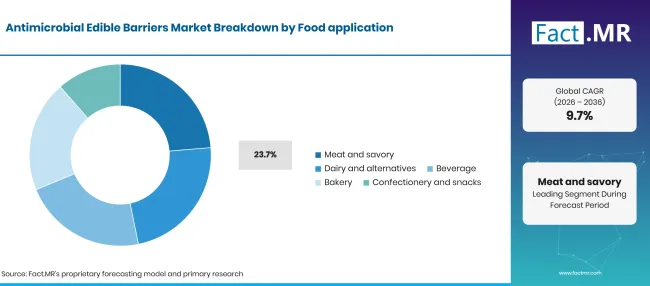
Antimicrobial Edible Barriers Breakdown Food Application | Source: Fact.MR
Meat and savory applications contribute 23.7% of market revenue in 2026, representing USD 37.9 million, because processed meats, deli products, sausages and ready-to-eat meals require strict microbial control throughout storage and distribution. The U.S. CDC identifies deli meats, cold cuts, hot dogs and sausages as potential sources of Listeria monocytogenes contamination, including through post-processing contact with contaminated equipment and surfaces. In August 2026, the CDC reported a Listeria outbreak involving 15 cases across four states, with 14 hospitalizations and one death. Although that outbreak involved soft cheese rather than meat, it demonstrates the continuing food-safety consequences of contamination in ready-to-eat food categories. These concerns encourage meat processors to invest in antimicrobial coatings and surface-preservation technologies. Confectionery, snacks and bakery products represent additional application opportunities.
How are encapsulated beads gaining a commercial-form advantage in the Antimicrobial Edible Barriers Market?
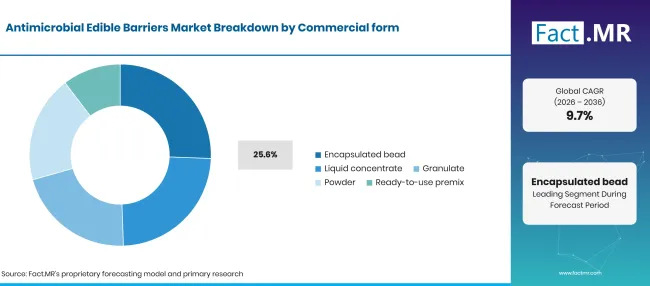
Antimicrobial Edible Barriers Breakdown Commercial Form | Source: Fact.MR
Demand for encapsulated beads represent 25.6% of market revenue in 2026, about USD 41.0 million, as food manufacturers seek better protection of antimicrobial ingredients during processing and more controlled release at food surfaces. Encapsulation can reduce premature exposure of sensitive active compounds to moisture, temperature and other processing conditions. The commercial opportunity is reinforced by the Food and Agriculture Organization's September 2026 update, which estimates that 13.4% of global food production is lost after harvest and before reaching retail. This continuing supply-chain loss strengthens the need for preservation technologies that maintain food quality and extend usable shelf life. Powders remain another established commercial form, while lipid-based encapsulated ingredients are gaining attention for controlled-release applications.
Why is texture and rheology the most prominent functional attribute?
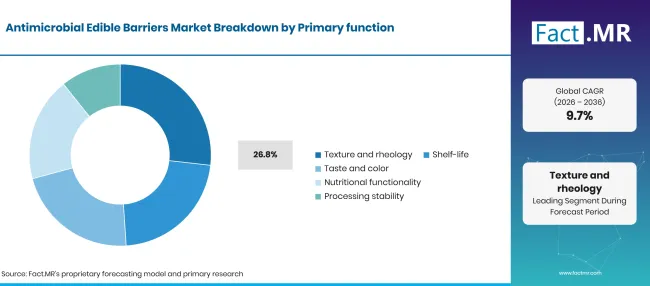
Antimicrobial Edible Barriers Breakdown Primary Function | Source: Fact.MR
Texture and rheology leads with 26.8% of market revenue in 2026, about USD 42.9 million, as food manufacturers increasingly seek edible barriers that provide microbial protection without compromising firmness, moisture retention, consistency or surface appearance. These properties are particularly important for fresh-cut produce, meat products and prepared foods, where changes in texture can reduce consumer acceptance even when products remain microbiologically safe. The FAO's September 2026 assessment estimates that 13.4% of food produced globally is lost between post-harvest and retail, highlighting the need for improved preservation throughout the supply chain. The FDA also notes that confusion over date labeling accounts for an estimated 20% of consumer food waste in the United States. Such concerns encourage manufacturers to develop multifunctional edible coatings that combine microbial protection with physical quality preservation. Shelf-life extension and nutritional functionality remain complementary performance attributes.
Antimicrobial Edible Barriers Market-Drivers, Restraints & Trends
Drivers: Rising Food Safety Requirements for Ready-to-Eat Products:
Demand for antimicrobial edible barriers is increasing as food processors seek additional protection against microbial contamination in ready-to-eat products, fresh produce and prepared meals. The U.S. FDA and CDC reported 28 Listeria infections, 27 hospitalizations and seven deaths in an outbreak linked to prepared pasta meals, with the investigation concluding in February 2026. This highlights the consequences of contamination in foods consumed without further cooking. Food manufacturers are therefore evaluating edible coatings and antimicrobial surface treatments that can improve microbial control without significantly changing product quality.
Restraints: Regulatory Approval and Sensory Compatibility Challenges:
Adoption of antimicrobial edible barriers is constrained by differences in food-ingredient authorization, permitted applications and labeling requirements across countries. Some antimicrobial compounds can also affect the taste, aroma, color or texture of treated foods, requiring additional formulation and shelf-life testing. The European Union and other regulatory jurisdictions apply different microbiological criteria and approval frameworks for food-preservation ingredients. These requirements increase validation costs and can delay commercialization, particularly for formulations intended for multiple international markets.
Opportunity: Fermentate-Based Clean-Label Antimicrobial Ingredients
Fermentate-based ingredients present an opportunity for manufacturers seeking naturally derived antimicrobial solutions with clean-label positioning. Cultured sugar, cultured dextrose and other fermentation-derived ingredients can provide antimicrobial activity through organic acids and other fermentation metabolites. In March 2026, India's FSSAI reported that more than 5.18 lakh food samples had been analyzed across states and union territories over three years, reinforcing the importance of food-quality monitoring. This creates an opportunity for suppliers to develop validated fermentate-based systems for bakery products, meat, dairy and ready-to-eat foods.
Trend: Growing Development of Fungal Chitosan Coatings
Fungal chitosan is gaining research and commercial interest as an alternative to crustacean-derived chitosan for antimicrobial edible coatings. Its film-forming properties and potential to inhibit microbial growth make it suitable for investigation in fresh produce, meat and other perishable food applications. The U.S. FDA's 2026 Listeria outbreak investigation involving soft cheese recorded 15 illnesses, 14 hospitalizations and one death across four states. Such incidents reinforce the need for additional preservation technologies, encouraging research into chitosan-based coatings that can help protect food surfaces while maintaining product quality.
Antimicrobial Edible Barriers Market by Analysis by Key Country
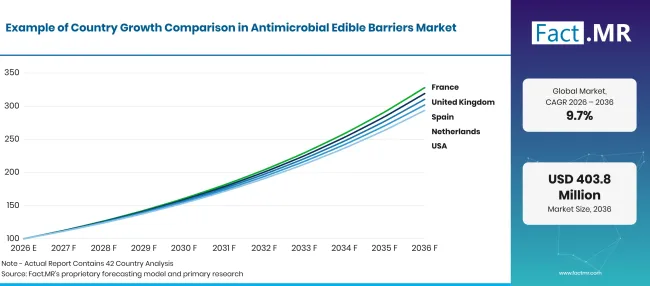
Antimicrobial Edible Barriers Growth Index | Source: Fact.MR
| Country | CAGR (2026-2036) |
|---|---|
| India | 12.0% |
| Spain | 11.8% |
| Netherlands | 11.7% |
| United States | 11.6% |
| China | 11.3% |
Source: Fact.MR analysis. Updated Nov 18, 2026
Source: Fact.MR analysis.
Why is India the fastest-growing market for antimicrobial edible barriers?
Demand for antimicrobial edible barriers in India is projected to increase at a 12.0% CAGR, the fastest among the five key countries, as dairy processing, packaged foods and meat distribution expand.
According to the Government of India's 2026 dairy-sector update, milk production reached 247.87 million tonnes in 2024–25, compared with 239.30 million tonnes in 2023–24. The government also reported that approximately 168 lakh litres per day of additional milk-chilling capacity had been created by June 2026. Meanwhile, the Ministry of Food Processing Industries listed 409 approved integrated cold-chain projects as of June 30, 2026. These developments indicate expanding food-processing capacity alongside continued investment in temperature-controlled distribution. Food manufacturers are therefore seeking complementary preservation technologies, including antimicrobial edible coatings, to manage spoilage and maintain product quality.
What is driving antimicrobial edible barrier demand in Spain?
Sales of antimicrobial edible barriers in Spain are projected to grow at an 11.8% CAGR as its large pork-processing and cured-meat industries require reliable microbial control across domestic and export supply chains.
According to Spain's Ministry of Agriculture, Fisheries and Food, cured ham and shoulder production reached approximately 317,000 tonnes in 2025, while exports of cured hams and shoulders approached EUR 800 million, increasing by 9.2% year over year. The scale of this export-oriented industry creates opportunities for surface-protection technologies that help maintain product quality during storage and distribution. EU Regulation 2073/2005 establishes microbiological criteria for ready-to-eat foods, including Listeria monocytogenes. These requirements encourage processors to strengthen contamination prevention and shelf-life management.
What is shaping antimicrobial edible barrier demand in the Netherlands?
Demand for antimicrobial edible barriers in the Netherlands is estimated to represent 11.7% CAGR as the country's dairy and meat industries serve extensive domestic and export markets.
Statistics Netherlands (CBS), in its 2026 agricultural trade report, valued Dutch dairy and egg exports at EUR 13.3 billion in 2025, up from EUR 12.1 billion in 2024. Meat exports reached EUR 12.1 billion, compared with EUR 11.0 billion in the previous year. This expansion increases the importance of maintaining microbial quality across processing, storage and distribution. Cheese manufacturers and meat processors have an incentive to explore edible surface treatments that can complement conventional preservation and packaging. Retailer interest in longer product life and reduced packaging waste also creates opportunities for multifunctional edible barriers.
Which factors drive antimicrobial edible barrier sales in the United States?
Sales of antimicrobial edible barriers in the United States are projected to increase at an 11.6% CAGR as ready-to-eat meat processors strengthen contamination controls and shelf-life management.
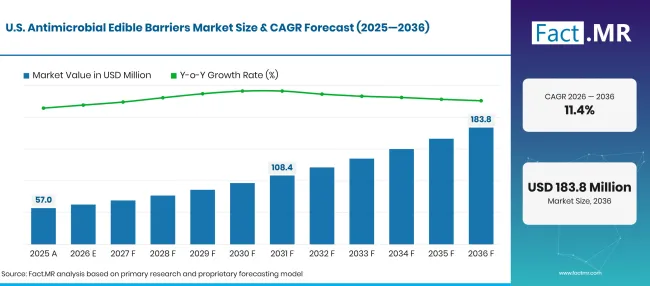
Antimicrobial Edible Barriers Forecast Usa | Source: Fact.MR
The 2024 Boar's Head Listeria outbreak remains an important industry reference. In a 2026 FDA public meeting, the agency summarized the outbreak as involving at least 61 cases, 60 hospitalizations and 10 deaths, with insanitary conditions in a ready-to-eat processing room identified as the root cause. This reinforces the need for improved microbial control in deli meat production. Food processors are evaluating complementary preservation approaches, including antimicrobial surface coatings, alongside sanitation, environmental monitoring and validated processing controls. Greater regulatory scrutiny and demand for safer ready-to-eat products are projected to support sales.
Why is antimicrobial edible barrier growth slower in China?
Demand for antimicrobial edible barriers in China is estimated to record 11.3% CAGR, the slowest among the five key countries, as manufacturers must comply with established food-additive approval requirements and permitted-use conditions before commercializing new antimicrobial ingredients.
The National Health Commission's February 2026 announcement confirmed the approval of 11 new food-additive varieties, following safety assessments. In addition, amendments to selected food-additive standards issued by the NHC and the State Administration for Market Regulation became effective on August 18, 2026. These regulatory developments demonstrate active oversight of food-additive safety and permitted applications. Food processors therefore have incentives to work with established ingredients such as nisin and natamycin where their specific uses are authorized, while evaluating newer antimicrobial barrier formulations within applicable regulatory requirements. This regulatory discipline is expected to moderate the pace of adoption compared with markets where established ingredient pathways are more readily available.
Competitive Landscape for Antimicrobial Edible Barriers Market
Competition in the antimicrobial edible barriers market is shaped by specialized edible-coating developers and established post-harvest treatment suppliers. Sufresca Ltd. and Akorn Technology Inc. compete through plant-based edible coatings designed to protect produce and help control microbial spoilage. Mantrose-Haeuser Co. Inc. offers edible coating solutions for produce and food applications, while Citrosol Group, AgroFresh Solutions Inc. and DECCO Worldwide Post-Harvest Holdings B.V. compete through post-harvest treatments, antimicrobial solutions and technologies that help manage decay and maintain produce quality. Buyers evaluate solutions based on antimicrobial efficacy, food safety, flavor impact, residue profile, regulatory compliance, application compatibility and cost.
From 2024 onward, competition has increasingly focused on clean-label preservation, reduced reliance on conventional chemical treatments and improved control of post-harvest pathogens. Suppliers that can demonstrate validated antimicrobial performance, maintain produce quality and establish strong relationships with growers, packers and distributors are better positioned to expand their market presence.
Recent Developments
- In 2024, a Listeria outbreak linked to Boar's Head deli meats led to a large US recall.
- In August 2026, AgroFresh advanced its post-harvest freshness and intelligent packaging portfolio through the acquisition and integration of Tessara. The development expands its post-harvest treatment and packaging capabilities, supporting broader efforts to maintain produce quality and extend shelf life.
- In September 2026, Citrosol promoted its GREENFOG-AS, Citrocide, and CATsystem solutions at Fruit Attraction 2026. These technologies support post-harvest antifungal treatment, microbial control, and produce-quality preservation, aligning with the broader demand for solutions that reduce spoilage and extend shelf life.
- In April 2026, Akorn Technology continued advancing its natural edible-coating technology, which is designed to inhibit microorganism growth and control rot and mold on fresh produce. These developments support demand for edible barrier solutions that improve post-harvest protection and reduce food losses.
- In September 2025, Citrosol showcased its CATsystem, Citrocide systems and GREENFOG-AS at Fruit Attraction 2025. CATsystem provides automated control of post-harvest treatment concentrations, Citrocide supports microbial control during fresh-cut washing, and GREENFOG-AS targets fungal spores on citrus fruit. These developments strengthen the company's post-harvest microbial-control portfolio.
- In April 2025, Citrosol documented a project focused on developing new post-harvest products for controlling spoilage using plant extracts. The project ran from November 2022 to April 2025, making it a relevant R&D development for natural antimicrobial preservation.
- In June 2025, Akorn introduced Natural Advantage for English cucumbers and bell peppers, a plant-derived edible coating designed to create an invisible protective barrier, maintain freshness and reduce the need for single-use plastic wrapping. This is a relevant edible-barrier product development, although the announcement focuses on freshness and packaging rather than explicitly claiming antimicrobial activity.
- In September 2025, Akorn announced a National Science Foundation (NSF) Phase IIB SBIR grant to advance plant-based edible coatings incorporating essential oils and natural plant extracts to control post-harvest plant pathogens. The company planned commercial trials beginning in Q4 2025. This is particularly relevant to antimicrobial edible barriers.
Key Players in Antimicrobial Edible Barriers Market
Key companies operating in the market include Sufresca Ltd., Akorn Technology Inc., Mantrose-Haeuser Co. Inc., Citrosol Group, AgroFresh Solutions Inc., and DECCO Worldwide Post-Harvest Holdings B.V.
- Sufresca Ltd.
- Akorn Technology Inc.
- Mantrose-Haeuser Co. Inc.
- Citrosol Group
- AgroFresh Solutions Inc.
- DECCO Worldwide Post-Harvest Holdings B.V.
Antimicrobial Edible Barriers Market by Segments
-
Antimicrobial active
- Chitosan
- Essential oils
- Organic acids
- Bacteriocins
- Plant polyphenols
-
Commercial form
- Powder
- Liquid concentrate
- Granulate
- Encapsulated bead
- Ready-to-use premix
-
Food application
- Bakery
- Dairy / alternatives
- Beverage
- Meat / savory
- Confectionery / snacks
-
Primary function
- Shelf-life
- Texture / rheology
- Taste / color
- Nutritional functionality
- Processing stability
-
Region:
- North America
- United States
- Canada
- Mexico
- Europe
- Germany
- United Kingdom
- France
- Italy
- Spain
- Rest of Europe
- Asia Pacific
- China
- India
- Japan
- South Korea
- Australia
- Rest of Asia Pacific
- Latin America
- Brazil
- Mexico
- Argentina
- Rest of Latin America
- Middle East & Africa
- GCC Countries
- South Africa
- Rest of Middle East & Africa
- North America
Bibliography
- Alphabetized in ascending order (A–Z), with duplicate entries consolidated and URLs retained.
- AgroFresh. (2026, August 7). AgroFresh + Tessara: Together for a fresher future.
- Akorn Technology. (n.d.). Our products.
- Akorn Technology. (n.d.). Blog.
- Centers for Disease Control and Prevention. (2024). Listeria outbreak linked to meats sliced at delis.
- Centers for Disease Control and Prevention. (2026, February 12). Investigation update: Prepared pasta meals outbreak, February 2026.
- Centers for Disease Control and Prevention. (2026). Listeria outbreak investigation: Soft cheese, August 2026.
- Citrosol. (2025). Citrosol se renueva en Fruit Attraction 2025 y estrena ubicación en el pabellón 10.
- Citrosol. (2025). FUNGIGREEN project.
- Citrosol. (2026). Citrosol exhibits its star post-harvest solutions at Fruit Attraction 2026.
- European Commission. (2024). Commission Regulation (EU) 2024/2895 of 20 November 2024 amending Regulation (EC) No 2073/2005 on microbiological criteria for foodstuffs as regards Listeria monocytogenes.
- European Food Safety Authority. (2024). The European Union One Health 2023 Zoonoses Report. EFSA.
- Food and Agriculture Organization of the United Nations. (2026). On the International Day of Awareness of Food Loss and Waste, learn how FAO is leveraging data to save food and advance the 2030 Agenda.
- Food and Drug Administration. (n.d.). Acetic acid: Substances added to food.
- Food and Drug Administration. (n.d.). How to cut food waste and maintain food safety.
- Food and Drug Administration. (n.d.). Lactic acid: Substances added to food.
- Food and Drug Administration. (n.d.). Propionic acid: Substances added to food.
- Food and Drug Administration. (2026). Key questions for 2026 Listeria monocytogenes public meeting and docket: Reducing L. monocytogenes in foods during manufacturing and processing. U.S. Department of Health and Human Services.
- Food and Drug Administration. (2026). Outbreak investigation of Listeria monocytogenes: Prepared pasta meals (June 2025). U.S. Department of Health and Human Services.
- Food Safety and Standards Authority of India. (2026, March 13). Steps taken to strengthen food safety, food quality monitoring and consumer protection. Press Information Bureau, Government of India.
- Food Safety and Standards Authority of India. (2026, October 15). Advisory on handling, storage and transportation of perishable food commodities.
- Food Standards Agency. (2026). Incidents and resilience annual report 2025/26. UK Government.
- Mantrose-Haeuser Co., Inc. (n.d.). Official website.
- Ministry of Food Processing Industries. (n.d.). Cold chain scheme and approved projects. Government of India.
- National Health Commission of the People's Republic of China. (2026, February 6). Approval of new food-related substances.
- National Health Commission of the People's Republic of China. (n.d.). New food additive administrative approval service.
- Statistics Netherlands. (2026). Value of agricultural exports up by over 8 percent in 2025
- United Nations Environment Programme. (2024). Food Waste Index Report 2024. UNEP.
- U.S. Department of Agriculture, Foreign Agricultural Service. (2026). China publishes amendments to selected food additive standards.
- United States, Centers for Disease Control and Prevention. (2026). Investigation update: Prepared pasta meals outbreak, February 2026.
Segmentation
Scope of Report
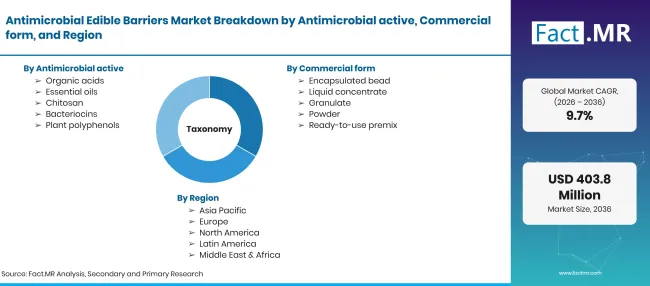
Antimicrobial Edible Barriers Taxonomy | Source: Fact.MR
| Items | Values |
|---|---|
| Quantitative Units (2026) | USD 160.0 Million |
| Antimicrobial active | Chitosan, Essential oils, Organic acids, Bacteriocins, Plant polyphenols |
| Commercial form | Powder, Liquid concentrate, Granulate, Encapsulated bead, Ready-to-use premix |
| Food application | Bakery, Dairy / alternatives, Beverage, Meat / savory, Confectionery / snacks |
| Primary function | Shelf-life, Texture / rheology, Taste / color, Nutritional functionality, Processing stability |
| Regions Covered | North America, Latin America, Europe, East Asia, South Asia and Pacific, Middle East & Africa |
| Countries Covered | India, Spain, Netherlands, United States, China, and other countries |
| Key Companies Profiled | Sufresca Ltd.; Akorn Technology Inc.; Mantrose-Haeuser Co. Inc.; Citrosol Group; AgroFresh Solutions Inc.; DECCO Worldwide Post-Harvest Holdings B.V. |
| Additional Attributes | Dollar revenue in the Antimicrobial Edible Barriers Market is segmented by antimicrobial active (chitosan, essential oils, organic acids, bacteriocins, plant polyphenols); commercial form (powder, liquid concentrate, granulate, encapsulated bead, ready-to-use premix); food application (bakery, dairy / alternatives, beverage, meat / savory, confectionery / snacks); primary function (shelf-life, texture / rheology, taste / color, nutritional functionality, processing stability) and region. |
Source: Fact.MR analysis. Updated Nov 18, 2026
Source: Fact.MR analysis.
Frequently Asked Questions
How big is the global Antimicrobial Edible Barriers Market in 2026?
What will be the size of the Antimicrobial Edible Barriers Market by 2036?
How fast will the Antimicrobial Edible Barriers Market grow during the forecast period?
Which antimicrobial active segment holds the largest share of the Antimicrobial Edible Barriers Market?
Who worked on this report


Preview the report firsthand - request a free sample
Free SampleGet the brochure for pricing and purchase details
Download PDF