- Market Value (2025): USD 146.5 Mn
- Estimated Value (2026): USD 160.0 Mn
- Forecast Value (2036): USD 385.8 Mn
- CAGR (2026-2036): 9.2%
Oxidation-Blocking Produce Films Market Forecast and Outlook 2026 to 2036
According to the Fact.MR analysis, the oxidation-blocking produce films market surpassed a value of USD 146.5 million in 2025 is projected to grow from USD 160.0 million in 2026 to USD 385.8 million by 2036. Demand for oxidation-blocking produce films is likely to grow at a CAGR of 9.2% over the forecast period.
Demand for oxidation-blocking produce films is rising as fresh-cut fruit and vegetable processors stop browning and flavor loss on sliced apples, avocados, potatoes and salads. These films deliver antioxidants such as ascorbate and tocopherols or limit oxygen at the cut surface. For example, Mantrose-Haeuser's NatureSeal calcium ascorbate treatment has been used for years to keep sliced apples from browning in snack packs and food service. Similar convenience food growth is projected to drive sales of oxidation-blocking produce films through 2036.
Key Takeaways from the Oxidation-Blocking Produce Films Market
- Oxidation-Blocking Produce Films Market Value (2025): USD 146.5 million
- Oxidation-Blocking Produce Films Market Value (2026): USD 160.0 million
- Oxidation-Blocking Produce Films Market Forecast Value (2036): USD 385.8 million
- Oxidation-Blocking Produce Films Market Forecast CAGR (2026-2036): 9.2%
- Leading Antioxidant chemistry: Ascorbate (29.0%)
- Key Market Participants: Apeel Sciences, Mori, Sufresca, Xampla, Mantrose-Haeuser, Akorn Technology
- Key Growth Regions: India, Spain, United States, China, Brazil
Retailers and quick-service chains are expanding pre-cut fruit cups, salad kits and snack packs as shoppers pay for convenience. Demand for oxidation-blocking produce films is growing as processors need several days of color stability without sulfites. Suppliers are offering sulfite-free antioxidant coatings. Similar convenience trends are projected to drive sales of oxidation-blocking produce films in North America, Europe and Asia.
Oxidation-Blocking Produce Films Market
| Metric | Value |
|---|---|
| Estimated Value in (2026) | USD 160.0 million |
| Forecast Value in (2036) | USD 385.8 million |
| Forecast CAGR (2026 to 2036) | 9.2% |
Source: Fact.MR analysis. Updated Nov 18, 2026
Source: Fact.MR analysis.
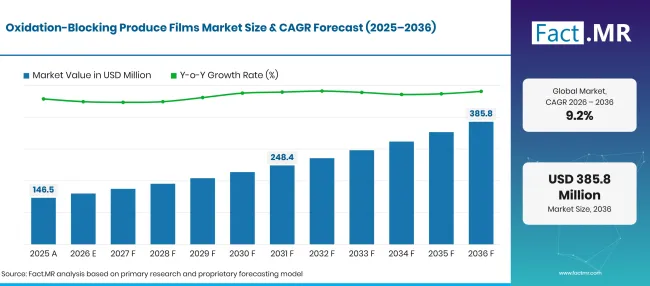
Oxidation Blocking Produce Films Forecast Global | Source: Fact.MR
Category
| Category | Segments |
|---|---|
| Antioxidant chemistry | Ascorbate, Tocopherol, Plant polyphenols, Enzyme inhibitors, Oxygen scavengers |
| Commercial form | Powder, Liquid concentrate, Granulate, Encapsulated bead, Ready-to-use premix |
| Food application | Bakery, Dairy / alternatives, Beverage, Meat / savory, Confectionery / snacks |
| Primary function | Shelf-life, Texture / rheology, Taste / color, Nutritional functionality, Processing stability |
| Region | India; Spain; United States; China; Brazil |
Source: Fact.MR analysis. Updated Nov 18, 2026
Source: Fact.MR analysis.
Segmental Analysis
Why does Ascorbate chemistry lead antioxidant demand in the Oxidation-Blocking Produce Films Market?
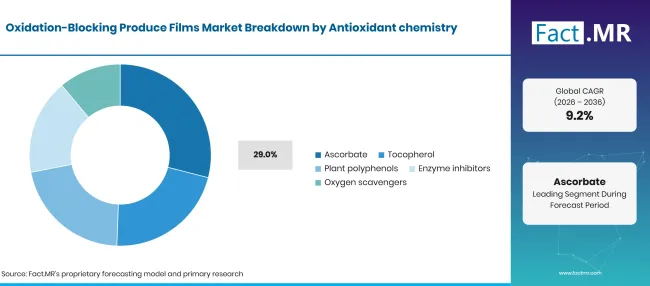
Oxidation Blocking Produce Films Breakdown Antioxidant Chemistry | Source: Fact.MR
Demand for ascorbate chemistry accounts for 29.0% of market revenue in 2026, about USD 46.4 million. Demand is supported by the use of calcium ascorbate and other vitamin C derivatives to limit enzymatic browning in freshly cut apples, pears, potatoes and other produce. These ingredients help processors maintain product appearance during washing, cutting and packaging while supporting formulations with recognizable food ingredients. India's Ministry of Agriculture and Farmers Welfare estimated fruit production at 123.07 million tonnes in 2025–26, expanding the potential processing base for antioxidant treatments. The availability of large fruit volumes supports demand for ascorbate-based preservation systems among fresh-cut processors.
What makes Powder lead commercial-form demand in the Oxidation-Blocking Produce Films Market?
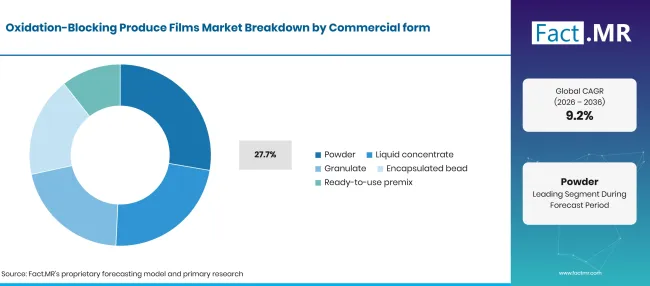
Oxidation Blocking Produce Films Breakdown Commercial Form | Source: Fact.MR
Sales of powder segment represent 27.7% of commercial-form revenue in 2026, about USD 44.3 million. Food processors favor powdered antioxidant blends because they can be stored, transported and measured before being dissolved into treatment solutions for dipping, spraying or coating applications. Their suitability for centralized ingredient handling also supports consistent dosing across processing lines. India's Ministry of Food Processing Industries reported that the country's food-processing sector contributes approximately 9.9% of manufacturing GVA, demonstrating the scale of industrial food production that can support demand for standardized antioxidant ingredients.
Which Factors Drives the Dairy / alternatives Segment demand in the Oxidation-Blocking Produce Films Market?
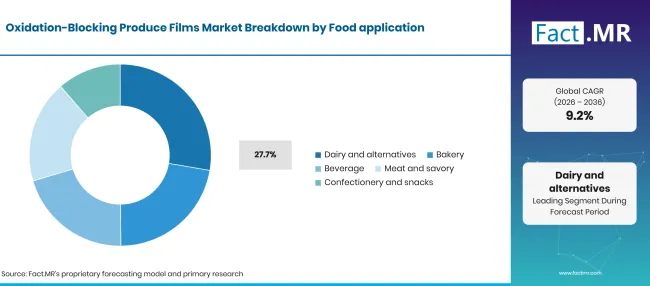
Oxidation Blocking Produce Films Breakdown Food Application | Source: Fact.MR
Demand of Dairy / alternatives is supported by fruit-based yogurt, dairy desserts, plant-based beverages and smoothie preparations, where exposure to oxygen can cause browning and changes in flavor and visual quality. Dairy / alternatives to capture for 27.7% of revenue in 2026, about USD 44.3 million, as fruit preparations for yogurts, plant-based desserts and smoothies must keep color and flavor. Confectionery and snacks follow. Suppliers serve dairy and alternative-dairy makers. Fruit inclusions require antioxidant treatments to retain their appearance during mixing, filling and refrigerated storage. India's Department of Animal Husbandry and Dairying reported that milk production reached 247.87 million tonnes in 2024–25, an increase of 3.58% over the previous year. Additionally, the government reported 418 lakh litres per day of approved milk-processing and value-addition capacity under the Animal Husbandry Infrastructure Development Fund as of June 2026. The expanding dairy-processing base creates opportunities for antioxidant films and coatings used in fruit-containing dairy preparations.
Why does Processing stability lead function demand in the Oxidation-Blocking Produce Films Market?
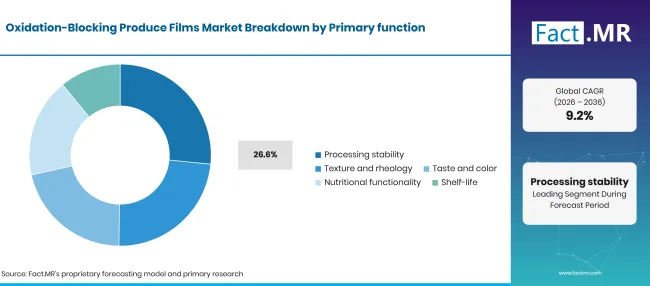
Oxidation Blocking Produce Films Breakdown Primary Function | Source: Fact.MR
Processing stability accounts for 26.6% of function revenue in 2026, about USD 42.6 million. Food manufacturers require oxidation-blocking solutions that preserve the color, texture and appearance of produce throughout washing, peeling, slicing, mixing and packaging. Treatments that remain effective during these operations help reduce discoloration before products reach retail shelves. India's Ministry of Food Processing Industries reported that 1,256 post-harvest infrastructure and processing projects were completed or operational by June 2026 under PMKSY. The government also reported that these initiatives had created 294.21 lakh metric tonnes per annum of processing and preservation capacity. Increasing industrial processing capacity strengthens demand for antioxidant systems that maintain produce quality across multiple production stages.
Oxidation-Blocking Produce Films Market-Drivers, Restraints & Trends
Drivers: Growing demand for fresh-cut and convenience produce:
Demand for oxidation-blocking produce films is increasing as retailers, food-service operators and fresh-cut processors seek to maintain the visual appeal and quality of ready-to-eat fruits and vegetables. Cutting and peeling expose plant tissues to oxygen, accelerating enzymatic browning, moisture loss and quality deterioration. Packaging suppliers are responding with films that regulate oxygen transmission, humidity and headspace conditions, helping processors preserve product appearance and reduce spoilage during distribution. Growth in fresh produce availability also supports the addressable market: USDA estimated U.S. fresh-market vegetable availability at 148 pounds per person in 2025, nearly 3 pounds higher than in 2024.
Restraints: Limited protection and competition from non-browning produce:
Market growth is constrained by the limited ability of films and anti-browning treatments to prevent all forms of deterioration throughout extended storage. Oxidation-blocking solutions can slow discoloration, but they cannot fully prevent microbial spoilage, texture degradation or changes caused by temperature fluctuations. The availability of non-browning produce varieties, including genetically engineered apples and potatoes, may also reduce the need for anti-browning treatments in selected applications. These alternatives are crop-specific, however, and do not eliminate the need for packaging that controls moisture, gas exchange and broader quality deterioration. Suppliers therefore need to demonstrate longer protection periods and compatibility with different fresh-cut produce categories.
Opportunity: Expansion of sulfite-free anti-browning solutions-
Demand for sulfite-free anti-browning solutions is creating opportunities for suppliers to develop formulations based on ascorbic acid, citric acid and plant-derived extracts. These ingredients can help limit enzymatic browning while supporting clean-label product positioning. In the United States, FDA regulations require sulfites to be declared when total sulfites reach 10 parts per million (ppm) in finished food. FDA also recognizes that sulfiting agents can cause adverse reactions in sensitive individuals, including people with asthma. This creates an incentive for processors to evaluate alternatives that reduce reliance on sulfite-based preservation, particularly in fresh-cut fruit and vegetable applications.
Trend: Avocado and Guacamole Stability -:
Avocado and guacamole processors are investing in preservation approaches that maintain green color, flavor and texture after cutting and processing. Exposure to oxygen accelerates enzymatic browning, making oxidation control especially important for packaged avocado pulp, dips and ready-to-eat products. Suppliers are combining antioxidant formulations, oxygen-management packaging and high-pressure processing (HPP) to improve product stability and extend usable shelf life. USDA reported that U.S. fresh avocado imports reached a record 2.87 billion pounds in 2025, up 7% from 2024, highlighting the scale of the avocado supply chain and the commercial relevance of technologies that preserve product quality.
Oxidation-Blocking Produce Films Market by Analysis by Key Country
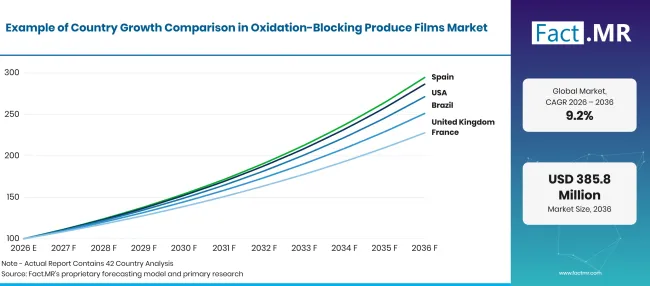
Oxidation Blocking Produce Films Growth Index | Source: Fact.MR
| Country | CAGR (2026-2036) |
|---|---|
| India | 11.5% |
| Spain | 11.3% |
| United States | 11.1% |
| China | 10.8% |
| Brazil | 10.5% |
Source: Fact.MR analysis. Updated Nov 18, 2026
Source: Fact.MR analysis.
Why is India the fastest-growing market for oxidation-blocking produce films?
Demand in India is estimated to represent a 11.5% CAGR, the fastest among the five key countries, as cut fruit, ready-to-cook vegetables and quick-commerce deliveries expand in cities.
Quick-commerce apps such as Blinkit, Zepto and Swiggy Instamart deliver cut fruit within minutes in large cities. The Ministry of Agriculture and Farmers Welfare estimated that 2025–26 fruit production would reach 123.07 million tonnes, up 4.60% year over year, while vegetable production was projected at 227.27 million tonnes, up 4.35%. Higher availability of apples, bananas, mangoes and vegetables increases the potential requirement for anti-browning films and coatings that preserve cut surfaces during storage and delivery.
What is driving oxidation-blocking produce film demand in Spain?
Spain's market is projected to expand at an 11.3% CAGR through 2036, supported by its substantial fresh-produce export base and the need to maintain appearance during international distribution.
The Murcia regional government's May 2026 foreign-trade report recorded fresh-fruit exports of EUR 262.38 million and fresh and frozen vegetable exports of EUR 863.73 million in the reported 2026 period. These export flows strengthen the commercial case for anti-browning films and coatings used by fresh-cut processors supplying supermarkets and food-service customers.
What is shaping oxidation-blocking produce film sales in the United States?
Sales in the United States are estimated to record a 11.1% CAGR as sliced apples and fruit cups are widely used in schools and food service. Mantrose-Haeuser serves US processors.
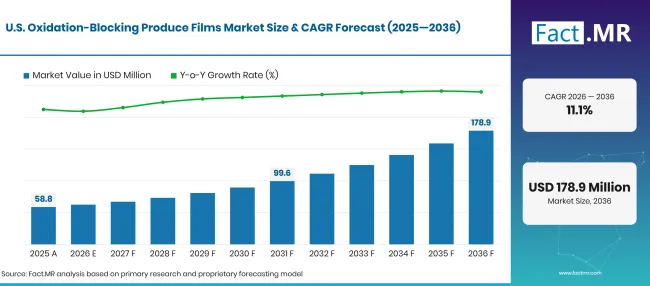
Oxidation Blocking Produce Films Forecast Usa | Source: Fact.MR
The USDA Economic Research Service reported fresh apple availability of 17 pounds per person in 2024–25, while total apple availability reached 41.3 pounds per person. Its April 2026 vegetable outlook also estimated fresh vegetable availability at 148 pounds per person for 2025, nearly 3 pounds higher than the previous year. These consumption volumes create opportunities for oxidation-blocking films used in sliced apples, fruit cups and prepared vegetable products to maintain appearance during retail storage.
What is shaping oxidation-blocking produce film demand in China?
Demand in China is projected to grow at a 10.8% CAGR as cut fruit sold through convenience stores and delivery apps such as Meituan grows.
Fruit chains such as Pagoda sell pre-cut fruit that needs browning control. China's National Bureau of Statistics reported that online retail sales of food products increased by 15.8% year over year during January–September 2026. Convenience-store retail sales also increased by 5.2% during the same period. The expansion of these distribution channels creates opportunities for oxidation-blocking films that preserve the color and visual quality of pre-cut fruit during storage, transportation and delivery.
Why is oxidation-blocking produce film growth slower in Brazil?
Demand in Brazil is estimated to record a 10.5% CAGR, the slowest among the five key countries, as fresh-cut processing is smaller than whole-fruit trade, and most produce is sold loose in open markets.
Supermarket chains such as GPA are expanding pre-cut ranges in São Paulo. The National Supply Company (CONAB) reported that 54 wholesale food distribution centers commercialized 16.6 million tonnes of fruits and vegetables in 2025, generating BRL 68.7 billion in transactions. Fruit exports also increased by 19.7% to approximately 1.3 million tonnes. These figures demonstrate a large produce supply chain, although much of the trade involves whole produce rather than processed fresh-cut products. Wider adoption of oxidation-blocking films will therefore depend on growth in supermarket-based cutting, packaging and refrigerated distribution.
Competitive Landscape for Oxidation-Blocking Produce Films Market
Competition in the oxidation-blocking produce films market involves established post-harvest treatment providers, modified-atmosphere packaging suppliers and emerging edible-coating developers. Apeel Sciences, Akorn Technology, Sufresca and Cambridge Crops (Mori) compete through edible and protective coatings designed to slow oxidation, reduce moisture loss and preserve produce freshness. AgriCoat NatureSeal and Pace International offer post-harvest anti-browning and freshness-preservation solutions, while StePac and Fresh-Lock/XtendPak compete through packaging technologies that regulate oxygen exposure, moisture and package conditions. Xampla focuses on plant-based packaging materials, while Mantrose-Haeuser supplies edible coatings and surface-treatment solutions. Buyers evaluate solutions based on browning control, color retention, shelf-life extension, food safety, packaging compatibility, regulatory compliance and cost.
From 2024 onward, competition has increasingly focused on sulfite-free preservation, plastic-reducing packaging formats and ready-to-eat or fresh-cut produce applications. Suppliers that can demonstrate reliable oxidation control, maintain product quality across distribution conditions and establish partnerships with produce processors and retailers are better positioned to expand their market presence.
Recent Developments
- In September 2026, StePacPPC introduced its next-generation Xgo PAZ Pouch, a resealable pouch combining modified-atmosphere and moisture-control technologies. The three-in-one design is intended to preserve moisture-sensitive produce, including cucumbers, by managing the packaging atmosphere and moisture conditions. This is a relevant development in oxidation and freshness management through modified-atmosphere produce packaging.
- On April 28, 2026, Cambridge Crops received U.S. Patent US 12,612,203 B2, covering methods and compositions for improving the storage and transportation of produce, flowers and plants using protective coatings. The technology includes silk fibroin and other coating materials intended to address spoilage mechanisms such as oxidation, microbial growth, moisture loss and gas exchange. This is relevant to produce preservation, although it concerns edible and non-edible coatings rather than conventional flexible packaging films.
- On January 19, 2026, StePacPPC developed an adapted modified-atmosphere/modified-humidity bulk packaging solution for dragon fruit shipped from Ecuador to the United States and Europe. The packaging is designed to maintain fruit freshness and appearance during long-distance ocean transportation.
- On February 2026, AgriCoat NatureSeal presented a sulphite-free treatment for prepared potato products at Fruit Logistica 2026. The treatment is designed to prevent oxidative browning both inside packaging and when products are exposed to air. This is relevant to oxidation-blocking preservation and clean-label processing, although it is a treatment rather than a produce packaging film.
- On January 16, 2025, Mori's patent application US 2025/0019105 A1 was published. It describes coating compositions and methods for extending the storage life of produce and reducing spoilage during transportation. The application discusses oxidation, moisture loss, microbial growth and gas exchange as factors affecting produce quality.
- In March 2025, StePacPPC launched its PAZ Stand-Up Pouch at Fruit Logistica 2025. The modified-atmosphere packaging solution uses specially engineered film with an enhanced water vapor transmission rate to regulate humidity, release excess moisture and prevent condensation. The technology helps reduce microbial decay and maintain fresh-produce quality during storage and distribution.
Key Players in Oxidation-Blocking Produce Films Market
Key companies operating in the market include Apeel Sciences, AgriCoat NatureSeal Ltd., Cambridge Crops Inc. (Mori), Pace International, Fresh-Lock / XtendPak, StePac, Sufresca, Xampla, Mantrose-Haeuser, and Akorn Technology.
- Apeel Sciences
- AgriCoat NatureSeal Ltd.
- Cambridge Crops Inc. (Mori)
- Pace International
- Fresh-Lock / XtendPak
- StePac
- Sufresca
- Xampla
- Mantrose-Haeuser
- Akorn Technology
Bibliography
- AgriCoat NatureSeal. (2026, February). Sulphite-free treatment for prepared potato products.
- Cambridge Crops, Inc. (2025). Storage and/or transportation of produce, flowers and plants (U.S. Patent Application Publication No. US 2025/0019105 A1). U.S. Patent and Trademark Office.
- Cambridge Crops, Inc. (2026). Storage and/or transportation of produce, flowers and plants (U.S. Patent No. 12,612,203 B2). U.S. Patent and Trademark Office.
- Companhia Nacional de Abastecimento. (2026, July 28). Comercialização de frutas e de hortaliças nas Ceasas brasileiras totalizam 16,6 milhões de toneladas em 2025. Governo Federal do Brasil.
- Citrosol. (2026). Citrosol exhibits its star post-harvest solutions at Fruit Attraction 2026.
- Department of Animal Husbandry and Dairying. (2026). Annual report 2025–26. Government of India.
- Electronic Code of Federal Regulations. (n.d.). 21 CFR § 130.9—General provisions for food standards.
- Food and Drug Administration. (n.d.). Food allergies and sulfite labeling. U.S. Department of Health and Human Services.
- Instituto de Fomento de la Región de Murcia. (2026, May). Informe mensual de comercio exterior: Región de Murcia (mayo 2026).
- Mantrose-Haeuser Co. (2025). NatureSeal. Westport, CT: Mantrose-Haeuser.
- Ministry of Agriculture and Farmers Welfare. (2026, November 17). India's horticulture production set to reach record 386.9 million tonnes in 2025–26: Third advance estimates. Press Information Bureau, Government of India.
- Ministry of Agriculture and Farmers Welfare. (2026). Third advance estimates of horticulture production for 2025–26. Government of India.
- Ministry of Fisheries, Animal Husbandry and Dairying. (2026, March 13). Production and consumption of milk. Press Information Bureau, Government of India.
- Ministry of Food Processing Industries. (2026). Annual report 2025–26. Government of India.
- Ministry of Food Processing Industries. (2026, July 30). PMKSY strengthens food processing infrastructure, reduces post-harvest losses and boosts farmers' income. Press Information Bureau, Government of India.
- Ministry of Food Processing Industries. (2026). Production linked incentive scheme for food processing industry and PMKSY progress. Press Information Bureau, Government of India.
- National Bureau of Statistics of China. (2026, October 20). Total retail sales of consumer goods from January to September 2026.
- Postharvest.biz. (2025). StePacPPC marks 30 years of innovation at Fruit Logistica 2025 with the groundbreaking PAZ stand-up pouch launch.
- StePacPPC. (2026, January 19). Xtend® modified-atmosphere and modified-humidity packaging solution for dragon fruit.
- StePacPPC. (2026, September). Xgo™ PAZ pouch: Patent-pending resealable packaging solution.
- United Nations Environment Programme. (2024). Food waste index report 2024.
- U.S. Department of Agriculture, Economic Research Service. (2026, March 26). Fruit and tree nuts outlook: March 2026 (FTS-384).
- U.S. Department of Agriculture, Economic Research Service. (2026, April 30). Vegetables and pulses outlook: April 2026 (VGS-378).
- U.S. Department of Agriculture, National Agricultural Statistics Service. (2026). Noncitrus fruits and nuts 2025 summary.
Segmentation
Scope of Report
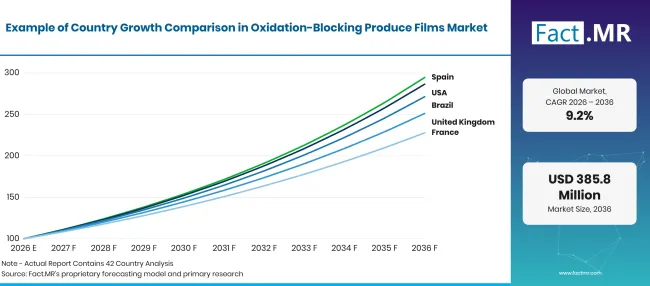
Oxidation Blocking Produce Films Growth Index 1 | Source: Fact.MR
| Items | Values |
|---|---|
| Quantitative Units (2026) | USD 160.0 Million |
| Antioxidant chemistry | Ascorbate, Tocopherol, Plant polyphenols, Enzyme inhibitors, Oxygen scavengers |
| Commercial form | Powder, Liquid concentrate, Granulate, Encapsulated bead, Ready-to-use premix |
| Food application | Bakery, Dairy / alternatives, Beverage, Meat / savory, Confectionery / snacks |
| Primary function | Shelf-life, Texture / rheology, Taste / color, Nutritional functionality, Processing stability |
| Regions Covered | North America, Latin America, Europe, East Asia, South Asia and Pacific, Middle East & Africa |
| Countries Covered | India, Spain, United States, China, Brazil, and other countries |
| Key Companies Profiled | Apeel Sciences; AgriCoat NatureSeal Ltd.; Cambridge Crops Inc. (Mori); Pace International; Fresh-Lock / XtendPak; StePac; Sufresca; Xampla; Mantrose-Haeuser and Akorn Technology |
| Additional Attributes | Dollar revenue in the Oxidation-Blocking Produce Films Market is segmented by antioxidant chemistry (ascorbate, tocopherol, plant polyphenols, enzyme inhibitors, oxygen scavengers); commercial form (powder, liquid concentrate, granulate, encapsulated bead, ready-to-use premix); food application (bakery, dairy / alternatives, beverage, meat / savory, confectionery / snacks); primary function (shelf-life, texture / rheology, taste / color, nutritional functionality, processing stability) and region. |
Source: Fact.MR analysis. Updated Nov 18, 2026
Source: Fact.MR analysis.
Oxidation-Blocking Produce Films Market by Segments
-
Antioxidant chemistry
- Ascorbate
- Tocopherol
- Plant polyphenols
- Enzyme inhibitors
- Oxygen scavengers
-
Commercial form
- Powder
- Liquid concentrate
- Granulate
- Encapsulated bead
- Ready-to-use premix
-
Food application
- Bakery
- Dairy / alternatives
- Beverage
- Meat / savory
- Confectionery / snacks
-
Primary function
- Shelf-life
- Texture / rheology
- Taste / color
- Nutritional functionality
- Processing stability
-
Region:
- North America
- United States
- Canada
- Mexico
- Europe
- Germany
- United Kingdom
- France
- Italy
- Spain
- Rest of Europe
- Asia Pacific
- China
- India
- Japan
- South Korea
- Australia
- Rest of Asia Pacific
- Latin America
- Brazil
- Mexico
- Argentina
- Rest of Latin America
- Middle East & Africa
- GCC Countries
- South Africa
- Rest of Middle East & Africa
- North America
Frequently Asked Questions
How big is the global Oxidation-Blocking Produce Films Market in 2026?
What will be the size of the Oxidation-Blocking Produce Films Market by 2036?
How fast will the Oxidation-Blocking Produce Films Market grow during the forecast period?
Which antioxidant chemistry segment holds the largest share of the Oxidation-Blocking Produce Films Market?
Who worked on this report


Preview the report firsthand - request a free sample
Free SampleGet the brochure for pricing and purchase details
Download PDF