- Base Value(2026): 8.1 Bn
- Estimated Value(2026): 8.1 Bn
- Forecast Value (2036): 16.9 Bn
- CAGR (2026 - 2036): 7.6%
Antioxidant-Rich Skincare Market Forecast and Outlook 2026 to 2036
In 2025, the antioxidant-rich skincare market surpassed a valuation of USD 8.0 billion. Based on Fact.MR analysis, demand for antioxidant-rich skincare products is estimated to grow to USD 8.1 billion in 2026 and USD 16.9 billion by 2036. FACT.MR projects a CAGR of 7.6% during the forecast period.
The antioxidant-rich skincare market is projected to generate an absolute dollar opportunity of USD 8.8 billion. This represents transformational rather than incremental expansion, driven by rising consumer focus on skin barrier repair, pollution defense, and preventative anti-aging regimens. Growth is structurally supported by dermatological endorsement, ingredient transparency movements, and rapid digital commerce penetration, although pricing pressure in mid-tier retail formats moderates premium brand velocity.
Daniel Isaacs, Chief Product Officer and Founding Partner of Medik8 said, "MNI-antioxidant Acetyl Zingerone... is labelled an ‘omni’ antioxidant due to its ability to defend against multiple types of free radicals, for optimal antioxidant protection. Expect to see it in vitamin C formulas acting as a booster due to its environmental protector properties."
Country growth reflects digital adoption, premiumization trends, and dermatology-led retail expansion. India leads at 8.8% CAGR driven by rapid e-commerce penetration and rising dermatological awareness. China follows at 8.2% supported by strong domestic beauty brand investment and cross-border e-commerce demand. Germany grows 7.5% amid clean beauty standard enforcement and pharmacy channel strength. Japan advances at 7.0% on anti-aging category depth. The United Kingdom posts 6.8% supported by specialty beauty retail growth. The United States grows 6.4%, representing a mature but innovation-driven replacement demand market constrained by category saturation and intense promotional activity.
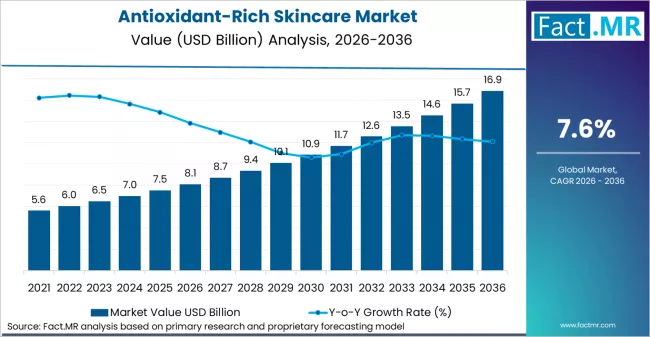
Antioxidant Rich Skincare Market Market Value Analysis | Source: Fact.MR
| Metric | Value |
|---|---|
| Estimated Value in 2026 | USD 8.1 billion |
| Forecast Value in 2036 | USD 16.9 billion |
| Forecast CAGR (2026 to 2036) | 7.6% |
Source: Fact.MR analysis. Updated Mar 4, 2026
Market Definition
The antioxidant-rich skincare market includes topical facial products formulated with active antioxidant ingredients such as Vitamin C, Vitamin E, polyphenols, resveratrol, and coenzyme Q10. These products, including serums, creams, masks, and toners, are designed to reduce oxidative stress, support anti-aging, and improve skin brightness.
Market Inclusions
Covers global and regional revenue forecasts (2026-2036) segmented by product type, ingredient, function, distribution channel, and end user. Includes pricing analysis, ingredient innovation trends, dermatology-backed positioning, e-commerce performance, and key cosmetic regulatory frameworks.
Market Exclusions
Excludes ingestible supplements, nutricosmetics, injectables, prescription dermatology treatments, sunscreen-only products, and non-facial categories such as haircare or body care unless specifically positioned as antioxidant facial skincare.
Research Methodology
- Primary Research: Interviews were conducted with cosmetic chemists, dermatologists, retail buyers, digital beauty platform managers, and marketing executives across North America, Europe, and Asia Pacific.
- Desk Research: Sources included company annual reports, investor presentations, regulatory agency cosmetic guidelines, dermatological association publications, and corporate press releases from 2024 and 2025.
- Market Sizing and Forecasting: A hybrid top-down and bottom-up model combined regional skincare category revenue with product-level antioxidant penetration rates and average selling price tiers across channels.
- Data Validation and Update Cycle: Outputs were validated against company segment disclosures, retail sell-through data, ingredient import/export statistics, and primary interview insights. Forecasts are reviewed annually.
Summary
- Market Definition
- Antioxidant-rich skincare products are topical formulations designed to neutralize oxidative stress and protect skin from environmental damage using active antioxidant compounds.
- Demand Drivers
- Rising pollution exposure and blue-light defense awareness are increasing daily antioxidant serum usage across urban populations.
- Dermatologist-led clinical positioning of stabilized Vitamin C and resveratrol formulations is driving premium segment adoption.
- E-commerce expansion is accelerating consumer access to ingredient-focused brands with transparent formulation claims.
- Key Segments Analyzed
- By Product Type: Serums lead with 40% share due to high active concentration and routine layering compatibility.
- By End use: Women dominates with 62% share reflecting preventive skincare prioritization.
- By Geography: Asia Pacific leads growth with India (8.8%) and China (8.2%) as primary expansion engines.
- Analyst Opinion at FACT.MR
- Shambhu Nath Jha, Principal Consultant at Fact.MR, opines, “CXOs will find that ingredient stabilization technology and dermatologist-backed clinical validation are becoming the primary levers of premium pricing and margin durability in antioxidant skincare.”
- Strategic Implications
- Invest in stabilized Vitamin C and encapsulation technology.
- Expand digital-first D2C distribution in India and China.
- Secure dermatology partnerships to substantiate efficacy claims.
- Methodology
- Hybrid revenue modeling combining retail channel data and ingredient penetration rates.
- Regulatory compliance tracking for cosmetic labeling standards.
- Cross-verification using corporate filings and investor disclosures.
Segmental Analysis
Antioxidant-Rich Skincare Market Analysis by Product Type
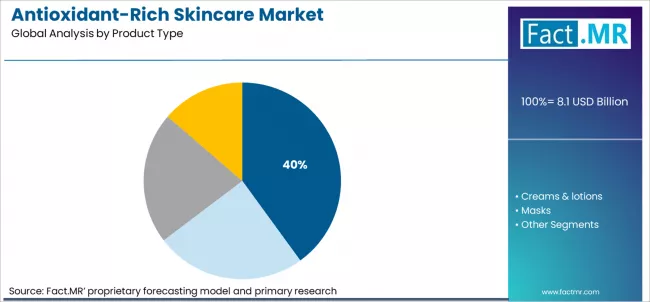
Antioxidant Rich Skincare Market Analysis By Product Type | Source: Fact.MR
Based on FACT.MR's antioxidant-rich skincare market report, consumption of serums is estimated to hold 40% share in 2026. Serums dominate because of higher active ingredient concentration, faster absorption, and compatibility with multi-step skincare regimens. Premium pricing per milliliter further amplifies revenue share versus creams.
- Estée Lauder Vitamin C Expansion: In March 2025, Estée Lauder expanded its Advanced Night Repair serum portfolio with antioxidant-focused variants targeting pollution defense. [2]
- L’Oréal Vitamin C Stabilization Tech: In 2024, L’Oréal disclosed continued R&D investment in stabilized ascorbic acid formulations improving shelf-life stability. [3]
- Sephora Digital Sales Growth: In 2024 earnings disclosures, Sephora reported double-digit online skincare sales growth, reinforcing e-commerce dominance. [4]
Antioxidant-Rich Skincare Market Analysis by End User
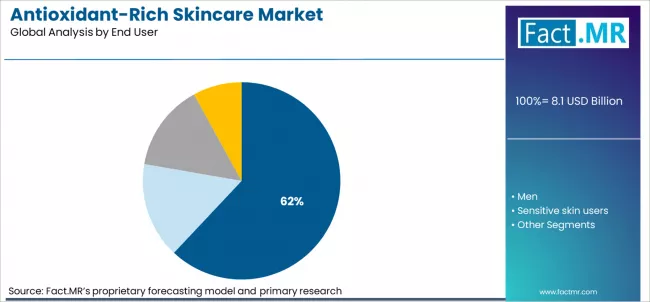
Antioxidant Rich Skincare Market Analysis By End User | Source: Fact.MR
Based on FACT.MR's antioxidant-rich skincare market report, consumption across Women segment estimated to hold 62% share in 2026. Women lead due to established multi-step skincare routines, higher layering frequency, and stronger engagement with preventative anti-aging regimens. Premium antioxidant serums and brightening products are more deeply integrated into daily routines among female consumers, driving higher repeat purchases and greater per-capita skincare spending compared to other end-user groups.
- Clinique Targeted Campaign Expansion: In February 2025, Clinique expanded its “Derm-Backed Radiance” campaign across North America and Europe, highlighting clinically tested antioxidant serums addressing hyperpigmentation and early aging. The campaign incorporated dermatologist endorsements and digital skin diagnostics, reinforcing efficacy-led positioning within specialty beauty retail channels. [1]
- Kiehl’s Sensitive Skin Portfolio Development: In September 2024, Kiehl’s broadened its antioxidant range within its sensitive skin portfolio, focusing on gentler Vitamin C derivatives designed to reduce irritation. This expansion responded to rising demand for dermatologist-tested, fragrance-free antioxidant formulations among female consumers. [2]
- Male Grooming Acceleration in Western Markets: While women remain the dominant segment, male skincare adoption is increasing across the U.S. and UK. In 2024, Procter & Gamble reported growth in male-focused skincare under its Olay and grooming brands, indicating gradual uptake of antioxidant moisturizers and serums among men. [3]
Drivers, Restraints, and Opportunities
FACT.MR analysts observe that antioxidant skincare has transitioned from optional beauty enhancement to preventative health positioning. The USD 8.0 billion valuation reflects its integration into daily skincare regimens rather than episodic cosmetic use.
The market is shifting from generic botanical extracts toward clinically validated active compounds such as stabilized Vitamin C and encapsulated polyphenols. Premium formulations command higher price per unit due to documented efficacy and dermatologist endorsement, even as volume growth moderates in saturated department store channels in mature markets.
- Regulatory Claims Scrutiny: Enforcement of the Modernization of Cosmetics Regulation Act (MoCRA) in the United States beginning in 2024 strengthened facility registration, adverse event reporting, and safety substantiation requirements. This regulatory shift increases compliance costs but enhances consumer trust, favoring established brands with clinical validation capabilities over smaller, loosely substantiated entrants.
- Digital Retail Expansion in India and China: Rapid expansion of direct-to-consumer (D2C) platforms and online beauty marketplaces in India and China is accelerating antioxidant product penetration beyond metropolitan centers. Influencer-led education and ingredient transparency campaigns are increasing awareness of oxidative stress and preventative skincare, supporting strong serum-led category growth.
- Clean Beauty Enforcement: In 2024, the UK Competition and Markets Authority (CMA) intensified oversight of environmental and “clean beauty” claims. Brands must now substantiate sustainability and ingredient transparency messaging, which encourages reformulation toward traceable antioxidant sourcing and strengthens the competitive position of clinically tested, evidence-backed products.
Regional Analysis
The antioxidant-rich skincare market is analysed across Asia Pacific, Europe, North America, Latin America, and Middle East and Africa, spanning over 40+ countries with distinct consumer skincare penetration levels, regulatory compliance frameworks, dermatology channel maturity, and digital commerce adoption profiles. The full report offers market attractiveness analysis based on premiumization intensity, e-commerce share of total skincare sales, ingredient innovation density, and cosmetic claims enforcement timelines by region.
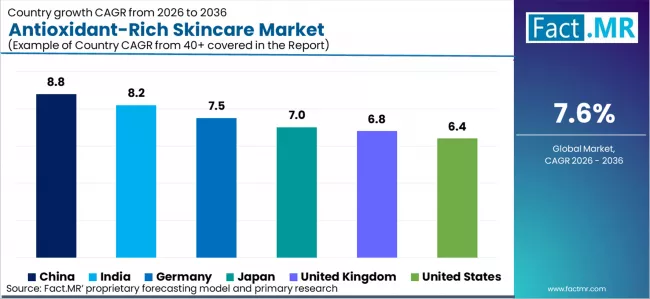
Antioxidant Rich Skincare Market Cagr Analysis By Country | Source: Fact.MR
| Country | CAGR (2026-2036) |
|---|---|
| China | 8.8% |
| India | 8.2% |
| Germany | 7.5% |
| Japan | 7.0% |
| United Kingdom | 6.8% |
| United States | 6.4% |
Source: Fact.MR analysis. Updated Mar 4, 2026
Source: Fact.MR (FACT.MR) analysis, based on proprietary forecasting model and primary research
Asia Pacific Antioxidant-Rich Skincare Market Analysis
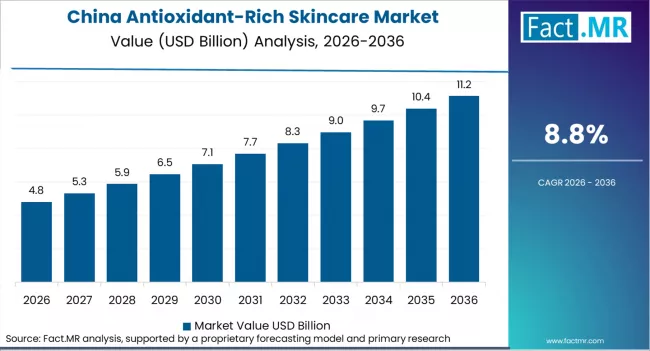
Antioxidant Rich Skincare Market Country Value Analysis | Source: Fact.MR
Asia Pacific is the volume consumption and fastest expansion epicenter for antioxidant-rich skincare, driven by urban pollution defense positioning, rapid digital commerce penetration, and strong domestic brand R&D investment. The region combines high social commerce engagement with accelerating demand for stabilized Vitamin C and clinically validated brightening formulations across both prestige and masstige segments.
- India: India’s antioxidant-rich skincare market is set to progress at a sustained 8.8% yearly growth pace through 2036, the fastest among major markets. Digital beauty platforms are the principal growth driver, with Nykaa reporting strong skincare revenue expansion in FY2024 driven by ingredient-focused serums. High UV exposure and pigmentation concerns structurally support Vitamin C and brightening antioxidant demand, while influencer-led education campaigns are expanding adoption into Tier 2 cities. Price sensitivity remains a moderating factor in non-urban markets.
- China: China stands out as a high-growth national market, with antioxidant-rich skincare demand forecast to advance at an 8.2% compound annual rate through 2036. Urban pollution concerns and “anti-oxidation” positioning is strengthening serum-led category growth in Tier 1 and Tier 2 cities. In March 2025, the National Medical Products Administration (NMPA) tightened cosmetic ingredient filing and safety documentation rules, raising substantiation requirements for active ingredient claims.
- Japan: Japan is projected to register a 7.0% CAGR in antioxidant-rich skincare demand through 2036. Japan’s aging demographic profile structurally supports anti-aging and firming formulations incorporating coenzyme Q10 and Vitamin C derivatives. In 2024, the Ministry of Health, Labour and Welfare reaffirmed quasi-drug claim standards under the Pharmaceutical and Medical Device Act, reinforcing substantiation requirements for efficacy positioning.
FACT.MR's Asia Pacific analysis of the antioxidant-rich skincare market covers China, India, Japan, South Korea, Australia and New Zealand, ASEAN, and Rest of Asia Pacific. Readers can find country-level CAGR projections, digital commerce penetration rates, dermatology channel expansion trends, regulatory enforcement updates, and premiumization benchmarks.
Europe Antioxidant-Rich Skincare Market Analysis
Europe remains regulation-led, with strict cosmetic claims substantiation requirements and pharmacy-channel credibility sustaining premium antioxidant serum demand across mature markets. Enforcement of EU Cosmetic Regulation (EC) No 1223/2009 strengthens clinically validated positioning and supports higher price realization relative to loosely substantiated botanical formulations.
- Germany: Germany is anticipated to record a 7.5% CAGR in antioxidant-rich skincare consumption through 2036. Pharmacy-led distribution and dermatologist endorsement underpin premium positioning. In 2024, German authorities reinforced evidence-backed claim enforcement under EU Regulation 1223/2009, discouraging unsubstantiated antioxidant efficacy marketing. Beiersdorf AG reported expanded R&D investment in its 2024 annual report targeting antioxidant and barrier-repair innovation under its Eucerin brand.
- United Kingdom: The UK market is projected to expand at a 6.8% average annual growth rate through 2036. In 2024, the Competition and Markets Authority (CMA) strengthened oversight of environmental and “clean beauty” marketing claims, increasing scrutiny of sustainability and ingredient transparency positioning. Boots UK expanded its premium skincare assortment in 2025, reinforcing pharmacy-led antioxidant serum distribution.
FACT.MR's European analysis of the antioxidant-rich skincare market covers Germany, France, the United Kingdom, Italy, Spain, the Netherlands, the Nordics, and Rest of Europe. Readers can find cosmetic compliance enforcement timelines, pharmacy channel penetration rates, dermatologist-backed brand positioning trends, and country-level CAGR projections by product type.
North America Antioxidant-Rich Skincare Market Analysis
North America remains innovation-led, with dermatologist-backed brands, prestige channel strength, and direct-to-consumer distribution sustaining structured antioxidant serum demand. Regulatory modernization and professional retail expansion reinforce clinically validated product positioning.
- United States: The U.S. antioxidant-rich skincare market is projected to expand at a 6.4% CAGR through 2036. Implementation of the Modernization of Cosmetics Regulation Act (MoCRA) in 2024 strengthened facility registration and safety substantiation requirements, increasing compliance standards for cosmetic manufacturers. This regulatory modernization favors established brands capable of meeting documentation and quality assurance thresholds. In its 2025 investor presentation, The Estée Lauder Companies reaffirmed skincare innovation particularly antioxidant serum development as a strategic growth priority.
FACT.MR's North American analysis of the antioxidant-rich skincare market covers the United States and Canada. Readers can find MoCRA compliance impacts, dermatologist channel expansion trends, demographic-driven anti-aging demand benchmarks, and country-level CAGR projections.
Competitive Aligners for Market Players
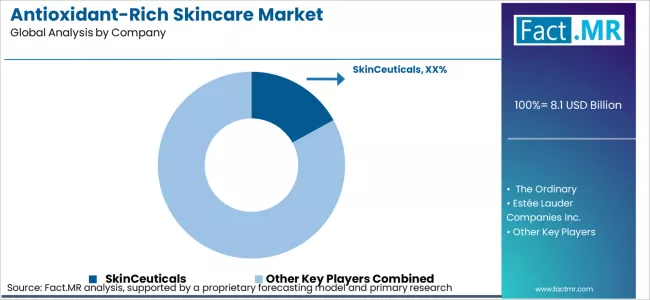
Antioxidant Rich Skincare Market Analysis By Company | Source: Fact.MR
The global antioxidant-rich skincare market is moderately concentrated at the prestige tier, while remaining fragmented across masstige and digital-native brands. Large multinational players such as Estée Lauder Companies, L’Oréal-owned brands, and Shiseido command strong positions due to deep R&D capabilities, dermatologist partnerships, and global distribution networks. Their structural advantage lies in ingredient stabilization technology particularly for Vitamin C and polyphenol complexes which requires sustained investment in formulation science and clinical testing. These capabilities create barriers for smaller entrants that rely on trend-driven botanical positioning without robust efficacy validation.
Digitally native brands such as The Ordinary and Paula’s Choice compete through ingredient transparency, simplified formulations, and direct-to-consumer pricing models. This has reshaped consumer expectations around concentration disclosure and clinical evidence. Buyer behavior differs by channel: department stores remain promotion-heavy and price sensitive, while D2C platforms allow brands to retain margin control and build subscription-based loyalty.
As regulatory scrutiny on cosmetic claims intensifies globally, competitive differentiation is shifting from marketing-led storytelling to scientifically substantiated efficacy, reinforcing the advantage of players with documented clinical data and dermatologist credibility.
Recent Development
- In June 2025, L’Oréal agreed to acquire a majority stake in British skincare brand Medik8 in June 2025, strengthening its position in science-backed anti-aging and serum segments.
- In May 2025, e.l.f. Beauty announced the acquisition of Hailey Bieber’s skincare brand Rhode in a deal valued at approximately USD 1 billion. Rhode had achieved rapid growth as a minimalist skincare brand with strong media resonance, and the acquisition aims to expand e.l.f.’s portfolio and accelerate innovation under a high-momentum brand founder leadership.
Key Players
- SkinCeuticals
- The Ordinary
- Estée Lauder Companies Inc.
- Paula’s Choice LLC
- Drunk Elephant
- Kiehl’s LLC
- Murad LLC
- La Roche-Posay
- Olay (Procter & Gamble)
- Clinique Laboratories LLC
Bibliography
- [1] The Estée Lauder Companies Inc. (2025). Investor Presentation FY2025.
- [2] The Estée Lauder Companies Inc. (2025). Product Launch Announcement.
- [3] L’Oréal Group. (2024). Research & Innovation Report.
- [4] Sephora (LVMH). (2024). Annual Results Presentation.
- [5] Shiseido Company Limited. (2024). Integrated Report.
- [6] Paula’s Choice. (2025). Product Launch Press Release.
- [7] Procter & Gamble. (2025). Annual Report.
- [8] Nykaa (FSN E-Commerce Ventures). (2024). Annual Report.
This Report Addresses
- Strategic intelligence on dermatologist-led antioxidant serum adoption, MoCRA compliance impact in the U.S., EU cosmetic claims enforcement, and rapid D2C skincare expansion across India and China.
- Market size and forecast: valued at USD 8.1 billion in 2026, projected to reach USD 16.9 billion by 2036 at a 7.6% CAGR, segmented by product type, key ingredient, function, channel, end user, and region.
- Growth opportunity mapping across stabilized Vitamin C and resveratrol formulations, anti-aging & firming demand, e-commerce-led premiumization, and masstige expansion in high-growth Asian markets.
- Country CAGR outlook: India (8.8%), China (8.2%), Germany (7.5%), Japan (7.0%), United Kingdom (6.8%), and United States (6.4%) with detailed segment splits by product type and function.
- Competitive analysis of Estée Lauder, SkinCeuticals, L’Oréal-owned brands, Shiseido, Paula’s Choice, and Kiehl’s covering clinical validation depth, ingredient stabilization capability, digital reach, and dermatologist partnerships.
- Product and technology tracking including stabilized L-ascorbic acid systems, encapsulated polyphenols, coenzyme Q10 anti-aging complexes, sensitive-skin antioxidant derivatives, and sustainable ingredient sourcing innovations.
- Regulatory impact analysis covering U.S. MoCRA enforcement (2024), EU Cosmetic Regulation (EC) No 1223/2009 claim substantiation, UK CMA clean beauty scrutiny, and India Cosmetic Rules compliance updates.
- Report delivered in Excel datasets, PowerPoint summary, and detailed PDF supported by verified corporate disclosures, regulatory publications, and primary research inputs.
Segmentation
Scope of Report
| Items | Values |
|---|---|
| Quantitative Units | USD 8.1 billion (2026) to USD 16.9 billion (2036), at a CAGR of 7.6% |
| Market Definition | Antioxidant-rich skincare products are topical cosmetic formulations containing active compounds such as Vitamin C, Vitamin E, polyphenols, resveratrol, and coenzyme Q10 designed to neutralize oxidative stress, prevent premature aging, improve skin brightness, and support barrier repair across daily skincare regimens. |
| Product Type | Serums, Creams & Lotions, Masks, Toners & Essences |
| Key Ingredient | Vitamin C, Vitamin E, Green Tea Polyphenols, Resveratrol, Coenzyme Q10 |
| Function | Anti-aging & Firming, Brightening, Free Radical Protection, UV Damage Repair |
| Channel | E-commerce, Pharmacies/Drugstores, Department Stores, Specialty Beauty Retail |
| End User | Women, Men, Sensitive Skin Users, Unisex |
| Application Coverage | Preventative anti-aging regimens, pigmentation correction, pollution-defense skincare, blue-light protection positioning, dermatologist-recommended formulations, sensitive-skin antioxidant solutions, and daily serum-based treatment layering within prestige and masstige skincare routines. |
| Regions Covered | Asia Pacific, Europe, North America, Latin America, Middle East and Africa |
| Countries Covered | China, Japan, South Korea, India, Australia and New Zealand, ASEAN, Rest of Asia Pacific, Germany, United Kingdom, France, Italy, Spain, Netherlands, Nordics, Rest of Europe, United States, Canada, Mexico, Brazil, Chile, Ecuador, Rest of Latin America, Kingdom of Saudi Arabia, United Arab Emirates, South Africa, Turkey, Rest of Middle East and Africa |
| Key Companies Profiled | SkinCeuticals, The Ordinary, Estée Lauder Companies Inc., Paula’s Choice LLC, Drunk Elephant, Kiehl’s LLC, Murad LLC, La Roche-Posay, Olay (Procter & Gamble), Clinique Laboratories LLC |
| Approach | A hybrid top-down and bottom-up model was applied. Top-down inputs covered regional skincare revenue forecasts, regulatory compliance timelines, and digital commerce penetration trends. Bottom-up analysis incorporated average selling prices by product type and channel, ingredient penetration rates, repeat purchase cycles, premiumization intensity, and primary interviews with cosmetic formulators, dermatology retailers, distributors, and brand executives. |
Source: Fact.MR analysis. Updated Mar 4, 2026
Antioxidant-Rich Skincare Market by Segments
-
By Product Type :
- Serums
- Creams & lotions
- Masks
- Toners & essences
-
By Key Ingredients :
- Vitamin C
- Vitamin E
- Green tea polyphenols
- Resveratrol
- Coenzyme Q10
-
By Function :
- Anti-aging & firming
- Brightening
- Free radical protection
- UV damage repair
-
By Channel :
- E-commerce
- Pharmacies/drugstores
- Department stores
- Specialty beauty retail
-
By End User :
- Women
- Men
- Sensitive skin users
- Unisex
-
By Region :
- North America
- United States
- Canada
- Mexico
- Europe
- Germany
- United Kingdom
- France
- Italy
- Spain
- Netherlands
- Nordics
- Rest of Europe
- Asia Pacific
- China
- Japan
- South Korea
- India
- Australia and New Zealand
- ASEAN
- Rest of Asia Pacific
- Latin America
- Brazil
- Chile
- Ecuador
- Rest of Latin America
- Middle East and Africa
- Kingdom of Saudi Arabia
- United Arab Emirates
- South Africa
- Turkey
- Rest of Middle East and Africa
- North America
Frequently Asked Questions
How large is the antioxidant-rich skincare market in 2025?
What is the estimated market size in 2026?
What will the market value be by 2036?
What is the expected CAGR from 2026 to 2036?
What is the total absolute dollar opportunity between 2026 and 2036?
Which product type leads the antioxidant-rich skincare market?
Which function segment holds the largest share?
Which distribution channel accounts for the largest revenue share?
Which end-user segment dominates the market?
Which country is projected to grow the fastest?
What drives demand for antioxidant-rich skincare products?
How does regulation impact the antioxidant skincare market?
Who worked on this report


Preview the report firsthand - request a free sample
Free SampleGet the brochure for pricing and purchase details
Download PDF