Post-Biotic Skincare Market (2026 - 2036)

Post-Biotic Skincare Market Size and Share Forecast Outlook 2026 to 2036

Core Findings

    Post-Biotic Skincare Market Forecast and Outlook 2026 to 2036

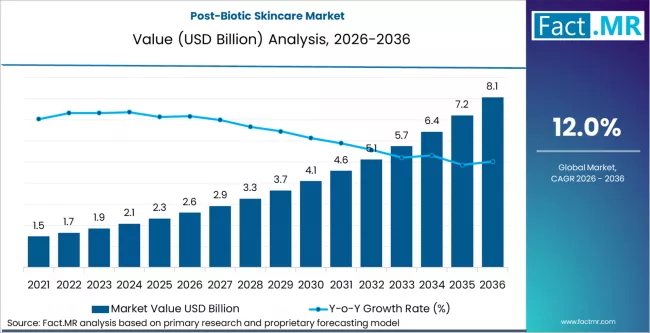
    The post-biotic skincare market is projected to grow from USD 2.6 billion in 2026 to USD 8.1 billion by 2036, reflecting a 12% CAGR.

    Post-Biotic Skincare Market Key Takeaways

    • Post-Biotic Skincare Market Value (2026): USD 2.6 billion
    • Post-Biotic Skincare Market Forecast Value (2036): USD 8.1 billion
    • Post-Biotic Skincare Market Forecast CAGR: 12%
    • Leading Type in Post-Biotic Skincare Market: Facial skincare (serums, moisturizers)
    • Key Growth Regions in Post-Biotic Skincare Market: North America, Europe, Asia Pacific, Latin America, Middle East & Africa
    • Top Players in Post-Biotic Skincare Market: L’Oréal, Beiersdorf, Kenvue, Unilever, Shiseido
    Post Biotic Skincare Market Market Value Analysis

    This category centers on ingredients that deliver functional skin benefits without the handling limits linked to live cultures. Formulators use these materials to secure stable shelf life, consistent texture, and predictable performance across large production volumes. Commercial uptake depends on repeatable results, compatibility with existing bases, and uniform sensory output across batches.

    Once a post-biotic system is validated, it is commonly extended across multiple products and regions to simplify sourcing and quality control. Investment decisions favor suppliers that can guarantee documentation, traceability, and steady supply. Growth comes from broader placement in care routines and from portfolio expansion within established brands rather than short cycle launches. The operating model rewards scale and process discipline, which supports long production runs and change management across ranges.

    Post-Biotic Skincare Market

    Metric Value
    Market Value (2026) USD 2.6 billion
    Forecast Value (2036) USD 8.1 billion
    Forecast CAGR (2026-2036) 12.0%

    Category

    Category Segments
    Product Categories Facial skincare (serums, moisturizers); Cleansers and barrier-repair washes; Body care products; Scalp care and shampoos; Dermatological skincare lines
    Skin Concerns or Claims Barrier repair and sensitivity reduction; Acne and microbiome balancing; Atopic dermatitis adjunct care; Anti-aging or texture improvement; Post-procedure soothing
    Sales Channel Mass retail and e-commerce; Regional pharmacies and drugstores; Dermatology clinics; Specialty beauty retail; Others
    Region North America; Europe; Asia Pacific; Latin America; Middle East & Africa

    Post-Biotic Skincare Market Segmental Analysis

    Why Does Facial Skincare Remain the Primary Product Category in Post-Biotic Formulations?
    Post Biotic Skincare Market Analysis By Product Categories

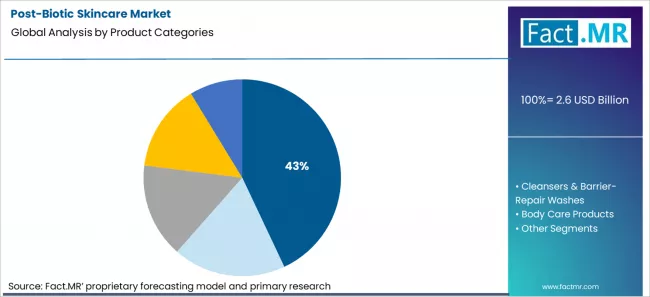
    Facial skincare products, including serums and moisturizers, account for 43% of product category usage in the post biotic skincare market. This area concentrates daily routines where consumers apply multiple layers and expect visible comfort and texture changes. Formulation teams place post-biotic ingredients here to influence barrier condition, surface balance, and tolerance without changing basic usage habits. Packaging sizes and price points also support frequent repurchase cycles. Retail presentation and online assortments give the face category the most shelf space and promotional attention. Cleansers, body care, scalp products, and dermatological lines extend coverage into other needs. The frequency and central role of facial routines keep this category as the main volume anchor for post-biotic skincare.

    Why Does Barrier Repair and Sensitivity Reduction Lead the List of Skin Concerns Addressed?
    Post Biotic Skincare Market Analysis By Skin Concerns Or Claims

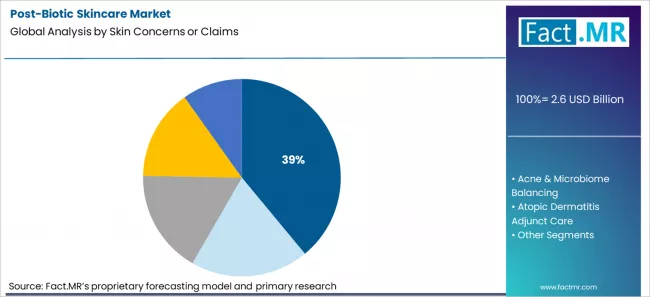
    Barrier repair and sensitivity reduction represent 39% of skin concern focus in the post biotic skincare market. Many users enter this category with complaints linked to irritation, tightness, or reactive skin rather than to purely cosmetic goals. Product development in this space emphasizes restoring surface comfort and reducing response to everyday triggers such as weather, cleansing, or treatments. Usage patterns involve regular, long-term application rather than short treatment courses. Dermatology influenced marketing and in-store guidance also steer consumers toward barrier focused claims as a first step before addressing acne or aging. Other concerns remain active. The broad relevance of comfort and tolerance keeps barrier support as the leading claim area.

    How Are Clinical Evidence Standards and Formulation Risk Shaping the Post-Biotic Skincare Category?

    • Scientific Logic: Post-biotics are being selected because they deliver defined, non-living bioactive fractions that influence barrier function, inflammation modulation, and skin comfort without the stability and safety risks associated with live microorganisms.
    • Adoption Friction: Absence of a universally accepted regulatory definition and uneven quality of clinical substantiation across suppliers make claim construction and dermatologist acceptance more difficult.
    • Formulation Direction: R&D teams are prioritizing ingredients with mechanistic data on ceramide support, TEWL reduction, and redness control rather than broad “microbiome balancing” narratives.
    • Go-to-Market Structure: Most credible launches are positioned in sensitive skin, post-procedure, and barrier repair segments where tolerability and predictability matter more than novelty.

    Analysis of the Post-Biotic Skincare Market by Key Country
    Post Biotic Skincare Market Cagr Analysis By Country

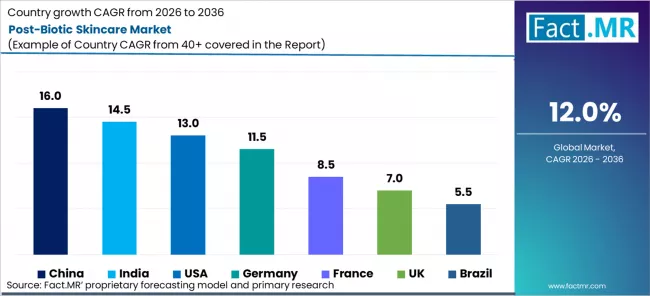
    Country CAGR (2026-2036)
    USA 13.0%
    China 16.0%
    India 14.5%
    Germany 11.5%
    France 8.5%
    UK 7.0%
    Brazil 5.5%

    The report covers an in-depth analysis of 40+ countries; top-performing countries are highlighted below.

    What Determines Clinical Positioning in the Post-Biotic Skincare Market in USA?

    Clinical adoption in USA is being planned around a trajectory close to 13% annually through 2036, which is reshaping how the post-biotic skincare market is positioned across professional channels. Dermatologist recommendation and specialty retail gatekeeping define credibility. Product development emphasizes barrier repair, inflammation control, and tolerance documentation. Distribution remains anchored in curated chains and clinic-linked outlets. Manufacturing strategy focuses on consistency, auditability, and supply continuity. Procurement favors suppliers with regulatory discipline. Volume growth is supported by chronic skin condition management and repeat purchase behavior. Expansion follows premium routine consolidation rather than rapid assortment churn or promotion-driven portfolio cycling.

    Why Does Industrial Scale Control the Post-Biotic Skincare Market in China?

    A 16% annual expansion rate through 2036 in China is forcing manufacturers to prioritize throughput and channel velocity over portfolio stability in the post-biotic skincare market. Platform retail, livestream commerce, and logistics reach determine commercial success. Product strategy centers on fast iteration and large batch output. Ingredient narratives support promotion, but production economics decide survival. Procurement favors vertically integrated suppliers controlling formulation and packaging. Distribution efficiency outweighs brand heritage. Volume growth follows traffic-based campaigns and channel rollout. Long-term regimen building remains secondary to rapid portfolio rotation and promotion scheduling within highly competitive digital commerce ecosystems.

    How Does Access Economics Shape the Post-Biotic Skincare Market in India?

    In India, a pace near 14.5% through 2036 is expanding the post-biotic skincare market primarily through access-driven categories rather than premium therapeutic positioning. Demand concentrates on acne management, pigmentation control, and basic barrier recovery. Portfolios are structured around entry price points and small packs. Distribution relies on pharmacy chains and regional trade networks. Manufacturing emphasizes domestic sourcing and cost discipline. Procurement decisions depend on margin structure and geographic coverage. Clinical influence remains concentrated in large cities, while retail visibility drives volume elsewhere. Growth follows organized retail expansion rather than specialist-led regimen migration.

    What Role Does Evidence-Based Practice Play in the Post-Biotic Skincare Market in Germany?

    In Germany, an 11.5% growth trajectory through 2036 is not accelerating adoption quickly, but it is widening acceptance of the post-biotic skincare market inside pharmacy and medically oriented channels. Product positioning depends on safety data, tolerability profiles, and documented performance. Manufacturing processes emphasize controlled formulation and traceability. Procurement favors suppliers meeting strict testing and compliance thresholds. Consumer switching behavior remains conservative. Volume growth is supported by sensitive skin and treatment-adjacent categories. Expansion occurs through gradual integration into care routines rather than portfolio disruption, influencer marketing, or fashion-driven assortment changes in mass retail environments.

    Why Does Institutional Structure Govern the Post-Biotic Skincare Market in France?

    France remains a controlled adoption environment, even with an 8.5% growth rate projected through 2036 for the post-biotic skincare market. Pharmacy-centered distribution and medical endorsement frameworks determine brand credibility. Product claims focus on microbiome balance and barrier stabilization. Manufacturing emphasizes formulation stability and regulatory conformity. Procurement decisions prioritize supplier reputation and documentation standards. Consumer purchasing follows treatment routines rather than discretionary experimentation. Volume growth remains measured because regimen change occurs slowly. Expansion depends on healthcare system alignment and professional validation rather than competitive repositioning, influencer momentum, or aggressive assortment expansion strategies across beauty retail.

    How Do Budget Structures Influence the Post-Biotic Skincare Market in UK?

    Budget discipline means that a 7% annual increase through 2036 in UK translates into distribution expansion, not margin expansion, for the post-biotic skincare market. Demand centers on sensitive skin, eczema-prone conditions, and maintenance products. Distribution is dominated by drugstores and online platforms. Manufacturing strategies prioritize scalable formulations and packaging efficiency. Procurement decisions are driven by promotional cycles and shelf productivity metrics. Private label participation remains significant. Volume growth follows broader skincare usage rather than regimen intensification. Expansion remains constrained by price competition and strong presence of established therapeutic brands within everyday consumer purchasing patterns.

    What Constrains Premium Adoption in the Post-Biotic Skincare Market in Brazil?

    Brazil demonstrates 5.5% trajectory through 2036 limits premiumization more than it supports it in the post-biotic skincare market. Income dispersion and retail price sensitivity shape demand toward acne control, oil regulation, and basic recovery products. Brands emphasize affordability and channel reach. Manufacturing strategies favor local production and cost containment. Procurement decisions depend on retail penetration and promotional support. Pharmacies and mass retailers account for most sales. Consumer upgrading remains selective. Volume growth follows gradual formalization of skincare usage rather than premium regimen adoption or specialist-driven dermatological positioning strategies.

    How Are Brand Portfolios and Validation Strategies Structuring Competition in the Post Biotic Skincare Market?
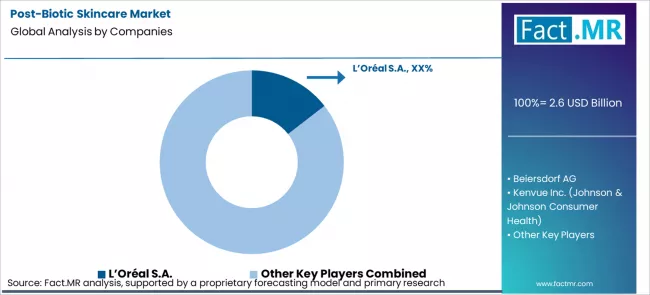
    Post Biotic Skincare Market Analysis By Company

    Competition in the post biotic skincare market is centered on portfolio positioning, claims architecture, and the ability to scale formulations across mass and premium channels. L’Oréal and Unilever use multi brand strategies to place post biotic concepts across dermatology, dermocosmetic, and mass retail ranges, supported by internal testing frameworks and rapid global rollouts. Beiersdorf and Shiseido focus on skin barrier repair and sensitive skin positioning, integrating post biotics into existing hero franchises to protect margin and shelf space. Kenvue leverages medical credibility and pharmacy channel reach to support trust based adoption. Product strategy depends on stability validation, reproducible ferment fractions, and compatibility with established base formulas. Marketing claims are tightly linked to internal testing protocols and regulatory risk management. Scale, not novelty, determines leadership. Once a platform proves transferable across multiple brands, competitors respond through range extensions, not single product launches. Channel control and brand architecture shape competitive outcomes more than ingredient access.

    Key Players in Post-Biotic Skincare Market

    • L’Oréal S.A.
    • Beiersdorf AG
    • Kenvue Inc. (Johnson & Johnson Consumer Health)
    • Unilever PLC
    • Shiseido Company, Limited
    • Others

    Scope of the Report

    Items Values
    Quantitative Units (2026) USD billion
    Product Categories Facial skincare (serums, moisturizers), cleansers and barrier-repair washes, body care products, scalp care and shampoos, dermatological skincare lines
    Skin Concerns or Claims Barrier repair and sensitivity reduction, acne and microbiome balancing, atopic dermatitis adjunct care, anti-aging or texture improvement, post-procedure soothing
    Sales Channel Mass retail and e-commerce, regional pharmacies and drugstores, dermatology clinics, specialty beauty retail, others
    Regions Covered Asia Pacific, Europe, North America, Latin America, Middle East & Africa
    Countries Covered United States, Canada, Mexico, Germany, United Kingdom, France, Italy, Spain, China, Japan, South Korea, India, Australia & New Zealand, ASEAN, Brazil, Chile, Saudi Arabia, Turkey, South Africa, and other regional markets
    Key Companies Profiled L’Oréal, Beiersdorf, Kenvue (Johnson & Johnson Consumer Health), Unilever, Shiseido
    Additional Attributes Dollar by sales by product category, skin concern, and sales channel; focus on barrier repair, tolerability claims, and formulation stability; demand driven by routine skincare integration and portfolio scale-up

    Post-Biotic Skincare Market Segmentation

    • Product Categories :

      • Facial Skincare (Serums, Moisturizers)
      • Cleansers & Barrier-Repair Washes
      • Body Care Products
      • Scalp Care & Shampoos
      • Dermatological Skincare Lines
    • Skin Concerns or Claims :

      • Barrier Repair & Sensitivity Reduction
      • Acne & Microbiome Balancing
      • Atopic Dermatitis Adjunct Care
      • Anti-Aging or Texture Improvement
      • Post-Procedure Soothing
    • Sales Channel :

      • Mass Retail & E-commerce
      • Regional Pharmacies & Drugstores
      • Dermatology Clinics
      • Specialty Beauty Retail
      • Others
    • Region :

      • Asia Pacific
        • China
        • Japan
        • South Korea
        • India
        • Australia & New Zealand
        • ASEAN
        • Rest of Asia Pacific
      • Europe
        • Germany
        • United Kingdom
        • France
        • Italy
        • Spain
        • Nordic
        • BENELUX
        • Rest of Europe
      • North America
        • United States
        • Canada
        • Mexico
      • Latin America
        • Brazil
        • Chile
        • Rest of Latin America
      • Middle East & Africa
        • Kingdom of Saudi Arabia
        • Other GCC Countries
        • Turkey
        • South Africa
        • Other African Union
        • Rest of Middle East & Africa

    References

    • European Commission, Scientific Committee on Consumer Safety (SCCS). (2023). Notes of guidance for the testing of cosmetic ingredients and their safety evaluation (12th revision). European Commission.
    • European Commission. (2024). Cosmetic products regulation (EC) No 1223/2009 - consolidated version. EUR-Lex.
    • National Institutes of Health, National Center for Biotechnology Information. (2023). Postbiotics in dermatology: Mechanisms of action and clinical applications. PubMed Central.
    • National Institutes of Health, National Center for Biotechnology Information. (2024). Skin barrier function and the role of microbial metabolites. PubMed Central.

    Table of Content

    1. Executive Summary
      • Global Market Outlook
      • Demand to side Trends
      • Supply to side Trends
      • Technology Roadmap Analysis
      • Analysis and Recommendations
    2. Market Overview
      • Market Coverage / Taxonomy
      • Market Definition / Scope / Limitations
    3. Research Methodology
      • Chapter Orientation
      • Analytical Lens and Working Hypotheses
        • Market Structure, Signals, and Trend Drivers
        • Benchmarking and Cross-market Comparability
        • Market Sizing, Forecasting, and Opportunity Mapping
      • Research Design and Evidence Framework
        • Desk Research Programme (Secondary Evidence)
          • Company Annual and Sustainability Reports
          • Peer-reviewed Journals and Academic Literature
          • Corporate Websites, Product Literature, and Technical Notes
          • Earnings Decks and Investor Briefings
          • Statutory Filings and Regulatory Disclosures
          • Technical White Papers and Standards Notes
          • Trade Journals, Industry Magazines, and Analyst Briefs
          • Conference Proceedings, Webinars, and Seminar Materials
          • Government Statistics Portals and Public Data Releases
          • Press Releases and Reputable Media Coverage
          • Specialist Newsletters and Curated Briefings
          • Expert Input and Fieldwork (Primary Evidence)
            • Primary Modes
              • Qualitative Interviews and Expert Elicitation
              • Quantitative Surveys and Structured Data Capture
              • Blended Approach
            • Why Primary Evidence is Used
            • Field Techniques
              • Interviews
              • Surveys
              • Focus Groups
              • Observational and In-context Research
              • Social and Community Interactions
            • Stakeholder Universe Engaged
              • C-suite Leaders
              • Board Members
              • Presidents and Vice Presidents
              • R&D and Innovation Heads
              • Technical Specialists
              • Domain Subject-matter Experts
              • Scientists
              • Physicians and Other Healthcare Professionals
            • Governance, Ethics, and Data Stewardship
              • Research Ethics
              • Data Integrity and Handling
          • Tooling, Models, and Reference Databases
        • Data Engineering and Model Build
          • Data Acquisition and Ingestion
          • Cleaning, Normalisation, and Verification
          • Synthesis, Triangulation, and Analysis
        • Quality Assurance and Audit Trail
      • Market Background
        • Market Dynamics
          • Drivers
          • Restraints
          • Opportunity
          • Trends
        • Scenario Forecast
          • Demand in Optimistic Scenario
          • Demand in Likely Scenario
          • Demand in Conservative Scenario
        • Opportunity Map Analysis
        • Product Life Cycle Analysis
        • Supply Chain Analysis
        • Investment Feasibility Matrix
        • Value Chain Analysis
        • PESTLE and Porter’s Analysis
        • Regulatory Landscape
        • Regional Parent Market Outlook
        • Production and Consumption Statistics
        • Import and Export Statistics
      • Global Market Analysis 2021 to 2025 and Forecast, 2026 to 2036
        • Historical Market Size Value (USD Million) Analysis, 2021 to 2025
        • Current and Future Market Size Value (USD Million) Projections, 2026 to 2036
          • Y to o to Y Growth Trend Analysis
          • Absolute $ Opportunity Analysis
      • Global Market Pricing Analysis 2021 to 2025 and Forecast 2026 to 2036
      • Global Market Analysis 2021 to 2025 and Forecast 2026 to 2036, By Product Categories
        • Introduction / Key Findings
        • Historical Market Size Value (USD Million) Analysis By Product Categories, 2021 to 2025
        • Current and Future Market Size Value (USD Million) Analysis and Forecast By Product Categories, 2026 to 2036
          • Facial Skincare (Serums, Moisturizers)
          • Cleansers & Barrier-Repair Washes
          • Body Care Products
          • Scalp Care & Shampoos
          • Dermatological Skincare Lines
        • Y to o to Y Growth Trend Analysis By Product Categories, 2021 to 2025
        • Absolute $ Opportunity Analysis By Product Categories, 2026 to 2036
      • Global Market Analysis 2021 to 2025 and Forecast 2026 to 2036, By Skin Concerns or Claims
        • Introduction / Key Findings
        • Historical Market Size Value (USD Million) Analysis By Skin Concerns or Claims, 2021 to 2025
        • Current and Future Market Size Value (USD Million) Analysis and Forecast By Skin Concerns or Claims, 2026 to 2036
          • Barrier Repair & Sensitivity Reduction
          • Acne & Microbiome Balancing
          • Atopic Dermatitis Adjunct Care
          • Anti-Aging or Texture Improvement
          • Post-Procedure Soothing
        • Y to o to Y Growth Trend Analysis By Skin Concerns or Claims, 2021 to 2025
        • Absolute $ Opportunity Analysis By Skin Concerns or Claims, 2026 to 2036
      • Global Market Analysis 2021 to 2025 and Forecast 2026 to 2036, By Sales Channel
        • Introduction / Key Findings
        • Historical Market Size Value (USD Million) Analysis By Sales Channel, 2021 to 2025
        • Current and Future Market Size Value (USD Million) Analysis and Forecast By Sales Channel, 2026 to 2036
          • Mass Retail & E-commerce
          • Regional Pharmacies & Drugstores
          • Dermatology Clinics
          • Specialty Beauty Retail
          • Others
        • Y to o to Y Growth Trend Analysis By Sales Channel, 2021 to 2025
        • Absolute $ Opportunity Analysis By Sales Channel, 2026 to 2036
      • Global Market Analysis 2021 to 2025 and Forecast 2026 to 2036, By Region
        • Introduction
        • Historical Market Size Value (USD Million) Analysis By Region, 2021 to 2025
        • Current Market Size Value (USD Million) Analysis and Forecast By Region, 2026 to 2036
          • North America
          • Latin America
          • Western Europe
          • Eastern Europe
          • East Asia
          • South Asia and Pacific
          • Middle East & Africa
        • Market Attractiveness Analysis By Region
      • North America Market Analysis 2021 to 2025 and Forecast 2026 to 2036, By Country
        • Historical Market Size Value (USD Million) Trend Analysis By Market Taxonomy, 2021 to 2025
        • Market Size Value (USD Million) Forecast By Market Taxonomy, 2026 to 2036
          • By Country
            • USA
            • Canada
            • Mexico
          • By Product Categories
          • By Skin Concerns or Claims
          • By Sales Channel
        • Market Attractiveness Analysis
          • By Country
          • By Product Categories
          • By Skin Concerns or Claims
          • By Sales Channel
        • Key Takeaways
      • Latin America Market Analysis 2021 to 2025 and Forecast 2026 to 2036, By Country
        • Historical Market Size Value (USD Million) Trend Analysis By Market Taxonomy, 2021 to 2025
        • Market Size Value (USD Million) Forecast By Market Taxonomy, 2026 to 2036
          • By Country
            • Brazil
            • Chile
            • Rest of Latin America
          • By Product Categories
          • By Skin Concerns or Claims
          • By Sales Channel
        • Market Attractiveness Analysis
          • By Country
          • By Product Categories
          • By Skin Concerns or Claims
          • By Sales Channel
        • Key Takeaways
      • Western Europe Market Analysis 2021 to 2025 and Forecast 2026 to 2036, By Country
        • Historical Market Size Value (USD Million) Trend Analysis By Market Taxonomy, 2021 to 2025
        • Market Size Value (USD Million) Forecast By Market Taxonomy, 2026 to 2036
          • By Country
            • Germany
            • UK
            • Italy
            • Spain
            • France
            • Nordic
            • BENELUX
            • Rest of Western Europe
          • By Product Categories
          • By Skin Concerns or Claims
          • By Sales Channel
        • Market Attractiveness Analysis
          • By Country
          • By Product Categories
          • By Skin Concerns or Claims
          • By Sales Channel
        • Key Takeaways
      • Eastern Europe Market Analysis 2021 to 2025 and Forecast 2026 to 2036, By Country
        • Historical Market Size Value (USD Million) Trend Analysis By Market Taxonomy, 2021 to 2025
        • Market Size Value (USD Million) Forecast By Market Taxonomy, 2026 to 2036
          • By Country
            • Russia
            • Poland
            • Hungary
            • Balkan & Baltic
            • Rest of Eastern Europe
          • By Product Categories
          • By Skin Concerns or Claims
          • By Sales Channel
        • Market Attractiveness Analysis
          • By Country
          • By Product Categories
          • By Skin Concerns or Claims
          • By Sales Channel
        • Key Takeaways
      • East Asia Market Analysis 2021 to 2025 and Forecast 2026 to 2036, By Country
        • Historical Market Size Value (USD Million) Trend Analysis By Market Taxonomy, 2021 to 2025
        • Market Size Value (USD Million) Forecast By Market Taxonomy, 2026 to 2036
          • By Country
            • China
            • Japan
            • South Korea
          • By Product Categories
          • By Skin Concerns or Claims
          • By Sales Channel
        • Market Attractiveness Analysis
          • By Country
          • By Product Categories
          • By Skin Concerns or Claims
          • By Sales Channel
        • Key Takeaways
      • South Asia and Pacific Market Analysis 2021 to 2025 and Forecast 2026 to 2036, By Country
        • Historical Market Size Value (USD Million) Trend Analysis By Market Taxonomy, 2021 to 2025
        • Market Size Value (USD Million) Forecast By Market Taxonomy, 2026 to 2036
          • By Country
            • India
            • ASEAN
            • Australia & New Zealand
            • Rest of South Asia and Pacific
          • By Product Categories
          • By Skin Concerns or Claims
          • By Sales Channel
        • Market Attractiveness Analysis
          • By Country
          • By Product Categories
          • By Skin Concerns or Claims
          • By Sales Channel
        • Key Takeaways
      • Middle East & Africa Market Analysis 2021 to 2025 and Forecast 2026 to 2036, By Country
        • Historical Market Size Value (USD Million) Trend Analysis By Market Taxonomy, 2021 to 2025
        • Market Size Value (USD Million) Forecast By Market Taxonomy, 2026 to 2036
          • By Country
            • Kingdom of Saudi Arabia
            • Other GCC Countries
            • Turkiye
            • South Africa
            • Other African Union
            • Rest of Middle East & Africa
          • By Product Categories
          • By Skin Concerns or Claims
          • By Sales Channel
        • Market Attractiveness Analysis
          • By Country
          • By Product Categories
          • By Skin Concerns or Claims
          • By Sales Channel
        • Key Takeaways
      • Key Countries Market Analysis
        • USA
          • Pricing Analysis
          • Market Share Analysis, 2025
            • By Product Categories
            • By Skin Concerns or Claims
            • By Sales Channel
        • Canada
          • Pricing Analysis
          • Market Share Analysis, 2025
            • By Product Categories
            • By Skin Concerns or Claims
            • By Sales Channel
        • Mexico
          • Pricing Analysis
          • Market Share Analysis, 2025
            • By Product Categories
            • By Skin Concerns or Claims
            • By Sales Channel
        • Brazil
          • Pricing Analysis
          • Market Share Analysis, 2025
            • By Product Categories
            • By Skin Concerns or Claims
            • By Sales Channel
        • Chile
          • Pricing Analysis
          • Market Share Analysis, 2025
            • By Product Categories
            • By Skin Concerns or Claims
            • By Sales Channel
        • Germany
          • Pricing Analysis
          • Market Share Analysis, 2025
            • By Product Categories
            • By Skin Concerns or Claims
            • By Sales Channel
        • UK
          • Pricing Analysis
          • Market Share Analysis, 2025
            • By Product Categories
            • By Skin Concerns or Claims
            • By Sales Channel
        • Italy
          • Pricing Analysis
          • Market Share Analysis, 2025
            • By Product Categories
            • By Skin Concerns or Claims
            • By Sales Channel
        • Spain
          • Pricing Analysis
          • Market Share Analysis, 2025
            • By Product Categories
            • By Skin Concerns or Claims
            • By Sales Channel
        • France
          • Pricing Analysis
          • Market Share Analysis, 2025
            • By Product Categories
            • By Skin Concerns or Claims
            • By Sales Channel
        • India
          • Pricing Analysis
          • Market Share Analysis, 2025
            • By Product Categories
            • By Skin Concerns or Claims
            • By Sales Channel
        • ASEAN
          • Pricing Analysis
          • Market Share Analysis, 2025
            • By Product Categories
            • By Skin Concerns or Claims
            • By Sales Channel
        • Australia & New Zealand
          • Pricing Analysis
          • Market Share Analysis, 2025
            • By Product Categories
            • By Skin Concerns or Claims
            • By Sales Channel
        • China
          • Pricing Analysis
          • Market Share Analysis, 2025
            • By Product Categories
            • By Skin Concerns or Claims
            • By Sales Channel
        • Japan
          • Pricing Analysis
          • Market Share Analysis, 2025
            • By Product Categories
            • By Skin Concerns or Claims
            • By Sales Channel
        • South Korea
          • Pricing Analysis
          • Market Share Analysis, 2025
            • By Product Categories
            • By Skin Concerns or Claims
            • By Sales Channel
        • Russia
          • Pricing Analysis
          • Market Share Analysis, 2025
            • By Product Categories
            • By Skin Concerns or Claims
            • By Sales Channel
        • Poland
          • Pricing Analysis
          • Market Share Analysis, 2025
            • By Product Categories
            • By Skin Concerns or Claims
            • By Sales Channel
        • Hungary
          • Pricing Analysis
          • Market Share Analysis, 2025
            • By Product Categories
            • By Skin Concerns or Claims
            • By Sales Channel
        • Kingdom of Saudi Arabia
          • Pricing Analysis
          • Market Share Analysis, 2025
            • By Product Categories
            • By Skin Concerns or Claims
            • By Sales Channel
        • Turkiye
          • Pricing Analysis
          • Market Share Analysis, 2025
            • By Product Categories
            • By Skin Concerns or Claims
            • By Sales Channel
        • South Africa
          • Pricing Analysis
          • Market Share Analysis, 2025
            • By Product Categories
            • By Skin Concerns or Claims
            • By Sales Channel
      • Market Structure Analysis
        • Competition Dashboard
        • Competition Benchmarking
        • Market Share Analysis of Top Players
          • By Regional
          • By Product Categories
          • By Skin Concerns or Claims
          • By Sales Channel
      • Competition Analysis
        • Competition Deep Dive
          • L’Oréal S.A.
            • Overview
            • Product Portfolio
            • Profitability by Market Segments (Product/Age /Sales Channel/Region)
            • Sales Footprint
            • Strategy Overview
              • Marketing Strategy
              • Product Strategy
              • Channel Strategy
          • Beiersdorf AG
          • Kenvue Inc. (Johnson & Johnson Consumer Health)
          • Unilever PLC
          • Shiseido Company, Limited
          • Others
    4. Assumptions & Acronyms Used

    List Of Table

    • Table 1: Global Market Value (USD Million) Forecast by Region, 2021 to 2036
    • Table 2: Global Market Value (USD Million) Forecast by Product Categories, 2021 to 2036
    • Table 3: Global Market Value (USD Million) Forecast by Skin Concerns or Claims, 2021 to 2036
    • Table 4: Global Market Value (USD Million) Forecast by Sales Channel, 2021 to 2036
    • Table 5: North America Market Value (USD Million) Forecast by Country, 2021 to 2036
    • Table 6: North America Market Value (USD Million) Forecast by Product Categories, 2021 to 2036
    • Table 7: North America Market Value (USD Million) Forecast by Skin Concerns or Claims, 2021 to 2036
    • Table 8: North America Market Value (USD Million) Forecast by Sales Channel, 2021 to 2036
    • Table 9: Latin America Market Value (USD Million) Forecast by Country, 2021 to 2036
    • Table 10: Latin America Market Value (USD Million) Forecast by Product Categories, 2021 to 2036
    • Table 11: Latin America Market Value (USD Million) Forecast by Skin Concerns or Claims, 2021 to 2036
    • Table 12: Latin America Market Value (USD Million) Forecast by Sales Channel, 2021 to 2036
    • Table 13: Western Europe Market Value (USD Million) Forecast by Country, 2021 to 2036
    • Table 14: Western Europe Market Value (USD Million) Forecast by Product Categories, 2021 to 2036
    • Table 15: Western Europe Market Value (USD Million) Forecast by Skin Concerns or Claims, 2021 to 2036
    • Table 16: Western Europe Market Value (USD Million) Forecast by Sales Channel, 2021 to 2036
    • Table 17: Eastern Europe Market Value (USD Million) Forecast by Country, 2021 to 2036
    • Table 18: Eastern Europe Market Value (USD Million) Forecast by Product Categories, 2021 to 2036
    • Table 19: Eastern Europe Market Value (USD Million) Forecast by Skin Concerns or Claims, 2021 to 2036
    • Table 20: Eastern Europe Market Value (USD Million) Forecast by Sales Channel, 2021 to 2036
    • Table 21: East Asia Market Value (USD Million) Forecast by Country, 2021 to 2036
    • Table 22: East Asia Market Value (USD Million) Forecast by Product Categories, 2021 to 2036
    • Table 23: East Asia Market Value (USD Million) Forecast by Skin Concerns or Claims, 2021 to 2036
    • Table 24: East Asia Market Value (USD Million) Forecast by Sales Channel, 2021 to 2036
    • Table 25: South Asia and Pacific Market Value (USD Million) Forecast by Country, 2021 to 2036
    • Table 26: South Asia and Pacific Market Value (USD Million) Forecast by Product Categories, 2021 to 2036
    • Table 27: South Asia and Pacific Market Value (USD Million) Forecast by Skin Concerns or Claims, 2021 to 2036
    • Table 28: South Asia and Pacific Market Value (USD Million) Forecast by Sales Channel, 2021 to 2036
    • Table 29: Middle East & Africa Market Value (USD Million) Forecast by Country, 2021 to 2036
    • Table 30: Middle East & Africa Market Value (USD Million) Forecast by Product Categories, 2021 to 2036
    • Table 31: Middle East & Africa Market Value (USD Million) Forecast by Skin Concerns or Claims, 2021 to 2036
    • Table 32: Middle East & Africa Market Value (USD Million) Forecast by Sales Channel, 2021 to 2036

    List Of Figures

    • Figure 1: Global Market Pricing Analysis
    • Figure 2: Global Market Value (USD Million) Forecast 2021 to 2036
    • Figure 3: Global Market Value Share and BPS Analysis by Product Categories, 2026 and 2036
    • Figure 4: Global Market Y to o to Y Growth Comparison by Product Categories, 2026 to 2036
    • Figure 5: Global Market Attractiveness Analysis by Product Categories
    • Figure 6: Global Market Value Share and BPS Analysis by Skin Concerns or Claims, 2026 and 2036
    • Figure 7: Global Market Y to o to Y Growth Comparison by Skin Concerns or Claims, 2026 to 2036
    • Figure 8: Global Market Attractiveness Analysis by Skin Concerns or Claims
    • Figure 9: Global Market Value Share and BPS Analysis by Sales Channel, 2026 and 2036
    • Figure 10: Global Market Y to o to Y Growth Comparison by Sales Channel, 2026 to 2036
    • Figure 11: Global Market Attractiveness Analysis by Sales Channel
    • Figure 12: Global Market Value (USD Million) Share and BPS Analysis by Region, 2026 and 2036
    • Figure 13: Global Market Y to o to Y Growth Comparison by Region, 2026 to 2036
    • Figure 14: Global Market Attractiveness Analysis by Region
    • Figure 15: North America Market Incremental Dollar Opportunity, 2026 to 2036
    • Figure 16: Latin America Market Incremental Dollar Opportunity, 2026 to 2036
    • Figure 17: Western Europe Market Incremental Dollar Opportunity, 2026 to 2036
    • Figure 18: Eastern Europe Market Incremental Dollar Opportunity, 2026 to 2036
    • Figure 19: East Asia Market Incremental Dollar Opportunity, 2026 to 2036
    • Figure 20: South Asia and Pacific Market Incremental Dollar Opportunity, 2026 to 2036
    • Figure 21: Middle East & Africa Market Incremental Dollar Opportunity, 2026 to 2036
    • Figure 22: North America Market Value Share and BPS Analysis by Country, 2026 and 2036
    • Figure 23: North America Market Value Share and BPS Analysis by Product Categories, 2026 and 2036
    • Figure 24: North America Market Y to o to Y Growth Comparison by Product Categories, 2026 to 2036
    • Figure 25: North America Market Attractiveness Analysis by Product Categories
    • Figure 26: North America Market Value Share and BPS Analysis by Skin Concerns or Claims, 2026 and 2036
    • Figure 27: North America Market Y to o to Y Growth Comparison by Skin Concerns or Claims, 2026 to 2036
    • Figure 28: North America Market Attractiveness Analysis by Skin Concerns or Claims
    • Figure 29: North America Market Value Share and BPS Analysis by Sales Channel, 2026 and 2036
    • Figure 30: North America Market Y to o to Y Growth Comparison by Sales Channel, 2026 to 2036
    • Figure 31: North America Market Attractiveness Analysis by Sales Channel
    • Figure 32: Latin America Market Value Share and BPS Analysis by Country, 2026 and 2036
    • Figure 33: Latin America Market Value Share and BPS Analysis by Product Categories, 2026 and 2036
    • Figure 34: Latin America Market Y to o to Y Growth Comparison by Product Categories, 2026 to 2036
    • Figure 35: Latin America Market Attractiveness Analysis by Product Categories
    • Figure 36: Latin America Market Value Share and BPS Analysis by Skin Concerns or Claims, 2026 and 2036
    • Figure 37: Latin America Market Y to o to Y Growth Comparison by Skin Concerns or Claims, 2026 to 2036
    • Figure 38: Latin America Market Attractiveness Analysis by Skin Concerns or Claims
    • Figure 39: Latin America Market Value Share and BPS Analysis by Sales Channel, 2026 and 2036
    • Figure 40: Latin America Market Y to o to Y Growth Comparison by Sales Channel, 2026 to 2036
    • Figure 41: Latin America Market Attractiveness Analysis by Sales Channel
    • Figure 42: Western Europe Market Value Share and BPS Analysis by Country, 2026 and 2036
    • Figure 43: Western Europe Market Value Share and BPS Analysis by Product Categories, 2026 and 2036
    • Figure 44: Western Europe Market Y to o to Y Growth Comparison by Product Categories, 2026 to 2036
    • Figure 45: Western Europe Market Attractiveness Analysis by Product Categories
    • Figure 46: Western Europe Market Value Share and BPS Analysis by Skin Concerns or Claims, 2026 and 2036
    • Figure 47: Western Europe Market Y to o to Y Growth Comparison by Skin Concerns or Claims, 2026 to 2036
    • Figure 48: Western Europe Market Attractiveness Analysis by Skin Concerns or Claims
    • Figure 49: Western Europe Market Value Share and BPS Analysis by Sales Channel, 2026 and 2036
    • Figure 50: Western Europe Market Y to o to Y Growth Comparison by Sales Channel, 2026 to 2036
    • Figure 51: Western Europe Market Attractiveness Analysis by Sales Channel
    • Figure 52: Eastern Europe Market Value Share and BPS Analysis by Country, 2026 and 2036
    • Figure 53: Eastern Europe Market Value Share and BPS Analysis by Product Categories, 2026 and 2036
    • Figure 54: Eastern Europe Market Y to o to Y Growth Comparison by Product Categories, 2026 to 2036
    • Figure 55: Eastern Europe Market Attractiveness Analysis by Product Categories
    • Figure 56: Eastern Europe Market Value Share and BPS Analysis by Skin Concerns or Claims, 2026 and 2036
    • Figure 57: Eastern Europe Market Y to o to Y Growth Comparison by Skin Concerns or Claims, 2026 to 2036
    • Figure 58: Eastern Europe Market Attractiveness Analysis by Skin Concerns or Claims
    • Figure 59: Eastern Europe Market Value Share and BPS Analysis by Sales Channel, 2026 and 2036
    • Figure 60: Eastern Europe Market Y to o to Y Growth Comparison by Sales Channel, 2026 to 2036
    • Figure 61: Eastern Europe Market Attractiveness Analysis by Sales Channel
    • Figure 62: East Asia Market Value Share and BPS Analysis by Country, 2026 and 2036
    • Figure 63: East Asia Market Value Share and BPS Analysis by Product Categories, 2026 and 2036
    • Figure 64: East Asia Market Y to o to Y Growth Comparison by Product Categories, 2026 to 2036
    • Figure 65: East Asia Market Attractiveness Analysis by Product Categories
    • Figure 66: East Asia Market Value Share and BPS Analysis by Skin Concerns or Claims, 2026 and 2036
    • Figure 67: East Asia Market Y to o to Y Growth Comparison by Skin Concerns or Claims, 2026 to 2036
    • Figure 68: East Asia Market Attractiveness Analysis by Skin Concerns or Claims
    • Figure 69: East Asia Market Value Share and BPS Analysis by Sales Channel, 2026 and 2036
    • Figure 70: East Asia Market Y to o to Y Growth Comparison by Sales Channel, 2026 to 2036
    • Figure 71: East Asia Market Attractiveness Analysis by Sales Channel
    • Figure 72: South Asia and Pacific Market Value Share and BPS Analysis by Country, 2026 and 2036
    • Figure 73: South Asia and Pacific Market Value Share and BPS Analysis by Product Categories, 2026 and 2036
    • Figure 74: South Asia and Pacific Market Y to o to Y Growth Comparison by Product Categories, 2026 to 2036
    • Figure 75: South Asia and Pacific Market Attractiveness Analysis by Product Categories
    • Figure 76: South Asia and Pacific Market Value Share and BPS Analysis by Skin Concerns or Claims, 2026 and 2036
    • Figure 77: South Asia and Pacific Market Y to o to Y Growth Comparison by Skin Concerns or Claims, 2026 to 2036
    • Figure 78: South Asia and Pacific Market Attractiveness Analysis by Skin Concerns or Claims
    • Figure 79: South Asia and Pacific Market Value Share and BPS Analysis by Sales Channel, 2026 and 2036
    • Figure 80: South Asia and Pacific Market Y to o to Y Growth Comparison by Sales Channel, 2026 to 2036
    • Figure 81: South Asia and Pacific Market Attractiveness Analysis by Sales Channel
    • Figure 82: Middle East & Africa Market Value Share and BPS Analysis by Country, 2026 and 2036
    • Figure 83: Middle East & Africa Market Value Share and BPS Analysis by Product Categories, 2026 and 2036
    • Figure 84: Middle East & Africa Market Y to o to Y Growth Comparison by Product Categories, 2026 to 2036
    • Figure 85: Middle East & Africa Market Attractiveness Analysis by Product Categories
    • Figure 86: Middle East & Africa Market Value Share and BPS Analysis by Skin Concerns or Claims, 2026 and 2036
    • Figure 87: Middle East & Africa Market Y to o to Y Growth Comparison by Skin Concerns or Claims, 2026 to 2036
    • Figure 88: Middle East & Africa Market Attractiveness Analysis by Skin Concerns or Claims
    • Figure 89: Middle East & Africa Market Value Share and BPS Analysis by Sales Channel, 2026 and 2036
    • Figure 90: Middle East & Africa Market Y to o to Y Growth Comparison by Sales Channel, 2026 to 2036
    • Figure 91: Middle East & Africa Market Attractiveness Analysis by Sales Channel
    • Figure 92: Global Market - Tier Structure Analysis
    • Figure 93: Global Market - Company Share Analysis

    - FAQs -

    How big is the post-biotic skincare market in 2026?

    The global post-biotic skincare market is estimated to be valued at USD 2.6 billion in 2026.

    What will be the size of post-biotic skincare market in 2036?

    The market size for the post-biotic skincare market is projected to reach USD 8.1 billion by 2036.

    How much will be the post-biotic skincare market growth between 2026 and 2036?

    The post-biotic skincare market is expected to grow at a 12.0% CAGR between 2026 and 2036.

    What are the key product types in the post-biotic skincare market?

    The key product types in post-biotic skincare market are facial skincare (serums, moisturizers), cleansers & barrier-repair washes, body care products, scalp care & shampoos and dermatological skincare lines.

    Which skin concerns or claims segment to contribute significant share in the post-biotic skincare market in 2026?

    In terms of skin concerns or claims, barrier repair & sensitivity reduction segment to command 39.0% share in the post-biotic skincare market in 2026.

    Post-Biotic Skincare Market