Probiotic Skincare Market Size, Share, Growth and Forecast (2026 - 2036)

The Global Probiotic Skincare Market is segmented by Product Type, by Ingredient Type, by Formulation Type, by Skin Concern, and by Distribution Channel, and Region, with forecasts covering the period from 2026 to 2036.

According to market estimates, the global probiotic skincare market stood at USD 728.2 million in 2025. The market is projected to reach around USD 776.3 million in 2026 and is expected to grow to approximately USD 1,470.9 million by 2036, progressing at a CAGR of 6.6% during the forecast period. Facial Skincare Products is anticipated to account for nearly 52.3% share by 2026, driven by its widespread use in daily skincare routines and increasing consumer awareness of skin microbiome health.
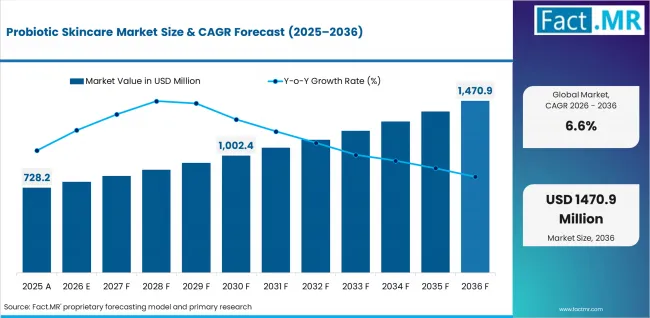
Probiotic Skincare Market Overview, Growth Outlook, and Forecast by Fact.MR

  • In 2025, the global probiotic skincare market was valued at approximately USD 728.2 million.
  • Based on Fact.MR analysis, demand for probiotic skincare products is estimated to grow to around USD 776.3 million in 2026 and USD 1,470.9 million by 2036.
  • The market is projected to expand at a CAGR of 6.6% during the forecast period.

Probiotic Skincare Market  Value Analysis

Summary of the Probiotic Skincare Market

  • Market Snapshot
    • In 2025, the global probiotic skincare market was valued at approximately USD 728.2 million
    • The market is estimated to reach around USD 776.3 million in 2026 and is projected to attain nearly USD 1,470.9 million by 2036.
    • The probiotic skincare market is expected to expand at a CAGR of 6.6% during the forecast period.
    • The market is anticipated to create an absolute dollar opportunity of approximately USD 694.6 million between 2026 and 2036.
    • In terms of product type, Facial Skincare Products holds the largest share of approximately 52.30% in 2026, driven by its widespread use in daily skincare routines and increasing consumer awareness of skin microbiome health.
    • Based on formulation type, Water‑based Formulations represents approximately 44.30% share in 2026, driven by their superior skin feel, compatibility with probiotic ingredients, and ease of absorption compared to emulsion‑based or advanced delivery formulations.
  • Demand and Growth Drivers
    • An increase in the demand for skin microbiome-friendly and probiotic skin care products, because of rising concerns about damaged skin barriers, sensitivity to skin issues, acne and inflammation, is propelling growth in the probiotic skin care formulations market.
    • Investments in dermatological research and microbiome science/cosmetic biotechnology are leading to a greater number of high-performance probiotics, prebiotic and postbiotic skin care ingredients with enhanced stability and performance.
    • Rising consumer preferences for natural, "clean-label" and sustainable beauty products are leading to a large increase in demand for probiotic skin care solutions as they have a direct association with skin health benefits such as repairing the barrier, providing moisture, and anti-aging support for the skin.
  • Product and Segment View
    • Facial Skincare Products holds a 52.30% share, driven by its essential role as the most frequently used category in daily skincare routines, with growing consumer adoption of microbiome-friendly formulations targeting facial skin health, and anti-aging concerns.
    • Skin Protection & Repair accounts for a 42.60% share, supported by increasing consumer awareness of environmental stressors and the need for barrier repair, making probiotic-based solutions a preferred choice for sensitive and damaged skin.
    • Water‑based Formulations commands a 44.30% share, owing to their superior skin feel, lightweight texture, and compatibility with live or postbiotic ingredients, enabling better absorption and hydration compared to emulsion‑based or advanced delivery systems.
    • Probiotic‑based Ingredients represent a 43.20% share, driven by the growing body of evidence supporting the role of live and derived probiotic actives in restoring skin microbiome balance, and enhancing the skin's natural defense against pathogens.
  • Geography and Competitive Outlook
    • North America has the largest market for skincare that no longer contains harmful ingredients since we have a very large number of companies producing this type of product as well as a heightened awareness on the part of consumers about the relationship between the skin microbiome and their skin health.
    • Europe is a significantly growing market for probiotic skincare due to highly enforced regulatory requirements relative to cosmetics and a proven propensity for using only natural, clean-label ingredients that have been dermatologically tested.
    • Asia-Pacific has been experiencing the quickest growth as it relates to probiotic skincare due to rising disposable income, a significant influence from K-beauty and J-beauty trends and an increasing need for cutting-edge products addressing skin conditions such as acne, pigmentation, and the overall health of one’s skin barrier.
    • The global Probiotic Skincare Market includes key players such as Loreal, Unilever, Amorepacific Corporation, Beiersdorf AG, TULA Life, and others.
  • Analyst Opinion
    • Shambhu Nath Jha, Principal Consultant at Fact.MR, says, “The market for probiotic-based cosmetics is steadily growing due to increased consumer knowledge regarding the skin microbiome and the need for a healthy skin barrier. The growing trend of incorporating functional bioactives in cosmetic products, especially for anti-aging, acne management, and sensitive skin, is propelling market growth.

Probiotic Skincare Market — At a Glance

Metric Value
Market Value 2025 USD 728.2 million
Market Value 2026 USD 776.3 million
Market Value 2036 USD 1,470.9 million
Absolute Dollar Opportunity USD 694.6 million
CAGR 6.6%
Growth Multiple 2.0x
Key Demand Theme Growing demand for skin protection & repair, anti‑aging benefits, and microbiome balance; increasing adoption of probiotic, prebiotic, and postbiotic ingredients in facial skincare, body care, and scalp care products
Leading Product Type Facial Skincare Products
Product Type Share (2026) 52.3%
Leading Ingredient Type Probiotic‑based Ingredients
Ingredient Type Share (2026) 43.2%
Leading Formulation Type Water‑based Formulations
Formulation Type Share (2026) 44.3%
Leading Skin Concern Skin Protection & Repair
Skin Concern Share (2026) 42.6%
Leading Distribution Channel Offline Retail
Distribution Channel Share (2026) 41.7%
Key Growth Regions Asia‑Pacific, North America, Europe
Fastest Growing Countries China, India, South Korea
Key Companies Loreal, Unilever, Amorepacific Corporation, Beiersdorf AG, TULA Life
Product Type Segmentation Facial Skincare Products, Body Care Products, Scalp & Specialized Care Products
Ingredient Type Segmentation Probiotic‑based Ingredients, Prebiotic‑based Ingredients, Postbiotic & Fermented Ingredients
Formulation Type Segmentation Water‑based Formulations, Emulsion‑based Formulations, Advanced Delivery Formulations
Skin Concern Segmentation Skin Protection & Repair, Beauty & Anti‑aging, Therapeutic & Wellness Care
Distribution Channel Segmentation Offline Retail, Online Retail, Professional Channels
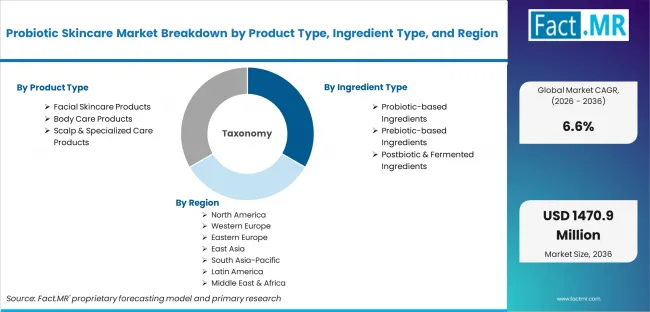
Region Segmentation North America, Latin America, Western Europe, Eastern Europe, East Asia, South Asia-Pacific, and Middle East & Africa

Key Growth Drivers, Constraints, and Opportunities
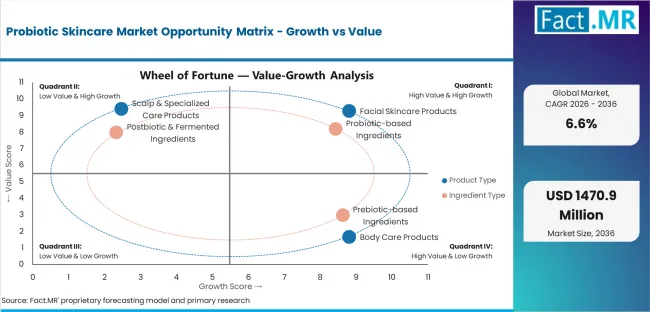
Probiotic Skincare Market Opportunity Matrix Growth Vs Value

Key Factors Driving Growth

  • Consumer interest in preventive skin care and maintaining skin health is rising, and so is the probiotic skin care industry, as there’s an increased demand for formulations for acne-prone, sensitive and microbiome-friendly skin.
  • Rise in consumer knowledge about clean beauty, natural ingredients, and the functional benefits of skin care, there has been an increase in the demand for probiotic and postbiotic formulations because they assist with skin barrier health, hydration, and the control of inflammation.
  • Beauty and dermatology brands are using microbial-based active ingredients in the formulation of new skin products; as such, they are creating more viable market opportunities within therapeutic and wellness-focused beauty products, as these ingredients contain a strong safety profile, high compatible with other ingredients, and science-based benefits to the skin.
Growth Driver Demand Impact Time Horizon Key Impact Area Fact.MR Insight
Increasing demand for microbiome-friendly and skin barrier–supporting skincare products High Short–Mid Term Adoption acceleration Rising consumer shift toward preventive skincare is significantly increasing demand for probiotic, prebiotic, and postbiotic skincare formulations
Expansion of applications in dermocosmetics and functional skincare products High Short–Mid Term Product innovation & scaling Growing awareness of skin health and sensitivity is driving large-scale integration of microbiome-based actives in skincare formulations
Rising use in therapeutic skincare and dermatology-driven treatments High Mid Term Clinical effectiveness Increasing focus on anti-inflammatory, acne-control, and skin-repair solutions is boosting adoption of probiotic-based skincare in clinical and professional settings
Advancements in fermentation and biotechnology-based ingredient production High Mid–Long Term Technology advancement Continuous improvements in fermentation, encapsulation, and delivery systems are enhancing stability, efficacy, and scalability of probiotic skincare ingredients
Growing adoption in clean beauty and wellness-oriented skincare formulations Medium Mid–Long Term Health & wellness Increasing scientific validation of skin microbiome health is driving demand for clean-label, functional, and wellness-focused skincare solutions

Key Market Constraints

  • The high costs of producing and formulating ingredients that are produced out of fermentation have created a barrier to large scale usage, particularly in mass markets that are price sensitive in the skin care industry.
  • A lack of consumer awareness and understanding of the skin microbiome and the functional benefits of probiotic skin care limit the ability to penetrate beyond premium and dermatologist driven skin care categories for consumers.
  • Strict regulations/government compliance of bioactive ingredients, fermentation derived compounds used in cosmetics, and microbiome-based claims are likely to impede product approval and ultimately the fast commercialization of innovative probiotic skin care formulations.

Key Opportunity Areas

  • The cosmetics and personal care fields are becoming more popular as people use more probiotic-like products to improve their appearance and the health of their skin. Companies in the cosmetic and personal care industries are reacting to this demand for new and creative insulin products by using the new technology for producing these types of products.
  • Advancements in biotechnology, fermentation science, and cosmetic formulation technologies are enabling collaboration between skincare brands, biotech firms, and research institutions to develop next generation postbiotic skincare solutions.
  • The growing preference for sustainably produced, clean-label, and microbiome-safe ingredients is creating significant opportunities across premium skincare, therapeutic dermatology, particularly in anti-aging, acne care, and sensitive skin treatments.

Segment-wise Analysis of the Probiotic Skincare Market

  • Facial Skincare Products holds a 52.30% share in the product type segment, driven by its essential role as the most frequently used category in daily skincare routines, with growing consumer adoption of microbiome‑friendly formulations targeting facial skin health, protection, and anti‑aging concerns.
  • Probiotic‑based Ingredients accounts for a 43.20% share in the ingredient type segment, supported by the increasing body of evidence demonstrating the role of live and derived probiotic actives in restoring skin microbiome balance, and enhancing the skin's natural defense against pathogens.
  • Water‑based Formulations commands a 44.30% share in the formulation type segment, driven by their superior skin feel, and compatibility with probiotic ingredients, enabling better absorption and hydration compared to emulsion‑based or advanced delivery systems.

The Global Probiotic Skincare Market is segmented by product type, ingredient type, formulation type, skin concern, and distribution channel.

Which Product Type Segment Dominates the Market?
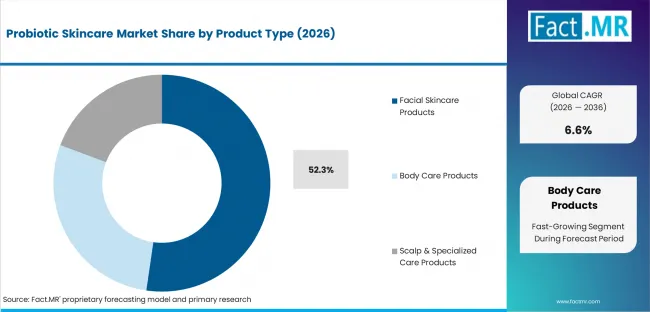
Probiotic Skincare Market Analysis By Product Type

Facial Skincare Products has a market share of more than 52.30%, and it will retain its market status. This type of product is the most frequently used, highly acceptable by consumers, and easy to formulate into serums, masks, and others are also compatible with existing skin care production techniques.

Which Ingredient Type Segment Dominates the Market?
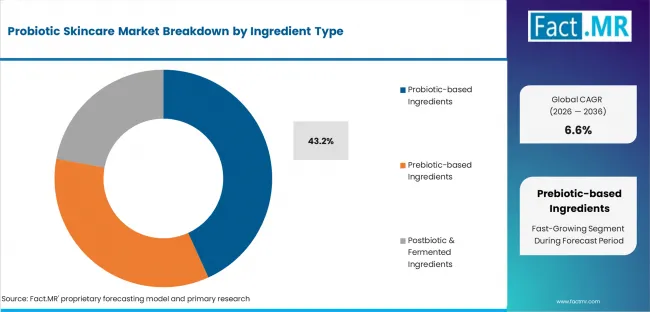
Probiotic Skincare Market Analysis By Ingredient Type

The Probiotics-based Ingredients segment is likely to maintain its dominance due to its high market share, which exceeds 43.20%. The utilization of probiotics-based ingredients in balancing the skin microbiome, decreasing inflammation, improving skin protection from pathogens, and raising interest in the skin microbiome-friendly formulations among clinicians and consumers has led to the dominance of the leading type of ingredients.

Which Formulation Type Segment Dominates the Market?
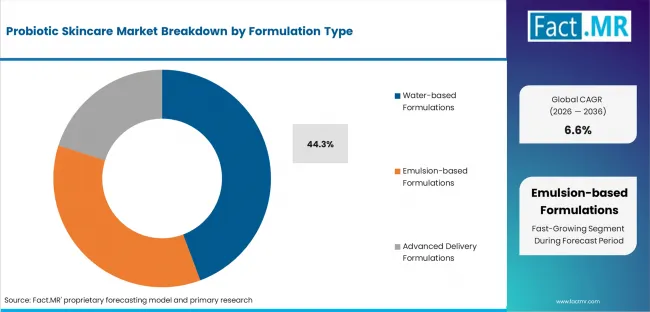
Probiotic Skincare Market Analysis By Formulation Type

Water-based Formulations is anticipated to maintain its market dominance owing to its large market share, which exceeds 44.30%. The preference for water-based formulations for offering improved skin feel, lightness, compatibility with probiotics, good absorption capability, and growing consumer demand for non-greasy and easily absorbable skincare products has made it the dominant formulation.

Which Skin Concern Segment Dominates the Market?
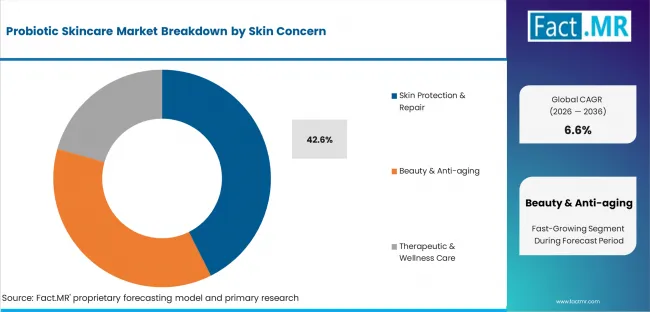
Probiotic Skincare Market Analysis By Skin Concern

Water-Based Formulations is expected to hold on to its leadership position due to its high market share, which stands above 44.30%. The choice of water-based formulations in providing a better feel of skin, lightness, compatibility with probiotics, good absorbability, and rising consumer inclination towards non-greasy and easily absorbable skin care products makes it a leading formulation.

Which Distribution Channel Segment Dominates the Market?
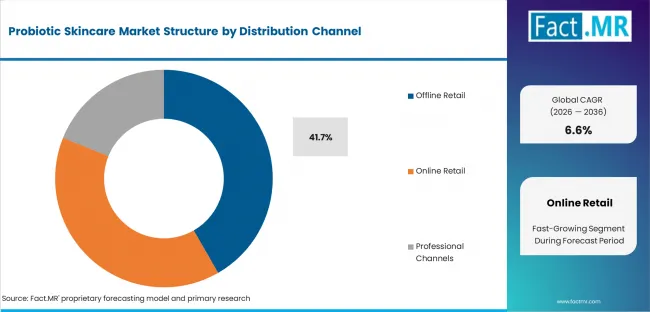
Probiotic Skincare Market Analysis By Distribution Channel

It is estimated that the Offline Retail sector will continue to maintain its dominance due to the large market share it enjoys, which is greater than 41.70%. The application of offline retail through specialty stores, supermarkets, drugstores, and department stores to provide customers with a tangible experience of the product, instant purchase opportunities, consultations, and building their confidence in physical retail for premium skincare products has been driving the key channel.

Regional Outlook Across Key Markets

The market analysis covers key global regions, including South Asia and Pacific, Middle East & Africa, North America, Latin America, Western Europe, and Eastern Europe. It is segmented geographically, with specific market dynamics for each region. The full report provides a detailed market attractiveness analysis.

Top Country Growth Comparison Probiotic Skincare Market Cagr (2026 2036)

CAGR Table

Country CAGR (%)
U.S.A. 5.7%
China 7.5%
India 7.3%
Japan 6.3%
South Korea 7.0%
Germany 6.6%
U.K. 7.7%

Source: Fact.MR (FMR) analysis, based on proprietary forecasting model and primary research.
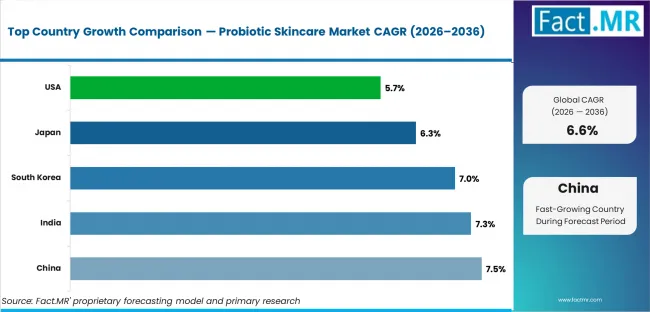
Probiotic Skincare Market Cagr Analysis By Country

North America – The Probiotic Skincare Hub
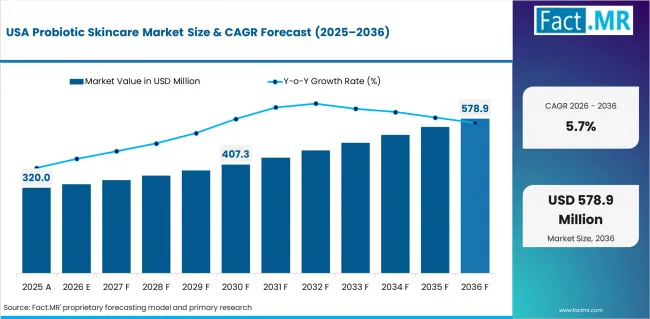
Probiotic Skincare Market Country Value Analysis

The demand for probiotics-based skincare products has been driven by their use in protecting and repairing the skin through the help of microbiome balance and anti-aging and wellness therapies, as well as in providing benefits related to anti-inflammatory and barrier repair properties, and it is projected that the North America Probiotics Skincare Market will register a consistent growth in both short-term and long-term prospects.

  • U.S.: Demand for probiotic skincare products in the U.S. is projected to grow at a CAGR of 5.7%, supported by increasing consumer awareness of skin microbiome health, rising utilization of probiotic, prebiotic, and postbiotic ingredients in daily skincare routines, and growing preference for clean-label and scientifically backed formulations.

Western Europe – The Probiotic Skincare Hub
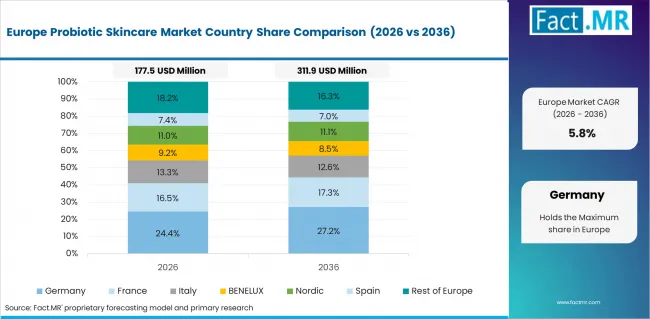
Probiotic Skincare Market Europe Country Market Share Analysis, 2026 & 2036

The market is anticipated to be developed uniformly throughout the short term, medium term, and long term because of the rising need for probiotic skincare owing to its use in protecting and healing the skin to maintain the balance of the microbiome and provide better barrier functionality as well as beauty and anti-aging purposes for wellness.

  • Germany: Demand for probiotic skincare products in Germany is projected to grow at a 6.6% CAGR, supported by increasing consumer awareness of microbiome-friendly skincare, growing preference for clean-label and scientifically backed formulations, and rising utilization of probiotic, prebiotic, and postbiotic ingredients in facial and body care products.

East Asia – The Emerging Powerhouse for Probiotic Skincare in Skin Protection & Microbiome Health

The East Asian market is experiencing high growth due to various reasons including greater availability of high-end skincare products, developments in the study of microbiomes and biotechnology in the region, and greater consumption of products that target the face, body, and scalp and contain probiotics, prebiotics, and postbiotics.

  • China: Demand for probiotic skincare products in China is projected to grow at a robust CAGR of 7.5% through 2036, supported by the rising middle-class spending on premium skincare, growing consumer awareness of skin microbiome balance and anti‑aging benefits.

South Asia & Pacific – The High‑Growth Frontier for Probiotic Skincare

There are opportunities for growth in the South Asia market because of the growing market for facial skin care and body care, heightened consumer consciousness regarding skin microbiome health and barrier function, and increased expenditure on therapeutic and anti-aging skin care products.

  • India: Demand for probiotic skincare products in India is projected to grow at around a 7.3% CAGR through 2036, supported by the booming beauty and personal care sector, rising adoption of probiotic‑based ingredients in skin protection and repair formulations, and increasing consumer preference for clean‑label and microbiome‑friendly products.

Latin America – The Untapped Opportunity for Probiotic Skincare

The Latin America market can be described as an emerging market that is anticipated to witness substantial growth during the forecast period, owing to rising demand for probiotics-enriched facial skincare and body care products, increasing awareness regarding the health of the skin microbiome and barrier, and growing use of anti-aging and therapeutic skincare applications.

  • Brazil: Demand for probiotic skincare products in Brazil is projected to grow at a steady 7.6% CAGR through 2036, supported by the country's large and growing beauty and personal care industry, and increasing adoption of probiotic‑based ingredients in skin protection products.

Middle East & Africa – The Rising Market for Probiotic Skincare

As a result of increased investments in beauty and personal care retail, rising demands for high-quality skincare products and skin health products, innovation in developing skin health ingredients, as well as the regional expansion in manufacturing facilities of facial skincare and body care products, the probiotic skincare market in the Middle East & Africa region is gradually picking up pace.

  • KSA: Demand for probiotic skincare products in Saudi Arabia is projected to grow at around 7.3% through 2036, supported by the country's Vision 2030 initiatives promoting health and wellness, increasing adoption of probiotic‑enriched facial skincare and body care products.

Fact.MR analysis provides a comprehensive regional outlook across North America, Latin America, Western Europe, Eastern Europe, East Asia, South Asia & Pacific, and the Middle East & Africa. It offers detailed country-wise insights, highlighting growth trends, demand patterns, and adoption across key industries in both developed and emerging markets.

Competitive Benchmarking and Company Positioning
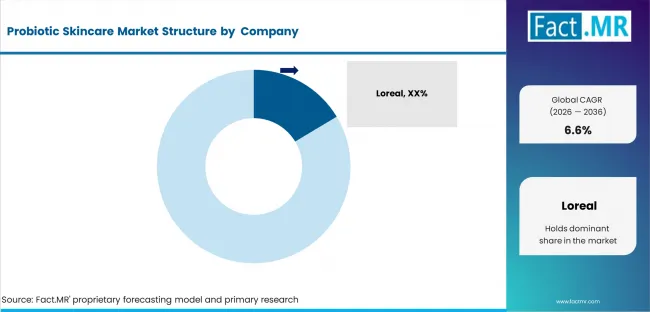
Probiotic Skincare Market Analysis By Company

Leading Companies Shaping the Probiotic Skincare Market

The probiotics-based skincare sector is moderately fragmented with a few major personal care corporations and niche biotech companies. Companies like Loreal, Unilever, Amorepacific Corporation, Beiersdorf AG, and TULA Life, along with others, account for 40-45% of global market share. This market is driven primarily by the growing popularity of higher efficacy products, stability of probiotics-based ingredients, and versatility in the application of probiotics in face care, scalp care, and wellness sectors.

Key Players of the Probiotic Skincare Market

  • Loreal
  • Unilever
  • Amorepacific Corporation
  • Beiersdorf AG
  • TULA Life
  • Gallinée
  • Glowbiotics
  • Murad
  • Clinique
  • YUN Probiotherapy
  • The Beauty Chef
  • Kheoni
  • Neubiome

Recent Industry Developments

  • Olly Expands Beyond Gut Health with Precision Probiotics Platform (2026), Olly is moving deeper into the microbiome with the launch of Precise Probiotics, a new capsule-based platform designed to push probiotics beyond general digestive health and into more targeted, functional use cases. (Olly) [1]
  • Bausch Health Launches YUN Probiotherapy™ ACN Skincare Line in Poland (2025): Launch of the YUN ACN skincare line in Poland, offering probiotic and prebiotic formulations designed for acne-prone skin. (Bausch) [2]
  • Leucine Rich Bio introduces India’s first skin microbiome centric healthcare product (2025): South Asia’s pioneering microbiome company, has launched Rychbiome Microbiome Balancing Cream, marking a significant milestone in probiotic skincare. (Leucine Rich Bio) [3]
  • BioGaia New Sciences AB – dedicated to advancing microbiome research and innovation (2025): BioGaia New Sciences builds on BioGaia’s vision to develop science-based, clinically relevant products, starting with BioGaia Aldermis, a probiotic ointment for dry and sensitive skin in infants. (BioGaia) [4]
  • Loreal Files Patent on Crystallized Live Probiotic Anti-aging Skin Care Formula (2025): Loreal has developed a topical skin care formulation containing a crystallized live probiotic to reverse signs of skin aging via microbiome modulation (Loreal) [5]

Sources and Research References

  • [1] “Olly Expands Beyond Gut Health with Precision Probiotics Platform”, 2026
  • [2] “Bausch Health Launches YUN Probiotherapy™ ACN Skincare Line in Poland”, 2025
  • [3] “Leucine Rich Bio introduces India’s first skin microbiome centric healthcare product”, 2025
  • [4] “BioGaia AB launches a subsidiary company – BioGaia New Sciences AB – dedicated to advancing microbiome research and innovation”, 2025
  • [5] “L'Oréal Files Patent on Crystallized Live Probiotic Anti-aging Skin Care Formula”, 2025

Probiotic Skincare Market Definition

Probiotic skincare market can be described as the sector within the cosmetics and personal care market that deals with the development, manufacture, and use of skincare products which contain probiotics, prebiotics, and postbiotics. The reason behind this is because of the role played by such ingredients in improving skin barrier functions and lowering skin inflammation.

Probiotic Skincare Market Inclusions

The probiotic skincare products industry consists of skincare products that use probiotics, prebiotics, and postbiotics as ingredients, which are generated by fermentation techniques, advanced biotechnologies, and bioactive extractions from nature. Such ingredients are extensively used in many types of skincare products such as creams, serums, cleansers, masks, and dermatology treatments.

Probiotic Skincare Market Exclusions

Probiotic skin care products refer to the category of products that exclude conventional skin care products that lack probiotic, prebiotic, and postbiotic bioactives. Any product that does not help achieve balance of the microbiome or skin barrier health is not included in the probiotic skin care products market segment.

Probiotic Skincare Market Research Methodology

  • Primary Research
    • The analysis does not cover any skincare products formulated with probiotics, prebiotics, or postbiotics, which have not been verified by science to possess active compounds that deliver a benefit to consumers. Also, cosmetic products without any effectiveness related to microbiome and skin barrier support are not included in the scope of analysis.
  • Desk Research
    • The probiotic skin care market desk research entails researching industry reports, corporate documents, scientific journals on dermatology and cosmetology, and regulatory databases. The aim is to analyze the trends, innovations, and developments in the field of microbiomes, fermentation, and bioactive skin care products.
  • Market-Sizing and Forecasting
    • The probiotic skincare market globally is calculated based on a top-down and bottom-up approach combination. The top-down approach is used to analyze the overall skincare market and the presence of microbiome-based products, whereas the bottom-up approach considers revenues generated by major companies producing probiotic, prebiotic, and postbiotic skincare products.
  • Data Validation and Update Cycle
    • Probiotic skin care market statistics are verified through systematic validation of information sourced from industry reports, dermatology journals, financial reports of companies, and other reliable secondary databases. Cross-validation of data from various sources helps ensure that the estimates are accurate.

Scope of Analysis

Probiotic Skincare Market Breakdown By Product Type, Ingredient Type, And Region

Parameter Details
Quantitative Units USD 728.2 million in 2025 to USD 1,470.9 million in 2036, at a CAGR of 6.6%
Market Definition The Probiotic Skincare Market comprises products formulated with probiotic‑based, prebiotic‑based, or postbiotic & fermented ingredients, used primarily as skin microbiome modulators, barrier repair enhancers, anti‑inflammatory and anti‑aging agents in facial skincare, body care, and scalp & specialized care applications.
Regions Covered North America, Latin America, Western Europe, Eastern Europe, East Asia, South Asia & Pacific, Middle East & Africa
Countries Covered USA, China, Germany, UK, Japan, India, Brazil, KSA, and 30+ countries
Key Companies Loreal, Unilever, Amorepacific Corporation, Beiersdorf AG, TULA Life, and others
Forecast Period 2026 to 2036
Approach Hybrid demand‑side and top‑down methodology based on growing consumer preference for microbiome‑friendly and skin barrier‑repair ingredients in daily skincare routines, increasing adoption of probiotic actives in facial and body care products, rising demand for natural anti‑inflammatory and anti‑aging bioactive formulations in cosmetic and therapeutic wellness applications.

Analysis by Product Type, by Ingredient Type, by Formulation Type, by Skin Concern, by Distribution Channel, and by Region

  • Probiotic Skincare Market By Product Type

    • Facial Skincare Products
      • Probiotic Facial Cleansers
      • Probiotic Face Creams & Moisturizers
      • Probiotic Serums & Ampoules
      • Probiotic Toners & Essences
      • Probiotic Face Masks
      • Probiotic Sunscreens
      • Probiotic Eye Care Products
      • Probiotic Spot & Acne Treatments
    • Body Care Products
      • Probiotic Body Lotions
      • Probiotic Body Washes
      • Probiotic Hand & Foot Care Products
    • Scalp & Specialized Care Products
      • Probiotic Scalp Treatments
      • Probiotic Post-procedure Recovery Products
      • Probiotic Baby & Sensitive Skin Products
      • Probiotic Therapeutic Dermocosmetics
  • Probiotic Skincare Market By Ingredient Type

    • Probiotic-based Ingredients
      • Lactobacillus Ferments
      • Bifidobacterium Ferments
      • Streptococcus Ferments
    • Prebiotic-based Ingredients
      • Inulin-based Prebiotics
      • Fructooligosaccharides (FOS)
      • Plant-derived Microbiome Nutrients
    • Postbiotic & Fermented Ingredients
      • Lysates & Ferment Filtrates
      • Bioactive Peptides
      • Fermented Botanical Extracts
  • Probiotic Skincare Market By Formulation Type

    • Water-based Formulations
      • Essences
      • Toners
      • Gel Moisturizers
    • Emulsion-based Formulations
      • Creams
      • Lotions
      • Milk Emulsions
    • Advanced Delivery Formulations
      • Encapsulated Probiotic Systems
      • Liposomal Formulations
      • Microbiome-stabilized Delivery Systems
  • Probiotic Skincare Market By Skin Concern

    • Skin Protection & Repair
      • Skin Barrier Repair
      • Sensitive Skin Care
      • Redness & Irritation Control
    • Beauty & Anti-aging
      • Anti-aging & Wrinkle Care
      • Skin Brightening
      • Firming & Elasticity Enhancement
    • Therapeutic & Wellness Care
      • Acne & Blemish Care
      • Eczema-prone Skin Support
      • Rosacea Care
  • Probiotic Skincare Market By Distribution Channel

    • Offline Retail
      • Hypermarkets & Supermarkets
      • Specialty Beauty Stores
      • Pharmacies & Drugstores
      • Dermatology Clinics
    • Online Retail
      • Brand-owned Websites
      • E-commerce Marketplaces
      • Beauty Subscription Platforms
    • Professional Channels
      • Medical Spas
      • Salons & Beauty Studios
      • Aesthetic Clinics
  • Probiotic Skincare Market By Region

    • North America
      • USA
      • Canada
      • Mexico
    • Latin America
      • Brazil
      • Chile
      • Rest of LATAM
    • East Asia
      • China
      • Japan
      • South Korea
    • Western Europe
      • Germany
      • Italy
      • France
      • U.K.
      • Spain
      • BENELUX
      • Nordic
      • Rest of W. Europe
    • Eastern Europe
      • Russia
      • Hungary
      • Poland
      • Balkan & Baltics
      • Rest of E. Europe
    • Middle East and Africa
      • Kingdom of Saudi Arabia
      • United Arab Emirates
      • South Africa
      • Rest of Middle East and Africa

- Frequently Asked Questions -

How large is the demand for Probiotic Skincare in the global market in 2025?

Demand for Probiotic Skincare in the global market is estimated to be valued at USD 728.2 million in 2025.

What will be the market size of Probiotic Skincare in the global market by 2036?

The market size for Probiotic Skincare is projected to reach USD 1,470.9 million by 2036.

What is the expected demand growth for Probiotic Skincare in the global market between 2026 and 2036?

Demand for Probiotic Skincare in the global market is expected to grow at a CAGR of 6.6% between 2026 and 2036.

Which product type segment is expected to dominate the Probiotic Skincare Market?

Facial Skincare Products is expected to dominate the market, accounting for a 52.30% share in 2026, driven by its widespread use in daily skincare routines, broad consumer acceptance across serums, creams, cleansers, and masks, and its compatibility with probiotic, prebiotic, and postbiotic ingredients for skin protection, anti‑aging, and therapeutic benefits.

How significant is the growth outlook for the USA in this market?

USA is expected to grow at a CAGR of 5.7% through 2036, supported by increasing consumer awareness of skin microbiome health, rising utilization of probiotic‑based ingredients in facial and body care formulations, and the presence of leading skincare and personal care companies investing in microbiome‑friendly product lines.

Which company is identified as a leading player in the Probiotic Skincare Market?

Loreal is identified as a leading player in the market, supported by its strong portfolio of advanced probiotic skincare products including probiotic‑infused facial serums for skin protection & repair, prebiotic‑based moisturizers for anti‑aging, and postbiotic scalp care formulations for therapeutic wellness applications.

Table of Content

  1. Global Probiotic Skincare Market – Executive Summary
  2. Market Overview
    • Market Definition & Introduction
    • Market Taxonomy & Research Scope
  3. Global Probiotic Skincare Market Demand Analysis 2021-2025 and Forecast, 2026–2036
    • Historical Market Volume (Tons) Analysis, 2021-2025
    • Current and Future Market Volume (Tons) Projections, 2026–2036
    • Y-o-Y Growth Trend Analysis
  4. Global Probiotic Skincare Market - Pricing Analysis
    • Product Category and Country-Level Pricing Analysis
    • Region Average Pricing Analysis Benchmark
    • Price Trends and Forecasts
      • Historical price trends
      • Future price forecasts
    • Factors Influencing Pricing
    • Competitive Pricing Strategies
    • Cost Structure Analysis
  5. Global Probiotic Skincare Market Demand (in Value or Size in US$ Mn) Analysis 2021-2025 and Forecast, 2026–2036
    • Historical Market Value (US$ Mn) Analysis, 2021-2025
    • Current and Future Market Value (US$ Mn) Projections, 2026–2036
      • Y-o-Y Growth Trend Analysis
      • Absolute $ Opportunity Analysis
  6. Market Background and Foundational Data Points
    • Microbiome-based skincare product share in total skincare market output (%)
    • Annual growth rate of demand for probiotic skincare products (%)
    • Share of probiotic, prebiotic, and postbiotic ingredients in total active skincare formulations (%)
    • Penetration rate of clean-label and natural skincare products (%)
    • E-commerce contribution to total probiotic skincare sales (%)
    • R&D investment in microbiome and fermentation-based cosmetic ingredients (% of revenue)
    • Share of facial skincare products in total probiotic skincare market (%)
    • Adoption rate of dermo cosmetic and therapeutic probiotic skincare products (%)
    • Premium product share in probiotic skincare segment (%)
    • Asia-Pacific contribution to global probiotic skincare market growth (%)
    • Probiotic Skincare Market Opportunity Assessment
      • Total Available Market (US$ Mn)
      • Serviceable Addressable Market (US$ Mn)
      • Serviceable Obtainable Market (US$ Mn)
    • Porter’s Five Forces and PESTEL Analysis
    • Investment Feasibility Analysis
    • Macro-Economic Factors & Forecast Factors - Relevance & Impact
    • Industry Value and Supply Chain Analysis
      • List of Key Channel Partners
      • Profit Margin & Operating Margin at Each Node of Supply Chain.
      • Notes on Value Added at Each Node in the Value Chain
      • Factors Influencing Value Chain
    • Market Dynamics
      • Drivers
      • Restraints
      • Opportunity Analysis
    • Key Regulations & Certifications
  7. Probiotic Skincare Market Analysis 2021-2025 and Forecast 2026–2036, By Product Type
    • Introduction / Key Findings
    • Historical Market Size (US$ Mn) & Volume (Tons) Trend Analysis By Product Type, 2021-2025
    • Current and Future Market Size (US$ Mn) & Volume (Tons) Analysis and Forecast By Product Type, 2026-2036
      • Facial Skincare Products
        • Probiotic Facial Cleansers
        • Probiotic Face Creams & Moisturizers
        • Probiotic Serums & Ampoules
        • Probiotic Toners & Essences
        • Probiotic Face Masks
        • Probiotic Sunscreens
        • Probiotic Eye Care Products
        • Probiotic Spot & Acne Treatments
      • Body Care Products
        • Probiotic Body Lotions
        • Probiotic Body Washes
        • Probiotic Hand & Foot Care Products
      • Scalp & Specialized Care Products
        • Probiotic Scalp Treatments
        • Probiotic Post-procedure Recovery Products
        • Probiotic Baby & Sensitive Skin Products
        • Probiotic Therapeutic Dermocosmetics
    • Market Attractiveness Analysis By Product Type
  8. Probiotic Skincare Market Analysis 2021-2025 and Forecast 2026–2036, By Ingredient Type
    • Introduction / Key Findings
    • Historical Market Size (US$ Mn) & Volume (Tons) Trend Analysis By Ingredient Type, 2021-2025
    • Current and Future Market Size (US$ Mn) & Volume (Tons) Analysis and Forecast By Ingredient Type, 2026-2036
      • Probiotic-based Ingredients
        • Lactobacillus Ferments
        • Bifidobacterium Ferments
        • Streptococcus Ferments
      • Prebiotic-based Ingredients
        • Inulin-based Prebiotics
        • Fructooligosaccharides (FOS)
        • Plant-derived Microbiome Nutrients
      • Postbiotic & Fermented Ingredients
        • Lysates & Ferment Filtrates
        • Bioactive Peptides
        • Fermented Botanical Extracts
    • Market Attractiveness Analysis By Ingredient Type
  9. Probiotic Skincare Market Analysis 2021-2025 and Forecast 2026–2036, By Formulation Type
    • Introduction / Key Findings
    • Historical Market Size (US$ Mn) & Volume (Tons) Trend Analysis By Formulation Type, 2021-2025
    • Current and Future Market Size (US$ Mn) & Volume (Tons) Analysis and Forecast By Formulation Type, 2026-2036
      • Water-based Formulations
        • Essences
        • Toners
        • Gel Moisturizers
      • Emulsion-based Formulations
        • Creams
        • Lotions
        • Milk Emulsions
      • Advanced Delivery Formulations
        • Encapsulated Probiotic Systems
        • Liposomal Formulations
        • Microbiome-stabilized Delivery Systems
    • Market Attractiveness Analysis By Formulation Type
  10. Probiotic Skincare Market Analysis 2021-2025 and Forecast 2026–2036, By Skin Concern
    • Introduction / Key Findings
    • Historical Market Size (US$ Mn) & Volume (Tons) Trend Analysis By Skin Concern, 2021-2025
    • Current and Future Market Size (US$ Mn) & Volume (Tons) Analysis and Forecast By Skin Concern, 2026-2036
      • Skin Protection & Repair
        • Skin Barrier Repair
        • Sensitive Skin Care
        • Redness & Irritation Control
      • Beauty & Anti-aging
        • Anti-aging & Wrinkle Care
        • Skin Brightening
        • Firming & Elasticity Enhancement
      • Therapeutic & Wellness Care
        • Acne & Blemish Care
        • Eczema-prone Skin Support
        • Rosacea Care
    • Market Attractiveness Analysis By Skin Concern
  11. Probiotic Skincare Market Analysis 2021-2025 and Forecast 2026–2036, By Distribution Channel
    • Introduction / Key Findings
    • Historical Market Size (US$ Mn) & Volume (Tons) Trend Analysis By Distribution Channel, 2021-2025
    • Current and Future Market Size (US$ Mn) & Volume (Tons) Analysis and Forecast By Distribution Channel, 2026-2036
      • Offline Retail
        • Hypermarkets & Supermarkets
        • Specialty Beauty Stores
        • Pharmacies & Drugstores
        • Dermatology Clinics
      • Online Retail
        • Brand-owned Websites
        • E-commerce Marketplaces
        • Beauty Subscription Platforms
      • Professional Channels
        • Medical Spas
        • Salons & Beauty Studios
        • Aesthetic Clinics
    • Market Attractiveness Analysis By Distribution Channel
  12. Global Probiotic Skincare Market Analysis and Forecast, by Region
    • Introduction / Key Findings
    • Historical Market Size (US$ Mn) & Volume (Tons) Trend Analysis by Region, 2021-2025
    • Current and Future Market Size (US$ Mn) & Volume (Tons) Analysis and Forecast by Region, 2026-2036
      • North America
      • Latin America
      • Western Europe
      • Eastern Europe
      • East Asia
      • South Asia & Pacific
      • Middle East & Africa
    • Market Attractiveness Analysis by Region
  13. North America Probiotic Skincare Market Analysis and Forecast
    • Introduction / Key Findings
    • Pricing Analysis
    • Historical Market Size (US$ Mn) & Volume (Tons) Trend Analysis by Market Taxonomy, 2021-2025
    • Current and Future Market Size (US$ Mn) and Volume (Tons) Analysis & Forecast by Market Taxonomy, 2026-2036
    • By Country
      • United States
      • Canada
      • Mexico
    • By Taxonomy
    • Market Attractiveness Analysis By Country & Taxonomy
    • Market Trends
    • Key Market Participants – Intensity Mapping
    • Drivers and Restraints - Impact Analysis
  14. Latin America Probiotic Skincare Market Analysis and Forecast
    • Introduction / Key Findings
    • Pricing Analysis
    • Historical Market Size (US$ Mn) & Volume (Tons) Trend Analysis by Market Taxonomy, 2021-2025
    • Current and Future Market Size (US$ Mn) and Volume (Tons) Analysis & Forecast by Market Taxonomy, 2026-2036
    • By Country
      • Brazil
      • Chile
      • Rest of LATAM
    • By Taxonomy
    • Market Attractiveness Analysis By Country & Taxonomy
    • Market Trends
    • Key Market Participants – Intensity Mapping
    • Drivers and Restraints - Impact Analysis
  15. Western Europe Probiotic Skincare Market Analysis and Forecast
    • Introduction / Key Findings
    • Pricing Analysis
    • Historical Market Size (US$ Mn) & Volume (Tons) Trend Analysis by Market Taxonomy, 2021-2025
    • Current and Future Market Size (US$ Mn) and Volume (Tons) Analysis & Forecast by Market Taxonomy, 2026-2036
    • By Country
      • Germany
      • Italy
      • France
      • United Kingdom
      • Spain
      • BENELUX
      • Nordics
      • Rest of Western Europe
    • By Taxonomy
    • Market Attractiveness Analysis By Country & Taxonomy
    • Market Trends
    • Key Market Participants – Intensity Mapping
    • Drivers and Restraints - Impact Analysis
  16. Eastern Europe Probiotic Skincare Market Analysis and Forecast
    • Introduction / Key Findings
    • Pricing Analysis
    • Historical Market Size (US$ Mn) & Volume (Tons) Trend Analysis by Market Taxonomy, 2021-2025
    • Current and Future Market Size (US$ Mn) and Volume (Tons) Analysis & Forecast by Market Taxonomy, 2026-2036
    • By Country
      • Russia
      • Hungary
      • Poland
      • Balkan & Baltics
      • Rest of Eastern Europe
    • By Taxonomy
    • Market Attractiveness Analysis By Country & Taxonomy
    • Market Trends
    • Key Market Participants – Intensity Mapping
    • Drivers and Restraints - Impact Analysis
  17. East Asia Probiotic Skincare Market Analysis and Forecast
    • Introduction / Key Findings
    • Pricing Analysis
    • Historical Market Size (US$ Mn) & Volume (Tons) Trend Analysis by Market Taxonomy, 2021-2025
    • Current and Future Market Size (US$ Mn) and Volume (Tons) Analysis & Forecast by Market Taxonomy, 2026-2036
    • By Country
      • China
      • Japan
      • South Korea
    • By Taxonomy
    • Market Attractiveness Analysis By Country & Taxonomy
    • Market Trends
    • Key Market Participants – Intensity Mapping
    • Drivers and Restraints - Impact Analysis
  18. South Asia & Pacific Probiotic Skincare Market Analysis and Forecast
    • Introduction / Key Findings
    • Pricing Analysis
    • Historical Market Size (US$ Mn) & Volume (Tons) Trend Analysis by Market Taxonomy, 2021-2025
    • Current and Future Market Size (US$ Mn) and Volume (Tons) Analysis & Forecast by Market Taxonomy, 2026-2036
    • By Country
      • India
      • ASEAN
      • Australia & New Zealand
      • Rest of South Asia & Pacific
    • By Taxonomy
    • Market Attractiveness Analysis By Country & Taxonomy
    • Market Trends
    • Key Market Participants – Intensity Mapping
    • Drivers and Restraints - Impact Analysis
  19. Middle East & Africa Probiotic Skincare Market Analysis and Forecast
    • Introduction / Key Findings
    • Pricing Analysis
    • Historical Market Size (US$ Mn) & Volume (Tons) Trend Analysis by Market Taxonomy, 2021-2025
    • Current and Future Market Size (US$ Mn) and Volume (Tons) Analysis & Forecast by Market Taxonomy, 2026-2036
    • By Country
      • Kingdom of Saudi Arabia
      • Other GCC Countries
      • Turkiye
      • South Africa
      • Other African Union
    • By Taxonomy
    • Market Attractiveness Analysis By Country & Taxonomy
    • Market Trends
    • Key Market Participants – Intensity Mapping
    • Drivers and Restraints - Impact Analysis
  20. Country-level Probiotic Skincare Market Analysis and Forecast
    • Introduction
    • Market Value Proportion Analysis, By Key Countries
    • Global Vs. Country Growth Comparison
      • United States Probiotic Skincare Market Analysis
        • Market Size (US$ Mn) & Volume (Tons) Analysis by Market Taxonomy, 2021–2036
        • By Formulation Type
        • By Ingredient Type
        • By Skin Concern
        • By Product Type
        • By Distribution Channel
        • Canada Probiotic Skincare Market Analysis
        • Mexico Probiotic Skincare Market Analysis
        • Brazil Probiotic Skincare Market Analysis
        • Chile Probiotic Skincare Market Analysis
        • Germany Probiotic Skincare Market Analysis
        • France Probiotic Skincare Market Analysis
        • Italy Probiotic Skincare Market Analysis
        • Spain Probiotic Skincare Market Analysis
        • United Kingdom Probiotic Skincare Market Analysis
        • BENELUX Probiotic Skincare Market Analysis
        • Nordics Probiotic Skincare Market Analysis
        • Poland Probiotic Skincare Market Analysis
        • Russia Probiotic Skincare Market Analysis
        • Hungary Probiotic Skincare Market Analysis
        • Balkan & Baltics Probiotic Skincare Market Analysis
        • China Probiotic Skincare Market Analysis
        • Japan Probiotic Skincare Market Analysis
        • South Korea Probiotic Skincare Market Analysis
        • India Probiotic Skincare Market Analysis
        • ASEAN Probiotic Skincare Market Analysis
        • ANZ Probiotic Skincare Market Analysis
        • KSA Probiotic Skincare Market Analysis
        • Other GCC Countries Probiotic Skincare Market Analysis
        • South Africa Probiotic Skincare Market Analysis
        • Turkiye Probiotic Skincare Market Analysis
    • Probiotic Skincare Market Structure Analysis
      • Market Analysis by Tier of Companies
      • Market Concentration
      • Market Share Analysis of Top Players
      • Market Space for New Brands and Dollar Opportunity
      • Market Presence Analysis
        • Regional Footprint of Players
        • Product Footprint by Players
    • Probiotic Skincare Competition Analysis
      • Competition Dashboard
      • Pricing Analysis by Competition
      • Competition Benchmarking
      • Competition Deep Dive
        • Loreal
          • Overview
          • Product Portfolio
          • Sales Footprint
          • Key Developments
          • SWOT Analysis
          • Strategy Overview
          • Key Financials
        • Unilever
        • Amorepacific Corporation
        • Beiersdorf AG
        • TULA Life
        • Gallinée
        • Glowbiotics
        • Murad
        • Clinique
        • YUN Probiotherapy
        • The Beauty Chef
        • Kheoni
        • Neubiome
        • Other Prominent Players
    • Primary insights
    • Assumptions & Acronyms Used
    • Research Methodology & Data Forms

List Of Table

  • Table 1: Global Market Value (USD Mn) Forecast by Region, 2021 to 2036
  • Table 2: Global Market Volume (Tons) Forecast by Region, 2021 to 2036
  • Table 3: Global Market Value (USD Mn) Forecast by Product Type, 2021 to 2036
  • Table 4: Global Market Volume (Tons) Forecast by Product Type, 2021 to 2036
  • Table 5: Global Market Value (USD Mn) Forecast by Ingredient Type, 2021 to 2036
  • Table 6: Global Market Volume (Tons) Forecast by Ingredient Type, 2021 to 2036
  • Table 7: Global Market Value (USD Mn) Forecast by Formulation Type, 2021 to 2036
  • Table 8: Global Market Volume (Tons) Forecast by Formulation Type, 2021 to 2036
  • Table 9: Global Market Value (USD Mn) Forecast by Skin Concern, 2021 to 2036
  • Table 10: Global Market Volume (Tons) Forecast by Skin Concern, 2021 to 2036
  • Table 11: Global Market Value (USD Mn) Forecast by Distribution Channel, 2021 to 2036
  • Table 12: Global Market Volume (Tons) Forecast by Distribution Channel, 2021 to 2036
  • Table 13: North America Market Value (USD Mn) Forecast by Country, 2021 to 2036
  • Table 14: North America Market Volume (Tons) Forecast by Country, 2021 to 2036
  • Table 15: North America Market Value (USD Mn) Forecast by Product Type, 2021 to 2036
  • Table 16: North America Market Volume (Tons) Forecast by Product Type, 2021 to 2036
  • Table 17: North America Market Value (USD Mn) Forecast by Ingredient Type, 2021 to 2036
  • Table 18: North America Market Volume (Tons) Forecast by Ingredient Type, 2021 to 2036
  • Table 19: North America Market Value (USD Mn) Forecast by Formulation Type, 2021 to 2036
  • Table 20: North America Market Volume (Tons) Forecast by Formulation Type, 2021 to 2036
  • Table 21: North America Market Value (USD Mn) Forecast by Skin Concern, 2021 to 2036
  • Table 22: North America Market Volume (Tons) Forecast by Skin Concern, 2021 to 2036
  • Table 23: North America Market Value (USD Mn) Forecast by Distribution Channel, 2021 to 2036
  • Table 24: North America Market Volume (Tons) Forecast by Distribution Channel, 2021 to 2036
  • Table 25: Latin America Market Value (USD Mn) Forecast by Country, 2021 to 2036
  • Table 26: Latin America Market Volume (Tons) Forecast by Country, 2021 to 2036
  • Table 27: Latin America Market Value (USD Mn) Forecast by Product Type, 2021 to 2036
  • Table 28: Latin America Market Volume (Tons) Forecast by Product Type, 2021 to 2036
  • Table 29: Latin America Market Value (USD Mn) Forecast by Ingredient Type, 2021 to 2036
  • Table 30: Latin America Market Volume (Tons) Forecast by Ingredient Type, 2021 to 2036
  • Table 31: Latin America Market Value (USD Mn) Forecast by Formulation Type, 2021 to 2036
  • Table 32: Latin America Market Volume (Tons) Forecast by Formulation Type, 2021 to 2036
  • Table 33: Latin America Market Value (USD Mn) Forecast by Skin Concern, 2021 to 2036
  • Table 34: Latin America Market Volume (Tons) Forecast by Skin Concern, 2021 to 2036
  • Table 35: Latin America Market Value (USD Mn) Forecast by Distribution Channel, 2021 to 2036
  • Table 36: Latin America Market Volume (Tons) Forecast by Distribution Channel, 2021 to 2036
  • Table 37: Western Europe Market Value (USD Mn) Forecast by Country, 2021 to 2036
  • Table 38: Western Europe Market Volume (Tons) Forecast by Country, 2021 to 2036
  • Table 39: Western Europe Market Value (USD Mn) Forecast by Product Type, 2021 to 2036
  • Table 40: Western Europe Market Volume (Tons) Forecast by Product Type, 2021 to 2036
  • Table 41: Western Europe Market Value (USD Mn) Forecast by Ingredient Type, 2021 to 2036
  • Table 42: Western Europe Market Volume (Tons) Forecast by Ingredient Type, 2021 to 2036
  • Table 43: Western Europe Market Value (USD Mn) Forecast by Formulation Type, 2021 to 2036
  • Table 44: Western Europe Market Volume (Tons) Forecast by Formulation Type, 2021 to 2036
  • Table 45: Western Europe Market Value (USD Mn) Forecast by Skin Concern, 2021 to 2036
  • Table 46: Western Europe Market Volume (Tons) Forecast by Skin Concern, 2021 to 2036
  • Table 47: Western Europe Market Value (USD Mn) Forecast by Distribution Channel, 2021 to 2036
  • Table 48: Western Europe Market Volume (Tons) Forecast by Distribution Channel, 2021 to 2036
  • Table 49: Eastern Europe Market Value (USD Mn) Forecast by Country, 2021 to 2036
  • Table 50: Eastern Europe Market Volume (Tons) Forecast by Country, 2021 to 2036
  • Table 51: Eastern Europe Market Value (USD Mn) Forecast by Product Type, 2021 to 2036
  • Table 52: Eastern Europe Market Volume (Tons) Forecast by Product Type, 2021 to 2036
  • Table 53: Eastern Europe Market Value (USD Mn) Forecast by Ingredient Type, 2021 to 2036
  • Table 54: Eastern Europe Market Volume (Tons) Forecast by Ingredient Type, 2021 to 2036
  • Table 55: Eastern Europe Market Value (USD Mn) Forecast by Formulation Type, 2021 to 2036
  • Table 56: Eastern Europe Market Volume (Tons) Forecast by Formulation Type, 2021 to 2036
  • Table 57: Eastern Europe Market Value (USD Mn) Forecast by Skin Concern, 2021 to 2036
  • Table 58: Eastern Europe Market Volume (Tons) Forecast by Skin Concern, 2021 to 2036
  • Table 59: Eastern Europe Market Value (USD Mn) Forecast by Distribution Channel, 2021 to 2036
  • Table 60: Eastern Europe Market Volume (Tons) Forecast by Distribution Channel, 2021 to 2036
  • Table 61: East Asia Market Value (USD Mn) Forecast by Country, 2021 to 2036
  • Table 62: East Asia Market Volume (Tons) Forecast by Country, 2021 to 2036
  • Table 63: East Asia Market Value (USD Mn) Forecast by Product Type, 2021 to 2036
  • Table 64: East Asia Market Volume (Tons) Forecast by Product Type, 2021 to 2036
  • Table 65: East Asia Market Value (USD Mn) Forecast by Ingredient Type, 2021 to 2036
  • Table 66: East Asia Market Volume (Tons) Forecast by Ingredient Type, 2021 to 2036
  • Table 67: East Asia Market Value (USD Mn) Forecast by Formulation Type, 2021 to 2036
  • Table 68: East Asia Market Volume (Tons) Forecast by Formulation Type, 2021 to 2036
  • Table 69: East Asia Market Value (USD Mn) Forecast by Skin Concern, 2021 to 2036
  • Table 70: East Asia Market Volume (Tons) Forecast by Skin Concern, 2021 to 2036
  • Table 71: East Asia Market Value (USD Mn) Forecast by Distribution Channel, 2021 to 2036
  • Table 72: East Asia Market Volume (Tons) Forecast by Distribution Channel, 2021 to 2036
  • Table 73: South Asia and Pacific Market Value (USD Mn) Forecast by Country, 2021 to 2036
  • Table 74: South Asia and Pacific Market Volume (Tons) Forecast by Country, 2021 to 2036
  • Table 75: South Asia and Pacific Market Value (USD Mn) Forecast by Product Type, 2021 to 2036
  • Table 76: South Asia and Pacific Market Volume (Tons) Forecast by Product Type, 2021 to 2036
  • Table 77: South Asia and Pacific Market Value (USD Mn) Forecast by Ingredient Type, 2021 to 2036
  • Table 78: South Asia and Pacific Market Volume (Tons) Forecast by Ingredient Type, 2021 to 2036
  • Table 79: South Asia and Pacific Market Value (USD Mn) Forecast by Formulation Type, 2021 to 2036
  • Table 80: South Asia and Pacific Market Volume (Tons) Forecast by Formulation Type, 2021 to 2036
  • Table 81: South Asia and Pacific Market Value (USD Mn) Forecast by Skin Concern, 2021 to 2036
  • Table 82: South Asia and Pacific Market Volume (Tons) Forecast by Skin Concern, 2021 to 2036
  • Table 83: South Asia and Pacific Market Value (USD Mn) Forecast by Distribution Channel, 2021 to 2036
  • Table 84: South Asia and Pacific Market Volume (Tons) Forecast by Distribution Channel, 2021 to 2036
  • Table 85: Middle East & Africa Market Value (USD Mn) Forecast by Country, 2021 to 2036
  • Table 86: Middle East & Africa Market Volume (Tons) Forecast by Country, 2021 to 2036
  • Table 87: Middle East & Africa Market Value (USD Mn) Forecast by Product Type, 2021 to 2036
  • Table 88: Middle East & Africa Market Volume (Tons) Forecast by Product Type, 2021 to 2036
  • Table 89: Middle East & Africa Market Value (USD Mn) Forecast by Ingredient Type, 2021 to 2036
  • Table 90: Middle East & Africa Market Volume (Tons) Forecast by Ingredient Type, 2021 to 2036
  • Table 91: Middle East & Africa Market Value (USD Mn) Forecast by Formulation Type, 2021 to 2036
  • Table 92: Middle East & Africa Market Volume (Tons) Forecast by Formulation Type, 2021 to 2036
  • Table 93: Middle East & Africa Market Value (USD Mn) Forecast by Skin Concern, 2021 to 2036
  • Table 94: Middle East & Africa Market Volume (Tons) Forecast by Skin Concern, 2021 to 2036
  • Table 95: Middle East & Africa Market Value (USD Mn) Forecast by Distribution Channel, 2021 to 2036
  • Table 96: Middle East & Africa Market Volume (Tons) Forecast by Distribution Channel, 2021 to 2036

List Of Figures

  • Figure 1: Global Market Volume (Tons) Forecast 2021 to 2036
  • Figure 2: Global Market Pricing Analysis
  • Figure 3: Global Market Value (USD Mn) Forecast 2021 to 2036
  • Figure 4: Global Market Value Share and BPS Analysis by Product Type, 2026 and 2036
  • Figure 5: Global Market Y-o-Y Growth Comparison by Product Type, 2026 to 2036
  • Figure 6: Global Market Attractiveness Analysis by Product Type
  • Figure 7: Global Market Value Share and BPS Analysis by Ingredient Type, 2026 and 2036
  • Figure 8: Global Market Y-o-Y Growth Comparison by Ingredient Type, 2026 to 2036
  • Figure 9: Global Market Attractiveness Analysis by Ingredient Type
  • Figure 10: Global Market Value Share and BPS Analysis by Formulation Type, 2026 and 2036
  • Figure 11: Global Market Y-o-Y Growth Comparison by Formulation Type, 2026 to 2036
  • Figure 12: Global Market Attractiveness Analysis by Formulation Type
  • Figure 13: Global Market Value Share and BPS Analysis by Skin Concern, 2026 and 2036
  • Figure 14: Global Market Y-o-Y Growth Comparison by Skin Concern, 2026 to 2036
  • Figure 15: Global Market Attractiveness Analysis by Skin Concern
  • Figure 16: Global Market Value Share and BPS Analysis by Distribution Channel, 2026 and 2036
  • Figure 17: Global Market Y-o-Y Growth Comparison by Distribution Channel, 2026 to 2036
  • Figure 18: Global Market Attractiveness Analysis by Distribution Channel
  • Figure 19: Global Market Value (USD Mn) Share and BPS Analysis by Region, 2026 and 2036
  • Figure 20: Global Market Y-o-Y Growth Comparison by Region, 2026 to 2036
  • Figure 21: Global Market Attractiveness Analysis by Region
  • Figure 22: North America Market Incremental $ Opportunity, 2026 to 2036
  • Figure 23: Latin America Market Incremental $ Opportunity, 2026 to 2036
  • Figure 24: Western Europe Market Incremental $ Opportunity, 2026 to 2036
  • Figure 25: Eastern Europe Market Incremental $ Opportunity, 2026 to 2036
  • Figure 26: East Asia Market Incremental $ Opportunity, 2026 to 2036
  • Figure 27: South Asia and Pacific Market Incremental $ Opportunity, 2026 to 2036
  • Figure 28: Middle East & Africa Market Incremental $ Opportunity, 2026 to 2036
  • Figure 29: North America Market Value Share and BPS Analysis by Country, 2026 and 2036
  • Figure 30: North America Market Value Share and BPS Analysis by Product Type, 2026 and 2036
  • Figure 31: North America Market Y-o-Y Growth Comparison by Product Type, 2026 to 2036
  • Figure 32: North America Market Attractiveness Analysis by Product Type
  • Figure 33: North America Market Value Share and BPS Analysis by Ingredient Type, 2026 and 2036
  • Figure 34: North America Market Y-o-Y Growth Comparison by Ingredient Type, 2026 to 2036
  • Figure 35: North America Market Attractiveness Analysis by Ingredient Type
  • Figure 36: North America Market Value Share and BPS Analysis by Formulation Type, 2026 and 2036
  • Figure 37: North America Market Y-o-Y Growth Comparison by Formulation Type, 2026 to 2036
  • Figure 38: North America Market Attractiveness Analysis by Formulation Type
  • Figure 39: North America Market Value Share and BPS Analysis by Skin Concern, 2026 and 2036
  • Figure 40: North America Market Y-o-Y Growth Comparison by Skin Concern, 2026 to 2036
  • Figure 41: North America Market Attractiveness Analysis by Skin Concern
  • Figure 42: North America Market Value Share and BPS Analysis by Distribution Channel, 2026 and 2036
  • Figure 43: North America Market Y-o-Y Growth Comparison by Distribution Channel, 2026 to 2036
  • Figure 44: North America Market Attractiveness Analysis by Distribution Channel
  • Figure 45: Latin America Market Value Share and BPS Analysis by Country, 2026 and 2036
  • Figure 46: Latin America Market Value Share and BPS Analysis by Product Type, 2026 and 2036
  • Figure 47: Latin America Market Y-o-Y Growth Comparison by Product Type, 2026 to 2036
  • Figure 48: Latin America Market Attractiveness Analysis by Product Type
  • Figure 49: Latin America Market Value Share and BPS Analysis by Ingredient Type, 2026 and 2036
  • Figure 50: Latin America Market Y-o-Y Growth Comparison by Ingredient Type, 2026 to 2036
  • Figure 51: Latin America Market Attractiveness Analysis by Ingredient Type
  • Figure 52: Latin America Market Value Share and BPS Analysis by Formulation Type, 2026 and 2036
  • Figure 53: Latin America Market Y-o-Y Growth Comparison by Formulation Type, 2026 to 2036
  • Figure 54: Latin America Market Attractiveness Analysis by Formulation Type
  • Figure 55: Latin America Market Value Share and BPS Analysis by Skin Concern, 2026 and 2036
  • Figure 56: Latin America Market Y-o-Y Growth Comparison by Skin Concern, 2026 to 2036
  • Figure 57: Latin America Market Attractiveness Analysis by Skin Concern
  • Figure 58: Latin America Market Value Share and BPS Analysis by Distribution Channel, 2026 and 2036
  • Figure 59: Latin America Market Y-o-Y Growth Comparison by Distribution Channel, 2026 to 2036
  • Figure 60: Latin America Market Attractiveness Analysis by Distribution Channel
  • Figure 61: Western Europe Market Value Share and BPS Analysis by Country, 2026 and 2036
  • Figure 62: Western Europe Market Value Share and BPS Analysis by Product Type, 2026 and 2036
  • Figure 63: Western Europe Market Y-o-Y Growth Comparison by Product Type, 2026 to 2036
  • Figure 64: Western Europe Market Attractiveness Analysis by Product Type
  • Figure 65: Western Europe Market Value Share and BPS Analysis by Ingredient Type, 2026 and 2036
  • Figure 66: Western Europe Market Y-o-Y Growth Comparison by Ingredient Type, 2026 to 2036
  • Figure 67: Western Europe Market Attractiveness Analysis by Ingredient Type
  • Figure 68: Western Europe Market Value Share and BPS Analysis by Formulation Type, 2026 and 2036
  • Figure 69: Western Europe Market Y-o-Y Growth Comparison by Formulation Type, 2026 to 2036
  • Figure 70: Western Europe Market Attractiveness Analysis by Formulation Type
  • Figure 71: Western Europe Market Value Share and BPS Analysis by Skin Concern, 2026 and 2036
  • Figure 72: Western Europe Market Y-o-Y Growth Comparison by Skin Concern, 2026 to 2036
  • Figure 73: Western Europe Market Attractiveness Analysis by Skin Concern
  • Figure 74: Western Europe Market Value Share and BPS Analysis by Distribution Channel, 2026 and 2036
  • Figure 75: Western Europe Market Y-o-Y Growth Comparison by Distribution Channel, 2026 to 2036
  • Figure 76: Western Europe Market Attractiveness Analysis by Distribution Channel
  • Figure 77: Eastern Europe Market Value Share and BPS Analysis by Country, 2026 and 2036
  • Figure 78: Eastern Europe Market Value Share and BPS Analysis by Product Type, 2026 and 2036
  • Figure 79: Eastern Europe Market Y-o-Y Growth Comparison by Product Type, 2026 to 2036
  • Figure 80: Eastern Europe Market Attractiveness Analysis by Product Type
  • Figure 81: Eastern Europe Market Value Share and BPS Analysis by Ingredient Type, 2026 and 2036
  • Figure 82: Eastern Europe Market Y-o-Y Growth Comparison by Ingredient Type, 2026 to 2036
  • Figure 83: Eastern Europe Market Attractiveness Analysis by Ingredient Type
  • Figure 84: Eastern Europe Market Value Share and BPS Analysis by Formulation Type, 2026 and 2036
  • Figure 85: Eastern Europe Market Y-o-Y Growth Comparison by Formulation Type, 2026 to 2036
  • Figure 86: Eastern Europe Market Attractiveness Analysis by Formulation Type
  • Figure 87: Eastern Europe Market Value Share and BPS Analysis by Skin Concern, 2026 and 2036
  • Figure 88: Eastern Europe Market Y-o-Y Growth Comparison by Skin Concern, 2026 to 2036
  • Figure 89: Eastern Europe Market Attractiveness Analysis by Skin Concern
  • Figure 90: Eastern Europe Market Value Share and BPS Analysis by Distribution Channel, 2026 and 2036
  • Figure 91: Eastern Europe Market Y-o-Y Growth Comparison by Distribution Channel, 2026 to 2036
  • Figure 92: Eastern Europe Market Attractiveness Analysis by Distribution Channel
  • Figure 93: East Asia Market Value Share and BPS Analysis by Country, 2026 and 2036
  • Figure 94: East Asia Market Value Share and BPS Analysis by Product Type, 2026 and 2036
  • Figure 95: East Asia Market Y-o-Y Growth Comparison by Product Type, 2026 to 2036
  • Figure 96: East Asia Market Attractiveness Analysis by Product Type
  • Figure 97: East Asia Market Value Share and BPS Analysis by Ingredient Type, 2026 and 2036
  • Figure 98: East Asia Market Y-o-Y Growth Comparison by Ingredient Type, 2026 to 2036
  • Figure 99: East Asia Market Attractiveness Analysis by Ingredient Type
  • Figure 100: East Asia Market Value Share and BPS Analysis by Formulation Type, 2026 and 2036
  • Figure 101: East Asia Market Y-o-Y Growth Comparison by Formulation Type, 2026 to 2036
  • Figure 102: East Asia Market Attractiveness Analysis by Formulation Type
  • Figure 103: East Asia Market Value Share and BPS Analysis by Skin Concern, 2026 and 2036
  • Figure 104: East Asia Market Y-o-Y Growth Comparison by Skin Concern, 2026 to 2036
  • Figure 105: East Asia Market Attractiveness Analysis by Skin Concern
  • Figure 106: East Asia Market Value Share and BPS Analysis by Distribution Channel, 2026 and 2036
  • Figure 107: East Asia Market Y-o-Y Growth Comparison by Distribution Channel, 2026 to 2036
  • Figure 108: East Asia Market Attractiveness Analysis by Distribution Channel
  • Figure 109: South Asia and Pacific Market Value Share and BPS Analysis by Country, 2026 and 2036
  • Figure 110: South Asia and Pacific Market Value Share and BPS Analysis by Product Type, 2026 and 2036
  • Figure 111: South Asia and Pacific Market Y-o-Y Growth Comparison by Product Type, 2026 to 2036
  • Figure 112: South Asia and Pacific Market Attractiveness Analysis by Product Type
  • Figure 113: South Asia and Pacific Market Value Share and BPS Analysis by Ingredient Type, 2026 and 2036
  • Figure 114: South Asia and Pacific Market Y-o-Y Growth Comparison by Ingredient Type, 2026 to 2036
  • Figure 115: South Asia and Pacific Market Attractiveness Analysis by Ingredient Type
  • Figure 116: South Asia and Pacific Market Value Share and BPS Analysis by Formulation Type, 2026 and 2036
  • Figure 117: South Asia and Pacific Market Y-o-Y Growth Comparison by Formulation Type, 2026 to 2036
  • Figure 118: South Asia and Pacific Market Attractiveness Analysis by Formulation Type
  • Figure 119: South Asia and Pacific Market Value Share and BPS Analysis by Skin Concern, 2026 and 2036
  • Figure 120: South Asia and Pacific Market Y-o-Y Growth Comparison by Skin Concern, 2026 to 2036
  • Figure 121: South Asia and Pacific Market Attractiveness Analysis by Skin Concern
  • Figure 122: South Asia and Pacific Market Value Share and BPS Analysis by Distribution Channel, 2026 and 2036
  • Figure 123: South Asia and Pacific Market Y-o-Y Growth Comparison by Distribution Channel, 2026 to 2036
  • Figure 124: South Asia and Pacific Market Attractiveness Analysis by Distribution Channel
  • Figure 125: Middle East & Africa Market Value Share and BPS Analysis by Country, 2026 and 2036
  • Figure 126: Middle East & Africa Market Value Share and BPS Analysis by Product Type, 2026 and 2036
  • Figure 127: Middle East & Africa Market Y-o-Y Growth Comparison by Product Type, 2026 to 2036
  • Figure 128: Middle East & Africa Market Attractiveness Analysis by Product Type
  • Figure 129: Middle East & Africa Market Value Share and BPS Analysis by Ingredient Type, 2026 and 2036
  • Figure 130: Middle East & Africa Market Y-o-Y Growth Comparison by Ingredient Type, 2026 to 2036
  • Figure 131: Middle East & Africa Market Attractiveness Analysis by Ingredient Type
  • Figure 132: Middle East & Africa Market Value Share and BPS Analysis by Formulation Type, 2026 and 2036
  • Figure 133: Middle East & Africa Market Y-o-Y Growth Comparison by Formulation Type, 2026 to 2036
  • Figure 134: Middle East & Africa Market Attractiveness Analysis by Formulation Type
  • Figure 135: Middle East & Africa Market Value Share and BPS Analysis by Skin Concern, 2026 and 2036
  • Figure 136: Middle East & Africa Market Y-o-Y Growth Comparison by Skin Concern, 2026 to 2036
  • Figure 137: Middle East & Africa Market Attractiveness Analysis by Skin Concern
  • Figure 138: Middle East & Africa Market Value Share and BPS Analysis by Distribution Channel, 2026 and 2036
  • Figure 139: Middle East & Africa Market Y-o-Y Growth Comparison by Distribution Channel, 2026 to 2036
  • Figure 140: Middle East & Africa Market Attractiveness Analysis by Distribution Channel
  • Figure 141: Global Market – Tier Structure Analysis
  • Figure 142: Global Market – Company Share Analysis

Probiotic Skincare Market