- Base Value(2026): 160 Bn
- Forecast Value (2036): 255.7 Bn
- CAGR (2036): 4.8%
Preservative-Rich Skincare Products Market Forecast and Outlook 2026 to 2036
Preservative-rich skincare products market is likely to be valued at USD 160 billion in 2026 and projected to reach USD 255.7 billion by 2036, reflecting a 4.8% CAGR, according to Fact.MR analysis.
Preservative-Rich Skincare Products Market Key Takeaways
- Preservative-Rich Skincare Products Market Value (2026): USD 160 billion
- Preservative-Rich Skincare Products Forecast Value (2036): USD 255.7 billion
- Preservative-Rich Skincare Products Forecast CAGR (2026-2036): 4.8%
- Preservative-Rich Skincare Products Leading Product Type: Face Creams & Moisturizers (36.7%)
- Preservative-Rich Skincare Products Key Growth Regions: China, India, Germany, Brazil, USA
- Preservative-Rich Skincare Products Top Players: L’Oréal S.A., Beiersdorf AG, Shiseido Co., Ltd., Procter & Gamble, Unilever, Johnson & Johnson Services, Inc., Avon Products, Inc., Coty Inc., Colgate Palmolive Company, Revlon
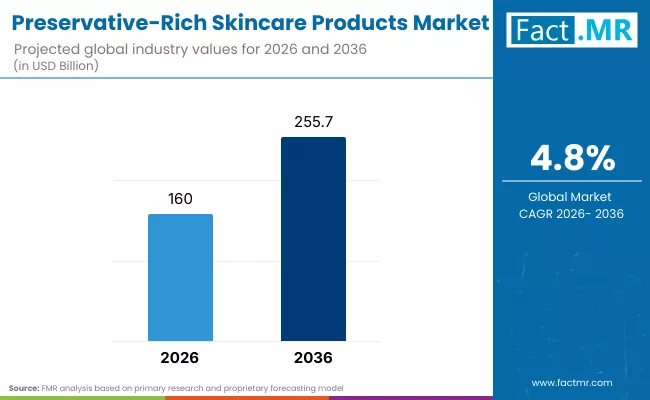
Preservative Rich Skincare Products Market By Industry | Source: Fact.MR
The market is being shaped by the transition from basic formulation longevity toward products designed for consistent shelf-life, global distribution, and high-volume logistics. Operational focus is on formulation stability, packaging compatibility, and predictable manufacturing processes that ensure product integrity across multi-region supply chains.
Procurement strategies prioritize reproducible raw material quality, batch-to-batch consistency, and compliance with international regulatory frameworks. Adoption is accelerating in mass, prestige, and professional skincare segments as manufacturers and distributors standardize handling procedures to reduce spoilage, minimize returns, and optimize inventory turnover. Evidence shows that growth is driven by efficient supply chain integration, reliable preservation technology, and the ability to scale production while maintaining formulation performance. Overall, the market reflects a long-term focus on operational resilience, quality assurance, and globally consistent product performance across the skincare ecosystem.
Preservative-Rich Skincare Products Market
| Metric | Value |
|---|---|
| Market Value (2026) | USD 160 billion |
| Forecast Value (2036) | USD 255.7 billion |
| Forecast CAGR (2026-2036) | 4.8% |
Source: Fact.MR analysis. Updated Feb 5, 2026
Category
| Category | Segments |
|---|---|
| Product Type | Face creams & moisturizers; Cleansers & face wash; Sunscreen; Body creams & moisturizers; Shaving lotions & creams; Others |
| Gender | Female; Male |
| Distribution Channel | Supermarkets & hypermarkets; Convenience stores; Pharmacy & drugstore; Online; Others |
| Region | North America; Europe; Asia Pacific; Latin America; Middle East & Africa |
Source: Fact.MR analysis. Updated Feb 5, 2026
Segmental Analysis
By Product Type, Why Do Face Creams and Moisturizers Lead the Preservative-Rich Skincare Products Market?
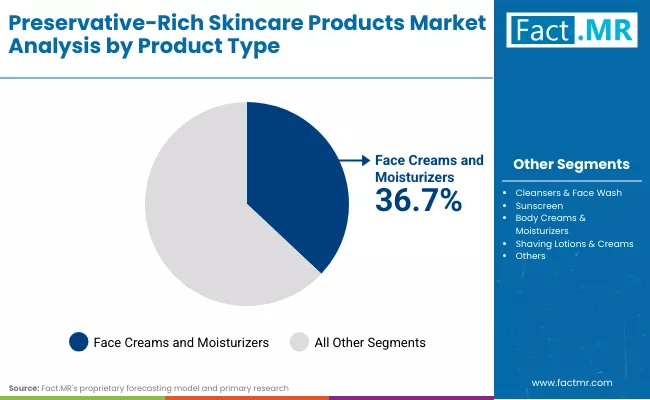
Preservative Rich Skincare Products Market By Product Type | Source: Fact.MR
Face creams and moisturizers lead the market with 36.7% share, reflecting consistent, repeatable demand across retail, e-commerce, and professional channels. Market growth is driven by high-frequency usage, multi-channel distribution, and predictable procurement cycles, which support operational efficiency and scalable logistics. Retailers benefit from inventory standardization, repeatable replenishment schedules, and streamlined supply chain workflows. Urban household penetration and recurring consumer purchasing reinforce sustained demand. Segment prominence arises from structural market drivers such as repeatable procurement, channel coverage, and operational repeatability rather than specific product formulation. High-frequency consumption remains the central driver of market activity.
By Gender, Why Does Female Consumers Represent the Largest Segment?
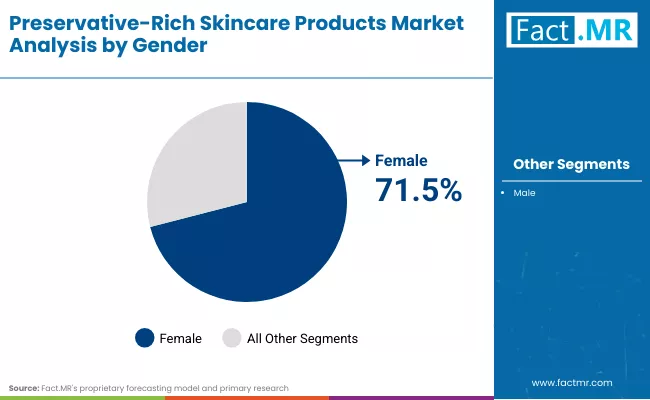
Preservative Rich Skincare Products Market By Gender | Source: Fact.MR
Female consumers account for 71.5% share, reflecting the largest demographic segment with frequent, repeatable purchases across retail and e-commerce channels. The market emphasizes predictable procurement, operational efficiency, and scalable distribution to meet ongoing consumer demand. Suppliers benefit from recurring order volumes, standardized production, and streamlined logistics. Segment dominance is shaped by structural market factors including consumer prevalence, high turnover, and channel penetration rather than product-specific attributes. Female-focused consumption drives consistent purchasing patterns and inventory planning, making this demographic the central contributor to overall market volume and sustained supply chain activity.
Country/Region
| Country/Region | Driver | Restraint | Trend |
|---|---|---|---|
| USA | Rising demand for long shelf-life and microbiologically safe skincare → drives premium preservative-rich formulations | FDA MoCRA 2026 cGMP → increases compliance costs for small/mid-tier brands | Growth of high-stability dermatologist-tested preservative skincare |
| India | Urbanization and e-commerce → accelerates preservative-rich skincare penetration | Supply chain/regulatory reporting challenges → slow rollout for smaller brands | Online-ready preservative-rich formulations targeting urban consumers |
| Brazil | Preference for natural-origin preservatives → drives differentiated product launches | Import/ingredient regulations → increase formulation costs | Growth of locally sourced sustainable preservative-rich skincare |
| China | Rising middle-class skincare awareness → fuels premium preservative-rich launches | GMP tightening → delays product approvals | Expansion of automated preservative-testing and formulation lines |
Source: Fact.MR analysis. Updated Feb 5, 2026
Analysis of the Preservative-Rich Skincare Products Market by Key Country
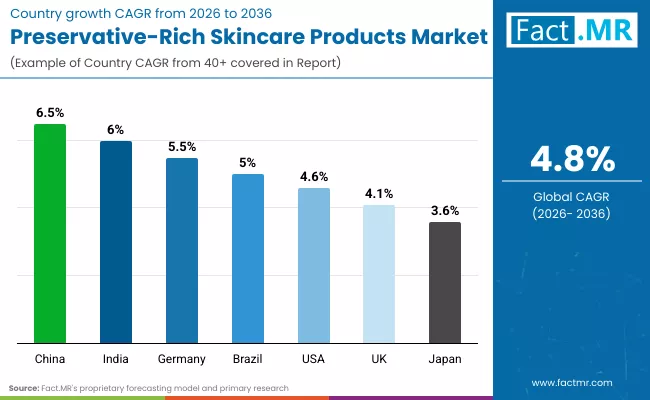
Preservative Rich Skincare Products Market By Country | Source: Fact.MR
| Country | CAGR (2026-2036) |
|---|---|
| China | 6.5% |
| India | 6.0% |
| Germany | 5.5% |
| Brazil | 5.0% |
| USA | 4.6% |
| UK | 4.1% |
| Japan | 3.6% |
Source: Fact.MR analysis. Updated Feb 5, 2026
The report covers an in-depth analysis of 40+ countries; top-performing countries are highlighted below.
How Is Demand for Preservative-Rich Skincare Products Growing in China?
Demand for preservative-rich skincare products in China grows at 6.5% CAGR through 2036. Urban consumers increasingly prefer formulations that balance skin health with extended shelf life, especially in high-humidity environments. E-commerce platforms accelerate product trial and repeat purchase cycles, while domestic and global brands invest in quality assurance and regulatory compliance. Operational focus emphasizes efficient inventory replenishment and regional distribution networks. Premium and mid-tier segments benefit from functional benefits combined with convenience. Supply chain digitization enables real-time tracking and reduces product loss. Market growth reflects rising consumer awareness of skin protection and efficacy-driven choices.
What Is the Growth in Adoption of Preservative-Rich Skincare Products in India?
Growth in adoption of preservative-rich skincare products in India reaches 6% CAGR through 2036. Expanding urbanization and rising disposable incomes drive demand for reliable, shelf-stable formulations. Retail modernization and e-commerce penetration enable broader access to functional products across metropolitan and secondary cities. Manufacturers prioritize formulation consistency, regulatory compliance, and quality assurance. Operational improvements focus on supply chain responsiveness to meet high-demand clusters. Consumer education highlights hygiene and efficacy benefits, increasing trust in preservative-stabilized products. Premium and mid-tier categories show strong adoption, reflecting evolving consumer expectations for convenient, effective, and safe skincare solutions.
How Is the Preservative-Rich Skincare Products Market Shaping in Germany?
Adoption of preservative-rich skincare products in Germany grows at 5.5% CAGR through 2036. Consumers prioritize safe, stable, and high-performance formulations for daily use. Retailers curate offerings across mass and specialty channels, highlighting quality and functional efficacy. Operational improvements emphasize supply chain reliability, regulatory compliance, and consistency in packaging and formulation. Urban adoption supports premium products, while regional networks maintain mass-market coverage. Manufacturers invest in process validation, ingredient safety, and quality assurance to meet consumer and regulatory expectations. Market growth is steady, reflecting the combination of consumer preference for safety, efficacy, and reliable product performance in skincare routines.
What Is the Outlook on Preservative-Rich Skincare Products in Brazil?
Outlook on preservative-rich skincare products in Brazil grows at 5% CAGR through 2036. Warm, humid climate conditions increase demand for formulations that provide stability and long-lasting efficacy. Urban retail chains and beauty specialty stores focus on functional skincare assortments. Operational improvements concentrate on supply chain reliability, moisture-resistant packaging, and consistent distribution. Manufacturers adjust formulations to maintain quality under regional climate conditions. Premiumization trends and product education drive adoption in metropolitan and coastal regions. Steady uptake is supported by consumer awareness of safety and efficacy, while regulatory compliance ensures trust and market access for both domestic and international brands.
How Is the Preservative-Rich Skincare Products Market Growing in the United States?
Growth in the preservative-rich skincare products market in the United States is 4.6% CAGR through 2036. Consumers increasingly integrate functional and hygiene-conscious products into daily skincare routines. Retailers expand offerings across department stores, specialty stores, and e-commerce channels. Operational focus emphasizes formulation safety, supply chain consistency, and regulatory compliance. Manufacturers invest in quality assurance and batch traceability to maintain consumer confidence. Urban and suburban adoption supports premium and mid-tier segments. Steady growth is driven by consumer preference for safe, long-lasting skincare, combined with operational efficiency that ensures reliable product availability nationwide.
What Are the Growth Patterns in the Preservative-Rich Skincare Products Market in the United Kingdom?
Growth patterns in the preservative-rich skincare products market in the United Kingdom reach 4.1% CAGR through 2036. Consumers seek safe, stable, and effective products for daily use. Retailers expand curated product lines in specialist stores and online channels. Operational improvements focus on supply chain reliability, formulation standardization, and consistent packaging quality. Urban adoption supports premium segments, while regional penetration ensures broader coverage. Manufacturers prioritize compliance, safety, and efficacy to meet consumer expectations. Market expansion is gradual, reflecting mature demand with steady uptake among functional and wellness-oriented consumers seeking long-lasting skincare benefits.
How Is the Preservative-Rich Skincare Products Market Developing in Japan?
Outlook on the preservative-rich skincare products market in Japan grows at 3.6% CAGR through 2036. Consumers prefer gentle, stable formulations that support daily skin health while maintaining product integrity. Urban and specialty retail channels highlight functional benefits alongside aesthetic performance. Manufacturers focus on consistent formulation, regulatory compliance, and quality assurance. Operational improvements optimize supply chain efficiency, packaging durability, and product availability across regions. Premium segments lead adoption, driven by consumer preference for safety and functional efficacy. Market growth is measured, reflecting a cautious, quality-conscious consumer base and stable long-term demand for preservative-rich skincare solutions.
How Are Supply Integration, Clinical Validation, and Regulatory Compliance Defining Competitive Moats in the Preservative-Rich Skincare Products Market?
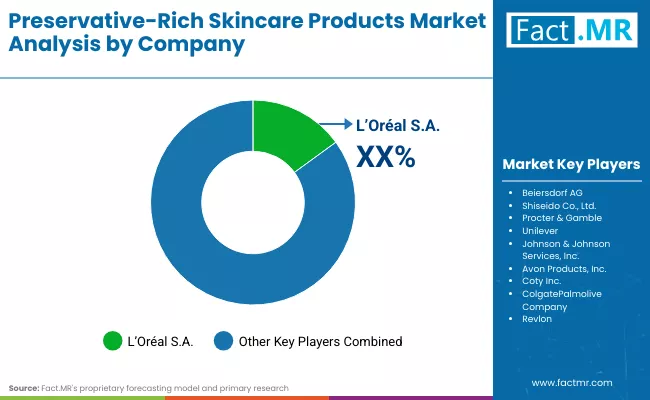
Preservative Rich Skincare Products Market By Company | Source: Fact.MR
As per Fact.MR analysis, the preservative-rich skincare products market in 2026 is defined by a shift from simple formulation innovation to evidence-backed preservation efficacy, where supply chain reliability and regulatory adherence determine competitive advantage. L’Oréal and Beiersdorf leveraged global R&D and validated preservative systems, which reinforced premium and professional channel adoption. Shiseido integrated preservative technologies into multi-step regimens, which increased basket penetration and repeat purchase. Procter & Gamble and Unilever scaled production and distribution, which ensured consistent quality across emerging and mature markets. Johnson & Johnson and Coty emphasized compliance with multi-region safety frameworks, which improved retailer and regulatory trust. Avon, Colgate-Palmolive, and Revlon optimized supply responsiveness and packaging compatibility, which enhanced adoption in direct-to-consumer and mass-market channels. Collectively, clinical substantiation, validated formulation efficacy, and integrated supply chains created defensible moats, reducing reliance on marketing claims and incremental preservative tweaks.
Key Players in Preservative-Rich Skincare Products Market
- L’Oréal S.A.
- Beiersdorf AG
- Shiseido Co., Ltd.
- Procter & Gamble
- Unilever
- Johnson & Johnson Services, Inc.
- Avon Products, Inc.
- Coty Inc.
- Colgate‑Palmolive Company
- Revlon
References
- U.S. Food and Drug Administration. (2024). Cosmetic good manufacturing practices and microbiological safety requirements under the Modernization of Cosmetics Regulation Act (MoCRA). U.S. Department of Health and Human Services.
- European Commission. (2024). Regulation (EU) 2024/996 amending Regulation (EC) No 1223/2009 on cosmetic products. Official Journal of the European Union.
- Congressional Research Service. (2023, October 30). FDA regulation of cosmetics and personal care products (R47826).
- European Commission. (2024, April 3). Commission Regulation (EU) 2024/996 amending Regulation (EC) No 1223/2009 on cosmetic products. Official Journal of the European Union.
- Scientific Committee on Consumer Safety (SCCS). (2023, December 22). SCCS Notes of guidance for the testing of cosmetic ingredients and their safety evaluation (12th revision) (Final opinion). European Commission.
Segmentation
Scope of the Report
| Items | Values |
|---|---|
| Quantitative Units (2026) | USD billion |
| Product Type | Face Creams & Moisturizers, Cleansers & Face Wash, Sunscreen, Body Creams & Moisturizers, Shaving Lotions & Creams, Others |
| Gender | Female, Male |
| Distribution Channel | Supermarkets & Hypermarkets, Convenience Stores, Pharmacy & Drugstore, Online, Others |
| Region | Asia Pacific, North America, Europe, Latin America, Middle East & Africa |
| Countries Covered | China, Japan, South Korea, India, Australia & New Zealand, ASEAN, Rest of Asia Pacific, Germany, UK, France, Italy, Spain, Nordic, BENELUX, Rest of Europe, USA, Canada, Mexico, Brazil, Chile, Rest of Latin America, KSA, Other GCC, Turkey, South Africa, Other African Union, Rest of MEA |
| Key Companies Profiled | L’Oréal S.A., Beiersdorf AG, Shiseido Co., Ltd., Procter & Gamble, Unilever, Johnson & Johnson Services, Inc., Avon Products, Inc., Coty Inc., Colgate Palmolive Company, Revlon |
| Additional Attributes | Dollar by sales by product type and gender; validated preservation efficacy; operational scalability; multi-channel distribution; batch-to-batch consistency; regulatory compliance; inventory predictability; shelf-life performance; professional and retail adoption; supply chain integration; formulation reproducibility; transport-efficient packaging; high-volume logistics supporting global skincare segments. |
Source: Fact.MR analysis. Updated Feb 5, 2026
Preservative-Rich Skincare Products Market Segmentation
-
Product Type :
- Face Creams & Moisturizers
- Cleansers & Face Wash
- Sunscreen
- Body Creams & Moisturizers
- Shaving Lotions & Creams
- Others
-
Gender :
- Female
- Male
-
Distribution Channel :
- Supermarkets & Hypermarkets
- Convenience Stores
- Pharmacy & Drugstore
- Online
- Others
-
Region :
- Asia Pacific
- China
- Japan
- South Korea
- India
- Australia & New Zealand
- ASEAN
- Rest of Asia Pacific
- Europe
- Germany
- United Kingdom
- France
- Italy
- Spain
- Nordic
- BENELUX
- Rest of Europe
- North America
- United States
- Canada
- Mexico
- Latin America
- Brazil
- Chile
- Rest of Latin America
- Middle East & Africa
- Kingdom of Saudi Arabia
- Other GCC Countries
- Turkey
- South Africa
- Other African Union
- Rest of Middle East & Africa
- Asia Pacific
Frequently Asked Questions
How big is the global preservative-rich skincare products market in 2026?
What will be the size of the preservative-rich skincare products market in 2036?
How much will the demand for preservative-rich skincare products grow between 2026 and 2036?
Which product type holds a significant share in the preservative-rich skincare products market in 2026?
Which gender segment leads the preservative-rich skincare products market in 2026?
Who worked on this report


Preview the report firsthand - request a free sample
Free SampleGet the brochure for pricing and purchase details
Download PDF