- Market Value (2025): USD 673.2 Mn
- Estimated Value (2026): USD 706.2 Mn
- Forecast Value (2036): USD 1344.0 Mn
- CAGR (2026-2036): 4.9%
What is the Apple Powder Market forecast to be worth by 2036?
USD 706.2 million in 2026 to USD 1344.0 million by 2036 at 4.9% CAGR.
- The apple powder market reached USD 673.2 million in 2025.
- Demand is projected to increase from USD 706.2 million in 2026 to USD 1344.0 million by 2036.
- The market is forecast to record 4.9% CAGR from 2026 to 2036 as powdered formats simplify storage and recipe control.
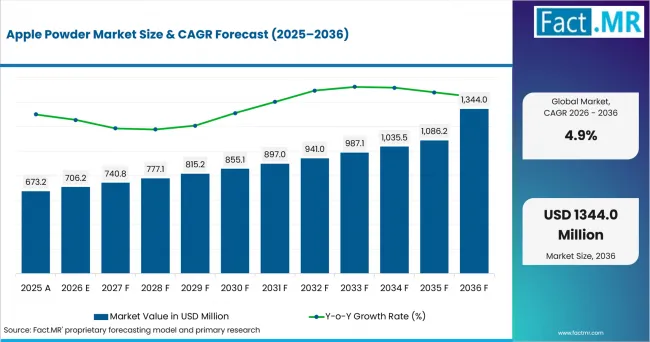
Apple Powder Market Value Analysis | Source: Fact.MR
What are the defining numbers behind Apple Powder Market growth?
USD 637.8 million absolute opportunity by 2036, led by Organic Apple Powder and Food applications.
- Demand Drivers in the Market
- Powdered apple ingredients help manufacturers add fruit flavor without managing fresh fruit spoilage in every batch.
- Food formulators use apple powder where pectin content and sweetness must support a clean ingredient statement.
- Channel reach across ingredient platforms is expected to improve availability for small brands and larger processors.
- Feed buyers use dried fruit inputs when palatability and consistent handling matter more than fresh-product seasonality.
- Key Segments Analyzed
- By Type: Regular Apple Powder is expected to hold 64.3% share in 2026.
- By Application: Food is projected to account for 65.0% share in 2026.
- Analyst Opinion at Fact.MR
- Shambhu Nath Jha, Principal Consultant at Fact.MR, states, “Apple powder demand depends on how clearly suppliers match powder grade with the way each buyer plans to use it. Food buyers compare particle behavior and color before approving repeat orders. Feed buyers focus on handling and palatability. This makes documentation and pack format important at the quotation stage.”
- Strategic Implications
- Ingredient buyers need to match organic and regular grades with the product role before price comparison begins.
- Suppliers can improve conversion by explaining how apple powder behaves inside functional food formulations and everyday recipes.
- Distributors can reduce buying friction by separating food-grade and feed-grade needs before pack-size decisions are made in the online grocery.
The UK records the highest country CAGR at 7.7% through premium ingredient use and channel readiness. Australia and the USA each reach 6.6% through different demand routes. Canada advances at 6.0% through retail and ingredient use. Germany expands at 5.5% as mature food processing supports steady uptake.
How does the Apple Powder Market break down by segment?
Regular Apple Powder is expected to lead Type with 64.3% share in 2026. Food is projected to lead Application with 65.0% share in 2026.
Why does Regular Apple Powder lead Type?
Regular Apple Powder is projected to account for 64.3% share in 2026.
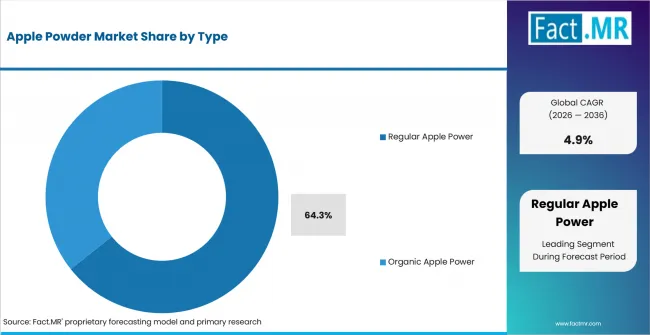
Apple Powder Market Analysis By Type | Source: Fact.MR
Regular Apple Powder leads because it offers wider availability and better cost control for food manufacturers. The format suits large-volume production where consistent supply matters more than certified sourcing. Organic Apple Powder remains relevant for brands focused on clean labels and premium ingredient claims.
Why does Food lead Application?
Food holds 65.0% share in 2026.
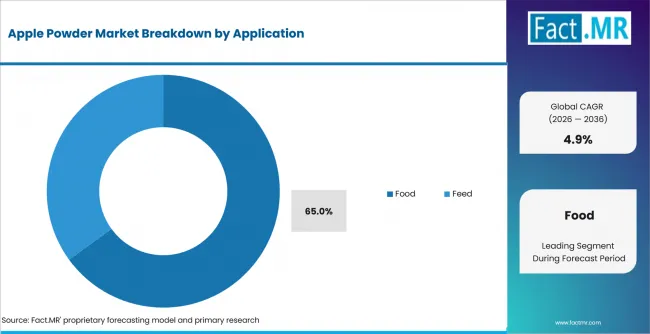
Apple Powder Market Analysis By Application | Source: Fact.MR
Apple powder has broad use across bakery, beverage and processed food recipes, which keeps Food ahead of other applications. Manufacturers also benefit from easier storage and handling compared with fresh apples. Feed demand remains smaller and is mainly linked to taste improvement and consistent mixing.
What is accelerating Apple Powder Market adoption, and what is holding it back?
Adoption is expected to rise through convenience-led formulation and wider powdered fruit use. Growth may be limited by input-price swings and quality variation. Labeling differences across destination markets can slow approval for new suppliers.
Drivers Impact Analysis
| DRIVER | (~) % IMPACT ON CAGR | GEOGRAPHIC RELEVANCE | IMPACT TIMELINE |
|---|---|---|---|
| Organic ingredient positioning | +1.4% | UK, Germany, Canada | Short term (<= 2 years) |
| Shelf-stable fruit formulation | +1.1% | USA, Australia, UK | Short term (<= 2 years) |
| Foodservice and industrial blending | +0.9% | USA, Canada, Germany | Medium term (2-4 years) |
| Feed palatability use | +0.6% | Australia, Canada | Medium term (2-4 years) |
| Digital ingredient discovery | +0.5% | UK, USA, Australia | Long term (>= 4 years) |
Source: Fact.MR analysis. Updated Aug 4, 2026
- Organic ingredient positioning: Certification is expected to support premium placement when food brands need clear sourcing language.
- Shelf-stable fruit formulation: Powdered fruit is likely to gain use where clean ingredients must pass through routine production lines.
- Foodservice and industrial blending: Bulk buyers are expected to value stable powder flow and predictable flavor during production.
Opportunity Impact Analysis
| OPPORTUNITY | (~) % IMPACT ON CAGR | GEOGRAPHIC RELEVANCE | IMPACT TIMELINE |
|---|---|---|---|
| Bakery and dry mix applications | +0.8% | USA, UK, Germany | Short term (<= 2 years) |
| Premium organic formulations | +0.7% | UK, Canada, Germany | Medium term (2-4 years) |
| Feed-grade product separation | +0.5% | Australia, Canada | Medium term (2-4 years) |
| Pack-size and format differentiation | +0.4% | Retail and online channels | Long term (>= 4 years) |
Source: Fact.MR analysis. Updated Aug 4, 2026
- Bakery and dry mix applications: Apple powder can support flavor and moisture balance where manufacturers need measured additions.
- Premium organic formulations: Suppliers that document sourcing and residue controls are expected to gain access to organic food portfolios.
- Feed-grade product separation: Clear grade distinction can help suppliers serve animal nutrition buyers without confusing food-grade positioning.
Restraints Impact Analysis
| RESTRAINT | (~) % IMPACT ON CAGR | GEOGRAPHIC RELEVANCE | IMPACT TIMELINE |
|---|---|---|---|
| Apple input-price volatility | -0.8% | Global | Short term (<= 2 years) |
| Color and flavor consistency | -0.6% | Food manufacturing hubs | Short term (<= 2 years) |
| Labeling and certification burden | -0.5% | UK, Germany, Canada | Medium term (2-4 years) |
| Storage and moisture sensitivity | -0.3% | Retail and distributor channels | Long term (>= 4 years) |
Source: Fact.MR analysis. Updated Aug 4, 2026
- Apple input-price volatility: Fruit availability and grade mix can change powder cost before contracts are renewed.
- Color and flavor consistency: Buyers may reject lots when drying behavior creates visible color drift or flavor loss in clean label ingredients products.
- Labeling and certification burden: Organic claims and food-grade documents can delay onboarding when suppliers serve several markets.
Which countries are scaling Apple Powder Market fastest?
- The country comparison spans 2.2 percentage points between the UK and Germany across the forecast period.
- The UK remains 1.1 percentage points above Australia through premium ingredient use and channel-led product discovery.
- Australia and the USA record the same 6.6% CAGR. Australia leans more on clean-label food use and the USA on manufacturing scale.
- Canada stays 0.6 percentage point below Australia and the USA as demand develops through retail and feed channels.
- Germany remains close to the global rate through mature formulation activity and stricter supplier qualification.
Comparable country CAGRs can still reflect different entry conditions. Full report coverage includes North America and Latin America. Europe and East Asia are also covered. South Asia and Pacific, Middle East and Africa complete the regional view.
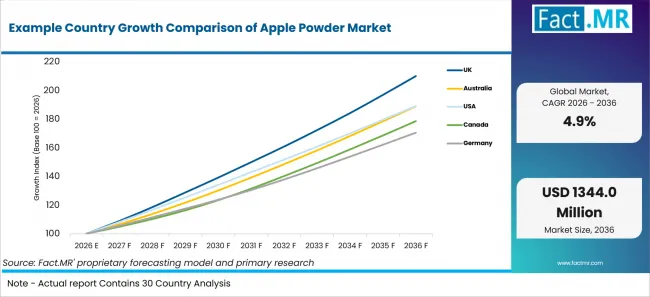
Example Country Growth Comparison Of Apple Powder Market | Source: Fact.MR
| Country | CAGR (2026-2036) |
|---|---|
| UK | 7.7% |
| Australia | 6.6% |
| USA | 6.6% |
| Canada | 6.0% |
| Germany | 5.5% |
Source: Fact.MR analysis. Updated Aug 4, 2026
What is driving the UK's growth through 2036?
7.7% CAGR, supported by premium ingredient use and channel readiness.
UK ingredient buyers are expected to approve apple powder when organic grade proof and retail-pack readiness are clear. Premium food brands need a fruit ingredient that can move through dry mixes without fresh-fruit handling. This favors suppliers that explain grade, color and pack size before sampling begins.
How is Australia scaling demand?
6.6% CAGR, driven by clean-label food use and wide distribution needs.
Australia’s demand route begins with the need to move stable ingredients across long supply distances. Powder formats reduce handling pressure for processors that serve regional buyers. Food and feed users are expected to compare moisture control and flavor behavior before wider approval.
What is driving the USA's growth through 2036?
6.6% CAGR, backed by manufacturing scale and ingredient platform access.
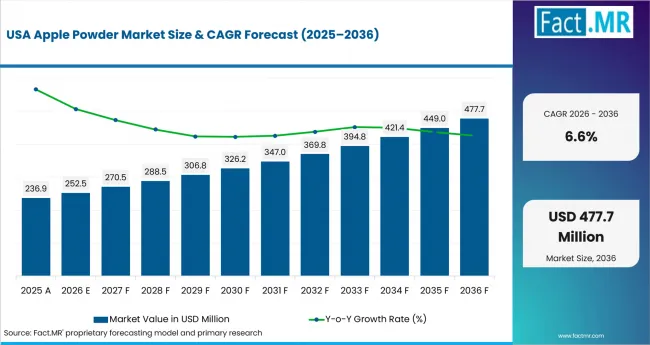
Apple Powder Market Country Value Analysis | Source: Fact.MR
Large USA food manufacturers are expected to use apple powder where batch consistency matters in repeat production. The same buyer base often reviews supplier documents before testing a new powder grade. This makes service response and pack flexibility important for repeat sourcing.
What is driving Canada's growth through 2036?
6.0% CAGR, led by retail and ingredient-use breadth.
Canada’s growth is shaped by a balanced mix of retail demand and food-processing use. Suppliers must handle organic proof and grade separation without raising buying friction. Feed buyers add another route where dried fruit inputs help palatability and storage planning.
How does Germany perform?
5.5% CAGR, supported by mature food-processing demand and supplier qualification.
Germany’s market develops through careful approval inside established food plants. Processors are expected to test color and particle behavior before approving new suppliers. Organic documentation and clear lot records matter because buyers often need proof before changing an existing formulation.
Who leads the Apple Powder Market?
CFF GmbH and Co. KG and Herbafood Ingredients GmbH show clear relevance through ingredient portfolios. Döhler GmbH adds botanical and powdered ingredient exposure. Van Drunen Farms, Mayer Brothers and Kanegrade Limited widen the provider group across ingredient supply and related food or feed uses.
Competition is shaped by product grade and sourcing evidence. Buyers compare delivery reliability and pack-size flexibility before repeat sourcing. The dehydrated food and spray drying equipment can influence how buyers judge powder quality.
Which companies are the key providers?
Key companies include CFF GmbH and Co. KG; Döhler GmbH; Van Drunen Farms; Mayer Brothers; Kanegrade Limited; Herbafood Ingredients GmbH.
- CFF GmbH and Co. KG
- Döhler GmbH
- Van Drunen Farms
- Mayer Brothers
- Kanegrade Limited
- Herbafood Ingredients GmbH
Bibliography
- Weber, C., Simnitt, S., Wakefield, H., & Wechsler, S. J. (2025, March 27). Fruit and tree nuts outlook: March 2025 (Report No. FTS-381). U.S. Department of Agriculture, Economic Research Service.
- National Agricultural Statistics Service. (2025). USDA forecasts U.S. corn production up and soybean production down from 2024. U.S. Department of Agriculture.
- Economic Research Service, & Foreign Agricultural Service. (2025, December 23). Outlook for U.S. agricultural trade: December 2025 (Report No. AES-134). U.S. Department of Agriculture.
- U.S. Food and Drug Administration. (2025, January). Guidance for industry: Questions and answers regarding food allergen labeling (Edition 5).
This Report Answers
- The report provides strategic intelligence on the Apple Powder Market across Type and Application choices that shape ingredient purchasing.
- Segment analysis covers Organic Apple Powder and Regular Apple Powder as the defined type categories.
- Application analysis evaluates Food and Feed use cases. Food holds the leading 65.0% share in 2026.
- Country outlook evaluates the UK and Australia alongside the USA. Canada and Germany complete the growth comparison.
What does the Apple Powder Market cover?
Apple powder products are dried apple-based ingredients used where powder form improves storage and measured addition.
The Apple Powder Market covers Organic Apple Powder and Regular Apple Powder sold into Food and Feed applications. Coverage includes food manufacturers and ingredient distributors. It also includes retailers and online sellers where apple powder is purchased as a defined input. Pack format and channel reach are included when they affect buyer access.
What is included in the scope?
The scope includes apple powder products sold in commercial ingredient formats across the defined type and application categories.
Coverage spans Organic Apple Powder and Regular Apple Powder. Food applications include bakery and beverages. Dry mixes and prepared foods are covered where powder form supports formulation. Feed applications are included where dried apple content supports palatability or product consistency.
What is excluded from the scope?
Finished products that only contain apple powder as a minor ingredient remain outside the scope unless demand is measured at the apple powder input level.
The scope excludes fresh apples and apple juice. Apple puree and finished snacks are outside coverage. It also excludes unrelated fruit ingredients and company revenue that cannot be traced to apple powder supply or the defined applications.
How Was the Analysis Built?
The analysis draws on more than 120 sources and 35 company portfolios. It also covers more than 25 countries and more than 20 industry interviews.
- Primary Research: Primary research includes discussions with manufacturers and service providers. It also covers technology developers and distributors. End users, procurement teams and subject-matter experts are included where they inform buyer decisions. These conversations examine purchasing priorities and product adoption. They also review operating issues and approval requirements. Competitive positioning is assessed where it affects wider market acceptance.
- Desk Research: Desk research covers government statistics and regulatory publications. Company filings, trade data and technical studies are reviewed. Industry associations and standards are used where they define market context. Every source used in the analysis is documented in the bibliography.
- Market Sizing and Forecasting: Market estimates combine historical performance and demand indicators. Pricing and volume trends are reviewed with segment shares. Company participation and country-level growth are compared with adoption patterns. Investment activity and barriers are reviewed before final estimates are set.
- Data Validation and Update Cycle: Findings are validated by comparing primary interviews with public data. Company activity and regulatory changes are reviewed during the same cycle. Regular updates review product launches and capacity changes. Partnerships, approvals and procurement trends are checked when they affect commercial adoption.
Segmentation
What is the report's scope and coverage?
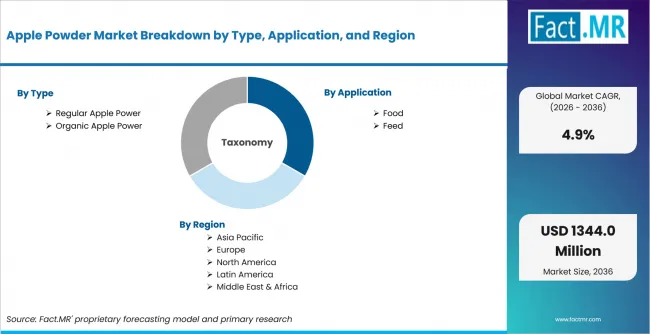
Apple Powder Market Breakdown By Type, Application, And Region | Source: Fact.MR
| Attribute | Details |
|---|---|
| Quantitative Units | USD million in 2026 to USD million by 2036 at CAGR |
| Market Definition | Apple powder products sold for food and feed applications where dried apple content supports flavor, texture, sweetness or formulation value |
| Type | Organic Apple Powder; Regular Apple Powder |
| Application | Food; Feed |
| Regions Covered | North America; Latin America; Europe; East Asia; South Asia and Pacific; Middle East and Africa |
| Countries Covered | UK; Australia; USA; Canada; Germany |
| Key Companies Profiled | CFF GmbH and Co. KG; Döhler GmbH; Van Drunen Farms; Mayer Brothers; Kanegrade Limited; Herbafood Ingredients GmbH |
| Forecast Period | 2026 to 2036 |
| Approach | Hybrid top-down and bottom-up approach using type demand; application fit; food and feed usage; country adoption patterns; distribution reach; supplier participation; pack formats; sourcing requirements and company portfolio review |
Source: Fact.MR analysis. Updated Aug 4, 2026
How is the market segmented?
-
By Type:
- Organic Apple Powder
- Regular Apple Powder
-
By Application:
- Food
- Feed
-
By Region:
- North America
- Latin America
- Europe
- East Asia
- South Asia and Oceania
- Middle East and Africa
Frequently Asked Questions
Which type leads the Apple Powder Market?
Which application leads the market?
Which country records the highest listed CAGR?
What is the primary driver in this market?
What is the main restraint?
Which companies are included in the market assessment?
Who worked on this report


Preview the report firsthand - request a free sample
Free SampleGet the brochure for pricing and purchase details
Download PDF