- Base Value(2026): 188.6 Mn
- Estimated Value(2026): 188.6 Mn
- Forecast Value (2036): 467.8 Mn
- CAGR (2026 - 2036): 9.5%
AR Headset Low-Sparkle Optical Films Market Forecast and Outlook 2026 to 2036
The global AR headset low-sparkle optical films market is projected to expand from USD 188.60 million in 2026 to USD 467.84 million by 2036, growing at a robust compound annual growth rate of 9.5%.
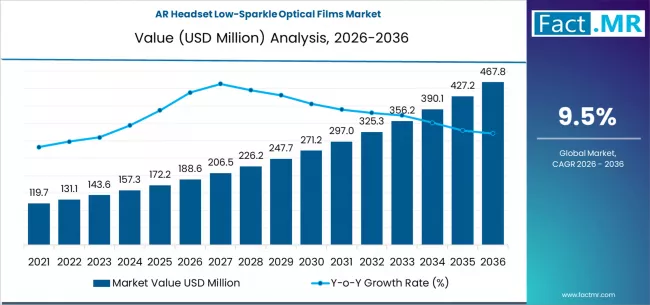
Ar Headset Low Sparkle Optical Films Market Market Value Analysis | Source: Fact.MR
Summary of AR Headset Low-Sparkle Optical Films Market
- Market Snapshot
- Global AR headset low-sparkle optical films market revenue stood at USD 188.60 million in 2026 and is forecast to reach USD 467.84 million by 2036.
- At a 9.5% CAGR from 2026 to 2036, this market is set to expand ~2.5x in value, adding USD 279.24 million in absolute opportunity.
- Growth is being driven by rising demand for high-clarity AR displays and improved user comfort in extended-use environments.
- Low-sparkle optical films are critical components that reduce light scattering and sparkle noise, improving visual fidelity in AR headsets.
- Demand and Growth Drivers
- Increasing adoption of AR headsets in enterprise and industrial applications is accelerating demand.
- Rising need for enhanced visual clarity and reduced eye strain is driving integration of low-sparkle films.
- Expansion of AR applications in training, remoteassistance, and complex assembly is supporting market growth.
- Need for materials that provide:
- Reduced sparkle noise and glare
- High light transmission
- Optical uniformity
- Improved user comfort for prolonged usage
- Advancements in display technologies such as Micro-OLED are increasing reliance on advanced optical films.
- Product and Segment View
- Micro-OLED holds 49.0% of display type share in 2026,emergingas the leading segment.
- Enterprise / Industrial accounts for 46.0% of end-use share in 2026, positioning it as the dominant segment.
- Anti-Sparkle filmsrepresent57% of film function share in 2026, reflecting core functional demand.
- Key product categories include:
- Anti-sparkle films
- Anti-reflection films
- Hybrid optical films
- Geography and Competitive Outlook
- Growth is supported across major electronics and AR innovation hubs driven by increasing headset production and R&D activity.
- Key growth markets and CAGR: USA (9.50%), China (9.00%), South Korea (8.80%), Japan (8.50%).
- Market expansion is closely tied to:
- Growth in AR hardware adoption
- Advancements in display technologies
- Increasing demand for immersive user experiences
- Key companies active in this marketinclude:3M, Nitto Denko, Toray Industries, LG Chem, Samsung SDI, Mitsubishi Chemical.
AR Headset Low-Sparkle Optical Films Market — At a Glance
| Attribute | Details |
| Market Value 2026 | USD 188.60 million |
| Market Value 2036 | USD 467.84 million |
| Absolute Dollar Opportunity 2026-2036 | USD 279.24 million |
| Total Growth 2026-2036 | 148.1% |
| CAGR 2026-2036 | 9.5% |
| Growth Multiple | ~2.5x |
| Key Demand Theme | Increasing need for high-clarity, low-glare optical solutions in AR headsets |
| Leading Segment by Display Type (2026) | Micro-OLED |
| Segment Share (2026) | 49.0% |
| Leading Segment by End Use (2026) | Enterprise / Industrial |
| Segment Share (2026) | 46.0% |
| Leading Segment by Film Function (2026) | Anti-Sparkle |
| Segment Share (2026) | 57% |
| Key Growth Regions | North America, East Asia, Western Europe |
| Country CAGRs | USA 9.50%, China 9.00%, South Korea 8.80%, Japan 8.50% |
| Top Companies | 3M, Nitto Denko, Toray Industries, LG Chem, Samsung SDI, Mitsubishi Chemical |
| Segmentation by Display Type | Micro-OLED, LCoS, Waveguide Hybrid |
| Segmentation by End Use | Enterprise/Industrial,Defense, Consumer |
| Segmentation by Film Function | Anti-Sparkle, Anti-Reflection |
| Segmentation by Region | North America, Latin America, Western Europe, Eastern Europe, East Asia, South Asia & Pacific, MEA |
Source: Fact.MR analysis. Updated Apr 8, 2026
Growth is fueled by the rising demand for high-visibility, enterprise-grade augmented reality devices where optical clarity and user comfort are paramount. These specialized films are critical for mitigating sparkle noise, which is a major barrier to prolonged use in industrial and defense applications. The market is segment-led, with Micro-OLED displays accounting for a 49% share due to their high resolution and contrast, necessitating advanced optical management. The enterprise and industrial end-use segment holds a leading 46% share, driven by adoption in training, remote assistance, and complex assembly. Anti-sparkle films dominate the film function segment with a 57% share, underscoring the primary technical challenge the market addresses. Geographically, innovation and manufacturing hubs like the USA, China, South Korea, and Japan are the key growth engines.
Category
| Category | Segments |
|---|---|
| Display Type | Micro-OLED, LCoS, Waveguide Hybrid |
| End Use | Enterprise / Industrial, Defense, Consumer |
| Film Function | Anti-Sparkle, Anti-Reflection |
| Region | North America, Latin America, Western Europe, Eastern Europe, East Asia, South Asia & Pacific, MEA |
Source: Fact.MR analysis. Updated Apr 8, 2026
Segmental Analysis
By Display Type, Which Technology Drives Demand for High-Performance Optical Films?
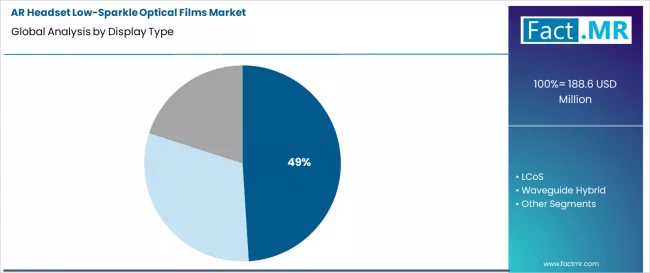
Ar Headset Low Sparkle Optical Films Market Analysis By Display Type | Source: Fact.MR
Micro-OLED displays lead the segment with a 49% share. Their dominance is due to superior pixel density and contrast ratios, which are essential for immersive AR experiences. However, these high-resolution displays are also highly susceptible to sparkle noise.
This creates a critical need for advanced low-sparkle optical films that can preserve the display's inherent clarity while diffusing light to eliminate visual artifacts, making them a non-negotiable component in premium AR headsets.
By End Use, Which Sector Prioritizes Performance and Long-Duration Use?
The enterprise and industrial sector commands a 46% market share. In applications like complex machinery repair, surgical guidance, or logistics, visual fidelity and user comfort over extended periods are critical for safety and productivity.
This sector is less price-sensitive than the consumer market and prioritizes optical performance, driving demand for high-grade films that effectively eliminate sparkle and glare to reduce eye strain and enhance information legibility.
By Film Function, Which Primary Challenge Defines the Market?
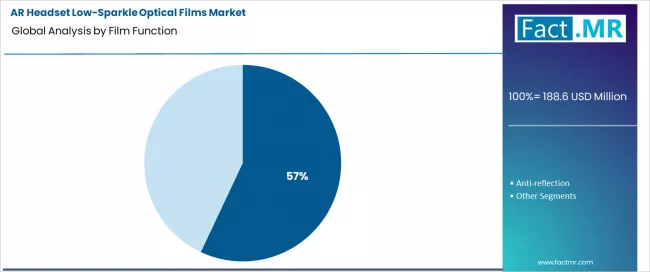
Ar Headset Low Sparkle Optical Films Market Analysis By Film Function | Source: Fact.MR
Anti-sparkle films hold a dominant 57% share of the film function segment. This highlights that mitigating pixel-level sparkle is the core technological imperative. While anti-reflection properties are often integrated, the primary value lies in films that employ sophisticated micro or nano-structures to break up coherent light from micro-displays, thereby removing the granular noise that degrades the see-through AR experience, especially in high-ambient light environments.
What are the Drivers, Restraints, Opportunities, and Trends in the AR Headset Low-Sparkle Optical Films Market?
| Metric | Description |
|---|---|
| Drivers | Accelerated investment in robotic painting automation for superior finish and efficiency. Rising aircraft production rates and stringent durability/environmental regulations boost demand. |
| Restraints | High cost of certified aerospace tapes limits budget-conscious MROs. Technical complexity in developing robotic-compliant, certified products hinders innovation and new entrants. |
| Opportunities | Developing advanced tapes for composite surfaces and sustainable adhesives. Expansion into emerging space tourism and urban air mobility markets. |
| Trends | Co-development of tapes and robotic systems with integrators.Growing focus on tapes that minimize waste and support lean manufacturing. |
Source: Fact.MR analysis. Updated Apr 8, 2026
Analysis of the AR Headset Low-Sparkle Optical Films Market by Key Countries
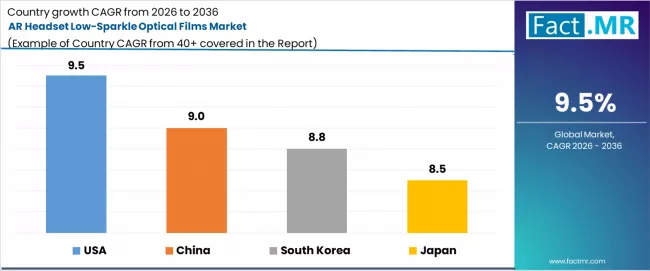
Ar Headset Low Sparkle Optical Films Market Cagr Analysis By Country | Source: Fact.MR
| Country | CAGR (2026-2036) |
|---|---|
| USA | 9.50% |
| China | 9.00% |
| South Korea | 8.80% |
| Japan | 8.50% |
Source: Fact.MR analysis. Updated Apr 8, 2026
How does the USA's Leadership in AR Software and Enterprise Adoption Drive the Market?
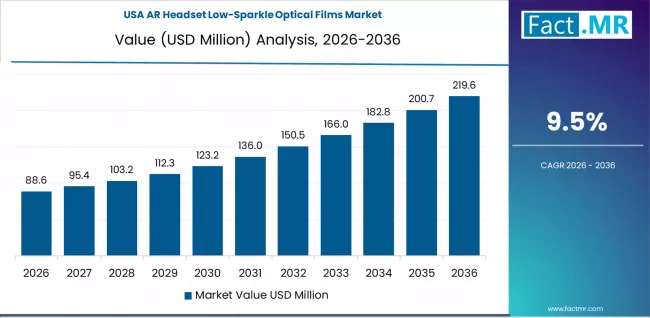
Ar Headset Low Sparkle Optical Films Market Country Value Analysis | Source: Fact.MR
USA leads the market growth, driven by its strong ecosystem of AR software developers and early enterprise adoption across sectors like healthcare, manufacturing, and logistics. American companies are pushing for headsets with superior optical performance to ensure software effectiveness. This creates demand for cutting-edge optical films, with R&D focused on integrating film functionality directly into waveguide and display modules for next-generation devices.
What is the Impact of China's Manufacturing Scale and Industrial Modernization?
China's growth is fueled by its massive electronics manufacturing base and national policies promoting industrial digitization. As a primary global manufacturer of AR hardware, there is immense volume demand for optical components.
Chinese display manufacturers are vertically integrating optical film solutions to enhance the value of their modules, focusing on cost-effective production of films that meet the demanding requirements of both domestic and export markets.
Why is South Korea's Display Technology Dominance a Critical Factor?
South Korea's market strength is directly tied to its global leadership in advanced display technologies. The country's major display producers are integral in developing Micro-OLED and other displays for AR.
This positions them to co-engineer and supply tailored low-sparkle optical films as a complete display subsystem. The focus is on proprietary film technologies that become a competitive advantage for their display panels in the high-end AR segment.
How does Japan's Expertise in Advanced Materials and Optics Shape its Role?
Japan's market contribution is defined by its world-class expertise in precision chemistry, optics, and high-performance films. Japanese chemical and material companies are key suppliers of specialized polymers and engineered film substrates.
Their role is in developing the core material science for ultra-thin, highly efficient anti-sparkle films with exceptional environmental durability, supplying both global film converters and headset manufacturers.
Competitive Landscape
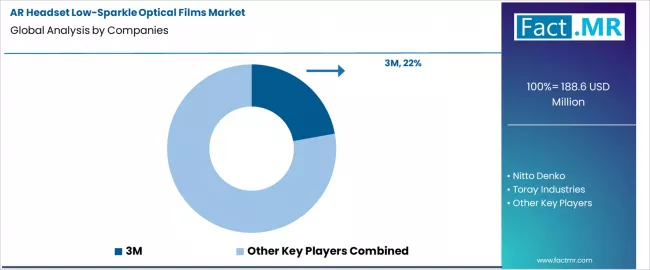
Ar Headset Low Sparkle Optical Films Market Analysis By Company | Source: Fact.MR
The competitive landscape involves a clash between diversified chemical giants and specialized optical film companies. Competition centers on proprietary micro-structuring technologies, material formulations for ultra-thinness and flexibility, and mastering the adhesion and lamination processes for fragile AR optics. Success depends on forming deep, collaborative partnerships with AR headset original equipment manufacturers and display panel makers at the early design phase.
Leaders must provide extensive optical simulation support and rapid prototyping to meet stringent field-of-view, clarity, and weight specifications. As the market evolves, providing certified film-integrated optical stacks, rather than just film rolls, will be key to capturing value and becoming a locked-in supplier for flagship AR devices.
Key Players in the AR Headset Low-Sparkle Optical Films Market
- 3M
- Nitto Denko
- Toray Industries
- LG Chem
- Samsung SDI
- Mitsubishi Chemical
References
- International Commission on Illumination (CIE). (2023). Visual Aspects of Optical Systems: Discomfort Glare and Sparkle. CIE Technical Report.
- International Organization for Standardization. (2024). ISO 18526-2:2024: Optics and photonics — Test methods for AR/VR optical components — Part 2: See-through clarity and sparkle.
- Kress, B. C. (2023). Optical Architectures for Augmented-, Virtual-, and Mixed-Reality Headsets. SPIE Press.
- Park, J., & Kim, S. (2023). Advanced Optical Films for Mitigating Visual Noise in Micro-Display Based Systems. Journal of the Society for Information Display.
- Society for Information Display. (2024). Proceedings of the International Symposium on AR/VR Near-Eye Displays.
- Urey, H., & Nishimura, K. (2023). Performance Metrics and Challenges in Augmented Reality Waveguides. Nature Reviews Physics.
Segmentation
Scope of Report
| Items | Values |
|---|---|
| Quantitative Units | USD Million |
| Display Type | Micro-OLED, LCoS, Waveguide Hybrid |
| End Use | Enterprise / Industrial, Defense, Consumer |
| Film Function | Anti-Sparkle, Anti-Reflection |
| Key Countries | USA, China, South Korea, Japan |
| Key Companies | 3M, Nitto Denko, Toray Industries, LG Chem, Samsung SDI, Mitsubishi Chemical |
| Additional Analysis | Analysis of sparkle metrics and measurement standards; study of film impact on modulation transfer function and see-through transparency; supply chain for high-purity optical polymers; comparative analysis of different micro-patterning technologies; cost-performance trade-off studies for different end-use segments. |
Source: Fact.MR analysis. Updated Apr 8, 2026
Market by Segments
-
Display Type :
- Micro-OLED
- LCoS
- Waveguide Hybrid
-
End Use :
- Enterprise/Industrial
- Defense
- Consumer
-
Film Function :
- Anti-Sparkle
- Anti-Reflection
-
Region :
-
North America
- USA
- Canada
-
Latin America
- Brazil
- Mexico
- Argentina
- Rest of Latin America
-
Western Europe
- Germany
- UK
- France
- Italy
- BENLUX
- Spain
- Rest of Western Europe
-
Eastern Europe
- Poland
- Russia
- Czech Republic
- Rest of Eastern Europe
-
East Asia
- China
- Japan
- South Korea
- Rest of East Asia
-
South Asia & Pacific
- India
- ASEAN
- Australia
- Rest of South Asia & Pacific
-
MEA
- South Africa
- GCC Countries
- Turkiye
- Rest of MEA
-
Frequently Asked Questions
How big is the ar headset low-sparkle optical films market in 2026?
What will be the size of ar headset low-sparkle optical films market in 2036?
How much will be the ar headset low-sparkle optical films market growth between 2026 and 2036?
What are the key product types in the ar headset low-sparkle optical films market?
Which end use segment to contribute significant share in the ar headset low-sparkle optical films market in 2026?
Who worked on this report


Preview the report firsthand - request a free sample
Free SampleGet the brochure for pricing and purchase details
Download PDF