- Base Value(2025): 2510 Mn
- Forecast Value (2035): 9979 Mn
- CAGR (2035): 15.3%
AR Tour Services Market Outlook 2025 to 2035
The global AR tour services market is expected to reach USD 9,979 million by 2035, up from USD 2,510 million in 2025. During the forecast period 2025 to 2035, the industry is projected to expand at a CAGR of 14.8%.
The AR tour services market is experiencing strong growth due to the increasing demand for immersive and interactive experiences of travelling. The rising smartphone penetration, 5G connectivity, and low-cost AR-capable hardware are enabling travelers to have real-time experiences with destinations via increased storytelling and navigation and gamified exploration.
AR is rapidly becoming popular among tourism boards and operators to increase engagement, enhance heritage conservation, and deliver personalized experiences to visitors. This digital boom is in line with how consumers have shifted to technologically powered, touchless, and informational traveling solutions, thus AR tours are an indispensable innovation that defines the future of world tourism in the coming decade.
Quick Stats for AR Tour Services Market
- Industry Value (2025): USD 2,510 Million
- Projected Value (2035): USD 9,979 Million
- Forecast CAGR (2025 to 2035): 14.8%
- Leading Segment (2025): Markerless AR (36.7% Market Share)
- Fastest Growing Country (2025-2035): China (15.4% CAGR)
- Top Key Players: Google Arts & Culture, TimeLooper, GuidiGO, Smartify, and ARLOOPA
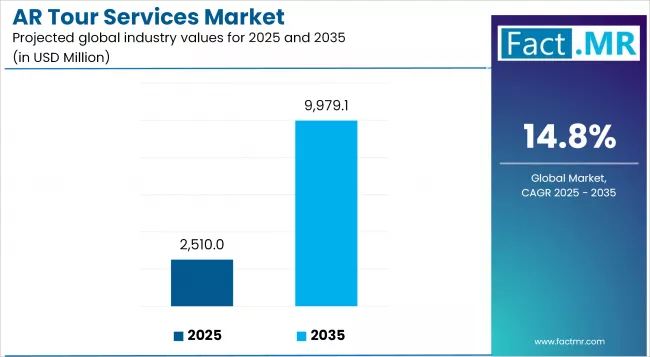
Ar Tour Services Market Industry Value Analysis | Source: Fact.MR
What are the drivers of the AR Tour Services market?
The AR tour services market is running on a number of strong drivers that are transforming the industry of travel and tourism. An increase in consumer desire to have immersive and interactive experiences is one of the growth driving factors, as travelers are looking towards more engaging and personalized experiences. The development of mobile technology and 5G and AR devices has brought augmented reality nearer to people and allowed effortlessly combining the digital overlays with real-world attractions.
Tourism boards, museums and heritage sites are using AR to provide better storytelling, visitor engagement, and to preserve cultural materials. Also, an increase in the use of contactless and self-guided tours, due to safety and health concerns, and further increases in market adoption.
It is also aided by the growing popularity of educational tourism and experiential traveling since AR provides new learning and traveling opportunities. Increased content availability through strategic alliances between AR designers and travel agencies, and the dropping cost of hardware is spurring large scale deployment which is leading to market growth in the world at large.
What are the regional trends of the AR Tour Services market?
The AR tour services market regional dynamics depict the presence of diverse digital adoption, tourism infrastructure, and technology investment.
- In North America, the innovation is robust, smart phone penetration is high and investment in AR platforms is high and especially in the cultural institutions and city tourism boards
- China, Japan, and South Korea lead East Asia with a rapid adoption rate and are promoted by government smart-city programs and a technologically advanced population, indicating that it is growing at the fastest rate
- The interest of Western Europe in connecting AR to heritage sites and museums is aligned with that of cultural preservation and sustainable tourism
- South Asia & Pacific is becoming one of the major expansion markets where India and Southeast Asia are using AR to appeal to younger travelers and expand domestic tourism
- Latin America and Middle East and Africa are slowly following the trend to adopt an AR, with the growing economies in tourist destinations and the digital transformation projects led by the government to increase the interaction of a visitor with the historical sites and to promote tourism areas
What are the challenges and restraining factors of the AR Tour Services market?
The AR tour services market has a number of challenges that may slack adoption. The cost of high development on AR applications, 3D content development, and the integration of devices are still big obstacles to small and mid-sized tourism operators. Poor infrastructure, like the inability to connect to the internet anywhere, may impair smooth AR experiences. The accessibility is also limited by compatibility problems between devices and operating systems, particularly among the users who do not have the newest smartphones or AR wearables.
Moreover, AR platforms require a lot of technical skills and need to be maintained, which can be costly. The regulatory obstacle is privacy and data security issues related to location tracking and data collection of users. In addition, not all users will be open to the adoption of AR because they just want to experience non-digital life. All these contribute to the drag in market penetration, especially in emerging economies and industry players have to invest in cost optimization, education and interoperability to realize mass adoption.
Country-Wise Insights
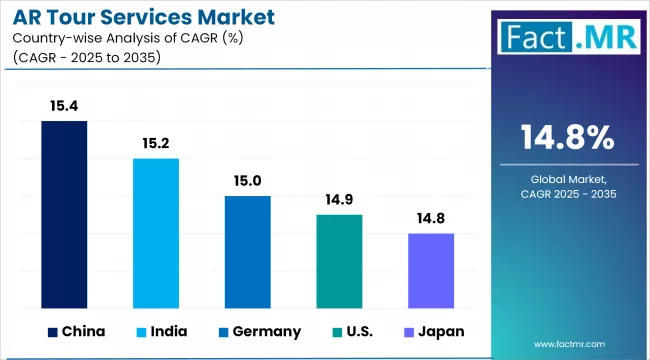
Ar Tour Services Market Cagr Analysis By Country | Source: Fact.MR
China is Accelerating AR Tour Services Adoption Through Smart Tourism Initiatives
The fast-growing AR tour service provider is China, which has ambitious policies of smart tourism and has invested heavily in digital infrastructure. The government is promoting the use of AR in cultural heritage sites, a theme park, and an attraction site in the city in order to boost visitor interaction and improve domestic tourism. The good 5G network coverage and proliferation of smartphones in the country facilitate smooth and quality AR experiences as a tourist.
Chinese tech firms are also inventing high-tech AR navigation, historical recreations, and virtual tours of the city, and it is popular among tech-sensitive younger tourists. Collaborations between tourism authorities, cultural organizations and individual AR creators are developing immersive narrative experiences which maintain heritage and advance local economies. China has a high consumer traffic and policy backing, which positions it as one of the best-growing markets of AR enabled tourism solutions up to 2035.
India is Emerging as a Hotspot for AR Tour Services Adoption
AR tour services market is soon emerging as a major growth centre in India due to rising domestic tourism, the government programmes, such as Dekho Apna Desh, and the high penetration of smartphones. The emergence of low-cost data and the 5G implementation is making it possible to experience AR in heritage locations, museums, and cultural sites with ease. Tourism boards are collaborating with start-ups and tech developers to develop location-based AR guides, gamified heritage trails, and educational tourism apps that would appeal to the youthful and tech-friendly population of India.
Increasing popularity of experiential travel among the millennials and Gen Z is rapidly accelerating the adoption, whereas the need to preserve the rich cultural heritage of India is pushing the demand towards AR reconstructions and storytelling. Even with the infrastructure disadvantages in rural locations, the digitalization of tourism in India and increasing disposable earnings make it one of the fastest-growing AR tour markets in the world in the next ten years.
Germany is Driving AR Tour Services with Cultural Heritage Digitization
Germany is being viewed as a prime market to the AR tour services based on its rich cultural background and the good technological infrastructure. The massive number of museums, historical sites and UNESCO World Heritage sites in the country provides a strong push on the need to experience the sites and landmarks immersively. German cultural institutions and tourism boards are also turning to AR to provide interactive narrations, virtual reconstruction and international guides that will help them to be more accessible to international tourists.
Favorable state policies to encourage the use of digital technologies in the tourism sector and the fact that smartphones and 5G are widely spread contribute to faster acceptance. Also, the successful tech culture and partnership between AR developers and cultural organizations in Germany is driving the development of quality AR content.
Category-Wise Analysis
Markerless AR is the Cornerstone of Immersive Tourism Experiences
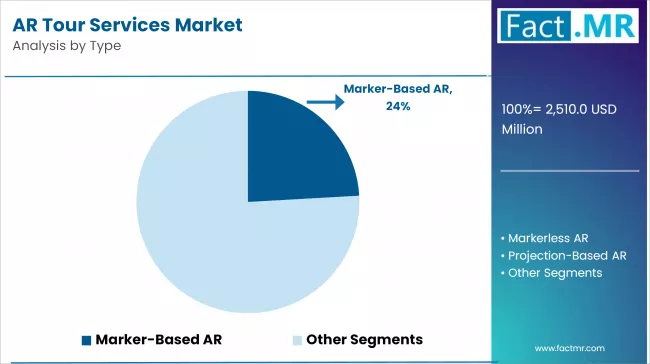
Ar Tour Services Market Analysis By Type | Source: Fact.MR
AR tour services market is being revolutionized by Markerless AR that eliminates reliance on physical markers and allows location-based experiences to be seamlessly experienced. Through the use of GPS, accelerometers and SLAM (Simultaneous Localization and Mapping), markerless AR gives the traveler an opportunity to visit the city, historic sites and museums through dynamic overlay, 3D reconstructions and live navigation.
It is a technology that improves interaction by providing opportunity of interactive storytelling and gamified experiences without the use of physical prompts, so it works well in large outdoor spaces and in places with a rich culture. It has the capability to produce contextual content, which enhances personalization, accessibility, and scalability to tourism operators.
As 5G networks and enhanced smartphones have emerged, markerless AR is now the future of developers and agencies aiming to provide frictionless, immersive tours that will appeal to the contemporary traveler and motivate him or her to higher satisfaction rates.
Individual Tourists are the Driving Force Behind AR Tour Services Growth
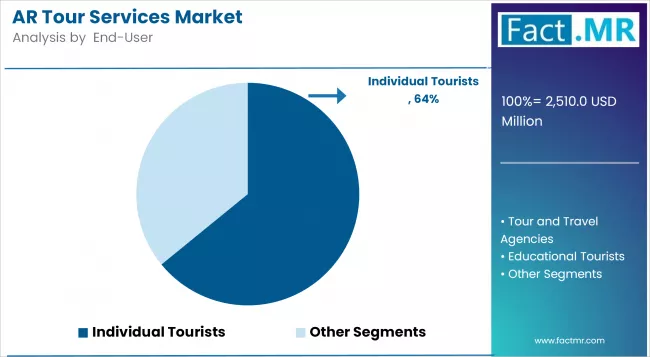
Ar Tour Services Market Analysis By End User | Source: Fact.MR
Individual tourists constitute the biggest and the most powerful segment of end-users. Their increasing preference for guided, interactive, and personalized experience contributes to the introduction of AR-based tours across the globe. Through intelligent phones, virtual eyewear, and location-based applications, individual travelers will be able to discover destinations at their own speed and gain access to in-depth historical information, interactive challenges, and navigation assistance. This segment is especially advantageous due to the possibility of AR providing multilingual content that will make the world’s destinations more accessible.
The growing disposable incomes, the growing trend of solo travel, and the need to have contactless, technology-oriented experiences following the pandemic further consolidate the power of this segment. With the development of AR platforms, deeper storytelling, social sharing elements, and deeper AI-based personalization will persist in the independent traveler segment, which will further contribute to achieving the objective of the module as the growth engine of AR tourism services.
Competitive Analysis
Key players in the AR Tour Services market Google Arts & Culture, TimeLooper, GuidiGO, Smartify, ARLOOPA, Zappar, Cluetivity, Program-Ace, Sunrise International Education, Blippar, SmartGuide, izi.TRAVEL, Niantic, Matterport, Magic Leap, CitrusBits.
AR tour services market is extremely competitive with many content developers, technology developers and service providers inventing to win market share. To satisfy the increasing expectations of tourists, companies are aiming at providing immersive and customizable AR experiences that can be done seamlessly. It is common to form strategic partnerships with tourism boards, museums and cultural institutions and deploy and be adopted by a wider range of users.
The focus on constant investment in the creation of 3D content, location-based AR, and multilingual support assists providers in separating their product. Pricing models also contribute to competition, as both pay-per-tour and subscription are offered to a variety of users. The speed of innovation and the user experience is also a key success factor.
Recent Development
- In July 2025, STQRY, a leading innovator in no-code platforms for cultural and educational experiences, is pleased to announce its acquisition of GuidiGO, a well-established leader in providing immersive tours for cultural institutions, tourist boards, and local communities. This partnership brings together two companies driven by a common mission to make cultural discovery more dynamic, inclusive, and impactful.
Fact.MR has provided detailed information about the price points of key manufacturers of AR Tour Services Market positioned across regions, sales growth, production capacity, and speculative technological expansion, in the recently published report.
Methodology and Industry Tracking Approach
The Fact.MR 2025 global AR Tour Services market report is based on the feedback of more than 1,200 stakeholders in 12 countries, with each of them providing a minimum of 75 responses. Among them 65% were end users; individual tourists, educational institutions, tour operators and corporate travel planners, and the rest 35% were technology developers, AR content creators, tourism consultants and policy advisors.
The fieldwork will take place between September 2024 and August 2025 and will involve studying user adoption trends, the quality of the AR experience, the viability of the pricing model, the compatibility of the devices, and the readiness of digital infrastructure. An equal calibration model was used to provide a precise representation in North America, Europe and Asia-Pacific.
The research was based on over 95 sources that were validated, such as tourism analytics reports, AR adoption research, device usage statistics, and regulatory frameworks, and digital transformation case studies. Triangulation protocols and sophisticated analytic tools like multi-variable regression and scenario modelling have been used to provide accurate forecasts, and practical value that provide a strategic road map to the stakeholders who require to grow, innovate, and gain a competitive edge within the AR tourism ecosystem.
Segmentation
Segmentation of AR Tour Services Market
-
By Type :
- Marker-Based AR
- Markerless AR
- Projection-Based AR
- Superimposition-Based AR
- Wearable AR
-
By Application :
- Museums and Art Galleries
- Historical Sites and Monuments
- City Tours and Sightseeing
- Nature and Wildlife Tours
- Industrial Tourism
- Others
-
By End-User :
- Individual Tourists
- Tour and Travel Agencies
- Educational Tourists
- Enterprises & Corporations Tourists
- By Pricing Model :
- Pay-per-Tour
- Subscription-Based
-
By Region :
- North America
- Latin America
- Western Europe
- Eastern Europe
- East Asia
- South Asia & Pacific
- Middle East & Africa
Frequently Asked Questions
What was the Global AR Tour Services Market Size Reported by Fact.MR for 2025?
Who are the Major Players Operating in the AR Tour Services Market?
What is the Estimated Valuation of the AR Tour Services Market in 2035?
What Value CAGR did the AR Tour Services Market Exhibit Over the Last Five Years?
Who worked on this report


Preview the report firsthand - request a free sample
Free SampleGet the brochure for pricing and purchase details
Download PDF