
- Market Value (2025): USD 380.0 Mn
- Estimated Value (2026): USD 408.5 Mn
- Forecast Value (2036): USD 881.9 Mn
- CAGR (2026-2036): 8.0%
Argon Knife Market Forecast and Outlook 2026 to 2036
As per the Fact.MR analysis, the argon knife market surpassed a value of USD 380.0 million in 2025 and is projected to grow from USD 408.5 million in 2026 to USD 881.9 million by 2036. Demand for argon knives is likely to grow at a CAGR of 8.0% over the forecast period.
Demand for argon knives is rising as surgeons and endoscopists use argon plasma and argon-based cryoablation to stop bleeding, remove tissue and treat tumors with limited contact damage. The key players are offering consoles, disposable probes and handpieces, reusable instruments and gas delivery kits for endoscopy, open and laparoscopic surgery and bronchoscopy.
Key Takeaways from the Argon Knife Market
- Argon Knife Market Value (2025): USD 380.0 million
- Argon Knife Market Value (2026): USD 408.5 million
- Argon Knife Market Forecast Value (2036): USD 881.9 million
- Argon Knife Market Forecast CAGR (2026-2036): 8.0%
- Leading Technology: Argon plasma coagulation (40.0%)
- Key Market Participants: Medtronic, Olympus, ERBE Elektromedizin, CONMED, Apyx Medical
- Key Growth Countries: India, China, South Korea, United States, France
Demand for endoscopic procedures and minimally invasive tumor treatments is expected to support steady sales of electrosurgical systems, with disposable probes generating recurring revenue through regular clinical use. India's expanding cancer-care infrastructure provides a strong demand indicator. According to the Ministry of Health and Family Welfare, 19.5 lakh medical oncology admissions worth approximately ₹2,926 crore were authorized under Ayushman Bharat PM-JAY as of November 4, 2026. Additionally, the Department of Pharmaceuticals reported medical device exports of USD 4.014 billion in FY 2024–25, including USD 1.863 billion from consumables and disposables. These developments support opportunities for electrosurgical equipment, endoscopic accessories and single-use probes across hospitals and specialized treatment centres.
Argon Knife Market
| Metric | Value |
|---|---|
| Estimated Value in (2026) | USD 408.5 million |
| Forecast Value in (2036) | USD 881.9 million |
| Forecast CAGR (2026 to 2036) | 8.0% |
Source: Fact.MR analysis.
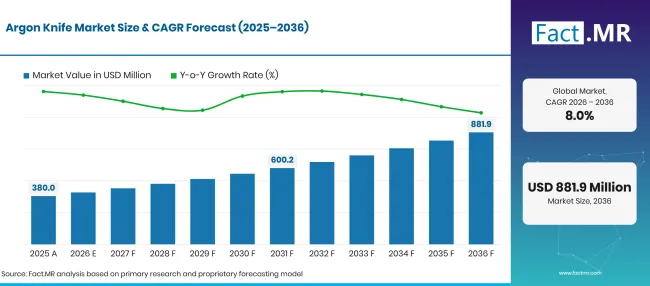
Argon Knife Market Forecast Global | Source: Fact.MR
Category
| Category | Segments |
|---|---|
| Technology | Argon plasma coagulation, Argon-helium cryoablation, Argon beam coagulation, Hybrid plasma-electrosurgical systems |
| Product | Disposable probes and handpieces, Consoles and generators, Reusable instruments and accessories, Argon gas delivery kits |
| Application | Gastrointestinal endoscopy, Open and laparoscopic surgery, Tumour ablation in oncology, Pulmonary and bronchoscopy, Dermatology and ENT |
| End User | Hospitals, Ambulatory surgical centres, Specialty cancer centres, Academic and research institutes |
| Region | India; China; South Korea; United States; France |
Source: Fact.MR analysis.
Segmental Analysis
What is sustaining demand for argon plasma coagulation as the leading technology segment in the Argon Knife Market?
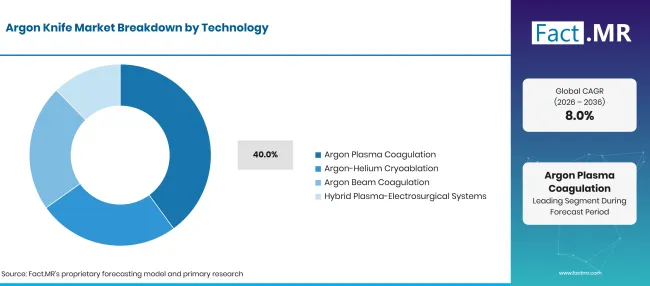
Argon Knife Market Breakdown Technology | Source: Fact.MR
Demand for argon plasma coagulation systems is supported by their established use in gastrointestinal bleeding control, tissue ablation and treatment of superficial lesions. The segment accounts for 40.0% of 2026 revenue, about USD 163.4 million, retaining its leading technology position. India's Tata Memorial Centre, in its government institutional Schedule of Charges updated on February 1, 2026, explicitly lists argon plasma coagulation for hemostasis and ablation as reimbursable procedures. The schedule includes separate charges for full and partial APC procedures. Clinical recognition and established procedural billing support continued adoption of APC consoles and associated accessories.
Which purchasing patterns are making disposable probes and handpieces the biggest product category?
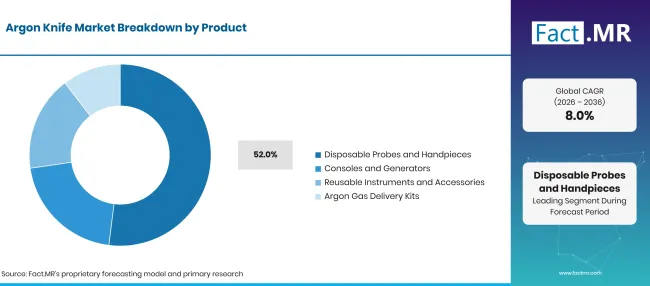
Argon Knife Market Breakdown Product | Source: Fact.MR
Sales of disposable probes and handpieces are estimated to contribute 52.0% of 2026 market revenue, about USD 212.4 million, making them the largest product segment. Recurring replacement requirements, procedure-specific accessories and infection-control considerations support repeat purchasing by healthcare facilities. The US Agency for Healthcare Research and Quality's 2026 inpatient benchmark dataset covers approximately 97% of annual US inpatient discharges, demonstrating the extensive institutional care environment served by procedural equipment suppliers.
How is gastrointestinal endoscopy generating demand for argon knife applications?
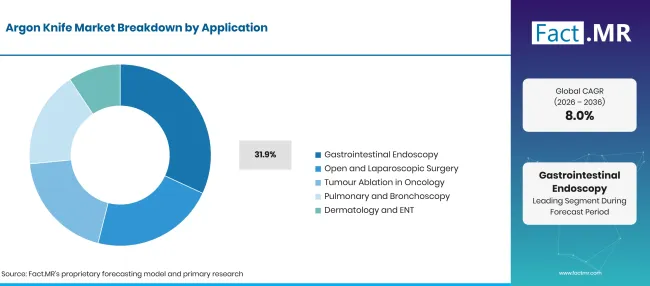
Argon Knife Market Breakdown Application | Source: Fact.MR
Demand for argon knife systems in gastrointestinal endoscopy represents 31.9% of 2026 application revenue, about USD 130.3 million. Argon plasma coagulation is used during endoscopic procedures to manage gastrointestinal bleeding, angiodysplasia and selected superficial lesions. The US Agency for Healthcare Research and Quality's 2026 benchmark tables identify 1,481,373 gastrointestinal hemorrhage discharges in their underlying 2021–2023 hospital dataset. This substantial clinical burden highlights the importance of effective gastrointestinal bleeding management. Established endoscopy workflows and the availability of APC-based treatment are supporting demand for compatible equipment, probes and accessories across specialist facilities.
What makes hospitals the principal purchasing channel for argon knife equipment?
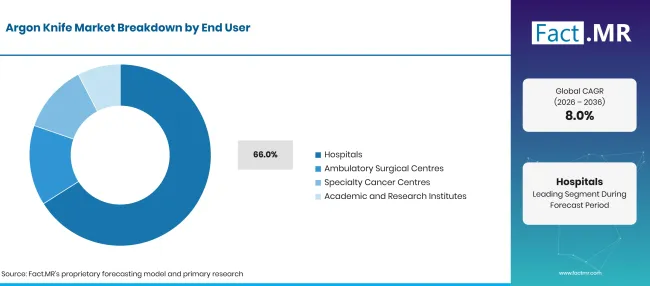
Argon Knife Market Breakdown End User | Source: Fact.MR
Hospital procurement accounts for 66.0% of 2026 Argon Knife Market revenue, about USD 269.6 million, reflecting the concentration of advanced endoscopic procedures and surgical infrastructure in these institutions. India's Ministry of Health and Family Welfare reported on November 18, 2026, that 18 operational AIIMS institutions had 14,860 functional beds and 404 operating theatres, alongside approximately 3.18 lakh surgeries during FY 2026-27 to date. Such institutional capacity supports procurement of advanced therapeutic equipment, including endoscopy and coagulation systems. Hospitals also maintain the specialist personnel and infrastructure required for equipment installation, utilization and maintenance.
Argon Knife Market-Drivers, Restraints & Trends
Drivers: Rising Demand for Minimally Invasive Cancer Treatment and Endoscopic Procedures
Demand for argon knives is increasing as hospitals expand endoscopic interventions, minimally invasive surgeries and tumor-treatment capabilities. The growing need for effective bleeding control and targeted tissue treatment is supporting adoption of argon plasma coagulation systems in gastrointestinal and surgical oncology procedures. India's Ministry of Health and Family Welfare reported that 19.5 lakh medical oncology admissions worth approximately ₹2,926 crore had been authorized under Ayushman Bharat PM-JAY as of November 4, 2026. Additionally, more than 1.86 lakh Ayushman Arogya Mandirs were functional by August 2026, strengthening access to cancer screening and referral services. These developments support broader investment in hospital-based cancer treatment and advanced surgical technologies.
Restraints: High Equipment Costs and Dependence on Specialized Clinical Expertise
Sales of argon knives are constrained by high initial equipment costs, recurring argon gas requirements, specialized maintenance and the need for trained clinical operators. Hospitals must also consider procedure-specific reimbursement and competition from bipolar electrosurgery, ultrasonic instruments and other energy-based surgical technologies. India's Department of Pharmaceuticals reported that medical device imports reached USD 8.822 billion in FY 2024–25, compared with exports of USD 4.014 billion, highlighting the country's continued reliance on imported medical technologies. Import dependence can expose healthcare providers to foreign exchange movements, procurement expenses and equipment servicing costs.
Opportunity: Expanding Use of Argon-Helium Cryoablation for Tumor Treatment
Demand for advanced tumor-ablation technologies is creating opportunities for manufacturers offering argon-helium cryoablation systems for minimally invasive treatment of selected kidney, lung and other tumors. India's government-supported cancer-care infrastructure provides a substantial clinical opportunity, with 19.5 lakh medical oncology admissions worth approximately ₹2,926 crore authorized under PM-JAY by November 4, 2026. The government's National Programme for Prevention and Control of Non-Communicable Diseases also supports cancer screening, early diagnosis, referral and treatment infrastructure. These developments strengthen the potential market for image-guided tumor-treatment technologies and specialized cryoprobes.
Trend: Growing Revenue Contribution from Single-Use Probes and Surgical Accessories
Adoption of disposable probes and handpieces is gaining importance as hospitals emphasize infection prevention, procedural consistency and compliance with single-use device instructions. India's Department of Pharmaceuticals reported that medical device exports in the consumables and disposables category reached USD 1.863 billion in FY 2024–25, compared with USD 1.752 billion in FY 2023–24. Furthermore, in October 2026, the Directorate General of Health Services directed healthcare facilities to prevent the unauthorized reuse of single-use medical devices and disposable surgical items, citing patient-safety and infection-control concerns. These developments support opportunities for manufacturers supplying disposable argon probes, handpieces and compatible accessories, creating recurring procurement requirements across hospitals and specialized surgical centres.
Argon Knife Market Analysis by Key Country
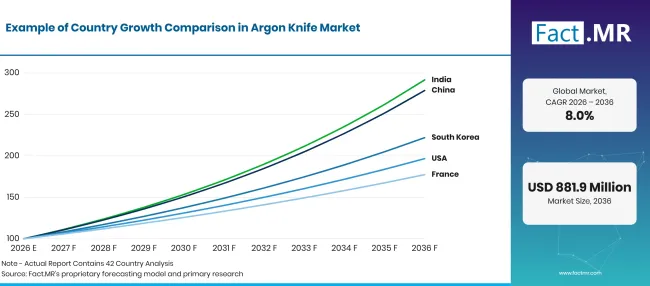
Argon Knife Market Growth Index 1 | Source: Fact.MR
| Country | CAGR (2026-2036) |
|---|---|
| India | 11.3% |
| China | 10.8% |
| South Korea | 8.3% |
| United States | 7.0% |
| France | 5.9% |
Source: Fact.MR analysis.
What is accelerating argon knife adoption and sales in India?
Demand for argon knives in India is projected to increase at an 11.3% CAGR through 2036, the fastest among the five countries.
Expanding cancer-screening programmes, gastrointestinal treatment capacity and private hospital investments are creating opportunities for endoscopic equipment suppliers. According to the Ministry of Health and Family Welfare, India had 1.86 lakh operational Ayushman Arogya Mandirs as of August 2026, while cancer screenings had reached 36.11 crore for oral cancer, 16.94 crore for breast cancer and 9.31 crore for cervical cancer by July 2026. Growing diagnostic activity and specialist treatment requirements support potential adoption of argon-based coagulation systems.
Which healthcare investments are expanding argon knife demand in China?
Sales of argon knives in China is forecast to rise at a 10.8% CAGR through 2036, exceeding the global rate of 8.0%.
Expanding gastrointestinal endoscopy capacity and growing requirements for minimally invasive tumor treatment are supporting equipment procurement. China's 2024 gastroenterology and digestive endoscopy report, published in 2025, documented 43.3 million digestive endoscopic procedures across participating hospitals in 2023, with tertiary general hospitals accounting for 72.5% of procedures. The report also identified increasing early-stage gastrointestinal cancer detection. These developments support demand for APC consoles, compatible probes and other advanced endoscopic treatment equipment.
How are South Korea's endoscopy programmes supporting argon knife adoption?
Demand for argon knives in South Korea is projected to grow at an 8.3% CAGR through 2036, slightly exceeding the global rate of 8.0%.
National cancer-screening programmes and established gastrointestinal treatment infrastructure support procurement of advanced endoscopic equipment. South Korea's National Cancer Center confirms that its National Cancer Screening Program includes stomach cancer screening through upper gastrointestinal endoscopy, including biopsy, for adults aged 40 and above every two years. Colorectal screening also includes colonoscopy when indicated. These government-supported screening pathways sustain endoscopy capacity and create opportunities for APC equipment suppliers serving hospitals and specialist centres.
What is sustaining argon knife equipment purchases across the United States?
Sales of argon knives in the United States is estimated to increase at a 7.0% CAGR through 2036, below the global rate of 8.0%.
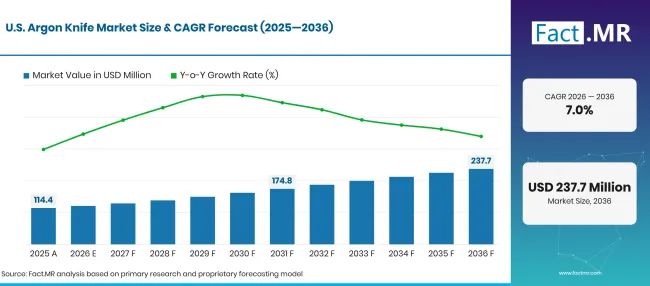
Argon Knife Market Forecast Usa | Source: Fact.MR
Extensive gastrointestinal procedure volumes and established hospital and ambulatory endoscopy infrastructure support equipment purchases. According to the CDC's latest national screening analysis, 63.5% of adults aged 45 to 75 were up to date with colorectal cancer screening in 2023, based on data published in 2025. The 2026 CMS procedure-volume reporting programme also tracks individual clinicians' colonoscopy and upper gastrointestinal endoscopy activity. These established procedural workflows support demand for APC systems, disposable probes and associated accessories.
Which clinical screening trends are influencing argon knife sales in France?
Demand for argon knives in France is forecast to expand at a 5.9% CAGR through 2036, the slowest among the five countries.
Established gastroenterology services and colorectal screening activity provide a continuing market for endoscopic treatment equipment, although mature healthcare infrastructure moderates new procurement. Santé publique France reported in March 2026 that 6.43 million people participated in the national colorectal cancer screening programme during 2024–2025, representing 30.7% of the target population of approximately 20.87 million. Continued screening and follow-up examinations support endoscopy service requirements and replacement demand for therapeutic equipment, including argon plasma coagulation systems.
Competitive Landscape for Argon Knife Market
The argon knife market is relatively concentrated, with Medtronic, Olympus, ERBE Elektromedizin, CONMED and Apyx Medical together hold about 66% of 2026 revenue, based on Fact.MR estimates. Competition centers on clinical evidence, console reliability, probe design and service, and hospital contracting. Large surgical and endoscopy groups lead, with specialist electrosurgery companies competing in argon plasma systems.
Recent Developments
- In July 2025, ERBE launched FiAPC plus probes for gastrointestinal and pulmonary endoscopy. The probes feature thermally insulated tips and improved plasma control, supporting precision and procedural reliability in argon plasma coagulation.
- In April 2025, ERBE introduced VIO 3n and VIO seal electrosurgical generators. The VIO 3n platform offers five configurations and integrates with existing APC systems, strengthening the company's electrosurgical equipment portfolio.
- In October 2025, Olympus launched THUNDERBEAT II, a hybrid surgical energy device combining ultrasonic and bipolar technologies. Its three energy modes support hemostatic dissection, vessel sealing and soft-tissue management in open and laparoscopic procedures.
- In August 2026, Olympus launched ENDOEYE FLEX 3D, a flexible-tip videoscope supporting 4K, 3D and infrared imaging. The development strengthens endoscopic visualization capabilities and complements the company's minimally invasive surgical technology portfolio.
- In May 2026, Apyx received expanded FDA 510(k) clearance for its AYON Body Contouring System, adding power liposuction capability. The expansion strengthens its integrated surgical energy and plasma-based body-contouring portfolio.
Key Players in Argon Knife Market
Key companies operating in the market include Medtronic, Olympus, ERBE Elektromedizin, CONMED, and Apyx Medical.
- Medtronic
- Olympus
- ERBE Elektromedizin
- CONMED
- Apyx Medical
Bibliography
- Department of Pharmaceuticals. (2026). Annual report 2025–26 [PDF].
- Directorate General of Health Services. (2026, October). Warning against reuse of single use medical devices. NewsOnAir.
- Lok Sabha. (2026, March). Medical device trade statistics [PDF].
- Ministry of Health and Family Welfare. (2026, November 6). Cheaper cancer medicines: What the new margin cap means for patients. Press Information Bureau.
- Press Information Bureau. (2026, March). Medical device manufacturers and exports.
- Erbe Elektromedizin GmbH. (2025, July 14). Erbe introduces FiAPC plus: Advancing control in flexible argon plasma coagulation [Press release].
Segmentation
Scope of Report
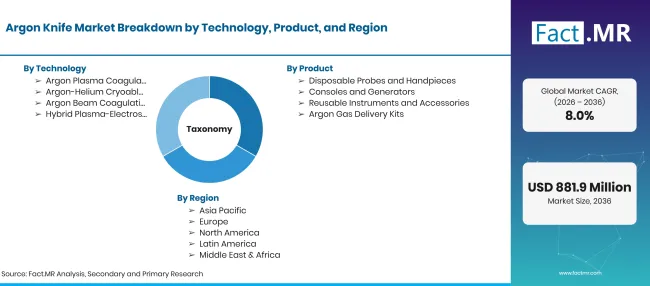
Argon Knife Market Taxonomy | Source: Fact.MR
| Items | Values |
|---|---|
| Quantitative Units (2026) | USD 408.5 Million |
| Technology | Argon plasma coagulation, Argon-helium cryoablation, Argon beam coagulation, Hybrid plasma-electrosurgical systems |
| Product | Disposable probes and handpieces, Consoles and generators, Reusable instruments and accessories, Argon gas delivery kits |
| Application | Gastrointestinal endoscopy, Open and laparoscopic surgery, Tumour ablation in oncology, Pulmonary and bronchoscopy, Dermatology and ENT |
| End User | Hospitals, Ambulatory surgical centres, Specialty cancer centres, Academic and research institutes |
| Regions Covered | North America, Latin America, Europe, Asia Pacific, Middle East & Africa |
| Countries Covered | India, China, South Korea, United States, France, and other countries |
| Key Companies Profiled | Medtronic, Olympus, ERBE Elektromedizin, CONMED, Apyx Medical |
| Additional Attributes | Dollar revenue in the Argon Knife Market is segmented by technology, product, application and end user and region. |
Source: Fact.MR analysis.
Argon Knife Market by Segments
-
Technology
- Argon plasma coagulation
- Argon-helium cryoablation
- Argon beam coagulation
- Hybrid plasma-electrosurgical systems
-
Product
- Disposable probes and handpieces
- Consoles and generators
- Reusable instruments and accessories
- Argon gas delivery kits
-
Application
- Gastrointestinal endoscopy
- Open and laparoscopic surgery
- Tumour ablation in oncology
- Pulmonary and bronchoscopy
- Dermatology and ENT
-
End User
- Hospitals
- Ambulatory surgical centres
- Specialty cancer centres
- Academic and research institutes
-
Region:
- North America
- United States
- Canada
- Mexico
- Europe
- Germany
- United Kingdom
- France
- Italy
- Spain
- Rest of Europe
- Asia Pacific
- China
- India
- Japan
- South Korea
- Australia and New Zealand
- Rest of Asia Pacific
- Latin America
- Brazil
- Argentina
- Rest of Latin America
- Middle East & Africa
- GCC Countries
- South Africa
- Rest of Middle East & Africa
- North America
Table of Contents
Key Takeaways
- Market Size and CAGR
- Top Growth Driver
- Fastest Growing Segment
- Leading Region
- Key Companies
- Emerging Opportunities

