- Base Value(2026): 1.9 Bn
- Estimated Value(2026): 1.9 Bn
- Forecast Value (2036): 5.3 Bn
- CAGR (2026 - 2036): 10.9%
Art and Craft Stationery Packaging Market Forecast and Outlook 2026 to 2036
The art and craft stationery packaging market is measured at USD 1.9 billion in 2026 and moves toward USD 5.3 billion by 2036, reflecting a 10.90% CAGR over the period.
Art and Craft Stationery Packaging Market Key Takeaways
- Art and Craft Stationery Packaging Market Value (2026): USD 1.9 billion
- Art and Craft Stationery Packaging Market Forecast Value (2036): USD 5.3 billion
- Art and Craft Stationery Packaging Market Forecast CAGR: 10.9%
- Leading Type in Art and Craft Stationery Packaging Market: Window cartons
- Key Growth Regions in Art and Craft Stationery Packaging Market: North America, Europe, Asia Pacific, Latin America, Middle East & Africa
- Top Players in Art and Craft Stationery Packaging Market: Sonoco Products Company, Huhtamäki, Stora Enso, Graphic Packaging, DS Smith
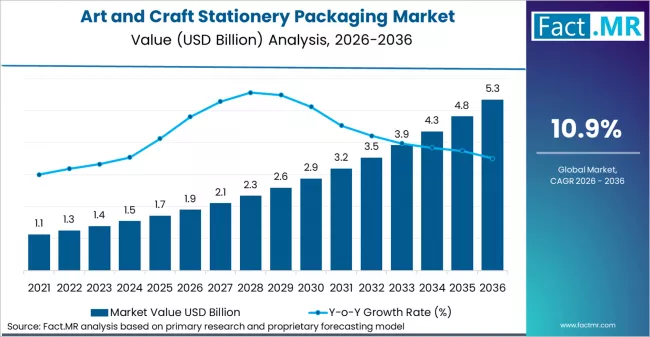
Art And Craft Stationery Packaging Market Market Value Analysis | Source: Fact.MR
This segment supports products used in schools, studios, and hobby retail, where packaging must protect contents while remaining easy to open, store, and handle. Packs need to prevent leakage, drying, and breakage while still allowing clear identification of colors, sizes, and types.
Retailers and producers prefer formats that stack well, travel without damage, and fit standard shelf layouts. Many product lines keep the same pack shapes for long periods since any change affects filling lines, shelf plans, and instruction inserts. Once a format is approved, it usually stays in use to avoid disruption. Buyers focus on consistency, print quality, and dependable supply rather than frequent design changes.
Art and Craft Stationery Packaging Market
| Metric | Value |
|---|---|
| Market Value (2026) | USD 1.9 billion |
| Forecast Value (2036) | USD 5.3 billion |
| Forecast CAGR 2026 to 2036 | 10.9% |
Category
| Category | Segments |
|---|---|
| End-use | Hobby retail chains; Specialty craft stores; OEM exports; Premium stationery; School supplies |
| Packaging Format | Window cartons; Blister packs; Folding cartons; Drawer boxes |
| Material | Paperboard; PET; Coated paper; Specialty board |
| Region | North America; Europe; Asia Pacific; Latin America; Middle East & Africa |
Art and Craft Stationery Packaging Market Segmental Analysis
Why Do Hobby Retail Chains Represent the Largest Outlet for Art and Craft Stationery Packaging?
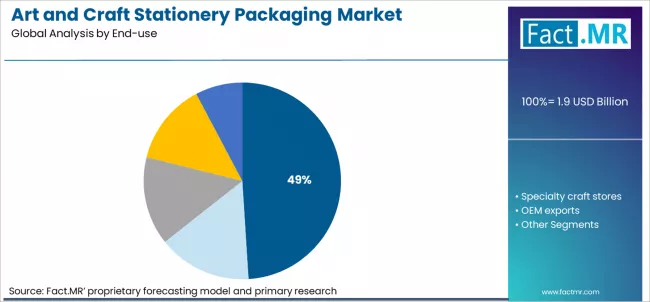
Art And Craft Stationery Packaging Market Analysis By End Use | Source: Fact.MR
Hobby retail chains account for 49% of end-use demand in the art and craft stationery packaging market. These stores stock wide assortments that range from basic tools to themed craft kits, which increases packaging turnover across many small stock keeping units. Product rotation remains frequent due to seasonal projects and trend driven assortments. Store layouts rely on peg walls and shelf displays that require consistent, ready-to-hang or ready-to-shelf packs. Centralized buying for chain networks also concentrates volume into fewer packaging programs. Specialty stores, school channels, and export programs add steady demand. The combination of assortment breadth and high unit movement keeps hobby chains as the main driver of packaging volume in this category.
What Makes Window Cartons the Most Used Format for Craft and Stationery Products?
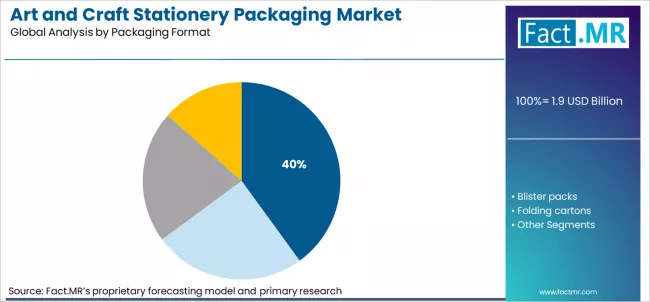
Art And Craft Stationery Packaging Market Analysis By Packaging Format | Source: Fact.MR
Window cartons represent 40% of packaging format usage in this market. This format allows customers to see colors, shapes, or contents without opening the pack, which supports quick purchase decisions. At the same time, the carton protects items from handling damage and keeps sets organized. Converters can run these cartons on standard die-cutting and folding lines with limited variation. Retailers also favor the balance between display quality and shelf stacking. Blister packs, folding cartons, and drawer boxes serve specific product types. Most everyday craft and stationery items still enter stores in window cartons as the standard display oriented package.
What are the Drivers, Restraints, and Key Trends of the Art and Craft Stationery Packaging Market?
- Drivers: Packaging needs that protect delicate artistic materials, convey creative brand identity, and support display functionality in retail environments influence how art and craft stationery is packaged for hobbyists, schools, and professional users.
- Restraint: Cost constraints in entry-level segments and pressure to balance protection with ease of access limit the adoption of highly specialized packaging features for some products.
- Trend 1: Use of protective inserts and compartmentalization to secure multi-piece sets and prevent damage during transport and handling.
- Trend 2: Expanded incorporation of visual and tactile design elements that communicate product purpose and appeal to creative consumers.
Analysis of the Art and Craft Stationery Packaging Market by Key Country
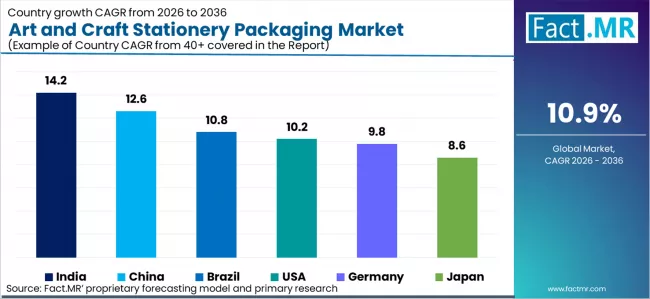
Art And Craft Stationery Packaging Market Cagr Analysis By Country | Source: Fact.MR
| Country | CAGR 2026 to 2036 |
|---|---|
| USA | 10.2% |
| Germany | 9.8% |
| China | 12.6% |
| Japan | 8.6% |
| India | 14.2% |
| Brazil | 10.8% |
The report covers an in-depth analysis of 40+ countries; top-performing countries are highlighted below.
How Are School Programs and Hobby Retail Shaping This Market in USA?
Art and craft packaging in USA is specified around classroom use, hobby storage, and mass retail presentation. The market grows near 10.2% per year through 2036 as participation in home crafting and organized education programs increases. Demand centers on durability, compartment separation, and clear labeling. Buyers focus on stackability, protection during transport, and ease of shelf handling. Procurement decisions balance cost, consistency, and retail compliance. Volume growth follows expansion of private label kits and back to school assortments. Market development stays tied to hobby participation and education spending rather than short term trend driven product launches.
Why Do Quality Discipline and Retail Standards Matter in Germany?
Packaging choices in Germany reflect strong attention to order, storage efficiency, and product protection. With growth near 9.8% per year through 2036, art and craft stationery packs expand mainly through specialty retailers and education channels. Demand focuses on robust boxes, tidy internal organization, and material durability. Buyers emphasize documentation, consistent specifications, and predictable performance on packing lines. Procurement decisions remain conservative and specification driven. Volume growth follows gradual expansion of hobby participation and school supply programs. Market development stays process oriented and tied to quality expectations rather than impulse driven novelty formats or aggressive assortment expansion across retail chains nationwide.
What Is Driving Faster Scaling of Art and Craft Packaging in China?
Education focused consumption and gift oriented purchasing define this market in China. The market expands near 12.6% per year through 2036 as creative learning programs and organized retail continue to grow. Demand centers on boxed sets, compartment trays, and protective outer packs. Buyers prioritize production speed, supply continuity, and compatibility with automated packing lines. Procurement strategies favor large suppliers with integrated printing and converting. Volume increases follow school calendar cycles and platform sales campaigns. Market development remains tied to consumption scale and distribution reach rather than premium materials or niche presentation concepts for limited edition hobby products.
How Do Presentation Standards and Storage Culture Shape This Market in Japan?
Stationery packaging in Japan reflects strong emphasis on neatness, compact storage, and visual order. With growth near 8.6% per year through 2036, art and craft packs expand mainly through specialty stores, schools, and gift channels. Demand focuses on precise fit, clean layout, and easy resealing. Buyers pay close attention to defect rates and appearance consistency. Procurement decisions favor long term supplier relationships and stable specifications. Volume growth follows gradual increases in hobby activity and educational use. Market development stays measured and tied to presentation discipline rather than rapid assortment changes or oversized multipack formats.
What Is Accelerating Adoption of Organized Craft Packaging in India?
Rising interest in creative learning and organized retail is reshaping packaging demand in India. The market advances near 14.2% per year through 2036 as schools, coaching centers, and hobby stores expand. Demand focuses on low cost, basic protection, and simple internal organization. Buyers emphasize availability and ability to scale volumes quickly. Procurement decisions often favor suppliers with wide regional reach. Volume growth follows expansion of branded kits and educational craft programs. Market development depends more on distribution access and affordability than on refined materials or premium presentation features in most mass market product lines.
How Are Retail Expansion and Hobby Participation Supporting This Market in Brazil?
Growth of organized retail and wider hobby participation influence stationery packaging demand in Brazil. With growth near 10.8% per year through 2036, art and craft packs gain presence in school supply chains and specialty stores. Demand centers on basic protection, clear labeling, and manageable pack sizes. Buyers focus on cost control and supply reliability. Procurement decisions emphasize distributor coverage and consistent quality. Volume growth follows expansion of education spending and private label assortments. Market development remains tied to retail access and participation levels rather than premium materials or complex packaging structures aimed at high end craft segments.
How Do Retail Replenishment Cycles and Assortment Turnover Shape Competition in the Art and Craft Stationery Packaging Market?
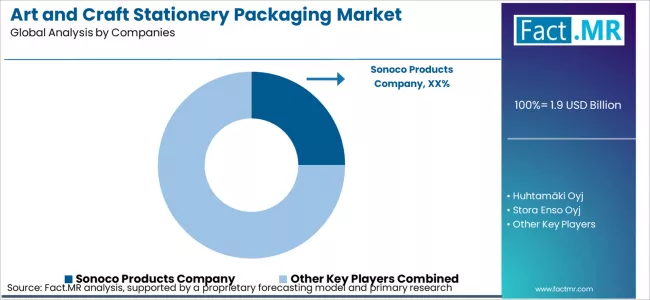
Art And Craft Stationery Packaging Market Analysis By Company | Source: Fact.MR
Stationery packaging programs are planned around store replenishment speed, seasonal assortment changes, and mixed SKU handling rather than around material selection alone. Retailers first set shelf depth, hook or stack display rules, and backroom storage limits before any supplier is reviewed. Sonoco, Huhtamaki, Stora Enso, Graphic Packaging, and DS Smith compete by aligning carton, tray, and display structures to these retail operating models. Merchandising teams compare options using stack stability, changeover time during resets, and resistance to scuffing in high traffic aisles. Logistics groups also assess pallet efficiency and damage rates in multi store distribution. Once a format is approved, volumes follow school calendars and promotional cycles. Supplier changes usually occur after assortment redesigns or store layout updates.
Key Players in Art and Craft Stationery Packaging Market
- Sonoco Products Company
- Huhtamäki Oyj
- Stora Enso Oyj
- Graphic Packaging Holding Company
- DS Smith Plc
References
- European Commission. (2024). Proposal for a regulation of the European Parliament and of the Council on packaging and packaging waste and repealing Directive 94/62/EC. European Commission.
- European Committee for Standardization. (2024). EN 13430: Packaging - Requirements for packaging recoverable by material recycling. CEN.
- Organisation for Economic Co-operation and Development. (2023). Global plastics outlook: Policy scenarios to 2060. OECD Publishing.
- United States Consumer Product Safety Commission. (2023). Labeling of hazardous art materials act (LHAMA): Compliance guidance. U.S. Consumer Product Safety Commission.
- European Chemicals Agency. (2023). Guidance on classification, labelling and packaging (CLP) of consumer products. ECHA.
Segmentation
Scope of the Report
| Items | Values |
|---|---|
| Quantitative Units (2026) | USD billion |
| End-use | Hobby retail chains, specialty craft stores, OEM exports, premium stationery, school supplies |
| Packaging Format | Window cartons, blister packs, folding cartons, drawer boxes |
| Material | Paperboard, PET, coated paper, specialty board |
| Regions Covered | Asia Pacific, Europe, North America, Latin America, Middle East & Africa |
| Countries Covered | United States, Canada, Mexico, Germany, United Kingdom, France, Italy, Spain, China, Japan, South Korea, India, Australia & New Zealand, ASEAN, Brazil, Chile, Saudi Arabia, Turkey, South Africa, and other regional markets |
| Key Companies Profiled | Sonoco Products Company, Huhtamäki, Stora Enso, Graphic Packaging, DS Smith |
| Additional Attributes | Dollar by sales by end-use, packaging format, and material; focus on display visibility, product protection, and stackability; demand linked to hobby retail expansion and school supply programs |
Art and Craft Stationery Packaging Market Segmentation
-
End-use :
- Hobby retail chains
- Specialty craft stores
- OEM exports
- Premium stationery
- School supplies
-
Packaging Format :
- Window cartons
- Blister packs
- Folding cartons
- Drawer boxes
-
Material :
- Paperboard
- PET
- Coated paper
- Specialty board
-
Region :
- Asia Pacific
- China
- Japan
- South Korea
- India
- Australia & New Zealand
- ASEAN
- Rest of Asia Pacific
- Europe
- Germany
- United Kingdom
- France
- Italy
- Spain
- Nordic
- BENELUX
- Rest of Europe
- North America
- United States
- Canada
- Mexico
- Latin America
- Brazil
- Chile
- Rest of Latin America
- Middle East & Africa
- Kingdom of Saudi Arabia
- Other GCC Countries
- Turkey
- South Africa
- Other African Union
- Rest of Middle East & Africa
- Asia Pacific
Frequently Asked Questions
How big is the art and craft stationery packaging market in 2026?
What will be the size of art and craft stationery packaging market in 2036?
How much will be the art and craft stationery packaging market growth between 2026 and 2036?
What are the key product types in the art and craft stationery packaging market?
Which packaging format segment to contribute significant share in the art and craft stationery packaging market in 2026?
Who worked on this report


Preview the report firsthand - request a free sample
Free SampleGet the brochure for pricing and purchase details
Download PDF