- Market Value (2025): USD 10.2 Bn
- Estimated Value (2026): USD 11.8 Bn
- Forecast Value (2036): USD 52.4 Bn
- CAGR (2026-2036): 16.1%
What is the Artificial Intelligence in Hospital Operations Market forecast to be worth by 2036?
USD 11.8 billion in 2026 to USD 52.4 billion by 2036 at 16.1% CAGR.
- The Artificial Intelligence in Hospital Operations Market was valued at USD 10.2 billion in 2025.
- Demand is projected to increase from USD 11.8 billion in 2026 to USD 52.4 billion by 2036.
- The market is forecast to record 16.1% CAGR from 2026 to 2036 as hospitals use AI for patient flow and documentation work.
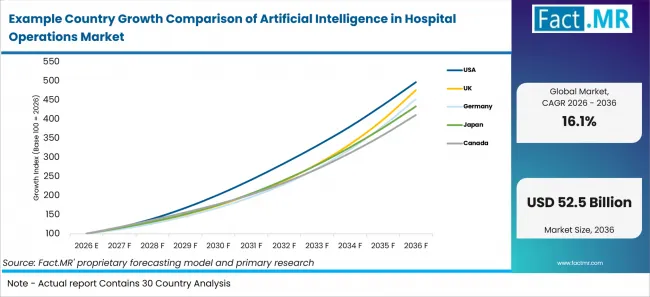
Example Country Growth Comparison Of Artificial Intelligence In Hospital Operations Market | Source: Fact.MR
What are the defining numbers behind Artificial Intelligence in Hospital Operations Market growth?
USD 40.6 billion absolute opportunity by 2036, led by Hospital Workflow Automation and Administrative Operations alongside Inpatient Care, Hospitals & Health Systems, and Machine Learning.
- Demand Drivers in the Market
- Hospital teams need clearer visibility across admissions and discharge readiness so bed pressure can be managed before it spreads.
- Clinical and administrative staff need automation for documentation and billing because repeated tasks take time away from patient-facing work.
- Health systems need better forecasts for staffing and equipment when service-line demand changes faster than resources can be added.
- Key Segments Analyzed
- By AI Solution: Hospital Workflow Automation is expected to hold 39% share in 2026 due to patient flow and bed management use.
- By Hospital Function: Administrative Operations is projected to account for 38% share in 2026 on the back of scheduling and billing workload.
- By Application Area: Inpatient Care is anticipated to capture 41% share in 2026 as hospitals manage admissions and discharge work.
- By End User: Hospitals & Health Systems are estimated to represent 45% share in 2026 given their control over hospital data and workflow rules.
- By AI Technology: Machine Learning is forecast to account for 40% share in 2026 with use in capacity and staffing forecasts.
- Analyst Opinion at Fact.MR
- Shambhu Nath Jha, Principal Consultant at Fact.MR, states, “Hospital AI creates value when it changes a real operating decision. A useful system helps staff decide where a patient moves next or which claim needs review. Suppliers need to turn predictions into accountable work and measurable service outcomes.”
- Strategic Implications
- Hospital executives should define the operating bottleneck and the accountable owner before funding broad AI platform work.
- Clinical and operations teams should test models against local workflows before outputs guide capacity or care coordination decisions.
- Technology leaders should require standards-based integration and role-based access so operational AI can be governed across its lifecycle.
The USA leads at 17.4% CAGR through hospital software scale and enterprise AI investment. The UK follows at 16.9% with NHS digital policy support. Germany records 16.3% through health-data rules and hospital digitalization. Japan reaches 15.8% through smart-hospital work. Canada posts 15.2% through connected-care policy. Australia reaches 14.7% with national digital-health governance. Singapore closes the range at 14.1% through shared health technology infrastructure.
How does the Artificial Intelligence in Hospital Operations Market break down by segment?
Hospital Workflow Automation is expected to lead AI Solution at 39% share in 2026. Administrative Operations is projected to lead Hospital Function at 38% share in 2026.
Which AI Solution dominates?
Hospital Workflow Automation is projected to account for 39% share in 2026.
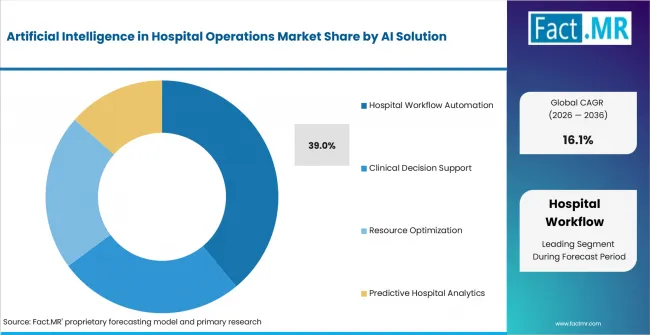
Artificial Intelligence In Hospital Operations Market Analysis By Ai Solution | Source: Fact.MR
Daily pressure around bed use, patient movement and discharge timing gives Hospital Workflow Automation the strongest position. Hospitals gain immediate value when routine coordination becomes easier to manage. Clinical Decision Support follows a slower path because validation requirements are stricter, while Resource Optimization and Predictive Hospital Analytics mainly support planning tasks.
What leads the Hospital Function segment?
Administrative Operations is expected to hold 38% share in 2026.
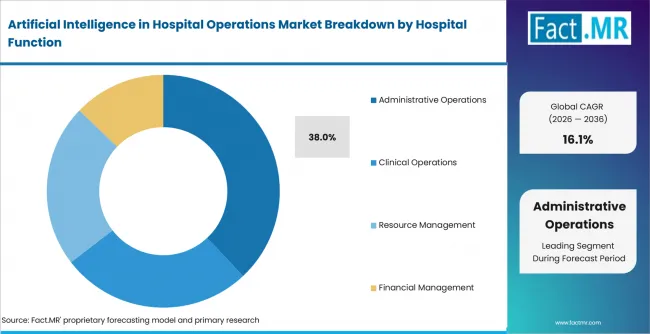
Artificial Intelligence In Hospital Operations Market Analysis By Hospital Function | Source: Fact.MR
Repeated work across scheduling, billing and claims creates a clear opening for automation. Administrative Operations benefits because these processes are easier to standardize and review. Robotic process automation can reduce duplicate data entry, whereas Clinical Operations develops through documentation support and lower clerical burden.
How does Application Area shape demand?
Inpatient Care is anticipated to lead with 41% share in 2026.
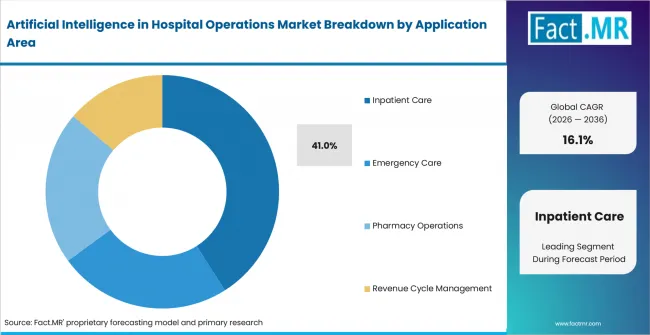
Artificial Intelligence In Hospital Operations Market Analysis By Application Area | Source: Fact.MR
Inpatient Care sits at the center of hospital capacity decisions. Admissions, transfers and discharge readiness directly affect bed availability across departments. Patient monitoring tools strengthen this position by linking status changes with operational planning, while Pharmacy Operations contributes where medication workflows influence patient movement.
Why do Hospitals & Health Systems lead End User demand?
Hospitals & Health Systems are estimated to represent 45% share in 2026.
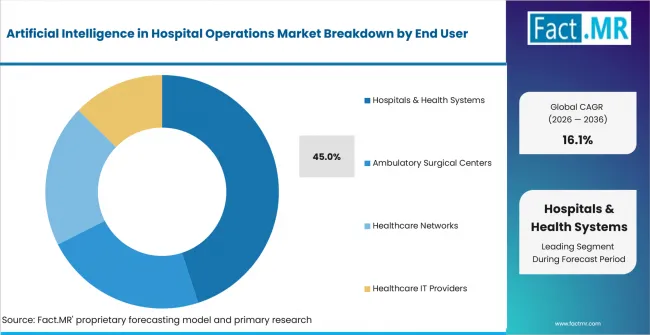
Artificial Intelligence In Hospital Operations Market Analysis By End User | Source: Fact.MR
Hospitals & Health Systems control the care setting where AI must work. Ambulatory Surgical Centers and Diagnostic Centers use narrower tools for scheduling or throughput. Large networks give suppliers a clearer route for enterprise healthcare automation tools.
Which AI Technology leads?
Machine Learning is forecast to account for 40% share in 2026.
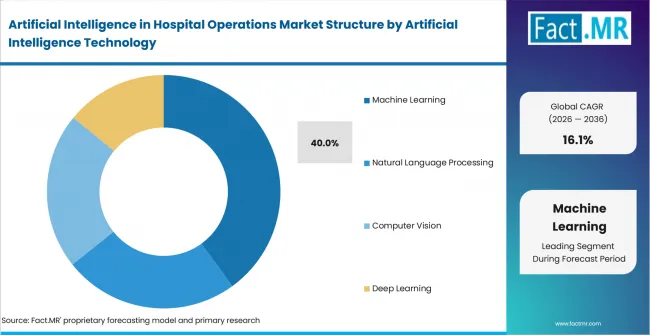
Artificial Intelligence In Hospital Operations Market Analysis By Artificial Intelligence Technology | Source: Fact.MR
Machine Learning holds the largest share because it is already used for forecasting and exception detection. Natural Language Processing supports notes and search workflows. Predictive analytics tools matter where managers need early warning on capacity pressure.
What is accelerating Artificial Intelligence in Hospital Operations Market adoption, and what is holding it back?
Capacity pressure and administrative automation are anticipated to drive adoption. Validation burden and data fragmentation are expected to restrain faster scale.
Drivers Impact Analysis
| DRIVER | (~) % IMPACT ON CAGR | GEOGRAPHIC RELEVANCE | IMPACT TIMELINE |
|---|---|---|---|
| Patient flow and discharge coordination | +3.8% | USA, UK and Germany | Short term (<= 2 years) |
| Administrative automation | +3.1% | USA, UK and Canada | Short term (<= 2 years) |
| Predictive staffing and resource planning | +2.4% | North America, Europe and Japan | Medium term (2-4 years) |
| Interoperable hospital data | +2.0% | Canada, Australia and Singapore | Medium term (2-4 years) |
| Revenue-cycle workflow automation | +1.3% | USA and multi-payer markets | Long term (>= 4 years) |
Source: Fact.MR analysis. Updated Aug 5, 2026
- Patient-flow coordination: Hospitals gain value when AI flags a bottleneck early enough for a bed manager or discharge team to act.
- Administrative automation: Documentation and claims work create repeated queues. Automation is expected to expand where it reduces re-entry and waiting time.
- Interoperable data: Forecasts become more useful when admission records and staffing systems can be read together under clear governance rules.
Opportunity Impact Analysis
| OPPORTUNITY | (~) % IMPACT ON CAGR | GEOGRAPHIC RELEVANCE | IMPACT TIMELINE |
|---|---|---|---|
| Enterprise command centers | +2.0% | USA, UK, Germany and Singapore | Medium term (2-4 years) |
| Role-based AI agents | +1.6% | USA, UK and Australia | Short term (<= 2 years) |
| Pharmacy and supply optimization | +1.1% | Global hospital networks | Medium term (2-4 years) |
| Connected AI platforms | +0.9% | Canada, Germany and Japan | Long term (>= 4 years) |
Source: Fact.MR analysis. Updated Aug 5, 2026
- Enterprise command centers: Hospitals are expected to use AI command centers when predictions can be turned into assignments and escalation steps.
- Role-based AI agents: Microsoft and Oracle Health show demand for tools that support documentation and task work inside staff routines.
- Supply and pharmacy optimization: Inventory tools are expected to gain interest when they reduce stockouts and improve reorder timing.
Restraints Impact Analysis
| RESTRAINT | (~) % IMPACT ON CAGR | GEOGRAPHIC RELEVANCE | IMPACT TIMELINE |
|---|---|---|---|
| Safety and validation burden | -1.4% | Global | Short term (<= 2 years) |
| Privacy and access requirements | -1.0% | Europe, Canada and Australia | Short term (<= 2 years) |
| Legacy-system integration | -0.8% | Global hospital systems | Medium term (2-4 years) |
| Unclear return on investment | -0.6% | Public and private hospitals | Long term (>= 4 years) |
Source: Fact.MR analysis. Updated Aug 5, 2026
- Validation burden: A model can perform differently when patient mix and local workflows change. Hospitals therefore need local testing and monitoring.
- Data and security constraints: Operational AI often needs data from records, finance applications and connected equipment. Access checks can slow projects even when the use case is clear.
- Change-management risk: A prediction does not improve operations unless the responsible team accepts it and has authority to act.
Which countries are scaling Artificial Intelligence in Hospital Operations Market fastest?
- The country comparison spans 3.3 percentage points across the forecast period.
- The USA records 0.5 percentage point above the UK through software scale and enterprise AI investment.
- The UK records 0.6 percentage point above Germany through NHS digital policy and shared buying power.
- Germany records 0.5 percentage point above Japan through health-data rules and hospital digitalization.
- Japan records 0.6 percentage point above Canada through smart-hospital work and workforce relief needs.
- Canada records 0.5 percentage point above Australia through connected-care policy and interoperability focus.
- Australia records 0.6 percentage point above Singapore through national digital-health governance.
Comparable CAGRs create different entry conditions because each country has a different mix of hospital scale and data readiness. Full report coverage includes North America and Europe. It also covers Asia Pacific, Central and South America and the Middle East and Africa.
Example Country Growth Comparison Of Artificial Intelligence In Hospital Operations Market | Source: Fact.MR
| Country | CAGR (2026-2036) |
|---|---|
| USA | 17.4% |
| UK | 16.9% |
| Germany | 16.3% |
| Japan | 15.8% |
| Canada | 15.2% |
| Australia | 14.7% |
| Singapore | 14.1% |
Source: Fact.MR analysis. Updated Aug 5, 2026
What supports USA adoption?
17.4% CAGR, supported by hospital software scale and enterprise AI investment.
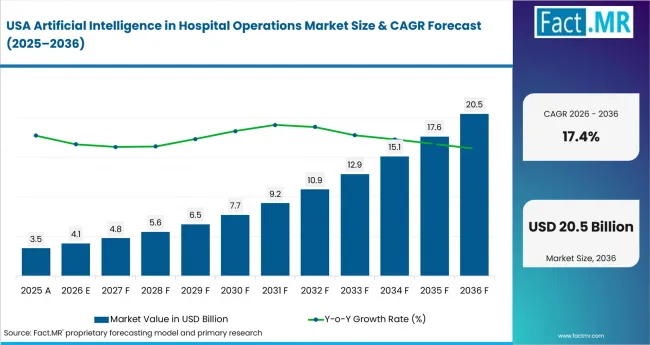
Artificial Intelligence In Hospital Operations Market Country Value Analysis | Source: Fact.MR
The USA’s growth reflects demand from large health systems that expect AI to improve patient flow and reduce staff workload. Existing enterprise platforms and health information exchange networks create a practical base for deployment. Hospitals are likely to expand adoption when tools show measurable operating value and fit established workflows.
How is the UK scaling hospital operations AI?
16.9% CAGR, driven by NHS digital policy and productivity pressure.
The UK’s growth is tied to a nationally coordinated hospital system that supports shared digital workflows. Scheduling and documentation tools can move more easily from pilot programs into governed use. Adoption is expected to strengthen where AI reduces administrative pressure without weakening staff oversight.
What supports Germany’s outlook?
16.3% CAGR, shaped by hospital digitalization and health-data infrastructure.
Germany’s growth reflects a market where secure data access and clear AI rules shape hospital purchasing. Providers are expected to favor tools that combine operational value with compliance. Stronger digital infrastructure can support wider use, but approval is likely to remain careful where governance requirements are strict.
What underpins Japan’s growth?
15.8% CAGR, supported by smart-hospital development and workforce constraints.
Japan’s growth is linked to hospital AI that assists staff with routine operational work. Front-desk support, workflow coordination and other service functions create practical entry points. Buyers are expected to prefer systems that reduce workload while keeping human review visible throughout daily hospital operations.
Why does Canada remain attractive?
15.2% CAGR, supported by connected-care policy and interoperability needs.
Canada’s growth depends on AI tools that can work across provincial healthcare systems without creating new data gaps. Hospitals need platforms that improve coordination between existing records and operational workflows. Adoption is expected to favor solutions that support connected care while maintaining clear data controls.
How is Australia developing demand?
14.7% CAGR, driven by national digital-health governance and safe AI use.
Australia’s growth reflects a structured approach to digital care and hospital AI governance. Buyers are likely to assess safety, accountability and workflow fit before wider deployment. This creates demand for systems that improve operations while remaining compatible with clinical oversight and national digital-health standards.
What supports Singapore’s growth?
14.1% CAGR, supported by shared public healthcare technology and controlled AI testing.
Singapore’s growth is shaped by a compact public healthcare system with shared technology infrastructure. Hospitals can test AI within coordinated environments before broader rollout. Buyers are expected to favor tools that perform reliably across common platforms and support controlled expansion into daily hospital operations.
Who leads the Artificial Intelligence in Hospital Operations Market?
Microsoft and Oracle Health show the clearest direct relevance, while GE HealthCare strengthens the wider hospital workflow and patient-flow landscape.
Microsoft supports hospital operations through AI tools for clinical documentation and task automation. Oracle Health contributes AI agents designed to reduce administrative work across emergency and inpatient settings. GE HealthCare adds hospital operations software focused on patient flow and capacity management. Siemens Healthineers extends the field through operational simulation and workflow-support tools. Philips and IBM broaden the provider set through healthcare informatics and enterprise AI capabilities. Qventus, TeleTracking Technologies, Epic Systems and LeanTaaS add specialized expertise in patient movement, bed management, scheduling and hospital capacity optimization.
Which companies are the key providers?
Key companies include Microsoft Corporation, Oracle Health, GE HealthCare Technologies Inc., Koninklijke Philips N.V., Siemens Healthineers AG, International Business Machines Corporation, Qventus, Inc., TeleTracking Technologies, Inc., Epic Systems Corporation, and LeanTaaS, Inc.
- Microsoft Corporation
- Oracle Health
- GE HealthCare Technologies Inc.
- Koninklijke Philips N.V.
- Siemens Healthineers AG
- International Business Machines Corporation
- Qventus, Inc.
- TeleTracking Technologies, Inc.
- Epic Systems Corporation
- LeanTaaS, Inc.
Bibliography
- Department of Health and Social Care, NHS England, & Ahmed, Z. (2025, October 21). Major NHS AI trial delivers unprecedented time and cost savings
- Epic Systems Corporation (2026, February 4). Epic AI Charting rolls out alongside an expanding set of built-in AI capabilities
- GE HealthCare Technologies Inc. (2025, October 20). GE HealthCare collaborates with two major medical systems to advance AI technology designed to transform hospital operations and improve patient care
- Microsoft Corporation (2025, March 3). Microsoft Dragon Copilot provides the healthcare industry’s first unified voice AI assistant that enables clinicians to streamline clinical documentation, surface information and automate tasks
This Report Answers
- The report provides strategic intelligence on the Artificial Intelligence in Hospital Operations Market across AI Solution, Hospital Function, Application Area, End User and AI Technology choices that shape hospital workflow adoption.
- Segment analysis covers Hospital Workflow Automation, Administrative Operations, Inpatient Care, Hospitals & Health Systems and Machine Learning as the share leaders within the 2026 market.
- Country outlook evaluates the USA and UK alongside Germany and Japan. Canada, Australia and Singapore complete the growth comparison across the profiled markets.
- Competitive analysis profiles Microsoft and Oracle Health alongside GE HealthCare and Siemens Healthineers. Philips, IBM, NVIDIA, SAP, Epic Systems and Veradigm complete the broader provider set.
- Technology assessment covers Machine Learning and Natural Language Processing. Computer Vision and Deep Learning complete the technology view alongside workflow automation, resource optimization and predictive hospital analytics.
What does the Artificial Intelligence in Hospital Operations Market cover?
The market covers AI-enabled software and services used to manage hospital operating work.
Coverage includes workflow automation, documentation support and resource planning. It excludes consumer health AI that does not affect hospital workflow decisions.
What is included in the scope?
The scope includes hospitals and health systems that use AI to manage daily operating decisions.
Included applications cover patient movement, administrative work and staffing support. The report covers vendors that sell software or services used by hospital operations teams.
What is excluded from the scope?
The scope excludes stand-alone diagnostic AI with no hospital operations workflow.
Excluded areas include general wellness applications and patient-facing consumer tools. Imaging algorithms are included only when they affect hospital workload.
How Was the Analysis Built?
The analysis draws on 120+ sources, 35+ company portfolios, 25+ countries, and more than 20 industry interviews.
- Primary Research: Primary research includes discussions with manufacturers, service providers, technology developers, distributors, end users, procurement teams, and subject-matter experts. These conversations examine purchasing priorities, product adoption, operational challenges, approval requirements, competitive positioning, and the factors that influence wider market acceptance.
- Desk Research: Desk research covers government statistics, regulatory publications, company filings, trade data, technical studies, industry associations, standards, public policy, and other authoritative sources. Every source used in the analysis is documented in the bibliography.
- Market Sizing and Forecasting: Market estimates combine historical performance, demand indicators, pricing and volume trends, segment shares, company participation, country-level growth, adoption patterns, investment activity, and barriers to market expansion.
- Data Validation and Update Cycle: Findings are validated by comparing primary interviews with public data, company activity, regulatory changes, trade patterns, and industry developments. Regular updates review new product launches, capacity changes, partnerships, approvals, procurement trends, and shifts in commercial adoption.
Segmentation
What is the report’s scope and coverage?
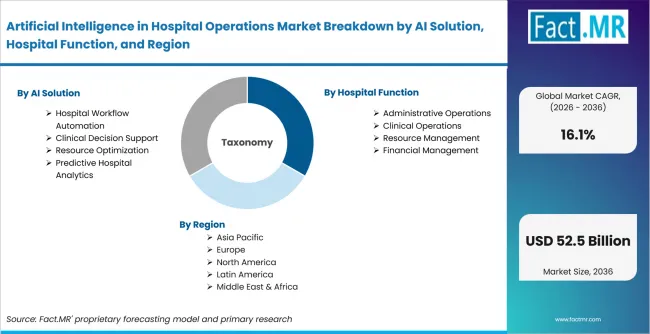
Artificial Intelligence In Hospital Operations Market Breakdown By Ai Solution, Hospital Function, And Region | Source: Fact.MR
| Attribute | Details |
|---|---|
| Quantitative Units | USD Billion |
| Market Definition | AI software and services used to coordinate hospital operations and workflow decisions where patient flow, documentation, staffing, resource planning, interoperability and human oversight shape adoption |
| AI Solution | Hospital Workflow Automation; Clinical Decision Support; Resource Optimization; Predictive Hospital Analytics |
| Hospital Function | Clinical Operations; Administrative Operations; Resource Management; Financial Management |
| Application Area | Emergency Care; Inpatient Care; Pharmacy Operations; Revenue Cycle Management |
| End User | Hospitals & Health Systems; Ambulatory Surgical Centers; Diagnostic Centers; Multi-specialty Clinics; Healthcare Networks; Healthcare IT Providers |
| AI Technology | Machine Learning; Natural Language Processing; Computer Vision; Deep Learning |
| Regions Covered | North America; Latin America; Europe; East Asia; South Asia and Oceania; Middle East and Africa |
| Countries Covered | USA; UK; Germany; Japan; Canada; Australia; Singapore |
| Key Companies Profiled | Microsoft Corporation; Oracle Health; GE HealthCare Technologies Inc.; Koninklijke Philips N.V.; Siemens Healthineers AG; International Business Machines Corporation; Qventus, Inc.; TeleTracking Technologies, Inc.; Epic Systems Corporation; LeanTaaS, Inc. |
| Forecast Period | 2026 to 2036 |
| Approach | Hybrid top-down and bottom-up approach using hospital AI spending; patient-flow and discharge coordination needs; administrative automation; staffing and capacity forecasting; interoperability requirements; revenue-cycle workflows; validation and privacy controls; legacy-system integration; hospital software adoption; country digital-health policies; buyer interviews; and company portfolio review |
Source: Fact.MR analysis. Updated Aug 5, 2026
How is the Artificial Intelligence in Hospital Operations Market segmented?
-
By AI Solution:
- Hospital Workflow Automation
- Clinical Decision Support
- Resource Optimization
- Predictive Hospital Analytics
-
By Hospital Function:
- Clinical Operations
- Administrative Operations
- Resource Management
- Financial Management
-
By Application Area:
- Emergency Care
- Inpatient Care
- Pharmacy Operations
- Revenue Cycle Management
-
By End User:
- Hospitals & Health Systems
- Ambulatory Surgical Centers
- Diagnostic Centers
- Multi-specialty Clinics
- Healthcare Networks
- Healthcare IT Providers
-
By AI Technology:
- Machine Learning
- Natural Language Processing
- Computer Vision
- Deep Learning
-
By Region:
- North America
- Latin America
- Europe
- East Asia
- South Asia and Oceania
- Middle East and Africa
Frequently Asked Questions
How big is the Artificial Intelligence in Hospital Operations Market in 2026?
What is the CAGR of the Artificial Intelligence in Hospital Operations Market from 2026 to 2036?
Which AI solution leads the Artificial Intelligence in Hospital Operations Market?
Which end-user segment leads the Artificial Intelligence in Hospital Operations Market?
Who are the leading companies in the Artificial Intelligence in Hospital Operations Market?
Who worked on this report


Preview the report firsthand - request a free sample
Free SampleGet the brochure for pricing and purchase details
Download PDF