- Market Value (2025): USD 3.3 Bn
- Estimated Value (2026): USD 3.6 Bn
- Forecast Value (2036): USD 8.7 Bn
- CAGR (2026-2036): 9.1%
What is accelerating Aseptic In-Line Pouches Market adoption, and what is holding it back?
Demand is expected to rise through shelf-stable liquid foods and in-line sterile filling; adoption is constrained by validation cost and packaging regulation.
Drivers Impact Analysis
| DRIVER | (~) % IMPACT ON CAGR | GEOGRAPHIC RELEVANCE | IMPACT TIMELINE |
|---|---|---|---|
| Shelf-stable puree and baby-food pouching | +1.5% | North America, Western Europe, Latin America | Short term (<= 2 years) |
| In-line pouch sterilization | +1.3% | Global | Medium term (2-4 years) |
| Foodservice sauce and concentrate formats | +0.9% | USA, UK, Germany | Medium term (2-4 years) |
| Reclosable pack convenience | +0.7% | USA, UK, Italy, Brazil | Long term (>= 4 years) |
Opportunity Impact Analysis
| OPPORTUNITY | (~) % IMPACT ON CAGR | GEOGRAPHIC RELEVANCE | IMPACT TIMELINE |
|---|---|---|---|
| Mono-material high-barrier pouch trials | +1.1% | Europe, North America | Medium term (2-4 years) |
| Regional co-packing for fruit and dairy brands | +0.8% | Brazil, Italy, USA | Short term (<= 2 years) |
| Nutrition-liquid portion packs | +0.6% | USA, UK, Germany | Long term (>= 4 years) |
Restraints Impact Analysis
| RESTRAINT | (~) % IMPACT ON CAGR | GEOGRAPHIC RELEVANCE | IMPACT TIMELINE |
|---|---|---|---|
| Food safety validation cost | -0.6% | Global | Short term (<= 2 years) |
| Recycling and fee rules | -0.5% | Europe, UK, Brazil | Medium term (2-4 years) |
| Barrier-film compatibility | -0.4% | Global | Long term (>= 4 years) |
Which countries are scaling the Aseptic In-Line Pouches Market through 2036?
- The country comparison spans 3.0 percentage points and forms three practical growth bands across the forecast period.
- The UK remains 1.5 percentage points above Brazil through food-manufacturing scale and packaging EPR cost pressure.
- Brazil stays 0.5 percentage point above Italy as dairy volume supports ambient pouch use.
- Italy remains 0.4 percentage point above the USA, with agri-food value added providing broad food-processing context.
- The USA remains 0.6 percentage point above Germany through food-away-from-home spending and food-product manufacturing activity.
- Germany closes the displayed range through ready-meal production and EU packaging regulation.
Comparable CAGRs create different entry conditions because aseptic pouches must match local food applications, filling-line qualification and packaging compliance. Full report coverage includes North America, Latin America, Western Europe, Eastern Europe, East Asia, South Asia & Pacific, Middle East & Africa.
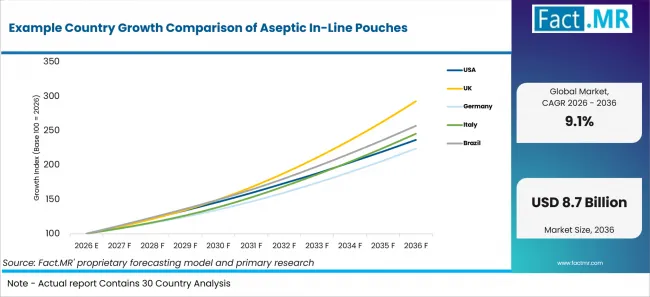
Example Country Growth Comparison Of Aseptic In Line Pouches | Source: Fact.MR
| Country | CAGR (2026-2036) |
|---|---|
| United Kingdom | 11.4% |
| Brazil | 9.9% |
| Italy | 9.4% |
| United States | 9.0% |
| Germany | 8.4% |
What supports United Kingdom adoption?
11.4% CAGR, supported by food-manufacturing scale and packaging cost pressure.
UK food manufacturers give pouch converters a broad application base in sauces, dairy drinks and spoonable products. Defra reported on September 3, 2026, that, in real terms at constant 2023 prices, consumer expenditure on food and alcoholic drinks reached GBP 303.3 Billion in 2025. Aseptic in-line pouches are expected to gain attention where brands seek ambient packs with documented shelf-life controls.
How is Brazil scaling demand?
9.9% CAGR, driven by dairy volume and tropical fruit applications.
Brazil’s dairy and fruit-processing base creates a practical route for ambient pouch filling. IBGE reported on March 18, 2026, that dairy establishments operating under sanitary inspection acquired 27.51 Billion litres of raw milk in 2025. Local processors are expected to evaluate aseptic pouches where distribution distances make shelf stability valuable for dairy and fruit preparations.
What supports Italy’s growth?
9.4% CAGR, backed by agri-food value added and food-processing activity.
Italy’s sauce, fruit and prepared-food producers provide a practical fit for mid-size pouch formats. Istat reported on June 12, 2026, that the agri-food sector generated EUR 89 Billion in value added in 2025. Aseptic pouch lines are expected to support brands that sell shelf-stable recipes across retail and foodservice channels.
How does the USA perform?
9.0% CAGR, led by food-away-from-home spending and food-product manufacturing.
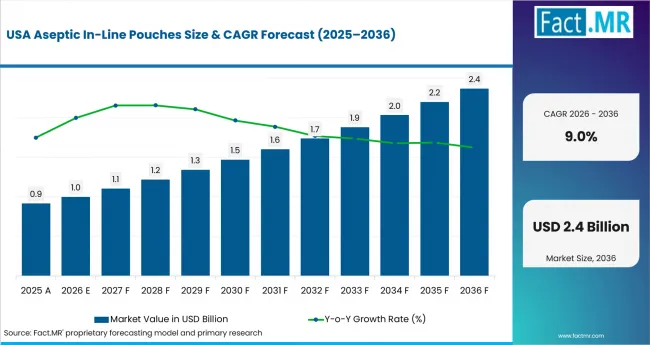
Aseptic In Line Pouches Country Value Analysis | Source: Fact.MR
The USA has a broad base of foodservice operators and packaged-food plants that can use sterile flexible formats. FRED, using U.S. Census Bureau M3 data, showed seasonally adjusted food-product manufacturers’ shipments of USD 90.876 Billion in July 2026. Sauce, puree and nutrition-liquid fillers are expected to use in-line pouch formats where handling efficiency supports repeat orders.
What is supporting Germany’s adoption?
8.4% CAGR, supported by ready-meal production and packaging regulation.
Germany’s prepared-food sector supports demand for pouches that protect ambient recipes. Destatis reported on January 14, 2026, that Germany produced 1.7 Million tonnes of ready meals in 2024. The same market is expected to prioritize pouch structures that balance shelf life with regulatory pressure on packaging waste.
Who leads the Aseptic In-Line Pouches Market?
SIG is directly active in in-line aseptic pouch sterilization through Prime 55 In-Line Aseptic, while Gualapack, Tetra Pak, Fres-co System USA, Elecster and IMA Group / Fillshape contribute pouch, aseptic-packaging, filling-line or flexible-material capabilities.
SIG has direct relevance through Prime 55 In-Line Aseptic, which sterilizes pre-made spouted pouches within the filling system and removes the need for third-party pre-sterilization. The company’s November 2025 Petite Palates launch also demonstrates the use of SIG aseptic spouted pouches for shelf-stable baby meals in the United States. Together, these capabilities combine aseptic processing with the convenience of a spouted-pouch format.
Gualapack supplies pre-made spouted pouches and rotary pouch-filling lines for food applications. Tetra Pak provides an adjacent aseptic pouch-format option through Tetra Fino Aseptic, which the company describes as a carton pouch for ambient-distribution food and beverage products.
Which companies are the key providers?
Key companies include SIG, Tetra Pak, Gualapack, Fres-co System USA, Elecster and IMA Group / Fillshape.
- SIG
- Tetra Pak
- Gualapack
- Fres-co System USA
- Elecster
- IMA Group / Fillshape
Bibliography
- Department for Environment, Food & Rural Affairs. (2026, September 3). Chapter 14: The food chain. GOV.UK.
- Department for Environment, Food & Rural Affairs, & Environment Agency. (2026, April 7). Extended producer responsibility for packaging: Recycling obligations and waste disposal fees. GOV.UK.
- Directorate-General for Environment. (2026, August 11). New EU packaging rules start to apply, including restrictions on PFAS in food-contact packaging. European Commission.
- Instituto Brasileiro de Geografia e Estatística. (2026, March 18). In 2025, Brazil registers the highest production of milk, leather and eggs in history; slaughter of cattle, chickens and pigs also hits record.
- Istat. (2026, June 12). Economic accounts for agriculture – Year 2025.
- Office for National Statistics. (2026, July 24). UK manufacturers’ sales by product: 2025.
- SIG. (2025, November 20). Petite Palates launches first-of-its-kind baby meals in SIG’s aseptic spouted pouches in the US.
- SIG. (2025, October 3). ALCA Corp launches first products filled on SIG’s next-gen aseptic spouted pouch system featuring in-line pouch sterilization.
- Statistisches Bundesamt (Destatis). (2026, January 14). Produktion von Fertiggerichten binnen fünf Jahren mengenmäßig um 25,6 % gestiegen.
- U.S. Census Bureau. (2026, September 2). Manufacturers’ value of shipments: Food products [Data set]. FRED, Federal Reserve Bank of St. Louis.
- U.S. Food and Drug Administration. (2025, August 6). FDA proposes to extend compliance date for Food Traceability Rule and issues new FAQs and other resources.
- Zeballos, E., & Sinclair, W. (2026, June 11). Total U.S. food spending reached $2.51 trillion in 2025. U.S. Department of Agriculture, Economic Research Service.
This Report Answers
- The report explains how aseptic in-line pouch systems are used across pouch structure, filling architecture and application categories.
- Segment analysis identifies the main subsegments and the operational reasons food processors prioritize them.
- Country analysis examines the listed markets and the food-sector mechanisms supporting sterile pouch conversion.
- Competitive analysis reviews current providers across in-line aseptic pouch filling, pre-made pouches and high-barrier flexible materials.
- Application analysis assesses how shelf-life needs, pack size and product viscosity influence supplier selection.
What does the Aseptic In-Line Pouches Market cover?
The Aseptic In-Line Pouches Market covers sterile pouch formats and filling systems that pack liquid and semi-liquid foods under aseptic conditions. It includes pouch structures used for fruit purees, dairy, baby food, sauces and nutrition liquids. Related flexible formats such as bag-in-box containers are relevant where bulk liquid handling overlaps with aseptic filling.
The assessment covers pre-made spouted pouches, in-line pouch sterilization and form-fill-seal aseptic formats. It also considers pack sizes from small child-focused pouches to larger foodservice packs. Printing and decoration are covered only where digital printing for flexible packaging affects pouch conversion and short-run launches.
What is included in the scope?
The scope includes multilayer high-barrier pouches, aluminum laminate pouches, mono-material high-barrier formats, paper-plastic hybrids and bio-based specialty packs. It includes in-line rotary aseptic, in-line linear aseptic and spouted aseptic filling systems used by food and beverage processors. Adjacent refill packaging formats are considered where they use comparable pouch materials and closure systems.
The scope includes application demand from fruit purees, dairy, baby food, sauces and nutrition liquids. It also includes materials that support recyclable or lower-plastic design, including biodegradable packaging materials where food-contact validation permits commercial use. Aseptic processing equipment is included when it forms part of the pouch filling system.
What is excluded from the scope?
The scope excludes rigid bottles, cans, glass jars, standard cartons and non-aseptic flexible pouches sold for dry snacks. It also excludes retort-only pouches, vacuum pouches and frozen-food bags when no aseptic in-line filling step is involved.
General flexible packaging film is excluded unless it is qualified for aseptic pouch applications. Industrial packs are excluded unless the same filling or barrier concept supports food-grade aseptic use. Wider industrial packaging coverage is treated as an adjacent category.
How Was the Analysis Built?
The analysis draws on 120+ references, 35+ company portfolios, 25+ countries and more than 20 industry interviews.
- Primary Research: Primary research includes discussions with packaging converters, filling-line suppliers, co-packers, food processors, distributors and subject-matter experts. These conversations examine qualification priorities, material selection, filling-line limitations, approval requirements and competitive positioning.
- Desk Research: Desk research covers government statistics, regulatory publications, company pages, standards, trade data, technical studies and public policy material. Each reference used in the analysis is documented in the bibliography.
- Market Sizing and Forecasting: Market estimates combine historical performance, application demand indicators, segment shares, country growth, packaging regulation, company participation and barriers to market expansion.
- Data Validation and Update Cycle: Findings are validated by comparing interviews with public data, company activity, regulatory changes and product developments. Regular updates review product launches, capacity changes, approvals and shifts in commercial adoption.
What is the Aseptic In-Line Pouches Market forecast to be worth by 2036?
USD 3.6 Billion in 2026 to USD 8.7 Billion by 2036, at a 9.1% CAGR.
- The Aseptic In-Line Pouches Market crossed a valuation of USD 3.3 Billion in 2025.
- Demand is projected to increase from USD 3.6 Billion in 2026 to USD 8.7 Billion by 2036.
- The market is forecast to record a 9.1% CAGR from 2026 to 2036 as puree processors, dairy fillers and co-packers qualify sterile pouch formats for ambient distribution.
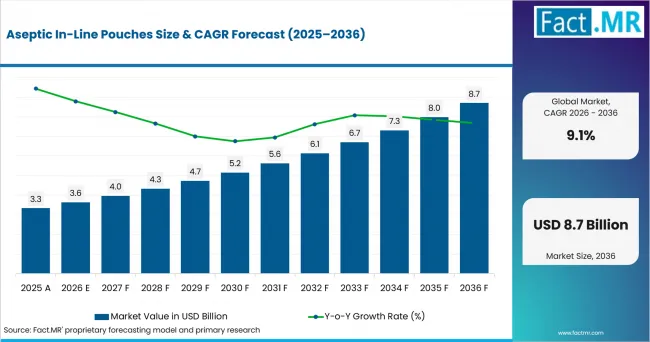
Aseptic In Line Pouches Value Analysis | Source: Fact.MR
What are the defining numbers behind Aseptic In-Line Pouches Market growth?
USD 5.1 Billion absolute opportunity by 2036, led by multilayer high-barrier pouches, inline rotary aseptic systems and fruit puree applications.
- Demand Drivers in the Market
- Fruit puree processors need aseptic packaging systems that protect color, texture and flavor during ambient storage.
- Dairy fillers require sterile packaging lines that manage low-acid products and maintain repeatable fill integrity across small pack sizes.
- Baby-food brands select reclosable pouches because caregivers value controlled dispensing and pantry storage for spoonable meals.
- Foodservice sauce suppliers use larger pouch volumes to lower rigid-pack handling in kitchens and back-of-house storage areas.
- USDA ERS reported on June 11, 2026, that inflation-adjusted U.S. food-away-from-home spending reached USD 1.41 Trillion in 2025. The scale of food-away-from-home spending provides demand context for foodservice packaging, including sauce and concentrate formats.
- Key Segments Analyzed
- By Pouch Structure: Multilayer high-barrier is expected to hold 38.0% share in 2026 owing to oxygen-sensitive puree, dairy and nutrition-liquid use.
- By Filling Architecture: Inline rotary aseptic is projected to account for 32.0% share in 2026 driven by repeatable handling of pre-made pouches.
- By Application: Fruit purees are anticipated to capture 29.0% share in 2026 supported by baby meals and snack puree formats.
- By Pack Volume: 250-500 mL is estimated to represent 31.0% share in 2026 because the format fits family portions and portable consumption.
- Analyst Opinion at Fact.MR
- Shambhu Nath Jha, Principal Consultant at Fact.MR, states, “In-line sterilization changes the approval question for pouch fillers. The market is expected to favor systems that combine sterile assurance with flexible pack design. Suppliers should prove repeatable fill integrity, material compatibility and application-specific shelf-life performance.”
- Strategic Implications
- Equipment vendors should document sterilization validation, fill accuracy and changeover behavior for each pouch family.
- Material suppliers should align barrier film design with fruit acids, dairy proteins and viscous sauces before line trials begin.
- Brand owners should compare pouch size, closure type and shelf-life target before selecting a filling architecture.
The UK is projected to record 11.4% CAGR through 2036, with food-manufacturing scale and packaging EPR cost pressure shaping the operating environment. Brazil is anticipated to post 9.9% CAGR, supported by dairy throughput and fruit-processing applications. Italy is estimated to advance at 9.4% CAGR, supported by the scale of agri-food value added. The USA is forecast at 9.0% CAGR as food-away-from-home spending and food-product shipments provide demand context. Germany is expected to reach 8.4% CAGR, supported by ready-meal production and EU packaging rules.
How does the Aseptic In-Line Pouches Market break down by segment?
Multilayer high-barrier leads Pouch Structure at 38.0%; inline rotary aseptic leads Filling Architecture at 32.0%.
Which Pouch Structure dominates?
Multilayer high-barrier holds 38.0% share in 2026.
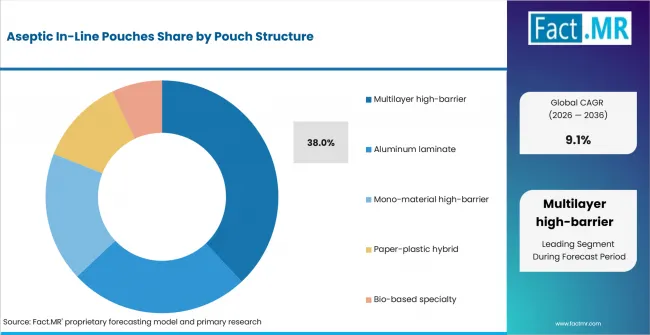
Aseptic In Line Pouches Analysis By Pouch Structure | Source: Fact.MR
Multilayer high-barrier pouches lead because aseptic puree, dairy and nutrition liquids need oxygen protection during ambient storage. Aluminum laminate remains familiar for long shelf-life programs. Mono-material high-barrier formats are gaining trial interest where brands evaluate high-recyclability mono-material flexible packaging for future pack redesigns.
What leads the Filling Architecture segment?
Inline rotary aseptic accounts for 32.0% share in 2026.
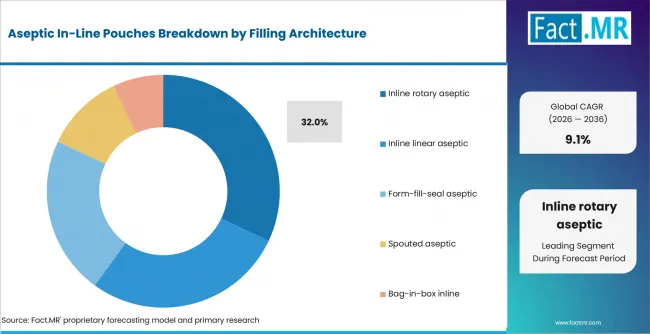
Aseptic In Line Pouches Analysis By Filling Architecture | Source: Fact.MR
Inline rotary aseptic systems lead because they match pre-made pouch handling with repeatable sterile filling. The design suits plants running multiple spout types and pack sizes. SIG’s October 2025 commercial launch of products filled on the Prime 55 In-Line Aseptic system demonstrated the use of in-line pouch sterilization, eliminating the need for third-party pre-sterilization of spouted pouches.
How does Application shape demand?
Fruit purees capture 29.0% share in 2026.
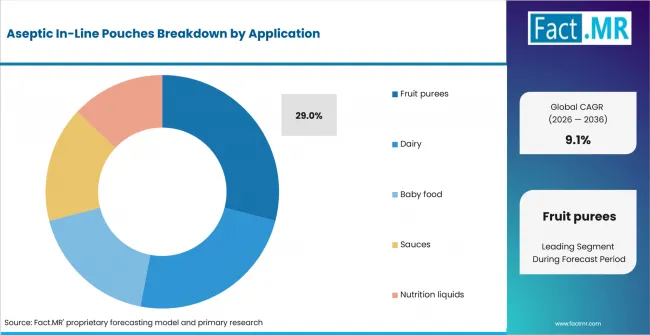
Aseptic In Line Pouches Analysis By Application | Source: Fact.MR
Fruit purees lead because the product category fits squeezable pouch use and benefits from ambient shelf stability. Tropical fruit ingredients, baby meals and snack purees need filling lines that protect product texture. SIG reported in November 2025 that Petite Palates selected its aseptic spouted pouches for shelf-stable baby meals in the United States.
What supports 250-500 mL within Pack Volume?
250-500 mL represents 24.0% share in 2026.
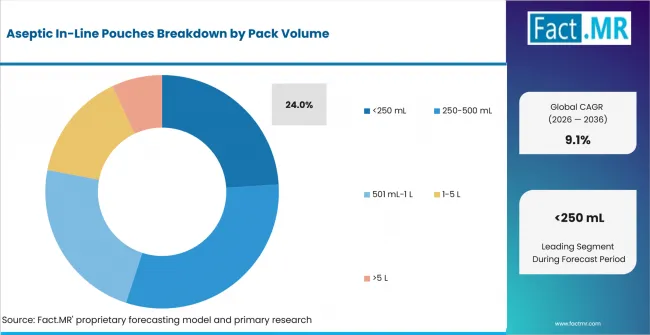
Aseptic In Line Pouches Analysis By Pack Volume | Source: Fact.MR
The 250-500 mL size is expected to lead because it bridges single-serve convenience and household pantry use. It works for puree, dairy drinks, sauce refills and nutrition liquids. SIG reports filling volumes of 30-500 mL for its Prime 55 In-Line Aseptic system, directly overlapping the 250-500 mL pack-volume band.
What is the report’s scope and coverage?
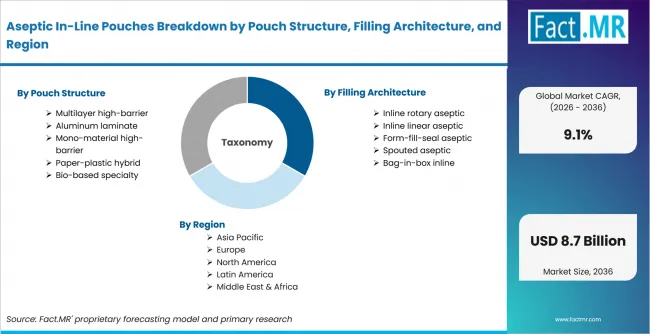
Aseptic In Line Pouches Breakdown By Pouch Structure, Filling Architecture, And Region | Source: Fact.MR
| Attribute | Details |
|---|---|
| Quantitative Units | USD Billion in 2026 to USD Billion by 2036 at a CAGR |
| Market Definition | Sterile flexible pouch packaging systems and pouch materials used for ambient fruit purees, dairy, baby food, sauces and nutrition liquids. The scope covers aseptic in-line pouch filling and pack structures used to maintain shelf-stable product quality. |
| Pouch Structure | Multilayer high-barrier; Aluminum laminate; Mono-material high-barrier; Paper-plastic hybrid; Bio-based specialty |
| Filling Architecture | Inline rotary aseptic; Inline linear aseptic; Form-fill-seal aseptic; Spouted aseptic; Bag-in-box inline |
| Application | Fruit purees; Dairy; Baby food; Sauces; Nutrition liquids |
| Pack Volume | 250-500 mL; <250 mL; 501 mL-1 L; 1-5 L; >5 L |
| Regions Covered | North America; Latin America; Western Europe; Eastern Europe; East Asia; South Asia & Pacific; Middle East & Africa |
| Countries Covered | United Kingdom; Brazil; Italy; United States; Germany |
| Key Companies Profiled | SIG; Tetra Pak; Gualapack; Fres-co System USA; Elecster; IMA Group / Fillshape |
| Forecast Period | 2026 to 2036 |
| Approach | Hybrid top-down and bottom-up approach using food application demand, pouch material fit, filling-line architecture, country growth, provider portfolio review and application-level validation. |
How is the market segmented?
-
By Pouch Structure
- Multilayer high-barrier
- Aluminum laminate
- Mono-material high-barrier
- Paper-plastic hybrid
- Bio-based specialty
-
By Filling Architecture
- Inline rotary aseptic
- Inline linear aseptic
- Form-fill-seal aseptic
- Spouted aseptic
- Bag-in-box inline
-
By Application
- Fruit purees
- Dairy
- Baby food
- Sauces
- Nutrition liquids
-
By Pack Volume
- 250-500 mL
- <250 mL
- 501 mL-1 L
- 1-5 L
- >5 L
-
By Region
- North America
- Latin America
- Western Europe
- Eastern Europe
- East Asia
- South Asia & Pacific
- Middle East & Africa