- Market Value (2025): USD 566.4 Mn
- Estimated Value (2026): USD 610 Mn
- Forecast Value (2036): USD 1281 Mn
- CAGR (2026-2036): 7.7%
What is the Inline Powder Dispersion Systems Market forecast to be worth by 2036?
USD 1,281 million by 2036, at 7.7% CAGR.
- The inline powder dispersion systems market reached USD 566.4 million in 2025.
- Demand is projected to increase from USD 610 million in 2026 to USD 1281 million by 2036.
- The market is expected to expand at 7.7% CAGR from 2026 to 2036.
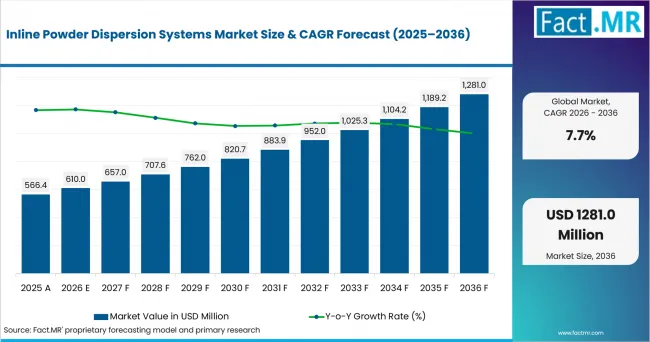
Inline Powder Dispersion Systems Market Value Analysis | Source: Fact.MR
What are the defining numbers behind Inline Powder Dispersion Systems Market growth?
USD 671 million in absolute opportunity is expected between 2026 and 2036.
- Demand Drivers in the Market
- Continuous processing improvements in pharmaceutical manufacturing under FDA PAT guidance are encouraging investment in inline powder dispersion systems that eliminate batch-tank cleaning between products.
- Growth in plant-protein, dairy-alternative and functional-beverage formulations is increasing demand for high-shear rotor-stator systems that hydrate gums, stabilizers and protein isolates in a single pass.
- Cosmetic and personal-care manufacturers are adopting inline dispersion to reduce batch cycle times for emulsions and creams while improving product consistency across production runs.
- Energy and water savings achievable with single-pass inline dispersion versus multi-stage batch tank mixing are driving adoption in cost-sensitive chemical and paint manufacturing operations.
- The shift toward smaller, more frequent production campaigns in food and beverage is favoring inline systems that minimize changeover time and eliminate cross-contamination risks between product runs.
- Key Segments Analyzed
- By Technology: The High-shear rotor-stator category is projected to account for 39.0% of the inline powder dispersion systems market in 2026. Rotor-stator heads provide controlled, high-intensity mixing across formulations ranging from thin beverages to viscous creams.
- By Application: The Dissolving category is projected to account for 34.0% of the inline powder dispersion systems market in 2026. Dissolving is a common duty because powders must enter liquid without floating, lumping or excessive air entrainment.
- By End-Use Industry: The Food & beverage category is projected to account for 31.0% of the inline powder dispersion systems market in 2026. Food and beverage plants process a wide range of gums, proteins, starches, minerals and other functional ingredients.
- Analyst Opinion at Fact.MR
- Shambhu Nath Jha, Principal Consultant at Fact.MR, states, "Inline dispersion earns its place when it removes a recurring production bottleneck. A processor needs the powder to enter the liquid without floating, lumping or creating dust, then reach the required texture in a repeatable pass. Rotor-stator systems cover a wide operating range, while vacuum induction becomes important when powder addition and housekeeping are the limiting steps."
- Strategic Implications
- Equipment manufacturers that combine high-shear rotor-stator dispersion with vacuum powder induction can address pharmaceutical and nutraceutical customers who require dust-free operation and validated cleaning protocols.
- The rise of plant-based and functional food categories is expanding the addressable market for inline dispersion systems that can handle challenging protein isolates, fibers and hydrocolloids at commercially viable throughputs.
- Inline systems that integrate with process automation platforms and provide real-time shear-rate, temperature and flow monitoring can differentiate in pharmaceutical and cosmetic segments where batch documentation is mandatory.
- Regional food-ingredient capacity expansion in Asia-Pacific, particularly in South Korea and Southeast Asia, is creating new demand for mid-scale inline dispersion systems suitable for contract manufacturing operations.
- Retrofitting existing batch-tank lines with inline dispersion modules offers a lower-capital entry path for mid-sized food and chemical processors seeking faster throughput without full plant replacement.
How does the Inline Powder Dispersion Systems Market break down by segment?
Why does the High-shear rotor-stator category lead Technology?
The High-shear rotor-stator category is projected to account for 39.0% in 2026.
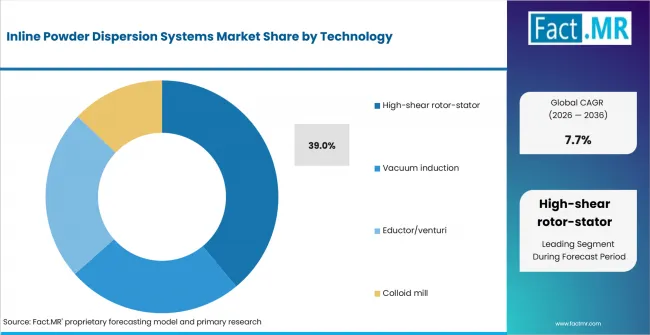
Inline Powder Dispersion Systems Market Analysis By Technology | Source: Fact.MR
A rotor-stator head creates concentrated shear in a small processing zone, pulling wetted particles apart before agglomerates can circulate through the batch. This makes the technology useful when dispersion quality must be reached in a controlled pass.
The same platform can be scaled across pilot and production equipment, which helps formulation teams preserve process intent. Vacuum induction gains preference when powder feed rate, dust containment or air entrainment is the main limitation.
Why does the Dissolving category lead Application?
The Dissolving category is projected to account for 34.0% in 2026.
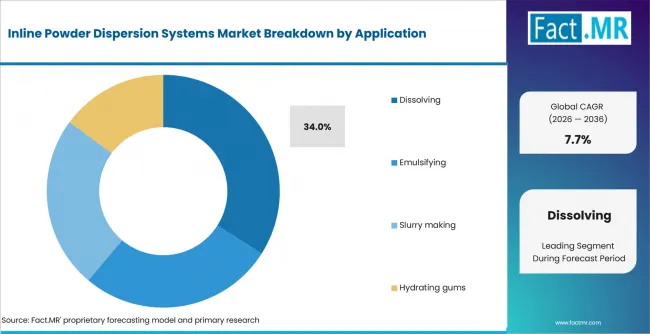
Inline Powder Dispersion Systems Market Analysis By Application | Source: Fact.MR
Many dry ingredients resist wetting and form floating rafts or fish-eyes when added to a vessel from the surface. Inline dissolving exposes powder to liquid and shear at the induction point, shortening the path to a uniform solution.
The production endpoint is usually defined by the absence of undissolved solids and a stable viscosity or concentration. Emulsifying and slurry making need related equipment, but their process targets introduce different droplet or solids-loading constraints.
Why does the Food & beverage category lead End-Use Industry?
The Food & beverage category is projected to account for 31.0% in 2026.
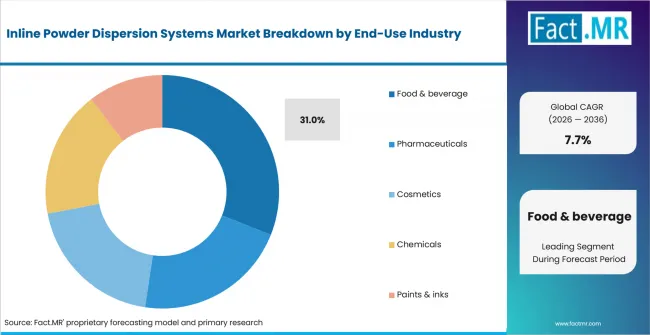
Inline Powder Dispersion Systems Market Analysis By End Use Industry | Source: Fact.MR
Food and beverage formulations routinely combine gums, starches, proteins, cocoa, minerals and other powders with water or oil phases. Frequent product changes make repeatable induction and clean-in-place access important to line utilization.
Sanitary design and scale-up support therefore influence supplier selection. Pharmaceutical and cosmetic plants impose tighter validation needs, while the food sector contributes a wider range of everyday dispersion duties.
What is accelerating Inline Powder Dispersion Systems Market adoption, and what is holding it back?
Adoption is being driven by demand for faster, cleaner single-pass powder incorporation, while higher equipment cost and cleaning-validation complexity can slow investment in multi-product facilities.
Drivers Impact Analysis
| Driver | (~) % Impact on CAGR | Geographic Relevance | Impact Timeline |
|---|---|---|---|
| FDA PAT guidance and continuous processing adoption in pharmaceuticals | +0.9% | North America, Europe | Near term |
| Growth in plant-protein and functional-beverage formulations requiring gum hydration | +0.8% | Global | Near term |
| Replacement of batch-tank mixing with single-pass inline dispersion for faster cycle times | +0.6% | Europe, Asia-Pacific | Mid term |
| Integration of vacuum powder induction for dust-free pharmaceutical operations | +0.4% | North America, Europe | Mid term |
Source: Fact.MR analysis. Updated Aug 20, 2026
Opportunity Impact Analysis
| Opportunity | (~) % Impact on CAGR | Geographic Relevance | Impact Timeline |
|---|---|---|---|
| Inline dispersion for plant-based protein and dairy-alternative processing | +0.7% | Global | Near term |
| Retrofit inline modules for existing batch-tank production lines | +0.5% | Asia-Pacific, Europe | Mid term |
| Continuous processing lines for cosmetic emulsion manufacturing | +0.4% | Asia-Pacific, Europe | Long term |
Source: Fact.MR analysis. Updated Aug 20, 2026
Restraints Impact Analysis
| Restraint | (~) % Impact on CAGR | Geographic Relevance | Impact Timeline |
|---|---|---|---|
| Higher capital cost of rotor-stator systems compared to eductor/venturi alternatives | -0.5% | Asia-Pacific, Latin America | Near term |
| Shear-sensitive formulations limiting applicability of high-shear dispersion in certain pharmaceutical products | -0.4% | Global | Mid term |
| Cleaning validation complexity in multi-product pharmaceutical facilities | -0.3% | North America, Europe | Long term |
Source: Fact.MR analysis. Updated Aug 20, 2026
Which countries are scaling the Inline Powder Dispersion Systems Market through 2036?
- Germany: Germany has a dense base of food-ingredient, pharmaceutical and chemical manufacturers that operate powder-processing lines requiring inline dispersion. The engineering heritage in process equipment and early adoption of continuous manufacturing in pharmaceutical production support steady demand for advanced rotor-stator and vacuum induction systems.
- United States: The United States represents a substantial share of demand, supported by food processing, pharmaceutical manufacturing and continued investment in functional-beverage and plant-protein capacity.
- Italy: Italy has a strong food-processing and cosmetic manufacturing base, particularly in pasta, baked goods and personal-care products. Inline dispersion systems serve Italian food manufacturers seeking to improve throughput of gum-hydration and starch-dissolving operations, and the cosmetics sector uses rotor-stator technology for emulsion production.
- Japan: Japan has a technically demanding food-ingredient and pharmaceutical sector that specifies high-precision inline dispersion systems with validated cleaning and low particle-size distribution. Japanese cosmetic manufacturers are also active users of inline emulsifying and dispersion equipment for premium skincare formulations.
- United Kingdom: The United Kingdom food and beverage sector has invested in inline processing to improve energy efficiency and reduce cleaning downtime. The pharmaceutical and nutraceutical contract manufacturing segment is adopting inline powder dispersion for smaller, more frequent production campaigns requiring rapid changeover.
- South Korea: Ingredient, beauty and pharmaceutical manufacturing clusters support demand for sanitary high-shear systems. Processors use inline dispersion to control hydration, emulsification and air entrainment when scaling functional beverages, cosmetics and drug formulations.
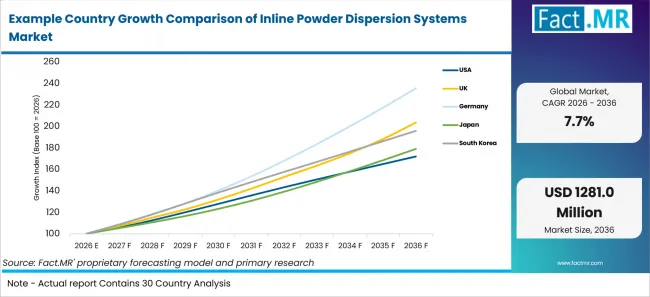
Example Country Growth Comparison Of Inline Powder Dispersion Systems Market | Source: Fact.MR
| Country | 2026 Share | CAGR (2026-2036) |
|---|---|---|
| Germany | 21.0% | 7.6% |
| United States | 23.0% | 9.0% |
| Italy | 16.0% | 7.9% |
| Japan | 14.0% | 7.7% |
| United Kingdom | 14.0% | 8.9% |
| South Korea | 12.0% | 9.8% |
Source: Fact.MR analysis. Updated Aug 20, 2026
What is driving Germany's growth through 2036?
Demand in Germany is projected to expand at 7.6% CAGR from 2026 to 2036.
Germany’s process-equipment engineering base and the presence of major food-ingredient and pharmaceutical manufacturers make it a leading European market for inline powder dispersion systems. German food processors have been early adopters of rotor-stator technology for gum and stabilizer hydration in dairy and beverage applications. The pharmaceutical sector, supported by government encouragement of continuous manufacturing, is investing in inline dispersion to replace batch-tank operations for active-ingredient processing.
What is driving growth in the United States through 2036?
Demand in the United States is projected to expand at 9.0% CAGR from 2026 to 2036.
The United States market reflects the scale of its food-processing industry, which spans dairy, beverage, bakery and nutritional products, and its pharmaceutical sector, where FDA PAT guidance on continuous manufacturing is encouraging investment in inline processing equipment. The growth of plant-protein and functional-beverage categories has created new demand for high-shear dispersion systems that can fully hydrate difficult powders such as pea protein, soy isolate and xanthan gum in a single pass.
What is driving Italy's growth through 2036?
Demand in Italy is projected to expand at 7.9% CAGR from 2026 to 2036.
Italy’s food and cosmetic manufacturing sectors create demand for inline powder dispersion systems that improve throughput and consistency. Italian food processors use rotor-stator technology for starch dissolving in pasta and baked-goods production, while the cosmetic sector employs inline emulsifying systems for creams and lotions. The market is served by a mix of domestic and international equipment suppliers.
What is driving Japan's growth through 2036?
Demand in Japan is projected to expand at 7.7% CAGR from 2026 to 2036.
Japan’s food-ingredient, pharmaceutical and cosmetic manufacturers specify inline dispersion systems with high precision and validated cleaning capability. Japanese pharmaceutical companies have been among the first in Asia to adopt continuous manufacturing for solid-dosage and liquid-formulation production, creating demand for compact, cleanable inline dispersion modules. The cosmetic sector requires rotor-stator and colloid-mill technology for premium emulsion products.
What is driving growth in the United Kingdom through 2036?
Demand in the United Kingdom is projected to expand at 8.9% CAGR from 2026 to 2036.
The United Kingdom food and beverage sector has adopted inline dispersion technology as part of energy-efficiency and throughput-improvement programs. The pharmaceutical and nutraceutical contract manufacturing segment, which serves both domestic and export markets, is a growing user of inline powder dispersion for multi-product facilities where rapid changeover between campaigns is essential.
What is driving South Korea's growth through 2036?
Demand in South Korea is projected to expand at 9.8% CAGR from 2026 to 2036.
South Korea has invested substantially in functional-food, cosmetic-ingredient and biopharmaceutical manufacturing infrastructure, creating demand for advanced inline powder dispersion systems. The Korean cosmetics industry, a global exporter of skincare and haircare products, requires high-shear rotor-stator and colloid-mill technology for emulsion and dispersion processes. Capacity expansion in food-ingredient processing for both domestic and export markets is driving purchases of mid-to-high-capacity inline dispersion systems.
Who leads the Inline Powder Dispersion Systems Market?
ystral, Silverson Machines and IKA fit where powder induction connects with high-shear dispersion and production-scale processing. Admix and SPX FLOW add relevance where sanitary design and integration with broader food, beverage and pharmaceutical process lines influence equipment selection.
The supplier base includes focused mixing specialists alongside diversified process-equipment companies. ystral, Silverson Machines and IKA offer inline high-shear systems across laboratory, pilot and production scales, allowing processors to evaluate formulations before moving to commercial throughput.
Admix focuses on sanitary inline mixing for food and beverage processing, while SPX FLOW supplies dispersion technology within broader process systems. Quadro Engineering participates through high-shear dispersion and particle-size-control equipment used where controlled powder incorporation is required.
Supplier selection depends on powder-induction rate, dispersion quality, cleaning access and integration with process controls. Buyers commonly evaluate equipment with their own powders and liquid formulations because wetting behaviour, shear sensitivity and air entrainment can change materially between formulations even when nominal processing requirements appear similar.
Which companies are the key providers?
Key Companies Ystral; Silverson Machines; IKA; Admix; SPX FLOW; Quadro Engineering.
- ystral
- Silverson Machines
- IKA
- Admix
- SPX FLOW
- Quadro Engineering
Bibliography
- U.S. Food and Drug Administration. Guidance for Industry: PAT - A Framework for Innovative Pharmaceutical Development, Manufacturing, and Quality Assurance.
- European Medicines Agency. Guideline on process validation for finished products.
- European Hygienic Engineering & Design Group. Hygienic design guidance for liquid-food processing equipment.
- 3-A Sanitary Standards, Inc. Sanitary standards for mixing and blending equipment.
- ystral. Conti-TDS inline powder wetting and dispersion system documentation.
- ystral. Coflow powder induction and dispersion technology documentation.
- Silverson Machines. High-shear inline mixer technical documentation.
- IKA. Process-pilot and inline dispersion system documentation.
- Admix. Sanitary inline high-shear mixing equipment documentation.
- SPX FLOW. APV inline mixing and dispersion systems.
- Quadro Engineering. High-shear dispersion and particle-size-control equipment.
This Report Answers
- The report evaluates technology, application and end-use demand for continuous powder-to-liquid processing.
- It distinguishes rotor-stator dispersion from vacuum induction, eductor systems and colloid-mill configurations.
- The country outlook links growth to food formulation, pharmaceutical processing and advanced cosmetic manufacturing.
- Supplier analysis reviews scale-up support, sanitary design and the ability to integrate dispersion with automated process lines.
- The scope separates inline powder wetting and dispersion from general tank agitators, dry blenders and unrelated milling equipment.
What does the Inline Powder Dispersion Systems Market cover?
Inline powder dispersion systems that introduce and disperse dry powders into a liquid stream in a single pass, including high-shear rotor-stator, vacuum induction, eductor/venturi and colloid mill configurations.
Dissolving, emulsifying, slurry-making and gum-hydrating applications across food and beverage, pharmaceutical, cosmetic, chemical, and paints and inks end-use industries.
What is included in the scope?
Factory-assembled inline dispersion systems sold to industrial end users for production-line use.
Integrated vacuum powder-induction modules, CIP-compatible dispersion heads, and process-automation interfaces sold with the dispersion system.
What is excluded from the scope?
Batch-tank top-entry mixers, portable stirrers, and laboratory-scale dispersion units not designed for continuous production.
Aftermarket spare parts, service contracts, and standalone powder-handling equipment sold separately from the dispersion system.
How Was the Analysis Built?
The market boundary is built around systems that introduce and disperse dry powder into a flowing liquid stream as a defined inline operation.
- Primary Research: Interviews focus on formulation engineers, production managers and process-equipment buyers who evaluate powder wetting, shear history and cleaning performance.
- Secondary Research: Regulatory guidance on pharmaceutical processing, hygienic-design standards and official equipment documentation support the application review.
- Market Sizing and Forecasting: System demand is estimated from technology mix, powder-processing intensity, end-use investment and the installed shift from batch tanks toward inline operation.
- Validation and Updates: Shares, country growth and supplier capabilities are reconciled independently, and references to laboratory-only mixers or standalone powder conveyors are excluded.
Segmentation
What is the report's scope and coverage?
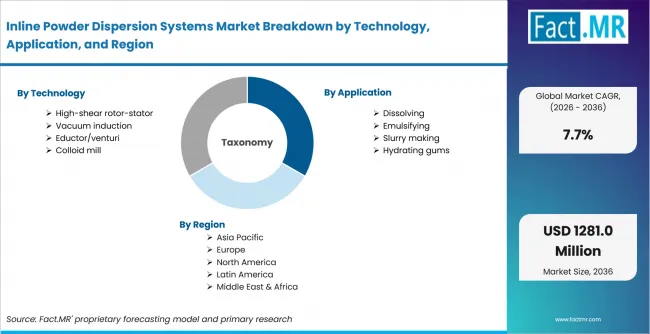
Inline Powder Dispersion Systems Market Breakdown By Technology, Application, And Region | Source: Fact.MR
| Attribute | Details |
|---|---|
| Quantitative Units | USD Million |
| Market Definition | Inline high-shear systems that wet, disperse and dissolve powders into liquids in a single pass, reducing dust and lump formation in continuous processes. |
| Segments Covered | Technology; Application; End-Use Industry |
| Regions Covered | North America; Latin America; Europe; East Asia; South Asia and Oceania; Middle East and Africa |
| Countries Covered | Germany; United States; Italy; Japan; United Kingdom; South Korea |
| Key Companies Profiled | ystral; Silverson Machines; IKA; Admix; SPX FLOW; Quadro Engineering |
| Forecast Period | 2026 to 2036 |
| Base Year | 2025 |
| Market Value, 2026 | USD 610 million |
| Market Value, 2036 | USD 1,281 million |
| CAGR, 2026-2036 | 7.7% |
| Absolute Opportunity | USD 671 million |
| Approach | System demand is estimated from technology mix, powder-processing intensity, end-use investment and the installed shift from batch tanks toward inline operation. |
Source: Fact.MR analysis. Updated Aug 20, 2026
How is the market segmented?
-
By Technology:
- High-shear rotor-stator
- Vacuum induction
- Eductor/venturi
- Colloid mill
-
By Application:
- Dissolving
- Emulsifying
- Slurry making
- Hydrating gums
-
By End-Use Industry:
- Food & beverage
- Pharmaceuticals
- Cosmetics
- Chemicals
- Paints & inks
Frequently Asked Questions
What is the Inline Powder Dispersion Systems Market value in 2026?
At what CAGR is the market projected to grow?
What is the projected market value by 2036?
Which Technology category has the leading share?
Which Application category has the leading share?
Which End-Use Industry category has the leading share?
What CAGR is projected for South Korea?
Which companies are assessed?
Who worked on this report


Preview the report firsthand - request a free sample
Free SampleGet the brochure for pricing and purchase details
Download PDF