- Market Value (2025): USD 13.7 Bn
- Estimated Value (2026): USD 15.2 Bn
- Forecast Value (2036): USD 41.9 Bn
- CAGR (2026-2036): 10.7%
What is the Asset Management Enterprise Resource Planning Market forecast to be worth by 2036?
USD 15.2 billion in 2026 to USD 41.9 billion by 2036 at 10.7% CAGR.
- The asset management enterprise resource planning market crossed a valuation of USD 13.7 billion in 2025.
- Demand is projected to reach from USD 15.2 billion in 2026 to USD 41.9 billion by 2036 as multi-site operators replace fragmented maintenance systems with enterprise platforms.
- The market is forecast to record 10.7% CAGR from 2026 to 2036 as lifecycle control and predictive maintenance gain budget priority.
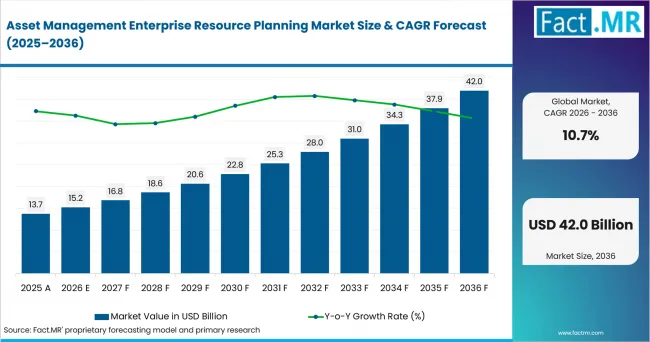
Asset Management Enterprise Resource Planning Market Value Analysis | Source: Fact.MR
What are the defining numbers behind Asset Management Enterprise Resource Planning Market growth?
USD 41.9 billion market by 2036, led by enterprise asset management software and asset lifecycle management alongside manufacturing demand.
- Demand Drivers in the Market
- Manufacturers need one operating record for equipment and spare parts so downtime costs can be seen before production plans are revised.
- Utilities and infrastructure operators need inspection history beside capital planning when repair or replacement decisions are reviewed.
- Transportation and healthcare organizations require auditable work execution since asset availability affects safety and service continuity.
- Key Segments Analyzed
- By ERP Asset Management Solution: Enterprise Asset Management Software is expected to hold 39% share in 2026 as preventive and predictive maintenance remain the core operating layer for buyers.
- By Business Function: Asset Lifecycle Management is projected to account for 37% share in 2026 as buyers use equipment reliability to guide investment decisions.
- By Industry Vertical: Manufacturing is anticipated to capture 40% share in 2026 owing to the direct relationship between equipment uptime and production output.
- By End User: Large Enterprises are estimated to represent 45% share in 2026 because global manufacturers manage complex combinations of assets and sites.
- By Deployment Model: Cloud-based ERP is forecast to hold 41% share in 2026 as cloud release cycles reduce local infrastructure burden.
- Analyst Opinion at Fact.MR
- Shambhu Nath Jha, Senior Consultant at Fact.MR, states, “Asset management ERP is purchased when maintenance decisions need financial and compliance context. Winning platforms preserve asset hierarchy and work history through implementation.”
- Strategic Implications
- ERP providers should prove how maintenance and fixed-asset accounting stay synchronized after configuration changes or acquisitions.
- Asset owners can improve implementation results by cleaning hierarchy design and failure codes before software deployment begins.
- Implementation partners should separate global controls from local execution rules so plants and field teams can use one platform without identical workflows.
The USA leads at 11.8% CAGR through enterprise software adoption and multi-site asset depth. Germany follows at 11.4% as industrial lifecycle governance shapes buying. Japan reaches 11.0% through legacy-system renewal. The UK records 10.6% through infrastructure renewal. Canada reaches 10.1% through public-asset governance. Australia records 9.7% through distributed infrastructure. Singapore reaches 9.2% through secure cloud-service expectations.
How does the Asset Management Enterprise Resource Planning Market break down by segment?
Enterprise Asset Management Software leads ERP Asset Management Solution at 39% share in 2026. Asset Lifecycle Management is projected to lead Business Function at 37% share in 2026.
Which ERP Asset Management Solution dominates?
Enterprise Asset Management Software holds 39% share in 2026.
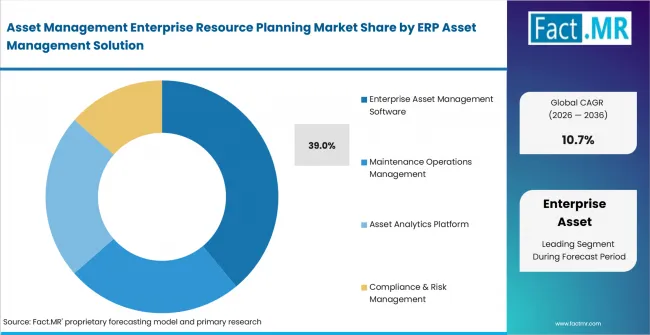
Asset Management Enterprise Resource Planning Market Analysis By Erp Asset Management Solution | Source: Fact.MR
Enterprise Asset Management Software gives maintenance teams a common record for work planning and inspection. SAP describes S/4HANA Asset Management around maintenance planning and execution. IBM Maximo gives the same buying discussion a reliability and lifecycle frame. Maintenance Operations Management follows when work orders and spare parts are the first budget items.
What leads the Business Function segment?
Asset Lifecycle Management accounts for 37% share in 2026.
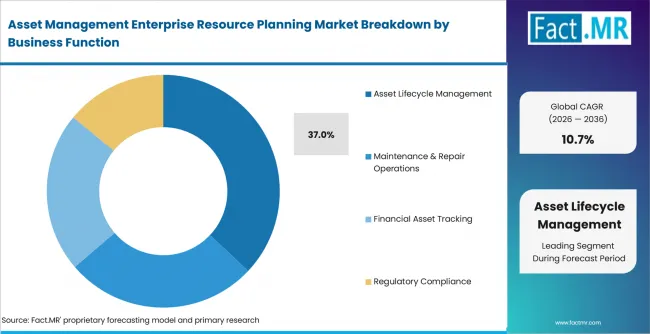
Asset Management Enterprise Resource Planning Market Analysis By Business Function | Source: Fact.MR
Asset Lifecycle Management leads when companies want asset history to guide replacement timing. Maintenance & Repair Operations turn that plan into schedules and field work. Financial Asset Tracking brings depreciation and capital planning into the same decision cycle.
Why does Manufacturing lead Industry Vertical demand?
Manufacturing holds 40% share in 2026.
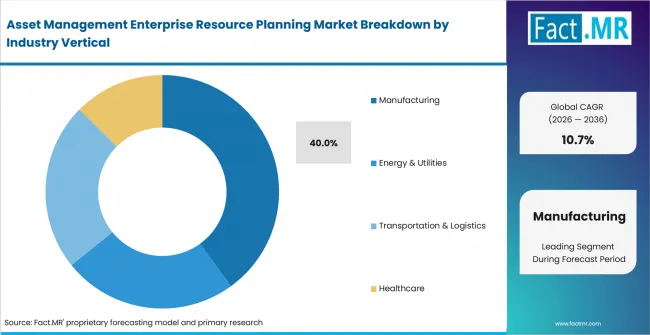
Asset Management Enterprise Resource Planning Market Analysis By Industry Vertical | Source: Fact.MR
Manufacturing leads since equipment downtime can interrupt production and raise working-capital pressure. Oracle maintenance cloud covers assets and work orders inside a cloud supply-chain environment. These product structures suit plants that need maintenance activity to inform production and cost control.
Why do Large Enterprises lead End User demand?
Large Enterprises lead with 45% share in 2026.
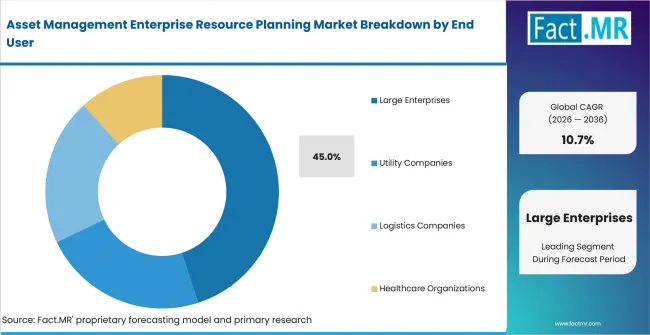
Asset Management Enterprise Resource Planning Market Analysis By End User | Source: Fact.MR
Large Enterprises lead when the asset record must work across plants and business units. Global Manufacturers need shared templates for maintenance history and role controls. Utility Companies need evidence across infrastructure networks.
What supports Cloud-based ERP within Deployment Model?
Cloud-based ERP holds 41% share in 2026.
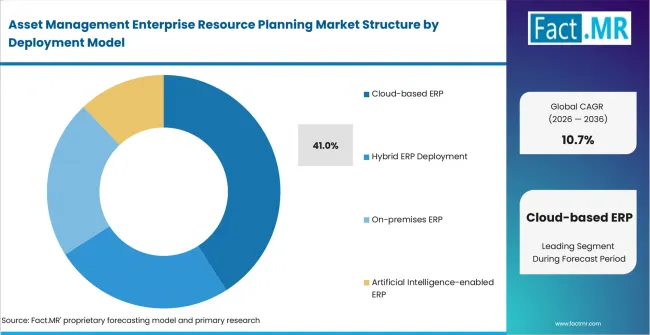
Asset Management Enterprise Resource Planning Market Analysis By Deployment Model | Source: Fact.MR
Cloud-based ERP leads because public cloud deployment and private cloud deployment give multi-site operators a common release path. Mobile execution and embedded recommendations are also becoming important parts of routine cloud ERP evaluation.
What is accelerating Asset Management Enterprise Resource Planning Market adoption, and what is holding it back?
Integrated asset and finance workflows support adoption. Data migration and system integration slow implementation.
Drivers Impact Analysis
| DRIVER | COMMERCIAL EFFECT | GEOGRAPHIC RELEVANCE | IMPACT TIMELINE |
|---|---|---|---|
| Connected maintenance and financial records | Expands ERP attachment and renewal scope | Global asset-intensive enterprises | Current forecast period |
| Predictive maintenance and asset health analytics | Creates analytics and service attachment | USA, Germany and Japan | Medium term |
| Auditability and lifecycle governance | Raises demand for controlled workflows | Europe, Canada and public infrastructure | Current forecast period |
| Cloud standardization across distributed sites | Supports multi-site rollout and subscriptions | North America, Europe and Asia Pacific | Medium term |
| Capital planning for aging assets | Uses maintenance evidence in investment decisions | Utilities, transport and healthcare systems | Medium to long term |
Source: Fact.MR analysis. Updated Aug 6, 2026
- Enterprise workflow control: A maintenance event can reserve inventory and change the financial view of an asset. Buyers prefer platforms that pass the same asset identity across operations and finance.
- Lifecycle governance: Organizations need controlled hierarchies and approval paths. Demand is strongest when an asset decision must be defensible to auditors or public stakeholders.
Opportunity Impact Analysis
| OPPORTUNITY | COMMERCIAL EFFECT | GEOGRAPHIC RELEVANCE | IMPACT TIMELINE |
|---|---|---|---|
| Artificial intelligence-enabled maintenance decisions | Adds prediction and automated triage | USA, Japan and Germany | Short to medium term |
| Composable EAM integration with core ERP | Allows phased modernization without full replacement | Global installed ERP estates | Medium term |
| Mobile and offline technician execution | Extends licensed use into field work | Utilities, transport and remote operations | Current forecast period |
| Industry-specific asset models and controls | Supports higher-value configurations | Manufacturing, energy, transport and healthcare | Medium to long term |
Source: Fact.MR analysis. Updated Aug 6, 2026
- Governed AI in maintenance: Practical demand is concentrated in recommendations that preserve approval controls.
- Phased modernization: Many enterprises cannot replace finance and maintenance systems at the same time.
Restraints Impact Analysis
| RESTRAINT | COMMERCIAL EFFECT | GEOGRAPHIC RELEVANCE | IMPACT TIMELINE |
|---|---|---|---|
| Inconsistent asset hierarchies and maintenance history | Delays migration and weakens analytics | Global legacy estates | Current forecast period |
| Complex integration with plant and financial systems | Extends implementation and testing cycles | Manufacturing, utilities and transport | Medium term |
| Cybersecurity and availability requirements | Limits deployment choices and raises control cost | Public sector and regulated industries | Current forecast period |
| Technician adoption and workflow mismatch | Reduces data quality and operating benefit | Distributed field organizations | Medium term |
Source: Fact.MR analysis. Updated Aug 6, 2026
- Master-data and migration burden: Asset names and failure codes often differ by site or acquired company. Buyers must fund cleansing work before analytics can be trusted.
- Operational control and adoption: Maintenance software is used during shutdowns and field work. A process built only for headquarters reporting can fail when technicians face extra steps.
Which countries are scaling Asset Management Enterprise Resource Planning Market fastest?
- The country comparison spans 2.6 percentage points across the forecast period.
- The USA stays 0.4 point above Germany through installed assets and enterprise software depth.
- Germany stays 0.4 point above Japan through industrial lifecycle governance.
- Japan stays 0.4 point above the UK through legacy-system renewal.
- The UK stays 0.5 point above Canada through infrastructure renewal.
- Canada stays 0.4 point above Australia through public-asset governance.
- Australia stays 0.5 point above Singapore through distributed infrastructure.
Comparable CAGRs can create different entry conditions as asset intensity and cloud readiness vary. Full report coverage includes North America; Europe; Asia Pacific; Central and South America; Middle East and Africa.
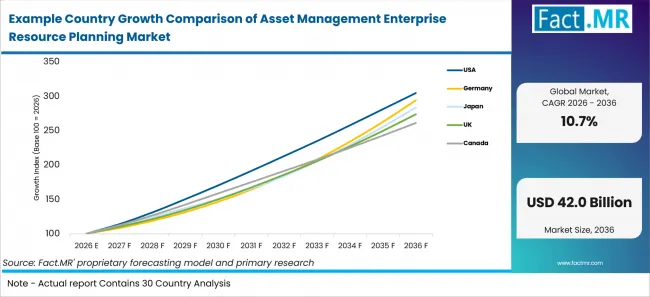
Example Country Growth Comparison Of Asset Management Enterprise Resource Planning Market | Source: Fact.MR
| Country | CAGR (2026-2036) |
|---|---|
| USA | 11.8% |
| Germany | 11.4% |
| Japan | 11.0% |
| UK | 10.6% |
| Canada | 10.1% |
| Australia | 9.7% |
| Singapore | 9.2% |
Source: Fact.MR analysis. Updated Aug 6, 2026
What supports USA adoption?
11.8% CAGR, supported by a large installed asset base and broad enterprise software adoption.
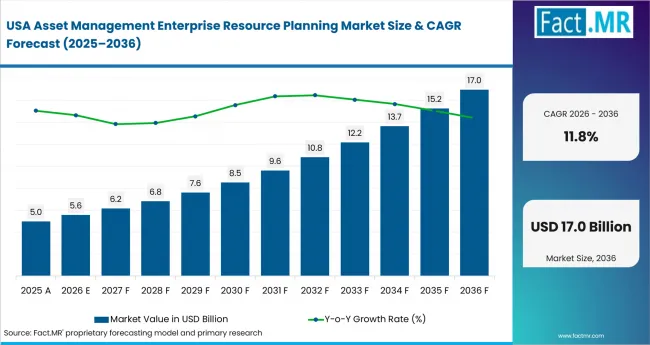
Asset Management Enterprise Resource Planning Market Country Value Analysis | Source: Fact.MR
USA buyers often evaluate asset management ERP through the lens of multi-site control. Plants and service networks need work history to support finance and inventory decisions. That makes migration depth and integration support decisive before a platform moves from pilot use to broader rollout.
How is Germany scaling demand?
11.4% CAGR, led by manufacturing depth and rigorous lifecycle governance.
German industrial buyers place high value on reliability evidence before changing core operating systems. Asset management ERP fits that environment when equipment records and supplier data move across plants without losing context.
What supports Japan's outlook?
11.0% CAGR, shaped by enterprise transformation and legacy-system renewal.
Japan’s route to adoption is shaped by careful process control and long equipment lifecycles. Buyers need software that protects asset history during renewal work. Supplier preference is expected to depend on service discipline and the ability to keep local operating knowledge intact.
How is the UK developing demand?
10.6% CAGR, supported by infrastructure renewal and stronger controls over legacy technology.
The UK market advances where utilities and public-service operators need clear asset records. Audit trails and role permissions matter during system review. Finance-system integration can decide whether a maintenance platform is approved as an enterprise program.
What is shaping Canada's growth?
10.1% CAGR, backed by public-asset governance and lifecycle planning.
Canada’s demand is shaped by asset owners that need a clearer view of condition and risk. Clean master data comes first in these projects. Once records are reliable, enterprise reporting and capital planning become easier to defend.
Why is Australia expanding Asset Management ERP use?
9.7% CAGR, led by capital-intensive operations and distributed infrastructure requirements.
Australia’s asset environment covers remote and high-value operating sites. Maintenance teams need mobile work execution and parts planning that can support distance and downtime risk. Cloud and hybrid models are expected to help buyers compare asset performance across locations.
How is Singapore building demand?
9.2% CAGR, driven by regional headquarters operations and secure cloud-service expectations.
Singapore’s demand is concentrated in compact but highly governed technology estates. Infrastructure operators and regional headquarters need standardized data handling across subsidiaries. Secure cloud operation is expected to guide supplier selection during platform renewal.
Who leads the Asset Management Enterprise Resource Planning Market?
SAP and Oracle anchor the market through integrated asset, maintenance and finance workflows, while IBM adds strong reliability and lifecycle management depth.
Infor and Microsoft support multi-site planning, mobile execution and connected operations. IFS and Hexagon extend industry-specific asset control. Ramco Systems, Aptean and Hitachi Digital Services broaden competition through cloud deployment, analytics, implementation support and enterprise modernization capabilities globally.
Which companies are the key providers?
Key companies include SAP SE; Oracle Corporation; IBM Corporation; Infor Inc.; Microsoft Corporation; IFS AB – IFS CLOUD AND IFS ULTIMO; Hexagon AB; Ramco Systems Limited; Aptean, Inc.; and Hitachi Digital Services LLC.
- SAP SE
- Oracle Corporation
- IBM Corporation
- Infor Inc.
- Microsoft Corporation
- IFS AB – IFS CLOUD AND IFS ULTIMO
- Hexagon AB
- Ramco Systems Limited
- Aptean, Inc.
- Hitachi Digital Services LLC
Bibliography
- IFS. (2026, June 30). IFS Cloud 26R1 elevates Enterprise Asset Management with safer, standardized work. IFS AB – IFS CLOUD AND IFS ULTIMO.
- Microsoft. (2025, July 11). Asset management overview, Dynamics 365 Supply Chain Management. Microsoft Learn.
- Microsoft. (2026, May 29). Asset Management mobile app open-source release. Microsoft Learn.
This Report Answers
- The report provides strategic intelligence on Asset Management Enterprise Resource Planning across solution and business-function choices that shape asset-intensive operating models.
- Segment analysis covers Enterprise Asset Management Software and Asset Lifecycle Management as the share leaders within the 2026 market structure. Smart manufacturing use cases are reviewed when they support asset workflows.
- Country outlook evaluates the USA and Germany alongside Japan and the UK. Canada, Australia and Singapore complete the growth comparison.
- Competitive analysis profiles SAP SE and Oracle Corporation alongside IBM Corporation and Microsoft Corporation. IFS AB – IFS CLOUD AND IFS ULTIMO and other listed providers complete the provider set.
- Deployment assessment covers cloud ERP and hybrid ERP deployment. Industrial IoT evidence is reviewed only when it supports asset workflows. On-premises and artificial intelligence-enabled ERP complete the platform view.
What does the Asset Management Enterprise Resource Planning Market cover?
ERP asset management systems are used when physical assets require one record for maintenance and financial control. Digital twin evidence is covered only when it supports asset history or maintenance decisions.
The market covers software platforms and modules used for work orders and spare parts. Asset health, audits and risk assessment are included under the same operating record. Coverage extends to cloud subscriptions and implementation services when they support a defined asset-management ERP function. Stand-alone maintenance tools are included only when they work as part of an enterprise planning environment.
What is included in the scope?
Asset-management ERP products and services are used across large enterprises and asset-intensive operating groups. Field service management workflows are counted when the same record supports technician work and ERP control.
The scope includes Enterprise Asset Management Software and Maintenance Operations Management. Asset Analytics Platforms and Compliance & Risk Management are included when they support ERP asset workflows. Licenses and SaaS subscriptions are counted when they support asset-management functions. .
What is excluded from the scope?
Financial investment management and physical asset valuation remain outside the scope of this market.
The scope excludes financial investment management and the value of physical assets themselves. General ERP and cloud hosting are excluded when no asset-management function is delivered. Cybersecurity and custom development follow the same rule. Stand-alone consulting is excluded unless it supports asset-management ERP implementation.
How Was the Analysis Built?
The analysis draws on 120+ sources, 35+ company portfolios, 25+ countries, and more than 20 industry interviews.
- Primary Research: Primary research includes discussions with manufacturers, service providers, technology developers, distributors, end users, procurement teams, and subject-matter experts. These conversations examine purchasing priorities, product adoption, operational challenges, approval requirements, competitive positioning, and the factors that influence wider market acceptance.
- Desk Research: Desk research covers government statistics, regulatory publications, company filings, trade data, technical studies, industry associations, standards, public policy, and other authoritative sources. Every source used in the analysis is documented in the bibliography.
- Market Sizing and Forecasting: Market estimates combine historical performance, demand indicators, pricing and volume trends, segment shares, company participation, country-level growth, adoption patterns, investment activity, and barriers to market expansion.
- Data Validation and Update Cycle: Findings are validated by comparing primary interviews with public data, company activity, regulatory changes, trade patterns, and industry developments. Regular updates review new product launches, capacity changes, partnerships, approvals, procurement trends, and shifts in commercial adoption.
Segmentation
What is the report’s scope and coverage?
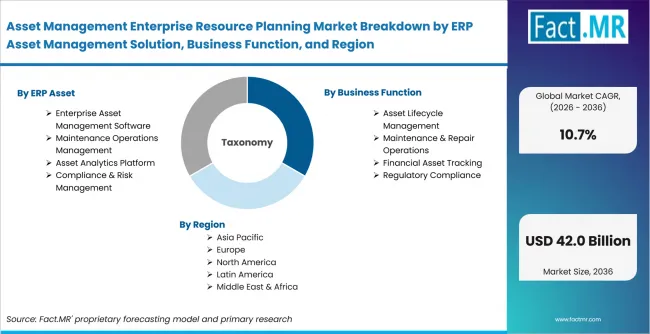
Asset Management Enterprise Resource Planning Market Breakdown By Erp Asset Management Solution, Business Function, And Region | Source: Fact.MR
| Attribute | Details |
|---|---|
| Quantitative Units | USD billion in 2026 to USD billion by 2036 at CAGR |
| Market Definition | ERP platforms and integrated applications used to plan, record, maintain, monitor and govern physical enterprise assets across their lifecycles |
| ERP Asset Management Solution | Enterprise Asset Management Software; Maintenance Operations Management; Asset Analytics Platform; Compliance & Risk Management |
| Business Function | Asset Lifecycle Management; Maintenance & Repair Operations; Financial Asset Tracking; Regulatory Compliance |
| Industry Vertical | Manufacturing; Energy & Utilities; Transportation & Logistics; Healthcare |
| End User | Large Enterprises; Utility Companies; Logistics Companies; Healthcare Organizations |
| Deployment Model | Cloud-based ERP; Hybrid ERP Deployment; On-premises ERP; Artificial Intelligence-enabled ERP |
| Regions Covered | North America; Europe; Asia Pacific; Central and South America; Middle East and Africa |
| Countries Covered | USA; Germany; Japan; UK; Canada; Australia; Singapore |
| Key Companies Profiled | SAP SE; Oracle Corporation; IBM Corporation; Infor Inc.; Microsoft Corporation; IFS AB – IFS CLOUD AND IFS ULTIMO; Hexagon AB; Ramco Systems Limited; Aptean, Inc.; Hitachi Digital Services LLC |
| Forecast Period | 2026 to 2036 |
| Approach | Hybrid top-down and bottom-up approach using ERP and EAM software adoption; asset-intensive industry activity; maintenance and lifecycle needs; deployment preferences; enterprise scale; country growth rates and provider validation |
Source: Fact.MR analysis. Updated Aug 6, 2026
How is the market segmented?
-
By ERP Asset Management Solution:
- Enterprise Asset Management Software
- Preventive Maintenance
- Predictive Maintenance
- Maintenance Operations Management
- Work Order Management
- Spare Parts Management
- Asset Analytics Platform
- Asset Utilization Analytics
- Asset Health Monitoring
- Compliance & Risk Management
- Audit Management
- Risk Assessment
- Enterprise Asset Management Software
-
By Business Function:
- Asset Lifecycle Management
- Asset Performance Monitoring
- Equipment Reliability
- Maintenance & Repair Operations
- Maintenance Scheduling
- Field Service Coordination
- Financial Asset Tracking
- Depreciation Management
- Capital Planning
- Regulatory Compliance
- Compliance Reporting
- Asset Governance
- Asset Lifecycle Management
-
By Industry Vertical:
- Manufacturing
- Discrete Manufacturing
- Process Manufacturing
- Energy & Utilities
- Power Generation
- Renewable Energy
- Transportation & Logistics
- Railways
- Aviation
- Healthcare
- Hospitals
- Medical Equipment Management
- Manufacturing
-
By End User:
- Large Enterprises
- Global Manufacturers
- Multinational Corporations
- Utility Companies
- Energy Providers
- Infrastructure Operators
- Logistics Companies
- Transportation Authorities
- Airport Operators
- Healthcare Organizations
- Public Healthcare Systems
- Government Agencies
- Large Enterprises
-
By Deployment Model:
- Cloud-based ERP
- Public Cloud Deployment
- Private Cloud Deployment
- Hybrid ERP Deployment
- Cloud-integrated ERP
- Multi-cloud Architecture
- On-premises ERP
- Local Data Center Deployment
- On-premises Integration
- Artificial Intelligence-enabled ERP
- Predictive Intelligence
- Automated Decision Support
- Cloud-based ERP
-
By Region:
- North America
- Europe
- Asia Pacific
- Central and South America
- Middle East and Africa
Frequently Asked Questions
How big is the asset management enterprise resource planning market in 2026?
What is the CAGR of the asset management enterprise resource planning market from 2026 to 2036?
Which ERP asset management solution leads the asset management enterprise resource planning market?
Which end-user segment leads the asset management enterprise resource planning market?
Who are the leading companies in the asset management enterprise resource planning market?
Who worked on this report


Preview the report firsthand - request a free sample
Free SampleGet the brochure for pricing and purchase details
Download PDF