- Forecast Value (2036): 1.6 Bn
- CAGR (2036): 14.9%
What is the autoinjector safety shields market forecast to be worth by 2036?
USD 0.4 billion in 2026 to USD 1.6 billion by 2036, at 14.9% CAGR.
- The autoinjector safety shields market crossed a valuation of USD 0.3 billion in 2025.
- Demand is expected to increase from USD 0.4 billion in 2026 to USD 1.6 billion by 2036.
- The market is forecast to record 14.9% CAGR from 2026 to 2036 as injectable biologics, GLP-1 therapies and specialty drugs move into patient self-administration.
What are the defining numbers behind autoinjector safety shields market growth?
USD 1.2 billion absolute opportunity by 2036, led by the United States and Switzerland.
- Demand Drivers in the Market
- Pharma companies need shielded devices for patient self-administration.
- Biologic developers need needle concealment to reduce injection anxiety.
- Device teams need post-use lockout to reduce accidental needle exposure.
- Home-care programs need simple safety features that reduce training burden.
- Key Segments Analyzed
- By Shield Type: Integrated Needle Safety Shrouds are expected to hold 41.0% share in 2026 because they protect users before and after injection.
- By Device Format: Disposable Two-Step Autoinjectors lead because they simplify patient handling. The share is projected at 46.0% in 2026.
- By Activation Mechanism: Push-on-Skin Activated Shields are likely to account for 38.0% share in 2026 because they combine activation and needle concealment.
- By Drug Use: Biologics and Biosimilars lead with 43.0% share in 2026 because these therapies increasingly use prefilled self-injection devices.
- By Customer Type: Pharma Combination Product Programs are expected to hold 52.0% share in 2026 because drug sponsors specify shield performance.
- By Geography: The United States is projected to record 15.1% CAGR through 2036 as home-use biologic injection expands.
- Analyst Opinion at Fact.MR
- Shambhu Nath Jha, Senior Analyst at Fact.MR, states, “Autoinjector safety shields are becoming a patient confidence feature and a device safety requirement. We see pharma teams asking for shielded platforms that reduce needle exposure through the full use cycle. Suppliers that combine shield reliability with strong human factors evidence will gain stronger access to combination product programs.”
- Strategic Implications
- Device suppliers should validate shield lockout across repeated handling conditions.
- Pharma companies should match shield design with patient dexterity needs.
- Human factors teams should test cap removal and skin activation early.
- Component makers should support shield compatibility across syringe formats.
Autoinjector safety shields include needle covers and automatic needle guards built into injection devices. The category connects with autoinjectors because needle shielding is a core part of safe self-injection design. The strongest adoption case comes from therapies where patients inject without clinical supervision.
SHL Medical stated in 2024 that the needle cover shields the needle and helps reduce needlestick injury risk before use. It also stated that the needle stays concealed until activation to improve safety and reduce patient anxiety. [1] This supports demand for shielded autoinjector platforms.
Owen Mumford states that Aidaptus keeps the needle hidden during the injection process and locks the safety shroud after injection. [3] This supports demand for safety shields that continue protection through disposal.
The United States is projected to record 15.1% CAGR through 2036 as specialty drug self-administration expands. Switzerland is expected to post 14.4% CAGR through 2036 as Ypsomed and SHL Medical support platform autoinjector development. Germany is likely to record 13.8% CAGR as Gerresheimer and pharma-device programs expand shielded device use. The United Kingdom is forecast to advance at 13.2% CAGR as Owen Mumford supports platform autoinjector adoption. France is set to record 12.9% CAGR as Nemera supports safety systems for prefilled injection devices.
How does the autoinjector safety shields market break down by segment?
Integrated Needle Safety Shrouds lead at 41.0%; Disposable Two-Step Autoinjectors lead at 46.0%.
Which shield type dominates?
Integrated Needle Safety Shrouds hold 41.0% share in 2026.
Integrated Needle Safety Shrouds are expected to hold 41.0% share in 2026 because they protect users across the injection cycle. These shrouds help keep the needle concealed before use and covered after use. The format supports patient confidence in home settings. The segment connects with subcutaneous drug delivery because many shielded autoinjectors deliver subcutaneous biologics.
Which device format dominates?
Disposable Two-Step Autoinjectors account for 46.0% share in 2026.
Disposable Two-Step Autoinjectors lead because users can remove the cap and press the device against the skin. The device format is projected to capture 46.0% share in 2026. Shielding is built into the device workflow and does not require extra user action after injection. Ypsomed’s YpsoMate platform uses push-on-skin activation and supports rigid needle shield configurations. [4]
Which activation mechanism dominates?
Push-on-Skin Activated Shields hold 38.0% share in 2026.
Push-on-Skin Activated Shields lead because the shielded nose area helps control contact with the injection site. The activation mechanism is likely to account for 38.0% share in 2026. This design can reduce confusion because the user presses the shielded device end against the skin. It also supports needle concealment until injection starts. Shield mechanics must work with springs, containers, and device activation sequences.
Which drug use dominates?
Biologics and Biosimilars lead with 43.0% share in 2026.
Biologics and Biosimilars lead because many specialty therapies are moving into home injection. The drug use category is expected to hold 43.0% share in 2026. Shielded autoinjectors help users manage injections without seeing the needle. Larger-volume biologics also need safety systems that work with stronger springs and longer injection times. The segment connects with biologics because biologic self-administration drives platform device selection.
Which customer type dominates?
Pharma Combination Product Programs hold 52.0% share in 2026.
Pharma Combination Product Programs lead because drug sponsors define device safety needs during development. The customer type is expected to hold 52.0% share in 2026. Sponsors need shield performance evidence and patient-use validation before launch. Device platforms with proven safety shrouds can reduce development risk. Autoinjector shields are evaluated as part of the full drug-device system.
What is accelerating autoinjector safety shield demand, and what is holding it back?
Home injection drives demand; device verification burden restrains adoption.
Home injection is the main driver. More specialty medicines are designed for patient use outside clinics. Safety shields reduce needle exposure and help users complete injections with less anxiety.
BD states that its safety and shielding systems use needle shielding technology for injectable drug delivery. [5] This supports demand for both active and passive shield solutions across injection formats.
Nemera states that Safe’n’Sound helps prevent needlestick injuries for healthcare professionals, patients and caregivers using prefilled syringes. [6] This supports shield demand around prefilled injection systems and self-administration workflows.
Gerresheimer’s Gx Inbeneo uses a shielded needle design before and after use. [2] This reinforces the trend toward shields that support both injection and disposal safety.
The main restraint is device verification burden. Shield force, lockout reliability and activation sequence must be tested under realistic user conditions. This adds development time before a pharma sponsor can scale a device platform.
Where do the biggest autoinjector safety shield opportunities sit?
Biologic self-injection, GLP-1 devices and large-volume autoinjectors.
- Biologic Self-Injection: Drug sponsors can use shielded platforms to support long-term home treatment.
- GLP-1 Devices: Metabolic therapy programs need user-friendly shield designs for repeat injection.
- Large-Volume Autoinjectors: Higher fill volumes need shield systems that protect users during longer injections.
Which countries are scaling autoinjector safety shields fastest?
United States 15.1%, Switzerland 14.4%, Germany 13.8%, United Kingdom 13.2%, France 12.9%.
Based on regional analysis, the autoinjector safety shields market covers North America, Western Europe, Asia Pacific, Latin America, and Middle East and Africa complete the regional scope.
| Country | CAGR |
|---|---|
| United States | 15.1% |
| Switzerland | 14.4% |
| Germany | 13.8% |
| United Kingdom | 13.2% |
| France | 12.9% |
Source: Fact.MR analysis. Updated Jun 29, 2026
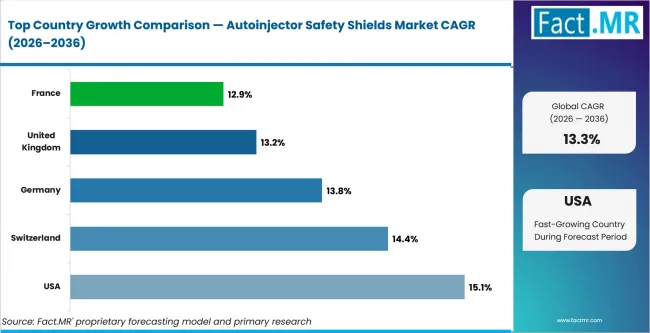
Autoinjector Safety Shields Market Cagr Analysis By Country | Source: Fact.MR
What is powering the United States lead?
15.1% CAGR, driven by BD and specialty drug self-administration.
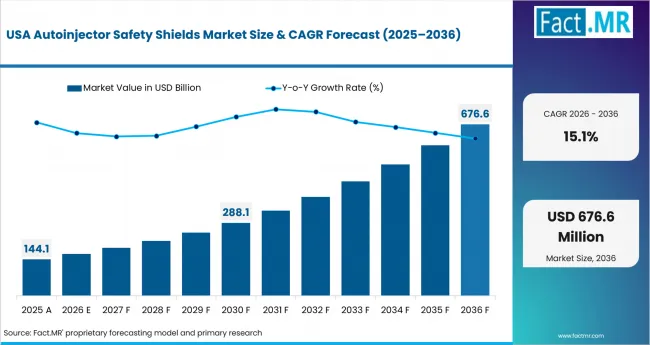
Autoinjector Safety Shields Market Country Value Analysis | Source: Fact.MR
The United States is projected to record 15.1% CAGR from 2026 to 2036 as specialty drug programs use shielded autoinjectors for home treatment. BD supports safety and shielding systems for injectable drug delivery. Pharma sponsors need platform devices that reduce needle exposure and support combination product review. Growth will favor suppliers with strong validation files.
How is Switzerland scaling autoinjector safety shield demand?
14.4% CAGR, supported by Ypsomed and SHL Medical platform development.
Switzerland is expected to post 14.4% CAGR through 2036 as autoinjector platform suppliers support biologic self-injection programs. Ypsomed supports YpsoMate platforms across 1 mL and larger-volume formats. SHL Medical supports shielded autoinjector architecture through concealed needle and needle cover designs. Growth will favor patient-friendly systems with clear completion feedback.
What supports Germany’s outlook?
13.8% CAGR, driven by Gerresheimer and biologics device programs.
Germany is likely to record 13.8% CAGR by 2036 as Gerresheimer and local pharma-device networks scale shielded injection platforms. Gx Inbeneo supports high-viscosity biologic delivery and covers the needle before and after use. German device programs need safety features that fit home-care use. Growth will favor robust platforms with clear activation behavior.
How is the United Kingdom scaling autoinjector safety shield adoption?
13.2% CAGR, led by Owen Mumford and platform autoinjector demand.
The United Kingdom is forecast to advance at 13.2% CAGR through 2036 as Owen Mumford supports platform autoinjector development. Aidaptus uses a safety shroud that locks after injection. UK device expertise supports self-injection programs for chronic therapies. Growth will favor shield designs that support easy training and disposal safety.
What underpins France’s growth?
12.9% CAGR, driven by Nemera and prefilled syringe safety systems.
France is set to record 12.9% CAGR through 2036 as Nemera supports passive safety systems for prefilled injection devices. Safe’n’Sound helps prevent needlestick injury and supports patient or caregiver use. French device suppliers can support pharma programs that need safety components and assembly expertise. Growth will favor shield systems with strong customization options.
Who leads the autoinjector safety shields market?
Ypsomed and SHL Medical lead through platform autoinjector safety design.
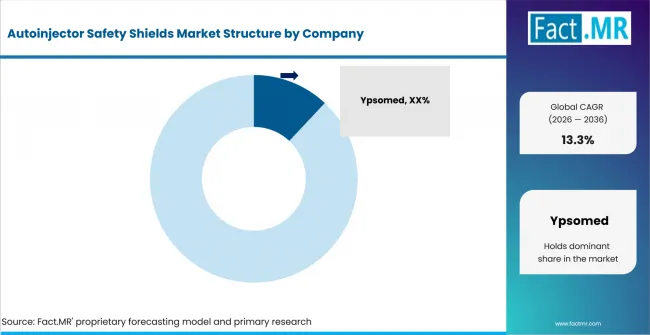
Autoinjector Safety Shields Market Analysis By Company | Source: Fact.MR
Autoinjector safety shields are supplied by autoinjector platform developers and injection safety component providers. Ypsomed leads through YpsoMate platforms with push-on-skin activation and rigid needle shield compatibility. SHL Medical supports concealed-needle systems and automatic needle guard design across autoinjector families.
Owen Mumford competes through Aidaptus and its locked safety shroud design. Gerresheimer supports Gx Inbeneo with shielded needle protection before and after use. Nemera supports passive safety systems through Safe’n’Sound. BD supports safety and shielding systems for injectable drug delivery.
Competition through 2036 will depend on shield reliability and patient handling comfort. Suppliers need strong testing support and platform flexibility. The medical polymers layer matters because shield components must perform across storage and injection conditions. The syringes layer is also relevant because shield design must fit the primary container.
Which companies are the key providers?
Ypsomed and SHL Medical are key providers. Owen Mumford and Gerresheimer are also profiled. Nemera and BD complete the company set.
- Ypsomed
- SHL Medical
- Owen Mumford
- Gerresheimer
- Nemera
- BD
Bibliography
- SHL Medical. (2024, December 11). Exploring the basics of autoinjectors. SHL Medical.
- Gerresheimer. (2024, October 22). Gerresheimer: Gx Inbeneo® wins Red Dot Award. Gerresheimer.
- Ypsomed. (2026, May 5). YpsoMate 2.25 – The 2-step large volume autoinjector. Ypsomed.
- Owen Mumford. (2026). Aidaptus® autoinjector. Owen Mumford.
- BD. (2026). Safety and shielding systems. BD.
- Nemera. (2025). Parenteral catalogue. Nemera.
This Report Addresses
- Strategic intelligence on autoinjector safety shields across shield type and activation mechanism.
- Segment analysis covering Integrated Needle Safety Shrouds and Disposable Two-Step Autoinjectors.
- Regional outlook covering the United States, Switzerland, Germany, the United Kingdom, and France.
- Competitive analysis of Ypsomed, SHL Medical, Owen Mumford, Gerresheimer, Nemera, and BD.
- Technology assessment covering automatic needle covers, safety shrouds, rigid needle shields, and post-use lockout.
- Use case assessment covering biologic self-injection, GLP-1 devices, and large-volume autoinjectors.
- Primary interviews, provider checks and official source review support the forecast.
What does the autoinjector safety shields market cover?
Needle shielding systems used inside autoinjectors and related self-injection devices.
The autoinjector safety shields market covers integrated shields that cover or isolate needles before and after injection. It includes push-on-skin shields, spring-loaded shrouds, automatic needle guards, cap-linked shields and locked disposal shields. The scope connects with self-injection devices because shield design affects patient confidence and safe handling.
The market differs from ordinary needle caps because the shield is part of the injection safety sequence. A cap protects the needle before use. A safety shield also supports activation, needle isolation and post-use lockout.
What is included in the scope?
Integrated needle shields and safety shrouds used in autoinjector platforms.
The scope includes shield mechanisms used in disposable and reusable autoinjectors. It covers shielded nose pieces, automatic safety guards and rigid needle shield interfaces. The scope also includes prefilled syringes when they are assembled into shielded autoinjector systems.
The scope includes shields used for biologics, biosimilars, GLP-1 drugs and emergency medicines. It covers design validation support and component supply when shield assemblies are sold into autoinjector programs. It also includes shielded platform devices supplied to pharma companies for combination products.
What is excluded from the scope?
Standalone syringe safety guards without autoinjector integration.
The scope excludes ordinary needle caps sold for manual syringes. It excludes hospital safety needles unless they are used in an autoinjector program. It excludes pen needles for insulin pens when no autoinjector platform is involved. It also excludes sharps containers and disposal boxes.
How was the analysis built?
100+ sources, 40+ company portfolios, 25+ countries, 20+ interviews.
- Primary Research: Primary research includes interviews with drug-device program managers and human factors specialists. It includes input from injection device suppliers and pharma packaging teams.
- Desk Research: Desk research reviews official company sources and injection safety documents. It covers autoinjector platforms, needle shielding systems and drug delivery systems used for subcutaneous medicines.
- Market-Sizing and Forecasting: Forecasting uses autoinjector program activity and shielded platform adoption. Biologic launches and prefilled syringe compatibility support the market assessment.
- Data Validation and Update Cycle: Forecasts are validated through supplier checks and device program references. Product pages and official safety feature descriptions help confirm market direction.
Segmentation
What is the report’s scope and coverage?
| Attribute | Details |
|---|---|
| Quantitative Units | USD Billion in 2026 to USD Billion by 2036 at CAGR |
| Market Definition | Needle shielding systems used inside autoinjectors and related self-injection devices |
| Shield Type | Integrated Needle Safety Shrouds; Automatic Needle Covers; Passive Safety Shields; Rigid Needle Shields; Lockout Disposal Shields |
| Device Format | Disposable Two-Step Autoinjectors; Multi-Step Autoinjectors; Large-Volume Autoinjectors; Prefilled Syringe Autoinjectors; Cartridge-Based Autoinjectors |
| Activation Mechanism | Push-on-Skin Activated Shields; Spring-Loaded Needle Guards; Cap-Removal Linked Shields; End-of-Dose Lockout Shields; Manual Shield Reset Systems |
| Drug Use | Biologics and Biosimilars; GLP-1 and Metabolic Drugs; Allergy Emergency Therapy; Autoimmune Therapy; Oncology Supportive Care |
| Customer Type | Pharma Combination Product Programs; Autoinjector Platform Developers; Contract Manufacturing Organizations; Home-Care Programs; Hospital Training Programs |
| Regions Covered | North America; Western Europe; Asia Pacific; Latin America; Middle East and Africa |
| Countries Covered | United States; Switzerland; Germany; United Kingdom; France |
| Key Companies Profiled | Ypsomed; SHL Medical; Owen Mumford; Gerresheimer; Nemera; BD |
| Forecast Period | 2026 to 2036 |
| Approach | Hybrid top-down and bottom-up approach using autoinjector platform adoption, biologic self-injection activity, shielded device programs and provider validation |
Source: Fact.MR analysis. Updated Jun 29, 2026
How is the market segmented?
-
By Shield Type:
- Integrated Needle Safety Shrouds
- Automatic Needle Covers
- Passive Safety Shields
- Rigid Needle Shields
- Lockout Disposal Shields
-
By Device Format:
- Disposable Two-Step Autoinjectors
- Multi-Step Autoinjectors
- Large-Volume Autoinjectors
- Prefilled Syringe Autoinjectors
- Cartridge-Based Autoinjectors
-
By Activation Mechanism:
- Push-on-Skin Activated Shields
- Spring-Loaded Needle Guards
- Cap-Removal Linked Shields
- End-of-Dose Lockout Shields
- Manual Shield Reset Systems
-
By Drug Use:
- Biologics and Biosimilars
- GLP-1 and Metabolic Drugs
- Allergy Emergency Therapy
- Autoimmune Therapy
- Oncology Supportive Care
-
By Customer Type:
- Pharma Combination Product Programs
- Autoinjector Platform Developers
- Contract Manufacturing Organizations
- Home-Care Programs
- Hospital Training Programs
-
Region:
- North America
- United States
- Canada
- Europe
- Switzerland
- Germany
- United Kingdom
- France
- Italy
- Asia Pacific
- Japan
- China
- South Korea
- Singapore
- India
- Latin America
- Brazil
- Mexico
- Argentina
- Middle East & Africa
- UAE
- Saudi Arabia
- South Africa
- Israel
- North America
Frequently Asked Questions
Which shield type leads the Autoinjector Safety Shields Market?
Which device format leads the Autoinjector Safety Shields Market?
Which activation mechanism leads the Autoinjector Safety Shields Market?
Which drug use leads the Autoinjector Safety Shields Market?
Which customer type leads the Autoinjector Safety Shields Market?
Which country expands fastest in the Autoinjector Safety Shields Market?
How does Switzerland perform in the Autoinjector Safety Shields Market?
How does Germany perform in the Autoinjector Safety Shields Market?
How does the United Kingdom perform in the Autoinjector Safety Shields Market?
How does France perform in the Autoinjector Safety Shields Market?
What is the primary driver in the Autoinjector Safety Shields Market?
What is the main restraint in the Autoinjector Safety Shields Market?
Why are integrated needle safety shrouds important?
Why are push-on-skin shields gaining adoption?
Who worked on this report


Preview the report firsthand - request a free sample
Free SampleGet the brochure for pricing and purchase details
Download PDF