- Market Value (2025): USD 2.8 Bn
- Estimated Value (2026): USD 2.95 Bn
- Forecast Value (2036): USD 5.06 Bn
- CAGR (2026-2036): 5.5%
What is the Automotive Automatic Seat Belt Market forecast to be worth by 2036?
USD 3.0 billion in 2026 to USD 5.1 billion by 2036 at a 5.5% CAGR.
- The valuation of the automotive automatic seat belt market was USD 2.8 billion in 2025, according to Fact.MR.
- By 2036, the market will be worth USD 5.06 billion, against USD 2.95 billion in 2026, as rear seats gain pretensioners and adaptive load limiters.
- Each crash-test upgrade adds sensors and motors to a part that was once purely mechanical, which will keep growth at a 5.5% CAGR through 2036.
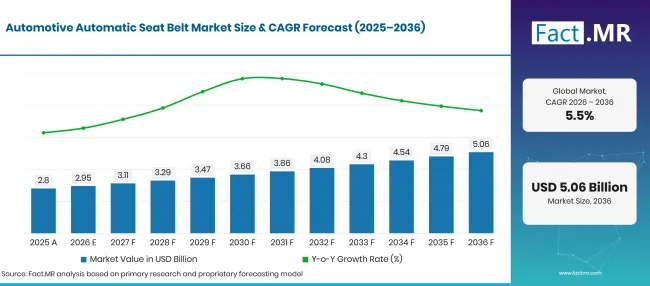
Automotive Automatic Seat Belt Market Forecast Global | Source: Fact.MR
| Year | Basis | Market Value (USD billion) |
|---|---|---|
| 2025 | Actual | 2.8 |
| 2026 | Estimate | 2.95 |
| 2036 | Forecast | 5.06 |
| CAGR 2026 to 2036 | Forecast period | 5.5% |
Source: Fact.MR analysis. Updated Oct 22, 2026
What are the defining numbers behind Automotive Automatic Seat Belt Market growth?
The 2026 to 2036 period adds USD 2.1 billion in new value, drawn mainly from OEM fitment in passenger cars.
- Demand Drivers in the Market
- Crash injury evidence keeps regulators focused on restraint hardware. The World Health Organization states that wearing a seat belt can reduce the risk of death among vehicle occupants by up to 50% [1]. Each tighter crash rule raises the content of pretensioners and limiters per car.
- Road death targets in Europe keep pressure on occupant protection. The European Commission reported that around 19,400 people died on EU roads in 2025, a 3% fall from 2024 [2]. Progress this slow pushes authorities and test bodies to ask more of belts in rear seats and in oblique crashes.
- Electric and software-defined cars are changing how belts work. Battery packs add mass, so crash pulses grow harsher and load limiters must be tuned with more care. Cabin cameras and seat sensors now feed data to belt controllers.
- Reclining seats and new cabin layouts need belts that move with the occupant. Belt-in-seat designs keep the shoulder strap in place when the seat slides or tilts.
- Replacement after a crash creates steady repair demand. A fired pyrotechnic pretensioner cannot be reset, so body shops order a new retractor or buckle assembly with each qualifying claim.
- Key Segments Analyzed
- By Technology: Retractor Pretensioners will hold 42.3% share in 2026, as nearly every front seat uses a pyrotechnic retractor that pulls in slack within milliseconds.
- By Vehicle Type: Passenger Cars will account for 67.8% share in 2026, given that cars outsell trucks and buses many times over in every listed country.
- By Sales Channel: Original Equipment Manufacturer (OEM) will capture 79.3% share in 2026 on the back of belts being validated and installed with the seat on the assembly line.
- By End-User: Private will represent 64.2% share in 2026, reflecting the size of the household car fleet next to business and fleet vehicles.
- Analyst Opinion at Fact.MR
- Shambhu Nath Jha, Principal Consultant at Fact.MR, states, “A seat belt used to be a strap and a spring, and today it is a sensor-linked device that talks to the airbag controller. Suppliers that can tune load limiting to each occupant’s size and posture will win the next round of platform awards. The aftermarket will stay modest, because a belt is replaced only after a crash or a recall.”
- Strategic Implications
- Restraint suppliers should pair pretensioners with occupant data from cameras and seat sensors, since adaptive load limiting is moving from premium models into volume platforms.
- Vehicle makers should plan rear-seat belt upgrades early in each platform cycle, given that changes to anchor points and seat frames are costly once tooling is fixed.
- Collision repair networks should stock certified retractor and buckle assemblies by model, as fired pyrotechnic units must be swapped before a car leaves the shop.
- Fleet operators should audit belt use in vans and trucks through telematics, because commercial drivers often skip the belt on short delivery stops.
Germany heads the five at 6.7% CAGR, backed by premium car output and strict crash testing. Brazil follows at 6.1% as federal rules start scoring belt reminders on new light vehicles. A 5.5% rate for the United States reflects a big pickup and SUV fleet with active belt programs. The United Kingdom grows at 4.9%, where rear-seat belt use remains a weak point. Japan rounds out the list at 4.4% with mature fitment and an aging driver base.
How does the Automotive Automatic Seat Belt Market break down by segment?
Retractor Pretensioners will lead Technology at 42.3%; Passenger Cars will top Vehicle Type at 67.8%; OEM will head Sales Channel at 79.3%; Private will hold first place in End-User at 64.2%.
Which Technology dominates?
Retractor Pretensioners take 42.3% of 2026 sales.
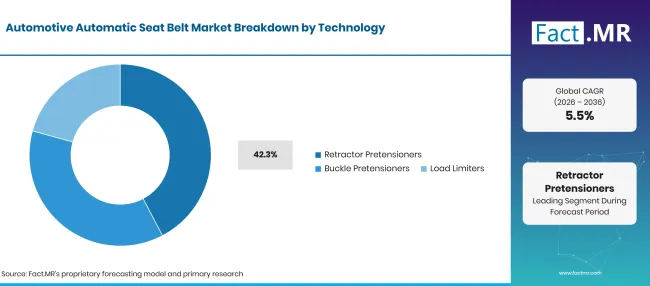
Automotive Automatic Seat Belt Market Breakdown Technology | Source: Fact.MR
| Technology | Share (2026) |
|---|---|
| Retractor Pretensioners (Leading segment) | 42.3% |
| Other segments combined | 57.7%* |
| Total | 100.0% |
Source: Fact.MR analysis. Updated Oct 22, 2026
Seat belt pretensioner technology starts at the retractor because that is where the webbing spool is mounted. A small gas charge spins the spool backward in a crash, removing slack before the body moves forward. Many suppliers now add an electric motor that pre-tightens the belt during hard braking and releases it if no crash follows, as described in Fact.MR’s pretensioners and retractors coverage. Buckle pretensioners pull the buckle down to tighten the lap belt and keep the pelvis in place. Load limiters let the webbing pay out under a set force, which lowers the risk of rib and chest injury for older occupants. Adaptive limiters switch between force levels once occupant sensing systems have classified the person in the seat.
What leads the Vehicle Type segment?
Passenger Cars make up 67.8% of 2026 sales.
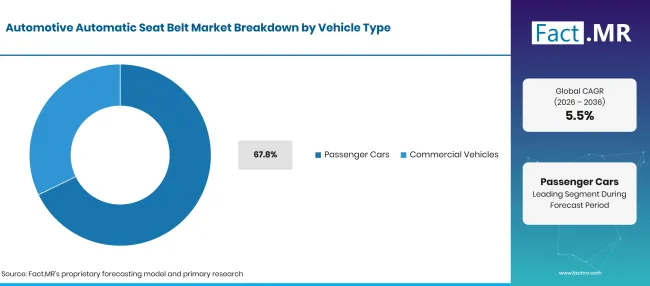
Automotive Automatic Seat Belt Market Breakdown Vehicle Type | Source: Fact.MR
| Vehicle Type | Share (2026) |
|---|---|
| Passenger Cars (Leading segment) | 67.8% |
| Other segments combined | 32.2%* |
| Total | 100.0% |
Source: Fact.MR analysis. Updated Oct 22, 2026
Passenger car seat belts are fitted to five or more seats per vehicle, and car volumes dwarf those of trucks and buses. Electrification also reshapes the car segment. The International Energy Agency reported that electric car sales exceeded 20 million in 2025, one-quarter of all new cars sold [3]. Heavier battery models need belts tuned to a different crash pulse. Commercial vehicle seat belts face rough daily use in vans, trucks and coaches. Belts in cargo vans see frequent buckling on delivery rounds. Coach operators need retractors at every passenger seat, and truck cabs use belts mounted to suspended seats.
How does Sales Channel shape demand?
OEM buyers account for 79.3% of 2026 sales.
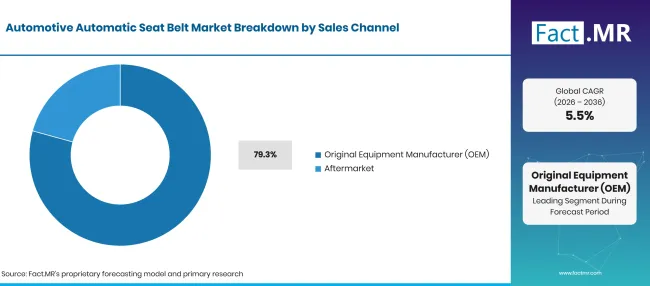
Automotive Automatic Seat Belt Market Breakdown Sales Channel | Source: Fact.MR
| Sales Channel | Share (2026) |
|---|---|
| Original Equipment Manufacturer (OEM) (Leading segment) | 79.3% |
| Other segments combined | 20.7%* |
| Total | 100.0% |
Source: Fact.MR analysis. Updated Oct 22, 2026
Original equipment seat belts are designed together with the seat, the airbag and the body structure, then tested as one system in sled and full-vehicle crashes. That joint testing ties each belt part number to a specific platform for six to eight years. Tier 1 suppliers deliver belts in sequence to the seat assembly line. Aftermarket seat belt replacement covers crash repairs, recalls and worn webbing. Insurers usually require OEM-approved parts for pretensioner swaps. Truck and bus fleets source belts through the heavy-duty aftermarket that already handles their cab and chassis parts.
What supports Private within End-User?
Private owners represent 64.2% of 2026 sales.
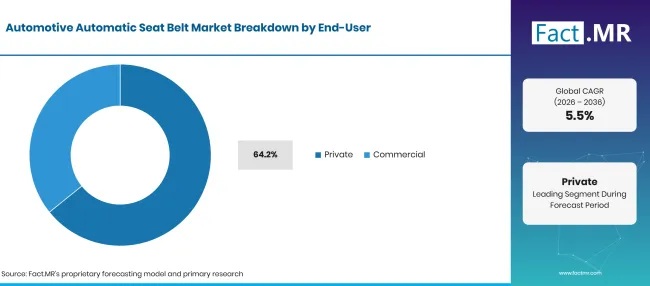
Automotive Automatic Seat Belt Market Breakdown End User | Source: Fact.MR
| End-User | Share (2026) |
|---|---|
| Private (Leading segment) | 64.2% |
| Other segments combined | 35.8%* |
| Total | 100.0% |
Source: Fact.MR analysis. Updated Oct 22, 2026
Family buyers compare crash-test stars and rear-seat protection when they choose a car. That buying habit gives vehicle makers a reason to fit pretensioners in second-row seats, where children and older parents often ride. Rear belts also anchor many baby car seats that lack ISOFIX points. Business fleets, ride-hailing drivers, delivery firms and bus operators make up commercial demand. In the United Kingdom, 4.88 million light goods vehicles were licensed for road use at the end of 2025 [4]. Fleet buyers specify belts with reminder alerts and durable webbing for drivers who buckle and unbuckle many times a day.
What is accelerating Automotive Automatic Seat Belt Market adoption, and what is holding it back?
Adoption will grow with tighter crash tests, rear-seat pretensioners and sensor-linked load limiters. Pressure on vehicle costs, low-cost belts in entry models and the long life of a belt that never fires will hold growth back.
Drivers Impact Analysis
| DRIVER | (~) % IMPACT ON CAGR | GEOGRAPHIC RELEVANCE | IMPACT TIMELINE |
|---|---|---|---|
| Stricter crash tests and belt reminder rules for all seating positions | +1.3% | Western Europe, Latin America, North America | Short term (<= 2 years) |
| Pretensioners and load limiters added to rear seats | +1.1% | Western Europe, East Asia | Medium term (2-4 years) |
| Adaptive belts linked to cabin cameras and seat sensors | +0.9% | Western Europe, North America, East Asia | Medium term (2-4 years) |
| Heavier electric vehicles requiring retuned load limiting | +0.7% | East Asia, Western Europe | Long term (>= 4 years) |
| Post-crash replacement of fired pyrotechnic units | +0.5% | North America, Western Europe | Short term (<= 2 years) |
Source: Fact.MR analysis. Updated Oct 22, 2026
Opportunity Impact Analysis
| OPPORTUNITY | (~) % IMPACT ON CAGR | GEOGRAPHIC RELEVANCE | IMPACT TIMELINE |
|---|---|---|---|
| Belt-in-seat systems for reclining and rotating seats | +0.8% | Western Europe, East Asia | Long term (>= 4 years) |
| Motorized reversible pretensioners in volume models | +0.7% | Global | Medium term (2-4 years) |
| Belt upgrades for coaches and light commercial fleets | +0.5% | Latin America, South Asia & Pacific | Medium term (2-4 years) |
Source: Fact.MR analysis. Updated Oct 22, 2026
Restraints Impact Analysis
| RESTRAINT | (~) % IMPACT ON CAGR | GEOGRAPHIC RELEVANCE | IMPACT TIMELINE |
|---|---|---|---|
| Cost pressure on entry-level vehicle platforms | -0.6% | Latin America, South Asia & Pacific | Short term (<= 2 years) |
| Long service life of belts that never deploy | -0.5% | Global | Long term (>= 4 years) |
| Recall and quality costs tied to pyrotechnic parts | -0.3% | North America, East Asia | Medium term (2-4 years) |
Source: Fact.MR analysis. Updated Oct 22, 2026
Which countries are scaling the Automotive Automatic Seat Belt Market through 2036?
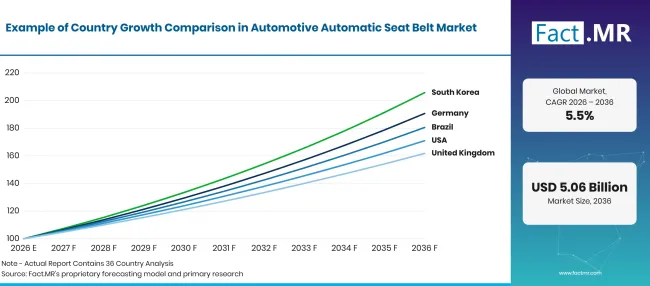
Automotive Automatic Seat Belt Market Growth Index | Source: Fact.MR
| Country | CAGR (2026 to 2036) |
|---|---|
| Germany | 6.7% |
| Brazil | 6.1% |
| United States | 5.5% |
| United Kingdom | 4.9% |
| Japan | 4.4% |
Source: Fact.MR analysis. Updated Oct 22, 2026
What supports Germany’s adoption?
6.7% CAGR, driven by premium vehicle output and demanding crash test programs.
Car seat belt demand in Germany starts with a dense fleet. Destatis reported that Germany had about 49.5 million cars on 1 January 2026, or 593 per 1,000 inhabitants [5]. Road safety has also slipped. Destatis counted 2,814 road deaths in 2025, up 44 from 2024 [6]. German premium brands often launch adaptive restraint features before they reach mass-market models.
How is Brazil scaling demand?
6.1% CAGR, backed by federal safety scoring under the Mover program.
Car safety rules in Brazil now count belt reminders toward a federal compliance index. Decree No. 12,435 of 15 April 2025 lists a driver seat belt reminder among the general safety items for light vehicles and requires full compliance with these general requirements by 1 October 2027 [7]. Later groups extend reminders to the front passenger and then to all seats [7]. Local assembly of compact cars and SUVs keeps OEM orders flowing.
What supports United States adoption?
5.5% CAGR, helped by high belt use and a fleet of heavy pickups and SUVs.
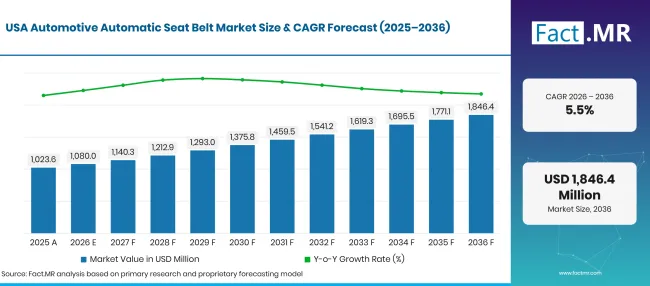
Automotive Automatic Seat Belt Market Forecast Usa | Source: Fact.MR
US seat belt use rates are high but not universal. NHTSA reported that 91.3% of adult front-seat occupants wore belts in 2025, while pickup truck occupants were belted at 85.6% [8]. A separate NHTSA early estimate put 2025 traffic deaths at 36,640, a decline of about 6.7% from 2024 [9]. Carmakers continue to add belt reminders for rear seats.
How is the United Kingdom developing demand?
4.9% CAGR, reflecting attention on rear-seat belt wearing.
UK seat belt statistics point to the rear seat as the gap. The Department for Transport’s 2025 seatbelts factsheet found that rear seat passengers had the greatest share of car occupant fatalities not wearing a belt, at 40%, using 2021 to 2025 data [10]. The UK had 42.3 million licensed vehicles at the end of 2025, a rise of 1% [4]. Replacement belts follow crash repairs under insurer approval.
How does Japan perform?
4.4% CAGR, as mature fitment rates limit new content gains.
Japan’s National Police Agency reported 2,547 traffic deaths in 2025, down 116 or 4.4% from 2024 [11]. Japanese belt makers ship retractors and buckles to domestic carmakers at home and abroad. Kei cars and compact models use simpler belt systems, though new safety features are spreading into these segments. Growth comes mainly from export platforms and rear-seat upgrades.
Who leads the Automotive Automatic Seat Belt Market?
Three groups shape supply.
Global restraint suppliers Autoliv, ZF Friedrichshafen AG and Joyson Safety Systems sell complete belt, airbag and steering wheel packages to vehicle makers on every continent. In April 2025, Autoliv presented its Omni Safety concept at the Shanghai Auto Show, combining advanced seatbelt and airbag systems for reclined occupants [12]. ZF’s passive safety unit, ZF LIFETEC, described in October 2025 its family 8 retractors with variable force limiters that adapt to each occupant’s build and posture [13]. In July 2026, ZF LIFETEC announced an infrared-visible belt webbing that cabin cameras can track, with series production from August 2026 [14]. Japanese specialists Tokai Rika and Ashimori Industry supply seat belts mainly to domestic carmakers, with Tokai Rika offering retractors with pretensioners, force limiters and motorized retraction. Securon serves the replacement and specialist vehicle trade with static and retracting belts. Integration with cabin sensing and cost per seat will set the order of suppliers through 2036.
Which companies are the key providers?
Key companies include Autoliv, Inc.; ZF Friedrichshafen AG; Joyson Safety Systems; Tokai Rika Co., Ltd.; Ashimori Industry Co., Ltd.; and Securon (Amersham) Ltd.
- Autoliv, Inc.
- ZF Friedrichshafen AG
- Joyson Safety Systems
- Tokai Rika Co., Ltd.
- Ashimori Industry Co., Ltd.
- Securon (Amersham) Ltd.
Bibliography
- [1] World Health Organization. (2026, July 20). Road traffic injuries.
- [2] European Commission. (2026, March 24). EU road deaths drop by 3% in 2025.
- [3] International Energy Agency. (2026, May). Global EV Outlook 2026: Executive summary.
- [4] Department for Transport, United Kingdom. (2026, April 29). Vehicle licensing statistics: 2025.
- [5] Statistisches Bundesamt (Destatis). (2026, July 22). Pkw-Dichte 2026 erneut gestiegen [Car density rose again in 2026].
- [6] Statistisches Bundesamt (Destatis). (2026, February 25). Unfallbilanz 2025: 44 Verkehrstote mehr als im Vorjahr [Accident report 2025: 44 more road deaths than in the previous year].
- [7] Presidency of the Republic of Brazil. (2025, April 15). Decreto nº 12.435, de 15 de abril de 2025 [Decree No. 12,435 of 15 April 2025].
- [8] National Highway Traffic Safety Administration. (2026, May). Seat Belt Use in 2025: Overall Results (DOT HS 813 799).
- [9] National Highway Traffic Safety Administration. (2026, April). Early Estimate of Motor Vehicle Traffic Fatalities and Fatality Rate in 2025 (DOT HS 813 800).
- [10] Department for Transport, United Kingdom. (2026, September 24). Reported road casualties Great Britain: fatal 4 - seatbelts factsheet, 2025.
- [11] National Police Agency, Japan. (2026, February 26). 令和7年における交通事故の発生状況について [Traffic accident situation in 2025].
- [12] Autoliv. (2025, April 25). Autoliv presents Omni Safety at 2025 Shanghai Auto Show.
- [13] ZF Friedrichshafen AG. (2025, October 6). Adaptive Restraint Systems Through Intelligent Occupant Monitoring.
- [14] ZF Friedrichshafen AG. (2026, July 23). Lifesaver with infrared signature: ZF LIFETEC makes the seat belt visible to in-cabin cameras.
This Report Answers
- How large automatic seat belt revenue will grow by 2036, and which technology carries the most value.
- Why retractor pretensioners, passenger cars, OEM fitment and private owners each lead their segment in 2026.
- How crash rules, belt use and fleet size differ across Germany, Brazil, the United States, the United Kingdom and Japan.
- Which restraint suppliers compete for platform awards, and on what product strengths.
- Where occupant sensing and new seat layouts will change belt design over the decade.
What does the Automotive Automatic Seat Belt Market cover?
Automatic seat belt systems in this study tighten and lock without any action by the occupant. They include pyrotechnic and motorized retractor pretensioners, buckle pretensioners and fixed or adaptive load limiters, along with the webbing, anchors and buckles sold as part of the assembly.
Sales are tracked for passenger cars and commercial vehicles, through OEM and aftermarket channels, and for private and commercial owners. Values are measured at the supplier selling price.
What is included in the scope?
Complete belt assemblies fitted on the vehicle line are included, as are retractors and buckles sold for crash repair. The scope draws on the wider automotive seatbelt supply base for webbing and hardware sold within these assemblies.
Belt reminder sensors and occupant classification parts are counted only when they ship inside the belt assembly. Belts for buses, coaches and truck cabs are part of commercial vehicle revenue.
What is excluded from the scope?
Purely manual belts without a pretensioner or load limiter fall outside the boundary. Airbags, airbag control units and child restraint seats are excluded, even when sold in one safety package.
Belts for aircraft, racing harnesses and off-road equipment are also excluded. Installation labor at repair shops is not counted.
How Was the Analysis Built?
The analysis draws on 120+ sources, 35+ company portfolios, 25+ countries, and more than 20 industry interviews.
- Primary Research: Primary research includes discussions with manufacturers, service providers, technology developers, distributors, end users, and subject-matter experts. These conversations examine purchasing priorities, product adoption, operational challenges, approval requirements, competitive positioning, and the factors that influence wider market acceptance.
- Desk Research: Desk research covers government statistics, regulatory publications, company filings, trade data, technical studies, industry associations, standards, public policy, and other authoritative sources. Every source used in the analysis is documented in the bibliography.
- Market Sizing and Forecasting: Market estimates combine historical performance, demand indicators, pricing and volume trends, segment shares, company participation, country-level growth, adoption patterns, investment activity, and barriers to market expansion.
- Data Validation and Update Cycle: Findings are validated by comparing primary interviews with public data, company activity, regulatory changes, trade patterns, and industry developments. Regular updates review new product launches, capacity changes, partnerships, approvals, and shifts in commercial adoption.
Segmentation
What is the report’s scope and coverage?
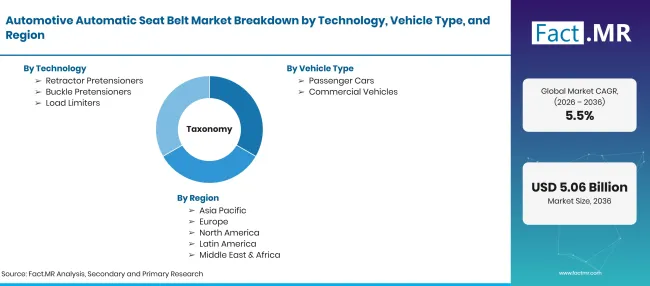
Automotive Automatic Seat Belt Market Taxonomy | Source: Fact.MR
| Attribute | Details |
|---|---|
| Quantitative Units | USD billion in 2026 to USD billion by 2036 at CAGR |
| Market Definition | Automatic seat belt systems that tighten, lock and limit load without occupant action, including retractor pretensioners, buckle pretensioners and load limiters. Revenue covers units sold to vehicle makers and to the replacement trade. |
| Technology | Retractor Pretensioners; Buckle Pretensioners; Load Limiters |
| Vehicle Type | Passenger Cars; Commercial Vehicles |
| Sales Channel | Original Equipment Manufacturer (OEM); Aftermarket |
| End-User | Private; Commercial |
| Regions Covered | North America; Latin America; Western Europe; Eastern Europe; East Asia; South Asia & Pacific; Middle East & Africa |
| Countries Covered | Germany; Brazil; United States; United Kingdom; Japan |
| Companies Profiled | Autoliv, Inc.; ZF Friedrichshafen AG; Joyson Safety Systems; Tokai Rika Co., Ltd.; Ashimori Industry Co., Ltd.; Securon (Amersham) Ltd. |
| Forecast Period | 2026 to 2036 |
| Approach | Hybrid top-down and bottom-up approach using vehicle production by type; seating positions per vehicle; pretensioner and load limiter fitment rates; crash repair and recall replacement volumes; and supplier portfolio review. |
Source: Fact.MR analysis. Updated Oct 22, 2026
How is the market segmented?
-
By Technology
- Retractor Pretensioners
- Buckle Pretensioners
- Load Limiters
-
By Vehicle Type
- Passenger Cars
- Commercial Vehicles
-
By Sales Channel
- Original Equipment Manufacturer (OEM)
- Aftermarket
-
By End-User
- Private
- Commercial
-
By Region
- North America
- Latin America
- Western Europe
- Eastern Europe
- East Asia
- South Asia & Pacific
- Middle East & Africa
Frequently Asked Questions
How big is the automotive automatic seat belt market in 2026?
What is the CAGR of the automotive automatic seat belt market from 2026 to 2036?
Which technology leads the automotive automatic seat belt market?
Which vehicle type leads the automotive automatic seat belt market?
Which sales channel leads the automotive automatic seat belt market?
Which end-user leads the automotive automatic seat belt market?
Which country will grow the most in the automotive automatic seat belt market?
Who are the main companies in the automotive automatic seat belt market?
Who worked on this report


Preview the report firsthand - request a free sample
Free SampleGet the brochure for pricing and purchase details
Download PDF