- Base Value(2025): 118 Bn
- Estimated Value(2026): 125.9 Bn
- Forecast Value (2036): 240.8 Bn
- CAGR (2026 - 2036): 6.7%
Cargo Vans Market Forecast and Outlook 2026 to 2036
In 2025, the cargo vans market was valued at USD 118 billion. Based on Future Market Insights’ analysis, demand for cargo vans is estimated to grow to USD 125.9 billion in 2026 and USD 240.8 billion by 2036. FACT.MR projects a CAGR of 6.7% during the forecast period.
FACT.MR analysis indicates that the cargo vans market is expected to generate an absolute dollar opportunity of USD 114.9 billion between 2026 and 2036. This substantial expansion reflects the continued scaling of last-mile delivery fleets worldwide, rising urban logistics demand fueled by e-commerce, and accelerating adoption of electric cargo vans in markets with strict emissions regulations.
Market growth will also be influenced by structural challenges such as volatility in battery-grade raw material costs, high upfront acquisition costs of electric vans that constrain fleet conversion in price-sensitive regions, and urban access regulations that create uneven demand across vehicle weight classes.
infrastructure investment. China leads at 9.2% CAGR, driven by rapid e-commerce platform growth and strong EV cargo van incentives from local government fleet replacement schemes. India follows at 8.7%, supported by expanding urban logistics demand from Flipkart, Amazon India, and Zomato last-mile delivery fleet procurement. Germany posts 8.0% as urban zero-emission zone regulations and corporate fleet electrification commitments accelerate electric van replacement cycles. France grows at 7.5% tied to Paris Metropole low-emission zone enforcement and La Poste fleet electrification investment. The United Kingdom posts 7.0% driven by ULEZ expansion and Royal Mail’s large-scale electric van rollout. The United States grows at 6.4%, the most mature market, driven by Amazon Delivery Service Partner fleet electrification and USPS electric vehicle procurement.
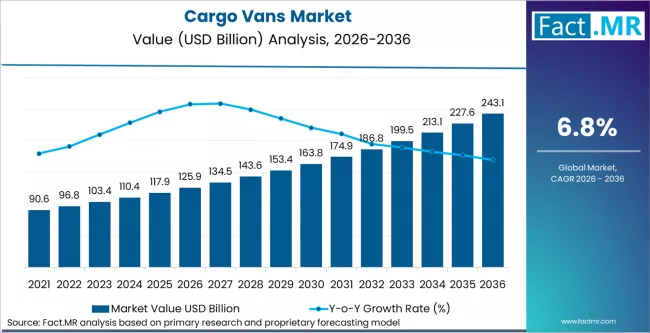
Cargo Vans Market Market Value Analysis | Source: Fact.MR
| Metric | Value |
|---|---|
| Estimated Value in 2026 | USD 125.9 billion |
| Forecast Value in 2036 | USD 240.8 billion |
| Forecast CAGR (2026 to 2036) | 6.8% |
Source: Fact.MR analysis. Updated Mar 11, 2026
Cargo Vans Market Definition
The cargo vans market covers light commercial vehicles designed primarily for the transport of goods and cargo, ranging from below 2-ton to above 3-ton payload configurations. Cargo vans serve e-commerce last-mile delivery, urban freight, trade services, postal and courier operations, and commercial fleet applications.
Cargo Vans Market Inclusions
Includes global and regional revenue forecasts from 2026 to 2036 by propulsion type, tonnage capacity, and end use. Covers commercial and personal end use segments, ICE and electric propulsion, and all major payload classes across North America, Europe, Asia Pacific, Latin America, and Middle East and Africa.
Cargo Vans Market Exclusions
Excludes heavy commercial trucks, pickup trucks, and passenger minivans not configured for cargo use. Excludes refrigerated van superstructures, aftermarket van conversions, and purpose-built ambulance or specialist utility vehicles derived from van platforms but not sold as cargo-configured units.
Cargo Vans Market Research Methodology
- Primary Research: Interviews with fleet procurement managers at logistics operators, automotive OEM commercial vehicle sales teams, last-mile delivery platform operators, and government fleet procurement officials across Asia Pacific, Europe, and North America.
- Desk Research: Sources include OEM annual reports, national vehicle registration data, EU zero-emission vehicle regulations, U.S. EPA commercial vehicle standards, e-commerce platform logistics disclosures, and fleet electrification programme announcements from 2024 to 2025.
- Market Sizing and Forecasting :A hybrid top-down and bottom-up model using registered commercial vehicle volumes, average selling prices by propulsion and tonnage class, fleet renewal cycles, and electrification adoption rate forecasts by region.
- Data Validation and Update Cycle: Outputs validated against OEM revenue disclosures, national vehicle registration databases, e-commerce logistics fleet data, and government zero-emission vehicle target timelines with annual forecast updates.
Cargo Vans Market Summary
- Market Definition
- Cargo vans are light commercial vehicles engineered for goods transport across last-mile delivery, trade, postal, and urban freight applications, available in ICE and electric drivetrains across multiple payload classes.
- Demand Drivers
- E-commerce platform growth in China, India, and Southeast Asia is generating sustained first-time cargo van fleet procurement by logistics operators and delivery service partners expanding urban last-mile coverage.
- European urban low-emission and zero-emission zone regulations are compelling fleet operators to accelerate replacement of diesel cargo vans with electric alternatives to maintain city centre access rights.
- National postal and logistics operator fleet electrification commitments, including USPS, Royal Mail, La Poste, and Deutsche Post DHL, are creating large-scale electric cargo van procurement waves through 2036.
- Key Segments Analyzed
- By Propulsion: ICE cargo vans hold approximately 60% share in 2026 due to established fuelling infrastructure, longer range capability, and lower upfront cost compared to electric alternatives.
- By Tonnage Capacity: 2 to 3 ton vans dominate at approximately 62.5% share in 2026, representing the optimal payload balance between urban maneuverability and last-mile delivery capacity.
- By End Use: Commercial use leads at approximately 59% share in 2026, driven by logistics operator demand, e-commerce delivery fleet requirements, and trade services procurement.
- By Geography: Asia Pacific leads growth through e-commerce expansion and fleet modernization.
- Analyst Opinion at FACT.MR
- Shambhu Nath Jha, Principal Consultant at Future Market Insights, opines that CXOs will find the market shaped by a dual growth engine of Asia Pacific e-commerce fleet expansion and European electric van replacement cycles, with electric propulsion share rising sharply from 2028 onward.
- Strategic Implications
- OEMs should accelerate electric cargo van platform development in the 2-to-3-ton segment and build charging infrastructure partnerships with fleet operators to address total cost of ownership concerns blocking fleet conversion.
- Fleet operators in China and India should establish multi-OEM preferred supplier agreements to secure electric van allocation as production capacity ramps and model availability tightens through 2027.
- Companies should engage directly with European municipal governments and logistics platform operators to co-develop urban charging depot solutions that reduce range anxiety barriers to full ICE-to-electric fleet conversion.
- Methodology
- Market sizing used registered commercial van volumes and average selling prices by propulsion and payload class, validated against OEM commercial vehicle revenue segments and national vehicle registration data.
- EU zero-emission zone regulations, U.S. EPA commercial vehicle standards, and national fleet electrification programme announcements from 2024 to 2025 supported compliance demand analysis.
- Forecasts incorporated e-commerce logistics fleet data, postal operator electrification timelines, vehicle registration statistics, and primary interviews with fleet procurement managers and logistics operators.
Segmental Analysis
Cargo Vans Market Analysis by Propulsion
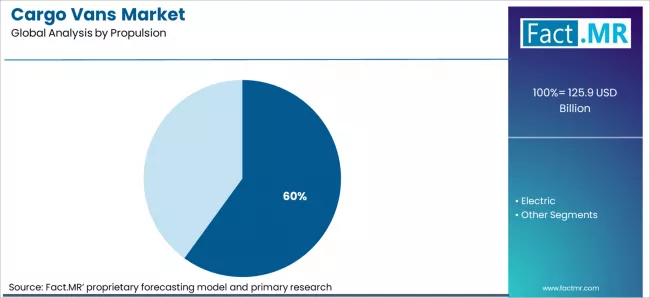
Cargo Vans Market Analysis By Propulsion | Source: Fact.MR
Based on FACT.MR’s cargo vans market report, ICE cargo vans are estimated to hold approximately 60% share in 2026. ICE propulsion maintains dominance because it delivers long-range capability, rapid refueling, and lower purchase price parity across all payload classes, making it the default choice for operators in markets without zero-emission zone mandates or without adequate commercial charging infrastructure.
- Ford Transit Electric Fleet Investment: In 2025, Ford Motor Company expanded its E-Transit commercial van production at its Kansas City Assembly Plant, adding a second shift to meet fleet order backlogs from logistics operators and government fleet accounts in North America and Europe. [5]
- Mercedes-Benz eSprinter Technology Launch: In 2024, Mercedes-Benz launched the new-generation eSprinter electric cargo van with a 113 kWh battery option delivering up to 440 km range, directly addressing fleet operator range anxiety concerns and enabling high-mileage urban delivery use cases. [6]
- Electric Van Adoption Acceleration Trend: The European Automobile Manufacturers’ Association (ACEA) reported that battery electric light commercial vehicle registrations in the EU increased 34% year-on-year in 2024, with the segment reaching 8.3% of total LCV registrations and signalling accelerating ICE displacement in Western European fleet markets. [7]
Cargo Vans Market Analysis by Tonnage Capacity
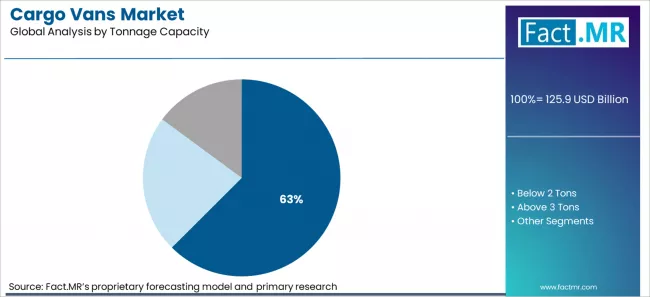
Cargo Vans Market Analysis By Tonnage Capacity | Source: Fact.MR
Based on FACT.MR’s cargo vans market report, 2-to-3-ton cargo vans are projected to hold approximately 62.5% share in 2026. This segment dominates because it delivers the optimal combination of urban manoeuvrability and payload capacity for last-mile delivery, trade, and courier operations in city environments where street access, loading bay dimensions, and parking constraints limit the practicality of above-3-ton alternatives.
- Volkswagen Transporter EV Platform Investment: In 2025, Volkswagen launched the all-new Transporter T7 in both ICE and electric variants, targeting the 2-to-3-ton segment with a modular EV platform enabling up to 600 kg payload capacity across panel van and kombi configurations for European fleet customers. [8]
- Stellantis eDucato Range Extension Development: In 2024, Stellantis announced an extended-range eDucato with a 110 kWh battery and 370 km range in the above-2-ton segment, directly addressing operator objections about payload compromise in electric conversion of ICE panel van platforms. [9]
- Below-2-Ton Urban Delivery Growth Trend: Renault’s 2025 commercial vehicle sales report showed its Kangoo E-Tech electric van, competing in the below-2-ton class, achieving the highest year-on-year growth of any Renault commercial vehicle model in Q1 2025, driven by European urban micro-delivery operator demand. [10]
Drivers, Restraints, and Opportunities
FACT.MR analysts observe that the cargo vans market is closely tied to global e-commerce growth, urban freight activity, and commercial fleet renewal cycles. The market reflects the structural role of cargo vans as the primary last-mile delivery and urban trade vehicle across mature and developing markets alike, with electric transition beginning to reshape premium segment dynamics.
The market faces a structural split between high-volume ICE cargo van demand in Asia Pacific and Latin America and a premium electric segment gaining rapid share in Europe and North America. Diesel van unit economics remain competitive in markets without zero-emission zone enforcement, while battery electric vans command 30 to 50% higher unit prices but offer lower total fleet operating costs over five-year ownership cycles for high-mileage urban delivery operators.
- EU Zero-Emission Zone Regulatory Pressure: The European Commission’s revised Urban Mobility Framework, reinforced by city-level zero-emission zone rollouts in Paris, Amsterdam, and London, is mandating fleet operators to phase out diesel cargo vans from urban cores by 2030 in major markets. Stellantis reported in its 2025 commercial vehicle investor day that EU urban access regulation was the primary cited driver of accelerated fleet conversion inquiries from European logistics clients. [2]
- E-Commerce Last-Mile Fleet Expansion: Amazon’s 2024 annual report confirmed its global Delivery Service Partner network operated over 400,000 cargo vans, with a commitment to deploy 100,000 electric delivery vans by 2030 through its agreement with Stellantis and Rivian. India’s Flipkart announced a 25,000-vehicle electric van procurement plan in partnership with Mahindra Electric in February 2025, directly expanding cargo van fleet demand. [3]
- China New Energy Vehicle Policy Incentives: China’s Ministry of Industry and Information Technology continued its NEV subsidy programme for commercial vehicles through 2025, providing per-vehicle purchase subsidies for electric cargo vans under 6 tonnes. SAIC-GM-Wuling and BYD expanded electric cargo van model offerings in 2025 specifically targeting urban delivery platform customers, increasing model availability and price competition. [4]
Regional Analysis
The cargo vans market is analysed across Asia Pacific, Europe, North America, Latin America, and Middle East and Africa, covering 40-plus countries with demand profiles shaped by e-commerce logistics growth, fleet electrification regulation, urban freight activity, and vehicle affordability. The full report offers market attractiveness analysis based on regulatory enforcement timelines and fleet renewal investment pipelines.
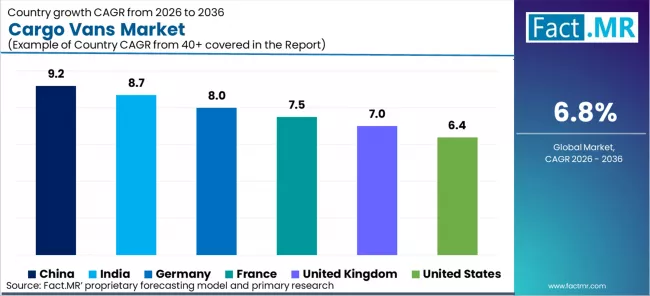
Cargo Vans Market Cagr Analysis By Country | Source: Fact.MR
| Country | CAGR (2026-2036) |
|---|---|
| China | 9.2% |
| India | 8.7% |
| Germany | 8.0% |
| France | 7.5% |
| United Kingdom | 7.0% |
| United States | 6.4% |
Source: Fact.MR analysis. Updated Mar 11, 2026
Source: Fact.MR (FACT.MR) analysis, based on proprietary forecasting model and primary research
Asia Pacific Cargo Vans Market Analysis
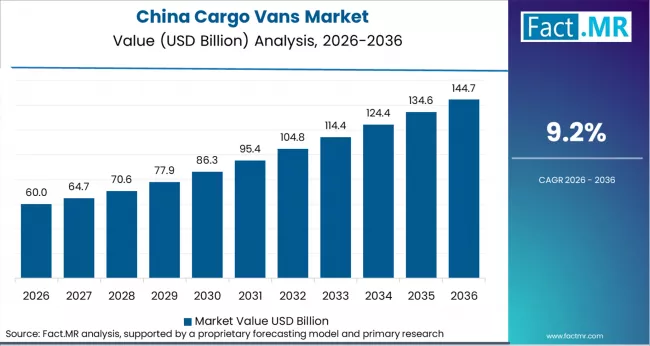
Cargo Vans Market Country Value Analysis | Source: Fact.MR
Asia Pacific represents the largest and fastest-expanding cargo van demand region, supported by China’s dominant e-commerce logistics ecosystem and India’s rapidly scaling urban delivery networks. Regional competition includes strong domestic electric van manufacturers in China and diversified OEM participation across India and Southeast Asia.
- China: China’s cargo van demand is expected to advance at a 9.2% CAGR through 2036. Government NEV incentives for commercial vehicles, combined with regulatory fleet electrification targets for urban logistics operators, continue accelerating electric cargo van procurement. Major logistics firms are expanding electric fleets to comply with national decarburization goals and municipal clean transport policies.
- India: India’s cargo van market is anticipated to expand at an 8.7% CAGR through 2036. National EV subsidy programmes and municipal incentives are improving the affordability of electric cargo vans for logistics fleets. Rising e-commerce penetration and growth in intra-city delivery networks are also supporting strong demand growth.
FACT.MR’s Asia Pacific analysis of the cargo vans market covers China, Japan, South Korea, India, Australia and New Zealand, ASEAN, and Rest of South Asia and Pacific. Readers can find country CAGR forecasts, e-commerce fleet procurement timelines, NEV policy incentive data, and OEM competitive positioning by propulsion and tonnage segment.
Europe Cargo Vans Market Analysis
Europe remains the global regulatory center for cargo van electrification, where low-emission zones and EU fleet emission standards are directly shaping procurement decisions by logistics operators and corporate fleets.
- Germany: Cargo van sales in Germany are projected to increase at an 8.0% CAGR through 2036. Government clean air programmes and corporate fleet electrification commitments are accelerating replacement of diesel vans in urban delivery operations.
- France: France’s cargo van market is forecast to register a 7.5% CAGR through 2036. Expansion of low-emission zones across major metropolitan areas is compelling fleet operators to replace older diesel vehicles with compliant or electric alternatives.
- United Kingdom: The United Kingdom cargo van sector is expected to grow at a 7.0% CAGR through 2036. Large urban clean transport initiatives and postal fleet electrification programmes are creating sustained demand for electric delivery vans.
FACT.MR’s European analysis of the cargo vans market covers Germany, France, the United Kingdom, Italy, Spain, Nordic countries, BENELUX, and Rest of Western Europe. Readers can find EU ZEZ regulation impact data, fleet electrification programme timelines, OEM model availability by propulsion type, and country-level forecasts by tonnage and end use.
North America Cargo Vans Market Analysis
North America represents the highest revenue-generating cargo van market, driven by large commercial fleet volumes, strong vehicle pricing, and rising adoption of electric delivery vans by logistics and postal operators.
- United States: The U.S. cargo van market is estimated to expand at a 6.4% CAGR through 2036. Federal fleet procurement programmes, large-scale e-commerce logistics networks, and corporate decarburization commitments are supporting steady demand growth.
FACT.MR’s North American analysis of the cargo vans market covers the United States, Canada, and Mexico. Readers can find federal fleet procurement data, EPA commercial vehicle emission standard timelines, e-commerce fleet electrification investment benchmarks, and country-level forecasts by propulsion and tonnage capacity.
Competitive Aligners for Market Players
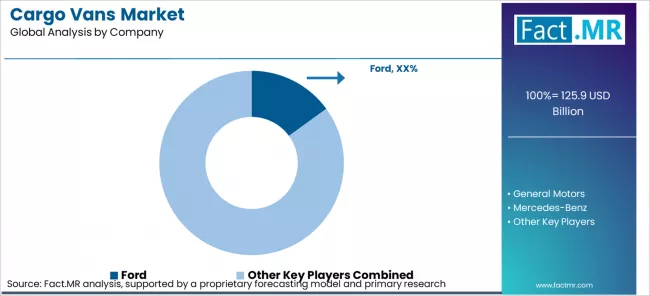
Cargo Vans Market Analysis By Company | Source: Fact.MR
The global cargo vans market is moderately concentrated in premium full-size and medium van segments and moderately fragmented in the light urban van category. Ford, Stellantis, Mercedes-Benz, and Volkswagen hold the largest combined share of commercial cargo van registrations across North America and Europe, competing primarily on total fleet cost of ownership, electrification roadmap credibility, and after-sales service network coverage. In Asia Pacific, SAIC-GM-Wuling, Dongfeng, and local NEV producers dominate the high-volume electric urban van segment through competitive pricing and government-aligned fleet procurement programmes.
Structural competitive advantages belong to OEMs with broad platform architectures enabling ICE and electric variants from a shared vehicle platform, reducing development and manufacturing cost per unit. Ford’s E-Transit and Stellantis’s multi-brand electric van strategy across Fiat Ducato, Peugeot Boxer, and Vauxhall Movano allow them to address multiple market segments from a unified electric platform investment.
Hyundai and Renault compete in mid-market fleet accounts through value-oriented total cost of ownership propositions and expanding electric model availability in sub-3-ton payload categories. Large fleet operators including Amazon, DHL, La Poste, and Royal Mail manage supplier dependency by maintaining two to three preferred OEM relationships per van segment, enabling competitive tender processes at contract renewal while preserving fleet standardization benefits. This limits single-OEM pricing power in commodity diesel van segments but gives first-mover electric platform OEMs strong leverage as fleet operators value model availability certainty during the constrained electric van supply ramp-up period of 2025 through 2028.
Key Players in Cargo Vans Market
- Ford
- General Motors
- Mercedes-Benz
- Volkswagen
- Stellantis
- Toyota
- Hyundai
- Nissan
- Renault
- Isuzu
- Kia
Bibliography
- [1] Stellantis NV. (2025). Commercial Vehicle Investor Day Presentation: European Urban Access Regulation Impact on Fleet Conversion Demand and ePro Van Electrification Strategy. January 2025. stellantis.com
- [2] Amazon.com Inc. (2025). Annual Report 2024: Delivery Service Partner Network Scale, Electric Van Fleet Commitments, and Rivian and Stellantis Procurement Programmes. February 2025. ir.aboutamazon.com
- [3] Ministry of Industry and Information Technology, People’s Republic of China. (2025). NEV Commercial Vehicle Purchase Subsidy Programme Extension: Electric Cargo Van Eligibility Criteria and Per-Vehicle Incentive Schedule. January 2025. miit.gov.cn
- [4] Ford Motor Company. (2025). Press Release: E-Transit Production Capacity Expansion at Kansas City Assembly Plant to Meet Commercial Fleet Demand Growth. January 2025. media.ford.com
- [6] Mercedes-Benz AG. (2024). Product Launch Release: New eSprinter Electric Cargo Van with 113 kWh Battery Option and 440 km WLTP Range for Fleet Customers. September 2024. media.mercedes-benz.com
- [6] European Automobile Manufacturers’ Association. (2025). Light Commercial Vehicle Registration Data: Battery Electric LCV Market Share and Year-on-Year Growth Statistics for EU Markets Full Year 2024. January 2025. acea.auto
- [7] Volkswagen Commercial Vehicles. (2025). Product Launch: All-New Transporter T7 ICE and Electric Variants for European Fleet Market. February 2025. vwcv-media.de
- [8] Stellantis NV. (2024). Product Announcement: Extended-Range eDucato with 110 kWh Battery for Above-2-Ton Cargo Segment Fleet Operators. October 2024. stellantis.com
- [9] Renault Group. (2025). Q1 2025 Commercial Vehicle Sales Report: Kangoo E-Tech Electric Van Year-on-Year Growth and European Micro-Delivery Operator Demand Commentary. April 2025. group.renault.com
This Report Addresses
- Strategic intelligence on EU zero-emission zone enforcement driving electric van fleet replacement, Asia Pacific e-commerce last-mile fleet expansion, postal operator electrification commitments, and U.S. federal fleet procurement driving cargo van demand.
- Market forecast from USD 125.9 billion in 2026 to USD 240.8 billion by 2036 at 6.7% CAGR, segmented by propulsion, tonnage capacity, end use, and region.
- Growth opportunity mapping across China NEV commercial vehicle incentives, India FAME EV subsidy fleet procurement, France and UK urban ZEZ enforcement, and U.S. Amazon and USPS electric van fleet programmes.
- Country CAGR outlook for China 9.2%, India 8.7%, Germany 8.0%, France 7.5%, United Kingdom 7.0%, and United States 6.4%, with key logistics, regulation, and fleet investment demand drivers per country.
- Competitive analysis of Ford, Stellantis, Mercedes-Benz, Volkswagen, Hyundai, and Renault covering ICE and electric model portfolios, fleet programme strategies, production investment, and OEM positioning by region.
- Technology tracking including electric van battery range improvement, multi-brand platform electric van strategies, fast-charging infrastructure deployment, and connected fleet management system integration.
- Regulatory analysis covering EU Urban Mobility Framework ZEZ mandates, UK ULEZ and Clean Air Zone standards, China MIIT NEV commercial vehicle policy, India FAME scheme commercial vehicle provisions, and U.S. EPA commercial vehicle emission standards.
- Report delivered in PDF, Excel datasets, PowerPoint summary, and dashboard formats supported by OEM registration data, fleet operator disclosures, and primary research interviews.
Segmentation
Scope of Report
| Metric | Value |
|---|---|
| Quantitative Units | USD 125.9 billion (2026) to USD 240.8 billion (2036), at a CAGR of 6.7% |
| Market Definition | Light commercial cargo vans for goods transport across e-commerce delivery, urban freight, trade, and postal applications in ICE and electric drivetrains across all payload capacity classes. |
| Propulsion Segmentation | ICE (60%), Electric |
| Tonnage Segmentation | 2 to 3 Tons (62.5%), Below 2 Tons, Above 3 Tons |
| End Use Segmentation | Commercial (59%), Personal |
| Application Coverage | E-commerce last-mile delivery, urban freight, trade services, postal and courier operations, corporate fleet transport, and commercial goods distribution. |
| Regions Covered | Asia Pacific, Europe, North America, Latin America, Middle East and Africa |
| Countries Covered | China, Japan, South Korea, India, Australia and New Zealand, ASEAN, Rest of South Asia and Pacific, Germany, UK, France, Italy, Spain, Nordic, BENELUX, Rest of Western Europe, Russia, Poland, Hungary, Balkan and Baltic, USA, Canada, Mexico, Brazil, Chile, Ecuador, Rest of Latin America, Saudi Arabia, GCC, Turkey, South Africa, Rest of MEA |
| Key Companies Profiled | Ford, General Motors, Mercedes-Benz, Volkswagen, Stellantis, Toyota, Hyundai, Nissan, Renault, Isuzu, Kia |
| Forecast Period | 2026 to 2036 |
| Approach | Hybrid top-down and bottom-up model using commercial van registration volumes, average selling prices by propulsion and tonnage class, fleet renewal cycles, e-commerce logistics fleet data, and primary interviews with fleet procurement managers and logistics operators. |
Source: Fact.MR analysis. Updated Mar 11, 2026
Cargo Vans Market by Segments
-
By Propulsion :
- ICE
- Electric
-
By Tonnage Capacity :
- 2 to 3 Tons
- Below 2 Tons
- Above 3 Tons
-
By End Use :
- Commercial
- Personal
-
By Region :
- North America
- United States
- Canada
- Mexico
- Latin America
- Brazil
- Chile
- Ecuador
- Rest of Latin America
- Western Europe
- Germany
- United Kingdom
- France
- Italy
- Spain
- Nordic
- BENELUX
- Rest of Western Europe
- Eastern Europe
- Russia
- Poland
- Hungary
- Balkan and Baltic
- Rest of Eastern Europe
- East Asia
- China
- Japan
- South Korea
- South Asia and Pacific
- India
- ASEAN
- Australia and New Zealand
- Rest of South Asia and Pacific
- Middle East and Africa
- Kingdom of Saudi Arabia
- Other GCC Countries
- Turkey
- South Africa
- Other African Union
- Rest of Middle East and Africa
- North America
Frequently Asked Questions
How large is the cargo vans market in 2025?
What will the market size be in 2026?
What is the projected market size by 2036?
What is the expected CAGR?
Which propulsion segment leads the market?
Which tonnage segment dominates?
Which end use segment holds the largest share?
Which country shows the fastest growth?
What is the primary restraint?
Who worked on this report


Preview the report firsthand - request a free sample
Free SampleGet the brochure for pricing and purchase details
Download PDF