- Market Value (2025): USD 2.5 Bn
- Estimated Value (2026): USD 2.6 Bn
- Forecast Value (2036):USD 4.2 Bn
- CAGR (2026-2036): 5.0%
What is the Automotive Paint Robots Market forecast to be worth by 2036?
USD 2.6 billion in 2026 to USD 4.2 billion by 2036 at 5.0% CAGR.
- The automotive paint robots market crossed a valuation of USD 2.5 billion in 2025 as OEM paint shops continued to automate finish-critical coating steps.
- Demand is projected to increase from USD 2.6 billion in 2026 to USD 4.2 billion by 2036.
- The market is forecast to record 5.0% CAGR from 2026 to 2036 owing to tighter finish repeatability and safer spray-booth operation.
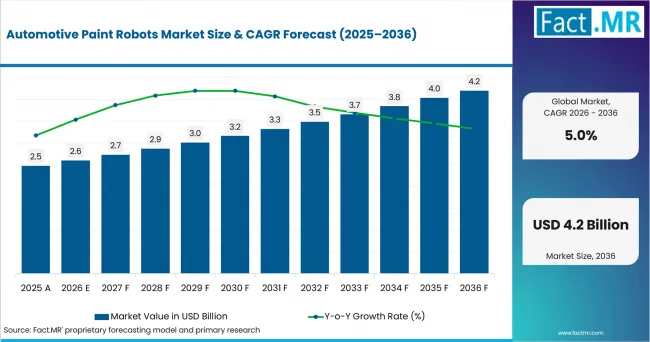
Automotive Paint Robots Market Value Analysis | Source: Fact.MR
What are the defining numbers behind Automotive Paint Robots Market growth?
USD 1.6 billion absolute opportunity by 2036, led by Floor Mounted Robots, Fully Automated systems and OEM Paint Shops.
- Demand Drivers in the Market
- OEM paint-shop engineers need stable robot paths because finish quality depends on repeatable spray distance and atomizer control.
- Automotive producers require flexible paint cells to support varied production requirements, while VDA reported in January 2026 that Germany produced 4.15 million passenger cars in 2025.
- Robot suppliers benefit when factory automation remains funded. The International Federation of Robotics reported in September 2025 that factories installed 542,000 industrial robots in 2024.
- Tier 1 coating cells need applicator proof so bumper and fascia colors remain aligned with OEM body panels.
- Key Segments Analyzed
- By Mounting: Floor Mounted Robots are expected to hold 38.9% share in 2026 because fixed booths favor stable reach and repeatable robot stance.
- By Payload: Up to 5 Kg is projected to account for 28.4% share in 2026 due to the payload profile of atomizers, bells and hoses.
- By Automation Level: Fully Automated is anticipated to capture 63.8% share in 2026 owing to recipe control and closed-booth safety requirements.
- By End Use: OEM Paint Shops are estimated to represent 33.2% share in 2026 because vehicle-body finishing sets the strictest appearance threshold.
- Analyst Opinion at Fact.MR
- Shambhu Nath Jha, Principal Consultant at Fact.MR, states, “Automotive paint robots are being judged less by headline speed and more by how reliably they hold distance, spray angle and color transfer inside live booths. Production acceptance is expected to depend on finish records and service response during model launch. Suppliers that combine applicator control, booth integration and path-programming support are better placed in OEM sourcing discussions.”
- Strategic Implications
- OEM paint-shop leaders should compare robot proposals using first-pass quality, booth downtime and applicator service response.
- Automation integrators should test rail, wall and floor layouts before quotation because older booths often restrict safe robot motion.
- Coating technology teams should connect robot sourcing with paint-system partners. Durr and Axalta announced in January 2025 a digital paint partnership that combines NextJet technology with robotic integration.
- Investors should separate direct paint-robot exposure from general industrial robot revenue when judging company participation.
Germany is forecast to record 5.5% CAGR through 2036 owing to OEM production depth and paint-shop modernization. Brazil is expected to post 5.0% CAGR as vehicle output recovery supports coating investment. The USA is projected to advance at 4.5% CAGR because assembly scale creates replacement demand in high-volume booths. The U.K. is anticipated to hold 4.0% CAGR as selective EV and hybrid programs support new paint-shop work. Japan is estimated to reach 3.6% CAGR due to disciplined robot use and mature paint-quality control.
How does the Automotive Paint Robots Market break down by segment?
Floor Mounted Robots lead Mounting at 38.9% share in 2026. Fully Automated systems lead Automation Level at 63.8% share in 2026.
Which mounting dominates?
Floor Mounted Robots are projected to account for 38.9% share in 2026.
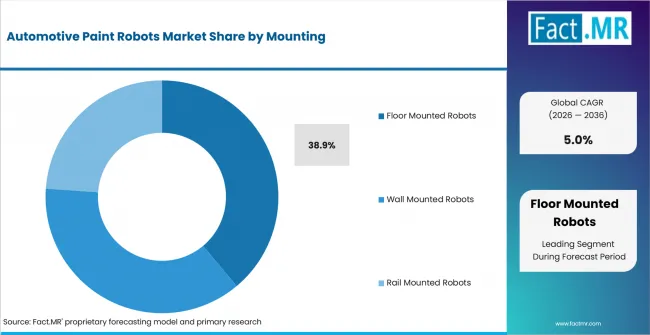
Automotive Paint Robots Market Analysis By Mounting | Source: Fact.MR
Floor mounted robots are projected to lead Mounting because most OEM booths are designed around stable reach from fixed stations. Stationary floor mounted systems suit high-volume body painting where path repeatability is checked daily. Mobile floor mounted systems are used where production engineers need limited repositioning during model mix changes. Integrated floor mounted units remain useful when paint circulation, robot base and safety envelopes must be qualified together.
What leads the Payload segment?
Up to 5 Kg is expected to hold 28.4% share in 2026.
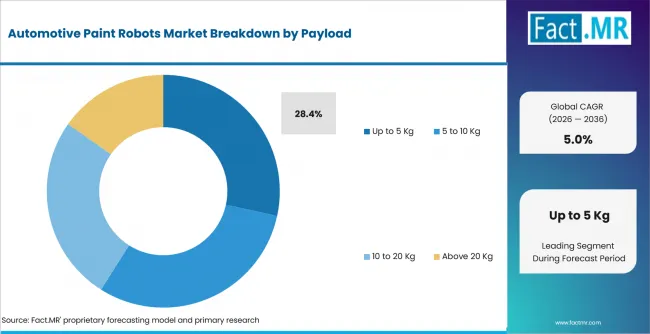
Automotive Paint Robots Market Analysis By Payload | Source: Fact.MR
Up to 5 Kg robots are expected to lead Payload since paint applicators place more value on motion accuracy than raw lifting capacity. Light payload robots fit bell atomizers and hose packages used in exterior body painting. High speed robots support cycle-time targets where two or more arms coordinate on the same body shell. Low power consumption robots are attractive when energy checks affect paint-shop approval.
How does Automation Level shape demand?
Fully Automated systems are anticipated to lead with 63.8% share in 2026.
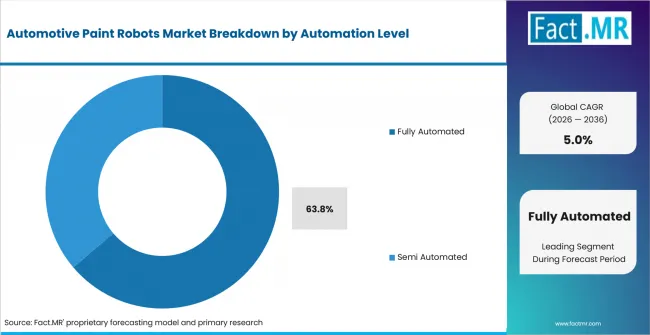
Automotive Paint Robots Market Analysis By Automation Level | Source: Fact.MR
Fully automated systems are anticipated to lead Automation Level because OEM paint shops want fewer manual touches inside hazardous spray areas. AI enabled automation supports path refinement when new body shapes enter the booth. Continuous production automation helps plants hold coating consistency across shifts. The International Federation of Robotics reported that Germany installed 26,982 industrial robots in 2024, representing 32% of Europe's annual industrial-robot installations.
What supports OEM Paint Shops within End Use?
OEM Paint Shops are estimated to represent 25.0% share in 2026.
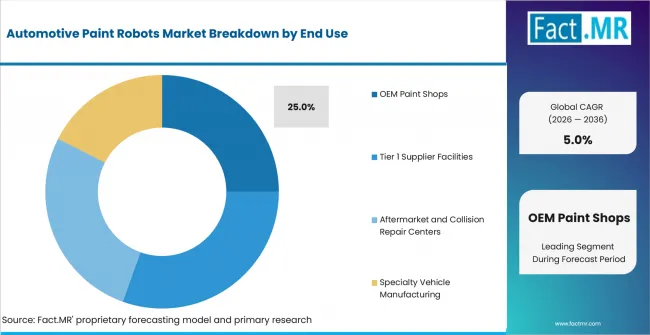
Automotive Paint Robots Market Analysis By End Use | Source: Fact.MR
OEM paint shops are estimated to lead End Use due to the finish standards applied to complete vehicle bodies. Tier 1 supplier facilities use smaller coating cells where bumpers, mirrors and exterior trim need color consistency. Aftermarket and collision repair centers remain limited because volume is less predictable. The International Federation of Robotics reported 50,100 industrial-robot installations in the Americas in 2024, with the United States accounting for 68%.
What is accelerating Automotive Paint Robots Market adoption, and what is holding it back?
Finish repeatability drives it; booth retrofit limits restrain it.
Drivers Impact Analysis
| DRIVER | (~) % IMPACT ON CAGR | GEOGRAPHIC RELEVANCE | IMPACT TIMELINE |
|---|---|---|---|
| OEM paint-shop modernization | +1.5% | Germany, USA, Japan | Short term (<= 2 years) |
| Finish repeatability requirements | +1.2% | High-volume OEM plants | Short term (<= 2 years) |
| Fully automated booth operation | +0.9% | USA, Germany, Brazil | Medium term (2-4 years) |
| Component coating at Tier 1 suppliers | +0.7% | North America, Europe, East Asia | Medium term (2-4 years) |
| Digital paint path control | +0.5% | Germany, Japan, USA | Long term (>= 4 years) |
Source: Fact.MR analysis. Updated Aug 17, 2026
- OEM paint-shop modernization: Model refreshes are expected to keep paint-shop engineers focused on robot reach, applicator stability and booth safety. The main commercial effect is not more robots per line. It is better replacement timing when old arms cannot support new body shapes.
- Finish repeatability requirements: Appearance checks are projected to raise the value of precise spray distance and atomizer control. Small path errors become visible in color shade and film build. Plants are expected to favor vendors that prove finish data during commissioning.
- Fully automated booth operation: Closed spray areas are anticipated to shift more coating work toward robots and away from manual touch points. The change lowers human exposure during live spraying. It also makes recipe records more useful when plants compare shifts and operators.
- Component coating at Tier 1 suppliers: Tier 1 facilities are expected to add compact cells where exterior components need OEM-grade appearance. Bumpers, fascias and mirror housings require repeatable color transfer. Demand is likely to favor smaller robots that can be serviced without full line shutdowns.
- Digital paint path control: Paint path simulation is forecast to shorten launch work when new models share the same booth. Offline programming reduces trial runs in live spray areas. Vendors with software support are expected to gain more influence during early engineering reviews.
Opportunity Impact Analysis
| OPPORTUNITY | (~) % IMPACT ON CAGR | GEOGRAPHIC RELEVANCE | IMPACT TIMELINE |
|---|---|---|---|
| Digital paint and inkjet coating | +0.8% | Germany, USA, Europe | Medium term (2-4 years) |
| Flexible floor-mounted cells | +0.6% | Brazil, USA, U.K. | Short term (<= 2 years) |
| Low-overspray atomizers | +0.5% | Global OEM plants | Medium term (2-4 years) |
| Aftermarket calibration packages | +0.3% | USA, Japan, Europe | Long term (>= 4 years) |
Source: Fact.MR analysis. Updated Aug 17, 2026
- Digital paint and inkjet coating: Digital paint systems are expected to create opportunity where two-tone and personalized finishes need less masking work. Robot integration becomes valuable when the paint head must follow exact body geometry. This favors providers that link coating data with robot motion.
- Flexible floor-mounted cells: Floor-mounted cells are projected to gain in plants that cannot rebuild an entire booth. Compact installations support model changes without moving the main conveyor. The opportunity is strongest where engineers need a controlled upgrade during planned shutdowns.
- Low-overspray atomizers: Low-overspray application is anticipated to appeal to plants under material waste and ventilation cost pressure. Better transfer efficiency reduces paint loss and booth cleaning time. The gain depends on proving finish quality across both light and dark colors.
- Aftermarket calibration packages: Service packages are forecast to become more relevant as installed paint robots age. Calibration support protects finish quality after atomizer changes, controller updates and booth maintenance. Smaller facilities are expected to value this support when internal robot skills are limited.
Restraints Impact Analysis
| RESTRAINT | (~) % IMPACT ON CAGR | GEOGRAPHIC RELEVANCE | IMPACT TIMELINE |
|---|---|---|---|
| Booth retrofit complexity | -0.9% | Older OEM plants | Short term (<= 2 years) |
| Explosion-safety validation | -0.7% | Global spray booths | Short term (<= 2 years) |
| Capital payback pressure | -0.5% | Brazil, U.K., smaller suppliers | Medium term (2-4 years) |
| Programming skill shortages | -0.4% | Tier 1 and repair networks | Long term (>= 4 years) |
Source: Fact.MR analysis. Updated Aug 17, 2026
- Booth retrofit complexity: Older booths often limit robot reach, rail travel and cable routing. These limits raise engineering time before installation begins. Plant teams are expected to delay upgrades when the retrofit requires conveyor, ventilation or shutdown changes.
- Explosion-safety validation: Paint robots work near flammable coatings and atomized materials. Safety validation is expected to extend approval work beyond ordinary industrial robot commissioning. The restraint is larger when local teams lack experience with hazardous-area controls.
- Capital payback pressure: Paint robots require booth work, programming time and service contracts beyond the arm price. Smaller facilities are expected to slow approvals when output does not justify the full package. Payback pressure is sharper during weak vehicle-order cycles.
- Programming skill shortages: Robot path programming remains a bottleneck when plants run many body styles. Skill shortages are projected to increase dependence on outside integrators. That dependence can add cost and delay when new models enter production together.
Which countries are scaling Automotive Paint Robots Market fastest?
- The country comparison spans 1.9 percentage points and forms three practical growth bands across the forecast period.
- Germany remains 0.5 percentage point above Brazil owing to OEM production depth and paint-shop modernization.
- Brazil remains 0.5 percentage point above the USA as production recovery supports coating investment.
- The USA remains 0.5 percentage point above the U.K. because assembly scale creates replacement demand in high-volume booths.
- The U.K. remains 0.4 percentage point above Japan as selective EV and hybrid programs support new paint-shop work.
- Japan closes the displayed range while factory discipline and robotized paint-quality control keep replacement demand steady.
Comparable CAGRs create different entry conditions due to plant scale, booth age and local service depth. Full report coverage includes North America, Latin America, Europe, East Asia, South Asia and Pacific, Middle East and Africa.
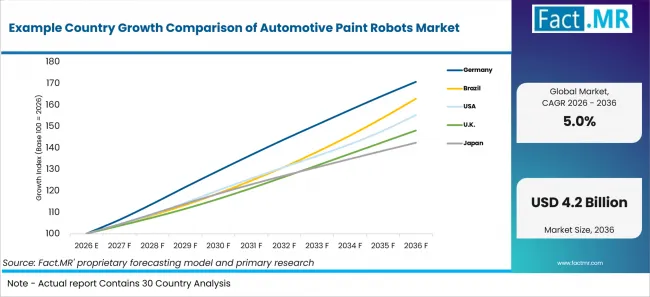
Example Country Growth Comparison Of Automotive Paint Robots Market | Source: Fact.MR
| Country | CAGR (2026-2036) |
|---|---|
| Germany | 5.5% |
| Brazil | 5.0% |
| USA | 4.5% |
| U.K. | 4.0% |
| Japan | 3.6% |
Source: Fact.MR analysis. Updated Aug 17, 2026
What supports Germany adoption?
5.5% CAGR, supported by OEM production depth and paint-shop upgrades.
Germany’s growth reflects a market where paint-shop automation is tied to model launches and surface-quality discipline. The country is forecast to record 5.5% CAGR from 2026 to 2036 as OEMs keep production engineering close to booth suppliers. German plants are expected to value robot vendors that can support applicator trials, shutdown planning and service response inside high-utilization paint shops.
How is Brazil scaling demand?
5.0% CAGR, driven by vehicle production recovery and export-linked finishing.
Brazil’s growth is tied to production recovery and the need to meet finish standards for domestic and export vehicles. ANFAVEA reported in January 2026 that Brazil produced 2.644 million vehicles in 2025, up 3.5% from 2024. Paint robot adoption is expected to remain selective, with OEMs and supplier parks favoring upgrades that reduce rework and protect launch timing.
What supports USA adoption?
4.5% CAGR, backed by assembly scale and robot replacement in high-volume plants.
The USA has a broad assembly base where paint robots are replaced when downtime risk becomes harder to defend. The Federal Reserve's January 16, 2026 G.17 release reported a 2025 average motor-vehicle assembly rate of 10.16 million units on a seasonally adjusted annual-rate basis. Large plants are expected to prioritize proven booth integration because flammable spray areas need controls that pass safety review before production release.
How is the U.K. developing demand?
4.0% CAGR, led by selective EV and hybrid paint-shop investment.
The U.K. outlook is more selective because plant scale is smaller and capital approval is tied closely to model programs. SMMT reported that U.K. factories produced 764,715 cars and commercial vehicles in 2025, comprising 717,371 cars and 47,344 commercial vehicles. Paint robot demand is expected to come from sites where new platforms need controlled finish quality despite tighter shutdown windows and energy-cost scrutiny.
How does Japan perform?
3.6% CAGR, supported by robotized production discipline and paint-quality control.
Japan’s growth reflects mature robot use and strict review before new equipment enters serial production. The International Federation of Robotics reported in July 2025 that Japan’s automotive industry installed about 13,000 industrial robots in 2024, up 11%. Paint robot suppliers are expected to win replacement work when they show stable path quality, compact layouts and quick technical support.
Who leads the Automotive Paint Robots Market?
ABB Ltd., Durr AG, FANUC CORPORATION, KUKA Roboter GmbH and Yaskawa Electric Corporation all publish dedicated painting-robot or automotive-paint automation offerings; ABB and Durr also publish broader paint-shop application portfolios.
ABB Ltd. is relevant through automotive paint robots, atomizers, control software and booth-focused application packages. Durr AG supports paint-shop automation through turnkey paint lines, robotic integration and coating process know-how. FANUC CORPORATION listed the P-55 in December 2025 as a mid-size paint robot designed for general and automotive applications, which supports its position in coating automation.
KUKA Roboter GmbH and Yaskawa Electric Corporation also offer dedicated painting robots for automotive body and component applications, so they should be classified as direct paint-robot participants rather than only as broader industrial-automation providers. Competition is expected to depend on booth integration, applicator control, programming support and local service availability. OEMs are likely to compare providers on finish records and launch support rather than robot arm specifications alone.
Which companies are the key providers?
ABB Ltd. and Durr AG are key providers. FANUC CORPORATION and KUKA Roboter GmbH are also profiled. Yaskawa Electric Corporation completes the company set.
- ABB Ltd.
- Durr AG
- FANUC CORPORATION
- KUKA Roboter GmbH
- Yaskawa Electric Corporation
Bibliography
- Associação Nacional dos Fabricantes de Veículos Automotores. (2026, January 15). Produção e venda de autoveículos crescem em 2025 e Anfavea projeta nova alta em 2026.
- Dürr Systems AG. (2025, January 22). Axalta and Dürr partner on automotive digital paint technology.
- FANUC Corporation. (2025, December). ROBOT new product: New innovative mid-size paint robot P-55.
- Board of Governors of the Federal Reserve System. (2026, January 16). Industrial production and capacity utilization – G.17: Table 3. Motor vehicle assemblies.
- International Federation of Robotics. (2025, July 15). Japan’s car industry has highest robot installations in five years.
- International Federation of Robotics. (2025, September 25). Global robot demand in factories doubles over 10 years.
- Society of Motor Manufacturers and Traders. (2026, January 29). Tough year for auto but new models and Industrial Strategy can deliver growth.
- Verband der Automobilindustrie. (2026, January 5). Passenger car production in 2025 slightly above previous year's level.
This Report Answers
- The report provides strategic intelligence on the Automotive Paint Robots Market across Mounting and Payload choices that shape paint-booth automation.
- Segment analysis covers Floor Mounted Robots and Fully Automated systems as the share leaders within the 2026 market.
- Country outlook evaluates Germany and Brazil alongside the USA. The U.K. and Japan complete the growth comparison across the profiled markets.
- Competitive analysis profiles ABB Ltd. and Durr AG alongside FANUC CORPORATION. KUKA Roboter GmbH and Yaskawa Electric Corporation complete the provider set.
- Technology assessment covers floor, wall and rail-mounted robot formats used in body painting, part coating and specialty vehicle facilities.
What does the Automotive Paint Robots Market cover?
Floor mounted, wall mounted and rail mounted paint robots used for automotive coating applications.
The Automotive Paint Robots Market covers robotic systems used to apply paint and coating materials inside vehicle production and component finishing environments. Coverage includes robot arms, mounting formats, applicator integration, path control and related automation used to produce repeatable finish quality.
The market differs from the broader industrial robot category because demand depends on paint-booth safety, atomizer control and coating-process release. General welding, material handling and assembly robots are excluded unless they are configured specifically for automotive painting or coating use.
What is included in the scope?
Automotive paint robot systems used in OEM, supplier, repair and specialty vehicle coating environments.
The scope includes Mounting and Payload alongside Automation Level and End Use. Coverage spans floor mounted robots, wall mounted robots and rail mounted robots. It includes payload categories from up to 5 Kg to above 20 Kg. Fully automated and semi automated systems are included where coating work depends on robot motion and applicator control. OEM paint shops, Tier 1 supplier facilities, aftermarket and collision repair centers and specialty vehicle manufacturing are included when robotized coating is part of the production or repair workflow.
What is excluded from the scope?
General factory robots and non-automotive coating systems are outside the scope.
The scope excludes welding robots, assembly robots and handling robots that do not apply paint or coating materials. General industrial coating cells are excluded when they serve appliances, furniture or metal fabrication without an automotive link. Paint materials, booths and ovens are excluded unless they are sold as part of an automotive robotic paint system or integration package.
How Was the Analysis Built?
The analysis draws on 120+ sources, 35+ company portfolios, 25+ countries, and more than 20 industry interviews.
- Primary Research: Primary research includes discussions with manufacturers, service providers, technology developers, distributors, end users, procurement teams, and subject-matter experts. These conversations examine purchasing priorities, product adoption, operational challenges, approval requirements, competitive positioning, and the factors that influence wider market acceptance.
- Desk Research: Desk research covers government statistics, regulatory publications, company filings, trade data, technical studies, industry associations, standards, public policy, and other authoritative sources. Every source used in the analysis is documented in the bibliography.
- Market Sizing and Forecasting: Market estimates combine historical performance, demand indicators, pricing and volume trends, segment shares, company participation, country-level growth, adoption patterns, investment activity, and barriers to market expansion.
- Data Validation and Update Cycle: Findings are validated by comparing primary interviews with public data, company activity, regulatory changes, trade patterns, and industry developments. Regular updates review new product launches, capacity changes, partnerships, approvals, procurement trends, and shifts in commercial adoption.
Segmentation
What is the report’s scope and coverage?
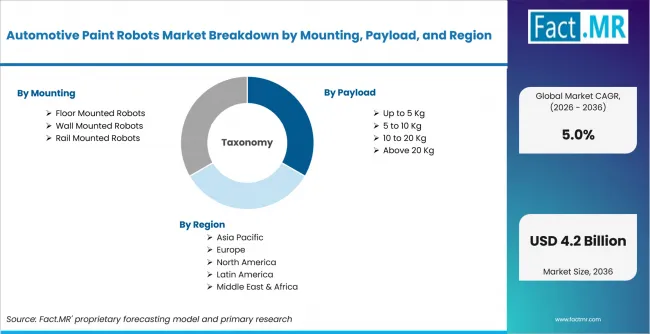
Automotive Paint Robots Market Breakdown By Mounting, Payload, And Region | Source: Fact.MR
| Attribute | Details |
|---|---|
| Quantitative Units | USD billion |
| Market Definition | Robotic painting systems used in automotive paint shops where spray-path repeatability, applicator control, booth safety and finish quality determine production approval |
| Mounting | Floor Mounted Robots; Wall Mounted Robots; Rail Mounted Robots |
| Payload | Up to 5 Kg; 5 to 10 Kg; 10 to 20 Kg; Above 20 Kg |
| Automation Level | Fully Automated; Semi Automated |
| End Use | OEM Paint Shops; Tier 1 Supplier Facilities; Aftermarket and Collision Repair Centers; Specialty Vehicle Manufacturing |
| Regions Covered | North America; Latin America; Europe; East Asia; South Asia and Pacific; Middle East and Africa |
| Countries Covered | Germany; Brazil; USA; U.K.; Japan |
| Key Companies Profiled | ABB Ltd.; Durr AG; FANUC CORPORATION; KUKA Roboter GmbH; Yaskawa Electric Corporation |
| Forecast Period | 2026 to 2036 |
| Approach | Hybrid top-down and bottom-up approach using automotive production activity; robot installation patterns; paint-shop modernization; mounting format selection; payload requirements; automation level; OEM and supplier plant activity; country adoption patterns and company portfolio review |
Source: Fact.MR analysis. Updated Aug 17, 2026
How is the market segmented?
-
By Mounting:
- Floor Mounted Robots
- Stationary Floor Mounted Systems
- Mobile Floor Mounted Systems
- Integrated Floor Mounted Units
- Wall Mounted Robots
- Compact Wall Mounted Systems
- High Reach Wall Mounted Systems
- Modular Wall Mounted Units
- Rail Mounted Robots
- Linear Rail Systems
- Overhead Rail Systems
- Automated Rail Guided Robots
- Floor Mounted Robots
-
By Payload:
- Up to 5 Kg
- Light Payload Robots
- High Speed Robots
- Low Power Consumption Robots
- 5 to 10 Kg
- Medium Payload Robots
- High Accuracy Robots
- Multi Purpose Robots
- 10 to 20 Kg
- Heavy Duty Mid Range Robots
- High Capacity Robots
- Advanced Motion Robots
- Above 20 Kg
- Heavy Payload Robots
- Industrial Automation Robots
- High Performance Robots
- Up to 5 Kg
-
By Automation Level:
- Fully Automated
- AI Enabled Automation
- Continuous Production Automation
- High Precision Automation
- Semi Automated
- Human Assisted Automation
- Flexible Automation Systems
- Modular Automation
- Fully Automated
-
By End Use:
- OEM Paint Shops
- Automotive OEM Facilities
- High Volume Paint Shops
- Integrated Manufacturing Facilities
- Tier 1 Supplier Facilities
- Component Manufacturing Facilities
- Contract Manufacturing Units
- Advanced Coating Facilities
- Aftermarket and Collision Repair Centers
- Collision Repair Facilities
- Aftermarket Paint Centers
- Independent Repair Networks
- Specialty Vehicle Manufacturing
- Custom Vehicle Production
- Industrial Vehicle Manufacturing
- Special Purpose Vehicle Facilities
- OEM Paint Shops
-
By Region:
- North America
- Latin America
- Europe
- East Asia
- South Asia and Oceania
- Middle East and Africa
Frequently Asked Questions
How big is the automotive paint robots market in 2026?
What is the CAGR of the automotive paint robots market from 2026 to 2036?
Which mounting type leads the automotive paint robots market?
Which payload segment leads the automotive paint robots market?
Who are the leading companies in the automotive paint robots market?
Who worked on this report


Preview the report firsthand - request a free sample
Free SampleGet the brochure for pricing and purchase details
Download PDF