- Market Value (2025): USD 2.4 Bn
- Estimated Value (2026): USD 2.6 Bn
- Forecast Value (2036): USD 5.7 Bn
- CAGR (2026-2036): 8.2%
What is the Automotive UV-Stabilized Thermoplastic Elastomer Market forecast to be worth by 2036?
USD 2.6 billion in 2026 to USD 5.7 billion by 2036, at 8.2% CAGR.
- The market crossed a valuation of USD 2.4 billion in 2025 across automotive material channels.
- Demand is projected to rise from USD 2.6 billion in 2026 to USD 5.7 billion by 2036.
- The market is forecast to record an 8.2% CAGR through 2036 as vehicle manufacturers specify weatherable compounds for exposed parts.
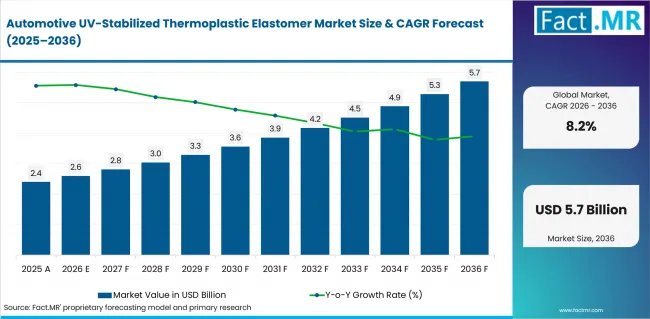
Automotive Uv Stabilized Thermoplastic Elastomer Market Value Analysis | Source: Fact.MR
What are the defining numbers behind Automotive UV-Stabilized Thermoplastic Elastomer Market growth?
USD 3.1 billion absolute opportunity by 2036, led by styrenic TPEs and exterior components alongside original equipment manufacturers.
- Demand Drivers in the Market
- Vehicle platform engineers need stable color and flexibility across prolonged sunlight exposure in varied operating climates.
- Tier-1 component manufacturers prefer predictable adhesion and flow during high-volume molding changes across approved production lines.
- Automotive quality teams require finished-part weathering evidence to limit warranty exposure from fading and reduced sealing force.
- Material teams need traceable recycled inputs that remain within approved odor and mechanical performance limits.
- Key Segments Analyzed
- By Product: Styrenic block copolymer thermoplastic elastomers are expected to account for 37.0% share in 2026, supported by polypropylene compatibility.
- By Application: Exterior automotive components are projected to capture 41.0% share in 2026, owing to direct sunlight exposure.
- By End User: Original equipment manufacturers are anticipated to represent 59.0% share in 2026, driven by platform approval authority.
- By Distribution Channel: Direct OEM supply is estimated to garner 52.0% share in 2026, attributable to formulation control.
- By Material Type: UV-stabilized thermoplastic polyolefins are forecast to hold 39.0% share in 2026, reinforced by scalable molding.
- Analyst Opinion at Fact.MR
- Shambhu Nath Jha, Sr. Consultant at Fact.MR, opines, “Automotive programs now connect weathering performance with part consolidation and recycled-content targets. Demand is expected to favor compounders proving finished-part durability under vehicle-specific aging conditions. Local testing and formulation control are expected to shape multi-plant approvals.”
- Strategic Implications
- Compounders should link accelerated weathering data to specific colors and component geometries during vehicle-platform approval.
- OEM material teams should compare natural exposure with laboratory aging before approving lower-cost formulation changes.
- Tier-1 molders should align tooling and adhesion trials with the exact substrate used during production ramp-up.
- Regional distributors should maintain documented lot traceability and technical escalation routes for lower-volume automotive programs.
Automotive cabin programs accept recycled content after odor and emissions testing confirms suitability under established vehicle limits. In December 2025, HEXPOL TPE secured Porsche PN 780 approval for a Dryflex Circular grade containing 45% recyclate. The approval gives recycled TPE a clearer route into controlled interior applications.
USA demand is projected at 9.5% CAGR through 2036 as platform redesign expands qualification for automotive lightweight materials. Germany is estimated at 9.2% CAGR owing to electric-vehicle production. Japan is anticipated at 8.9% CAGR as compact components require strict change control. South Korea is forecast at 8.6% CAGR across export platforms. France is expected at 8.3% CAGR as mass rules favor lighter materials.
How does the Automotive UV-Stabilized Thermoplastic Elastomer Market break down by segment?
Styrenic block copolymer thermoplastic elastomers are projected at 37.0% share, exterior components are estimated at 41.0% share.
Which Product category accounts for the primary share?
Styrenic block copolymer thermoplastic elastomers are projected to account for 37.0% share in 2026
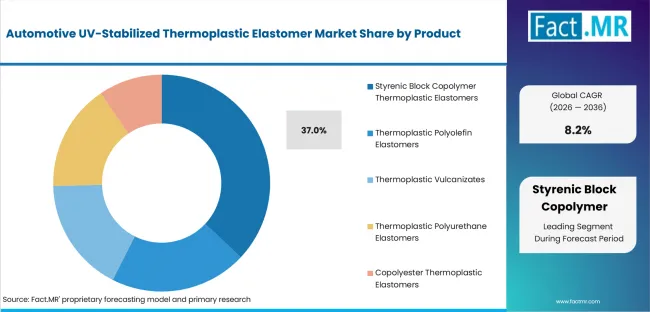
Automotive Uv Stabilized Thermoplastic Elastomer Market Analysis By Product | Source: Fact.MR
Styrenic block copolymer thermoplastic elastomers are projected to hold 37.0% share in 2026 owing to tunable softness and polypropylene compatibility. These thermoplastic elastomer compounds support molded skins requiring controlled adhesion
What supports Exterior Automotive Components within Application?
Exterior automotive components are estimated to capture 41.0% share in 2026
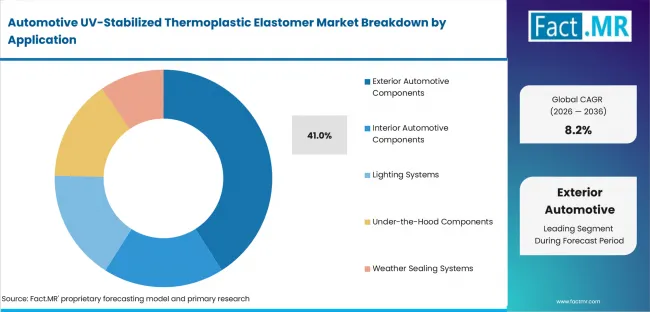
Automotive Uv Stabilized Thermoplastic Elastomer Market Analysis By Application | Source: Fact.MR
By application, exterior automotive components are forecast to represent 41.0% share in 2026 due to visible-surface qualification. Ultraviolet stabilizer systems must protect color while elastomers retain adhesion and compression recovery across exposed seals.
How do Original Equipment Manufacturers shape End User demand?
Original equipment manufacturers are anticipated to represent 59.0% share in 2026
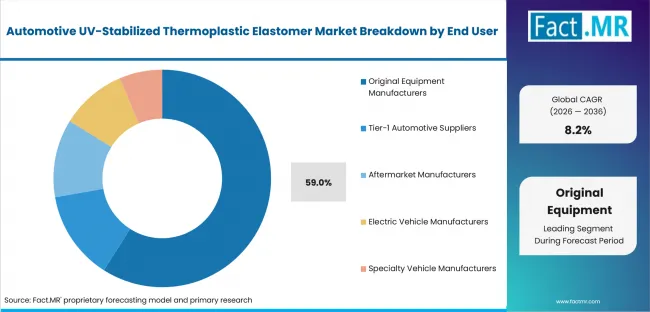
Automotive Uv Stabilized Thermoplastic Elastomer Market Analysis By End User | Source: Fact.MR
In 2026, original equipment manufacturers are expected to lead end-user demand with 59.0% share because they control platform specifications. In August 2025, KRAIBURG TPE introduced UV-resistant Light Effect compounds meeting VDA odor and fogging requirements. The development supports illuminated automotive plastic components.
What supports Direct OEM Supply in the Distribution Channel category?
Direct OEM supply is forecast to hold 52.0% share in 2026
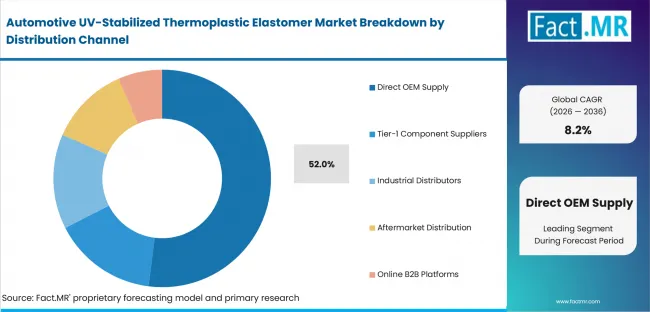
Automotive Uv Stabilized Thermoplastic Elastomer Market Analysis By Distribution Channel | Source: Fact.MR
By distribution channel, direct OEM supply is estimated to hold 52.0% share in 2026 owing to controlled formulations. Platform contracts connect compound identity with approved plants and change notifications for weatherstrip sealing systems across scheduled vehicle programs.
How does Material Type influence automotive compound selection?
UV-stabilized thermoplastic polyolefins are expected to garner 39.0% share in 2026
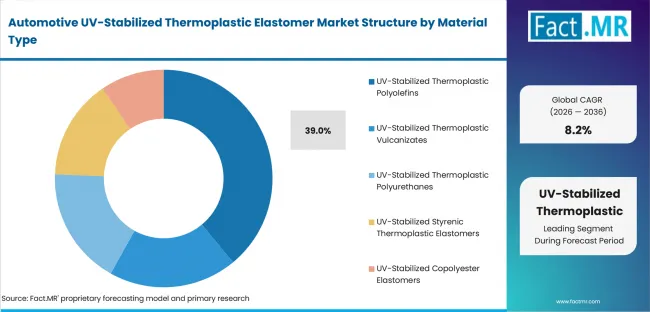
Automotive Uv Stabilized Thermoplastic Elastomer Market Analysis By Material Type | Source: Fact.MR
UV-stabilized thermoplastic polyolefins are projected to hold 39.0% share in 2026 owing to low density and scalable molding. Thermoplastic polyolefin platforms suit exterior modules requiring controlled stiffness and integrated color. Vulcanizates remain suited to compressive sealing profiles.
What is accelerating Automotive UV-Stabilized Thermoplastic Elastomer Market adoption, and what is holding it back?
Vehicle-platform redesign drives adoption, OEM requalification cost restrains material switching.
Drivers Impact Analysis
| DRIVER | (~) % IMPACT ON CAGR |
GEOGRAPHIC RELEVANCE | IMPACT TIMELINE |
|---|---|---|---|
| Exterior durability and longer service exposure | +1.1% | Global automotive hubs | Medium term (2-4 years) |
| Vehicle lightweighting and part consolidation | +0.9% | North America, Europe and East Asia | Medium term (2-4 years) |
| Electric-platform redesign for seals and cable protection | +0.7% | USA, Germany and South Korea | Long term (>= 4 years) |
| Recycled-content qualification with retained performance | +0.5% | Europe and North America | Long term (>= 4 years) |
| Regional compounding and technical support | +0.4% | Asia Pacific and North America | Medium term (2-4 years) |
Source: Fact.MR analysis. Updated Jul 31, 2026
- Exterior durability: Exposed trim and seals need component-specific aging evidence to limit fading and recovery failures.
- Vehicle lightweighting: Thermoplastic processing consolidates parts and integrates color without weakening long-term surface performance.
- Electric-platform redesign: New cable routes create heat and chemical exposures that increase qualification requirements.
- Recycled-content qualification: Vehicle programs require traceable inputs that pass established odor and aging tests.
- Regional technical support: Local laboratories shorten tooling approval and troubleshooting across multi-country vehicle platforms.
Opportunity Impact Analysis
| OPPORTUNITY | (~) % IMPACT ON CAGR |
GEOGRAPHIC RELEVANCE | IMPACT TIMELINE |
|---|---|---|---|
| UV-stable recycled TPE grades | +0.6% | Europe and North America | Medium term (2-4 years) |
| Low-emission cabin compounds | +0.5% | Europe and East Asia | Short term (<= 2 years) |
| Color-integrated exterior TPO parts | +0.4% | North America and Europe | Medium term (2-4 years) |
| Regional validation laboratories | +0.3% | East Asia and North America | Long term (>= 4 years) |
Source: Fact.MR analysis. Updated Jul 31, 2026
- UV-stable recycled grades: Controlled feedstocks create openings for compounds supported by traceability and weathering evidence.
- Low-emission cabin compounds: Consistent testing helps low-VOC TPE compounds secure specifications without appearance or processing losses.
- Color-integrated exterior parts: Molded-in color removes coating steps while weatherable compounds preserve gloss during service.
- Regional validation laboratories: Local aging and adhesion tests reduce launch delays for globally controlled formulations.
Restraints Impact Analysis
| RESTRAINT | (~) % IMPACT ON CAGR |
GEOGRAPHIC RELEVANCE | IMPACT TIMELINE |
|---|---|---|---|
| OEM requalification cost | -0.7% | Global automotive programs | Medium term (2-4 years) |
| Formulation-change risk | -0.5% | Multi-plant vehicle platforms | Medium term (2-4 years) |
| Natural-weathering test duration | -0.4% | High-sun operating regions | Long term (>= 4 years) |
| Feedstock and color consistency | -0.3% | Global | Medium term (2-4 years) |
Source: Fact.MR analysis. Updated Jul 31, 2026
- OEM requalification cost: New grades require finished-part aging and production trials across affected plants.
- Formulation-change risk: Stabilizer or pigment changes can alter appearance and adhesion before formal approval.
- Natural-weathering duration: Long outdoor tests delay material comparison for exposed parts requiring climate-specific evidence.
- Feedstock and color consistency: Controlled blending and pigment management prevent visible variation between production lots.
Which countries are scaling Automotive UV-Stabilized Thermoplastic Elastomer Market fastest?
USA 9.5%, Germany 9.2%, Japan 8.9%, South Korea 8.6%, France 8.3%.
Regional analysis covers North America, Europe, East Asia, South Asia and Pacific, Latin America, and Middle East and Africa.
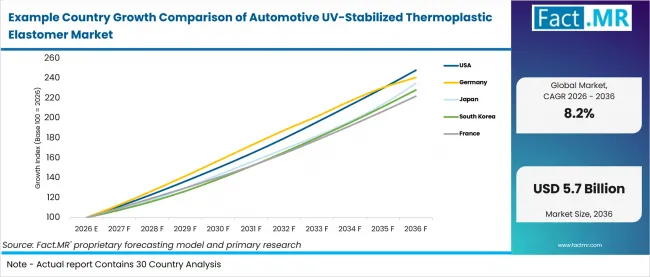
Example Country Growth Comparison Of Automotive Uv Stabilized Thermoplastic Elastomer Market | Source: Fact.MR
| COUNTRY | CAGR |
|---|---|
| USA | 9.5% |
| Germany | 9.2% |
| Japan | 8.9% |
| South Korea | 8.6% |
| France | 8.3% |
Source: Fact.MR analysis. Updated Jul 31, 2026
What is driving the USA outlook through 2036?
9.5% CAGR, supported by platform redesign and multi-climate qualification requirements.
USA programs qualify compounds across varied climates under common platform specifications. Demand is forecast at 9.5% CAGR through 2036. The EPA model-year schedule supports redesign activity, while plant revalidation remains the main friction for UV-stabilized PCR polymers.
How is Germany scaling automotive elastomer demand?
9.2% CAGR, owing to electric-vehicle production and export-platform specifications.
German automakers use specifications that extend into overseas plants. Demand is projected at 9.2% CAGR through 2036. VDA reported a 40% electric production share in February 2026, supporting demand for thermoplastic vulcanizate grades.
What supports Japan's growth profile?
8.9% CAGR, reinforced by compact design and disciplined production-change control.
Japanese vehicle programs favor compact components and documented process control. Demand is anticipated at 8.9% CAGR through 2036. METI retained its software-defined vehicle goal in June 2025, supporting thermoplastic polyurethane families while long approvals constrain changes.
How is South Korea developing demand?
8.6% CAGR, driven by export platforms serving several climate and regulatory zones.
Demand in South Korea is estimated at 8.6% CAGR through 2036. South Korean manufacturers select compounds for export platforms serving varied climates. For instance, Hyundai Transys and BASF presented an Elastollan TPU seat in November 2025.
What underpins the France outlook?
8.3% CAGR, attributable to electric-vehicle uptake and vehicle-mass requirements.
French vehicle programs connect material selection with mass and environmental scoring. Demand is expected at 8.3% CAGR through 2036. Buyers continue to compare low-density compounds with weathering evidence and color validation requirements for exterior and interior parts.
Who leads the Automotive UV-Stabilized Thermoplastic Elastomer Market?
Teknor Apex and KRAIBURG TPE provide broad coverage, while Celanese and HEXPOL TPE add sealing capabilities.
Competition is concentrated among compounders holding automotive platform approvals. Entry requires traceable formulations and finished-part weathering records. Regional formulators gain lower-volume work through customization, but limited exposure evidence restricts multi-country awards.
Teknor Apex supports seals through Sarlink TPV and styrenic TPE families. KRAIBURG TPE combines exterior grades with low-VOC cabin compounds. Celanese adds Santoprene TPV and Hytrel TPC for dynamic seals. Avient provides appearance control, while Mitsui Chemicals and HEXPOL TPE broaden coverage.
Which companies are the key providers?
Key providers include Teknor Apex, KRAIBURG TPE, Celanese, Avient, Mitsui Chemicals, Lubrizol, and HEXPOL TPE.
- Teknor Apex
- KRAIBURG TPE
- Celanese Corporation
- Avient Corporation
- Mitsui Chemicals
- Lubrizol Corporation
- HEXPOL TPE
Bibliography
- HEXPOL TPE. (2025, December 2).
- KRAIBURG TPE. (2025, August 12).
- U.S. Environmental Protection Agency. (2024, March 20).
- German Association of the Automotive Industry. (2026, February 3).
- Ministry of Economy, Trade and Industry. (2025, June 9).
- BASF SE. (2025, November 5).
- Ministry for Ecological Transition. (2025, November 26).
This Report Addresses
- The report covers product and application choices shaping automotive compound qualification.
- Segment analysis covers styrenic elastomers and exterior components as the approved 2026 positions.
- Regional analysis compares the USA, Germany, Japan, South Korea, and France.
- Competitive analysis profiles key compounders serving automotive component programs.
- Product assessment covers styrenic, polyolefin, vulcanizate, polyurethane, and copolyester families.
- Application assessment covers exterior, interior, lighting, under-hood, and weather-sealing uses.
- Operating evidence covers vehicle activity, material approvals, and regional development capacity
What does the Automotive UV-Stabilized Thermoplastic Elastomer Market cover?
Styrenic, polyolefin, vulcanizate, polyurethane, and copolyester elastomers used in sunlight-exposed automotive components.
The market covers UV-stabilized thermoplastic elastomers used in automotive trim and sealing applications. Included materials retain flexibility and surface quality during prolonged outdoor exposure.
Commercial value excludes broader automotive plastics by focusing on elastomers with defined weathering performance. Finished components and rigid plastics remain outside unless revenue represents the covered compound.
What is included in the scope?
Automotive UV-stabilized thermoplastic elastomer compounds used in molded and extruded vehicle components.
The scope includes styrenic and polyolefin elastomers alongside vulcanizates and polyurethanes. Applications cover exterior and interior components plus lighting seals and under-hood protection. End users include original-equipment manufacturers and Tier-1 suppliers. Distribution analysis covers direct OEM supply, component-supplier routes, industrial distributors, and aftermarket channels.
What is excluded from the scope?
Rigid automotive plastics and finished component revenue are outside the scope.
The scope excludes unstabilized thermoplastic elastomers without an automotive weathering requirement. Thermoset rubber and rigid polymers remain outside unless revenue represents a covered UV-stabilized elastomer compound.
How was the analysis built?
The analysis draws on 120+ sources, 35+ company portfolios, 25+ countries, and more than 20 industry interviews.
- Primary Research: Primary research includes discussions with manufacturers, service providers, technology developers, distributors, end users, procurement teams, and subject-matter experts. These conversations examine purchasing priorities, product adoption, operational challenges, approval requirements, competitive positioning, and the factors that influence wider market acceptance.
- Desk Research: Desk research covers government statistics, regulatory publications, company filings, trade data, technical studies, industry associations, standards, public policy, and other authoritative sources. Every source used in the analysis is documented in the bibliography.
- Market Sizing and Forecasting: Market estimates combine historical performance, demand indicators, pricing and volume trends, segment shares, company participation, country-level growth, adoption patterns, investment activity, and barriers to market expansion.
- Data Validation and Update Cycle: Findings are validated by comparing primary interviews with public data, company activity, regulatory changes, trade patterns, and industry developments. Regular updates review new product launches, capacity changes, partnerships, approvals, procurement trends, and shifts in commercial adoption.
Segmentation
What is the report’s scope and coverage?
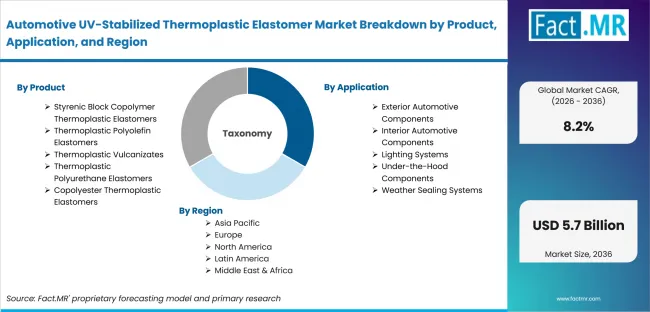
Automotive Uv Stabilized Thermoplastic Elastomer Market Breakdown By Product, Application, And Region | Source: Fact.MR
| Coverage field | Report scope |
|---|---|
| Quantitative Units | USD Billion |
| Market Definition | Revenue from UV-stabilized thermoplastic elastomer compounds sold for automotive components. |
| Product | Styrenic Block Copolymer Thermoplastic Elastomers, Thermoplastic Polyolefins, Thermoplastic Vulcanizates, Thermoplastic Polyurethanes, Copolyester Thermoplastic Elastomers |
| Application | Exterior Automotive Components, Interior Automotive Components, Lighting Systems, Under-the-Hood Components, Weather Sealing Systems |
| End User | Original Equipment Manufacturers, Tier-1 Automotive Suppliers, Aftermarket Manufacturers, Electric Vehicle Manufacturers, Specialty Vehicle Manufacturers |
| Distribution Channel | Direct OEM Supply, Tier-1 Component Suppliers, Industrial Distributors, Aftermarket Distribution, Online B2B Platforms |
| Material Type | UV-Stabilized Thermoplastic Polyolefins, UV-Stabilized Thermoplastic Vulcanizates, UV-Stabilized Thermoplastic Polyurethanes, UV-Stabilized Styrenic Thermoplastic Elastomers, UV-Stabilized Copolyester Elastomers |
| Regions Covered | North America, Latin America, Western Europe, Eastern Europe, East Asia, South Asia and Pacific, Middle East and Africa |
| Countries Covered | United States, Canada, Brazil, Mexico, Argentina, Chile, Germany, France, United Kingdom, Italy, Spain, Poland, Japan, South Korea, India, Australia, South Africa, Türkiye, Israel |
| Key Companies Profiled | Teknor Apex, KRAIBURG TPE, Celanese Corporation, Avient Corporation, Mitsui Chemicals, Lubrizol Corporation, HEXPOL TPE |
| Forecast Period | 2026 to 2036 |
| Approach | Top-down and bottom-up analysis of vehicle production, component exposure, grade mix, qualification cycles, and verified company activity. |
Source: Fact.MR analysis. Updated Jul 31, 2026
How is the market segmented?
-
By Product:
- Styrenic Block Copolymer Thermoplastic Elastomers
- SEBS-Based TPE
- SBS-Based TPE
- Thermoplastic Polyolefin Elastomers
- PP-Based TPO
- PE-Based TPO
- Thermoplastic Vulcanizates
- EPDM-Based TPV
- PP-EPDM TPV
- Thermoplastic Polyurethane Elastomers
- Polyether TPU
- Polyester TPU
- Copolyester Thermoplastic Elastomers
- High UV Resistant COPE
- High Flexibility COPE
- Styrenic Block Copolymer Thermoplastic Elastomers
-
By Application:
- Exterior Automotive Components
- Bumper Systems
- Body Side Moldings
- Interior Automotive Components
- Instrument Panels
- Door Trim Panels
- Lighting Systems
- Headlamp Seals
- Rear Lamp Gaskets
- Under-the-Hood Components
- Air Intake Ducts
- Cable Protection
- Weather Sealing Systems
- Window Seals
- Door Weatherstrips
- Exterior Automotive Components
-
By End User:
- Original Equipment Manufacturers
- Passenger Vehicle Manufacturers
- Commercial Vehicle Manufacturers
- Tier-1 Automotive Suppliers
- Interior System Suppliers
- Exterior System Suppliers
- Aftermarket Manufacturers
- Replacement Parts Manufacturers
- Accessory Manufacturers
- Electric Vehicle Manufacturers
- Battery Electric Vehicle OEMs
- Plug-in Hybrid Vehicle OEMs
- Specialty Vehicle Manufacturers
- Recreational Vehicle Manufacturers
- Off-Highway Vehicle Manufacturers
- Original Equipment Manufacturers
-
By Distribution Channel:
- Direct OEM Supply
- Long-Term Supply Contracts
- Just-in-Time Deliveries
- Tier-1 Component Suppliers
- Global Tier-1 Suppliers
- Regional Tier-1 Suppliers
- Industrial Distributors
- Polymer Distributors
- Specialty Material Suppliers
- Aftermarket Distribution
- Authorized Automotive Parts Dealers
- Independent Parts Distributors
- Online B2B Platforms
- Manufacturer Portals
- Industrial E-Commerce Platforms
- Direct OEM Supply
-
By Material Type:
- UV-Stabilized Thermoplastic Polyolefins
- Mineral Filled TPO
- Glass Reinforced TPO
- UV-Stabilized Thermoplastic Vulcanizates
- High Heat TPV
- High Flexibility TPV
- UV-Stabilized Thermoplastic Polyurethanes
- Aromatic TPU
- Aliphatic TPU
- UV-Stabilized Styrenic Thermoplastic Elastomers
- SEBS Compounds
- SBS Compounds
- UV-Stabilized Copolyester Elastomers
- High Durability COPE
- Chemical Resistant COPE
- UV-Stabilized Thermoplastic Polyolefins
-
By Region:
- North America
- United States
- Canada
- Latin America
- Brazil
- Mexico
- Argentina
- Chile
- Western Europe
- Germany
- France
- United Kingdom
- Italy
- Spain
- Benelux
- Nordics
- Eastern Europe
- Poland
- Czech Republic
- Romania
- Hungary
- East Asia
- China
- Japan
- South Korea
- South Asia and Pacific
- India
- ASEAN
- Australia and New Zealand
- Middle East and Africa
- GCC Countries
- South Africa
- Türkiye
- Israel
- North America
Frequently Asked Questions
Which product category carries the primary 2026 share?
How are exterior components positioned within application demand?
What share is assigned to original equipment manufacturers?
How much share is direct OEM supply expected to capture?
Which material type carries the primary 2026 position?
How quickly is USA demand expected to expand?
What is the primary demand driver?
Which restraint slows material switching?
Who worked on this report


Preview the report firsthand - request a free sample
Free SampleGet the brochure for pricing and purchase details
Download PDF