- Market Value (2025): USD 7.1 Bn
- Estimated Value (2026): USD 7.41 Bn
- Forecast Value (2036): USD 11.3 Bn
- CAGR (2026-2036): 4.4%
What is the Automotive Retreaded Tires Market forecast to be worth by 2036?
USD 7.4 billion in 2026 to USD 11.4 billion by 2036 at a 4.4% CAGR.
- According to Fact.MR analysis, the automotive retreaded tires market reached USD 7.1 billion in 2025.
- Demand will increase from USD 7.41 billion in 2026 to USD 11.3 billion by 2036.
- The 2026 to 2036 outlook records a 4.4% CAGR, with truck operators and tire service networks forming the core buyer base.
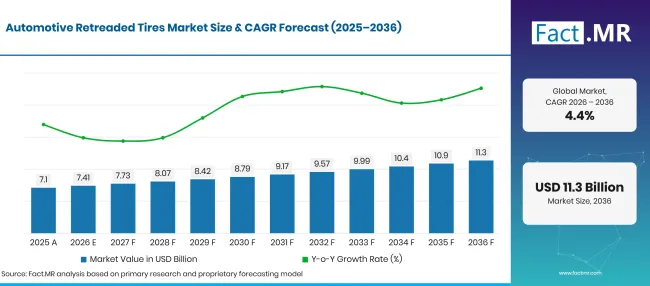
Factmr Automotive Retreaded Tires Market Forecast Global | Source: Fact.MR
| Year | Basis | Market value (USD billion) |
|---|---|---|
| 2025 | Actual | 7.1 |
| 2026 | Estimate | 7.41 |
| 2036 | Forecast | 11.3 |
| CAGR 2026 to 2036 | Forecast period | 4.4% |
Source: Fact.MR analysis. Updated Oct 14, 2026
What are the defining numbers behind Automotive Retreaded Tires Market growth?
An absolute opportunity of USD 4.0 billion is forecast between 2026 and 2036.
- Demand Drivers in the Market
- Heavy truck operators use retread services to get more use from a tire after the original tread wears out. A tire can be retreaded when the casing remains in good condition.
- Fleet maintenance teams review tire condition and past repairs before approving a retread. This makes casing quality an important factor in repeat retread orders.
- Commercial fleets also pay attention to new product developments. In June 2025, Michelin expanded its REMIX 2 hot-retread range for X MULTI truck tires used on regional routes [2].
- Key Segments Analyzed
- By Product Type: Pre-Cure accounts for 65.8% share in 2026 as workshops apply prepared tread material to inspected casings.
- By Vehicle Type: Heavy Commercial Vehicles represent 58.7% share in 2026 since fleet operators manage many tire positions over repeated service cycles.
- By Sales Channel: Aftermarket captures 62.3% share in 2026 because retreading follows vehicle use and tire wear rather than new vehicle assembly.
- By Process: Hot Retreading represents 67.3% share in 2026 under the separate process classification used for this report.
- Analyst Opinion at Fact.MR
- Shambhu Nath Jha, Principal Consultant at Fact.MR, states, “Truck fleets often compare tire costs across the full working life of a tire. They also value service partners that return usable casings on time. This assessment reflects common industry practices and does not come from completed buyer interviews.”
- Strategic Implications
- Fleet managers often track the reasons tires are removed from service and record casing condition over time. This helps them distinguish normal wear from accidental damage.
- Retread providers match tread patterns to the routes their customers operate. They also inspect incoming casings before confirming return schedules.
- Tire distributors often plan collection and return services around the operating schedules of regional trucking fleets.
- Manufacturers can clearly state the casing requirements and processing standards for each retread product. This helps fleets choose the most suitable option for their operations.
The United Kingdom leads the group with a 5.0% CAGR. Germany follows at 4.6%, while the United States records 4.2%. Japan reaches 3.9%, and Brazil stands at 3.1%. Differences in route distances and service network availability influence how fleets purchase retread tires.
How does the Automotive Retreaded Tires Market break down by segment?
Pre-Cure accounts for 65.8%; Heavy Commercial Vehicles 58.7%; Aftermarket 62.3%; Hot Retreading 67.3%.
Which Product Type dominates?
Pre-Cure holds 65.8% share in 2026.
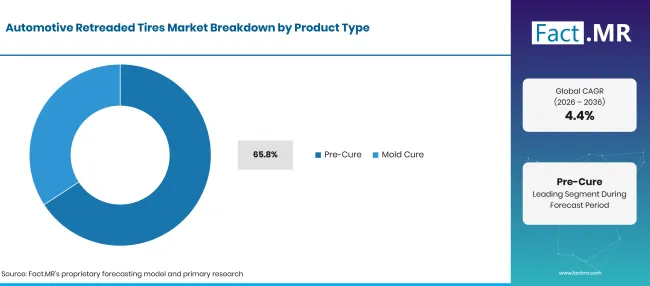
Factmr Automotive Retreaded Tires Market Breakdown Product Type | Source: Fact.MR
| Product Type | Share (2026) |
|---|---|
| Pre-Cure (Leading segment) | 65.8% |
| Other segments combined | 34.2%* |
| Total | 100.0% |
Source: Fact.MR analysis. Updated Oct 14, 2026
Pre-cure retreading uses a ready-made tread that is applied to a prepared tire casing. This approach allows workshops to choose tread patterns that match different truck operations. Mold-cure retreading is another option where the tread pattern is formed during the retreading process. The choice between the two often depends on workshop setup, production methods, and the condition of the incoming tires.
What leads the Vehicle Type segment?
Heavy Commercial Vehicles hold 58.7% share in 2026.
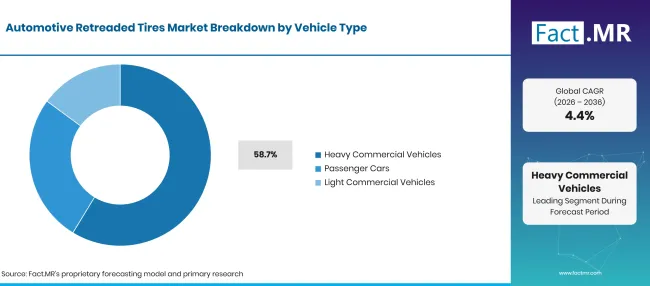
Factmr Automotive Retreaded Tires Market Breakdown Vehicle Type | Source: Fact.MR
| Vehicle Type | Share (2026) |
|---|---|
| Heavy Commercial Vehicles (Leading segment) | 58.7% |
| Other segments combined | 41.3%* |
| Total | 100.0% |
Source: Fact.MR analysis. Updated Oct 14, 2026
Long-distance trucks and other heavy commercial vehicles cover high mileage during regular operations. This makes tire recovery and reuse an important part of fleet maintenance. Passenger cars form a separate segment, where tire availability and customer buying habits are different. Light commercial vehicles operate on delivery and service routes, where frequent stops and varying road conditions affect tire use.
How does the Sales Channel shape purchases?
Aftermarket holds 62.3% share in 2026.
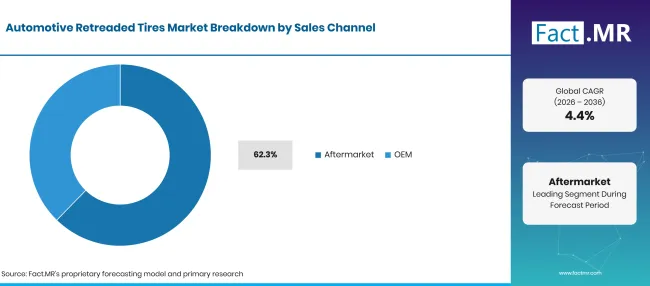
Factmr Automotive Retreaded Tires Market Breakdown Sales Channel | Source: Fact.MR
| Sales Channel | Share (2026) |
|---|---|
| Aftermarket (Leading segment) | 62.3% |
| Other segments combined | 37.7%* |
| Total | 100.0% |
Source: Fact.MR analysis. Updated Oct 14, 2026
Aftermarket demand is linked to the working life of vehicles and the replacement of worn tires. Fleet operators usually place these orders through tire dealers or retread service providers. Original equipment serves a different market. Tire collection and casing tracking help service providers manage inventory and avoid replacement errors.
Which Process accounts for the greater share?
Hot Retreading holds 67.3% share in 2026.
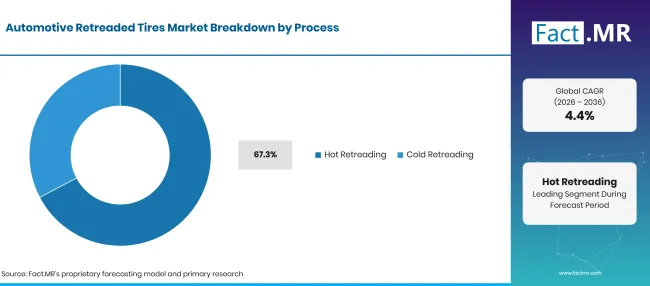
Factmr Automotive Retreaded Tires Market Breakdown Process | Source: Fact.MR
| Process | Share (2026) |
|---|---|
| Hot Retreading (Leading segment) | 67.3% |
| Other segments combined | 32.7%* |
| Total | 100.0% |
Source: Fact.MR analysis. Updated Oct 14, 2026
Hot retreading forms the tread pattern during the heating process. Cold retreading uses a pre-made tread that is attached to an inspected tire casing. These are two different retreading methods and are not part of the same product breakdown.
What is accelerating Automotive Retreaded Tires Market adoption, and what is holding it back?
Retread services can help fleets manage tire costs over the life of a tire. However, damaged casings and limited tire collection networks can reduce the number of tires available for retreading.
Drivers Impact Analysis
| DRIVER | (~) % IMPACT ON CAGR | GEOGRAPHIC RELEVANCE | IMPACT TIMELINE |
|---|---|---|---|
| Fleet tire cost management | +0.9%] | Global commercial fleets | Medium term (2–4 years) |
| Casing collection and tracking | +0.7% | North America, Europe | Medium term (2–4 years) |
| Commercial freight activity | +0.6% | UK, USA | Short term (<= 2 years) |
| Purpose-built tread patterns | +0.5% | Regional haulage networks | Medium term (2–4 years) |
| Workshop service contracts | +0.4% | Mature fleet markets | Long term (>= 4 years) |
Source: Fact.MR analysis. Updated Oct 14, 2026
Opportunity Impact Analysis
| OPPORTUNITY | (~) % IMPACT ON CAGR | GEOGRAPHIC RELEVANCE | IMPACT TIMELINE |
|---|---|---|---|
| Scheduled casing collection | +0.7% | Fleet operating hubs | Medium term (2–4 years) |
| Trailer retread product upgrades | +0.6% | North America | Short term (<= 2 years) |
| Regional distributor partnerships | +0.5% | Brazil, Europe | Medium term (2–4 years) |
| Tire life record systems | +0.4% | Large commercial fleets | Long term (>= 4 years) |
Source: Fact.MR analysis. Updated Oct 14, 2026
Restraints Impact Analysis
| RESTRAINT | (~) % IMPACT ON CAGR | GEOGRAPHIC RELEVANCE | IMPACT TIMELINE |
|---|---|---|---|
| Casing damage and rejection | -0.8% | All regions | Short term (<= 2 years) |
| Low-price new tire competition | -0.6% | Price-sensitive fleets | Medium term (2–4 years) |
| Workshop capacity constraints | -0.5% | Rural freight corridors | Medium term (2–4 years) |
| Variable return logistics | -0.4% | Dispersed fleet operations | Short term (<= 2 years) |
Source: Fact.MR analysis. Updated Oct 14, 2026
Which countries are scaling the Automotive Retreaded Tires Market through 2036?
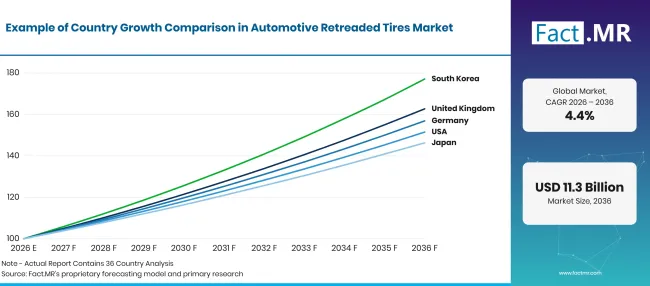
Factmr Automotive Retreaded Tires Market Growth Index | Source: Fact.MR
| Country | CAGR (2026–2036) |
|---|---|
| United Kingdom | 5.0% |
| Germany | 4.6% |
| United States | 4.2% |
| Japan | 3.9% |
| Brazil | 3.1% |
Source: Fact.MR analysis. Updated Oct 14, 2026
Why is the United Kingdom leading retreaded tire adoption?
5.0% CAGR, supported by intensive heavy-goods traffic and scheduled fleet servicing.
The United Kingdom stands out because commercial fleets operate on established freight routes and regularly return vehicles to service depots. The Department for Transport reported that GB-registered heavy goods vehicles travelled 19.0 billion kilometres in 2025 [1]. This creates regular demand for tire inspections and casing collection.
What supports Germany’s retread market growth?
4.6% CAGR, driven by structured fleet maintenance and tire-life management.
Germany has a well-developed freight sector and established vehicle maintenance practices. Fleet operators track tire condition throughout its service life and use maintenance records to identify casings suitable for retreading. Many regional distributors collect used casings during regular tire service visits, making the process easier for fleets to manage. Lower-priced new tires and the demands of international transport routes still influence replacement decisions.
How is the United States supporting retread purchases?
4.2% CAGR, backed by large long-haul fleets and established tire-service networks.
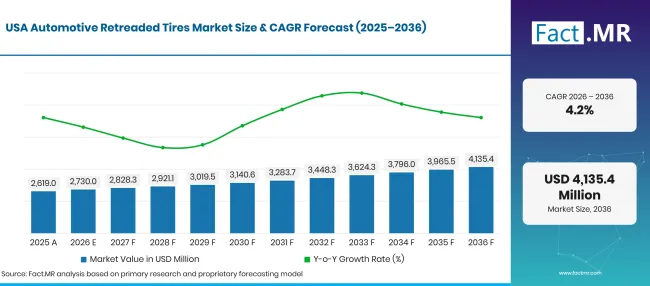
Factmr Automotive Retreaded Tires Market Forecast Usa | Source: Fact.MR
The United States has one of the world's largest commercial trucking networks. Long-haul fleets often work with tire service providers that collect casings and return retreaded tires across different locations. Fleet operators also choose tread patterns based on route conditions, weather, and axle position. This established service network supports steady use of retread tires, even when lower-priced new tires are available.
Why does Japan maintain steady retread adoption?
3.9% CAGR, shaped by scheduled delivery operations and route-specific tire servicing.
Japan combines busy urban delivery routes with regional trucking operations, making regular tire maintenance an important part of fleet planning. Fleet operators prefer dependable service schedules because vehicle downtime can disrupt deliveries. Service providers inspect casings, separate damaged tires, and use maintenance records to manage repeat retread orders. Route conditions and axle position also affect tread selection, making organized tire servicing a practical requirement.
What is shaping Brazil’s retreaded tire market?
3.1% CAGR, linked to road-freight intensity and access to local retread services.
Brazil's market is closely tied to long-distance trucking and the availability of workshops near major freight routes. The National Land Transport Agency reported 1.165 billion tonnes of road freight movement in 2025 [4]. The high volume of freight traffic creates regular demand for tire inspections and maintenance. Collection networks help workshops recover used casings when vehicles return from their routes. Long journeys, casing damage, workshop availability, and competition from lower-cost new tires all play a role in retread purchasing decisions.
Who supplies the Automotive Retreaded Tires Market?
Bridgestone supplies Bandag retread systems and commercial tire services. Michelin offers REMIX products for truck tire casings, while Continental provides ContiTread solutions for commercial fleets. Goodyear also participates through commercial truck-tire retreading solutions. According to Fact.MR analysis, workshop availability, casing qualification and fleet-service coverage can influence supplier selection.
In October 2025, Continental launched the ContiTread HTR trailer retread for regional and long-haul applications [3]. The two developments address different commercial-fleet applications and show continued product development around truck and trailer operating requirements.
Which companies are the key providers?
Key companies include Bridgestone Corporation; Michelin Group; Goodyear Tire & Rubber Company; Continental AG; Yokohama Rubber Company; Hankook Tire & Technology Co., Ltd.; Sumitomo Rubaber Industries, Ltd.; and Apollo Tyres Ltd.
- Bridgestone Corporation
- Michelin Group
- Goodyear Tire & Rubber Company
- Continental AG
- Yokohama Rubber Company
- Hankook Tire & Technology Co., Ltd.
- Sumitomo Rubber Industries, Ltd.
- Apollo Tyres Ltd.
Bibliography
- [1] Statistisches Bundesamt (Destatis). (2026, February 6). Production in December 2025: -1.9% on the previous month.
- [2] Statistisches Bundesamt (Destatis). (2026, February 20). China is Germany’s most important trading partner once again in 2025.
- [3] Statistisches Bundesamt (Destatis). (2026, September 21). Exports of new passenger cars down 4.0% year on year in the first seven months of 2026.
- [4] Department for Business and Trade. (2025, July 14). DRIVE35 Funding Programme: Transformation. GOV.UK.
- [5] Japan Automobile Manufacturers Association. (2026, February 27). 2025 [2025 fourth-quarter and annual overseas production statistics].
- [6] Japan Automobile Manufacturers Association. (2026, August 31). 2026 [2026 second-quarter and first-half overseas production statistics].
- [7] Office for National Statistics. (2025, November 6). Economic activity and social change in the UK, real-time indicators: 6 November 2025.
- [8] Department for Business and Trade. (2025, December 15). DRIVE35: Summary Business Case. GOV.UK.
- [9] German Association of the Automotive Industry. (2026, January 5). Passenger car production in 2025 slightly above previous year's level.
- [10] Society of Motor Manufacturers and Traders. (2026, February 20). SMMT Motor Industry Facts 2026.
- [11] Ministry of Economy, Trade and Industry. (2026, June 30). Indices of Industrial Production: Preliminary Report for May 2026.
This Report Answers
- The report explains how commercial and passenger vehicle retreads are classified by product and manufacturing process.
- Segment analysis reviews casing suitability and workshop operations behind the four specified 2026 shares.
- Country analysis compares tire servicing conditions across the United Kingdom, Germany, the United States, Japan and Brazil.
- Competitive analysis separates documented retreading programs from broader tire manufacturing activity.
- The report reviews opportunities in casing collection and aftermarket fleet service.
What does the Automotive Retreaded Tires Market cover?
The scope covers automotive tires that undergo a retreading process after the original tread has worn. It includes the new tread material and associated service value for qualifying casings used on commercial and passenger vehicles. The report covers both listed product types and both process categories without treating the categories as equivalent measures.
What is included in the scope?
Included activities comprise inspection of worn casings and use of new tread through appropriate retreading methods.
Commercial truck and light commercial fleet work are included alongside retreaded passenger tire uses. Aftermarket and OEM are retained as distinct sales channel categories.
What is excluded from the scope?
New tires sold without retreading are excluded from the retread market value. Standalone tire repair work without new tread use is also excluded.
Tires rejected at casing inspection are not counted as completed retread output. Retreading tools and workshop equipment are treated as inputs to service delivery rather than finished retread tire sales.
How Was the Analysis Built?
The analysis draws on 120+ sources, 35+ company portfolios, 25+ countries, and more than 20 industry interviews.
- Primary Research: Primary research includes discussions with manufacturers, service providers, technology developers, distributors, end users, and subject-matter experts. These conversations examine purchasing priorities, product adoption, operational challenges, approval requirements, competitive positioning, and the factors that influence wider market acceptance.
- Desk Research: Desk research covers government statistics, regulatory publications, company filings, trade data, technical studies, industry associations, standards, public policy, and other authoritative sources. Every source used in the analysis is documented in the bibliography.
- Market Sizing and Forecasting: Market estimates combine historical performance, demand indicators, pricing and volume trends, segment shares, company participation, country-level growth, adoption patterns, investment activity, and barriers to market expansion.
- Data Validation and Update Cycle: Findings are validated by comparing primary interviews with public data, company activity, regulatory changes, trade patterns, and industry developments. Regular updates review new product launches, capacity changes, partnerships, approvals, and shifts in commercial adoption.
Segmentation
What is the report’s scope and coverage?
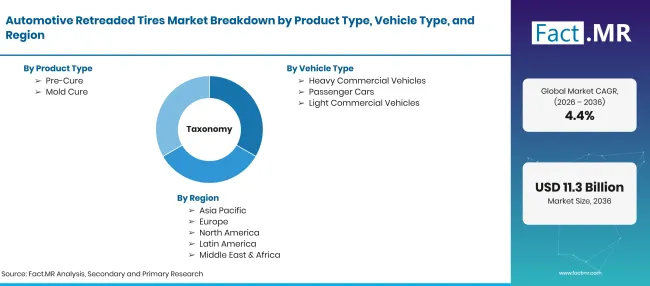
Factmr Automotive Retreaded Tires Market Taxonomy | Source: Fact.MR
| Attribute | Details |
|---|---|
| Quantitative Units | USD Billion |
| Market Definition | Retreaded automotive tires produced by applying new tread to suitable, inspected used tire casings. The market covers retread tires used across commercial and passenger vehicles, including the associated tread material and retreading service value. |
| Product Type | Pre-Cure; Mold Cure |
| Vehicle Type | Heavy Commercial Vehicles; Passenger Cars; Light Commercial Vehicles |
| Sales Channel | Aftermarket; OEM |
| Process | Hot Retreading; Cold Retreading |
| Regions Covered | North America; Latin America; Western Europe; Eastern Europe; East Asia; South Asia & Pacific; Middle East & Africa |
| Countries Covered | United Kingdom; Germany; United States; Japan; Brazil |
| Key Companies Profiled | Bridgestone Corporation; Michelin Group; Goodyear Tire & Rubber Company; Continental AG; Yokohama Rubber Company; Hankook Tire & Technology Co., Ltd.; Sumitomo Rubber Industries, Ltd.; and Apollo Tyres Ltd. |
| Forecast Period | 2026 to 2036 |
| Approach | Market assessment based on fleet service patterns, casing suitability, collection and return logistics, retread sales by product type, vehicle type, sales channel and process, supported by official freight statistics and dated manufacturer product information. |
Source: Fact.MR analysis. Updated Oct 14, 2026
How is the market segmented?
-
By Product Type:
- Pre-Cure
- Mold Cure
-
By Vehicle Type:
- Heavy Commercial Vehicles
- Passenger Cars
- Light Commercial Vehicles
-
By Sales Channel:
- Aftermarket
- OEM
-
By Process:
- Hot Retreading
- Cold Retreading
-
By Region:
- North America
- Latin America
- Western Europe
- Eastern Europe
- East Asia
- South Asia & Pacific
- Middle East & Africa
Frequently Asked Questions
How big is the automotive retreaded tires market in 2026?
What is the CAGR from 2026 to 2036?
Which product type accounts for the largest listed share?
Which vehicle type leads the outlook?
Which companies are active in documented commercial retreading?
Who worked on this report


Preview the report firsthand - request a free sample
Free SampleGet the brochure for pricing and purchase details
Download PDF