- Market Value (2025): USD 3.73 Bn
- Estimated Value (2026): USD 4.25 Bn
- Forecast Value (2036): USD 15.6 Bn
- CAGR (2026-2036): 13.9%
What is the Automotive Semiconductors for Battery Management Market forecast to be worth by 2036?
USD 4.3 billion in 2026 to USD 15.6 billion by 2036 at a 13.9% CAGR.
- Fact.MR estimates that the automotive semiconductors for battery management market reached USD 3.73 billion in 2025, a base built mostly on high-voltage traction packs.
- Revenue will climb from USD 4.25 billion in 2026 to USD 15.6 billion by 2036 as more cells per vehicle need monitoring.
- Sales will compound at 13.9% CAGR over 2026 to 2036, since larger high-voltage packs lift chip content per vehicle.
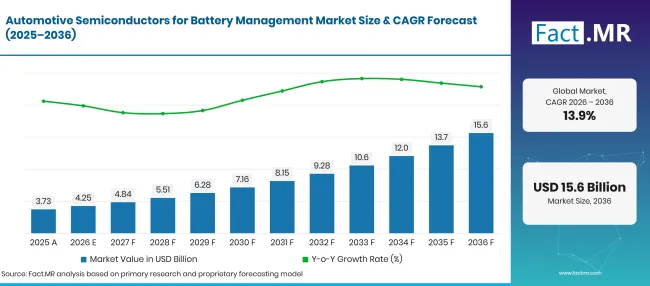
Factmr Automotive Semiconductors For Battery Management Market Forecast Global | Source: Fact.MR
| Year | Basis | Market Value (USD billion) |
|---|---|---|
| 2025 | Actual | 3.73 |
| 2026 | Estimate | 4.25 |
| 2036 | Forecast | 15.6 |
| CAGR 2026 to 2036 | Forecast period | 13.9% |
Source: Fact.MR analysis. Updated Oct 15, 2026
What are the defining numbers behind Automotive Semiconductors for Battery Management Market growth?
The 2026 to 2036 period adds USD 11.3 billion in new value, concentrated in high-voltage cell monitoring.
- Demand Drivers in the Market
- Electric car sales set the base volume for battery management chips. The International Energy Agency reported that global electric car sales passed 20 million in 2025, equal to 25% of the car market [1]. Each of these vehicles carries a high-voltage pack that needs cell monitoring and protection.
- Battery volume is growing faster than vehicle count as packs get larger. Global EV battery deployment reached 1.2 TWh in 2025, an increase of almost 30% over 2024, according to the International Energy Agency [2].
- Durability rules are moving into heavy vehicles. In October 2025, the European Commission proposed that the EU back a new UN global technical regulation with common methods to determine in-vehicle battery durability for electrified heavy-duty vehicles [3].
- Functional safety targets raise chip content per pack. Vehicle makers specify ISO 26262 ASIL D safety for battery systems, so suppliers add redundant measurement paths. These features will lift the value of each chipset.
- Key Segments Analyzed
- By Component: Battery Management ICs will take 32.4% share in 2026, as every series cell group needs its own voltage sensing, temperature inputs and balancing channel.
- By Vehicle Type: Electric Vehicles will command 54.2% share in 2026, with each high-voltage pack carrying long strings of cells to watch.
- By Application: Battery Monitoring will capture 35.8% share in 2026 on the strength of readings taken many times per second during driving and charging.
- By Distribution Channel: OEMs will represent 84.6% share in 2026, since chips are locked in at the pack design stage for multi-year platform programs.
- Analyst Opinion at Fact.MR
- Shambhu Nath Jha, Principal Consultant at Fact.MR, states, “Battery management chips will move from basic measurement toward diagnostics that estimate cell health inside the vehicle. Suppliers that pair accurate cell monitors with safety microcontrollers and ready software will win more pack platforms. Wireless links and impedance sensing will separate the next generation of chipsets from the current one.”
- Strategic Implications
- Chip suppliers should qualify cell monitors for lithium iron phosphate packs, given that flat voltage curves require millivolt-level accuracy for state-of-charge estimates.
- Battery pack makers should evaluate wireless and impedance-capable chipsets early in platform design, since harness removal and health tracking change module layout.
- Vehicle makers should source cell monitors, safety microcontrollers and power supply chips as one validated chipset where possible, cutting software integration time.
The United States will set the pace at 14.8% CAGR as hybrid and electric vehicle sales rise and new domestic chip output comes online. Germany will follow at 14.1% as battery electric car registrations climb. Japan will record 12.7% with a strong semiconductor export base. The United Kingdom will post 11.7% on a growing zero emission fleet, while Brazil will close at 11.0% where electric car sales are rising from a low base.
How does the Automotive Semiconductors for Battery Management Market break down by segment?
Component: Battery Management ICs at 32.4%; Vehicle Type: Electric Vehicles at 54.2%; Application: Battery Monitoring at 35.8%; Distribution Channel: OEMs at 84.6%, all in 2026.
Which Component dominates?
Battery Management ICs take 32.4% of 2026 sales.
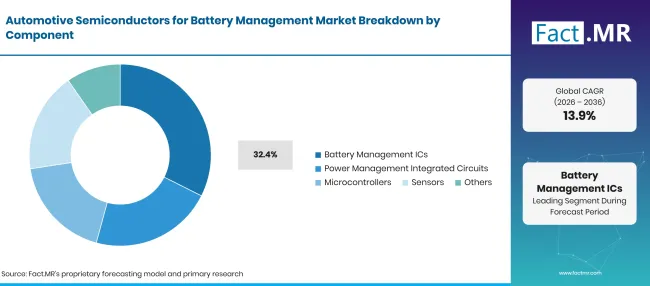
Factmr Automotive Semiconductors For Battery Management Market Breakdown Component | Source: Fact.MR
| Component | Share (2026) |
|---|---|
| Battery Management ICs (Leading segment) | 32.4% |
| Other segments combined | 67.6%* |
| Total | 100.0% |
Source: Fact.MR analysis. Updated Oct 15, 2026
Every group of series cells in a pack relies on a dedicated chip to read voltages and balance charge. That core cell work falls to battery management ICs in each module. Larger packs and 800V architectures need more battery management ICs per vehicle, linked in a daisy chain along the pack. Microcontrollers run state-of-charge and state-of-health algorithms. Power management integrated circuits supply stable rails, and sensors track pack current and isolation. In May 2026, STMicroelectronics released the L9963F battery management IC as a drop-in upgrade for existing L9963 designs, with ASIL-D readiness under ISO 26262 [4].
What leads the Vehicle Type segment?
Electric Vehicles make up 54.2% of 2026 revenue.
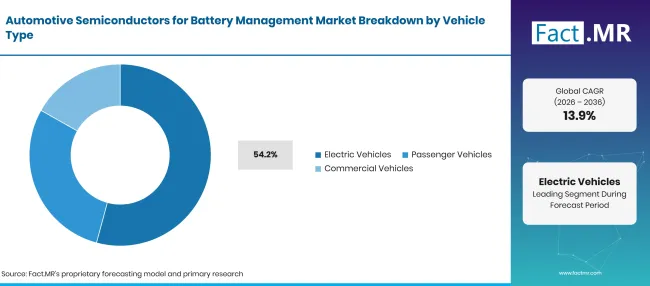
Factmr Automotive Semiconductors For Battery Management Market Breakdown Vehicle Type | Source: Fact.MR
| Vehicle Type | Share (2026) |
|---|---|
| Electric Vehicles (Leading segment) | 54.2% |
| Other segments combined | 45.8%* |
| Total | 100.0% |
Source: Fact.MR analysis. Updated Oct 15, 2026
Battery electric and plug-in hybrid models carry high-voltage packs with long strings of series cells. Each pack needs cell monitors, a pack monitor and a safety microcontroller. Cell chemistry changes the accuracy target. Lithium iron phosphate accounted for over 55% of EV batteries deployed globally in 2025, according to the International Energy Agency [2]. Passenger vehicles and commercial vehicles with combustion or mild hybrid powertrains use battery sensors on 12V and 48V systems. These sensors track charge to protect start-stop functions. Fleet operators of electric trucks and buses value health data that supports electric vehicle battery warranty claims.
How does Application shape demand?
Battery Monitoring holds 35.8% of 2026 demand.
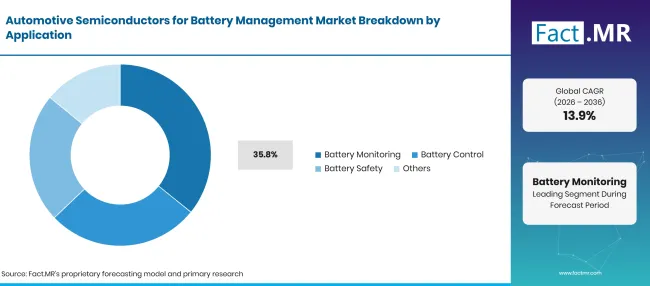
Factmr Automotive Semiconductors For Battery Management Market Breakdown Application | Source: Fact.MR
| Application | Share (2026) |
|---|---|
| Battery Monitoring (Leading segment) | 35.8% |
| Other segments combined | 64.2%* |
| Total | 100.0% |
Source: Fact.MR analysis. Updated Oct 15, 2026
Cell voltage, current and temperature must be read many times per second while the vehicle drives and charges, so monitoring never pauses. Readings from pack temperature and voltage sensors feed every other function in the pack. Battery control covers contactor switching, charge limits and cell balancing. The safety function covers isolation monitoring, overcurrent detection and thermal event warnings. In October 2025, NXP introduced a battery management chipset with electrochemical impedance spectroscopy, which measures how each cell responds across frequencies to reveal aging effects or micro short circuits [5].
What supports OEMs within Distribution Channel?
OEMs command 84.6% of 2026 purchases.
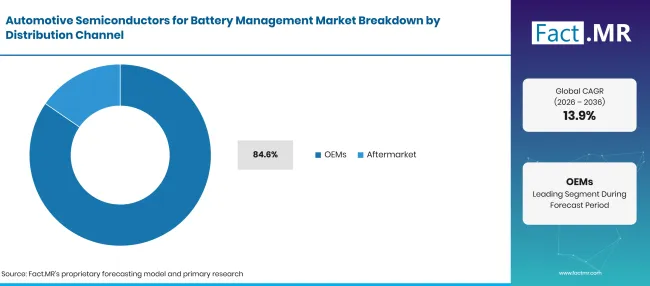
Factmr Automotive Semiconductors For Battery Management Market Breakdown Distribution Channel | Source: Fact.MR
| Distribution Channel | Share (2026) |
|---|---|
| OEMs (Leading segment) | 84.6% |
| Other segments combined | 15.4%* |
| Total | 100.0% |
Source: Fact.MR analysis. Updated Oct 15, 2026
Chip choice happens while the pack is still in design, and vehicle makers keep that choice for the full platform program. The aftermarket serves replacement battery sensors, repair modules and second-life packs. Cheaper batteries widen this pool, with the International Energy Agency reporting that average battery prices declined by 8% in 2025 [2].
What is accelerating Automotive Semiconductors for Battery Management Market adoption, and what is holding it back?
Adoption will rise with electric and hybrid vehicle sales, larger packs and stricter safety and durability rules. Growth is constrained by price pressure from vehicle makers, slower battery electric sales in some markets and long automotive qualification cycles.
Drivers Impact Analysis
| DRIVER | (~) % IMPACT ON CAGR | GEOGRAPHIC RELEVANCE | IMPACT TIMELINE |
|---|---|---|---|
| Electric and plug-in hybrid vehicle sales that add high-voltage packs | +2.8% | East Asia, Western Europe, North America | Short term (<= 2 years) |
| Larger packs and 800V architectures that raise monitoring channels per vehicle | +2.3% | Global | Medium term (2-4 years) |
| Functional safety and battery durability rules that require health diagnostics | +1.9% | Western Europe, North America, East Asia | Medium term (2-4 years) |
| Hybrid and 48V system growth on combustion-based platforms | +1.4% | North America, East Asia, Latin America | Short term (<= 2 years) |
| Lithium iron phosphate adoption that demands higher measurement accuracy | +1.0% | East Asia, Western Europe | Long term (>= 4 years) |
Source: Fact.MR analysis. Updated Oct 15, 2026
Opportunity Impact Analysis
| OPPORTUNITY | (~) % IMPACT ON CAGR | GEOGRAPHIC RELEVANCE | IMPACT TIMELINE |
|---|---|---|---|
| Wireless battery management systems that remove pack wiring harnesses | +1.3% | North America, Western Europe | Long term (>= 4 years) |
| Impedance-based cell health sensing for warranty and resale data | +1.0% | Global | Medium term (2-4 years) |
| Battery management chips for electric trucks and buses | +0.8% | Western Europe, North America, East Asia | Long term (>= 4 years) |
Source: Fact.MR analysis. Updated Oct 15, 2026
Restraints Impact Analysis
| RESTRAINT | (~) % IMPACT ON CAGR | GEOGRAPHIC RELEVANCE | IMPACT TIMELINE |
|---|---|---|---|
| Price pressure from vehicle makers on chipset sourcing | -1.2% | Global | Short term (<= 2 years) |
| Slower battery electric car sales after incentive changes | -0.9% | North America | Short term (<= 2 years) |
| Long automotive qualification cycles for new chip designs | -0.6% | Global | Medium term (2-4 years) |
Source: Fact.MR analysis. Updated Oct 15, 2026
Which countries are scaling the Automotive Semiconductors for Battery Management Market through 2036?
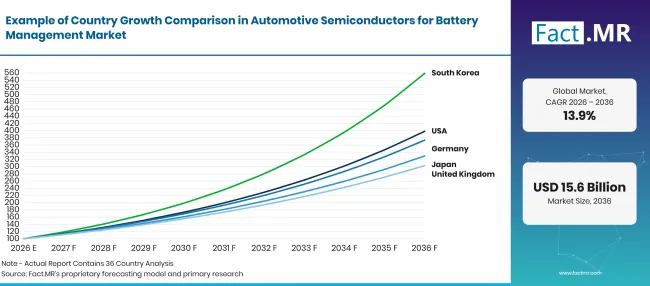
Factmr Automotive Semiconductors For Battery Management Market Growth Index | Source: Fact.MR
| Country | CAGR (2026–2036) |
|---|---|
| United States | 14.8% |
| Germany | 14.1% |
| Japan | 12.7% |
| United Kingdom | 11.7% |
| Brazil | 11.0% |
Source: Fact.MR analysis. Updated Oct 15, 2026
What supports United States adoption?
14.8% CAGR, backed by rising hybrid sales and new domestic chip capacity.
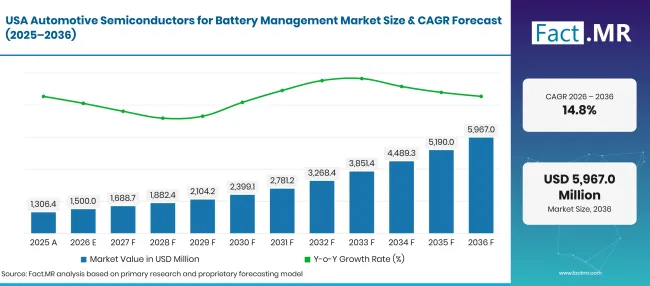
Factmr Automotive Semiconductors For Battery Management Market Forecast Usa | Source: Fact.MR
The U.S. Energy Information Administration reported that 24% of new light-duty vehicles sold in the United States in the second quarter of 2026 were hybrid, battery electric or plug-in hybrid models [6]. Hybrids alone reached a record 16% of light-duty sales in that quarter [6]. Texas Instruments began production at its newest 300mm wafer fab in Sherman, Texas in December 2025, making analog and embedded processing chips for uses that include automotive systems [7].
What is supporting Germany’s adoption?
14.1% CAGR, reflecting fast growth in battery electric car registrations.
Germany’s Kraftfahrt-Bundesamt reported 545,142 new battery electric car registrations in 2025, up 43.2% and equal to 19.1% of all new cars [8]. Registered battery electric cars reached 2,034,260 at the start of 2026, the first count above two million [9]. Infineon offers a complete battery management chipset with ASIL-D safety from its base in Germany.
How is Japan developing demand?
12.7% CAGR, on the back of semiconductor exports and large vehicle output.
Japan’s Ministry of Finance reported that exports of semiconductors and related devices rose 8.4% in 2025 to about 6.6 trillion yen [10]. The same trade data show that Japan exported 5,896,177 motor vehicles in 2025 [10]. Renesas builds its electric vehicle battery management design around its ISL78714 battery manager and RH850 automotive microcontrollers.
How is the United Kingdom scaling demand?
11.7% CAGR, driven by a growing zero emission vehicle fleet.
The Department for Transport reported that zero emission vehicles made up 4.8% of all licensed vehicles in the United Kingdom at the end of 2025 [11]. That licensed zero emission fleet reached 2,012,000 vehicles [11]. Zero emission cars registered for the first time in 2025 rose 24% to 473,000 [11].
How does Brazil perform?
11.0% CAGR, helped by rising electric car adoption from a low base.
The International Energy Agency reported that electric car sales in Brazil reached 180,000 in 2025 [1]. That volume equaled 9% of new car sales, up from 6.5% in 2024 [1]. Local assembly of electric and hybrid models will raise demand for battery management chipsets through Tier 1 pack suppliers.
Who leads the Automotive Semiconductors for Battery Management Market?
Competition runs across two groups of chip suppliers.The first group sells complete battery management chipsets and competes on cell measurement accuracy and ASIL D safety. NXP and Texas Instruments are pushing this group toward impedance sensing inside cell monitors. Texas Instruments introduced the BQ79826Z-Q1 battery monitor in June 2026 with an integrated impedance spectroscopy engine that gives early warning of cell faults [12].
Analog Devices brought wireless battery management into series production. Infineon and STMicroelectronics pair cell monitors with automotive microcontrollers from their own portfolios. The second group competes on microcontrollers, power devices and sensing. Renesas combines battery manager ICs with RH850 microcontrollers, while onsemi supplies switches, gate drivers and current sensing for pack protection. Microchip launched an electric two-wheeler ecosystem in March 2025 that includes a battery management system with intelligent power conversion and sensing [13]. Supplier wins will turn on measurement accuracy, health diagnostics and validated software.
Which companies are the key providers?
Key companies include Infineon Technologies AG; NXP Semiconductors N.V.; Texas Instruments Incorporated; STMicroelectronics N.V.; Renesas Electronics Corporation; onsemi; Analog Devices, Inc.; and Microchip Technology Incorporated.
- Infineon Technologies AG
- NXP Semiconductors N.V.
- Texas Instruments Incorporated
- STMicroelectronics N.V.
- Renesas Electronics Corporation
- onsemi
- Analog Devices, Inc.
- Microchip Technology Incorporated
Bibliography
- [1] International Energy Agency. (2026, May 20). Global EV Outlook 2026: Trends in electric cars.
- [2] International Energy Agency. (2026, May 20). Global EV Outlook 2026: Electric vehicle batteries.
- [3] European Commission. (2025, October 8). Proposal for a Council Decision on the position to be taken on behalf of the European Union within the World Forum for Harmonization of Vehicle Regulations of the United Nations Economic Commission for Europe as regards the November 2025 proposals for UN regulations.
- [4] STMicroelectronics. (2026, May 21). Enhanced version of an industry-proven battery-management IC.
- [5] NXP Semiconductors. (2025, October 29). NXP Improves Battery Health Monitoring with EIS Capable Battery Management Chipset.
- [6] U.S. Energy Information Administration. (2026, July 27). Hybrid sales rise while battery electric sales remain lower after tax credit expiration.
- [7] Texas Instruments. (2025, December 17). Texas Instruments begins production at its newest 300mm semiconductor manufacturing facility in Sherman, Texas.
- [8] Kraftfahrt-Bundesamt. (2026, January 6). Fahrzeugzulassungen im Dezember 2025 - Jahresbilanz [Vehicle registrations in December 2025: annual review].
- [9] Kraftfahrt-Bundesamt. (2026, February 27). Zahl der in Deutschland zugelassenen reinen Elektrofahrzeuge überschreitet erstmals die Zwei-Millionen-Marke [Number of battery electric vehicles registered in Germany exceeds two million for the first time].
- [10] Ministry of Finance, Japan. (2026, March 12). Trade Statistics: Value of Exports and Imports 2025 (Calendar Year) (January-December) (Revised Data).
- [11] Department for Transport. (2026, April 29). Vehicle licensing statistics, United Kingdom: 2025.
- [12] Texas Instruments. (2026, June 9). TI brings intelligence to battery management systems with industry’s highest-cell-count EIS-enabled battery monitor.
- [13] Microchip Technology Incorporated. (2025, March 17). Microchip Introduces Electric Two-Wheeler Ecosystem to Accelerate E-Mobility Innovation.
This Report Answers
- Readers learn how battery management semiconductors are sold by component, vehicle type, application and channel.
- Each segment’s leading subsegment is traced back to the operating factors behind its 2026 share.
- Powertrain mix, electric vehicle adoption and local chip supply frame the comparison of the five listed countries.
- The company section sets out which suppliers are active in battery management chips and with what product lines.
- Impedance sensing and wireless links are examined for how they change chip content per pack.
What does the Automotive Semiconductors for Battery Management Market cover?
Chips that measure, control and protect vehicle battery cells and packs form this market. Its product base spans battery management ICs, power management integrated circuits, microcontrollers and sensors used in battery management systems.
The assessment tracks all vehicle types and applications across OEM and aftermarket channels.
What is included in the scope?
Cell and pack monitors, safety microcontrollers, supply ICs and current or isolation sensors fitted to vehicle batteries are counted. Both high-voltage traction packs and 12V or 48V systems fall inside the boundary.
Chips delivered inside complete battery management systems are counted at the value of their semiconductor content.
What is excluded from the scope?
Traction inverters, onboard chargers and DC-DC converters stay outside, since they belong to automotive power electronics. Battery cells, enclosures and cooling hardware are excluded as well.
Chips for infotainment, driver assistance and body control fall within the wider automotive semiconductor space and are excluded. Battery management chips for consumer electronics and stationary storage fall outside the revenue boundary.
How Was the Analysis Built?
The analysis draws on 120+ sources, 35+ company portfolios, 25+ countries, and more than 20 industry interviews.
- Primary Research: Primary research includes discussions with manufacturers, service providers, technology developers, distributors, end users, and subject-matter experts. These conversations examine purchasing priorities, product adoption, operational challenges, approval requirements, competitive positioning, and the factors that influence wider market acceptance.
- Desk Research: Desk research covers government statistics, regulatory publications, company filings, trade data, technical studies, industry associations, standards, public policy, and other authoritative sources. Every source used in the analysis is documented in the bibliography.
- Market Sizing and Forecasting: Market estimates combine historical performance, demand indicators, pricing and volume trends, segment shares, company participation, country-level growth, adoption patterns, investment activity, and barriers to market expansion.
- Data Validation and Update Cycle: Findings are validated by comparing primary interviews with public data, company activity, regulatory changes, trade patterns, and industry developments. Regular updates review new product launches, capacity changes, partnerships, approvals, and shifts in commercial adoption.
Segmentation
What is the report’s scope and coverage?
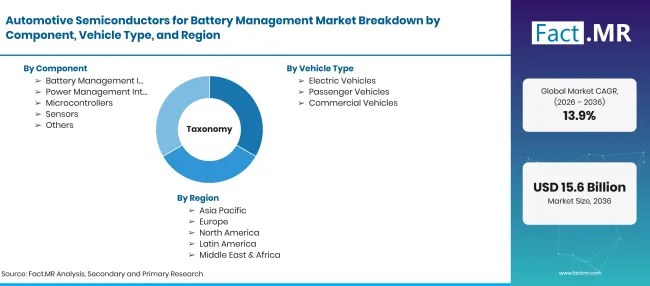
Factmr Automotive Semiconductors For Battery Management Market Taxonomy | Source: Fact.MR
| Attribute | Details |
|---|---|
| Quantitative Units | USD billion |
| Market Definition | Semiconductors used in vehicle battery management systems to measure, control and protect battery cells and packs. The scope covers battery management ICs, power management integrated circuits, microcontrollers and sensors sold to vehicle makers and through the aftermarket. |
| Component | Battery Management ICs; Power Management Integrated Circuits; Microcontrollers; Sensors; Others |
| Vehicle Type | Electric Vehicles; Passenger Vehicles; Commercial Vehicles; Others |
| Application | Battery Monitoring; Battery Control; Battery Safety |
| Distribution Channel | OEMs; Aftermarket |
| Regions Covered | North America; Latin America; Western Europe; Eastern Europe; East Asia; South Asia & Pacific; Middle East & Africa |
| Countries Covered | United States; Germany; Japan; United Kingdom; Brazil |
| Companies Profiled | Infineon Technologies AG; NXP Semiconductors N.V.; Texas Instruments Incorporated; STMicroelectronics N.V.; Renesas Electronics Corporation; onsemi; Analog Devices, Inc.; Microchip Technology Incorporated |
| Forecast Period | 2026 to 2036 |
| Approach | Hybrid top-down and bottom-up approach using powertrain mix, semiconductor content per pack, channel split and supplier portfolio review. |
Source: Fact.MR analysis. Updated Oct 15, 2026
How is the market segmented?
-
ByComponent:
- Battery Management ICs
- Power Management Integrated Circuits
- Microcontrollers
- Sensors
- Others
-
By Vehicle Type:
- Electric Vehicles
- Passenger Vehicles
- Commercial Vehicles
- Others
-
By Application:
- Battery Monitoring
- Battery Control
- Battery Safety
-
By Distribution Channel:
- OEMs
- Aftermarket
-
By Region:
- North America
- Latin America
- Western Europe
- Eastern Europe
- East Asia
- South Asia & Pacific
- Middle East & Africa
Frequently Asked Questions
How big is the automotive semiconductors for battery management market in 2026?
What is the CAGR of the automotive semiconductors for battery management market from 2026 to 2036?
Which component leads the automotive semiconductors for battery management market?
Which vehicle type leads the automotive semiconductors for battery management market?
Which application leads the automotive semiconductors for battery management market?
Which distribution channel leads the automotive semiconductors for battery management market?
Which country will grow the most in the automotive semiconductors for battery management market?
Who are the main companies in the automotive semiconductors for battery management market?
Who worked on this report


Preview the report firsthand - request a free sample
Free SampleGet the brochure for pricing and purchase details
Download PDF