- Market Value (2025): USD 76.3 Mn
- Estimated Value (2026): USD 95.0 Mn
- Forecast Value (2036): USD 850.0 Mn
- CAGR (2026-2036): 24.5%
What is the autonomous aircraft towing market forecast to be worth by 2036?
USD 95.0 million in 2026 to USD 850.0 million by 2036, at 24.5% CAGR.
- The autonomous aircraft towing market crossed a valuation of USD 76.3 million in 2025.
- Demand is expected to increase from USD 95.0 million in 2026 to USD 850.0 million by 2036.
- The market is forecast to record a 24.5% CAGR from 2026 to 2036 as airports test remote-supervised towing, engine-off aircraft movement and site-specific apron validation.
- Remote-supervised and semi-autonomous towing systems form the core of this market. In 2024, global airport passenger traffic reached 9.5 billion. This recovery placed more pressure on turnaround discipline and stand movement planning at large airports.
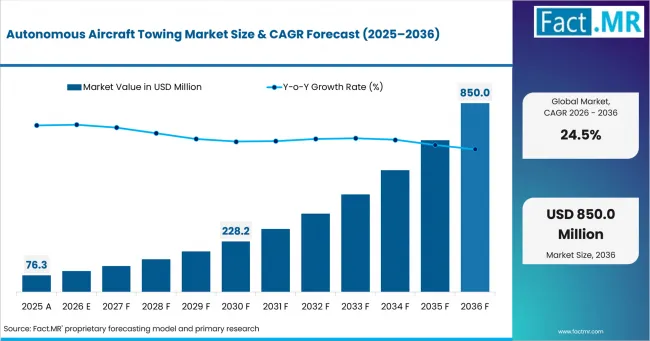
Autonomous Aircraft Towing Market Market Value Analysis | Source: Fact.MR
What are the defining numbers behind autonomous aircraft towing growth?
USD 755.0 million absolute opportunity by 2036, led by remote-supervised systems and narrowbody aircraft.
- Demand Drivers in the Market
- Ground handlers need towing systems that reduce operator exposure during repetitive apron movement.
- Airlines want engine-off movement where airport rules and aircraft compatibility permit use.
- Airport operators need geofenced movement paths because mixed ramp traffic creates route conflicts.
- Maintenance Repair and Overhaul facilities need low-speed remote towing for hangar repositioning.
- Key Segments Analyzed
- By Automation Level: Remote-supervised systems are expected to hold 38.0% share in 2026 because airports prefer human oversight during early autonomy use.
- By Operation: Pushback accounts for 41.0% share in 2026 because the task repeats across scheduled departures.
- By Aircraft Class: Narrowbody aircraft lead with 46.0% share in 2026 because Airbus A320 and Boeing 737 families carry the largest early fit case.
- By Guidance Tech: Light Detection and Ranging is projected to hold 32.0% share in 2026 because live apron routes need obstacle detection.
- By Buyer Type: Ground handlers are likely to account for 34.0% share in 2026 because they operate tug fleets under airline service contracts.
- By Geography: China is projected to record a 27.8% CAGR through 2036 as high airport throughput supports supervised towing trials.
- Analyst Opinion at Fact.MR
- Shambhu Nath Jha, Senior Analyst at Fact.MR, states, “Autonomous aircraft towing is not moving straight to driverless aircraft movement. Buyers are first paying for supervised control and certified aircraft fit. Providers that prove safe apron behavior before full autonomy should gain the first commercial programs.”
- Strategic Implications
- Suppliers should sell site validation and operator training with each autonomous towing program.
- Ground handlers should start with pushback and gate repositioning because these routes are easier to repeat.
- Airports should audit charging points, stand geometry and ramp traffic rules before procurement.
- Airlines should specify aircraft family coverage because narrowbody compatibility controls early utilization.
China is projected to record 27.8% CAGR through 2036 as high airport throughput supports supervised towing trials. India is expected to expand at a 27.2% CAGR because airport capacity additions create new ground support procurement windows. The United States is forecast to grow at 25.8% CAGR as hub airports need safer pushback and repositioning workflows. Germany is expected to advance at 24.9% CAGR because safety review and service documentation shape airport equipment procurement. France is projected to rise at 24.4% CAGR as airport movement density and local supplier presence support early programs.
How does the autonomous aircraft towing market break down by segment?
Remote-supervised systems lead at 38.0%; pushback leads at 41.0%.
Which automation level dominates?
Remote-supervised systems hold 38.0% share in 2026.
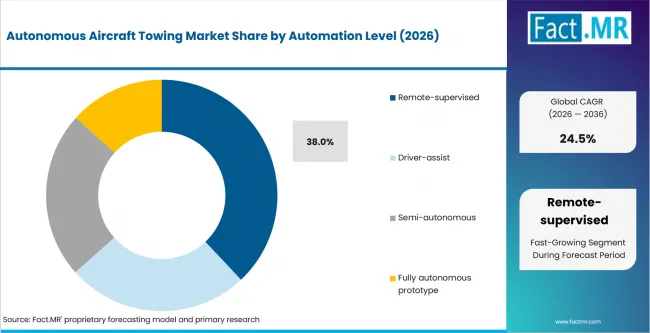
Autonomous Aircraft Towing Market Analysis By Automation Level | Source: Fact.MR
Remote supervision leads because airport safety teams can keep human control inside the towing loop. Airport buyers still compare these systems with related aircraft tugs before they approve autonomous movement. Fully autonomous prototypes remain important, but commercial orders are more likely to begin with supervised routes. This gives suppliers a path to collect field data before removing operators from the vehicle.
Which operation dominates?
Pushback accounts for 41.0% share in 2026.
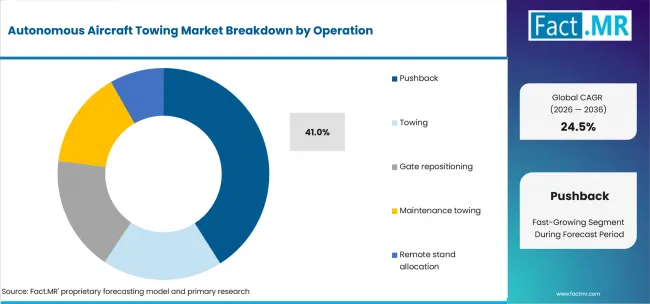
Autonomous Aircraft Towing Market Analysis By Operation | Source: Fact.MR
Pushback leads because every departure creates a repeat towing task. Airlines can compare time, fuel and safety records across similar stands. This repeatability makes pushback easier to validate than free-form apron movement. Airport buyers also compare towing automation with conventional aircraft tow tractors when they plan fleet replacement. This keeps compatibility and service access inside the buying case.
Which aircraft class dominates?
Narrowbody aircraft hold 46.0% share in 2026.
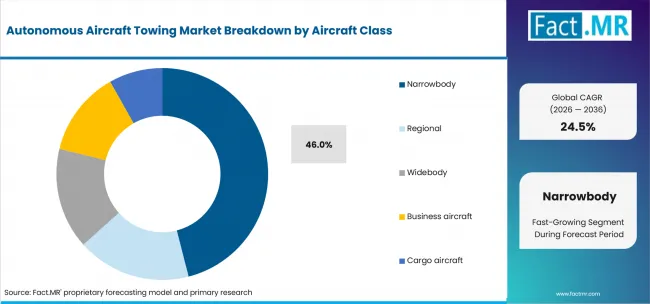
Autonomous Aircraft Towing Market Analysis By Aircraft Class | Source: Fact.MR
Narrowbody aircraft lead because high-frequency routes create more towing events per aircraft family. TaxiBot is certified for Airbus A320 family aircraft and Boeing 737 NG aircraft. This supports the early commercial fit for narrowbody use.
Which guidance technology dominates?
Light Detection and Ranging leads with 32.0% share in 2026.
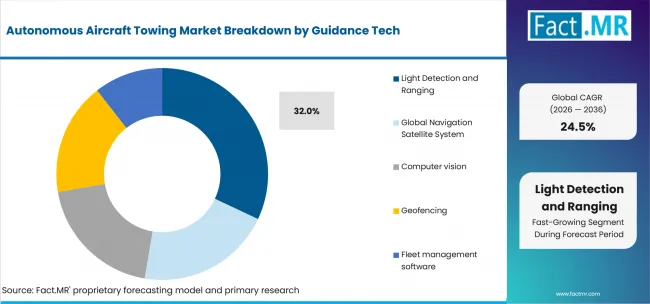
Autonomous Aircraft Towing Market Analysis By Guidance Tech | Source: Fact.MR
Light Detection and Ranging leads because apron routes contain people, carts and service vehicles. Towing suppliers still combine it with Global Navigation Satellite System support and aircraft sensors where aircraft compatibility matters. Computer vision and geofencing are likely to gain share as airports add mapped stand zones. Fleet management software becomes more useful when a ground handler runs several automated units together.
Which buyer type dominates?
Ground handlers account for 34.0% share in 2026.
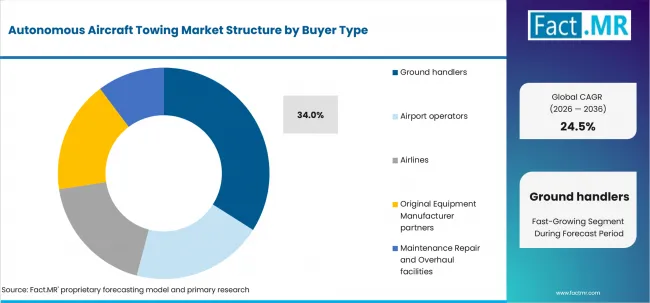
Autonomous Aircraft Towing Market Analysis By Buyer Type | Source: Fact.MR
Ground handlers lead because they staff ramps and manage tug fleets for airlines. They also carry the operating risk when a towing unit delays a turn. Airlines influence specifications, but ground handlers often control the daily procurement case.
What is accelerating autonomous aircraft towing adoption, and what is holding it back?
Remote-supervised apron movement and engine-off aircraft towing drive it. Live apron approval burden and charging route data gaps hold it back.
Drivers Impact Analysis
| DRIVER | (~) % IMPACT ON CAGR |
GEOGRAPHIC RELEVANCE | IMPACT TIMELINE |
|---|---|---|---|
| Remote-supervised apron movement | +5.8% | Global, strongest in hub airports | Short term (<= 2 years) |
| Engine-off aircraft movement economics | +5.2% | USA, China, Europe | Medium term (2-4 years) |
| Ground handling labor pressure | +4.6% | Japan, USA, India, Europe | Medium term (2-4 years) |
| Electric ground support procurement | +4.1% | Europe, North America, China | Long term (>= 4 years) |
| Aircraft family certification proof | +3.7% | Global, strongest in narrowbody fleets | Short term (<= 2 years) |
Source: Fact.MR analysis. Updated Jul 4, 2026
Remote supervision inside aprons
Airports are not moving directly from manual tugs to uncontrolled towing. They are testing systems that keep an operator or safety team involved. This lowers the approval barrier because live aprons still have pedestrians, service vehicles and aircraft under tight spacing. Remote supervision therefore becomes the first commercial step before wider autonomy.
Engine-off taxi economics
Aircraft towing gains attention when it reduces engine use during taxi or repositioning. TaxiBot is designed to let aircraft taxi without jet engine power until the aircraft nears takeoff. The economics depend on route length and aircraft family. Airports with long taxi routes have a clearer payback case than compact regional airports.
Labor pressure on ramps
Ramp work remains labor-intensive and training-heavy. Japan’s transport ministry reported that about 40% of ground handling employees had less than three years of experience. Automation does not remove the need for trained staff. It changes the work from vehicle driving toward supervised movement, exception handling and safety checks. Warehouses made a similar staged move with autonomous mobile robots.
Opportunity Impact Analysis
| OPPORTUNITY | (~) % IMPACT ON CAGR |
GEOGRAPHIC RELEVANCE | IMPACT TIMELINE |
|---|---|---|---|
| Pre-certified narrowbody packages | +5.4% | China, USA, India, France | Medium term (2-4 years) |
| Remote stand allocation links | +4.8% | Large hub airports | Short term (<= 2 years) |
| Maintenance towing pilots | +4.2% | USA, Germany, Japan | Short term (<= 2 years) |
| Airport route data services | +3.9% | Global | Medium term (2-4 years) |
| Charging and fleet service bundles | +3.5% | Europe, China, India | Long term (>= 4 years) |
Source: Fact.MR analysis. Updated Jul 4, 2026
Pre-certified narrowbody packages
The practical near-term package is a supervised system built around narrowbody aircraft. Buyers want aircraft-family evidence, operator training and airport route approval before volume procurement. Suppliers that prepare this package can shorten buyer testing cycles. The opportunity resembles the way warehouses first applied automated guided vehicles on repeat routes before wider layout changes. Airport towing is more regulated, but the repeat-route logic is similar.
Remote stand allocation links
Gate congestion gives autonomous towing a stronger software angle. A tug that receives stand instructions and follows approved routes can reduce dispatcher calls. This matters at hub airports where remote stands and towing windows shape flight recovery after delays.
Maintenance towing pilots
Maintenance facilities offer a controlled setting for early deployments. Routes are shorter and the operating environment is easier to map than an active passenger apron. This can make hangar towing a useful proof point before a supplier moves into hub pushback. The same site managers may compare aircraft movement with yard equipment such as terminal tractors when they evaluate remote control and low-speed maneuvering. This helps explain why industrial vehicle suppliers are watching airport towing.
Restraints Impact Analysis
|
RESTRAINT |
(~) % IMPACT |
GEOGRAPHIC RELEVANCE |
IMPACT |
|
Live apron approval burden |
-4.8% |
Global, strongest in major hubs |
Medium term (2-4 years) |
|
Charging and route data gaps |
-3.9% |
India, Latin America, parts of Europe |
Medium term (2-4 years) |
|
Mixed ground fleet control |
-3.4% |
USA, Europe, East Asia |
Short term (<= 2 years) |
|
Aircraft compatibility limits |
-2.8% |
Global |
Long term (>= 4 years) |
|
Higher capital cost than manual tugs |
-2.5% |
Emerging airport markets |
Short term (<= 2 years) |
Source: Fact.MR analysis. Updated Jul 4, 2026
Live apron approval burden
Autonomous aircraft towing faces a harder safety test than warehouse vehicle automation. A failure can affect aircraft, passengers and ramp employees at the same time. Airports therefore need route trials, emergency procedures and human override plans before wider deployment.
Charging and route data gaps
Many airports do not yet have clean stand maps, charger access and apron traffic data ready for automated towing. A supplier may have a capable vehicle but still fail the site deployment test. This delays conversion until the airport prepares the operating environment. Other airport service fleets such as airport catering trucks compete for curb space and charging plans. This makes equipment coordination a restraint on towing autonomy.
Mixed ground fleet control
Autonomous towing units must share space with baggage tractors, fuel trucks and passenger steps. The towing unit cannot be evaluated in isolation. Airports need rules that define right-of-way and stopping behavior for every vehicle class in the same apron zone. Fleet planners also include lavatory and cabin-service movement in stand-level traffic planning. These vehicles create extra crossing points near aircraft doors and service panels.
Which countries are scaling autonomous aircraft towing fastest?
China 27.8%. India 27.2%. United States 25.8%. Germany 24.9%. France 24.4%. United Kingdom 23.6%. Japan 22.9%.
Based on regional analysis, the autonomous aircraft towing market is segmented into North America, Western Europe, East Asia, South Asia & Pacific, Latin America, and the Middle East & Africa.
| Country | CAGR |
|---|---|
| China | 27.8% |
| India | 27.2% |
| United States | 25.8% |
| Germany | 24.9% |
| France | 24.4% |
| United Kingdom | 23.6% |
| Japan | 22.9% |
Source: Fact.MR analysis. Updated Jul 4, 2026
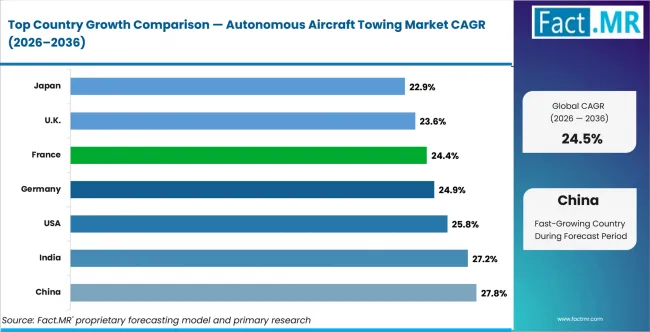
Autonomous Aircraft Towing Market Cagr Analysis By Country | Source: Fact.MR
What is powering China’s lead?
27.8% CAGR, supported by airport scale and domestic equipment development.
China handled 1.529 billion passenger trips at national commercial airports in 2025. China is projected to record a 27.8% CAGR through 2036, supported by airport scale and local ground support equipment capability. Large hub operators can test repeat movement before smaller airports follow. Suppliers with local service teams and mapping support are better placed because approval depends on site-specific route evidence.
Why is India above the global average?
27.2% CAGR, driven by airport capacity expansion and new ground support procurement.
India’s airport buildout is creating more stand movement and more procurement events. The Ministry of Civil Aviation reported 159 airports as of 31 December 2024. India is expected to expand at 27.2% CAGR through 2036, driven by airport capacity expansion and fleet modernization. Suppliers can gain earlier access where new terminals include charging points and apron route data during construction.
What supports the USA outlook?
25.8% CAGR, supported by high traffic and airline pressure on turnaround time.
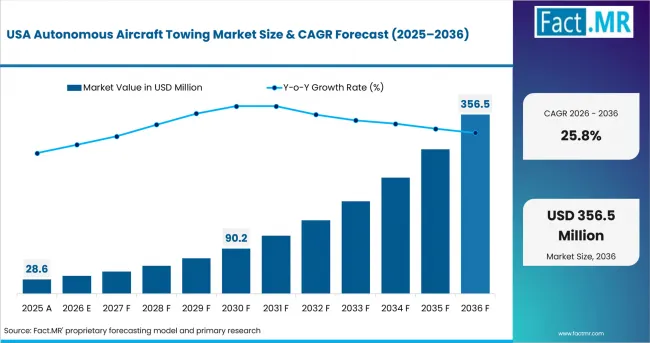
Autonomous Aircraft Towing Market Country Value Analysis | Source: Fact.MR
United States buyers compare autonomous towing with strict service reliability needs at large hubs. The Transportation Security Administration screened 904 million passengers in 2024. The United States is forecast to grow at 25.8% CAGR through 2036, supported by high traffic and airline pressure on turnaround time. Suppliers that document safety cases and downtime response can gain access to major hub evaluations.
Why does Germany remain a core market?
24.9% CAGR, attributable to hub traffic and strict equipment review.
Germany’s buyers place heavy weight on safety files, equipment certification and service support. Federal Statistical Office data linked aviation tax to roughly 84.0 million air passengers in 2025. Germany is expected to advance at 24.9% CAGR through 2036, attributable to hub traffic and strict equipment review. Suppliers with a documented maintenance network and training access should compete better here.
How is France shaping towing demand?
24.4% CAGR, supported by airport movement density and local supplier presence.
France combines hub airport pressure with local towing and taxiing technology capability. Direction des Services de la Navigation Aerienne reported that France controlled more than 3 million flights in 2024. France is projected to rise at 24.4% CAGR through 2036, supported by airport movement density and the Alvest ecosystem through TLD and Smart Airport Systems. Buyers are likely to value certified aircraft families, emissions reduction and service reach in the same procurement case.
What defines the United Kingdom opportunity?
23.6% CAGR, backed by electric and hydrogen ground operations planning.
United Kingdom airports are linking ground vehicle changes to aviation decarbonization planning. The Department for Transport used six evolution points for hydrogen aviation planning in 2026. The United Kingdom is forecast at 23.6% CAGR through 2036, supported by electric and hydrogen ground operations planning. Suppliers can gain traction by offering route trials, charging reviews and operator training as one package.
Why is Japan a careful but important buyer base?
22.9% CAGR, supported by labor constraints and conservative safety review.
Ground handling labor pressure is a clear trigger for automation testing in Japan. Japan is expected to post 22.9% CAGR through 2036, supported by labor constraints and conservative safety review. Buyers are likely to start with controlled airport zones and maintenance towing before wider apron deployment.
Who leads the autonomous aircraft towing landscape?
TLD and Smart Airport Systems lead through aircraft towing experience. Mototok and Goldhofer add remote and heavy tractor depth.
Autonomous aircraft towing suppliers compete on aircraft compatibility, supervised movement controls and airport deployment support. TLD and Smart Airport Systems have a stronger taxiing position through the TaxiBot ecosystem. Mototok is known for remote-controlled electric aircraft tugs. Goldhofer brings heavy towbarless tractor experience for large aircraft.
Israel Aerospace Industries supports the TaxiBot system through aircraft taxiing control know-how. Kalmar Motor and Charlatte add aircraft tractor and airport vehicle experience, but autonomous aircraft movement requires stronger route validation than standard tug supply.
Vehicle categories such as industrial tugger show how remote control and electric drive are spreading into low-speed movement tasks. Airport towing remains harder because aircraft compatibility and apron safety approval are stricter. Navigation lessons from mobile industrial robots can help suppliers refine route supervision. Providers still need aviation-grade documentation before buyers approve aircraft movement.
Which companies are the key players?
TLD, Smart Airport Systems, Mototok International GmbH, Goldhofer Aktiengesellschaft, Israel Aerospace Industries, Oshkosh AeroTech, and Kalmar Motor AB
- TLD
- Smart Airport Systems
- Mototok International GmbH
- Goldhofer Aktiengesellschaft
- Israel Aerospace Industries
- Oshkosh AeroTech
- Kalmar Motor AB
Bibliography
- Airports Council International. (2024, September 18). ACI World projects 10% growth for passenger traffic in 2024 to reach 9.5 billion.
- International Air Transport Association. (2025, May 13). Ground handling priorities: Safety, baggage, global standards and sustainability.
- Transportation Security Administration. (2025, January). TSA 2024 by the numbers.
- Civil Aviation Administration of China. (2026, April 22). CAAC releases statistical bulletin of civil aviation industry development in 2025.
- Ministry of Civil Aviation, Government of India. (2025, March). Annual report: Civil aviation for the year 2024–25. Government of India.
- Civil Aviation Bureau, Ministry of Land, Infrastructure, Transport and Tourism. (2026, January). Guideline for the fair transactions in the airport ground handling services. Government of Japan.
- Federal Statistical Office. (2026, April 1). 2.1 billion euros of aviation tax declared in 2025 for roughly 84.0 million air passengers. Destatis.
- Direction des Services de la Navigation Aérienne. (2025, June). DSNA: The French air navigation service provider: Annual report 2024.
- Department for Transport. (2026, March 17). Jet Zero Taskforce: Hydrogen Task and Finish Group 2025 report. GOV.UK.
- Smart Airport Systems. (2025). TaxiBot. Smart Airport Systems.
- TLD. (2026). TaxiBot. TLD.
- Mototok International GmbH. (2026). Electric, towbarless, remote-controlled aircraft tugs. Mototok.
- Goldhofer Aktiengesellschaft. (2026). Towbarless tractors. Goldhofer.
- Oshkosh AeroTech. (2026). LEKTRO® all-electric, towbarless aircraft tow tractors. Oshkosh AeroTech.
This Report Addresses
- Strategic intelligence on autonomous aircraft towing across automation level, operation and aircraft class.
- Segment analysis covers Remote-supervised systems and Pushback. It also covers Narrowbody aircraft, Light Detection and Ranging and Ground handlers.
- Regional outlook covers China and India. It also covers the United States and Germany. France, United Kingdom and Japan complete the outlook.
- Competitive analysis covers TLD and Smart Airport Systems. It also covers Mototok International GmbH and Goldhofer Aktiengesellschaft. Israel Aerospace Industries, Oshkosh AeroTech and Kalmar Motor AB complete the company view.
- Technology assessment covers remote supervision and geofencing. It also covers sensor guidance and fleet management software.
- Procurement assessment covers aircraft-family compatibility and apron validation. It also covers charging access and service support.
- Primary interviews and provider checks support the forecast. Official source review and airport deployment signals were also used.
What does the autonomous aircraft towing market cover?
Remote-supervised and semi-autonomous aircraft towing systems used for controlled aircraft movement.
The autonomous aircraft towing market covers towing systems that use remote supervision, sensor guidance and route control to move aircraft on aprons and in maintenance areas. It includes pushback and gate repositioning. It also includes maintenance towing and remote stand allocation support. The market differs from conventional tug sales because the service focus is controlled autonomy, aircraft compatibility and site approval.
What is included in the scope?
Driver-assist, remote-supervised and semi-autonomous aircraft towing equipment.
The scope includes aircraft towing equipment when automation supports aircraft movement. It covers remote-supervised towing and semi-autonomous route control. It also covers obstacle sensing, geofencing and fleet management software. It also includes validation services, operator training and deployment support when sold with autonomous towing capability.
What is excluded from the scope?
Manual aircraft tugs and general ground support equipment without autonomous towing functions.
The scope excludes manual tugs that do not use remote supervision or sensor guidance. It excludes general ground support equipment leasing unless the contract specifies autonomous towing functions. It also excludes air traffic control software, baggage automation and passenger boarding equipment unless the system directly supports aircraft towing movement.
How was the analysis built?
100+ sources. 45+ company portfolios. 25+ countries. 20+ interviews.
- Primary Research: Primary research includes interviews with airport ground handling managers and ground support equipment procurement teams. It includes input from towing equipment suppliers and airport operations consultants.
- Desk Research: Desk research reviews airport traffic data and ground support equipment electrification guidance. It covers aircraft towing product portfolios and autonomous apron vehicle trials.
- Market-Sizing and Forecasting: Forecasting uses aircraft tug replacement logic and airport throughput. Narrowbody fleet activity and supervised autonomy readiness support the forecast. Country values are reconciled against airport traffic and ground handling investment signals.
- Data Validation and Update Cycle: Forecasts are validated through supplier checks and airport deployment signals. Company portfolio updates and official aviation statistics help confirm the market direction.
Segmentation
What is the report’s scope and coverage?
| Attribute | Details |
|---|---|
| Quantitative Units | USD Million in 2026 to USD Million by 2036 at CAGR |
| Market Definition | Remote-supervised and semi-autonomous aircraft towing systems used for controlled aircraft movement |
| Automation Level | Driver-assist, Remote-supervised, Semi-autonomous, Fully autonomous prototype |
| Operation | Pushback, Towing, Gate repositioning, Maintenance towing, Remote stand allocation |
| Aircraft Class | Regional, Narrowbody, Widebody, Business aircraft, Cargo aircraft |
| Guidance Tech | Global Navigation Satellite System, Light Detection and Ranging, Computer vision, Geofencing, Fleet management software |
| Buyer Type | Airlines, Airport operators, Ground handlers, Original Equipment Manufacturer partners, Maintenance Repair and Overhaul facilities |
| Regions Covered | North America, East Asia, Western Europe, South Asia and Pacific, Latin America, Middle East and Africa |
| Countries Covered | China, India, United States, Germany, France, United Kingdom, Japan |
| Key Companies Profiled | TLD, Smart Airport Systems, Mototok International GmbH, Goldhofer Aktiengesellschaft, Israel Aerospace Industries, Oshkosh AeroTech and Kalmar Motor AB |
| Forecast Period | 2026 to 2036 |
| Approach | Hybrid top-down and bottom-up approach using aircraft tug replacement logic, airport traffic, narrowbody fleet activity, certification evidence and provider validation |
Source: Fact.MR analysis. Updated Jul 4, 2026
How is the market segmented?
-
By Automation Level:
- Driver-assist
- Remote-supervised
- Semi-autonomous
- Fully autonomous prototype
-
By Operation:
- Pushback
- Towing
- Gate repositioning
- Maintenance towing
- Remote stand allocation
-
By Aircraft Class:
- Regional
- Narrowbody
- Widebody
- Business aircraft
- Cargo aircraft
-
By Guidance Tech:
- Global Navigation Satellite System
- Light Detection and Ranging
- Computer vision
- Geofencing
- Fleet management software
-
By Buyer Type:
- Airlines
- Airport operators
- Ground handlers
- Original Equipment Manufacturer partners
- Maintenance Repair and Overhaul facilities
-
By Region:
- North America
- United States
- Canada
- Mexico
- Latin America
- Brazil
- Argentina
- Rest of Latin America
- Europe
- Germany
- United Kingdom
- France
- Rest of Europe
- East Asia
- China
- Japan
- South Korea
- South Asia and Pacific
- India
- ASEAN
- Australia
- Middle East & Africa
- GCC Countries
- South Africa
- UAE
- Rest of Middle East & Africa
- North America
Frequently Asked Questions
Which automation level leads the Autonomous Aircraft Towing Market?
Which country expands faster in the Autonomous Aircraft Towing Market?
How does India perform in the Autonomous Aircraft Towing Market?
How does the United States perform in the Autonomous Aircraft Towing Market?
How does Germany perform in the Autonomous Aircraft Towing Market?
How does France perform in the Autonomous Aircraft Towing Market?
What is the primary driver in the Autonomous Aircraft Towing Market?
What is the main restraint in the Autonomous Aircraft Towing Market?
Why are narrowbody aircraft important in this market?
Who worked on this report


Preview the report firsthand - request a free sample
Free SampleGet the brochure for pricing and purchase details
Download PDF