- Base Value(2025): 3.6 Bn
- Estimated Value(2026): 4.0 Bn
- Forecast Value (2036): 11.2 Bn
- CAGR (2026 - 2036): 10.8%
Autonomous Driving Sensor Test and Calibration Rigs Market Forecast and Outlook By Fact.MR
- In 2025, the autonomous driving sensor test and calibration rigs market was valued at USD 3.6 billion.
- Based on Fact.MR analysis, demand for autonomous driving sensor test and calibration rigs is estimated to grow to USD 4.0 billion in 2026 and USD 11.2 billion by 2036.
- Fact.MR projects a CAGR of 10.8% during the forecast period.
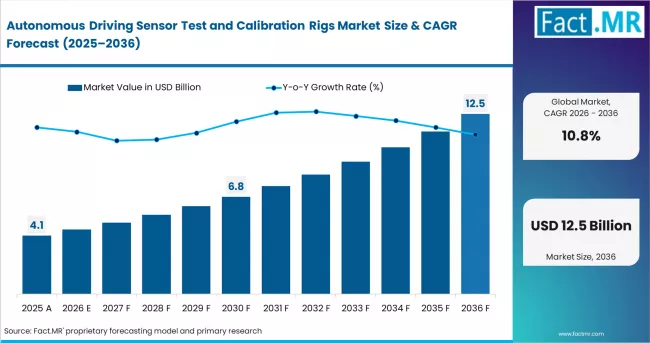
Autonomous Driving Sensor Test And Calibration Rigs Market Market Value Analysis | Source: Fact.MR
| Metric | Value |
|---|---|
| Estimated Value in 2026 | USD 4.05 billion |
| Forecast Value in 2036 | USD 11.28 billion |
| Forecast CAGR (2026 to 2036) | 10.8% |
Source: Fact.MR analysis. Updated May 8, 2026
Summary of Autonomous Driving Sensor Test and Calibration Rigs Market
- Market Definition
- The market includes sensor test and calibration rigs used for radar, lidar, camera, ultrasonic, and fused perception validation in automated-driving development and production.
- Demand Drivers
- Sensor fusion and perception validation require repeatable lab-based scenarios that road testing alone cannot deliver efficiently.
- Radar, lidar, and camera systems increasingly need calibration and verification across development, functional testing, and production workflows. [3]
- HIL, replay, and over-the-air test setups are becoming established components of holistic ADAS and AD validation strategies.
- Key Segments Analyzed
- By Sensor Type: Radar Sensor Test Rigs lead with approximately 28.6% share in 2026, driven by strong demand for radar calibration and target simulation.
- By Application: Sensor Validation leads with approximately 26.1% share in 2026, supported by the need to verify perception performance under controlled scenarios.
- By Geography: China leads growth at 11.6% CAGR through 2036, supported by autonomous-driving development intensity and automotive electronics scale. These segment assumptions are aligned with the same structured report flow used in your uploaded reference.
- Analyst Opinion at Fact.MR
- Shambhu Nath Jha, Senior Analyst at Fact.MR, notes the market value is increasingly defined by how effectively rigs can create realistic but repeatable sensor conditions. Buyers no longer want isolated sensor checks when perception stacks now depend on synchronized radar, camera, lidar, and ECU validation under scenario-rich workflows.
- Strategic Implications
- Suppliers should deepen multi-sensor and scenario-based validation workflows rather than competing on single-sensor calibration hardware alone.
- OEMs and Tier 1 suppliers should prioritize replay, HIL, and over-the-air compatibility before simply scaling road-test mileage. [4]
- Vendors with stronger radar emulation, sensor realism, and integrated perception validation capability are better positioned than suppliers focused on isolated calibration steps.
- Methodology
- Market sizing uses autonomous-driving sensor validation intensity, supplier rig investment, and sensor-rich vehicle development growth.
- Analysis includes official supplier materials describing radar emulation, sensor simulation, HIL validation, and multi-sensor testing requirements.
- Forecasts account for higher scenario complexity, stronger lab-based validation needs, and tighter calibration requirements across perception systems.
The market is projected to generate USD 7.2 billion in absolute opportunity between 2026 and 2036. Growth remains strong because sensor validation is becoming a fixed part of the development, homologation, and production-quality workflow for higher-level assisted and autonomous systems. The IEA reports that electric and software-rich vehicles continued to expand rapidly in 2024, reinforcing wider investment in electronically intensive vehicle architectures and associated validation infrastructure. [1]
China leads with a projected CAGR of 11.6% through 2036, driven by strong automotive electronics scale and increasing investment in autonomous-driving validation infrastructure. India follows at 10.9%, supported by growing automotive electronics capability and rising demand for sensor validation and calibration systems. South Korea grows at 10.3%, underpinned by advanced sensor technology development and strong OEM-led validation activity. Germany records 9.8%, with growth anchored in engineering-driven automotive ecosystems and increasing focus on homologation-oriented sensor validation. The United States grows at 9.5%, driven by expanding autonomous-driving development and stronger preference for lab-based perception testing.
Segmental Analysis
Autonomous Driving Sensor Test and Calibration Rigs Market Analysis by Sensor Type
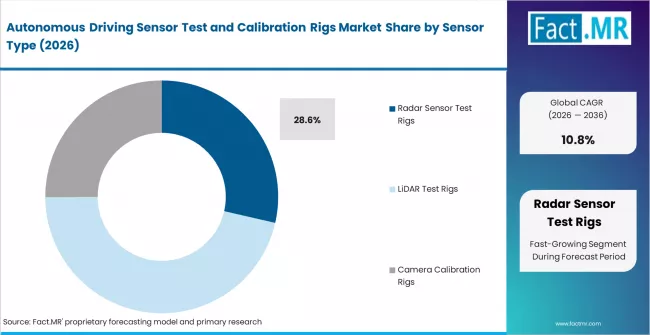
Autonomous Driving Sensor Test And Calibration Rigs Market Analysis By Sensor Type | Source: Fact.MR
Based on Fact.MR’s autonomous driving sensor test and calibration rigs market report, radar sensor test rigs are estimated to hold 28.6% share in 2026. This segment leads because radar remains one of the most commercially mature and safety-critical sensing layers in automated-driving and advanced ADAS functions. Rohde & Schwarz states that its R&S RadEsT can streamline radar sensor testing in calibration, ADAS and autonomous-driving functional testing, and OEM production lines. The company also highlights dynamic target simulation that can be configured on the fly for distance, velocity, and attenuation, which is crucial for qualifying automated-driving functions. Keysight likewise positions radar scene emulation as central to robust radar-based function development. This makes radar rigs commercially stronger than many single-purpose calibration setups in current perception-development environments.
- Radar Target Simulation Expansion: Rohde & Schwarz introduced next-generation radar target simulation focused on ADAS testing, calibration, and production-line support.
- Radar Scene Emulation Depth: Keysight continues to position radar scene emulation around full-scene object generation and perception validation under dynamic conditions.
- Production Relevance: Supplier positioning increasingly links radar rigs not only to R&D but also to OEM production-line and lifecycle calibration needs.
Autonomous Driving Sensor Test and Calibration Rigs Market Analysis by Application
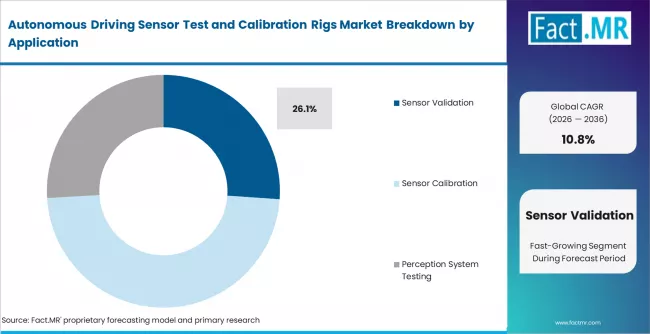
Autonomous Driving Sensor Test And Calibration Rigs Market Analysis By Application | Source: Fact.MR
Sensor validation holds approximately 26.1% share in 2026. This segment leads because the core commercial requirement in autonomous-driving perception is proving that sensors and fused outputs behave correctly under controlled and reproducible scenarios. dSPACE states that HIL remains an integral part of ADAS/AD validation and that data replay and closed-loop HIL each play distinct roles depending on the validation objective. Keysight positions its perception validation tools around sensor signal fidelity and system-level behavior, while dSPACE’s AURELION platform is used across HIL, SIL, and VIL phases. This keeps validation as the anchor application because it is required across development, homologation, and release preparation.
- HIL Validation Momentum: dSPACE highlights HIL as a continuing pillar in holistic ADAS and AD validation despite cost and complexity.
- Sensor-Realistic Simulation: AURELION is positioned to integrate realistic sensor data into development and validation across multiple stages.
System-Level Perception Checks: Keysight emphasizes validation across sensor signal fidelity, fusion behavior, and dynamic scene modeling.
Drivers, Restraints, and Opportunities
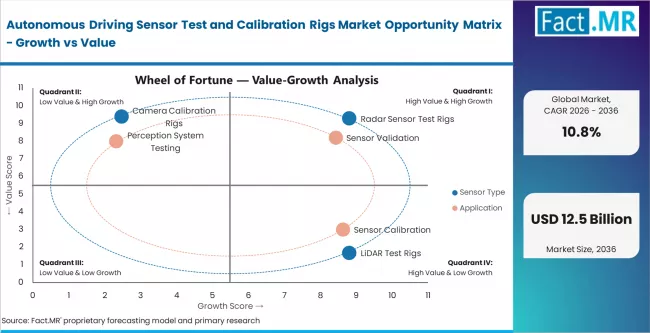
Autonomous Driving Sensor Test And Calibration Rigs Market Opportunity Matrix Growth Vs Value | Source: Fact.MR
Fact.MR analysts observe that the autonomous driving sensor test and calibration rigs market is strongly linked to the expansion of sensor-rich vehicle development and the increasing complexity of perception validation. Structural demand is anchored by broader investment in automated-driving systems, rising scenario counts, and the need to validate perception under controlled conditions that can be repeated and audited. The market’s size reflects the fact that sensor test rigs are becoming strategic validation infrastructure rather than optional lab accessories.
A key restraint remains technical and integration complexity. Multi-sensor validation requires realistic raw data, synchronized buses, replay capability, and scenario orchestration across different development phases. dSPACE highlights the distinction between data replay and closed-loop HIL, while supplier materials show that camera, lidar, and radar validation are increasingly interconnected. This raises the technical threshold for both buyers and suppliers and can make rig integration costly and time-intensive.
- Perception Complexity: More advanced radar, lidar, and camera stacks continue to expand demand for dedicated validation and calibration rigs.
- Lab-Based Qualification: Radar emulation and sensor-realistic simulation are creating stronger demand for scenario-based lab validation instead of exclusive road dependence.
- Homologation Opportunity: dSPACE’s lab-based homologation and digital homologation positioning supports stronger demand for rigorous, auditable lab workflows.
Regional Analysis
The autonomous driving sensor test and calibration rigs market is assessed across Asia Pacific, North America, Europe, Latin America, and Middle East & Africa, covering 40+ countries with demand shaped by automotive electronics scale, autonomous-driving development intensity, and investment in perception validation infrastructure. Asia Pacific remains the strongest growth region, while North America and Europe continue to lead in higher-value validation environments and engineering workflows.
.webp "Top Country Growth Comparison Autonomous Driving Sensor Test And Calibration Rigs Market Cagr (2026 2036)")
Top Country Growth Comparison Autonomous Driving Sensor Test And Calibration Rigs Market Cagr (2026 2036) | Source: Fact.MR
| Country | CAGR (2026 to 2036) |
|---|---|
| China | 11.6% |
| India | 10.9% |
| South Korea | 10.3% |
| Germany | 9.8% |
| United States | 9.5% |
Source: Fact.MR analysis. Updated May 8, 2026
Source: Fact.MR analysis, based on proprietary forecasting model and primary research.
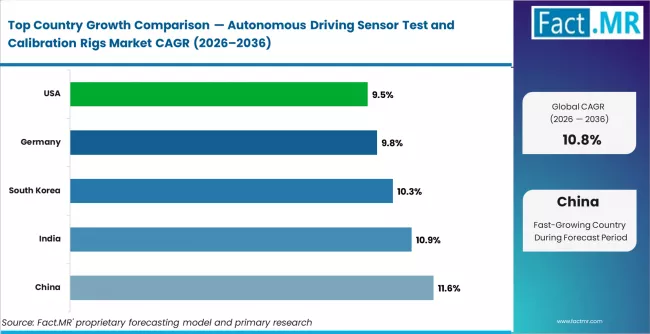
Autonomous Driving Sensor Test And Calibration Rigs Market Cagr Analysis By Country | Source: Fact.MR
Asia Pacific Autonomous Driving Sensor Test and Calibration Rigs Market Analysis
Asia Pacific is the primary demand growth region. China, South Korea, Japan, and India anchor regional demand through automotive electronics scale, autonomous-driving pilot activity, and broader investment in sensor-rich vehicle development. China remains central because of its automotive manufacturing base and accelerating electronics integration, while South Korea and Japan support high-value sensor and vehicle-system engineering. India is growing from a lower installed base but benefits from wider automotive electronics capability and validation demand. This keeps Asia Pacific at the front of rig demand even though development intensity varies across countries.
- China: China continues to dominate regional demand due to its large automotive electronics base and rapid adoption of sensor-rich vehicle systems. The market is projected to grow at an 11.6% CAGR, reflecting strong investment in autonomous-driving development and supplier-led validation capabilities. Growing emphasis on perception accuracy and system reliability is driving adoption of advanced calibration rigs.
- India: India is emerging as a developing market where automotive electronics capability and validation infrastructure are expanding. Demand is expected to grow at a CAGR of 10.9%, supported by increasing investment in testing environments and gradual adoption of ADAS and sensor technologies.
- South Korea: South Korea plays a critical role as a high-value contributor with advanced automotive electronics and strong focus on autonomous-driving technologies. Growth is expected to reach around 10.3% CAGR, driven by OEM and supplier investment in sensor validation and calibration systems. The country’s strength in semiconductor and electronics manufacturing supports development of sophisticated perception systems, increasing the need for precise testing infrastructure.
Fact.MR’s analysis of Asia Pacific covers China, Japan, South Korea, India, ASEAN, Australia and New Zealand, and Rest of South Asia and Pacific. Includes automotive electronics trends, validation demand, and sensor test-infrastructure investment.
North America Autonomous Driving Sensor Test and Calibration Rigs Market Analysis
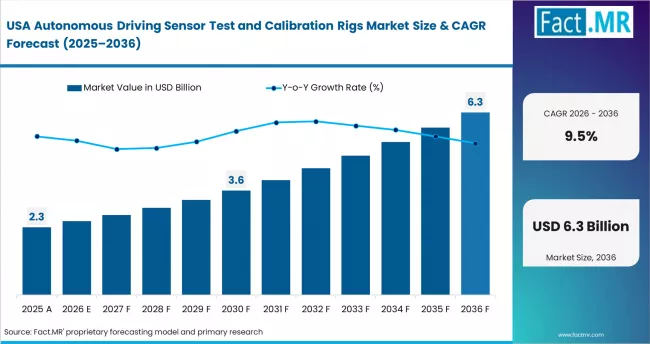
Autonomous Driving Sensor Test And Calibration Rigs Market Country Value Analysis | Source: Fact.MR
North America is a high-value and expanding region. Demand is tied to autonomous-driving development, software-defined vehicle programs, and strong interest in moving more validation from the road into the lab. The United States remains the core market in this study because of its concentration of automotive development, test-lab infrastructure, and sensor-validation activity. Keysight’s autonomous-drive validation positioning and dSPACE’s ADAS/AD HIL content reinforce North America’s role as a major market for sensor validation rigs and scenario-based testing systems.
- United States: The United States remains the core demand center, supported by a concentration of automotive R&D, technology firms, and advanced testing facilities. Growth is projected at a 9.5% CAGR, reflecting strong demand for perception validation, scenario-based testing, and sensor calibration systems. Companies are investing in rigs that enable repeatable and scalable testing workflows.
Fact.MR’s analysis covers the United States, Canada, and Mexico. Includes ADAS and AD development demand, sensor-validation workflows, and advanced automotive test infrastructure.
Europe Autonomous Driving Sensor Test and Calibration Rigs Market Analysis
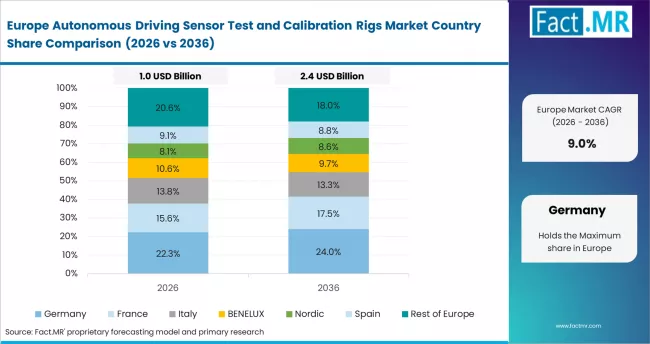
Autonomous Driving Sensor Test And Calibration Rigs Market Europe Country Market Share Analysis, 2026 & 2036 | Source: Fact.MR
Europe remains an engineering-intensive and quality-driven market. The region places strong emphasis on structured validation, realistic sensor simulation, and future digital homologation workflows. Germany leads in this study because of its automotive engineering base, supplier presence, and strong investment in perception and sensor-validation capability. dSPACE’s digital homologation and lab-based homologation positioning, along with Rohde & Schwarz radar-testing activity, reinforce Europe’s role as a major center for autonomous-driving sensor test rigs.
- Germany: Germany leads regional demand due to its strong automotive engineering base and investment in autonomous-driving technologies. The market is expected to grow at a 9.8% CAGR, supported by demand for sensor validation systems aligned with homologation and safety standards. Manufacturers and suppliers are focusing on high-precision calibration and integration of simulation-based testing.
Fact.MR’s analysis covers Germany, France, the United Kingdom, Italy, Spain, Nordic Countries, BENELUX, and Rest of Western Europe, along with Eastern European markets. Includes sensor validation demand, homologation-linked workflows, and automotive electronics testing trends.
Competitive Aligners for Market Players
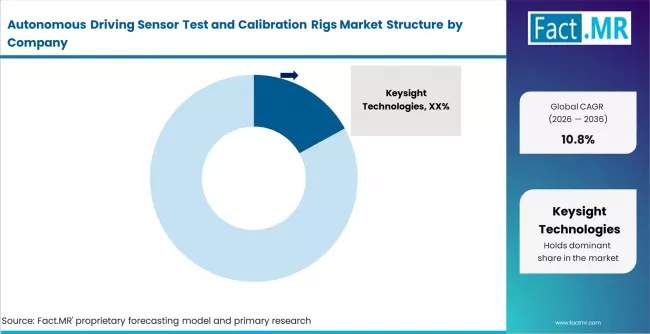
Autonomous Driving Sensor Test And Calibration Rigs Market Analysis By Company | Source: Fact.MR
The autonomous driving sensor test and calibration rigs market is moderately concentrated, with specialized test and validation providers controlling much of the higher-function end of the category. Key players include Keysight, Rohde & Schwarz, dSPACE, HORIBA MIRA, AVL, and adjacent perception-validation and sensor-simulation specialists. These companies benefit from integrated know-how across radar target simulation, sensor fusion testing, replay, HIL, and sensor-realistic simulation. Competitive advantage is defined by scenario realism, replay capability, data synchronization, and the ability to support both individual sensor and fused perception validation inside one scalable workflow.
Competitive intensity is rising as autonomous-driving programs expand, though integration credibility remains a barrier to entry. Buyers increasingly prefer vendors that can package radar emulation, data replay, over-the-air test support, and sensor-realistic simulation into one validation environment rather than stitching together disconnected tools. This keeps the market tilted toward suppliers with proven ADAS and AD application depth rather than toward generic RF or camera test vendors.
Key Players
- Keysight Technologies
- Rohde & Schwarz
- dSPACE
- HORIBA MIRA
- AVL
- Anritsu
- Teledyne LeCroy
Bibliography
- [1] International Energy Agency (IEA). (2025). Global EV Outlook 2025. 2025. iea.org
- [2] dSPACE. (2025). AURELION Sensor Simulation. 2025. dspace.com
- [3] Keysight Technologies. (2025). Radar Scene Emulator (AD1012A). 2025. keysight.com
- [4] Rohde & Schwarz. (2024). R&S RadEsT Next-Gen Radar Target Simulator for ADAS Testing. 2024. rohde-schwarz.com
- [5] Rohde & Schwarz. (2024). CES 2025 Automotive Testing Innovations for ADAS and Autonomous Driving. 2024. rohde-schwarz.com
This Report Addresses
- Strategic intelligence on autonomous-driving sensor test and calibration rig demand across perception validation, calibration, and production-support workflows.
- Market forecast from USD 4.05 billion in 2026 to USD 11.28 billion by 2036 at a CAGR of 10.8%.
- Growth opportunity mapping across radar target simulation, multi-sensor fusion testing, replay, and scenario-based validation workflows.
- Segment analysis by sensor type, application, end use, deployment mode, and automation level.
- Regional outlook covering Asia Pacific automotive electronics scale, North American validation demand, and Europe’s homologation-oriented test environment.
- Competitive analysis of Keysight, Rohde & Schwarz, dSPACE, and other autonomous-driving sensor test-rig suppliers.
- The role of sensor fusion, radar emulation, and lab-based validation in driving test rig demand.
- Why the category is shifting from isolated sensor checks toward integrated perception validation environments.
Market Definition
The market covers laboratory, production-line, and integrated validation rigs used to test, calibrate, and verify sensors and perception subsystems for automated-driving functions. These rigs support the evaluation of radar, lidar, camera, ultrasonic, and fused sensor systems under controlled and repeatable conditions for development, validation, and quality assurance. dSPACE describes this broader category as sensor-realistic simulation and validation for ADAS/AD processes, while Keysight and Rohde & Schwarz frame it around scene emulation and radar target simulation for perception verification. [2]
Autonomous Driving Sensor Test and Calibration Rigs Market Inclusions
Covers global and regional forecasts from 2026 to 2036. Includes radar target simulators, radar scene emulators, camera calibration rigs, lidar validation rigs, replay-based sensor validation systems, over-the-air sensor test setups, and multi-sensor perception validation platforms used across automotive OEM, Tier 1, and test-lab workflows. It also includes software-linked automation and scenario tools where they form part of the calibration or test rig solution.
Autonomous Driving Sensor Test and Calibration Rigs Market Exclusions
Excludes general automotive oscilloscopes, generic RF lab instruments without autonomous-driving sensor calibration or validation positioning, and vehicle-level proving-ground services sold without associated rigs or rig platforms. It also excludes purely virtual simulation software when no physical calibration or test rig integration is part of the offering.
Autonomous Driving Sensor Test and Calibration Rigs Market Research Methodology
- Primary Research:Interviews with perception engineers, autonomous-driving validation leads, radar calibration specialists, sensor-fusion development teams, and test-system integrators across major automotive development regions.
- Desk Research:Uses IEA mobility trend data, Keysight sensor validation material, Rohde & Schwarz radar target simulation references, and dSPACE sensor simulation and HIL validation content from 2024 to 2025.
- Market-Sizing and Forecasting:Hybrid model using ADAS and autonomous-driving validation intensity, sensor test infrastructure capex, production-line calibration demand, and integrated rig-system pricing by sensor type and automation level.
- Data Validation and Update Cycle:Validated using supplier capability disclosures, validation workflow references, and cross-checks against current autonomous-driving sensor testing requirements and deployment patterns.
Segmentation
Scope of Report
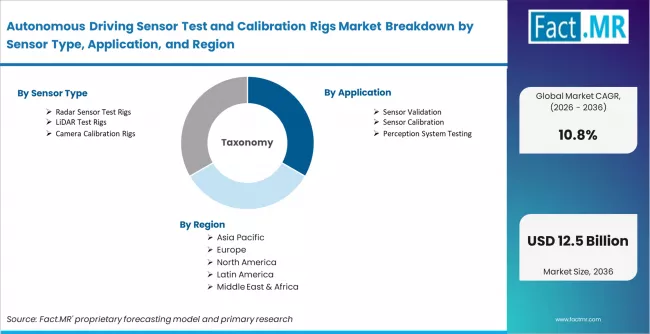
Autonomous Driving Sensor Test And Calibration Rigs Market Breakdown By Sensor Type, Application, And Region | Source: Fact.MR
|
Attribute |
Details |
|---|---|
|
Quantitative Units |
USD 4.0 billion (2026) to USD 11.2 billion (2036), at a CAGR of 10.8% |
|
Market Definition |
Sensor test and calibration rigs used for radar, lidar, camera, ultrasonic, and fused perception validation across autonomous-driving development, calibration, and production workflows |
|
Sensor Type Segmentation |
Radar Sensor Test Rigs, LiDAR Test Rigs, Camera Calibration Rigs, Multi-Sensor Fusion Test Rigs, Ultrasonic Sensor Test Rigs |
|
Application Segmentation |
Sensor Validation, Sensor Calibration, Perception System Testing, End-of-Line Testing, Scenario-Based Functional Testing |
|
End Use Segmentation |
Automotive OEMs, Tier 1 Suppliers, Independent Test Labs, Research Institutes, Autonomous Vehicle Developers |
|
Deployment Mode Segmentation |
Laboratory Rigs, Production-Line Rigs, Vehicle-Integrated Calibration Setups |
|
Automation Level Segmentation |
Manual-Assisted Systems, Semi-Automated Systems, Fully Automated Systems |
|
Regions Covered |
Asia Pacific, North America, Europe, Latin America, Middle East and Africa |
|
Countries Covered |
China, India, South Korea, Germany, United States, Japan, Brazil, and 40+ countries |
|
Key Companies Profiled |
Keysight Technologies, Rohde & Schwarz, dSPACE, HORIBA MIRA, AVL, Anritsu, Teledyne LeCroy |
|
Forecast Period |
2026 to 2036 |
|
Approach |
Hybrid top-down and bottom-up model using autonomous-driving validation intensity, sensor-rich vehicle development growth, and integrated rig-system value across hardware and software layers |
Source: Fact.MR analysis. Updated May 8, 2026
Autonomous Driving Sensor Test and Calibration Rigs Market by Segments
-
By Sensor Type:
- Radar Sensor Test Rigs
- LiDAR Test Rigs
- Camera Calibration Rigs
- Multi-Sensor Fusion Test Rigs
- Ultrasonic Sensor Test Rigs
-
By Application:
- Sensor Validation
- Sensor Calibration
- Perception System Testing
- End-of-Line Testing
- Scenario-Based Functional Testing
-
By Region:
- North America
- United States
- Canada
- Mexico
- Latin America
- Brazil
- Argentina
- Chile
- Rest of Latin America
- Western Europe
- Germany
- France
- United Kingdom
- Italy
- Spain
- Nordic Countries
- BENELUX
- Rest of Western Europe
- Eastern Europe
- Russia
- Poland
- Hungary
- Balkan and Baltic
- Rest of Eastern Europe
- East Asia
- China
- Japan
- South Korea
- South Asia and Pacific
- India
- ASEAN
- Australia and New Zealand
- Rest of South Asia and Pacific
- Middle East and Africa
- Kingdom of Saudi Arabia
- Other GCC Countries
- Turkey
- South Africa
- Rest of Middle East and Africa
- North America
Frequently Asked Questions
How large is the global autonomous driving sensor test and calibration rigs market in 2025?
What will the market size be in 2026?
What is the projected market size by 2036?
What is the expected CAGR from 2026 to 2036?
Which sensor type segment is poised to lead the market?
Which application segment holds the largest share?
Which country shows the fastest growth?
What is driving demand for autonomous driving sensor test and calibration rigs?
What is the key challenge in this market?
Who worked on this report


Preview the report firsthand - request a free sample
Free SampleGet the brochure for pricing and purchase details
Download PDF