- Market Value (2025): USD 19.7 Bn
- Estimated Value (2026): USD 20.7 Bn
- Forecast Value (2036): USD 33.7 Bn
- CAGR (2026-2036): 5.0%
What is the Rotating Equipment Repair Market forecast to be worth by 2036?
USD 20.7 billion in 2026 to USD 33.7 billion by 2036 at a 5.0% CAGR.
- The Rotating Equipment Repair Market was approximately USD 19.7 billion in 2025.
- Demand is projected to increase from USD 20.7 billion in 2026 to USD 33.7 billion by 2036.
- The market is forecast to expand at a 5.0% CAGR from 2026 to 2036.
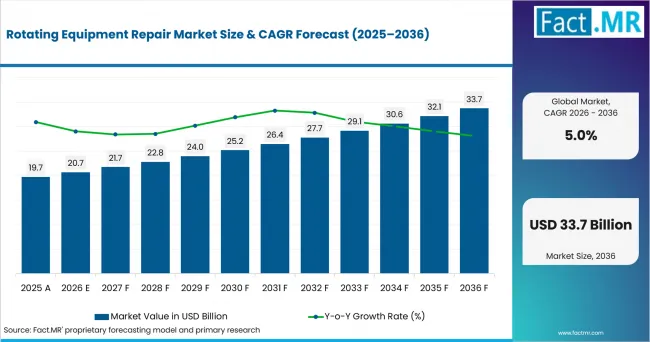
Rotating Equipment Repair Market Value Analysis | Source: Fact.MR
What are the defining numbers behind Rotating Equipment Repair Market growth?
An absolute opportunity of USD 13.0 billion is expected between 2026 and 2036.
- Demand Drivers in the Market
- Industrial plants depend on pumps market equipment to move process fluids, provide cooling and support hydraulic operations. The U.S. Department of Energy notes that pumping systems are used extensively across manufacturing and that effective maintenance can identify deterioration before failure. This makes repair spending recurring wherever equipment uptime is tied directly to production.
- Refining and process industries maintain a substantial installed base of pumps and air compressors that operate through scheduled turnarounds and unscheduled outages. The U.S. Energy Information Administration reported 130 operable refineries with 18.2 million barrels per calendar day of atmospheric distillation capacity as of January 1, 2026. Repair providers benefit when equipment must be inspected, reconditioned or returned to service within fixed outage windows.
- Oil and gas production growth increases operating hours for offshore pumps, compressors and gas turbines. Brazil produced 3.8 million barrels of oil per day in 2025, up 12% from 2024, according to the National Agency of Petroleum, Natural Gas and Biofuels. Higher utilization raises the need for seal work, bearing replacement, rotor work and overhaul during planned maintenance campaigns.
- Energy-efficiency pressure supports repair and modernization of existing equipment instead of operating degraded assets. The International Energy Agency identifies motor-system upgrades, including pumps and compressors, as an industrial efficiency measure. Repair programmes that restore clearances, alignment and hydraulic performance can therefore reduce energy losses as well as improve reliability.
- Condition monitoring is shifting part of the market from reactive repair toward planned intervention. Japan’s Ministry of Economy, Trade and Industry is supporting smart industrial safety technologies such as remote monitoring and AI-based equipment inspection for power, gas and industrial infrastructure. Earlier fault detection gives service providers more opportunities to schedule targeted repair before failure causes extended downtime.
- Key Segments Analyzed
- Direct OEM-based accounts for 78.5% of Sales Channel in 2026. Critical equipment owners often prefer original specifications, authorized parts and manufacturer-backed overhaul procedures when repair risk can affect plant availability.
- Pumps represent 45.2% of Equipment in 2026, supported by their extensive installed base across process-fluid handling, cooling and water systems and recurring work on seals, bearings, shafts, impellers and alignment.
- Analyst Opinion at Fact.MR
- Shambhu Nath Jha, Principal Consultant, Fact.MR
- “Rotating equipment repair demand is shaped by the cost of lost production as much as by the repair invoice itself. Plants are more likely to retain service partners that can diagnose failure quickly, return equipment within the planned outage window and document the condition of critical components. OEM access remains important for specialized machines, while independent providers can compete where customers need multi-brand coverage and faster regional response.”
- Strategic Implications
- Service providers should build turnaround capacity around industrial clusters where outage schedules create concentrated demand for field crews and workshop slots.
- OEM-linked providers should make spare-parts availability and engineering documentation visible in proposals because buyers use these factors to assess repair risk on critical equipment.
- Independent repair companies can strengthen their position through multi-brand machining, balancing and diagnostic capability that reduces the number of vendors required during an outage.
- Repair recommendations should connect mechanical findings with asset performance outcomes such as expected operating-life extension, efficiency recovery and downtime reduction so plant owners can compare overhaul economics with full equipment replacement.
How does the Rotating Equipment Repair Market break down by segment?
The market is segmented by Sales Channel and Equipment.
Why does Direct OEM-based lead Sales Channel?
Direct OEM-based accounts for 78.5% of Sales Channel in 2026.
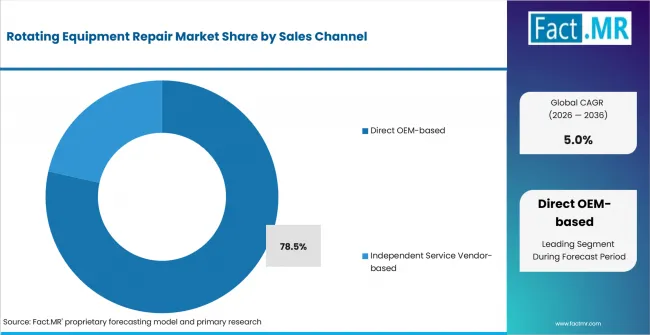
Rotating Equipment Repair Market Analysis By Sales Channel | Source: Fact.MR
Repair of critical rotating equipment often depends on original drawings, material specifications and machine-specific tolerances. Equipment owners also use authorized service channels when control-system access, proprietary replacement components or performance guarantees make third-party repair more difficult.
The purchasing advantage is lower technical uncertainty. Siemens Energy, for example, combines field service, spare-parts support, outage planning and repair capability for compressor and turbine fleets, allowing asset owners to coordinate inspection, overhaul and recommissioning through one service relationship.
Why do Pumps lead Equipment?
Pumps account for 45.2% of Equipment in 2026.
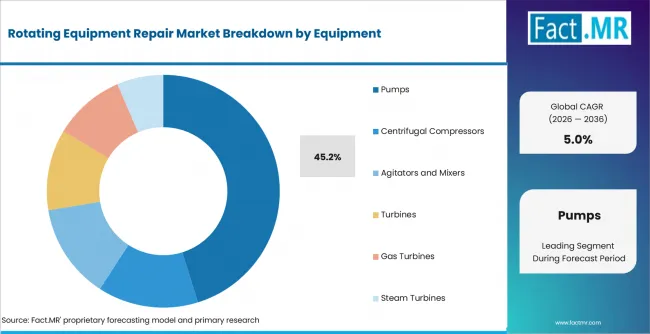
Rotating Equipment Repair Market Analysis By Equipment | Source: Fact.MR
Pumps operate across process-fluid transfer, cooling, lubrication and water systems and often run for long duty cycles. Wear develops in seals, bearings, shafts and impellers, while changes in alignment or internal clearances can reduce both reliability and efficiency.
The U.S. Department of Energy identifies pumping systems as a major industrial electricity user and emphasizes maintenance as a route to preserving system performance. A broad installed base combined with recurring wear therefore keeps pump repair active even when new-equipment investment slows.
What is accelerating Rotating Equipment Repair Market adoption, and what is holding it back?
Demand is being supported by aging installed equipment, planned plant outages, condition-based maintenance and pressure to recover efficiency without replacing complete machines. Growth can be limited by skilled-labour shortages, restricted access to proprietary parts and cases where replacement becomes more economical than repeated overhaul.
Drivers Impact Analysis
| Factor | (~) % Impact on CAGR | Geographic Relevance | Impact Timeline |
|---|---|---|---|
| Installed-base maintenance and overhaul cycles | +1.6% | Global | Short term (<= 2 years) |
| Energy-efficiency and asset-life extension programmes | +1.4% | Germany, USA and Japan | Short term (<= 2 years) |
| Oil, gas and refining equipment utilization | +1.1% | Brazil, USA and UK | Medium term (2-4 years) |
| Condition monitoring and predictive diagnostics | +0.9% | Germany, Japan and USA | Medium term (2-4 years) |
| Expansion of OEM and regional service networks | +0.6% | Global | Long term (>= 4 years) |
Source: Fact.MR analysis. Updated Sep 3, 2026
Opportunity Impact Analysis
| Factor | (~) % Impact on CAGR | Geographic Relevance | Impact Timeline |
|---|---|---|---|
| Multi-brand repair and overhaul contracts | +1.0% | Global | Medium term (2-4 years) |
| Digital condition-based service agreements | +0.8% | Germany, USA and Japan | Medium term (2-4 years) |
| Retrofit work for compressors and turbines in transition projects | +0.7% | Europe, USA and Brazil | Long term (>= 4 years) |
| Regional field-service and rapid-response capacity | +0.5% | Global | Long term (>= 4 years) |
Source: Fact.MR analysis. Updated Sep 3, 2026
Restraints Impact Analysis
| Factor | (~) % Impact on CAGR | Geographic Relevance | Impact Timeline |
|---|---|---|---|
| Replacement becomes more economical than repeated repair | -1.1% | Global | Short term (<= 2 years) |
| Skilled technician constraints and narrow outage windows | -0.9% | Germany, USA, UK and Japan | Short term (<= 2 years) |
| Proprietary parts and OEM access restrictions | -0.7% | Global | Medium term (2-4 years) |
| Industrial production and capital-spending cyclicality | -0.5% | Germany, Brazil, USA and Japan | Long term (>= 4 years) |
Source: Fact.MR analysis. Updated Sep 3, 2026
Which countries are scaling the Rotating Equipment Repair Market through 2036?
- Germany: A broad process-industry and power-generation asset base sustains repair demand. Energy-intensive industries accounted for 75.6% of German industrial energy use in 2024, while the Bundesnetzagentur listed 294.7 GW of generating capacity in June 2026. Operators have a direct incentive to preserve reliability and energy performance in pumps, compressors and turbines.
- Brazil: Oil production reached 3.8 million barrels per day in 2025, with pre-salt output accounting for about 80% of national production. Offshore production uses high-duty pumping and compression systems, creating recurring overhaul and field-repair requirements as operating hours accumulate.
- USA: The country operated 130 refineries with 18.2 million barrels per calendar day of atmospheric distillation capacity at the start of 2026. Fixed turnaround windows and the cost of lost throughput support rapid repair of process pumps, compressors and turbine-related equipment.
- U.K.: North Sea operators improved production efficiency to 76% in 2025 while reducing production losses from facilities and transport systems. More effective planned maintenance and fewer unplanned shutdowns support continued repair demand across a mature offshore asset base.
- Japan: Smart industrial safety programmes are encouraging remote monitoring and AI-assisted inspection, while thermal generation represented 67.5% of electricity generation in FY2024. This supports repair providers that can combine mechanical overhaul with diagnostic data and planned intervention.
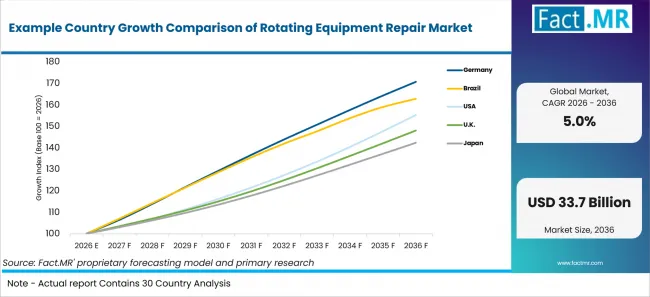
Example Country Growth Comparison Of Rotating Equipment Repair Market | Source: Fact.MR
Country CAGR (2026-2036)
| Country | CAGR (2026-2036) |
|---|---|
| Germany | 5.5% |
| Brazil | 5.0% |
| USA | 4.5% |
| U.K. | 4.0% |
| Japan | 3.6% |
Source: Fact.MR analysis. Updated Sep 3, 2026
What is driving Germany’s growth through 2036?
Germany is forecast to expand at a 5.5% CAGR from 2026 to 2036.
The country retains a broad installed base across chemical production, metals and mineral processing, all of which depend on pumps and other rotating systems for continuous operations. Destatis reported that energy-intensive industries represented 75.6% of industrial energy consumption in 2024, with chemicals accounting for 27.9% of total industrial energy use.
Energy-cost pressure increases the value of repair work that restores hydraulic or mechanical performance. The country also had 294.7 GW of generating capacity listed by the Bundesnetzagentur in June 2026, creating an additional service base for turbine and balance-of-plant equipment.
What is driving Brazil’s growth through 2036?
Brazil is forecast to expand at a 5.0% CAGR from 2026 to 2036.
Oil production increased to 3.8 million barrels per day in 2025, 12% above 2024, according to the ANP. Pre-salt fields contributed about 80% of national oil output, concentrating significant rotating-equipment demand in offshore production systems.
Pumps and compressors in offshore service operate under demanding pressure and corrosion conditions and must be maintained around production schedules. Higher utilization therefore supports repair work on seals, bearings and compressor internals as operators seek to avoid extended shutdowns.
What is driving USA’s growth through 2036?
The USA is forecast to expand at a 4.5% CAGR from 2026 to 2036.
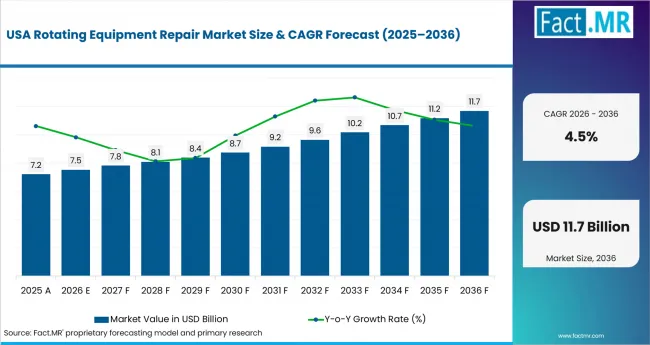
Rotating Equipment Repair Market Country Value Analysis | Source: Fact.MR
The U.S. Energy Information Administration reported 130 operable refineries and 18.2 million barrels per calendar day of atmospheric distillation capacity as of January 1, 2026. Calendar-day capacity incorporates expected maintenance downtime, demonstrating how turnaround planning is built into refinery operations.
Repair demand extends across process pumps and compressors as plants manage outage windows and equipment reliability. Service providers that can mobilize machining, balancing and field crews quickly can shorten the interval between equipment removal and recommissioning.
What is driving the U.K.’s growth through 2036?
The U.K. is forecast to expand at a 4.0% CAGR from 2026 to 2036.
The UK Continental Shelf is a mature operating environment where reliability work is closely tied to production efficiency. The North Sea Transition Authority reported that production efficiency improved to 76% in 2025 and that operators reduced production losses from facilities, wells and transport systems.
More effective planned maintenance and fewer unplanned shutdowns support recurring repair and overhaul of pumps, compressors and turbine-related equipment as operators seek to keep existing infrastructure productive for longer.
What is driving Japan’s growth through 2036?
Japan is forecast to expand at a 3.6% CAGR from 2026 to 2036.
Japan combines an established manufacturing base with continued dependence on thermal generation. METI reported that thermal power accounted for 67.5% of electricity generation in FY2024, maintaining service requirements for turbines, pumps and auxiliary rotating equipment across conventional plants.
The repair model is also becoming more digital. METI’s smart industrial safety programme supports remote monitoring and AI-based automated inspection for power, gas and industrial infrastructure, helping maintenance teams identify deterioration before failure and plan repair around operating schedules.
Who Leads the Rotating Equipment Repair Market?
Key players in the Rotating Equipment Repair Market include Siemens Energy, Wood, Sulzer AG, Ebara Corporation, KSB SE & Co. KGaA, GE Vernova, Flowserve Corporation, The Weir Group PLC, Howden Maintenance Partners, De Pretto Industrie S.r.l., Rainbow Mechanical Solutions LLC, Amarù Giovanni S.r.l., Hydro Inc., Bilfinger SE, Everllence SE, Torishima Pump Mfg. Co., Ltd., Sanad Powertech, CFATEC, MEOS Co. LLC, Basis Plant Services S.r.l., and S.T. Cotter Turbine Services, Inc.
Competition is shaped by installed-base knowledge, workshop capability, engineering documentation, spare-parts access and response time during planned or emergency outages. OEM service businesses such as Siemens Energy, GE Vernova, Sulzer, Ebara and KSB can combine equipment knowledge with parts and field support, while independent providers compete through multi-brand machining, balancing, reverse engineering and regional turnaround capacity.
Several corporate identities have changed. Wood has operated as a Sidara-owned business since March 2026. The former MAN Energy Solutions business now operates as Everllence, with PrimeServ continuing turbine and compressor services. Stork’s acquired operating units were integrated into Bilfinger, while TS&S Industrial was rebranded as Sanad Powertech. Howden Maintenance Partners now sits within Baker Hughes following Baker Hughes’ July 2026 acquisition of Chart Industries. S.T. Cotter Turbine Services remains an operating service brand within Fox Innovation & Technologies following the 2024 acquisition of Cotter Holdings Group.
Which companies are the key providers?
Key providers include Siemens Energy, Wood, Sulzer AG, Ebara Corporation, KSB SE & Co. KGaA, GE Vernova, Flowserve Corporation, The Weir Group PLC, Howden Maintenance Partners, De Pretto Industrie S.r.l., Rainbow Mechanical Solutions LLC, Amarù Giovanni S.r.l., Hydro Inc., Bilfinger SE, Everllence SE, Torishima Pump Mfg. Co., Ltd., Sanad Powertech, CFATEC, MEOS Co. LLC, Basis Plant Services S.r.l., and S.T. Cotter Turbine Services, Inc.
- Siemens Energy
- Wood
- Sulzer AG
- Ebara Corporation
- KSB SE & Co. KGaA
- GE Vernova
- Flowserve Corporation
- The Weir Group PLC
- Howden Maintenance Partners
- De Pretto Industrie S.r.l.
- Rainbow Mechanical Solutions LLC
- Amarù Giovanni S.r.l.
- Hydro Inc.
- Bilfinger SE
- Everllence SE
- Torishima Pump Mfg. Co., Ltd.
- Sanad Powertech
- CFATEC
- MEOS Co. LLC
- Basis Plant Services S.r.l.
- S.T. Cotter Turbine Services, Inc.
Bibliography
- Agência Nacional do Petróleo, Gás Natural e Biocombustíveis. (2026). Consolidated Data for the Regulated Oil and Gas Sector in 2025. Government of Brazil.
- Baker Hughes. (2026). Baker Hughes Completes Acquisition of Chart Industries. Baker Hughes.
- Bilfinger SE. (2024). Successful Closing of Stork Acquisition Strengthens Market Position in Europe. Bilfinger SE.
- Bundesnetzagentur. (2026). List of Power Plants. Federal Network Agency, Germany.
- Destatis. (2026). Energy-intensive Industries: Production and Industrial Energy Use. German Federal Statistical Office.
- Everllence SE. (2026). PrimeServ Field Service and Turbomachinery Repair Services. Everllence SE.
- Fox Innovation & Technologies. (2024). Fox Innovation & Technologies Acquires Cotter Holdings Group. Fox Innovation & Technologies.
- GE Vernova. (2026). Steam Turbine Repairs and Maintenance. GE Vernova.
- Hydro Inc. (2026). Quality Pump Repair and Field Services. Hydro Inc.
- International Energy Agency. (2025). Energy Efficiency 2025: Industry. IEA.
- KSB SE & Co. KGaA. (2026). Repair Service for Pumps, Pump Sets, Valves and Rotating Equipment. KSB.
- Ministry of Economy, Trade and Industry, Japan. (2025). Smart Industrial Safety Demonstration Support Programme. Government of Japan.
- Ministry of Economy, Trade and Industry, Japan. (2026). FY2024 Energy Supply and Demand Report. Government of Japan.
- North Sea Transition Authority. (2026). UKCS Production Efficiency in 2025. North Sea Transition Authority.
- Sanad. (2019). Introducing Sanad Powertech, Mubadala’s Rebranded Energy Sector MRO Business. Sanad.
- Sidara. (2026). Wood Joins Sidara. Sidara.
- Siemens Energy. (2026). Compressor Repair Solutions and Services. Siemens Energy.
- U.S. Department of Energy. (2006). Improving Pumping System Performance: A Sourcebook for Industry, Second Edition. U.S. Department of Energy.
- U.S. Department of Energy. (2026). Pump Systems. U.S. Department of Energy.
- U.S. Energy Information Administration. (2026). Refinery Capacity Report. U.S. Department of Energy.
- Wood. (2026). Rotating Equipment Reliability and Condition Monitoring Services. Wood.
This Report Answers
- How industrial uptime and planned outage cycles influence rotating-equipment repair demand.
- Why OEM service channels retain a high share of critical equipment repair work.
- Why pumps generate recurring repair activity across process and utility systems.
- How country-specific industrial and energy assets shape repair demand through 2036.
- How competition differs between OEM-linked service networks and independent multi-brand repair providers.
What does the Rotating Equipment Repair Market cover?
The Rotating Equipment Repair Market covers commercial repair, overhaul and refurbishment services for industrial rotating machinery. Counted revenue includes workshop repair and field service that restores covered equipment to operating condition or extends usable life.
Revenue includes labour and repair activity related to component replacement, machining, balancing, alignment and reassembly when these are sold as part of an equipment repair engagement. New-equipment sales are not counted as repair revenue.
What is included in the scope?
The scope includes Direct OEM-based and Independent Service Vendor-based sales channels. OEM-based activity includes Original Equipment Manufacturer Service Contracts and Manufacturer Authorized Service Centers, while independent activity includes Third-party Service Providers and Multi-brand Service Providers.
Equipment coverage includes Pumps, Centrifugal Compressors, Agitators and Mixers, Turbines, Gas Turbines and Steam Turbines together with their listed subsegments. Buyers include industrial plants, energy operators and other asset owners that purchase repair services for operating rotating equipment.
What is excluded from the scope?
The scope excludes revenue from new pumps, compressors, mixers or turbines sold as complete replacement equipment. Standalone spare-parts sales are excluded when no repair or overhaul service is attached to the transaction.
Repair of static process equipment, electrical switchgear and unrelated mobile machinery is outside the market. Routine plant-operation contracts are also excluded when they do not contain repair or overhaul activity for the covered rotating equipment.
How Was the Analysis Built?
The analysis draws on more than 120 sources, over 35 company portfolios and more than 20 industry interviews across at least 25 countries.
- Primary Research: Interviews with rotating-equipment repair companies, OEM service teams, refinery and chemical-plant maintenance managers, power-plant operators and industrial reliability specialists examine failure modes, outage planning, repair-versus-replace decisions and service-provider selection.
- Desk Research: The review covers industrial production data, refinery and oil-production statistics, power-generation asset information, industrial energy-efficiency guidance, maintenance programmes and current company ownership or branding. Sources used in the article are listed in the bibliography.
- Market Sizing and Forecasting: Estimates consider the installed base of covered equipment, repair frequency, overhaul pricing, equipment criticality, industrial utilization, OEM versus independent service mix and country-level maintenance demand. Forecasting also considers efficiency upgrades and condition-based maintenance adoption.
- Data Validation and Update Cycle: Findings are cross-checked against public industrial data, company service activity and interview evidence. Updates account for plant closures or additions, changes in equipment utilization, company acquisitions, service-network changes and maintenance technology adoption.
Segmentation
What is the report's scope and coverage?
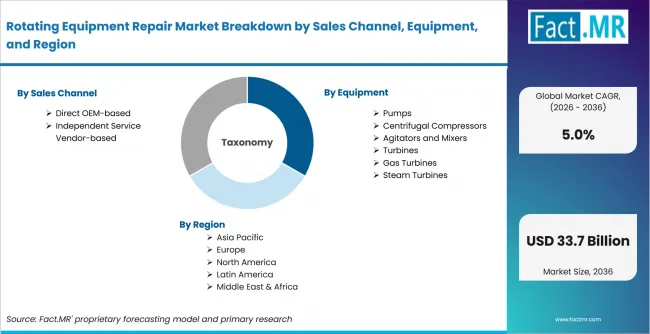
Rotating Equipment Repair Market Breakdown By Sales Channel, Equipment, And Region | Source: Fact.MR
| Attribute | Details |
|---|---|
| Quantitative Units | USD billion |
| Market Definition | Commercial repair, overhaul and refurbishment services for industrial rotating equipment |
| Segments Covered | Sales Channel; Equipment |
| Regions Covered | North America; Latin America; Europe; East Asia; South Asia and Pacific; Middle East and Africa |
| Countries Covered | Germany; Brazil; USA; U.K.; Japan |
| Key Companies Profiled | Siemens Energy; Wood; Sulzer AG; Ebara Corporation; KSB SE & Co. KGaA; GE Vernova; Flowserve Corporation; and other active repair providers |
| Forecast Period | 2026 to 2036 |
| Base Year | 2026 |
| Market Value, 2026 | USD 20.7 billion |
| Market Value, 2036 | USD 33.7 billion |
| CAGR, 2026-2036 | 5.0% |
| Absolute Opportunity | USD 13.0 billion |
| Approach | Hybrid top-down and bottom-up approach using installed equipment base, repair frequency, overhaul pricing, equipment criticality, service-channel mix and country growth |
Source: Fact.MR analysis. Updated Sep 3, 2026
How is the market segmented?
-
By Sales Channel
- Direct OEM-based
- Original Equipment Manufacturer Service Contracts
- Manufacturer Authorized Service Centers
- Independent Service Vendor-based
- Third-party Service Providers
- Multi-brand Service Providers
- Direct OEM-based
-
By Equipment
- Pumps
- Centrifugal Pumps
- Positive Displacement Pumps
- Centrifugal Compressors
- Process Compressors
- Industrial Compressors
- Agitators and Mixers
- Agitators
- Mixers
- Turbines
- Industrial Turbines
- Utility Turbines
- Gas Turbines
- Aeroderivative Gas Turbines
- Heavy-duty Gas Turbines
- Steam Turbines
- Back Pressure Steam Turbines
- Condensing Steam Turbines
- Pumps
Frequently Asked Questions
What is the Rotating Equipment Repair Market value in 2026?
At what CAGR is the market projected to grow?
What is the projected market value by 2036?
Which Sales Channel leads the market?
Which Equipment leads the market?
What CAGR is projected for Germany?
Which companies are active in the Rotating Equipment Repair Market?
What is the primary driver in this market?
What is the main restraint?
Who worked on this report


Preview the report firsthand - request a free sample
Free SampleGet the brochure for pricing and purchase details
Download PDF