- Base Value(2026): 428.7 Mn
- Estimated Value(2026): 428.7 Mn
- Forecast Value (2036): 1486.2 Mn
- CAGR (2026 - 2036): 13.2%
Autonomous Mobile Robots for Tire Plant Intralogistics Market Forecast and Outlook By Fact.MR
Valuation of the autonomous mobile robots for tire plant intralogistics market stood at USD 386.4 million in 2025. According to Fact MR, demand for autonomous mobile robots for tire manufacturing logistics is expected to reach USD 428.7 million in 2026 and USD 1,486.2 million by 2036. A CAGR of 13.2% is projected for the forecast timeline.
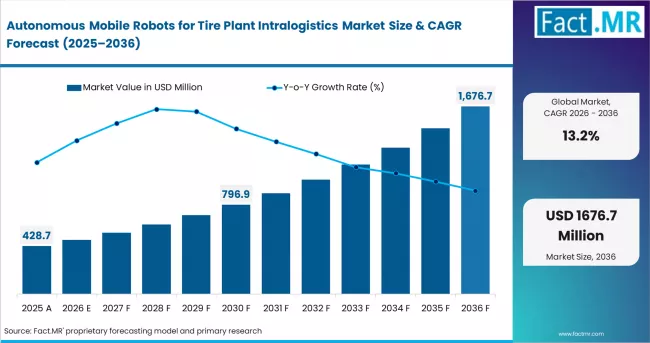
Autonomous Mobile Robots For Tire Plant Intralogistics Market Market Value Analysis | Source: Fact.MR
Summary of the Autonomous Mobile Robots for Tire Plant Intralogistics Market
- Market Definition
- The market comprises autonomous mobile robotic systems deployed within tire manufacturing facilities to transport raw materials, work in progress inventory, molds, and finished tires using sensor based navigation, fleet management software, and intelligent routing algorithms to improve internal logistics efficiency and production flow continuity.
- Demand Drivers
- Increasing automation of tire manufacturing workflows requiring continuous material movement between production stages.
- Rising demand for flexible intralogistics systems supporting dynamic routing across changing plant layouts.
- Growing focus on reducing labor dependency across repetitive material handling operations.
- Expansion of smart factory initiatives supporting integration of robotic material transport systems.
- Increasing requirement for optimized warehouse transfer supporting improved production throughput.
- Rising adoption of sensor based navigation systems supporting accurate positioning in industrial environments.
- Key Segments Analyzed
- Navigation: LiDAR SLAM leads with 41% share supported by accurate real time spatial mapping capability.
- Payload Capacity: Up to 500 kg holds 38% share driven by suitability for semi finished tire component transport.
- Application Role: Material transport and WIP movement support continuous flow across mixing, curing, and inspection processes.
- Technology Role: Vision guidance and QR navigation support structured routing across defined factory pathways.
- Geography: Asia Pacific demonstrates strong adoption supported by expansion of tire manufacturing automation infrastructure.
- Analyst Opinion at Fact MR
- Shambhu Nath Jha, Principal Consultant, Fact MR, opines, 'In this updated edition of the Autonomous Mobile Robots for Tire Plant Intralogistics Market report, manufacturers increasingly adopt flexible robotic material handling platforms supporting continuous production flow optimization. Demand patterns indicate gradual transition from fixed conveyor systems toward adaptive mobile robotics enabling improved layout flexibility, reduced operational disruption, and optimized intralogistics coordination across tire manufacturing facilities through 2036.'
- Strategic Implications/Executive Takeaways
- Invest in LiDAR based navigation systems supporting adaptive routing across dynamic manufacturing layouts.
- Develop modular robotic fleet architecture supporting scalability across varied production capacity requirements.
- Strengthen integration capability with MES and warehouse management systems supporting synchronized material flow.
- Improve payload optimization supporting efficient transport of semi finished tire components.
- Focus on safety compliant navigation systems supporting human robot interaction across shared production environments.
- Expand predictive fleet management software supporting real time monitoring of robotic transport performance.
- Methodology
- Primary interviews conducted with robotics manufacturers, tire producers, automation integrators, and industrial logistics specialists.
- Benchmarked against tire production workflow indicators influencing demand for intralogistics automation solutions.
- Evaluated utilization across material transport, pallet handling, and warehouse transfer applications.
- Hybrid modeling applied combining top down tire manufacturing automation demand assessment with bottom up AMR deployment analysis.
- Validation conducted using robotic fleet deployment data, manufacturing throughput indicators, and intralogistics automation benchmarks.
- Peer review applied using Fact MR analytical frameworks linking smart factory adoption patterns with robotic material handling demand trends.
Autonomous Mobile Robots for Tire Plant Intralogistics Market
| Metric | Details |
|---|---|
| Industry Size (2026E) | USD 428.7 million |
| Industry Value (2036F) | USD 1,486.2 million |
| CAGR (2026 to 2036) | 13.2% |
Source: Fact.MR analysis. Updated Apr 14, 2026
A CAGR of 13.2% indicates transformational expansion as tire manufacturers automate material movement across mixing, curing, and warehousing operations. Growth is supported by throughput optimization and labor risk reduction, while constraints persist due to facility layout constraints, integration with legacy MES systems, and capital expenditure cycles in automotive supply chains.
China leads with a projected CAGR of 14.6%, supported by expansion of automated tire production facilities integrating robotic material transport systems. India follows with a CAGR of 14.1%, driven by increasing deployment of autonomous handling platforms across rubber processing and tire assembly operations. The United Kingdom records a CAGR of 13.9%, reflecting steady adoption of automated intralogistics solutions across industrial manufacturing plants. Germany shows a CAGR of 13.7%, supported by consistent integration of robotic transport systems across precision tire manufacturing environments. The United States records the slowest growth at 13.2%, reflecting a relatively mature automation ecosystem tied to replacement cycles within existing factory logistics infrastructure.
Segmental Analysis
Autonomous Mobile Robots for Tire Plant Intralogistics Market Analysis by Navigation
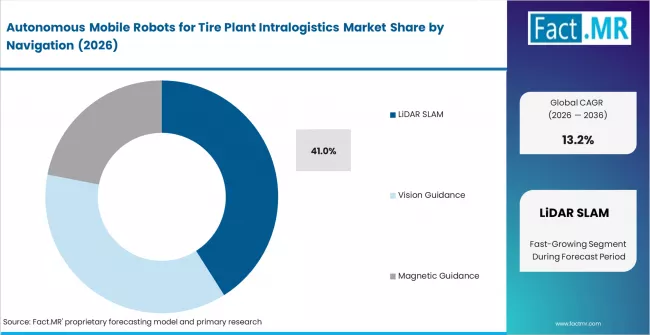
Autonomous Mobile Robots For Tire Plant Intralogistics Market Analysis By Navigation | Source: Fact.MR
- Market Overview: Based on Fact MR assessment, LiDAR SLAM navigation is projected to account for 41% share of the autonomous mobile robots for tire plant intralogistics market in 2026. Simultaneous localization and mapping algorithms utilize laser scanning sensors to generate real time spatial maps enabling navigation across dynamic manufacturing layouts. Tire production environments include curing presses, material storage zones, and conveyor transfer points requiring adaptive routing performance across continuously changing floor conditions. LiDAR based positioning supports obstacle detection and route recalibration enabling stable movement of raw rubber compounds, semi finished components, and finished tires across automated material transport workflows.
- Demand Drivers:
- Dynamic Navigation Requirements: LiDAR SLAM supports continuous mapping of production floor environments requiring adaptive routing performance across evolving layout configurations.
- Obstacle Detection Parameters: Laser scanning sensors enable identification of moving equipment and personnel requiring safe path adjustment across industrial transport routes.
- Operational Continuity Needs: Autonomous navigation supports consistent material transfer across production zones requiring minimized interruption of intralogistics workflows.
Autonomous Mobile Robots for Tire Plant Intralogistics Market Analysis by Payload Capacity
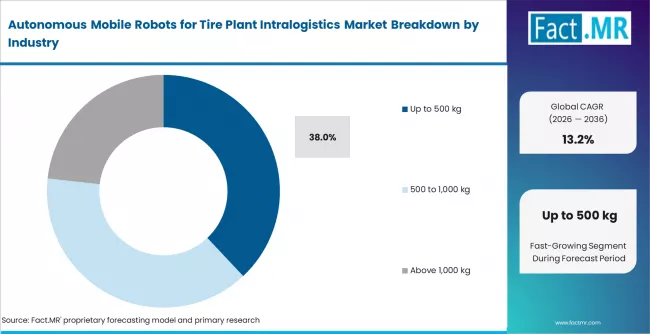
Autonomous Mobile Robots For Tire Plant Intralogistics Market Analysis By Payload Capacity | Source: Fact.MR
- Market Overview: Payload capacity up to 500 kg is estimated to hold 38% share of the autonomous mobile robots for tire plant intralogistics market in 2026, supported by requirement for transport of rubber compounds, molds, and finished tire units across manufacturing stages requiring moderate load handling capability. Medium capacity AMRs support movement across mixing areas, curing stations, and warehouse storage zones requiring controlled load balance performance across automated transport cycles. Equipment design supports maneuverability across constrained aisle layouts requiring stable handling of palletized materials across high throughput tire production environments.
- Demand Drivers:
- Material Transport Requirements: Medium payload AMRs support movement of semi finished tire components across production workflows requiring controlled handling performance.
- Load Stability Parameters: Robotic platforms maintain balance characteristics enabling safe transport of palletized materials across factory floor conditions.
- Workflow Integration Needs: Payload optimized AMRs support coordination across storage, staging, and production line supply operations within tire manufacturing facilities.
Key Dynamics
Autonomous Mobile Robots for Tire Plant Intralogistics Market Drivers, Restraints, and Opportunities
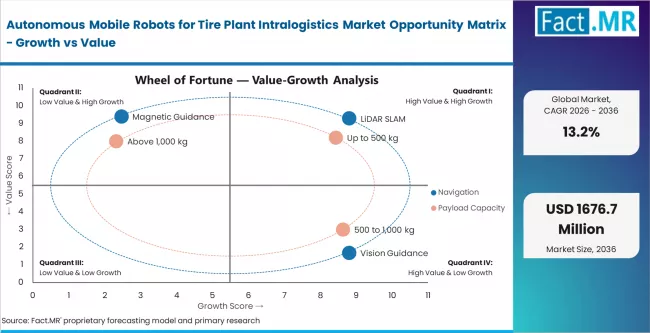
Autonomous Mobile Robots For Tire Plant Intralogistics Market Opportunity Matrix Growth Vs Value | Source: Fact.MR
Fact MR analysis indicates historical material handling within tire manufacturing has relied on conveyor networks, forklifts, and manual pallet transfer systems designed for predictable batch production layouts. The present market size reflects a structural transition toward flexible intralogistics automation as tire plants increasingly manage mixed SKU production, higher throughput targets, and tighter process synchronization between mixing, calendaring, curing, and inspection stages. Structural reality indicates a growth-phase market because tire manufacturing requires continuous movement of heavy rubber compounds and semi-finished components, where production delays directly reduce equipment utilization across capital-intensive curing presses and extrusion lines.
The current structural shift reflects declining reliance on fixed conveyor infrastructure as autonomous mobile robots enable dynamic routing across complex plant layouts with lower installation disruption. Higher upfront cost per robotic unit is offset by reduced floor space modification, lower safety incident exposure, and improved workflow adaptability when product mix changes. Value growth remains supported by productivity gains rather than large shipment volumes, as tire manufacturers prioritize incremental automation upgrades aligned with plant modernization cycles.
- Flexible Plant Flow: Autonomous navigation platforms support variable material routing between mixing, building, curing, and warehouse zones without requiring conveyor redesign.
- Industrial Safety Compliance: ISO 3691-4 safety requirements for driverless industrial trucks support wider deployment of autonomous transport systems in human-shared manufacturing environments.
- Asia Tire Capacity: China, India, and Southeast Asia drive adoption due to expansion of high-volume tire production facilities serving automotive replacement and OEM demand.
Regional Analysis
Regions Covered and Geographic Segmentation
The autonomous mobile robots for tire plant intralogistics market is assessed across North America, Europe, and Asia Pacific, segmented by country-level demand in material transport automation, pallet handling robotics, work-in-progress transfer systems, and warehouse flow optimization in tire manufacturing plants. Regional demand reflects expansion of smart factory logistics and adoption of robotic intralogistics platforms. The full report offers market attractiveness analysis.
.webp "Top Country Growth Comparison Autonomous Mobile Robots For Tire Plant Intralogistics Market Cagr (2026 2036)")
Top Country Growth Comparison Autonomous Mobile Robots For Tire Plant Intralogistics Market Cagr (2026 2036) | Source: Fact.MR
| Country | CAGR (2026–2036) |
|---|---|
| China | 14.6% |
| India | 14.1% |
| United Kingdom | 13.9% |
| Germany | 13.7% |
| United States | 13.2% |
Source: Fact.MR analysis. Updated Apr 14, 2026
Source: Fact MR analysis, based on proprietary forecasting model and primary research
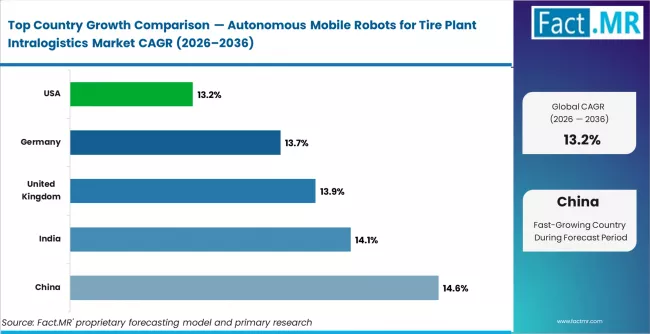
Autonomous Mobile Robots For Tire Plant Intralogistics Market Cagr Analysis By Country | Source: Fact.MR
Asia Pacific
Asia Pacific functions as the tire manufacturing automation hub, supported by expansion of high-volume production plants and adoption of robotic material handling systems. Daifuku Co. Ltd. strengthens factory intralogistics automation capability. Toyota Industries Corporation expands mobile robotic transport solutions. Murata Machinery Ltd. supports warehouse automation integration.
- China: China is projected to record 14.6% CAGR in autonomous mobile robots for tire plant intralogistics through 2036. Intelligent Manufacturing pilot factory programme expansion (MIIT, March 2024) supports robotic material transport adoption. Daifuku Co. Ltd. expanded automated intralogistics deployment capability (July 2023).
- India: Implementation of autonomous mobile robots for tire plant intralogistics in India is forecast to grow at 14.1% CAGR through 2036. Production Linked Incentive scheme update for automotive manufacturing (Ministry of Heavy Industries, January 2024) supports smart factory logistics integration. Toyota Industries Corporation expanded automated transport system engineering support (May 2023).
Europe
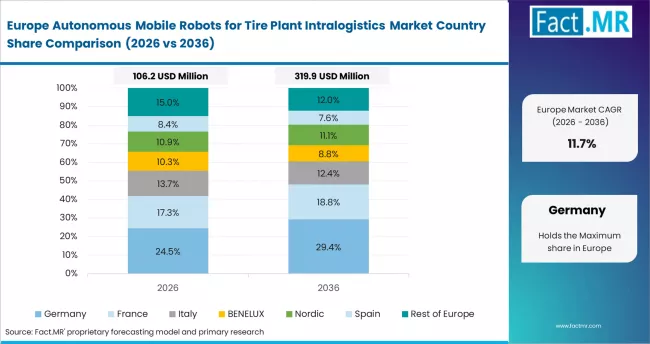
Autonomous Mobile Robots For Tire Plant Intralogistics Market Europe Country Market Share Analysis, 2026 & 2036 | Source: Fact.MR
Europe operates as the precision manufacturing intralogistics engineering center, supported by structured automation standards and strong presence of tire manufacturing technology providers. KUKA AG strengthens autonomous robotic navigation capability. SSI Schaefer AG expands warehouse automation system portfolio. Jungheinrich AG supports industrial mobile robotics integration.
- United Kingdom: Adoption of autonomous mobile robots for tire plant intralogistics in United Kingdom is expected to expand at 13.9% CAGR through 2036. Made Smarter digital manufacturing programme expansion (Department for Business and Trade, February 2024) supports robotic material handling integration. SSI Schaefer AG expanded automated warehouse robotics solutions (June 2023).
- Germany: Germany is anticipated to observe 13.7% CAGR in autonomous mobile robots for tire plant intralogistics through 2036. Plattform Industrie 4.0 smart factory initiative update (BMWK, October 2023) supports autonomous transport system integration. KUKA AG expanded mobile robot navigation software capability (April 2023).
North America
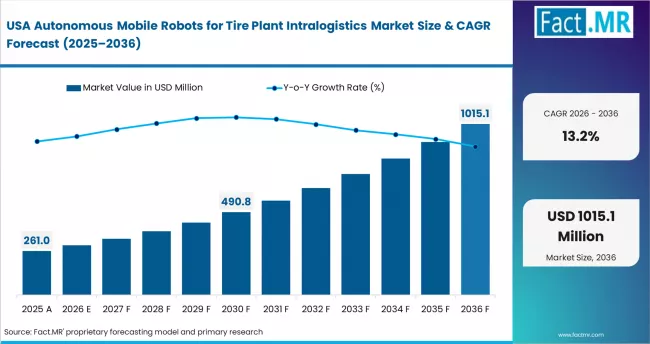
Autonomous Mobile Robots For Tire Plant Intralogistics Market Country Value Analysis | Source: Fact.MR
North America represents the connected factory logistics optimization environment, supported by adoption of robotic material flow systems and modernization of tire production distribution networks. Dematic (KION Group) strengthens warehouse robotics integration capability. Omron Corporation expands autonomous navigation technology. ABB Ltd. supports industrial robotic material handling platforms.
- United States: The United States is forecast to witness 13.2% CAGR in autonomous mobile robots for tire plant intralogistics through 2036. Manufacturing USA smart factory logistics funding update (NIST, April 2024) supports robotic workflow automation adoption. Dematic expanded autonomous warehouse vehicle deployment capability (August 2023).
- Fact MR's analysis of autonomous mobile robots for tire plant intralogistics market in global regions consists of country-wise assessment that includes China, India, United Kingdom, Germany, and United States. Readers can find robotic material transport trends, smart factory intralogistics developments, industrial automation signals, and competitive positioning across key markets.
Competitive Landscape
Competitive Structure and Buyer Dynamics in the Autonomous Mobile Robots for Tire Plant Intralogistics Market
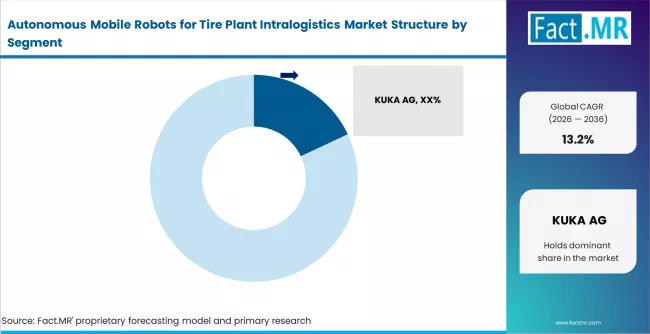
Autonomous Mobile Robots For Tire Plant Intralogistics Market Analysis By Company | Source: Fact.MR
The competitive structure of the Autonomous Mobile Robots for Tire Plant Intralogistics Market is moderately concentrated, with established industrial automation and material handling equipment manufacturers controlling a significant share of deployments. Companies such as KUKA AG, ABB Ltd., Omron Corporation, Daifuku Co. Ltd., SSI Schaefer AG, Toyota Industries Corporation, Jungheinrich AG, Murata Machinery Ltd., Geekplus Technology Co. Ltd., and Dematic maintain strong positions through integrated robotics platforms and warehouse automation technologies. These firms provide autonomous navigation systems designed to support material movement, pallet handling, and work in progress transport within tire manufacturing facilities. Competition is primarily influenced by navigation accuracy, payload handling capability, integration with manufacturing execution systems, and operational reliability in continuous production environments.
Several companies maintain structural advantages through established expertise in industrial robotics and long term relationships with automotive and tire manufacturers. Firms such as Daifuku Co. Ltd., Dematic, and SSI Schaefer AG benefit from extensive experience in automated storage and intralogistics system integration. KUKA AG, ABB Ltd., and Omron Corporation maintain advantages through advanced robotics engineering capabilities and global service infrastructure. Tire manufacturers often adopt multi vendor automation strategies to reduce dependence on a single robotics provider and maintain operational flexibility. Procurement decisions evaluate suppliers based on fleet scalability, system durability, and long term technical support, moderating supplier pricing leverage across intralogistics automation deployments.
Key Players of the Autonomous Mobile Robots for Tire Plant Intralogistics Market
- KUKA AG
- ABB Ltd.
- Omron Corporation
- Daifuku Co. Ltd.
- SSI Schaefer AG
- Jungheinrich AG
- Toyota Industries Corporation
- Murata Machinery Ltd.
- Geekplus Technology Co. Ltd.
- Dematic (KION Group)
Report Scope
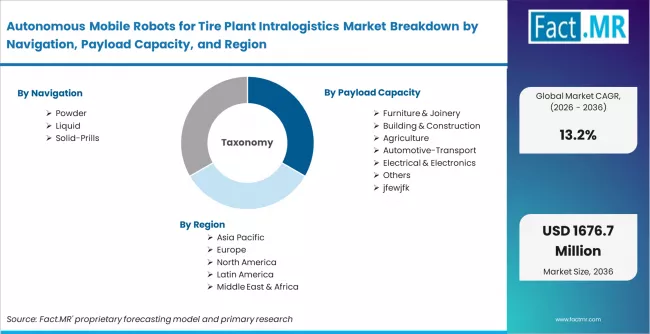
Autonomous Mobile Robots For Tire Plant Intralogistics Market Breakdown By Navigation, Payload Capacity, And Region | Source: Fact.MR
| Metric | Value |
|---|---|
| Quantitative Units | USD 428.7 million (2026) to USD 1,486.2 million (2036), at a CAGR of 13.2% |
| Market Definition | The autonomous mobile robots for tire plant intralogistics market includes robotic material handling systems deployed within tire manufacturing facilities to automate transport of raw materials, work in progress inventory, finished goods, and palletized loads across production and warehouse environments. |
| Application Segmentation | Material transport, Pallet handling, WIP movement, Warehouse transfer, Sorting |
| Payload Capacity Segmentation | Up to 500 kg, 500 to 1,000 kg, Above 1,000 kg |
| Navigation Segmentation | LiDAR SLAM, Vision guidance, Magnetic guidance, QR navigation |
| Regions Covered | North America, Latin America, Europe, East Asia, South Asia, Oceania, Middle East and Africa |
| Countries Covered | United States, Germany, France, United Kingdom, Italy, Spain, China, Japan, South Korea, India, Thailand, Indonesia, Brazil, Mexico, Saudi Arabia, United Arab Emirates, Singapore, and 40+ countries |
| Key Companies Profiled | KUKA AG, ABB Ltd., Omron Corporation, Daifuku Co. Ltd., SSI Schaefer AG, Jungheinrich AG, Toyota Industries Corporation, Murata Machinery Ltd., Geekplus Technology Co. Ltd., Dematic |
| Forecast Period | 2026 to 2036 |
| Approach | Hybrid top-down and bottom-up market estimation based on tire manufacturing automation adoption trends, intralogistics robotics deployment benchmarking, factory material flow optimization demand, industrial automation investment analysis, and validation through primary interviews with robotics manufacturers, tire producers, and automation system integrators. |
Source: Fact.MR analysis. Updated Apr 14, 2026
Autonomous Mobile Robots for Tire Plant Intralogistics Market Key Segments
-
Application:
- Material Transport
- Pallet Handling
- WIP Movement
- Warehouse Transfer
- Sorting
-
Payload Capacity:
- Up to 500 kg
- 500 to 1,000 kg
- Above 1,000 kg
-
Navigation:
- LiDAR SLAM
- Vision Guidance
- Magnetic Guidance
- QR Navigation
-
Region:
- North America
- USA
- Canada
- Mexico
- Europe
- Germany
- UK
- France
- Italy
- Spain
- Nordic Countries
- BENELUX
- Rest of Europe
- Asia Pacific
- China
- Japan
- South Korea
- India
- Australia
- Rest of Asia Pacific
- Latin America
- Brazil
- Argentina
- Rest of Latin America
- Middle East and Africa
- Kingdom of Saudi Arabia
- United Arab Emirates
- South Africa
- Rest of Middle East and Africa
- Other Regions
- Oceania
- Central Asia
- Other Markets
- North America
Bibliographies
- [1] International Organization for Standardization. (2023). ISO 3691-4:2023 Industrial trucks, safety requirements and verification for driverless industrial trucks. ISO.
- [2] National Institute of Standards and Technology. (2024, April). Smart manufacturing operations planning and control program. U.S. Department of Commerce.
- [3] Ministry of Industry and Information Technology. (2024, March). Intelligent manufacturing pilot factory programme expansion. Government of China.
- [4] Ministry of Heavy Industries. (2024, January). Production linked incentive scheme update for automotive manufacturing. Government of India.
- [5] Department for Business and Trade. (2024, February). Made Smarter digital manufacturing programme expansion. UK Government.
- [6] Federal Ministry for Economic Affairs and Climate Action. (2023, October). Plattform Industrie 4.0 smart factory initiative update. Government of Germany.
This Report Addresses
- Market size forecasts for 2026 to 2036 based on tire manufacturing automation demand and intralogistics robotics deployment benchmarks.
- Opportunity mapping across material transport, pallet handling, WIP movement, warehouse transfer, and sorting workflows within tire production facilities.
- Segment and regional forecasts covering LiDAR SLAM, vision guidance, magnetic guidance, and QR navigation technologies for autonomous movement.
- Competition assessment based on navigation accuracy performance, fleet coordination software capability, and integration with manufacturing execution systems.
- Regulatory review covering ISO 3691-4 safety standards for driverless industrial trucks and factory automation compliance requirements.
- Report delivery in PDF, Excel, PPT, and dashboard formats for tire manufacturers, robotics integrators, and industrial automation solution providers.
- Technology risk assessment covering facility layout constraints, navigation calibration complexity, fleet interoperability limitations, and integration with legacy production control architectures.
Autonomous Mobile Robots for Tire Plant Intralogistics Market Definition
Autonomous Mobile Robots for Tire Plant Intralogistics Market Definition Paragraph
The Autonomous Mobile Robots for Tire Plant Intralogistics Market includes mobile robotic systems designed to transport raw materials, semi finished components, and finished tires within manufacturing facilities using autonomous navigation, sensors, and fleet management software to improve internal logistics efficiency and production flow.
Autonomous Mobile Robots for Tire Plant Intralogistics Market Inclusions
The report includes global and regional market size estimates, forecast analysis, and segmentation by robot type, payload capacity, navigation technology, application area, end use industry, pricing structure, and integration with tire manufacturing automation systems.
Autonomous Mobile Robots for Tire Plant Intralogistics Market Exclusions
The scope excludes automated guided vehicles dependent on fixed navigation infrastructure, industrial robots without mobility functionality, warehouse software platforms not linked to robotic transport systems, and manual material handling equipment used in tire production facilities.
Autonomous Mobile Robots for Tire Plant Intralogistics Market Research Methodology
- Primary Research
- Interviews were conducted with robotics manufacturers, tire producers, automation integrators, logistics specialists, and industrial digitalization experts.
- Desk Research
- Public sources included robotics engineering publications, company technical documentation, industrial automation standards, and research studies on intralogistics robotics deployment.
- Market-Sizing and Forecasting
- A hybrid model combining top-down tire manufacturing automation demand evaluation and bottom-up analysis of AMR deployment across intralogistics workflows was applied.
- Data Validation and Update Cycle
- Outputs were validated through cross comparison of supplier data, expert consultation, and periodic monitoring of robotics adoption trends in industrial material handling.
Frequently Asked Questions
How large is the demand for Autonomous Mobile Robots for Tire Plant Intralogistics in the global market in 2026?
What will be the market size of Autonomous Mobile Robots for Tire Plant Intralogistics in the global market by 2036?
What is the expected demand growth for Autonomous Mobile Robots for Tire Plant Intralogistics in the global market between 2026 and 2036?
Which company is identified as a leading manufacturer in the Autonomous Mobile Robots for Tire Plant Intralogistics market?
Which navigation technology is projected to dominate AMR deployment by 2026?
Why is LiDAR SLAM widely used in tire plant intralogistics automation?
What is driving demand for AMRs for tire plant intralogistics in China?
What is the growth outlook for the Autonomous Mobile Robots for Tire Plant Intralogistics market in China?
Why is India an important market for robotic intralogistics systems?
What is the growth outlook for the Autonomous Mobile Robots for Tire Plant Intralogistics market in India?
How is demand for AMRs evolving in the United Kingdom manufacturing sector?
What is the growth outlook for the Autonomous Mobile Robots for Tire Plant Intralogistics market in the United Kingdom?
What is the growth outlook for the Autonomous Mobile Robots for Tire Plant Intralogistics market in Germany?
How is the United States positioned in the Autonomous Mobile Robots for Tire Plant Intralogistics market?
What is the growth outlook for the Autonomous Mobile Robots for Tire Plant Intralogistics market in the United States?
What are autonomous mobile robots for tire plant intralogistics and what are they mainly used for?
What does the Autonomous Mobile Robots for Tire Plant Intralogistics market include in this report?
What applications are included in the scope of the Autonomous Mobile Robots for Tire Plant Intralogistics market?
What is excluded from the scope of the Autonomous Mobile Robots for Tire Plant Intralogistics market report?
What does market forecast mean in the Autonomous Mobile Robots for Tire Plant Intralogistics market report?
How is the Autonomous Mobile Robots for Tire Plant Intralogistics market forecast developed in this report?
What does primary validation indicate in the Autonomous Mobile Robots for Tire Plant Intralogistics market analysis?
Who worked on this report


Preview the report firsthand - request a free sample
Free SampleGet the brochure for pricing and purchase details
Download PDF