Variable-Rate Precision Autonomous Tractors Market
Variable-Rate Precision Autonomous Tractors Market Size and Share Forecast Outlook 2026 to 2036
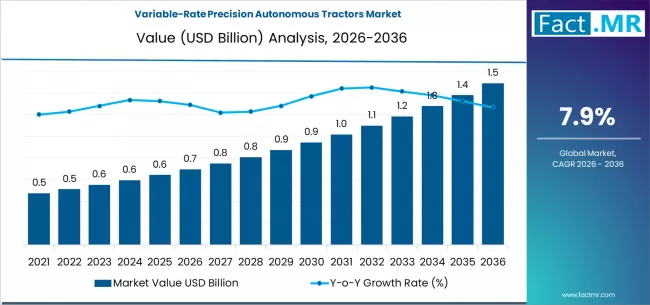
Variable-rate precision autonomous tractors market is projected to grow from USD 0.7 billion in 2026 to USD 1.5 billion by 2036, at a CAGR of 7.9%. 150-300 HP will dominate with a 44.0% market share, while assisted autonomy will lead the automation level segment with a 63.0% share.
Variable-Rate Precision Autonomous Tractors Market Forecast and Outlook 2026 to 2036
The global variable-rate precision autonomous tractors market is projected to expand from USD 0.70 billion in 2026 to USD 1.49 billion by 2036, growing at a compound annual growth rate of 7.9%. This growth signifies a fundamental transformation in agriculture, moving from mechanization to digitization and autonomy.
The convergence of GPS guidance, machine vision, artificial intelligence, and variable-rate application technology is creating intelligent machines that optimize every pass across a field. These tractors are no longer just about pulling implements; they are mobile data hubs that apply seed, fertilizer, and crop protection products at dynamically variable rates based on real-time soil and crop sensor data, maximizing input efficiency and yield.
Key Takeaways from the Variable-Rate Precision Autonomous Tractors Market
- Market Value for 2026: USD 0.70 Billion
- Market Value for 2036: USD 1.49 Billion
- Forecast CAGR (2026 to 2036): 7.9%
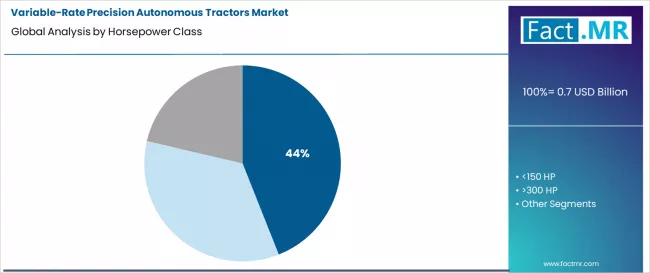
- Leading Horsepower Class Segment (2026): 150-300 HP (44%)
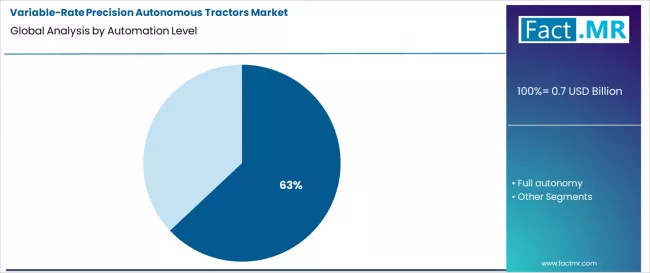
- Leading Automation Level Segment (2026): Assisted Autonomy (63%)
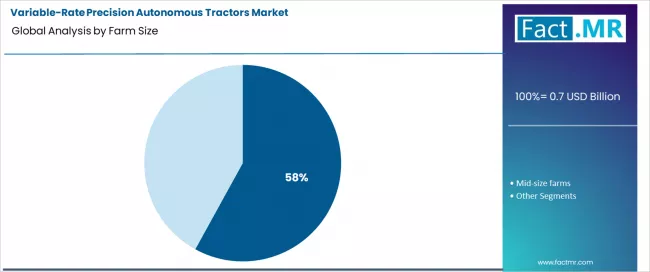
- Leading Farm Size Segment (2026): Large Farms (58%)
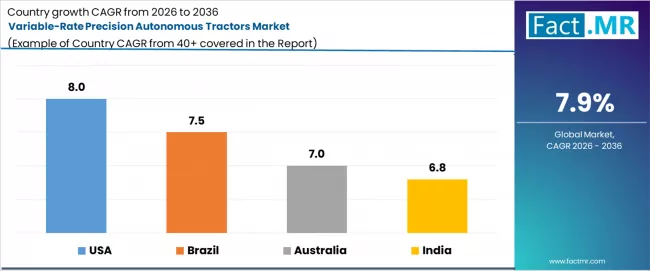
- Key Growth Countries: USA (8.00% CAGR), Brazil (7.50% CAGR), Australia (7.00% CAGR), India (6.80% CAGR)
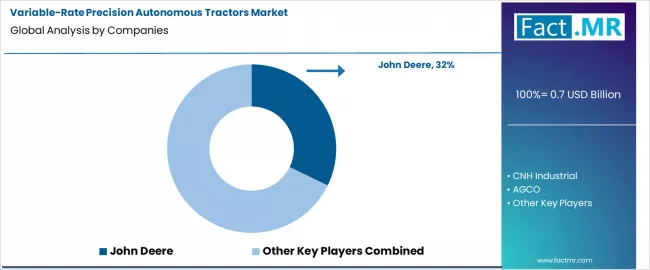
- Key Players in the Market: John Deere, CNH Industrial, AGCO, Kubota, Yanmar, Mahindra & Mahindra

Key trends include the dominance of assisted autonomy systems, which hold a 63% share as a critical stepping stone toward full self-operation, and the focus on large farms (58% share) that have the scale to justify the investment and integrate the technology into complex operational workflows.
The 150-300 horsepower class leads (44% share), balancing power for large implements with versatility. Geographically, adoption is strongest in major agricultural economies with expansive farmlands and pressing labor challenges, led by the United States, Brazil, Australia, and India.
Metric
| Metric | Value |
|---|---|
| Market Value (2026) | USD 0.70 Billion |
| Market Forecast Value (2036) | USD 1.49 Billion |
| Forecast CAGR (2026 to 2036) | 7.9% |
Category
| Category | Segments |
|---|---|
| Horsepower Class | 150-300 HP, <150 HP, >300 HP |
| Automation Level | Assisted Autonomy, Full Autonomy |
| Farm Size | Large Farms, Mid-size Farms |
| Region | North America, Latin America, Western Europe, Eastern Europe, East Asia, South Asia & Pacific, MEA |
Segmental Analysis
By Horsepower Class, Which Segment Offers the Optimal Balance of Capability and Versatility?

The 150-300 horsepower class leads the market with a 44% share. This range represents the workhorse capacity for large-scale row-crop farming in North and South America, capable of pulling wide, variable-rate implements for planting, spraying, and spreading.
It offers sufficient power for high-capacity field operations while remaining versatile enough for various tasks, making it the primary target for integrating advanced precision and autonomous features by manufacturers serving commercial grain and oilseed producers.
By Automation Level, Which Technology is Bridging the Gap to Full Autonomy?

Assisted autonomy systems command a dominant 63% market share. This segment includes advanced driver-assist features like GPS auto-steering, implement control, and section control, which dramatically reduce operator fatigue and improve accuracy.
It represents the pragmatic adoption phase where farmers gain tangible efficiency benefits and build trust in the technology without the regulatory and liability complexities of fully driverless machines, serving as the essential foundation for the market's evolution.
By Farm Size, Which Operations Drive Early and Scalable Adoption?

Large-scale farming operations are the primary adopters, holding a 58% share. These enterprises possess the financial capacity for significant capital investment, the technical staff to manage complex systems, and the vast acreage over which the efficiency gains from precision autonomy generate a compelling return on investment.
The economic model for autonomous, variable-rate technology scales most effectively on large farms, where marginal input savings and yield improvements per acre translate into substantial whole-farm profitability gains.
What are the Drivers, Restraints, Opportunities, and Trends in the Variable-Rate Precision Autonomous Tractors Market?
The market is driven by the persistent and growing shortage of skilled farm labor, which makes autonomy a strategic necessity rather than a luxury. Rising costs of seeds, fertilizers, and crop protection chemicals create a powerful economic incentive for variable-rate technology to optimize input use and reduce waste. Supportive government subsidies in some regions for precision agriculture equipment further encourage adoption.
A key restraint is the very high initial capital cost of these advanced systems, which places them out of reach for many small and mid-sized farms. Limited rural broadband connectivity and data infrastructure can hinder the full realization of cloud-based data analytics and real-time machine optimization.
Significant opportunities exist in developing more affordable, modular autonomy solutions for smaller farms and in creating robust data integration platforms that turn field data into actionable agronomic insights.
Current trends include the rise of retrofit kits to add autonomy to existing fleets, the integration of machine learning for predictive field analytics, and the development of swarming protocols where multiple smaller autonomous tractors work collaboratively.
Analysis of the Variable-Rate Precision Autonomous Tractors Market by Key Countries
<
| Country | CAGR (2026 to 2036) |
|---|---|
| USA | 8.00% |
| Brazil | 7.50% |
| Australia | 7.00% |
| India | 6.80% |
How is the USA's Advanced Farm Economics and Labor Challenge Driving its 8.00% CAGR?

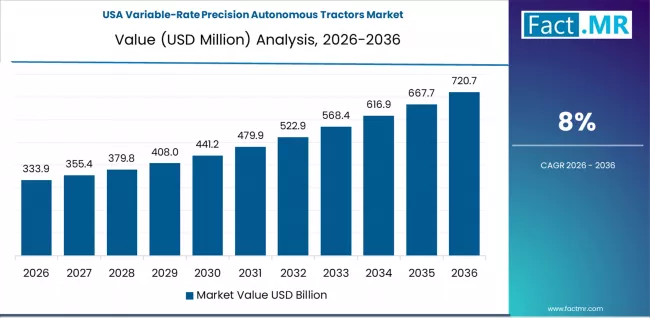
USA, with its 8.00% CAGR, leads the market due to its large-scale, technologically advanced farming sector. High labor costs and chronic operator shortages make autonomy a critical solution.
American farmers have a long history of adopting precision agriculture, creating a ready foundation for autonomous upgrades. The market is characterized by demand for high-horsepower, fully integrated systems from major OEMs, with a strong focus on corn, soybean, and wheat production across the Midwest and Great Plains.
What Factors Underpin Brazil's Strong 7.50% CAGR Growth?
The vast scale of agricultural production, particularly in soybeans and sugarcane, where large farms dominate, fuels Brazil’s 7.50% CAGR. The need to maximize efficiency on immense fields and manage operations across multiple growing seasons drives adoption.
Brazilian farmers are highly receptive to technology that boosts productivity on sometimes challenging soils. The market focuses on robust machines capable of handling large-scale planting and spraying with precision, often in regions where connectivity is improving but remains a consideration.
Why is Australia's Unique Farming Context Supporting a 7.00% CAGR?
Australia's 7.00% CAGR is shaped by its extensive broadacre farming systems, severe labor shortages in remote areas, and a need for meticulous input management in variable climates. Autonomy offers a way to operate longer hours and cover vast pastures and grain fields more efficiently.
The market emphasizes durability, fuel efficiency, and systems that can operate reliably with minimal supervision over long distances, catering to the country's specific conditions of large, often arid, farm holdings.
How is India's Evolving Agricultural Mechanization Landscape Contributing to its 6.80% CAGR?
India's 6.80% CAGR reflects a growing, though nascent, market segment within its diverse agricultural sector. Adoption is initially focused on very large progressive farms, contract service providers, and research institutions. The growth driver is the potential to address rural labor migration and improve the precision of input application in high-value crops.
The market opportunity lies in developing and adapting cost-effective, lower-horsepower autonomous solutions suitable for smaller field sizes and different cropping patterns prevalent in India.
Competitive Landscape

Established global agricultural machinery giants who are fiercely competing to embed proprietary autonomy and data platforms into their equipment ecosystems dominate the competitive landscape. Their strategy is one of vertical integration, controlling the hardware, software, and data layer to create customer lock-in.
Competition centers on the sophistication of machine vision and decision-making AI, the reliability of autonomous operation in diverse conditions, and the value of the agronomic insights generated by the platform. A segment of specialist technology firms is emerging, focusing on retrofit autonomy kits and best-in-class perception software that can work across OEM platforms.
Success for all players depends on demonstrating a clear and rapid return on investment through input savings and yield gains, providing robust dealer networks for support and service, and navigating the evolving regulatory environment for autonomous vehicle operation on public roads between fields.
Key Players in the Variable-Rate Precision Autonomous Tractors Market
- John Deere
- CNH Industrial
- AGCO
- Kubota
- Yanmar
- Mahindra & Mahindra
Scope of Report
| Items | Values |
|---|---|
| Quantitative Units | USD Billion |
| Horsepower Class | 150-300 HP, <150 HP, >300 HP |
| Automation Level | Assisted Autonomy, Full Autonomy |
| Farm Size | Large Farms, Mid-size Farms |
| Key Countries | USA, Brazil, Australia, India |
| Key Companies | John Deere, CNH Industrial, AGCO, Kubota, Yanmar, Mahindra & Mahindra |
| Additional Analysis | Return on investment modeling for autonomy under different crop systems; analysis of sensor fusion technologies (LiDAR, radar, vision); regulatory framework analysis for autonomous farm machinery; study of farmer adoption barriers and technology acceptance; impact of telematics and farm management software integration; supply chain analysis for key components like perception systems. |
Market by Segments
-
Horsepower Class :
- 150-300 HP
- <150 HP
- 300 HP
-
Automation Level :
- Assisted Autonomy
- Full Autonomy
-
Farm Size :
- Large Farms
- Mid-size Farms
-
Region :
- North America
- USA
- Canada
- Latin America
- Brazil
- Mexico
- Argentina
- Rest of Latin America
- Western Europe
- Germany
- UK
- France
- Italy
- BENELUX
- Spain
- Rest of Western Europe
- Eastern Europe
- Poland
- Russia
- Czech Republic
- Rest of Eastern Europe
- East Asia
- China
- Japan
- South Korea
- Rest of East Asia
- South Asia & Pacific
- India
- ASEAN
- Australia
- Rest of South Asia & Pacific
- MEA
- South Africa
- GCC Countries
- Turkiye
- Rest of MEA
- North America
References
- Food and Agriculture Organization of the United Nations (FAO). (2023). The Future of Food and Agriculture: Drivers and triggers for transformation.
- Gebbers, R., & Adamchuk, V. I. (2023). Precision Agriculture and Food Security. Science.
- Lowenberg-DeBoer, J., & Huang, I. Y. (2023). Economics of Robots and Automation in Crop Production. Precision Agriculture.
- National Academy of Sciences. (2024). Automation in USA Agriculture: A Research Roadmap. The National Academies Press.
- Zhang, Q., & Pierce, F. J. (Eds.). (2023). Agricultural Automation: Fundamentals and Practices. CRC Press.
Table of Content
- Executive Summary
- Global Market Outlook
- Demand to side Trends
- Supply to side Trends
- Technology Roadmap Analysis
- Analysis and Recommendations
- Market Overview
- Market Coverage / Taxonomy
- Market Definition / Scope / Limitations
- Market Background
- Market Dynamics
- Drivers
- Restraints
- Opportunity
- Trends
- Scenario Forecast
- Demand in Optimistic Scenario
- Demand in Likely Scenario
- Demand in Conservative Scenario
- Opportunity Map Analysis
- Product Life Cycle Analysis
- Supply Chain Analysis
- Investment Feasibility Matrix
- Value Chain Analysis
- PESTLE and Porter’s Analysis
- Regulatory Landscape
- Regional Parent Market Outlook
- Production and Consumption Statistics
- Import and Export Statistics
- Market Dynamics
- Global Market Analysis 2021 to 2025 and Forecast, 2026 to 2036
- Historical Market Size Value (USD Million) Analysis, 2021 to 2025
- Current and Future Market Size Value (USD Million) Projections, 2026 to 2036
- Y to o to Y Growth Trend Analysis
- Absolute $ Opportunity Analysis
- Global Market Pricing Analysis 2021 to 2025 and Forecast 2026 to 2036
- Global Market Analysis 2021 to 2025 and Forecast 2026 to 2036, By Horsepower Class
- Introduction / Key Findings
- Historical Market Size Value (USD Million) Analysis By Horsepower Class, 2021 to 2025
- Current and Future Market Size Value (USD Million) Analysis and Forecast By Horsepower Class, 2026 to 2036
- 150-300 HP
- <150 HP
- >300 HP
- 150-300 HP
- Y to o to Y Growth Trend Analysis By Horsepower Class, 2021 to 2025
- Absolute $ Opportunity Analysis By Horsepower Class, 2026 to 2036
- Global Market Analysis 2021 to 2025 and Forecast 2026 to 2036, By Automation Level
- Introduction / Key Findings
- Historical Market Size Value (USD Million) Analysis By Automation Level, 2021 to 2025
- Current and Future Market Size Value (USD Million) Analysis and Forecast By Automation Level, 2026 to 2036
- Assisted autonomy
- Full autonomy
- Assisted autonomy
- Y to o to Y Growth Trend Analysis By Automation Level, 2021 to 2025
- Absolute $ Opportunity Analysis By Automation Level, 2026 to 2036
- Global Market Analysis 2021 to 2025 and Forecast 2026 to 2036, By Farm Size
- Introduction / Key Findings
- Historical Market Size Value (USD Million) Analysis By Farm Size, 2021 to 2025
- Current and Future Market Size Value (USD Million) Analysis and Forecast By Farm Size, 2026 to 2036
- Large farms
- Mid-size farms
- Large farms
- Y to o to Y Growth Trend Analysis By Farm Size, 2021 to 2025
- Absolute $ Opportunity Analysis By Farm Size, 2026 to 2036
- Global Market Analysis 2021 to 2025 and Forecast 2026 to 2036, By Region
- Introduction
- Historical Market Size Value (USD Million) Analysis By Region, 2021 to 2025
- Current Market Size Value (USD Million) Analysis and Forecast By Region, 2026 to 2036
- North America
- Latin America
- Western Europe
- Eastern Europe
- East Asia
- South Asia and Pacific
- Middle East & Africa
- Market Attractiveness Analysis By Region
- North America Market Analysis 2021 to 2025 and Forecast 2026 to 2036, By Country
- Historical Market Size Value (USD Million) Trend Analysis By Market Taxonomy, 2021 to 2025
- Market Size Value (USD Million) Forecast By Market Taxonomy, 2026 to 2036
- By Country
- USA
- Canada
- Mexico
- By Horsepower Class
- By Automation Level
- By Farm Size
- By Country
- Market Attractiveness Analysis
- By Country
- By Horsepower Class
- By Automation Level
- By Farm Size
- Key Takeaways
- Latin America Market Analysis 2021 to 2025 and Forecast 2026 to 2036, By Country
- Historical Market Size Value (USD Million) Trend Analysis By Market Taxonomy, 2021 to 2025
- Market Size Value (USD Million) Forecast By Market Taxonomy, 2026 to 2036
- By Country
- Brazil
- Chile
- Rest of Latin America
- By Horsepower Class
- By Automation Level
- By Farm Size
- By Country
- Market Attractiveness Analysis
- By Country
- By Horsepower Class
- By Automation Level
- By Farm Size
- Key Takeaways
- Western Europe Market Analysis 2021 to 2025 and Forecast 2026 to 2036, By Country
- Historical Market Size Value (USD Million) Trend Analysis By Market Taxonomy, 2021 to 2025
- Market Size Value (USD Million) Forecast By Market Taxonomy, 2026 to 2036
- By Country
- Germany
- UK
- Italy
- Spain
- France
- Nordic
- BENELUX
- Rest of Western Europe
- By Horsepower Class
- By Automation Level
- By Farm Size
- By Country
- Market Attractiveness Analysis
- By Country
- By Horsepower Class
- By Automation Level
- By Farm Size
- Key Takeaways
- Eastern Europe Market Analysis 2021 to 2025 and Forecast 2026 to 2036, By Country
- Historical Market Size Value (USD Million) Trend Analysis By Market Taxonomy, 2021 to 2025
- Market Size Value (USD Million) Forecast By Market Taxonomy, 2026 to 2036
- By Country
- Russia
- Poland
- Hungary
- Balkan & Baltic
- Rest of Eastern Europe
- By Horsepower Class
- By Automation Level
- By Farm Size
- By Country
- Market Attractiveness Analysis
- By Country
- By Horsepower Class
- By Automation Level
- By Farm Size
- Key Takeaways
- East Asia Market Analysis 2021 to 2025 and Forecast 2026 to 2036, By Country
- Historical Market Size Value (USD Million) Trend Analysis By Market Taxonomy, 2021 to 2025
- Market Size Value (USD Million) Forecast By Market Taxonomy, 2026 to 2036
- By Country
- China
- Japan
- South Korea
- By Horsepower Class
- By Automation Level
- By Farm Size
- By Country
- Market Attractiveness Analysis
- By Country
- By Horsepower Class
- By Automation Level
- By Farm Size
- Key Takeaways
- South Asia and Pacific Market Analysis 2021 to 2025 and Forecast 2026 to 2036, By Country
- Historical Market Size Value (USD Million) Trend Analysis By Market Taxonomy, 2021 to 2025
- Market Size Value (USD Million) Forecast By Market Taxonomy, 2026 to 2036
- By Country
- India
- ASEAN
- Australia & New Zealand
- Rest of South Asia and Pacific
- By Horsepower Class
- By Automation Level
- By Farm Size
- By Country
- Market Attractiveness Analysis
- By Country
- By Horsepower Class
- By Automation Level
- By Farm Size
- Key Takeaways
- Middle East & Africa Market Analysis 2021 to 2025 and Forecast 2026 to 2036, By Country
- Historical Market Size Value (USD Million) Trend Analysis By Market Taxonomy, 2021 to 2025
- Market Size Value (USD Million) Forecast By Market Taxonomy, 2026 to 2036
- By Country
- Kingdom of Saudi Arabia
- Other GCC Countries
- Turkiye
- South Africa
- Other African Union
- Rest of Middle East & Africa
- By Horsepower Class
- By Automation Level
- By Farm Size
- By Country
- Market Attractiveness Analysis
- By Country
- By Horsepower Class
- By Automation Level
- By Farm Size
- Key Takeaways
- Key Countries Market Analysis
- USA
- Pricing Analysis
- Market Share Analysis, 2025
- By Horsepower Class
- By Automation Level
- By Farm Size
- Canada
- Pricing Analysis
- Market Share Analysis, 2025
- By Horsepower Class
- By Automation Level
- By Farm Size
- Mexico
- Pricing Analysis
- Market Share Analysis, 2025
- By Horsepower Class
- By Automation Level
- By Farm Size
- Brazil
- Pricing Analysis
- Market Share Analysis, 2025
- By Horsepower Class
- By Automation Level
- By Farm Size
- Chile
- Pricing Analysis
- Market Share Analysis, 2025
- By Horsepower Class
- By Automation Level
- By Farm Size
- Germany
- Pricing Analysis
- Market Share Analysis, 2025
- By Horsepower Class
- By Automation Level
- By Farm Size
- UK
- Pricing Analysis
- Market Share Analysis, 2025
- By Horsepower Class
- By Automation Level
- By Farm Size
- Italy
- Pricing Analysis
- Market Share Analysis, 2025
- By Horsepower Class
- By Automation Level
- By Farm Size
- Spain
- Pricing Analysis
- Market Share Analysis, 2025
- By Horsepower Class
- By Automation Level
- By Farm Size
- France
- Pricing Analysis
- Market Share Analysis, 2025
- By Horsepower Class
- By Automation Level
- By Farm Size
- India
- Pricing Analysis
- Market Share Analysis, 2025
- By Horsepower Class
- By Automation Level
- By Farm Size
- ASEAN
- Pricing Analysis
- Market Share Analysis, 2025
- By Horsepower Class
- By Automation Level
- By Farm Size
- Australia & New Zealand
- Pricing Analysis
- Market Share Analysis, 2025
- By Horsepower Class
- By Automation Level
- By Farm Size
- China
- Pricing Analysis
- Market Share Analysis, 2025
- By Horsepower Class
- By Automation Level
- By Farm Size
- Japan
- Pricing Analysis
- Market Share Analysis, 2025
- By Horsepower Class
- By Automation Level
- By Farm Size
- South Korea
- Pricing Analysis
- Market Share Analysis, 2025
- By Horsepower Class
- By Automation Level
- By Farm Size
- Russia
- Pricing Analysis
- Market Share Analysis, 2025
- By Horsepower Class
- By Automation Level
- By Farm Size
- Poland
- Pricing Analysis
- Market Share Analysis, 2025
- By Horsepower Class
- By Automation Level
- By Farm Size
- Hungary
- Pricing Analysis
- Market Share Analysis, 2025
- By Horsepower Class
- By Automation Level
- By Farm Size
- Kingdom of Saudi Arabia
- Pricing Analysis
- Market Share Analysis, 2025
- By Horsepower Class
- By Automation Level
- By Farm Size
- Turkiye
- Pricing Analysis
- Market Share Analysis, 2025
- By Horsepower Class
- By Automation Level
- By Farm Size
- South Africa
- Pricing Analysis
- Market Share Analysis, 2025
- By Horsepower Class
- By Automation Level
- By Farm Size
- USA
- Market Structure Analysis
- Competition Dashboard
- Competition Benchmarking
- Market Share Analysis of Top Players
- By Regional
- By Horsepower Class
- By Automation Level
- By Farm Size
- Competition Analysis
- Competition Deep Dive
- John Deere
- Overview
- Product Portfolio
- Profitability by Market Segments (Product/Age /Sales Channel/Region)
- Sales Footprint
- Strategy Overview
- Marketing Strategy
- Product Strategy
- Channel Strategy
- CNH Industrial
- AGCO
- Kubota
- Yanmar
- Mahindra & Mahindra
- John Deere
- Competition Deep Dive
- Assumptions & Acronyms Used
- Research Methodology
List Of Table
- Table 1: Global Market Value (USD Million) Forecast by Region, 2021 to 2036
- Table 2: Global Market Value (USD Million) Forecast by Horsepower Class, 2021 to 2036
- Table 3: Global Market Value (USD Million) Forecast by Automation Level, 2021 to 2036
- Table 4: Global Market Value (USD Million) Forecast by Farm Size, 2021 to 2036
- Table 5: North America Market Value (USD Million) Forecast by Country, 2021 to 2036
- Table 6: North America Market Value (USD Million) Forecast by Horsepower Class, 2021 to 2036
- Table 7: North America Market Value (USD Million) Forecast by Automation Level, 2021 to 2036
- Table 8: North America Market Value (USD Million) Forecast by Farm Size, 2021 to 2036
- Table 9: Latin America Market Value (USD Million) Forecast by Country, 2021 to 2036
- Table 10: Latin America Market Value (USD Million) Forecast by Horsepower Class, 2021 to 2036
- Table 11: Latin America Market Value (USD Million) Forecast by Automation Level, 2021 to 2036
- Table 12: Latin America Market Value (USD Million) Forecast by Farm Size, 2021 to 2036
- Table 13: Western Europe Market Value (USD Million) Forecast by Country, 2021 to 2036
- Table 14: Western Europe Market Value (USD Million) Forecast by Horsepower Class, 2021 to 2036
- Table 15: Western Europe Market Value (USD Million) Forecast by Automation Level, 2021 to 2036
- Table 16: Western Europe Market Value (USD Million) Forecast by Farm Size, 2021 to 2036
- Table 17: Eastern Europe Market Value (USD Million) Forecast by Country, 2021 to 2036
- Table 18: Eastern Europe Market Value (USD Million) Forecast by Horsepower Class, 2021 to 2036
- Table 19: Eastern Europe Market Value (USD Million) Forecast by Automation Level, 2021 to 2036
- Table 20: Eastern Europe Market Value (USD Million) Forecast by Farm Size, 2021 to 2036
- Table 21: East Asia Market Value (USD Million) Forecast by Country, 2021 to 2036
- Table 22: East Asia Market Value (USD Million) Forecast by Horsepower Class, 2021 to 2036
- Table 23: East Asia Market Value (USD Million) Forecast by Automation Level, 2021 to 2036
- Table 24: East Asia Market Value (USD Million) Forecast by Farm Size, 2021 to 2036
- Table 25: South Asia and Pacific Market Value (USD Million) Forecast by Country, 2021 to 2036
- Table 26: South Asia and Pacific Market Value (USD Million) Forecast by Horsepower Class, 2021 to 2036
- Table 27: South Asia and Pacific Market Value (USD Million) Forecast by Automation Level, 2021 to 2036
- Table 28: South Asia and Pacific Market Value (USD Million) Forecast by Farm Size, 2021 to 2036
- Table 29: Middle East & Africa Market Value (USD Million) Forecast by Country, 2021 to 2036
- Table 30: Middle East & Africa Market Value (USD Million) Forecast by Horsepower Class, 2021 to 2036
- Table 31: Middle East & Africa Market Value (USD Million) Forecast by Automation Level, 2021 to 2036
- Table 32: Middle East & Africa Market Value (USD Million) Forecast by Farm Size, 2021 to 2036
List Of Figures
- Figure 1: Global Market Pricing Analysis
- Figure 2: Global Market Value (USD Million) Forecast 2021 to 2036
- Figure 3: Global Market Value Share and BPS Analysis by Horsepower Class, 2026 and 2036
- Figure 4: Global Market Y to o to Y Growth Comparison by Horsepower Class, 2026 to 2036
- Figure 5: Global Market Attractiveness Analysis by Horsepower Class
- Figure 6: Global Market Value Share and BPS Analysis by Automation Level, 2026 and 2036
- Figure 7: Global Market Y to o to Y Growth Comparison by Automation Level, 2026 to 2036
- Figure 8: Global Market Attractiveness Analysis by Automation Level
- Figure 9: Global Market Value Share and BPS Analysis by Farm Size, 2026 and 2036
- Figure 10: Global Market Y to o to Y Growth Comparison by Farm Size, 2026 to 2036
- Figure 11: Global Market Attractiveness Analysis by Farm Size
- Figure 12: Global Market Value (USD Million) Share and BPS Analysis by Region, 2026 and 2036
- Figure 13: Global Market Y to o to Y Growth Comparison by Region, 2026 to 2036
- Figure 14: Global Market Attractiveness Analysis by Region
- Figure 15: North America Market Incremental Dollar Opportunity, 2026 to 2036
- Figure 16: Latin America Market Incremental Dollar Opportunity, 2026 to 2036
- Figure 17: Western Europe Market Incremental Dollar Opportunity, 2026 to 2036
- Figure 18: Eastern Europe Market Incremental Dollar Opportunity, 2026 to 2036
- Figure 19: East Asia Market Incremental Dollar Opportunity, 2026 to 2036
- Figure 20: South Asia and Pacific Market Incremental Dollar Opportunity, 2026 to 2036
- Figure 21: Middle East & Africa Market Incremental Dollar Opportunity, 2026 to 2036
- Figure 22: North America Market Value Share and BPS Analysis by Country, 2026 and 2036
- Figure 23: North America Market Value Share and BPS Analysis by Horsepower Class, 2026 and 2036
- Figure 24: North America Market Y to o to Y Growth Comparison by Horsepower Class, 2026 to 2036
- Figure 25: North America Market Attractiveness Analysis by Horsepower Class
- Figure 26: North America Market Value Share and BPS Analysis by Automation Level, 2026 and 2036
- Figure 27: North America Market Y to o to Y Growth Comparison by Automation Level, 2026 to 2036
- Figure 28: North America Market Attractiveness Analysis by Automation Level
- Figure 29: North America Market Value Share and BPS Analysis by Farm Size, 2026 and 2036
- Figure 30: North America Market Y to o to Y Growth Comparison by Farm Size, 2026 to 2036
- Figure 31: North America Market Attractiveness Analysis by Farm Size
- Figure 32: Latin America Market Value Share and BPS Analysis by Country, 2026 and 2036
- Figure 33: Latin America Market Value Share and BPS Analysis by Horsepower Class, 2026 and 2036
- Figure 34: Latin America Market Y to o to Y Growth Comparison by Horsepower Class, 2026 to 2036
- Figure 35: Latin America Market Attractiveness Analysis by Horsepower Class
- Figure 36: Latin America Market Value Share and BPS Analysis by Automation Level, 2026 and 2036
- Figure 37: Latin America Market Y to o to Y Growth Comparison by Automation Level, 2026 to 2036
- Figure 38: Latin America Market Attractiveness Analysis by Automation Level
- Figure 39: Latin America Market Value Share and BPS Analysis by Farm Size, 2026 and 2036
- Figure 40: Latin America Market Y to o to Y Growth Comparison by Farm Size, 2026 to 2036
- Figure 41: Latin America Market Attractiveness Analysis by Farm Size
- Figure 42: Western Europe Market Value Share and BPS Analysis by Country, 2026 and 2036
- Figure 43: Western Europe Market Value Share and BPS Analysis by Horsepower Class, 2026 and 2036
- Figure 44: Western Europe Market Y to o to Y Growth Comparison by Horsepower Class, 2026 to 2036
- Figure 45: Western Europe Market Attractiveness Analysis by Horsepower Class
- Figure 46: Western Europe Market Value Share and BPS Analysis by Automation Level, 2026 and 2036
- Figure 47: Western Europe Market Y to o to Y Growth Comparison by Automation Level, 2026 to 2036
- Figure 48: Western Europe Market Attractiveness Analysis by Automation Level
- Figure 49: Western Europe Market Value Share and BPS Analysis by Farm Size, 2026 and 2036
- Figure 50: Western Europe Market Y to o to Y Growth Comparison by Farm Size, 2026 to 2036
- Figure 51: Western Europe Market Attractiveness Analysis by Farm Size
- Figure 52: Eastern Europe Market Value Share and BPS Analysis by Country, 2026 and 2036
- Figure 53: Eastern Europe Market Value Share and BPS Analysis by Horsepower Class, 2026 and 2036
- Figure 54: Eastern Europe Market Y to o to Y Growth Comparison by Horsepower Class, 2026 to 2036
- Figure 55: Eastern Europe Market Attractiveness Analysis by Horsepower Class
- Figure 56: Eastern Europe Market Value Share and BPS Analysis by Automation Level, 2026 and 2036
- Figure 57: Eastern Europe Market Y to o to Y Growth Comparison by Automation Level, 2026 to 2036
- Figure 58: Eastern Europe Market Attractiveness Analysis by Automation Level
- Figure 59: Eastern Europe Market Value Share and BPS Analysis by Farm Size, 2026 and 2036
- Figure 60: Eastern Europe Market Y to o to Y Growth Comparison by Farm Size, 2026 to 2036
- Figure 61: Eastern Europe Market Attractiveness Analysis by Farm Size
- Figure 62: East Asia Market Value Share and BPS Analysis by Country, 2026 and 2036
- Figure 63: East Asia Market Value Share and BPS Analysis by Horsepower Class, 2026 and 2036
- Figure 64: East Asia Market Y to o to Y Growth Comparison by Horsepower Class, 2026 to 2036
- Figure 65: East Asia Market Attractiveness Analysis by Horsepower Class
- Figure 66: East Asia Market Value Share and BPS Analysis by Automation Level, 2026 and 2036
- Figure 67: East Asia Market Y to o to Y Growth Comparison by Automation Level, 2026 to 2036
- Figure 68: East Asia Market Attractiveness Analysis by Automation Level
- Figure 69: East Asia Market Value Share and BPS Analysis by Farm Size, 2026 and 2036
- Figure 70: East Asia Market Y to o to Y Growth Comparison by Farm Size, 2026 to 2036
- Figure 71: East Asia Market Attractiveness Analysis by Farm Size
- Figure 72: South Asia and Pacific Market Value Share and BPS Analysis by Country, 2026 and 2036
- Figure 73: South Asia and Pacific Market Value Share and BPS Analysis by Horsepower Class, 2026 and 2036
- Figure 74: South Asia and Pacific Market Y to o to Y Growth Comparison by Horsepower Class, 2026 to 2036
- Figure 75: South Asia and Pacific Market Attractiveness Analysis by Horsepower Class
- Figure 76: South Asia and Pacific Market Value Share and BPS Analysis by Automation Level, 2026 and 2036
- Figure 77: South Asia and Pacific Market Y to o to Y Growth Comparison by Automation Level, 2026 to 2036
- Figure 78: South Asia and Pacific Market Attractiveness Analysis by Automation Level
- Figure 79: South Asia and Pacific Market Value Share and BPS Analysis by Farm Size, 2026 and 2036
- Figure 80: South Asia and Pacific Market Y to o to Y Growth Comparison by Farm Size, 2026 to 2036
- Figure 81: South Asia and Pacific Market Attractiveness Analysis by Farm Size
- Figure 82: Middle East & Africa Market Value Share and BPS Analysis by Country, 2026 and 2036
- Figure 83: Middle East & Africa Market Value Share and BPS Analysis by Horsepower Class, 2026 and 2036
- Figure 84: Middle East & Africa Market Y to o to Y Growth Comparison by Horsepower Class, 2026 to 2036
- Figure 85: Middle East & Africa Market Attractiveness Analysis by Horsepower Class
- Figure 86: Middle East & Africa Market Value Share and BPS Analysis by Automation Level, 2026 and 2036
- Figure 87: Middle East & Africa Market Y to o to Y Growth Comparison by Automation Level, 2026 to 2036
- Figure 88: Middle East & Africa Market Attractiveness Analysis by Automation Level
- Figure 89: Middle East & Africa Market Value Share and BPS Analysis by Farm Size, 2026 and 2036
- Figure 90: Middle East & Africa Market Y to o to Y Growth Comparison by Farm Size, 2026 to 2036
- Figure 91: Middle East & Africa Market Attractiveness Analysis by Farm Size
- Figure 92: Global Market - Tier Structure Analysis
- Figure 93: Global Market - Company Share Analysis
- FAQs -
How big is the variable-rate precision autonomous tractors market in 2026?
The global variable-rate precision autonomous tractors market is estimated to be valued at USD 0.7 billion in 2026.
What will be the size of variable-rate precision autonomous tractors market in 2036?
The market size for the variable-rate precision autonomous tractors market is projected to reach USD 1.5 billion by 2036.
How much will be the variable-rate precision autonomous tractors market growth between 2026 and 2036?
The variable-rate precision autonomous tractors market is expected to grow at a 7.9% CAGR between 2026 and 2036.
What are the key product types in the variable-rate precision autonomous tractors market?
The key product types in variable-rate precision autonomous tractors market are 150-300 hp, <150 hp and >300 hp.
Which automation level segment to contribute significant share in the variable-rate precision autonomous tractors market in 2026?
In terms of automation level, assisted autonomy segment to command 63.0% share in the variable-rate precision autonomous tractors market in 2026.