The Electronic Warfare Helicopter Decoys Market is analyzed across its key product, application and end-use segments, with the study covering market dynamics, regional trends and demand outlook, forecast 2026 to 2036.
By Fact.MR Industrial Goods DeskLead analyst:
Shubham PatidarPublished :
Updated :
11 min read
Fact-checked under the Fact.MR editorial process
Electronic Warfare Helicopter Decoys Market Forecast and Outlook 2026 to 2036
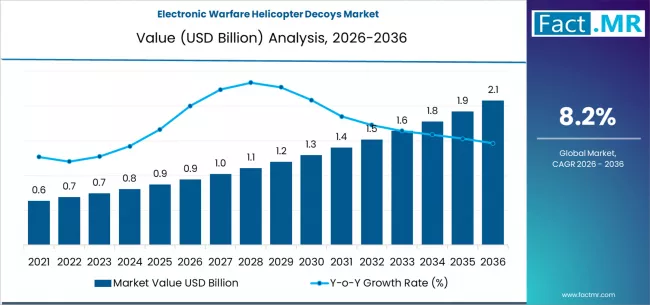
The global market for electronic warfare helicopter decoys is forecast to grow from USD 0.95 billion in 2026 to USD 2.08 billion by 2036, reflecting a CAGR of 8.2%. This growth trajectory is primarily anchored in the accelerating modernization of military helicopter fleets worldwide and the concurrent proliferation of advanced, low-cost IR and radar-guided missile threats. Modern battlefield environments demand multi-layered survivability suites, moving beyond basic countermeasures to integrated, intelligent decoy systems.
Summary of Electronic Warfare Helicopter Decoys Market
Market Snapshot
Global electronic warfare helicopter decoys market revenue stood at USD 0.95 billion in 2026 and is forecast to reach USD 2.08 billion by 2036.
Ata8.2% CAGR from 2026 to 2036, this market is set to expand ~2.2x in value, adding USD 1.13 billion in absolute opportunity.
Growth is being driven by modernization of military helicopter fleets and increasing threats from IR- and radar-guided missiles.
Electronic warfare decoys are critical survivability systems, enabling helicopters to evade advanced missile targeting through signal deception and diversion.
Demand and Growth Drivers
Rising proliferation of MANPADS and advanced missile systems is accelerating demand for decoy countermeasures.
Increasingdefensespending and helicopter fleet modernization programs are driving adoption.
Growing integration of multi-spectral threat detection and response systems is enhancing decoy effectiveness.
Need for systems that provide:
Multi-spectral threat mitigation (IR and radar)
Real-time detection and response
High-fidelity decoy signatures
Integration with onboard warning systems
Advancements in expendable and directed countermeasure technologies are improving survivability in contested environments.
Product and Segment View
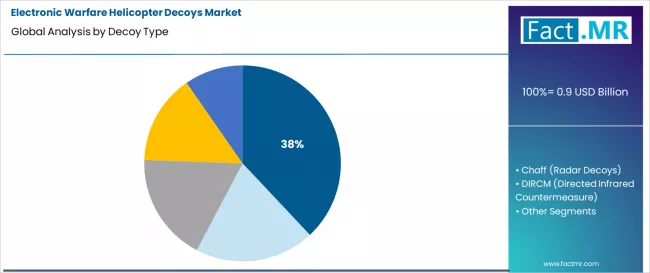
Flares (Infrared) hold 38% of decoy type share in 2026,emergingas the leading segment due to effectiveness against IR-guided missiles.
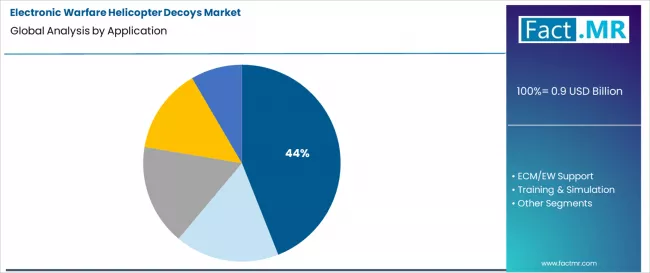
Missile Countermeasures account for 44% of application share in 2026, positioning them as the dominant segment.
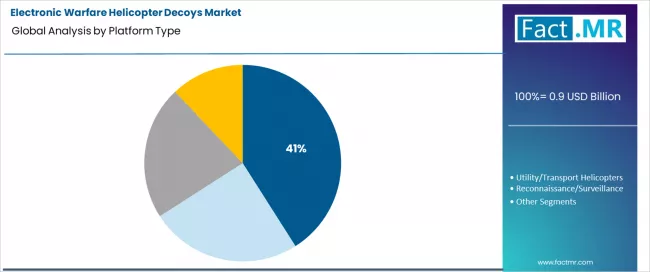
Attack Helicoptersrepresent41% of platform share in 2026, reflecting the highest deployment concentration.
Key product categories include:
Flares (infrared)
Chaff (radar decoys)
Directed Infrared Countermeasures (DIRCM)
Dispenser systems
Others
Geography and Competitive Outlook
Growth is supported across majordefenseeconomies driven by military modernization and evolving aerial threat landscapes.
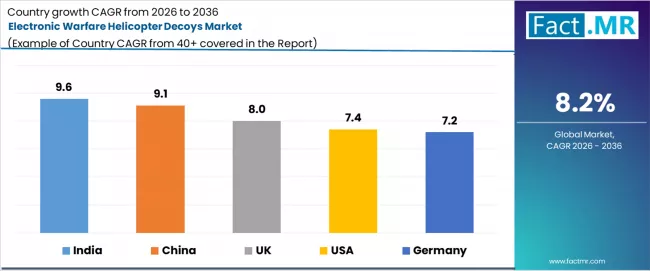
Key growth markets and CAGR: India (9.60%), China (9.10%), UK (8.00%), USA (7.40%), Germany (7.20%).
Market expansion is closely tied to:
Increasing missile threat complexity
Defensemodernization programs
Integration of electronic warfare suites in rotorcraft
Key companies active in this marketinclude:BAE Systems, Northrop Grumman, Leonardo S.p.A., Thales Group, Elbit Systems.
Electronic Warfare Helicopter Decoys Market — At a Glance
Attribute
Details
Market Value 2026
USD 0.95 billion
Market Value 2036
USD 2.08 billion
Absolute Dollar Opportunity 2026–2036
USD 1.13 billion
Total Growth 2026–2036
118.9%
CAGR 2026–2036
8.2%
Growth Multiple
~2.2x
Key Demand Theme
Increasing need for advanced countermeasure systems against IR and radar-guided missile threats
Leading Segment by Decoy Type (2026)
Flares (Infrared)
Segment Share (2026)
38%
Leading Segment by Application (2026)
Missile Countermeasures
Segment Share (2026)
44%
Leading Segment by Platform (2026)
Attack Helicopters
Segment Share (2026)
41%
Key Growth Regions
Asia-Pacific, North America, Western Europe
Country CAGRs
India 9.60%, China 9.10%, UK 8.00%, USA 7.40%, Germany 7.20%
Top Companies
BAE Systems, Northrop Grumman, Leonardo S.p.A., Thales Group, Elbit Systems
Segmentation by Decoy Type
Flares, Chaff, DIRCM, Dispenser Systems, Others
Segmentation by Application
Missile Countermeasures, Radar Confusion, IR Suppression
Segmentation by Platform
Attack Helicopters, Utility Helicopters, Transport Helicopters
Segmentation by Region
North America, Latin America, Europe, Asia Pacific, MEA
Source: Fact.MR analysis. Updated Apr 8, 2026
The market is evolving towards networks of expendable and directed countermeasures that can autonomously detect, classify, and respond to multi-spectral threats. Success in this sector is tied to developing decoys with higher fidelity signatures, longer burn times, and seamless integration with onboard missile warning and radar warning receivers. The significantly higher CAGRs in India (9.60%) and China (9.10%) highlight the intense focus on indigenous defense capabilities and fleet modernization in the Asia-Pacific region, positioning it as a central arena for both technological adoption and market competition.
Attack Helicopters, Utility/Transport Helicopters, Reconnaissance/Surveillance, Special Mission Aircraft
Region
North America, Latin America, Western Europe, Eastern Europe, East Asia, South Asia & Pacific, MEA
Source: Fact.MR analysis. Updated Apr 8, 2026
Segmental Analysis
By Decoy Type, Which Segment Remains Fundamental Amidst Technological Evolution?
Electronic Warfare Helicopter Decoys Market Analysis By Decoy Type | Source: Fact.MR
Flares (Infrared) lead the segment with a 38% share. Their enduring dominance is rooted in their proven efficacy against the most prevalent heat-seeking missile threats, cost-effectiveness for high-volume expenditure, and reliability under extreme conditions.
While advanced systems like DIRCM grow in importance, flares remain the essential, last-line kinetic defense. Innovation here focuses on advanced pyrotechnic compositions that produce spectrally matched IR signatures to counter newer-generation imaging infrared (IIR) seekers, and on programmable multi-spectral flares that offer enhanced deception capabilities.
By Application, Where is Core Operational Demand Concentrated?
Missile Countermeasures is the dominant application, holding a 44% share. This reflects the irreducible core mission of helicopter decoy systems: to enhance survivability against surface-to-air and air-to-air missiles.
The entire technological evolution of decoys, from simple pyrotechnics to laser-based DIRCM and smart dispenser systems, is fundamentally geared towards neutralizing this threat. This segment’s growth is coupled with the sophistication of missile guidance systems, demanding continuous countermeasure upgrades.
By Platform Type, Which Helicopter Class Drives Primary Demand?
Electronic Warfare Helicopter Decoys Market Analysis By Platform Type | Source: Fact.MR
Attack Helicopters constitute the leading platform segment at 41%. These platforms operate at the forefront of high-threat environments, conducting close air support, anti-armor, and escort missions where exposure to integrated air defense systems is highest.
Their survivability is paramount to mission success, justifying significant investment in comprehensive, state-of-the-art decoy and countermeasure suites. The requirement for these helicopters to ingress, engage, and egress in contested airspace makes them the primary testbed and initial deployment platform for next-generation decoy technologies.
What are the Drivers, Restraints, and Key Trends of the Electronic Warfare Helicopter Decoys Market?
Aspect
Detail
Driver
The global proliferation of advanced, commercially available drone technology and portable air defense systems (MANPADS) has dramatically lowered the barrier to acquiring potent aerial threats. This democratization of threat capability forces militaries to universally enhance helicopter survivability packages.
Restraint
The development and integration of advanced decoy systems, particularly DIRCM and next-generation smart dispensers, involve exceptionally high unit costs and system complexity. This creates budgetary and logistical hurdles for widespread fleet upgrades, especially for nations with large, aging helicopter inventories.
Opportunity
The shift towards multi-domain operations and network-centric warfare opens opportunities for decoy systems to evolve from isolated countermeasure devices into networked sensors. Future decoys could relay threat data, perform limited electronic attack, or act as communication nodes, enhancing overall battlefield awareness.
Trend
There is a clear trend towards integrated, adaptive countermeasure systems. These systems use AI and machine learning algorithms to fuse data from multiple onboard sensors, automatically select the optimal countermeasure (flare, chaff, laser) based on the specific threat signature, and deploy it with precise timing and sequencing, maximizing effectiveness while conserving resources.
Source: Fact.MR analysis. Updated Apr 8, 2026
Analysis of the Electronic Warfare Helicopter Decoys Market by Key Countries
Electronic Warfare Helicopter Decoys Market Cagr Analysis By Country | Source: Fact.MR
Country
CAGR (2026-2036)
India
9.60%
China
9.10%
UK
8.00%
USA
7.40%
Germany
7.20%
Source: Fact.MR analysis. Updated Apr 8, 2026
How is India's Focus on Indigenous Defense Manufacturing and Border Security Shaping Demand?
India’s leading 9.60% CAGR is driven by a potent combination of ambitious indigenous defense programs like the Made in India initiative, ongoing territorial security concerns, and a massive helicopter modernization drive across its armed forces.
The focus is on developing and sourcing advanced countermeasure systems for new platforms like the Apache and Chinook, as well as upgrading legacy fleets. Strategic partnerships and technology transfers with global players are key, aiming to build domestic capacity for next-generation decoy production and integration.
What Drives China's High-Growth Trajectory in Helicopter Decoy Modernization?
China’s 9.10% growth is fueled by the rapid expansion and technological advancement of the People’s Liberation Army’s (PLA) rotary-wing assets. As China develops and deploys more attack and heavy-lift helicopters for power projection and amphibious operations, the requirement for advanced self-protection systems grows in parallel.
Chinese defense firms are heavily investing in indigenous DIRCM and integrated countermeasure systems, seeking to reduce reliance on foreign technology and equip a growing fleet for high-intensity operational scenarios.
What is the Basis for the UK's Robust Growth in the EW Decoy Sector?
The UK's 8.00% CAGR reflects its commitment to maintaining a technological edge and the specific requirements of its helicopter fleet. Programs like the upgrade of the Wildcat and Apache fleets demand next-generation, network-enabled countermeasure suites.
Growth is supported by the UK's strong domestic defense electronics base and its role in international consortiums, driving demand for advanced, interoperable decoy systems that can function within a NATO framework and on complex multi-role platforms.
How Does the USA's Role as a Developer and Integrator Influence Its Market Growth?
Electronic Warfare Helicopter Decoys Market Country Value Analysis | Source: Fact.MR
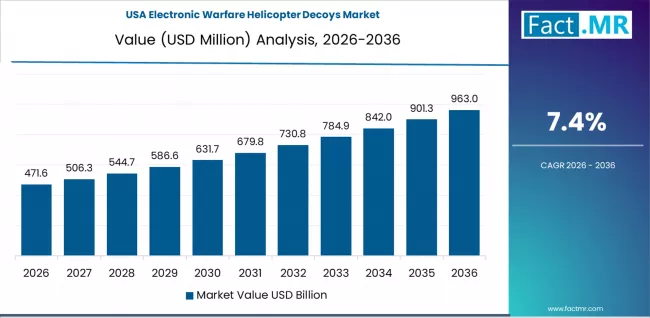
The USA's 7.40% CAGR stems from its position as the primary developer and early integrator of cutting-edge countermeasure technologies. Growth is sustained through continuous product improvement cycles for platforms like the AH-64E Apache and the CH-53K King Stallion, where new software-definable decoy systems and laser-based DIRCM are being fielded.
The market is driven by the U.S. Department of Defense's focus on enhancing survivability against peer-threat systems, leading to significant investment in upgrading existing inventories rather than just expanding fleet size.
Why Does Germany Represent a Key Mature Market for Advanced Upgrades?
Germany’s 7.20% growth is indicative of a sophisticated, modernizing market centered on European platform leadership. The focus is on integrating state-of-the-art defensive aids suites (DAS) into the Tiger attack helicopter and the NH90 transport fleet.
Growth in Germany is closely tied to multinational European defense initiatives and a demand for decoy systems that offer high reliability, meet stringent EU regulations, and are sourced through or in partnership with the continent's robust defense industrial network.
Competitive Landscape of the Electronic Warfare Helicopter Decoys Market
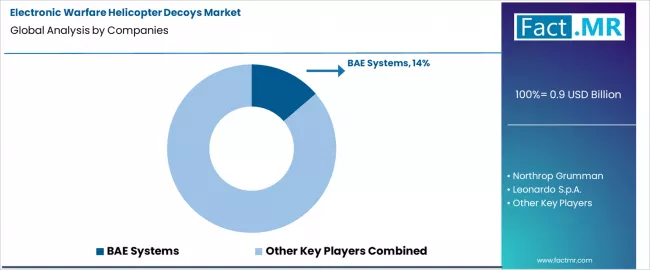
Electronic Warfare Helicopter Decoys Market Analysis By Company | Source: Fact.MR
The competitive landscape is dominated by established global defense primes with deep expertise in electronic warfare, sensors, and systems integration. These companies compete on the breadth of their survivability suite offerings, from expendables to directed energy, and their ability to provide fully integrated solutions.
Competition increasingly revolves around software-defined systems, algorithmic threat response, and securing long-term support and upgrade contracts. Success depends on deep partnerships with helicopter original equipment manufacturers (OEMs) and direct contracts with defense ministries.
Strategic Recommendation
Rationale
Develop Open Architecture, Software-Defined Systems
Move away from proprietary, hardware-locked solutions. Offering modular, software-upgradable systems allows for easier integration on multiple platforms, faster threat library updates, and sustained revenue through lifecycle software and service contracts.
Pursue Strategic Partnerships in High-Growth Regions
Forge joint ventures or technology partnership agreements with defense firms in key markets like India. This facilitates market access, meets offset obligations, and positions the company favorably for large fleet modernization tenders.
Invest in Multi-Function Countermeasure Technologies
Research and develop decoy systems that serve dual purposes, such as expendables with embedded sensors or DIRCM systems capable of limited communications jamming. This increases the value proposition per unit and aligns with the trend towards multi-role platforms.
Focus on Affordability and Scalability for Mid-Tier Fleets
While pursuing high-end technology, create scalable, cost-optimized versions of advanced countermeasures for the vast market of utility and transport helicopters. Offering effective, modular upgrades for these platforms can unlock significant volume.
Source: Fact.MR analysis. Updated Apr 8, 2026
Key Players in the Electronic Warfare Helicopter Decoys Market
BAE Systems
Northrop Grumman
Leonardo S.p.A.
Thales Group
Elbit Systems
Others
References
Chant, C. (2023). Aircraft survivability equipment: The development of electronic countermeasures in aviation. Air World Books.
Defense Science Board. (2024). Report on directed energy weapons and countermeasures. U.S. Department of Defense.
Johnson, R. E., & Johnson, S. L. (2023). The physics and engineering of infrared countermeasures (2nd ed.). IOP Publishing.
North Atlantic Treaty Organization (NATO). (2024). STANAG 7067: Evaluation of infrared countermeasures effectiveness. NATO Standardization Office.
Stimson, A. L. (2024). Tactics and technology in helicopter warfare: The evolving threat environment. Journal of Strategic Studies, 47(2), 145-167.
Technical analysis of decoy effectiveness against evolving IIR and RF seeker technologies; lifecycle cost analysis of expendables vs. directed energy systems; study of integration challenges with legacy helicopter avionics; assessment of training and simulation demand for countermeasure deployment; regulatory and safety analysis for DIRCM laser use in civilian airspace.
Source: Fact.MR analysis. Updated Apr 8, 2026
Market by Segments
Decoy Type :
Flares (Infrared)
Chaff (Radar Decoys)
DIRCM (Directed Infrared Countermeasure)
Dispenser Systems
Others
Application :
Missile Countermeasures
ECM/EW Support
Training & Simulation
Intelligence & Reconnaissance Support
Others
Platform Type :
Attack Helicopters
Utility/Transport Helicopters
Reconnaissance/Surveillance
Special Mission Aircraft
Region :
North America
USA
Canada
Latin America
Brazil
Mexico
Argentina
Rest of Latin America
Western Europe
Germany
Spain
Italy
France
Spain
UK
Rest of Western Europe
Eastern Europe
Russia
Poland
Czech Republic
Rest of Eastern Europe
East Asia
China
Japan
South Korea
Rest of East Asia
South Asia & Pacific
India
ASEAN
Australia
Rest of South Asia & Pacific
MEA
GCC Countries
South Africa
Turkiye
Rest of MEA
Questions Answered
Frequently Asked Questions
How big is the electronic warfare helicopter decoys market in 2026?
The global electronic warfare helicopter decoys market is estimated to be valued at USD 0.9 billion in 2026.
What will be the size of electronic warfare helicopter decoys market in 2036?
The market size for the electronic warfare helicopter decoys market is projected to reach USD 2.1 billion by 2036.
How much will be the electronic warfare helicopter decoys market growth between 2026 and 2036?
The electronic warfare helicopter decoys market is expected to grow at a 8.2% CAGR between 2026 and 2036.
What are the key product types in the electronic warfare helicopter decoys market?
The key product types in electronic warfare helicopter decoys market are flares (infrared), chaff (radar decoys), dircm (directed infrared countermeasure), dispenser systems and others.
Which application segment to contribute significant share in the electronic warfare helicopter decoys market in 2026?
In terms of application, missile countermeasures segment to command 44.0% share in the electronic warfare helicopter decoys market in 2026.