Autopsy Tables Market Size, Share, Growth and Forecast (2026 - 2036)

The Autopsy Tables Market is segmented by Type (Rectangular Autopsy Tables, L-shaped Autopsy Tables), Application (Clinical, Academic, Forensic Research), End User (Hospitals, Medical Colleges, Forensic Laboratories, Mortuary Facilities, Research Institutes), Table Configuration (Fixed Tables, Mobile Tables, Ventilated Tables, Hydraulic Tables, Refrigerated Tables), Material Type (Stainless Steel, Composite Surface, Polypropylene Surface, Custom Fabricated Tables), and Region. Forecast for 2026 to 2036.

Fact.MR states that autopsy table demand is shifting toward safer and more ergonomic post-mortem workstations. Hospitals and forensic laboratories need tables that support drainage, and infection-control procedures during autopsy work.

Autopsy Tables Market Size, Market Forecast and Outlook by Fact.MR

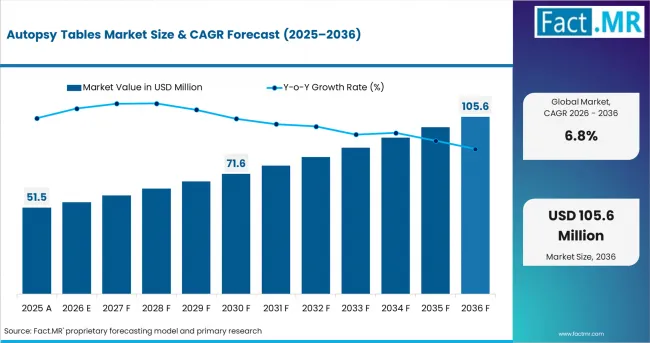
  • The autopsy tables market crossed a valuation of USD 51.5 million in 2025. Demand is estimated to reach USD 54.7 million in 2026. The market is projected to record 6.8% CAGR from 2026 to 2036.
  • Clinical research, forensic casework, and replacement of older morgue equipment are forecast to lift the market to USD 105.6 million by 2036 as facilities improve post-mortem examination areas.
  • Clinical examination needs and forensic infrastructure upgrades support autopsy table use. Fact.MR identifies clinical applications as the leading use area in the original base. The source page identifies rectangular and L-shaped tables as core product types.
Autopsy Tables Market Market Value Analysis

Summary of Autopsy Tables Market

  • Demand Drivers in the Market
    • Clinical Examination: Hospital pathology departments need autopsy tables for structured post-mortem review and clinical research. Rising emphasis on accurate cause of death analysis supports demand for tables with stable work surfaces and integrated fluid management.
    • Forensic Infrastructure: Medical examiner offices use autopsy tables to improve case handling and documentation. Rising caseloads in urban forensic centers increase demand for durable tables that support evidence preservation and standardized examination workflows.
    • Operator Safety: Mortuary managers need tables with drainage and ventilation features that reduce exposure during procedures. Stainless steel construction and enclosed waste channels are important equipment selection factors. Easy clean surfaces support daily sanitation needs.
  • Key Segments Analyzed
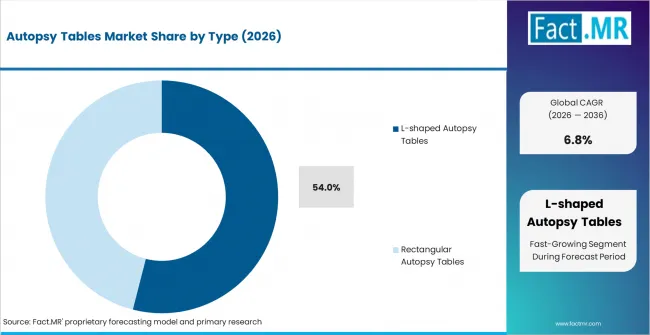
    • By Type: L-shaped autopsy tables are projected to reach 54.0% share of demand by type in 2026 as forensic and clinical users need better side access during examination.
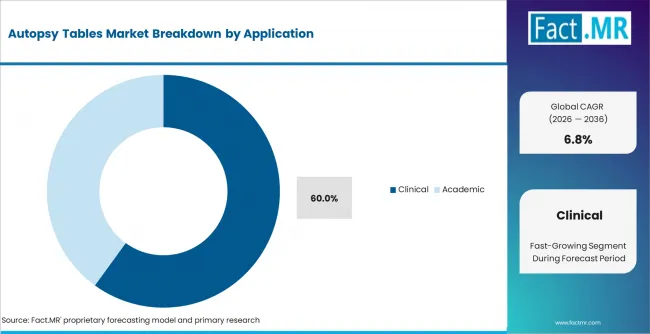
    • By Application: Clinical applications represent 60.0% share of demand in the Fact.MR base because hospital and research use creates regular need for post-mortem workstations.
    • By End User: Hospitals are projected to account for 39.0% share of demand by end user in 2026 as pathology departments require durable examination equipment.
    • By Table Configuration: Ventilated tables are expected to represent 31.0% share by table configuration in 2026 because facilities need better fume and aerosol control.
    • By Material Type: Stainless steel is projected to account for 72.0% share by material type in 2026 as autopsy rooms require durable and easy-to-clean surfaces.
    • By Geography: China autopsy table demand is forecast to grow at 9.4% CAGR from 2026 to 2036 as hospital infrastructure and medical education demand expand.
  • Analyst Opinion at Fact.MR
    • Shambhu Nath Jha, Senior Analyst at Fact.MR, states, “Autopsy table demand is moving beyond basic stainless-steel surfaces. Facilities need equipment that supports safer handling, and better workflow for pathologists. Suppliers that combine durable fabrication with ventilation and service support can protect repeat demand.”
  • Strategic Implications
    • Facility Safety: Autopsy table producers must align table design with cleaning, drainage, and body handling needs. Safer workstations support pathology and forensic use.
    • Ventilation Readiness: Mortuary planners should assess tables through downdraft or point-of-use ventilation support. Weak exposure control can delay replacement.
    • Service Support: Hospital facilities need suppliers that can support plumbing, stainless-steel repair, and height adjustment systems.
Metric Details
Industry Size (2026) USD 54.7 million
Industry Value (2036) USD 105.6 million
CAGR (2026 to 2036) 6.8%

Source: Fact.MR analysis, based on adjusted forecast model and primary research.

Pathology and forensic facilities are adopting workstations with improved drainage and ventilation. Mortuary managers need equipment that reduces manual handling. Pathologists need clean working access around the body. Facility planners need durable stainless-steel systems that can withstand repeated cleaning. Supplier service is important because plumbing, and table height adjustment affect daily use.

China is forecast to grow at 9.4% CAGR from 2026 to 2036 as hospitals, and local equipment suppliers adopt newer post-mortem workstations. India is anticipated to record 7.6% CAGR as forensic infrastructure and medical education capacity expand. United States demand is projected to grow at 7.2% CAGR through medical examiner office upgrades and private morgue use. Germany may register 6.6% CAGR through 2036 as regulated pathology and hospital mortuary standards support replacement. United Kingdom records 6.2% CAGR through NHS mortuary practice and high-risk autopsy guidance. France is forecast to post 5.8% CAGR through hospital infrastructure renewal. Japan follows at 3.8% CAGR by 2036 as selective replacement and quality-focused equipment use shape demand.

Segmental Analysis

Autopsy Tables Market Analysis by Type
Autopsy Tables Market Analysis By Type

L-shaped autopsy tables are projected to reach 54.0% share in 2026 as pathologists need improved body access and fluid-control support during examination. L-shaped designs support post-mortem inspection by improving working reach around the table. Rectangular autopsy tables remain important for standard hospital and teaching use. Fact.MR identifies L-shaped tables as a preferred format for anatomical studies and post-mortem medical inspection. Rectangular tables serve routine autopsy rooms because they provide a flat working surface and simple installation. L-shaped systems lead because they support side access and integrated utility placement in higher-use facilities.

  • L-Shaped Use: L-shaped tables improve side access during post-mortem work. Pathologists can inspect body areas with less repositioning. Forensic rooms prefer this layout because it supports busier examination schedules.
  • Rectangular Demand: Rectangular tables suit routine autopsy rooms that need a plain work surface. Hospitals and teaching centers use them because installation is simpler and existing room layouts need fewer changes.
  • Utility Placement: L-shaped tables place sinks and drainage closer to the examination zone. Better utility access helps staff manage fluids with less body movement during detailed clinical or forensic review.

Autopsy Tables Market Analysis by Application
Autopsy Tables Market Analysis By Application

Clinical applications form the main demand base because hospitals and clinical research centers need regular post-mortem examination support. Academic use depends on cadaver teaching and anatomical study. Clinical applications are anticipated to account for 60.0% share over the study period. Forensic research use is limited but specification-sensitive because chain-of-custody and evidence handling affect facility choice. RCPath’s 2025 guidance on high-risk infectious autopsies reinforces the need for defined precautions during post-mortem work. [1] Clinical demand leads because hospitals need cleanable and durable tables for repeat examination use.

  • Clinical Use: Clinical applications need tables for repeated post-mortem examinations. Hospitals favor durable surfaces with drainage support because routine work requires easy cleaning and stable positioning during each daily examination cycle safely.
  • Academic Study: Medical colleges use autopsy tables for cadaver training and anatomical instruction. Access around the body helps instructors guide demonstrations with safer handling and clearer viewing for student groups.
  • Forensic Research: Forensic laboratories need tables built for controlled examination and evidence handling. Fluid control and ventilation support documented procedures because sample handling is strict during investigative post-mortem work.

Autopsy Tables Market Analysis by End User
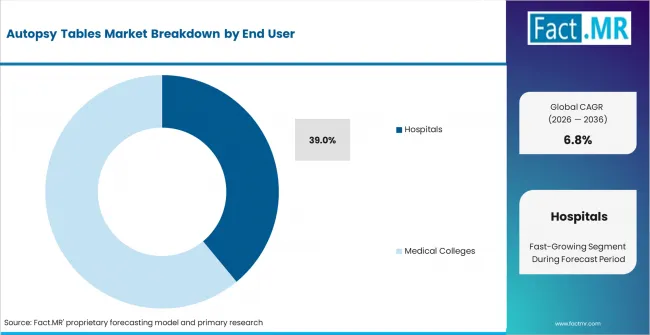
Autopsy Tables Market Analysis By End User

Hospitals are projected to account for 39.0% share by end user in 2026 as pathology departments and morgues require durable examination equipment. Medical colleges use tables for anatomy instruction and cadaveric study. Forensic laboratories need higher-specification systems because casework involves documentation and body handling under formal processes. Mortuary facilities use tables for preparation and post-mortem handling. The NAME 2024 to 2029 Autopsy Facility Checklist covers facility space, equipment, and operational requirements for medical examiner or coroner offices. [2] Hospitals lead because clinical autopsy work and morgue replacement cycles create a steady equipment base.

  • Hospital Morgues: Hospitals need tables that support pathology workflow and cleaning. Durable stainless steel helps manage repeated use.
  • Medical Colleges: Anatomy departments use tables for cadaver training. Equipment must support teaching access and safe handling.
  • Forensic Labs: Forensic laboratories require tables with stronger workflow control. Documentation and evidence handling shape specifications.

Autopsy Tables Market Analysis by Table Configuration
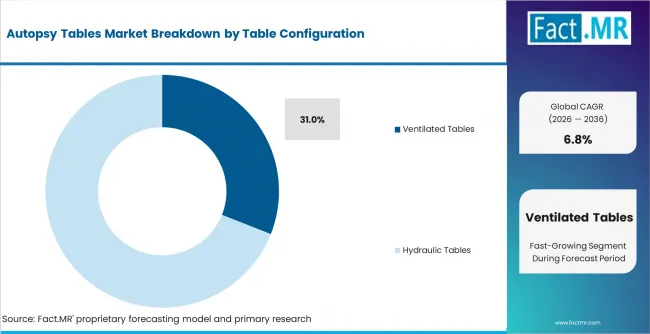
Autopsy Tables Market Analysis By Table Configuration

Ventilated tables are expected to represent 31.0% share by table configuration in 2026 because facilities need better exposure control during post-mortem work. Fixed tables support traditional autopsy rooms with dedicated drainage and plumbing. Mobile tables help smaller facilities move bodies between preparation and examination areas. Hydraulic tables reduce manual strain because staff can adjust height during procedures. LEEC’s mobile ventilated autopsy table provides point-of-use ventilation at the working zone when connected to site ventilation. [3] Ventilated configurations lead because infection-control and fume-control needs are becoming more important in autopsy rooms.

  • Ventilated Systems: Ventilated tables improve air capture near the examination surface. Mortuary operators use them to reduce chemical odor and aerosol exposure during higher-risk procedures in dedicated post-mortem rooms.
  • Hydraulic Tables: Hydraulic tables support safer height control during autopsy work. Adjustable surfaces help pathologists position bodies with less lifting effort and improve reach during extended examinations or repeated daily procedures.
  • Mobile Platforms: Mobile platforms help mortuaries move bodies between preparation rooms and examination rooms. Flexible movement supports facilities with limited space and lowers reliance on fixed tables across compact operations.

Autopsy Tables Market Analysis by Material Type
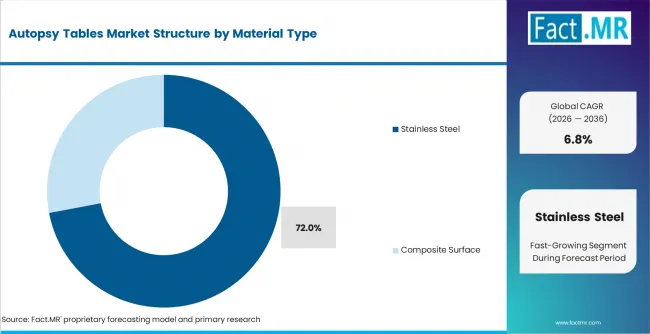
Autopsy Tables Market Analysis By Material Type

Material selection affects durability and table life. Stainless steel is projected to account for 72.0% share in 2026 as autopsy rooms require surfaces that withstand repeated disinfection. Composite and polypropylene surfaces serve selected facilities that need light weight or specialized chemical resistance. Custom fabricated tables support forensic laboratories and medical colleges with space-specific needs. Mopec states that its autopsy tables and carts include stainless-steel construction for post-mortem dissection workflow. [4] Stainless steel leads because autopsy rooms need durable surfaces that support cleaning and drainage.

  • Stainless Steel: Stainless steel tables suit high-use autopsy rooms that need repeat disinfection and fluid handling. Long service life helps hospitals control replacement costs across daily post-mortem examination work and room upkeep.
  • Composite Surfaces: Composite surfaces suit facilities seeking light table structures or targeted chemical resistance. Cleaning proof is important because pathology rooms must confirm safe disinfection before wider equipment use across daily work.
  • Custom Fabrication: Custom tables serve forensic laboratories and medical colleges with room-specific layouts. Installation quality matters because drainage placement and body access must match examination needs in limited facility space.

Autopsy Tables Market Drivers, Restraints, and Opportunities

Autopsy Tables Market Opportunity Matrix Growth Vs Value

Facility safety is the main demand driver for autopsy tables. Hospitals require durable workstations for clinical post-mortem examinations. Forensic laboratories need tables that support evidence handling and cleaning. Medical colleges use cadaver study equipment that supports teaching access. Mortuary facilities need tables that reduce manual strain during body handling.

The main restraint is capital replacement timing. Autopsy tables have long service lives and replacement usually occurs during facility upgrades. Installation can require plumbing and ventilation work. Low case volume facilities may delay upgrades. Supplier switching is difficult because room layout and service staff training often align with existing equipment.

Opportunities in the Autopsy Tables Market

  • Ventilated Workstations: Facilities can replace aging tables with ventilated systems to improve exposure control. LEEC’s post-mortem autopsy station uses downdraught ventilation and a rear sink.
  • Forensic Facility Upgrades: Medical examiner offices can improve workflow through tables with better drainage and body handling support.
  • Ergonomic Handling: Hospitals can use hydraulic tables to reduce manual strain. Mortech’s hydraulic table literature highlights adjustable height and body handling support. [5]

Regional Analysis

Top Country Growth Comparison Autopsy Tables Market Cagr (2026 2036)

Based on regional analysis, the autopsy tables market is segmented into North America, Latin America, Western Europe, Eastern Europe, East Asia, South Asia and Pacific, and Middle East and Africa.

Country CAGR (2026 to 2036)
China 9.4%
India 7.6%
United States 7.2%
Germany 6.6%
United Kingdom 6.2%
France 5.8%
Japan 3.8%

Source: Fact.MR analysis, based on adjusted forecast model and primary research.
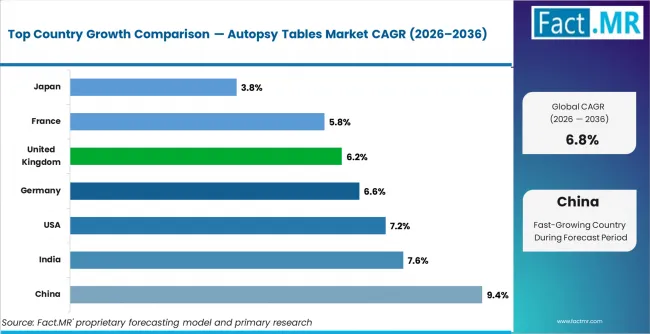
Autopsy Tables Market Cagr Analysis By Country

East Asia Autopsy Tables Market Analysis
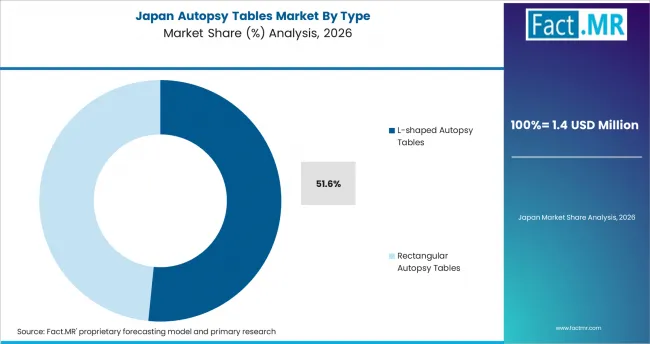
Autopsy Tables Market Japan Market Share Analysis By Type

East Asia demand reflects hospital infrastructure and local medical equipment supply. China leads through private hospital growth and local manufacturing. Japan supports demand through selective replacement and quality-focused autopsy room equipment.

  • China: China is forecast to grow at 9.4% CAGR from 2026 to 2036 as hospitals and academic institutions replace basic post-mortem workstations. Local manufacturers can support faster supply of stainless-steel and L-shaped systems. Private morgues and medical colleges strengthen demand. Supplier acceptance will depend on table durability and installation support.
  • Japan: Japan autopsy tables demand is projected to record 3.8% CAGR over the assessment period as selective replacement and quality-focused equipment use shape the market. Hospitals and forensic facilities in Japan tend to prioritize durable equipment and controlled room design. Replacement demand is measured because installed autopsy infrastructure is used for long service cycles. Academic and clinical use supports steady demand for stainless-steel systems. Suppliers that provide documentation and service support can improve adoption in replacement projects.

South Asia and Pacific Autopsy Tables Market Analysis

South Asia and Pacific demand benefits from medical education growth and forensic infrastructure upgrades. India leads the region because hospital morgues and forensic laboratories need improved post-mortem examination facilities. Replacement demand will rise as new facilities specify stainless-steel tables and improved drainage systems.

  • India: India autopsy table demand is shaped by medical education capacity and forensic laboratory upgrades. Demand is anticipated to record 7.6% CAGR from 2026 to 2036 as hospitals and medical colleges expand post-mortem facilities. Anatomy departments need tables that support cadaver-based teaching and repeated cleaning. Forensic laboratories require durable workstations that can support evidence-sensitive examinations. Public hospital upgrades can increase demand for stainless-steel and hydraulic systems. Suppliers that offer installation support and spare parts access can protect repeat sales. India grows through a combination of new facility buildout and replacement of older mortuary equipment.

North America Autopsy Tables Market Analysis
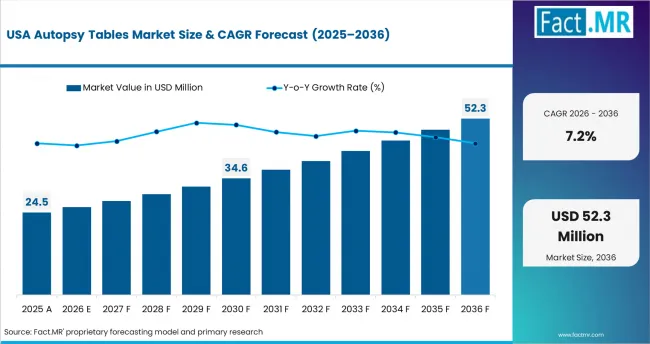
Autopsy Tables Market Country Value Analysis

North America demand is supported by medical examiner offices and private mortuary facilities. The United States leads regional value because forensic infrastructure and private morgue networks require durable post-mortem equipment. Accreditation and facility checklists support structured investment in autopsy room equipment.

  • United States: United States autopsy table demand is supported by medical examiner offices and hospital-based pathology departments. The country is projected to grow at 7.2% CAGR from 2026 to 2036 as forensic facilities replace older tables and improve autopsy room workflow. OSHA’s formaldehyde standard applies to occupational exposure from formaldehyde gas, solutions, and releasing materials. [6] Equipment choices in the United States often focus on stainless-steel durability, ventilation compatibility, and body handling support. Supplier success will depend on service access and compliance-oriented documentation.

Western Europe Autopsy Tables Market Analysis
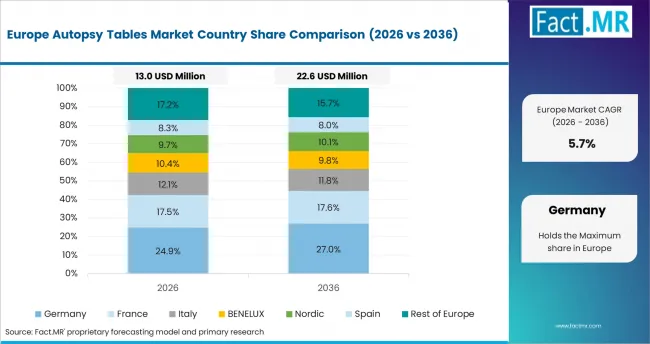
Autopsy Tables Market Europe Country Market Share Analysis, 2026 & 2036

Western Europe demand reflects hospital mortuary modernization and structured pathology practice. Germany leads through hospital infrastructure and forensic medicine capacity. The United Kingdom supports demand through NHS mortuary practice and high-risk infectious autopsy guidance. France adds steady demand through hospital renewal and public forensic facilities.

  • Germany: Germany’s autopsy tables demand is supported by hospital pathology facilities and forensic medicine institutes. The country is forecast to post 6.6% CAGR by 2036 as hospitals replace older mortuary workstations with better drainage and ventilation-ready systems. German facilities often specify durable stainless-steel tables that can support long service life and repeated disinfection. Forensic institutes need reliable body handling and clean working access. Replacement projects may favor hydraulic or ventilated configurations. Supplier acceptance will depend on documentation and installation support. Custom fabrication helps adopt tables to room layouts. Growth is tied to clinical quality needs and forensic facility renewal.
  • United Kingdom: United Kingdom demand is likely to rise at 6.2% CAGR over the foreseen period as NHS mortuary facilities and forensic service providers upgrade post-mortem rooms. Mortuary managers need workstations that support cleaning, and staff protection. Medical colleges require tables for anatomy teaching and cadaveric study. Ventilated and hydraulic systems can gain adoption in higher-use facilities. Supplier support will influence repeat adoption because public facilities need dependable maintenance and installation planning.
  • France: France autopsy table demand is linked to hospital infrastructure renewal and forensic service modernization. The country is forecast to grow at 5.8% CAGR through 2036 as public hospitals and pathology facilities improve post-mortem work areas. Clinical users need durable stainless-steel tables that support cleaning and drainage. Forensic facilities require workstations that can support case documentation and controlled body handling. Replacement demand is gradual because autopsy tables are long-life equipment. Suppliers can improve adoption by offering modular options and service support. France grows through hospital renewal rather than rapid new-unit demand.

Competitive Aligners for Market Players
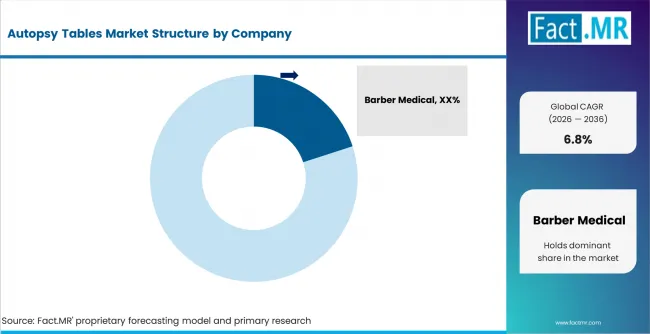
Autopsy Tables Market Analysis By Company

The autopsy tables market includes mortuary equipment suppliers, and hospital furniture manufacturers. Barber Medical, Flexmort, Ceabis, Eihf Isofroid, Fiocchetti, Funeralia, Hygeco, Ferno-Washington, Afos, Angelantoni Life Science, Kugel Medical, LEEC, Mopec, Mortech Manufacturing, and Thermo Fisher Scientific compete through table design, stainless-steel quality, ventilation support, drainage, and service reach.

Competitive strength comes from workstation design rather than table surface alone. LEEC offers fixed and mobile ventilated autopsy tables with point-of-use ventilation for the working zone. Mopec lists autopsy tables and carts designed for post-mortem dissection workflow. Mortech’s pedestal autopsy table literature includes L-shaped adjustable-height formats and drainage features.

Supplier position will rely on installation and service depth through 2036. Hospitals need plumbing and drainage support. Forensic laboratories need durable workstations and evidence-friendly workflows. Medical colleges need teaching access and safe cleaning. Companies that combine stainless-steel fabrication with ventilation-ready design and service support can protect repeat demand.

Key Players in Autopsy Tables Market

• Barber Medical
• Flexmort
• Ceabis
• Eihf Isofroid
• Fiocchetti
• Funeralia
• Hygeco
• Ferno-Washington
• Afos
• Angelantoni Life Science

Bibliography

  • [1]. Royal College of Pathologists. (2025, January). G183 Guidelines on autopsy practice: Precautions for high-risk infectious autopsies. Royal College of Pathologists.
  • [2]. National Association of Medical Examiners. (2025, July 25). NAME Inspection and Accreditation Autopsy Facility Checklist 2024 to 2029. National Association of Medical Examiners.
  • [3]. LEEC. (2025). Mobile ventilated autopsy table. LEEC.
  • [4]. Mopec. (2026). Autopsy tables and carts. Mopec.
  • [5]. Mortech Manufacturing. (2024). Pedestal autopsy tables. Mortech Manufacturing.
  • [6]. Occupational Safety and Health Administration. (2026). 1910.1048 Formaldehyde.

This Report Addresses

• Strategic intelligence on autopsy table demand across hospitals, forensic laboratories, and medical colleges.
• Growth opportunity mapping across China, India, the United States, and Germany.
• Segment analysis by type, application, end user, table configuration, and material type.
• Regional outlook covering forensic infrastructure, hospital morgue use, and medical education demand.
• Competitive analysis of Barber Medical, Flexmort, Ceabis, LEEC, Mopec, and Mortech Manufacturing.
• Product assessment covering L-shaped tables, rectangular tables, ventilated tables, and stainless-steel systems.
• Report delivered through PDF, Excel datasets, and presentation formats.
• Primary interviews, supplier checks, and facility replacement review support validation.

Autopsy Tables Market Definition

The autopsy tables market covers specialized tables used during post-mortem examinations in hospitals, and mortuary facilities. The market differs from general laboratory tables because demand is tied to drainage, and safe handling during autopsy procedures. It includes fixed, and stainless-steel autopsy tables.

Autopsy Tables Market Inclusions

The scope includes rectangular and L-shaped autopsy tables used for clinical, academic, and forensic research applications. Stainless-steel fixed tables, and refrigerated table systems are included. Drainage systems, and table-integrated handling features are counted when supplied as part of the autopsy workstation.

Autopsy Tables Market Exclusions

The scope excludes general hospital beds, operating tables, and anatomy teaching benches that are not designed for post-mortem examination. Body storage cabinets and biomedical refrigerators are outside scope unless supplied as part of an integrated autopsy table system. Embalming machines, and standalone ventilation systems are not counted.

Autopsy Tables Market Research Methodology

  • Primary Research
    • Primary research includes interviews with mortuary managers and forensic pathology laboratory directors. Hospital facility planners and medical college anatomy department heads are covered separately. Supplier feedback supports equipment-level demand checks.
  • Desk Research
    • Desk research reviews autopsy practice guidance and manufacturer product pages. Facility accreditation references and equipment specifications support validation. Application data is compared with clinical and forensic post-mortem use patterns.
  • Market-Sizing and Forecasting
    • Forecasting uses type demand and application adoption. Clinical autopsy use and facility replacement demand are linked to table durability, and body handling requirements.
  • Data Validation and Update Cycle
    • Forecasts are validated through supplier checks and facility manager interviews. Regional assumptions are reviewed with forensic infrastructure updates and autopsy practice guidance.

Scope of the Report

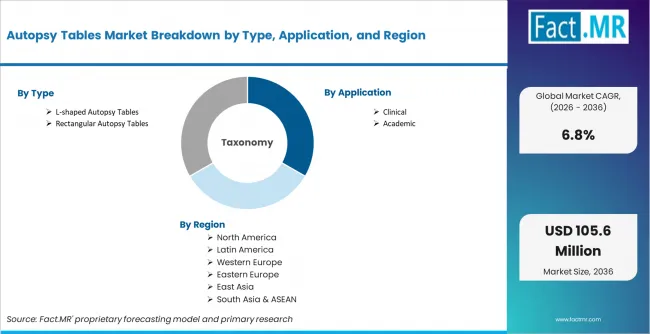
Autopsy Tables Market Breakdown By Type, Application, And Region

Attribute Details
Quantitative Units USD 54.7 million in 2026 to USD 105.6 million by 2036, at 6.8% CAGR
Market Definition Specialized post-mortem examination tables used in hospitals, forensic laboratories, medical colleges, and mortuary facilities.
Type Rectangular Autopsy Tables, L-shaped Autopsy Tables
Application Clinical, Academic, Forensic Research
End User Hospitals, Medical Colleges, Forensic Laboratories, Mortuary Facilities, Research Institutes
Table Configuration Fixed Tables, Mobile Tables, Ventilated Tables, Hydraulic Tables, Refrigerated Tables
Material Type Stainless Steel, Composite Surface, Polypropylene Surface, Custom Fabricated Tables
Regions Covered North America, Latin America, Western Europe, Eastern Europe, East Asia, South Asia and Pacific, Middle East and Africa
Countries Covered United States, China, India, Germany, United Kingdom, France, Japan, Canada, GCC Countries
Key Companies Profiled Barber Medical, Flexmort, Ceabis, Eihf Isofroid, Fiocchetti, Funeralia, Hygeco, Ferno-Washington, Afos, Angelantoni Life Science, Kugel Medical, LEEC, Mopec, Mortech Manufacturing, Thermo Fisher Scientific
Forecast Period 2026 to 2036
Approach Hybrid top-down and bottom-up model using type demand, application demand, end-user demand, table configuration checks, material preference, and supplier validation.

Autopsy Tables Market Analysis by Segments

  • By Type:

    • Rectangular Autopsy Tables
    • L-shaped Autopsy Tables
  • By Application:

    • Clinical
    • Academic
    • Forensic Research
  • By End User:

    • Hospitals
    • Medical Colleges
    • Forensic Laboratories
    • Mortuary Facilities
    • Research Institutes
  • By Table Configuration:

    • Fixed Tables
    • Mobile Tables
    • Ventilated Tables
    • Hydraulic Tables
    • Refrigerated Tables
  • By Material Type:

    • Stainless Steel
    • Composite Surface
    • Polypropylene Surface
    • Custom Fabricated Tables
  • Region:

    • North America
      • United States
      • Canada
    • Europe
      • Germany
      • United Kingdom
      • France
      • Italy
      • Spain
    • Asia Pacific
      • China
      • Japan
      • South Korea
      • Taiwan
      • Singapore
    • Latin America
      • Brazil
      • Mexico
      • Argentina
    • Middle East & Africa
      • GCC Countries
      • South Africa
      • Israel

- Frequently Asked Questions -

How large is the autopsy tables market in 2025?

The autopsy tables market was valued at USD 51.5 million in 2025 based on Fact.MR’s public base and adjusted growth assumptions.

What is the expected value of the autopsy tables market in 2026?

The autopsy tables market is estimated to reach USD 54.7 million in 2026 through clinical and forensic facility demand.

What is the forecast value of the autopsy tables market by 2036?

The autopsy tables market is forecast to reach USD 105.6 million by 2036 as post-mortem facility upgrades expand.

What CAGR is projected for the autopsy tables market from 2026 to 2036?

Fact.MR’s adjusted forecast projects 6.8% CAGR for the autopsy tables market from 2026 to 2036.

Why do L-shaped autopsy tables lead the market?

L-shaped autopsy tables lead because pathologists need better side access and utility placement during examination.

Which application leads the autopsy tables market?

Clinical applications lead the autopsy tables market with 60.0% share in the Fact.MR base.

Why do clinical applications lead autopsy table demand?

Clinical applications lead because hospitals and research facilities need durable tables for repeat post-mortem examination.

Which end user leads the autopsy tables market?

Hospitals lead the autopsy tables market with 39.0% share in 2026 because pathology departments require regular examination equipment.

Which table configuration leads the autopsy tables market?

Ventilated tables lead configuration demand with 31.0% share in 2026 because facilities need better exposure control.

Which material type leads the autopsy tables market?

Stainless steel leads material demand with 72.0% share in 2026 because autopsy rooms require durable and easy-to-clean surfaces.

Which country is growing fastest in the autopsy tables market?

China is forecast to grow fastest at 9.4% CAGR from 2026 to 2036.

Why is China growing fastest in the autopsy tables market?

China grows fastest because hospital infrastructure, private morgues, and medical college capacity support equipment demand.

Why is India growing quickly in the autopsy tables market?

India grows quickly because medical education capacity and forensic laboratory upgrades support autopsy room investment.

Which companies compete in the autopsy tables market?

Barber Medical, Flexmort, Ceabis, LEEC, Mopec, Mortech Manufacturing, Kugel Medical, and Thermo Fisher Scientific compete in this market.

What drives autopsy tables market growth?

Facility safety and post-mortem workflow needs drive demand across hospitals, forensic laboratories, and medical colleges.

What restrains autopsy tables market growth?

Capital replacement timing restrains demand because autopsy tables have long service lives and require room-level installation work.

How do ventilated autopsy tables support users?

Ventilated autopsy tables help remove fumes near the work zone and support safer autopsy room conditions.

How do hydraulic autopsy tables support facilities?

Hydraulic autopsy tables support height adjustment and reduce manual handling strain during post-mortem examination.

What is included in the autopsy tables market scope?

The scope includes rectangular, L-shaped, fixed, mobile, ventilated, hydraulic, and stainless-steel autopsy tables.

What is excluded from the autopsy tables market scope?

The scope excludes general hospital beds, operating tables, body storage cabinets, embalming machines, and pathology software.

How does Fact.MR forecast autopsy table demand?

Fact.MR forecasts demand using type mix, application demand, end-user adoption, table configuration, material preference, and supplier validation.

Table of Content

  1. Executive Summary
    • Global Market Outlook
    • Demand to side Trends
    • Supply to side Trends
    • Technology Roadmap Analysis
    • Analysis and Recommendations
  2. Market Overview
    • Market Coverage / Taxonomy
    • Market Definition / Scope / Limitations
  3. Research Methodology
    • Chapter Orientation
    • Analytical Lens and Working Hypotheses
      • Market Structure, Signals, and Trend Drivers
      • Benchmarking and Cross-market Comparability
      • Market Sizing, Forecasting, and Opportunity Mapping
    • Research Design and Evidence Framework
      • Desk Research Programme (Secondary Evidence)
        • Company Annual and Sustainability Reports
        • Peer-reviewed Journals and Academic Literature
        • Corporate Websites, Product Literature, and Technical Notes
        • Earnings Decks and Investor Briefings
        • Statutory Filings and Regulatory Disclosures
        • Technical White Papers and Standards Notes
        • Trade Journals, Industry Magazines, and Analyst Briefs
        • Conference Proceedings, Webinars, and Seminar Materials
        • Government Statistics Portals and Public Data Releases
        • Press Releases and Reputable Media Coverage
        • Specialist Newsletters and Curated Briefings
        • Sector Databases and Reference Repositories
        • Fact.MR Internal Proprietary Databases and Historical Market Datasets
        • Subscription Datasets and Paid Sources
        • Social Channels, Communities, and Digital Listening Inputs
        • Additional Desk Sources
      • Expert Input and Fieldwork (Primary Evidence)
        • Primary Modes
          • Qualitative Interviews and Expert Elicitation
          • Quantitative Surveys and Structured Data Capture
          • Blended Approach
        • Why Primary Evidence is Used
        • Field Techniques
          • Interviews
          • Surveys
          • Focus Groups
          • Observational and In-context Research
          • Social and Community Interactions
        • Stakeholder Universe Engaged
          • C-suite Leaders
          • Board Members
          • Presidents and Vice Presidents
          • R&D and Innovation Heads
          • Technical Specialists
          • Domain Subject-matter Experts
          • Scientists
          • Physicians and Other Healthcare Professionals
        • Governance, Ethics, and Data Stewardship
          • Research Ethics
          • Data Integrity and Handling
      • Tooling, Models, and Reference Databases
    • Data Engineering and Model Build
      • Data Acquisition and Ingestion
      • Cleaning, Normalisation, and Verification
      • Synthesis, Triangulation, and Analysis
    • Quality Assurance and Audit Trail
  4. Market Background
    • Market Dynamics
      • Drivers
      • Restraints
      • Opportunity
      • Trends
    • Scenario Forecast
      • Demand in Optimistic Scenario
      • Demand in Likely Scenario
      • Demand in Conservative Scenario
    • Opportunity Map Analysis
    • Product Life Cycle Analysis
    • Supply Chain Analysis
    • Investment Feasibility Matrix
    • Value Chain Analysis
    • PESTLE and Porter’s Analysis
    • Regulatory Landscape
    • Regional Parent Market Outlook
    • Production and Consumption Statistics
    • Import and Export Statistics
  5. Global Market Analysis 2021 to 2025 and Forecast, 2026 to 2036
    • Historical Market Size Value (USD Million) Analysis, 2021 to 2025
    • Current and Future Market Size Value (USD Million) Projections, 2026 to 2036
      • Y to o to Y Growth Trend Analysis
      • Absolute $ Opportunity Analysis
  6. Global Market Pricing Analysis 2021 to 2025 and Forecast 2026 to 2036
  7. Global Market Analysis 2021 to 2025 and Forecast 2026 to 2036, By Type
    • Introduction / Key Findings
    • Historical Market Size Value (USD Million) Analysis By Type , 2021 to 2025
    • Current and Future Market Size Value (USD Million) Analysis and Forecast By Type , 2026 to 2036
      • L-shaped Autopsy Tables
      • Rectangular Autopsy Tables
    • Y to o to Y Growth Trend Analysis By Type , 2021 to 2025
    • Absolute $ Opportunity Analysis By Type , 2026 to 2036
  8. Global Market Analysis 2021 to 2025 and Forecast 2026 to 2036, By Application
    • Introduction / Key Findings
    • Historical Market Size Value (USD Million) Analysis By Application, 2021 to 2025
    • Current and Future Market Size Value (USD Million) Analysis and Forecast By Application, 2026 to 2036
      • Clinical
      • Academic
      • Forensic Research
    • Y to o to Y Growth Trend Analysis By Application, 2021 to 2025
    • Absolute $ Opportunity Analysis By Application, 2026 to 2036
  9. Global Market Analysis 2021 to 2025 and Forecast 2026 to 2036, By End User
    • Introduction / Key Findings
    • Historical Market Size Value (USD Million) Analysis By End User, 2021 to 2025
    • Current and Future Market Size Value (USD Million) Analysis and Forecast By End User, 2026 to 2036
      • Hospitals
      • Medical Colleges
      • Forensic Laboratories
    • Y to o to Y Growth Trend Analysis By End User, 2021 to 2025
    • Absolute $ Opportunity Analysis By End User, 2026 to 2036
  10. Global Market Analysis 2021 to 2025 and Forecast 2026 to 2036, By Table Configuration
    • Introduction / Key Findings
    • Historical Market Size Value (USD Million) Analysis By Table Configuration, 2021 to 2025
    • Current and Future Market Size Value (USD Million) Analysis and Forecast By Table Configuration, 2026 to 2036
      • Ventilated Tables
      • Hydraulic Tables
      • Refrigerated Tables
    • Y to o to Y Growth Trend Analysis By Table Configuration, 2021 to 2025
    • Absolute $ Opportunity Analysis By Table Configuration, 2026 to 2036
  11. Global Market Analysis 2021 to 2025 and Forecast 2026 to 2036, By Material Type
    • Introduction / Key Findings
    • Historical Market Size Value (USD Million) Analysis By Material Type, 2021 to 2025
    • Current and Future Market Size Value (USD Million) Analysis and Forecast By Material Type, 2026 to 2036
      • Stainless Steel
      • Composite Surface
      • Polypropylene Surface
    • Y to o to Y Growth Trend Analysis By Material Type, 2021 to 2025
    • Absolute $ Opportunity Analysis By Material Type, 2026 to 2036
  12. Global Market Analysis 2021 to 2025 and Forecast 2026 to 2036, By Region
    • Introduction
    • Historical Market Size Value (USD Million) Analysis By Region, 2021 to 2025
    • Current Market Size Value (USD Million) Analysis and Forecast By Region, 2026 to 2036
      • North America
      • Latin America
      • Western Europe
      • Eastern Europe
      • East Asia
      • South Asia and Pacific
      • Middle East & Africa
    • Market Attractiveness Analysis By Region
  13. North America Market Analysis 2021 to 2025 and Forecast 2026 to 2036, By Country
    • Historical Market Size Value (USD Million) Trend Analysis By Market Taxonomy, 2021 to 2025
    • Market Size Value (USD Million) Forecast By Market Taxonomy, 2026 to 2036
      • By Country
        • USA
        • Canada
        • Mexico
      • By Type
      • By Application
      • By End User
      • By Table Configuration
      • By Material Type
    • Market Attractiveness Analysis
      • By Country
      • By Type
      • By Application
      • By End User
      • By Table Configuration
      • By Material Type
    • Key Takeaways
  14. Latin America Market Analysis 2021 to 2025 and Forecast 2026 to 2036, By Country
    • Historical Market Size Value (USD Million) Trend Analysis By Market Taxonomy, 2021 to 2025
    • Market Size Value (USD Million) Forecast By Market Taxonomy, 2026 to 2036
      • By Country
        • Brazil
        • Chile
        • Rest of Latin America
      • By Type
      • By Application
      • By End User
      • By Table Configuration
      • By Material Type
    • Market Attractiveness Analysis
      • By Country
      • By Type
      • By Application
      • By End User
      • By Table Configuration
      • By Material Type
    • Key Takeaways
  15. Western Europe Market Analysis 2021 to 2025 and Forecast 2026 to 2036, By Country
    • Historical Market Size Value (USD Million) Trend Analysis By Market Taxonomy, 2021 to 2025
    • Market Size Value (USD Million) Forecast By Market Taxonomy, 2026 to 2036
      • By Country
        • Germany
        • UK
        • Italy
        • Spain
        • France
        • Nordic
        • BENELUX
        • Rest of Western Europe
      • By Type
      • By Application
      • By End User
      • By Table Configuration
      • By Material Type
    • Market Attractiveness Analysis
      • By Country
      • By Type
      • By Application
      • By End User
      • By Table Configuration
      • By Material Type
    • Key Takeaways
  16. Eastern Europe Market Analysis 2021 to 2025 and Forecast 2026 to 2036, By Country
    • Historical Market Size Value (USD Million) Trend Analysis By Market Taxonomy, 2021 to 2025
    • Market Size Value (USD Million) Forecast By Market Taxonomy, 2026 to 2036
      • By Country
        • Russia
        • Poland
        • Hungary
        • Balkan & Baltic
        • Rest of Eastern Europe
      • By Type
      • By Application
      • By End User
      • By Table Configuration
      • By Material Type
    • Market Attractiveness Analysis
      • By Country
      • By Type
      • By Application
      • By End User
      • By Table Configuration
      • By Material Type
    • Key Takeaways
  17. East Asia Market Analysis 2021 to 2025 and Forecast 2026 to 2036, By Country
    • Historical Market Size Value (USD Million) Trend Analysis By Market Taxonomy, 2021 to 2025
    • Market Size Value (USD Million) Forecast By Market Taxonomy, 2026 to 2036
      • By Country
        • China
        • Japan
        • South Korea
      • By Type
      • By Application
      • By End User
      • By Table Configuration
      • By Material Type
    • Market Attractiveness Analysis
      • By Country
      • By Type
      • By Application
      • By End User
      • By Table Configuration
      • By Material Type
    • Key Takeaways
  18. South Asia and Pacific Market Analysis 2021 to 2025 and Forecast 2026 to 2036, By Country
    • Historical Market Size Value (USD Million) Trend Analysis By Market Taxonomy, 2021 to 2025
    • Market Size Value (USD Million) Forecast By Market Taxonomy, 2026 to 2036
      • By Country
        • India
        • ASEAN
        • Australia & New Zealand
        • Rest of South Asia and Pacific
      • By Type
      • By Application
      • By End User
      • By Table Configuration
      • By Material Type
    • Market Attractiveness Analysis
      • By Country
      • By Type
      • By Application
      • By End User
      • By Table Configuration
      • By Material Type
    • Key Takeaways
  19. Middle East & Africa Market Analysis 2021 to 2025 and Forecast 2026 to 2036, By Country
    • Historical Market Size Value (USD Million) Trend Analysis By Market Taxonomy, 2021 to 2025
    • Market Size Value (USD Million) Forecast By Market Taxonomy, 2026 to 2036
      • By Country
        • Kingdom of Saudi Arabia
        • Other GCC Countries
        • Turkiye
        • South Africa
        • Other African Union
        • Rest of Middle East & Africa
      • By Type
      • By Application
      • By End User
      • By Table Configuration
      • By Material Type
    • Market Attractiveness Analysis
      • By Country
      • By Type
      • By Application
      • By End User
      • By Table Configuration
      • By Material Type
    • Key Takeaways
  20. Key Countries Market Analysis
    • USA
      • Pricing Analysis
      • Market Share Analysis, 2025
        • By Type
        • By Application
        • By End User
        • By Table Configuration
        • By Material Type
    • Canada
      • Pricing Analysis
      • Market Share Analysis, 2025
        • By Type
        • By Application
        • By End User
        • By Table Configuration
        • By Material Type
    • Mexico
      • Pricing Analysis
      • Market Share Analysis, 2025
        • By Type
        • By Application
        • By End User
        • By Table Configuration
        • By Material Type
    • Brazil
      • Pricing Analysis
      • Market Share Analysis, 2025
        • By Type
        • By Application
        • By End User
        • By Table Configuration
        • By Material Type
    • Chile
      • Pricing Analysis
      • Market Share Analysis, 2025
        • By Type
        • By Application
        • By End User
        • By Table Configuration
        • By Material Type
    • Germany
      • Pricing Analysis
      • Market Share Analysis, 2025
        • By Type
        • By Application
        • By End User
        • By Table Configuration
        • By Material Type
    • UK
      • Pricing Analysis
      • Market Share Analysis, 2025
        • By Type
        • By Application
        • By End User
        • By Table Configuration
        • By Material Type
    • Italy
      • Pricing Analysis
      • Market Share Analysis, 2025
        • By Type
        • By Application
        • By End User
        • By Table Configuration
        • By Material Type
    • Spain
      • Pricing Analysis
      • Market Share Analysis, 2025
        • By Type
        • By Application
        • By End User
        • By Table Configuration
        • By Material Type
    • France
      • Pricing Analysis
      • Market Share Analysis, 2025
        • By Type
        • By Application
        • By End User
        • By Table Configuration
        • By Material Type
    • India
      • Pricing Analysis
      • Market Share Analysis, 2025
        • By Type
        • By Application
        • By End User
        • By Table Configuration
        • By Material Type
    • ASEAN
      • Pricing Analysis
      • Market Share Analysis, 2025
        • By Type
        • By Application
        • By End User
        • By Table Configuration
        • By Material Type
    • Australia & New Zealand
      • Pricing Analysis
      • Market Share Analysis, 2025
        • By Type
        • By Application
        • By End User
        • By Table Configuration
        • By Material Type
    • China
      • Pricing Analysis
      • Market Share Analysis, 2025
        • By Type
        • By Application
        • By End User
        • By Table Configuration
        • By Material Type
    • Japan
      • Pricing Analysis
      • Market Share Analysis, 2025
        • By Type
        • By Application
        • By End User
        • By Table Configuration
        • By Material Type
    • South Korea
      • Pricing Analysis
      • Market Share Analysis, 2025
        • By Type
        • By Application
        • By End User
        • By Table Configuration
        • By Material Type
    • Russia
      • Pricing Analysis
      • Market Share Analysis, 2025
        • By Type
        • By Application
        • By End User
        • By Table Configuration
        • By Material Type
    • Poland
      • Pricing Analysis
      • Market Share Analysis, 2025
        • By Type
        • By Application
        • By End User
        • By Table Configuration
        • By Material Type
    • Hungary
      • Pricing Analysis
      • Market Share Analysis, 2025
        • By Type
        • By Application
        • By End User
        • By Table Configuration
        • By Material Type
    • Kingdom of Saudi Arabia
      • Pricing Analysis
      • Market Share Analysis, 2025
        • By Type
        • By Application
        • By End User
        • By Table Configuration
        • By Material Type
    • Turkiye
      • Pricing Analysis
      • Market Share Analysis, 2025
        • By Type
        • By Application
        • By End User
        • By Table Configuration
        • By Material Type
    • South Africa
      • Pricing Analysis
      • Market Share Analysis, 2025
        • By Type
        • By Application
        • By End User
        • By Table Configuration
        • By Material Type
  21. Market Structure Analysis
    • Competition Dashboard
    • Competition Benchmarking
    • Market Share Analysis of Top Players
      • By Regional
      • By Type
      • By Application
      • By End User
      • By Table Configuration
      • By Material Type
  22. Competition Analysis
    • Competition Deep Dive
      • Barber Medical
        • Overview
        • Product Portfolio
        • Profitability by Market Segments (Product/Age /Sales Channel/Region)
        • Sales Footprint
        • Strategy Overview
          • Marketing Strategy
          • Product Strategy
          • Channel Strategy
      • Flexmort
      • Ceabis
      • Eihf Isofroid
      • Fiocchetti
      • Funeralia
      • Hygeco
      • Ferno-Washington
  23. Assumptions & Acronyms Used

List Of Table

  • Table 1: Global Market Value (USD Million) Forecast by Region, 2021 to 2036
  • Table 2: Global Market Value (USD Million) Forecast by Type , 2021 to 2036
  • Table 3: Global Market Value (USD Million) Forecast by Application, 2021 to 2036
  • Table 4: Global Market Value (USD Million) Forecast by End User, 2021 to 2036
  • Table 5: Global Market Value (USD Million) Forecast by Table Configuration, 2021 to 2036
  • Table 6: Global Market Value (USD Million) Forecast by Material Type, 2021 to 2036
  • Table 7: North America Market Value (USD Million) Forecast by Country, 2021 to 2036
  • Table 8: North America Market Value (USD Million) Forecast by Type , 2021 to 2036
  • Table 9: North America Market Value (USD Million) Forecast by Application, 2021 to 2036
  • Table 10: North America Market Value (USD Million) Forecast by End User, 2021 to 2036
  • Table 11: North America Market Value (USD Million) Forecast by Table Configuration, 2021 to 2036
  • Table 12: North America Market Value (USD Million) Forecast by Material Type, 2021 to 2036
  • Table 13: Latin America Market Value (USD Million) Forecast by Country, 2021 to 2036
  • Table 14: Latin America Market Value (USD Million) Forecast by Type , 2021 to 2036
  • Table 15: Latin America Market Value (USD Million) Forecast by Application, 2021 to 2036
  • Table 16: Latin America Market Value (USD Million) Forecast by End User, 2021 to 2036
  • Table 17: Latin America Market Value (USD Million) Forecast by Table Configuration, 2021 to 2036
  • Table 18: Latin America Market Value (USD Million) Forecast by Material Type, 2021 to 2036
  • Table 19: Western Europe Market Value (USD Million) Forecast by Country, 2021 to 2036
  • Table 20: Western Europe Market Value (USD Million) Forecast by Type , 2021 to 2036
  • Table 21: Western Europe Market Value (USD Million) Forecast by Application, 2021 to 2036
  • Table 22: Western Europe Market Value (USD Million) Forecast by End User, 2021 to 2036
  • Table 23: Western Europe Market Value (USD Million) Forecast by Table Configuration, 2021 to 2036
  • Table 24: Western Europe Market Value (USD Million) Forecast by Material Type, 2021 to 2036
  • Table 25: Eastern Europe Market Value (USD Million) Forecast by Country, 2021 to 2036
  • Table 26: Eastern Europe Market Value (USD Million) Forecast by Type , 2021 to 2036
  • Table 27: Eastern Europe Market Value (USD Million) Forecast by Application, 2021 to 2036
  • Table 28: Eastern Europe Market Value (USD Million) Forecast by End User, 2021 to 2036
  • Table 29: Eastern Europe Market Value (USD Million) Forecast by Table Configuration, 2021 to 2036
  • Table 30: Eastern Europe Market Value (USD Million) Forecast by Material Type, 2021 to 2036
  • Table 31: East Asia Market Value (USD Million) Forecast by Country, 2021 to 2036
  • Table 32: East Asia Market Value (USD Million) Forecast by Type , 2021 to 2036
  • Table 33: East Asia Market Value (USD Million) Forecast by Application, 2021 to 2036
  • Table 34: East Asia Market Value (USD Million) Forecast by End User, 2021 to 2036
  • Table 35: East Asia Market Value (USD Million) Forecast by Table Configuration, 2021 to 2036
  • Table 36: East Asia Market Value (USD Million) Forecast by Material Type, 2021 to 2036
  • Table 37: South Asia and Pacific Market Value (USD Million) Forecast by Country, 2021 to 2036
  • Table 38: South Asia and Pacific Market Value (USD Million) Forecast by Type , 2021 to 2036
  • Table 39: South Asia and Pacific Market Value (USD Million) Forecast by Application, 2021 to 2036
  • Table 40: South Asia and Pacific Market Value (USD Million) Forecast by End User, 2021 to 2036
  • Table 41: South Asia and Pacific Market Value (USD Million) Forecast by Table Configuration, 2021 to 2036
  • Table 42: South Asia and Pacific Market Value (USD Million) Forecast by Material Type, 2021 to 2036
  • Table 43: Middle East & Africa Market Value (USD Million) Forecast by Country, 2021 to 2036
  • Table 44: Middle East & Africa Market Value (USD Million) Forecast by Type , 2021 to 2036
  • Table 45: Middle East & Africa Market Value (USD Million) Forecast by Application, 2021 to 2036
  • Table 46: Middle East & Africa Market Value (USD Million) Forecast by End User, 2021 to 2036
  • Table 47: Middle East & Africa Market Value (USD Million) Forecast by Table Configuration, 2021 to 2036
  • Table 48: Middle East & Africa Market Value (USD Million) Forecast by Material Type, 2021 to 2036

List Of Figures

  • Figure 1: Global Market Pricing Analysis
  • Figure 2: Global Market Value (USD Million) Forecast 2021-2036
  • Figure 3: Global Market Value Share and BPS Analysis by Type, 2026 and 2036
  • Figure 4: Global Market Y-o-Y Growth Comparison by Type,2026 to 2036
  • Figure 5: Global Market Attractiveness Analysis by Type
  • Figure 6: Global Market Value Share and BPS Analysis by Application, 2026 and 2036
  • Figure 7: Global Market Y-o-Y Growth Comparison by Application,2026 to 2036
  • Figure 8: Global Market Attractiveness Analysis by Application
  • Figure 9: Global Market Value Share and BPS Analysis by End User, 2026 and 2036
  • Figure 10: Global Market Y-o-Y Growth Comparison by End User,2026 to 2036
  • Figure 11: Global Market Attractiveness Analysis by End User
  • Figure 12: Global Market Value Share and BPS Analysis by Table Configuration, 2026 and 2036
  • Figure 13: Global Market Y-o-Y Growth Comparison by Table Configuration,2026 to 2036
  • Figure 14: Global Market Attractiveness Analysis by Table Configuration
  • Figure 15: Global Market Value Share and BPS Analysis by Material Type, 2026 and 2036
  • Figure 16: Global Market Y-o-Y Growth Comparison by Material Type,2026 to 2036
  • Figure 17: Global Market Attractiveness Analysis by Material Type
  • Figure 18: Global Market Value (USD Million) Share and BPS Analysis by Region, 2026 and 2036
  • Figure 19: Global Market Y-o-Y Growth Comparison by Region,2026 to 2036
  • Figure 20: Global Market Attractiveness Analysis by Region
  • Figure 21: North America Market Incremental Dollar Opportunity,2026 to 2036
  • Figure 22: Latin America Market Incremental Dollar Opportunity,2026 to 2036
  • Figure 23: Western Europe Market Incremental Dollar Opportunity,2026 to 2036
  • Figure 24: Eastern Europe Market Incremental Dollar Opportunity,2026 to 2036
  • Figure 25: East Asia Market Incremental Dollar Opportunity,2026 to 2036
  • Figure 26: South Asia and Pacific Market Incremental Dollar Opportunity,2026 to 2036
  • Figure 27: Middle East & Africa Market Incremental Dollar Opportunity,2026 to 2036
  • Figure 28: North America Market Value Share and BPS Analysis by Country, 2026 and 2036
  • Figure 29: North America Market Value Share and BPS Analysis by Type, 2026 and 2036
  • Figure 30: North America Market Y-o-Y Growth Comparison by Type,2026 to 2036
  • Figure 31: North America Market Attractiveness Analysis by Type
  • Figure 32: North America Market Value Share and BPS Analysis by Application, 2026 and 2036
  • Figure 33: North America Market Y-o-Y Growth Comparison by Application,2026 to 2036
  • Figure 34: North America Market Attractiveness Analysis by Application
  • Figure 35: North America Market Value Share and BPS Analysis by End User, 2026 and 2036
  • Figure 36: North America Market Y-o-Y Growth Comparison by End User,2026 to 2036
  • Figure 37: North America Market Attractiveness Analysis by End User
  • Figure 38: North America Market Value Share and BPS Analysis by Table Configuration, 2026 and 2036
  • Figure 39: North America Market Y-o-Y Growth Comparison by Table Configuration,2026 to 2036
  • Figure 40: North America Market Attractiveness Analysis by Table Configuration
  • Figure 41: North America Market Value Share and BPS Analysis by Material Type, 2026 and 2036
  • Figure 42: North America Market Y-o-Y Growth Comparison by Material Type,2026 to 2036
  • Figure 43: North America Market Attractiveness Analysis by Material Type
  • Figure 44: Latin America Market Value Share and BPS Analysis by Country, 2026 and 2036
  • Figure 45: Latin America Market Value Share and BPS Analysis by Type, 2026 and 2036
  • Figure 46: Latin America Market Y-o-Y Growth Comparison by Type,2026 to 2036
  • Figure 47: Latin America Market Attractiveness Analysis by Type
  • Figure 48: Latin America Market Value Share and BPS Analysis by Application, 2026 and 2036
  • Figure 49: Latin America Market Y-o-Y Growth Comparison by Application,2026 to 2036
  • Figure 50: Latin America Market Attractiveness Analysis by Application
  • Figure 51: Latin America Market Value Share and BPS Analysis by End User, 2026 and 2036
  • Figure 52: Latin America Market Y-o-Y Growth Comparison by End User,2026 to 2036
  • Figure 53: Latin America Market Attractiveness Analysis by End User
  • Figure 54: Latin America Market Value Share and BPS Analysis by Table Configuration, 2026 and 2036
  • Figure 55: Latin America Market Y-o-Y Growth Comparison by Table Configuration,2026 to 2036
  • Figure 56: Latin America Market Attractiveness Analysis by Table Configuration
  • Figure 57: Latin America Market Value Share and BPS Analysis by Material Type, 2026 and 2036
  • Figure 58: Latin America Market Y-o-Y Growth Comparison by Material Type,2026 to 2036
  • Figure 59: Latin America Market Attractiveness Analysis by Material Type
  • Figure 60: Western Europe Market Value Share and BPS Analysis by Country, 2026 and 2036
  • Figure 61: Western Europe Market Value Share and BPS Analysis by Type, 2026 and 2036
  • Figure 62: Western Europe Market Y-o-Y Growth Comparison by Type,2026 to 2036
  • Figure 63: Western Europe Market Attractiveness Analysis by Type
  • Figure 64: Western Europe Market Value Share and BPS Analysis by Application, 2026 and 2036
  • Figure 65: Western Europe Market Y-o-Y Growth Comparison by Application,2026 to 2036
  • Figure 66: Western Europe Market Attractiveness Analysis by Application
  • Figure 67: Western Europe Market Value Share and BPS Analysis by End User, 2026 and 2036
  • Figure 68: Western Europe Market Y-o-Y Growth Comparison by End User,2026 to 2036
  • Figure 69: Western Europe Market Attractiveness Analysis by End User
  • Figure 70: Western Europe Market Value Share and BPS Analysis by Table Configuration, 2026 and 2036
  • Figure 71: Western Europe Market Y-o-Y Growth Comparison by Table Configuration,2026 to 2036
  • Figure 72: Western Europe Market Attractiveness Analysis by Table Configuration
  • Figure 73: Western Europe Market Value Share and BPS Analysis by Material Type, 2026 and 2036
  • Figure 74: Western Europe Market Y-o-Y Growth Comparison by Material Type,2026 to 2036
  • Figure 75: Western Europe Market Attractiveness Analysis by Material Type
  • Figure 76: Eastern Europe Market Value Share and BPS Analysis by Country, 2026 and 2036
  • Figure 77: Eastern Europe Market Value Share and BPS Analysis by Type, 2026 and 2036
  • Figure 78: Eastern Europe Market Y-o-Y Growth Comparison by Type,2026 to 2036
  • Figure 79: Eastern Europe Market Attractiveness Analysis by Type
  • Figure 80: Eastern Europe Market Value Share and BPS Analysis by Application, 2026 and 2036
  • Figure 81: Eastern Europe Market Y-o-Y Growth Comparison by Application,2026 to 2036
  • Figure 82: Eastern Europe Market Attractiveness Analysis by Application
  • Figure 83: Eastern Europe Market Value Share and BPS Analysis by End User, 2026 and 2036
  • Figure 84: Eastern Europe Market Y-o-Y Growth Comparison by End User,2026 to 2036
  • Figure 85: Eastern Europe Market Attractiveness Analysis by End User
  • Figure 86: Eastern Europe Market Value Share and BPS Analysis by Table Configuration, 2026 and 2036
  • Figure 87: Eastern Europe Market Y-o-Y Growth Comparison by Table Configuration,2026 to 2036
  • Figure 88: Eastern Europe Market Attractiveness Analysis by Table Configuration
  • Figure 89: Eastern Europe Market Value Share and BPS Analysis by Material Type, 2026 and 2036
  • Figure 90: Eastern Europe Market Y-o-Y Growth Comparison by Material Type,2026 to 2036
  • Figure 91: Eastern Europe Market Attractiveness Analysis by Material Type
  • Figure 92: East Asia Market Value Share and BPS Analysis by Country, 2026 and 2036
  • Figure 93: East Asia Market Value Share and BPS Analysis by Type, 2026 and 2036
  • Figure 94: East Asia Market Y-o-Y Growth Comparison by Type,2026 to 2036
  • Figure 95: East Asia Market Attractiveness Analysis by Type
  • Figure 96: East Asia Market Value Share and BPS Analysis by Application, 2026 and 2036
  • Figure 97: East Asia Market Y-o-Y Growth Comparison by Application,2026 to 2036
  • Figure 98: East Asia Market Attractiveness Analysis by Application
  • Figure 99: East Asia Market Value Share and BPS Analysis by End User, 2026 and 2036
  • Figure 100: East Asia Market Y-o-Y Growth Comparison by End User,2026 to 2036
  • Figure 101: East Asia Market Attractiveness Analysis by End User
  • Figure 102: East Asia Market Value Share and BPS Analysis by Table Configuration, 2026 and 2036
  • Figure 103: East Asia Market Y-o-Y Growth Comparison by Table Configuration,2026 to 2036
  • Figure 104: East Asia Market Attractiveness Analysis by Table Configuration
  • Figure 105: East Asia Market Value Share and BPS Analysis by Material Type, 2026 and 2036
  • Figure 106: East Asia Market Y-o-Y Growth Comparison by Material Type,2026 to 2036
  • Figure 107: East Asia Market Attractiveness Analysis by Material Type
  • Figure 108: South Asia and Pacific Market Value Share and BPS Analysis by Country, 2026 and 2036
  • Figure 109: South Asia and Pacific Market Value Share and BPS Analysis by Type, 2026 and 2036
  • Figure 110: South Asia and Pacific Market Y-o-Y Growth Comparison by Type,2026 to 2036
  • Figure 111: South Asia and Pacific Market Attractiveness Analysis by Type
  • Figure 112: South Asia and Pacific Market Value Share and BPS Analysis by Application, 2026 and 2036
  • Figure 113: South Asia and Pacific Market Y-o-Y Growth Comparison by Application,2026 to 2036
  • Figure 114: South Asia and Pacific Market Attractiveness Analysis by Application
  • Figure 115: South Asia and Pacific Market Value Share and BPS Analysis by End User, 2026 and 2036
  • Figure 116: South Asia and Pacific Market Y-o-Y Growth Comparison by End User,2026 to 2036
  • Figure 117: South Asia and Pacific Market Attractiveness Analysis by End User
  • Figure 118: South Asia and Pacific Market Value Share and BPS Analysis by Table Configuration, 2026 and 2036
  • Figure 119: South Asia and Pacific Market Y-o-Y Growth Comparison by Table Configuration,2026 to 2036
  • Figure 120: South Asia and Pacific Market Attractiveness Analysis by Table Configuration
  • Figure 121: South Asia and Pacific Market Value Share and BPS Analysis by Material Type, 2026 and 2036
  • Figure 122: South Asia and Pacific Market Y-o-Y Growth Comparison by Material Type,2026 to 2036
  • Figure 123: South Asia and Pacific Market Attractiveness Analysis by Material Type
  • Figure 124: Middle East & Africa Market Value Share and BPS Analysis by Country, 2026 and 2036
  • Figure 125: Middle East & Africa Market Value Share and BPS Analysis by Type, 2026 and 2036
  • Figure 126: Middle East & Africa Market Y-o-Y Growth Comparison by Type,2026 to 2036
  • Figure 127: Middle East & Africa Market Attractiveness Analysis by Type
  • Figure 128: Middle East & Africa Market Value Share and BPS Analysis by Application, 2026 and 2036
  • Figure 129: Middle East & Africa Market Y-o-Y Growth Comparison by Application,2026 to 2036
  • Figure 130: Middle East & Africa Market Attractiveness Analysis by Application
  • Figure 131: Middle East & Africa Market Value Share and BPS Analysis by End User, 2026 and 2036
  • Figure 132: Middle East & Africa Market Y-o-Y Growth Comparison by End User,2026 to 2036
  • Figure 133: Middle East & Africa Market Attractiveness Analysis by End User
  • Figure 134: Middle East & Africa Market Value Share and BPS Analysis by Table Configuration, 2026 and 2036
  • Figure 135: Middle East & Africa Market Y-o-Y Growth Comparison by Table Configuration,2026 to 2036
  • Figure 136: Middle East & Africa Market Attractiveness Analysis by Table Configuration
  • Figure 137: Middle East & Africa Market Value Share and BPS Analysis by Material Type, 2026 and 2036
  • Figure 138: Middle East & Africa Market Y-o-Y Growth Comparison by Material Type,2026 to 2036
  • Figure 139: Middle East & Africa Market Attractiveness Analysis by Material Type
  • Figure 140: Global Market - Tier Structure Analysis
  • Figure 141: Global Market - Company Share Analysis

Autopsy Tables Market