- Base Value(2025): 268.3 Mn
- Forecast Value (2035): 1067 Mn
- CAGR (2035): 15.3%
Exosome Serums Market Outlook (2025 to 2035)
The global exosome serums market is expected to reach USD 1,067 million by 2035, up from USD 268.3 million in 2025. During the forecast period (2025 to 2035), the industry is projected to expand at a CAGR of 14.8%.
Exosome serums are revolutionizing dermatology and luxury skincare by providing cell derived signaling molecules that have a repair and regeneration boosting effect. Aging populations, procedural aftercare demands and spend-premiumizing skincare will drive demand. Clinics and direct to consumer channels generate commercial use cases in rejuvenation, scar management, and hair restoration. Measurable clinical outcomes accelerate adoption.
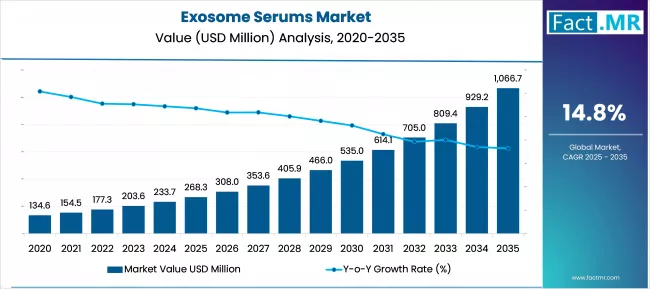
Exosome Serums Market Analysis By Value 2025 To 2035 | Source: Fact.MR
Quick Stats for Exosome Serums Market
- Industry Value (2025): USD 268.3 Million
- Projected Value (2035): USD 1,067 Million
- Forecast CAGR (2025 to 2035): 14.8%
- Leading Segment (2025): Human-derived Exosomes (60.0% Market Share)
- Fastest Growing Country (2025-2035): South Korea (16.3% CAGR)
- Top Key Players: ExoCoBio, CellExosome, Exocel Bio, and Plated Skin Science
What are the drivers of the exosome serums market?
The main driver of demand is clinical approval, and quantifiable effectiveness. Exosome payloads deliver specific growth factors and the regulatory microRNAs that favor collagenesis and immunomodulation. The performance measures are being defined by trials and real-world protocols that has changed the locus of buying decisions, moving it off of marketing claims and at on to evidence based procurement. More clinical confidence and payer interest are provided by precision delivery modalities and an improvement of negative effect profiles. Analysis using a biomarker driven segmentation enhances targeting and formulary coverage.
The premium skincare budgets and procedural aftercare contracts drive commercial adoption. Exosome serums are introduced to the treatment regimen by dermatology clinics and med spas to enhance the result and reclaim faster per patient revenue. Direct to consumer channels expand the reach of brands and professional channels maintain margin density. Subscriptions business and repeat procedures in clinics, are more valuable in customer lifetime value and streamlined predictable earnings. International market access is through the retail cooperation with high-status chains.
The scale of manufacturing and chain certainty in the supply opens the expansion of the market. The allocation of financial resources on GMP manufacturing, uniform potency testing, and temperature regulated logistics decreases the clinical risk and enables brokering cross borders.
Compliance friction is reduced, and medical positioning becomes possible due to regulatory clarity in most important jurisdictions. A strategic partnership with other device companies and CDMOs shorten productization and increase commercial moats. The funding direction is moving to combined clinical and customer brands. There is data in favour of scaling.
What are the regional trends of the exosome serums market?
North America is the leader in both clinical translation and commercial scale. Clinical programs and GMP capacity are being financed by venture and strategic capital. Pathways to reimbursement have been piecemeal, but the opportunities with private pay medical aesthetic and high-end retail are driving rapid revenue expansion and early adoption by dermatology group practices.
The process of translation of academic clusters and technology transfer offices translates more readily into viable consumer and clinical products and develops high value licensing.
The Asia Pacific exhibits the faster demand and density of manufacturing. South Korea and Japan unite highly sophisticated R&D with high per capita spending on cos metics, and well-established clinic systems. Price competition is fuelled by domestic OEMs, and regulatory modernization in some markets facilitates transfer of clinical grade serums to the market more quickly. Export oriented manufacturers factor in increasing global demand to match capacity and to take advantage of competitive production costs.
Europe is strict in terms of regulation and production of evidence. Medical claims can be supported by clinical trials and independent publications and determine the decisions of professional buyers to procure.
The presence of harmonized standards facilitates cross border distribution, but fragmentation in markets remains as a result of the variety of national health regulations. In lead markets, professional adoption and commanded premium pricing are supported by clinical training and university hospital affiliations.
What are the challenges and restraining factors of the exosome serums market?
Regulatory uncertainty is a structural constraint. Ambiguous classification between cosmetic and therapeutic creates compliance risk and slows market entry for clinical grade formulations. Differences in the national regulations add to the legal expenses and make multi market releases more complicated.
Traceability problems are emerging together with reputational risks because of the ethical origins of sources as well as the variation of donors. Ambiguity in the law puts off institutional investor and slows strategic alliances in various jurisdiction worldwide.
There is a failure in analytical standardization that hinders comparability and procurement decision. Potency assays, cargo profiling, and release criteria are currently uneven prompting buyers to dismiss claims of efficacy and instead prefer well-established clinical data.
Strict randomization differences and low long term safety data bar the entry of guidelines. In critical markets manufacturers will be confronted with expensive assay validation procedures and delays in certification.
Country-Wise Insights
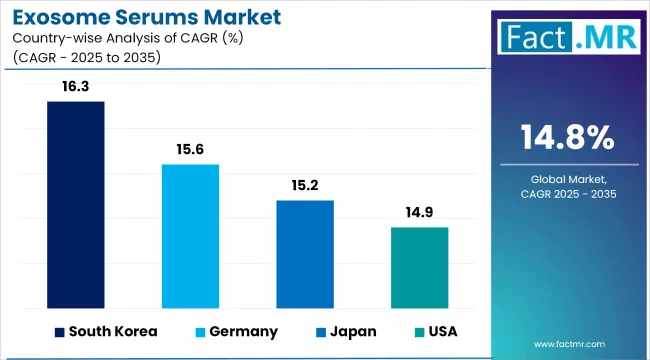
Exosome Serums Market Analysis By Country | Source: Fact.MR
The United States is The Clinical Innovation Leader in Exosome Serums
Active biotech clusters and top-tier academic medical centers bring to bear translational research. In U.S. New ventures and old dermatology brands transform clinical facts into business serums and treatment regimens. The venture funding will aid in scale up of GMP capacity and potency assay development. Interaction with FDA advisory bodies is geared towards classification and the expedited issuance of clinical grade approval.
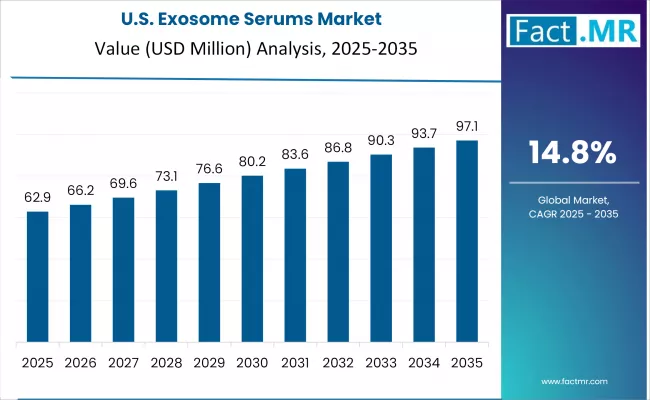
US Exosome Serums Market Analysis By Value 2025 To 2035 | Source: Fact.MR
The medical aesthetics and premium retail have high domestic demand. Aesthetic procedures are not commonly subsidized by payors therefore the private pay clinics are a significant source of income. Distribution composites between direct sales in clinics and e commerce as well as specialty retailers. Training, and bundled care pathways that not only elevate uptake, but also bend average treatment value quickly, are funded by clinic networks.
Export orientation focuses on professional market and Asia and Europe in which regulatory dossiers of clinical data have been performed. Strategic priorities here are on assay standardization, scale manufacturing and cow development with device partners to internalize treatment pathways and allow premium pricing. This has a commercial payoff in terms of exportable SKUs and increases bargaining power with international distributors, up-market clinic chains.
Japan is The Precision Manufacturing Leader in Exosome Serums
Japan has a strict regulation and a high analytical process. Domestic companies focus on assay validation, reproducible manufacturing and traceability that has an appeal to professional customers. Mechanistic studies and safety profiling can be found in academic collaborations which support incremental clinical claims. Cell derived products regulatory recognition is conservative that prompts the firms to invest in the pre market evidence.
The consumption tends towards high-end make-up and clinical quality products distributed in dermatology chains. Medical aesthetics has a strong consumer trust and clinician adoption that helps to maintain substantial domestic revenues. Production companies also have quality management tools that satisfy export anticipations. There are retail and clinical channels that are coupled with loyalty and physician led education programs.
Export strategy targets markets that value regulatory proof points and high quality manufacturing. Japanese manufacturers have taken a niche role of providing clinical grade concentrates and contract manufacturing to a few global brands. Partnerships with research hospitals enable clinical pilots that validate performance for B2B customers.
South Korea is The Fast Adopter and Cosmetic Innovation Engine in Exosome Serums
South Korea leverages an agile cosmetic industry and dense med spa networks to commercialize exosome serums within a short amount of time. Clinical aesthetic has high market penetration since customers are willing to pay. Superior execution speed For local brands, speed is on point, where it takes less time to conceptualize, and implement in retail and clinics. Good quality domestic testing facilities accelerate the iteration of products and lower the risk factor with regards to launch.
Development of R&D investments is aimed at formulation innovations that result in stability and skin penetrations. The CDMOs in the domestic market provide competitive solutions with regard to GMP manufacturing and logistics basis to cater to both export and domestic orders. Regulatory changes are changing to strike the right mixture between future innovations and safety regulation. Focus on scaleable micro manufacture and cold chain excellence lowers cost per unit.
Export orientation focuses on the markets of Asia Pacific and worldwide specialty retailers. Marketing focuses on immediate results and endorsements of professional use that reduces length of cycle of purchase. Influencer led awareness paired with clinic level education with the help of a strategic playbook maintains rapid adoption. Together these make a potent export multiplier effect and an absorbent strategic investment pull
Category-Wise Analysis
Topical Serums are The Consumer Scale Entry Point for Exosome Serums
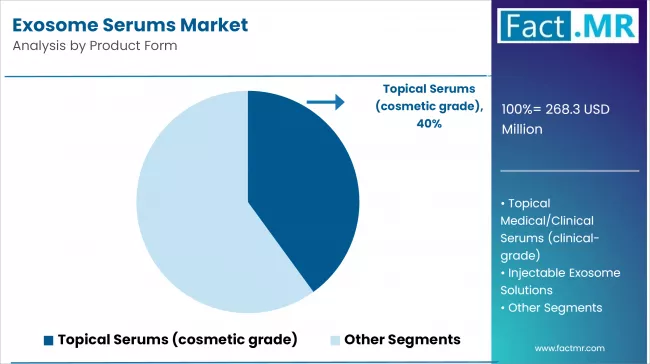
Exosome Serums Market Analysis By Product Form | Source: Fact.MR
Topical serums capture the largest addressable market by combining ease of use with broad consumer acceptance. These ready-made formulations enable brands to use the science of exosomes to convert it to the retail shapes and subscription products. Reduced cost of regulation compared to injectables increases the velocity of the distribution via e commerce and to specialty retailing and maintains premium prices. The resulting economies of scale in fill/pack capabilities decrease unit cost and allow ASPs to be competitive.
Commercial role focuses on drive and growth through awareness, clinic to consumer funnels. Brands make use of clinical data as a differentiator and make use of professional endorsements to streamline the buying cycles. Trajectory is into broader usage as formulation science advances ability to provide better stability and lower cost of cold chain to extend into mass channels. Selling with retailers and under a label prolongs access and subscriptions smooth out earnings. The continued enhancements to encapsulation, sustained release will also improve perception of efficacy and assist in premiumization.
Human derived Exosomes are The Clinical Efficacy Backbone
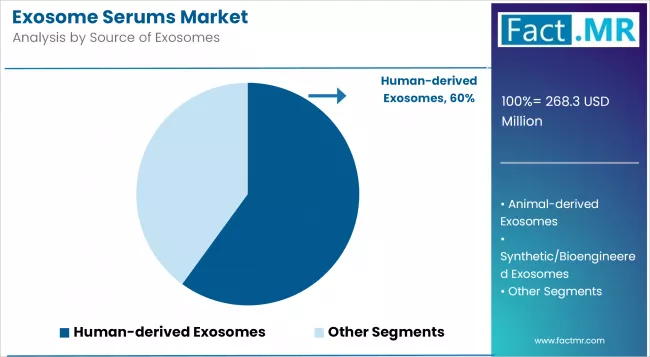
Exosome Serums Market Analysis By Source Of Exosomes | Source: Fact.MR
Human derived exosomes underpin clinical grade propositions by carrying native signaling profiles that align with regenerative endpoints. Traceability and donor screening is essential to procurement that adds to production costs and overhead on governance. Autologous methods lessen the threat of immune attack, albeit at the expense of scalability, whereas allogeneic master cell lines may provide industrial scale albeit at the expense of a more complex regulatory pathway. Chain investments in the cold chain systems increase the reliability of supply, encouraged by strategic tie-ups with tissue banks.
Commercial focuses on clinic dispensed protocols and high quality topical lines referred to human source biology. When making supplier choices, buyers have validated potency assays and published clinical outcomes on their priority. A future trend may include the standardization of collections of defined cell lines, optimized manufacturing yields, and bioengineering to optimize payload, with a safety profile of interest. The concentration of supplier shares will be as a result of regulatory alignment and industry wide assays standards. Firms that win the markets will merge facts with the provision of security in order to grow exponentially
Competitive Analysis
Key players in the exosome serums industry including ExoCoBio, CellExosome, Exocel Bio, Plated Skin Science, Elevai Skincare, ExoGlow Labs, Reviv (RevivSkin), Neogenesis, Calecim (Cellular Biomedicine-related), Osmosis Skincare, Dermalogica (Pro Exo Booster), BENEV, Dr. Barbara Sturm
Competition erupts into two divisions between science-first companies that are investing in clinical programs and brand-first companies that are scaling early DTC distribution. The actual procurement of clinics emphasizes the valid potency and assurance of the supply whereas the retail buyers value brand reliability and obvious results. Other ways that companies differentiate themselves include proprietary assays, proprietary formulation platforms, and exclusive clinician relationships.
The innovation will focus on assay standardization, delivery technologies with better penetration and cost effective workflows of GMP. Selling mass channels are beginning to see price competition; however, professional grade premiums remain where clinical evidence and training can defend pricing. Mergers and acquisitions will bring a faster consolidation of the suppliers as well as brands. New entrants have to demonstrate clinical and the safety of their supply chains in order to get accounts. The operational competitive advantages will be achieved through channel specialization and the customized education of the clinicians.
Recent Development
- In June 2025, ExoCoBio, in partnership with InMode, unveiled its leading ASCE+ exosome technology in New Zealand through exclusive events showcasing synergy with InMode’s Morpheus8 multi-platform. These events mark a regional expansion and highlight regenerative aesthetic integration with energy-based devices.
- In December 2024, Elevai Skincare debuted the S-Series Root Renewal System, a three-part hair and scalp kit (shampoo, conditioner, serum) incorporating patent-pending exosome and mitochondrial technologies. Launching first in medical aesthetic practices, it leverages proprietary PREx Exosomes™ and Y100™, aiming for a broader consumer rollout in early 2025
Fact.MR has provided detailed information about the price points of key manufacturers of the Exosome Serums Market positioned across regions, sales growth, production capacity, and speculative technological expansion, in the recently published report.
Methodology and Industry Tracking Approach
The 2025 exosome serums market report by Fact.MR is informed by primary interviews with 1,450 stakeholders across 10 countries conducted between June 2024 and May 2025. Each market included a minimum of 60 respondents drawn from clinical buyers, retail category managers and manufacturing leads.
About 62 percent of participants were end users including dermatology clinics, med spas, premium retailers and subscription brands while the remainder comprised procurement leads, clinical R and D heads, regulatory advisors and CDMO executives.
Data collection emphasized potency assay performance, formulation stability, cold chain logistics, clinical outcome metrics, regulatory classification and commercial supply resilience. A regionally balanced calibration model ensured representation across North America, Europe and Asia Pacific and the analysis was triangulated with more than 120 validated sources including clinical studies, product specification sheets and corporate filings.
Fact.MR applied rigorous analytical tools such as multi-variable regression and scenario modeling to ensure data robustness. With continuous monitoring of the glass adhesives space since 2018, this report offers a comprehensive roadmap for firms seeking competitive advantage, innovation, and sustainable growth within the sector.
Segmentation
Segmentation of Exosome Serums Market
-
By Product Form :
- Topical Serums (cosmetic grade)
- Topical Medical/Clinical Serums (clinical-grade)
- Injectable Exosome Solutions
- Adjunct Delivery Products / Kits
- Finished-Formulations (combination products)
-
By Source of Exosomes :
- Human-derived Exosomes
- Animal-derived Exosomes
- Synthetic/Bioengineered Exosomes
-
By Application :
- Anti-Aging & Skin Rejuvenation
- Hair Restoration
- Wound Healing & Scar Reduction
- Anti-Inflammatory & Dermatological Conditions
- Cosmetic Enhancement (Adjuvant Therapy)
-
By Distribution Channel :
- Direct-to-Consumer (DTC) / E-commerce
- Medical & Aesthetic Clinics
- Retail & Specialty Stores
- B2B & Wholesale
-
By Region :
- North America
- Latin America
- Western Europe
- Eastern Europe
- East Asia
- South Asia & Pacific
- Middle East & Africa
Frequently Asked Questions
What was the Global Exosome Serums Market Size Reported by Fact.MR for 2025?
Who are the Major Players Operating in the Exosome Serums Market?
What is the Estimated Valuation of the Exosome Serums Market in 2035?
What Value CAGR did the Exosome Serums Market Exhibit Over the Last Five Years?
Who worked on this report


Preview the report firsthand - request a free sample
Free SampleGet the brochure for pricing and purchase details
Download PDF