- Base Value(2026): 893.0 Mn
- Estimated Value(2026): 893.0 Mn
- Forecast Value (2036): 1468.5 Mn
- CAGR (2026 - 2036): 5.1%
B20 - B30 Biodiesel Fuel Injection Components Market Forecast Outlook 2026 to 2036
The B20 - B30 biodiesel fuel injection components market is estimated to reach USD 893 million in 2026 and grow to USD 1,471 million by 2036, reflecting a CAGR of 5.1%.
Summary of B20 - B30 Biodiesel Fuel Injection Components Market - Key Takeaways
- The B20 - B30 biodiesel fuel injection components market comprises components used in biodiesel fuel systems, such as injectors, pumps, and seals, essential for optimizing engine performance and reducing emissions.
- The market is projected to grow at a CAGR of 5.1% from 2026 to 2036, expanding from USD 893 million in 2026 to USD 1,471 million by 2036, based on Fact.MR forecasting and increasing adoption of biodiesel blends.
- OEM line-fit sales dominate the market with a 63% share in 2026, driven by the integration of biodiesel-compatible fuel injection components directly into new vehicle and engine models during manufacturing.
- B20 blend/spec accounts for 53% of the market share in 2026, as it remains the most widely used biodiesel blend in commercial and passenger vehicles due to its compatibility with existing diesel engines.
- China records the fastest growth at a 6.6% CAGR, supported by strong government policies promoting biodiesel use, especially in the industrial and transportation sectors.
- Key players in the market include Robert Bosch GmbH, DENSO CORPORATION, and Cummins Inc., focusing on advanced fuel injection technologies for biodiesel blends, along with BorgWarner Inc. and MAHLE GmbH contributing to the development of high-performance components.
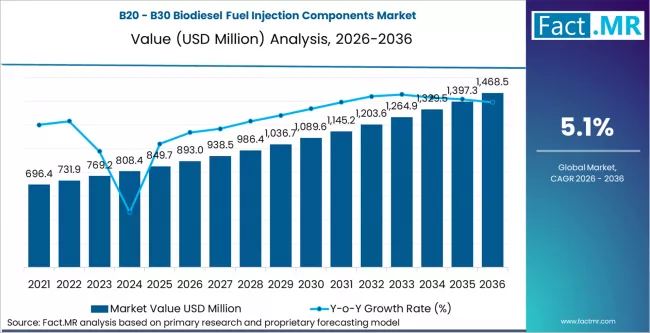
B20 B30 Biodiesel Fuel Injection Components Market Market Value Analysis | Source: Fact.MR
Key performance drivers in this market include production concentration and regional manufacturing control, with a significant portion of production concentrated in regions with established biodiesel infrastructure. Supply reliability remains a critical challenge, as fluctuations in raw material availability and transportation logistics can impact component production timelines.
Manufacturers must contend with dependencies on both feedstock suppliers and regional policy changes that affect biodiesel production incentives. Additionally, rising demand for biodiesel in various geographies can create short-term supply constraints, further complicating production planning. Companies with strong control over regional production capacities and resilient supply chains are likely to navigate these constraints more effectively, ensuring consistent delivery to customers while maintaining competitive pricing.
B20 - B30 Biodiesel Fuel Injection Components Market
| Metric | Value |
|---|---|
| Estimated Value in (2026E) | USD 893 million |
| Forecast Value in (2036F) | USD 1,471 million |
| Forecast CAGR 2026 to 2036 | 5.1% |
Source: Fact.MR analysis. Updated Feb 12, 2026
Category
| Category | Sub-Segment |
|---|---|
| By Component | Injectors; Pumps & Seals; Lines/Rails; Other |
| By Application | On-Road Heavy-Duty; Off-Highway; Marine/Stationary; Other |
| By Blend/Spec | B20; B30; Variable Blend Systems; Other |
| By Sales Channel | OEM Line-Fit; Service/Replacement; Retrofit; Other |
| Region | North America; Europe; Asia Pacific; Latin America; Middle East & Africa |
Source: Fact.MR analysis. Updated Feb 12, 2026
Segmental Analysis
What is Driving the Dominance of OEM Line-Fit in the B20 - B30 Biodiesel Fuel Injection Components Market?
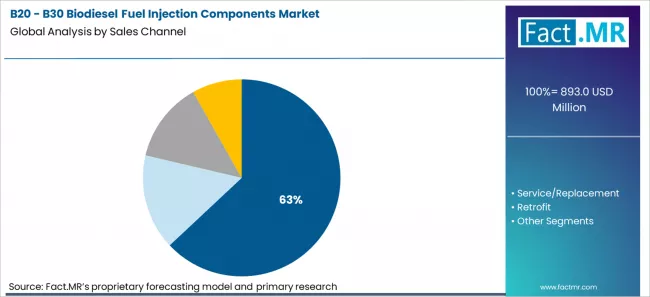
B20 B30 Biodiesel Fuel Injection Components Market Analysis By Sales Channel | Source: Fact.MR
OEM Line-Fit leads the B20-B30 biodiesel fuel injection components market with 63% of the market share in 2026. This dominance is driven by the integration of biodiesel-compatible fuel injection components directly into new vehicle and engine models during manufacturing. OEMs prefer line-fit installations to ensure that all components meet the necessary performance, durability, and regulatory standards, especially as biodiesel blends become more widely adopted. The seamless integration of these components guarantees optimal engine operation and efficiency when using biodiesel fuels like B20 and B30.
What is the Role of B20 Blend in the B20 - B30 Biodiesel Fuel Injection Components Market?
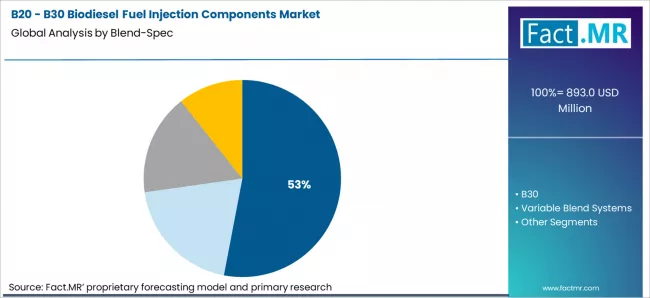
B20 B30 Biodiesel Fuel Injection Components Market Analysis By Blend Spec | Source: Fact.MR
B20 accounts for 53% of the market share in 2026. B20, which consists of 20% biodiesel and 80% petroleum diesel, remains the most widely used biodiesel blend in commercial and passenger vehicles. The adoption of B20 is driven by its compatibility with existing diesel engines without requiring significant modifications, making it an attractive option for fleet operators and consumers seeking a more environmentally friendly fuel alternative. The demand for fuel injection components specifically designed for B20 ensures smooth engine performance while supporting the shift toward renewable energy sources.
What are the Principal Drivers, Constraints, and Evolving Dynamics of the B20 - B30 Biodiesel Fuel Injection Components Market?
The growth of the B20-B30 biodiesel fuel injection components market is driven by renewable fuel standards that promote the use of biodiesel blends to reduce emissions. These blends help meet regulatory requirements, particularly in reducing carbon monoxide and particulate matter. However, compatibility challenges arise, as biodiesel can degrade seals, gaskets, and other components, requiring specialized materials and design modifications. This adds complexity and cost to manufacturing.
Market dynamics reflect increasing demand for components engineered to withstand biodiesel's chemical properties, especially in regions with stricter fuel regulations. Retrofit opportunities exist as fleet operators look to upgrade existing diesel engines to accommodate biodiesel blends. Innovations in materials and precision injection control continue to evolve, supporting long-term component reliability and efficiency for biodiesel-powered engines.
Analysis of the B20 - B30 Biodiesel Fuel Injection Components Market by Key Country
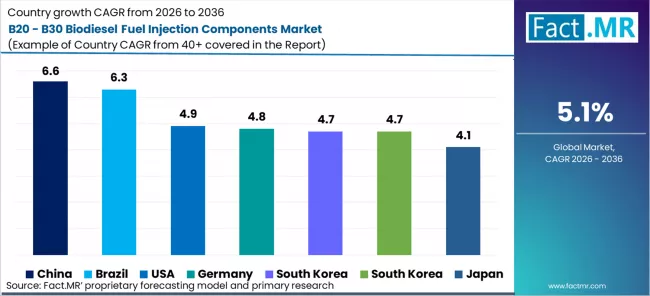
B20 B30 Biodiesel Fuel Injection Components Market Cagr Analysis By Country | Source: Fact.MR
| Country | CAGR 2026 to 2036 |
|---|---|
| USA | 4.9% |
| Japan | 4.1% |
| South Korea | 4.7% |
| Germany | 4.8% |
| China | 6.6% |
| UK | 4.7% |
| Brazil | 6.3% |
Source: Fact.MR analysis. Updated Feb 12, 2026
The report covers an in-depth analysis of 40+ countries; top-performing countries are highlighted below.
What is Driving the Growth of the B20 - B30 Biodiesel Fuel Injection Components Market in the USA?
The USA’s B20-B30 Biodiesel Fuel Injection Components market is projected to grow at 4.9%, driven by the increasing adoption of biodiesel blends in the transportation sector and government incentives for renewable energy sources. With a push for cleaner fuels to reduce carbon emissions and dependence on fossil fuels, the U.S. is transitioning toward renewable biodiesel. This, combined with growing fleet adoption of B20-B30 blends, boosts demand for specialized fuel injection components designed for high-percentage biodiesel use. Regulatory policies such as the Renewable Fuel Standard (RFS) further support growth in this market.
How is the B20 - B30 Biodiesel Fuel Injection Components Market Expanding in Japan?
Japan’s B20-B30 Biodiesel Fuel Injection Components market is growing at 4.1%, supported by the country’s increasing efforts to promote renewable energy sources and reduce greenhouse gas emissions. While Japan's biodiesel usage is still limited compared to traditional diesel, there is rising interest in cleaner alternatives for transportation and industrial applications. The government’s focus on sustainability and its promotion of biofuels to meet carbon reduction goals contribute to the demand for advanced fuel injection components capable of handling higher biodiesel blends.
What Factors Are Fueling the Growth of the B20 - B30 Biodiesel Fuel Injection Components Market in South Korea?
South Korea’s B20-B30 Biodiesel Fuel Injection Components market is projected to grow at 4.7%, driven by the country’s ongoing transition toward greener fuel alternatives. South Korea is committed to reducing its carbon footprint, and this is reflected in its push to integrate biodiesel blends like B20 and B30 into the fuel market. The demand for fuel injection components capable of managing biodiesel blends is increasing as the government sets new targets for biofuel usage. Additionally, South Korea’s expanding focus on renewable energy in the transportation sector further contributes to the market’s growth.
How is the B20 - B30 Biodiesel Fuel Injection Components Market Evolving in Germany?
Germany’s B20-B30 Biodiesel Fuel Injection Components market is growing at 4.8%, supported by the country's strong focus on sustainability and its leadership in promoting biofuels. As one of the largest producers of biodiesel in Europe, Germany is seeing growing demand for biodiesel blends such as B20 and B30 in both transportation and industrial sectors. The European Union's Renewable Energy Directive (RED) mandates increased use of biofuels, driving the need for advanced fuel injection systems that are compatible with biodiesel blends. This regulatory environment, along with a strong automotive industry, fosters growth in the market for biodiesel fuel injection components.
What is Contributing to the Growth of the B20 - B30 Biodiesel Fuel Injection Components Market in China?
China’s B20-B30 Biodiesel Fuel Injection Components market is expanding at 6.6%, driven by the country’s rapid adoption of biodiesel as part of its efforts to improve air quality and reduce dependence on fossil fuels. With China’s heavy industrial and transportation sectors, the government has introduced policies to promote the use of biofuels like B20 and B30 to decrease pollution levels. The growing demand for biofuel-compatible components in fuel injection systems, particularly in heavy-duty vehicles and machinery, is driving this market. China's aggressive renewable energy targets and emphasis on reducing carbon emissions contribute to the strong growth of the biodiesel fuel injection components market.
How is the B20 - B30 Biodiesel Fuel Injection Components Market Evolving in the UK?
The UK’s B20-B30 Biodiesel Fuel Injection Components market is growing at 4.7%, supported by the country’s commitment to meeting renewable energy targets and reducing carbon emissions. The UK’s adoption of biofuels, including B20 and B30, is rising, driven by government policies aimed at reducing greenhouse gas emissions from transportation. As demand for more sustainable fuel options grows, the need for biodiesel-compatible fuel injection systems increases. The market’s growth is further supported by the UK’s investment in green technologies and biofuel infrastructure, aligning with broader efforts to meet climate goals.
What is Driving the Growth of the B20 - B30 Biodiesel Fuel Injection Components Market in Brazil?
Brazil’s B20-B30 Biodiesel Fuel Injection Components market is expanding at 6.3%, driven by the country’s strong emphasis on biofuels. Brazil is one of the leading countries in biodiesel production, with the government mandating increasing biodiesel blends in the fuel supply. The growing demand for renewable fuels in the transportation and agricultural sectors, combined with Brazil’s expertise in biofuel production, contributes to the steady growth of the market for biodiesel-compatible fuel injection components. Brazil’s commitment to reducing carbon emissions and transitioning to more sustainable energy sources further supports the increasing adoption of B20 and B30 biodiesel blends.
How Are Key Players Competing in the B20 - B30 Biodiesel Fuel Injection Components Market?
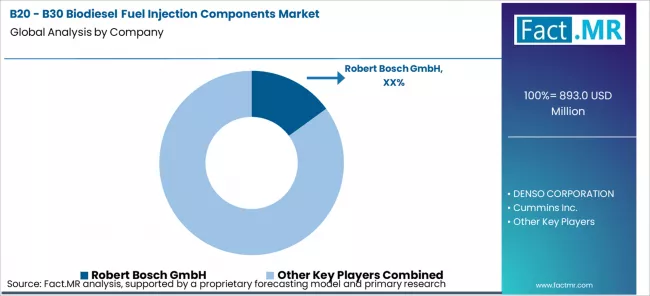
B20 B30 Biodiesel Fuel Injection Components Market Analysis By Company | Source: Fact.MR
In the B20 - B30 biodiesel fuel injection components market, companies like Robert Bosch GmbH and DENSO CORPORATION are at the forefront, focusing on advanced fuel injection technologies that ensure compatibility with biodiesel blends. Cummins Inc. and BorgWarner Inc. are integrating their solutions with next-generation engine technologies to optimize performance while maintaining low emissions. Stanadyne LLC and Weifu High-Technology Group Co., Ltd. are expanding their portfolios to meet the growing demand for biodiesel-compatible fuel injection components. MAHLE GmbH, Parker-Hannifin Corporation, Rheinmetall AG, and Continental AG are also playing a significant role by developing high-efficiency systems tailored to the biodiesel sector.
Recent Industry Developments
- Standard / Specification Update - EN 16709:2024 for High-FAME diesel (B20 & B30) (Published Jul 21, 2024) CEN’s EN 16709:2024 sets the fuel quality requirements and test methods for B20/B30 diesel, which directly drives materials compatibility, filtration/contamination limits, and OEM fuel-system validation expectations for injectors, HP pumps, rails, seals, and hoses. (ANSI Webstore)
- OEM Guidance / Compatibility - Cummins publishes B20 guidance and compatibility notes (Published May 10, 2024) Cummins re-stated B20 compatibility across many engine families and explains operational considerations (e.g., fuel quality, handling) that affect fuel-system reliability and injection-component durability under higher-FAME blends. (Cummins Inc.)
- OEM Policy / Warranty & Failure Mode Update - Detroit Diesel “Biofuel Statement” (Published Jan 2025) Detroit’s updated biofuel policy highlights B-blend handling risks (notably water separation and corrosion) and explicitly notes fuel-injection system failures from corrosion linked to biodiesel blends are not covered-an important constraint shaping component selection and maintenance for B20-B30 use. (dtnacontent-dtna.prd.freightliner.com)
Key Players of the B20 - B30 Biodiesel Fuel Injection Components Market
- Robert Bosch GmbH
- DENSO CORPORATION
- Cummins Inc.
- BorgWarner Inc.
- Stanadyne LLC
- Weifu High-Technology Group Co., Ltd.
- MAHLE GmbH
- Parker-Hannifin Corporation
- Rheinmetall AG
- Continental AG
Bibliographies
- U.S. Department of Energy, Alternative Fuels Data Center. (2024). Biodiesel blends and material compatibility in diesel engines. DOE AFDC.
- U.S. Environmental Protection Agency (EPA). (2023). Renewable Fuel Standard (RFS) program: Biodiesel pathways and engine compliance considerations. EPA.
- National Renewable Energy Laboratory (NREL). (2023). Fuel property impacts of biodiesel blends on diesel injection systems and durability. U.S. DOE.
- Oak Ridge National Laboratory (ORNL). (2024). Effects of biodiesel blends on spray atomization and injector deposit formation. U.S. Department of Energy.
- International Energy Agency (IEA). (2023). Biofuels for transport: Compatibility challenges with legacy diesel fuel systems. IEA Publications.
Segmentation
Scope of the Report
| Items | Values |
|---|---|
| Quantitative Units (2026) | USD 893 Million |
| By Component | Injectors, Pumps & Seals, Lines/Rails, Other |
| By Application | On-Road Heavy-Duty, Off-Highway, Marine/Stationary, Other |
| By Blend/Spec | B20, B30, Variable Blend Systems, Other |
| By Sales Channel | OEM Line-Fit, Service/Replacement, Retrofit, Other |
| Regions Covered | North America, Europe, Asia Pacific, Latin America, Middle East & Africa |
| Countries Covered | United States, Canada, Mexico, Germany, United Kingdom, France, Japan, South Korea, China, India, Brazil, and other countries |
| Key Companies Profiled | Robert Bosch GmbH, DENSO CORPORATION, Cummins Inc., BorgWarner Inc., Stanadyne LLC, Weifu High-Technology Group Co., Ltd., MAHLE GmbH, Parker-Hannifin Corporation, Rheinmetall AG, Continental AG |
| Additional Attributes | Market trends by component, application, blend/spec, and sales channel; regional demand trends; competitive landscape; technological advancements in biodiesel fuel injection components; operational performance optimization initiatives; and product development strategies |
Source: Fact.MR analysis. Updated Feb 12, 2026
B20 - B30 Biodiesel Fuel Injection Components Market Key Segments
-
By Component
- Injectors
- Pumps & Seals
- Lines/Rails
- Other
-
By Application
- On-Road Heavy-Duty
- Off-Highway
- Marine/Stationary
- Other
-
By Blend/Spec
- B20
- B30
- Variable Blend Systems
- Other
-
By Sales Channel
- OEM Line-Fit
- Service/Replacement
- Retrofit
- Other
-
Region
- North America
- USA
- Canada
- Mexico
- Europe
- Germany
- UK
- France
- Italy
- Spain
- Nordic Countries
- BENELUX
- Rest of Europe
- Asia Pacific
- China
- Japan
- South Korea
- India
- Australia
- Rest of Asia Pacific
- Latin America
- Brazil
- Argentina
- Rest of Latin America
- Middle East and Africa
- Kingdom of Saudi Arabia
- United Arab Emirates
- South Africa
- Rest of Middle East and Africa
- Other Regions
- Oceania
- Central Asia
- Other Markets
- North America
Frequently Asked Questions
How big is the b20 - b30 biodiesel fuel injection components market in 2026?
What will be the size of b20 - b30 biodiesel fuel injection components market in 2036?
How much will be the b20 - b30 biodiesel fuel injection components market growth between 2026 and 2036?
What are the key product types in the b20 - b30 biodiesel fuel injection components market?
Which sales channel segment to contribute significant share in the b20 - b30 biodiesel fuel injection components market in 2026?
Who worked on this report


Preview the report firsthand - request a free sample
Free SampleGet the brochure for pricing and purchase details
Download PDF