- Market Value (2025): USD 951.7 Mn
- Estimated Value (2026): USD 1010.7 Mn
- Forecast Value (2036): USD 1810.9 Mn
- CAGR (2026-2036): 6.2%
What is the Banana Chips Market forecast to be worth by 2036?
USD 1010.7 million in 2026 to USD 1810.9 million by 2036 at 6.2% CAGR.
- The banana chips market crossed a valuation of USD 951.7 million in 2025.
- Demand is projected to increase from USD 1010.7 million in 2026 to USD 1810.9 million by 2036.
- The market is forecast to record 6.2% CAGR from 2026 to 2036.
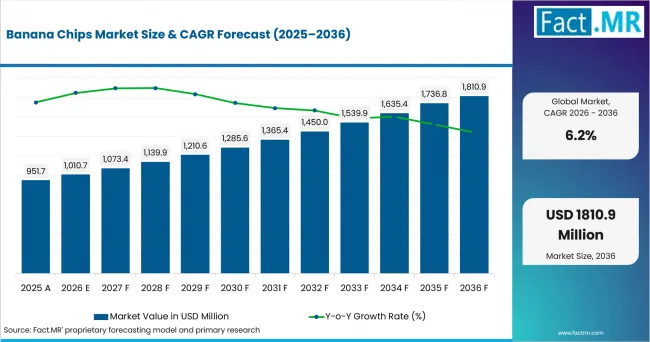
Banana Chips Market Value Analysis | Source: Fact.MR
What are the defining numbers behind Banana Chips Market growth?
USD 800.2 million absolute opportunity is expected between 2026 and 2036, led by Sweetened products and Online Sales within the assessed structure.
- Demand Drivers in the Market
- Taste-led snacking is expected to keep banana chips visible near healthy snacks where buyers want a familiar product with a crisp format.
- Shelf-stable fruit positioning is projected to support trial when stores place banana chips near dried fruit and other pantry snacks.
- Digital shelves are anticipated to improve discovery because shoppers can compare ingredients and pack size before ordering.
- Processing consistency is expected to matter because buyers judge banana chips quickly by color, sweetness and crunch.
- Key Segments Analyzed
- By Type: Sweetened is anticipated to hold 63.0% share in 2026 since familiar flavor supports household snacking.
- By Application: Online Sales is projected to account for 68.8% share in 2026 as digital ordering supports product comparison and repeat purchase.
- Analyst Opinion at Fact.MR
- Shambhu Nath Jha, Principal Consultant at Fact.MR, states, “Banana chips suppliers need to keep sweetness and cut style aligned with pack format. Repeat buying is expected to depend on consistent crispness and clear product positioning instead of one broad product claim.”
- Strategic Implications
- Buyers can match product type with the eating occasion, as Sweetened banana chips appeal to a wider snacking audience than unsweetened formats.
- Suppliers improve product comparison by clearly explaining ingredients and pack size. This helps customers assess banana chips against other non-potato snacks.
- Distribution planning works best when shelf availability and Online Sales are aligned. Online listings still depend on reliable fulfillment and consistent pack quality.
he UK leads the listed country set at 8.4% CAGR through 2036. Australia records 7.5% and the USA records 7.9% CAGR. Canada advances at 6.6% CAGR and Germany reaches 6.0% CAGR during the same period.
How does the Banana Chips Market break down by segment?
Sweetened leads Type with 63.0% share and Online Sales leads Application with 68.8% share in 2026.
Why does Sweetened lead Type?
Sweetened is projected to account for 63.0% share in 2026.
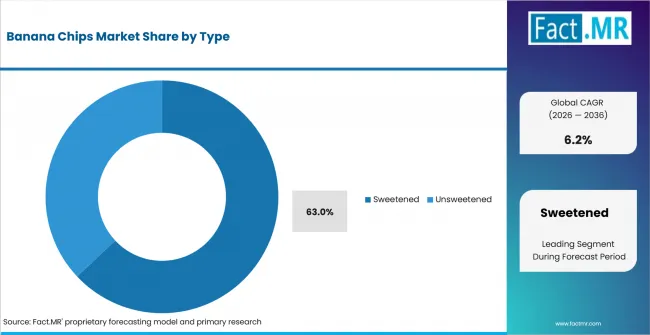
Banana Chips Market Analysis By Type | Source: Fact.MR
Sweetened banana chips are expected to remain the largest type because the flavor profile fits casual snacking and family purchase. The format gives brands an easier path into trial packs and store assortments. Unsweetened products are expected to serve customers who prefer simpler labels or lower added sugar. This leaves Sweetened with a broader repeat-buying base.
Why does Online Sales lead Application?
Online Sales hold 68.8% share in 2026.
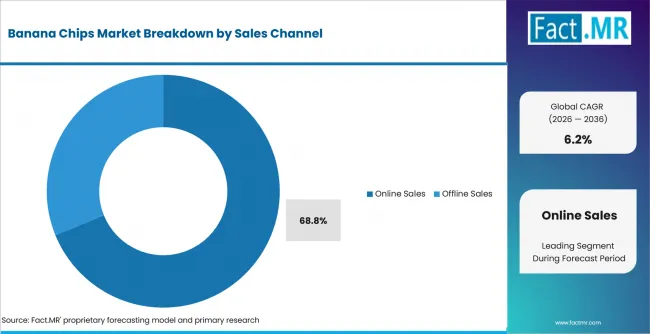
Banana Chips Market Analysis By Sales Channel | Source: Fact.MR
Online Sales is estimated to lead because customers can compare brand claims and pack sizes before purchase. The channel supports repeat ordering when a snack product becomes familiar. Offline Sales remains important where buyers want immediate availability and visual pack inspection. Online discovery extends reach beyond local store shelves.
What is accelerating Banana Chips Market adoption, and what is holding it back?
Demand is expected to grow through wider snack use and Online Sales. High banana costs and labeling rules may limit growth by affecting prices and buyer confidence.
Drivers Impact Analysis
| DRIVER | (~) % IMPACT ON CAGR | GEOGRAPHIC RELEVANCE | IMPACT TIMELINE |
|---|---|---|---|
| Sweetened taste preference | +1.4% | UK, USA, Canada | Short term (<= 2 years) |
| Online product discovery | +1.2% | UK, Australia, USA | Short term (<= 2 years) |
| Retail pack flexibility | +0.9% | Developed snack markets | Medium term (2-4 years) |
| Stable sourcing and frying quality | +0.7% | Banana-processing supply hubs | Medium term (2-4 years) |
Source: Fact.MR analysis. Updated Aug 4, 2026
- Sweetened taste preference: Familiar flavor is expected to make trial easier. It should support repeat household purchase when crispness and pack condition remain consistent.
- Online product discovery: Digital shelves are expected to help buyers compare brand claims before purchase. This route is useful for smaller suppliers that need reach outside nearby stores.
- Retail pack flexibility: Single-serve packs and value packs are expected to serve different buying occasions without changing the core product. This supports both trial and routine stocking.
Opportunity Impact Analysis
| OPPORTUNITY | (~) % IMPACT ON CAGR | GEOGRAPHIC RELEVANCE | IMPACT TIMELINE |
|---|---|---|---|
| Pack-size differentiation | +0.8% | Retail and online channels | Short term (<= 2 years) |
| Private-label supply | +0.6% | UK and Germany | Medium term (2-4 years) |
| Ingredient-led positioning | +0.5% | USA and Canada | Medium term (2-4 years) |
| Adjacent snack placement | +0.4% | Online marketplaces | Long term (>= 4 years) |
Source: Fact.MR analysis. Updated Aug 4, 2026
- Pack-size differentiation: Smaller packs are expected to make trial easier for new buyers. Larger packs are expected to support pantry stocking and family use.
- Private-label supply: Retailers are expected to use own-label banana chips when volume buying and stable quality give them price control.
- Adjacent snack placement: Banana chips are expected to gain visibility when they are sold near non-potato veggie chips and other crisp snack alternatives.
Restraints Impact Analysis
| RESTRAINT | (~) % IMPACT ON CAGR | GEOGRAPHIC RELEVANCE | IMPACT TIMELINE |
|---|---|---|---|
| Banana input variability | -0.7% | Global sourcing routes | Short term (<= 2 years) |
| Oil and frying cost exposure | -0.5% | Processing markets | Short term (<= 2 years) |
| Label and import compliance | -0.4% | USA, UK, Germany | Medium term (2-4 years) |
| Preference for familiar snack types | -0.3% | Mature retail markets | Long term (>= 4 years) |
Source: Fact.MR analysis. Updated Aug 4, 2026
- Banana input variability: Raw fruit quality is expected to affect slice color and finished texture. This makes supplier planning harder when fruit supply changes.
- Oil and frying cost exposure: Frying quality depends on oil control and process discipline. Higher input cost can limit price flexibility in retail packs.
- Label and import compliance: Exporters are expected to manage ingredient declarations before entering formal retail channels. Delays can slow new listings even when demand exists.
Which countries are scaling Banana Chips Market fastest?
- The country comparison spans 2.4 percentage points between the UK and Germany across the forecast period.
- The UK remains 0.5 percentage point above Australia through stronger premium snack discovery in online and specialty retail.
- Australia records 7.5% and the USA records 7.9% CAGR through 2036 with different channel and snacking habits.
- Canada remains 1.3 percentage points below Australia and the USA as diversified snack demand advances from a smaller base.
- Germany closes the displayed range at 6.0% CAGR because a mature packaged-snack structure is expected to keep growth steadier.
Comparable CAGRs are expected to create different entry conditions because each country has a distinct retail structure and snack preference. Full report coverage includes North America; Latin America; Europe; East Asia; South Asia and Pacific; and Middle East and Africa.
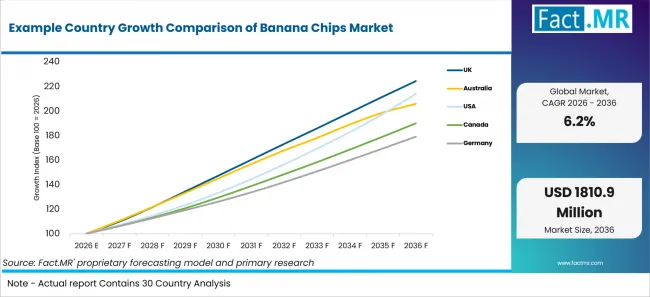
Example Country Growth Comparison Of Banana Chips Market | Source: Fact.MR
| Country | CAGR (2026-2036) |
|---|---|
| UK | 8.4% |
| Australia | 7.5% |
| USA | 7.9% |
| Canada | 6.6% |
| Germany | 6.0% |
Source: Fact.MR analysis. Updated Aug 4, 2026
What supports UK adoption?
8.4% CAGR, supported by specialty retail placement and online product discovery.
The UK’s growth reflects stronger visibility for banana chips across premium fruit snacks and vegetable chip categories. Online channels are expected to help new products gain trial before wider retail adoption. Suppliers with simple labels, stable texture and dependable quality are likely to gain preference, particularly within Sweetened formats.
How is Australia scaling demand?
7.5% CAGR, driven by lunchbox use and travel snacking.
Australia’s growth is linked to demand for convenient snacks across family and on-the-go occasions. Retailers are expected to compare pack sizes before expanding listings. Online availability may improve access for imported and specialty brands, while reliable replenishment and consistent packaging remain important for repeat purchasing.
What is driving USA growth from 2026 to 2036?
7.9% CAGR, backed by wider snack comparison and Online Sales access.
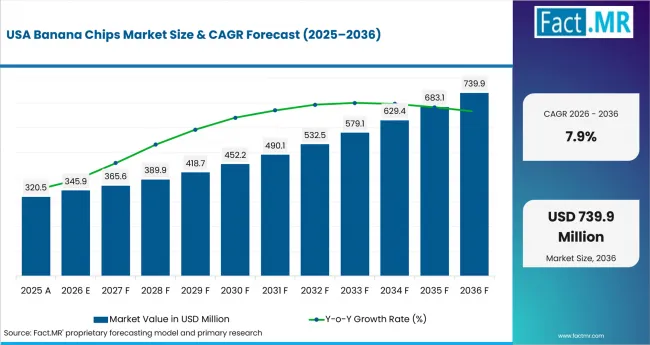
Banana Chips Market Country Value Analysis | Source: Fact.MR
The USA’s growth reflects consumer interest in banana chips as an alternative to kale chips and other crisp snack products. Taste and texture are expected to shape repeat demand. Online marketplaces may give smaller brands wider visibility, but suppliers still need consistent flavor and reliable delivery across retail and digital channels.
How is Canada developing demand?
6.6% CAGR, supported by varied snack preferences and retail availability.
Canada’s growth is shaped by demand across household and convenience snacking occasions. Private-label products may improve access for price-conscious buyers. Pack size, freshness and shelf stability are likely to influence repeat orders, especially where retailers compare family formats with smaller convenience packs.
How does Germany perform?
6.0% CAGR, led by careful label review and established packaged snack demand.
Germany’s growth reflects a mature snack market where buyers compare banana chips with other plant-based products. Retailers are expected to place weight on clear product information and consistent quality. Wider placement may remain measured until suppliers prove reliable texture, labeling and shelf performance.
Who leads the Banana Chips Market?
GSL Premium Food Export Corporation and See’s International Food Manufacturing Corporation hold strong positions in the banana chips supplier group, while Prime Fruits International adds further processed-fruit manufacturing reach.
GSL Premium Food Export Corporation serves packaged snack demand through banana-based export products. See’s International Food Manufacturing Corporation contributes manufacturing capacity for commercial chip formats. Prime Fruits International supports fruit-snack supply across broader customer channels. Four Seasons Fruits Corporation and LTA Foods Manufacturing add production depth. Snapsnax Ventures and Mota Chips strengthen branded snack participation, while Jamaica Producers Group expands the field through established banana and food-processing operations.
Which companies are the key providers?
Key companies include GSL Premium Food Export Corporation; See’s International Food Manufacturing Corporation; Prime Fruits International; Four Seasons Fruits Corporation; LTA FOODS MANUFACTURING; Prime Fruits International, Inc.; Snapsnax Ventures; Jamaica Producers Group; Mota Chips.
- GSL Premium Food Export Corporation
- See’s International Food Manufacturing Corporation
- Prime Fruits International
- Four Seasons Fruits Corporation
- LTA FOODS MANUFACTURING
- Prime Fruits International, Inc.
- Snapsnax Ventures
- Jamaica Producers Group
- Mota Chips
Bibliography
- OECD & Food and Agriculture Organization of the United Nations. (2026, June 29). OECD-FAO Agricultural Outlook 2026-2035: Other products.
- Food and Agriculture Organization of the United Nations. (2025, February 21). The impact of voluntary sustainability standards on banana exports.
- U.S. Food and Drug Administration. (2025, January). Guidance for industry: Questions and answers regarding food allergen labeling (Edition 5).
This Report Answers
- The report provides strategic intelligence on Banana Chips Market across Type and Application choices that shape packaged snack selection.
- Segment analysis covers Sweetened and Online Sales as the share leaders within the 2026 market.
- Country outlook evaluates the UK and Australia alongside the USA and Canada. Germany completes the growth comparison across the profiled markets.
- Competitive analysis profiles GSL Premium Food Export Corporation alongside See’s International Food Manufacturing Corporation and Prime Fruits International.
- Channel assessment covers Online Sales and Offline Sales. Product-positioning review explains how pack format and flavor support repeat buying.
What does the Banana Chips Market cover?
Banana chips are sliced banana snack products sold in Sweetened and Unsweetened formats where flavor and texture guide purchase decisions.
The Banana Chips Market covers products used for direct snacking and related retail consumption. Coverage extends to Online Sales and Offline Sales. The market includes sliced banana products sold as fried or dried chips. It covers branded and private-label routes where the product is sold as a packaged snack.
What is included in the scope?
The scope includes Type and Application alongside Region. Coverage spans Sweetened and Unsweetened banana chips. Online Sales and Offline Sales define the application view. Country coverage includes the UK; Australia; USA; Canada; and Germany. The scope includes supplier review where named companies show banana chips or related snack activity. It also covers banana processing considerations that affect taste, texture and shelf stability.
What is excluded from the scope?
Fresh bananas and unrelated processed fruit products remain outside the scope of this market.
The scope excludes fresh banana trade that is not processed into chips. It also excludes banana puree and banana flour as standalone markets. General fruit snacks are excluded unless the comparison explains banana chips placement. Potato chips and vegetable chips remain outside the market unless they are used as adjacent snack references. Company revenue without a clear connection to banana chips or related snack supply is excluded from provider analysis.
How Was the Analysis Built?
The analysis draws on 120+ sources and 35+ company portfolios. It also covers 25+ countries and more than 20 industry interviews.
- Primary Research: Primary research includes discussions with manufacturers and distributors. These conversations examine purchasing priorities and product adoption. They also review operational challenges and approval requirements that influence market acceptance.
- Desk Research: Desk research covers government statistics and regulatory publications. It also reviews company filings and trade data. Every source used in the analysis is documented in the bibliography.
- Market Sizing and Forecasting: Market estimates combine historical performance and demand indicators. They also consider pricing trends and segment shares. Country-level growth and barriers to market expansion are reviewed before the forecast is finalised.
- Data Validation and Update Cycle: Findings are validated by comparing primary interviews with public data. Regular updates review new product launches and capacity changes. The cycle also checks partnerships and shifts in commercial adoption.
Segmentation
What is the report’s scope and coverage?
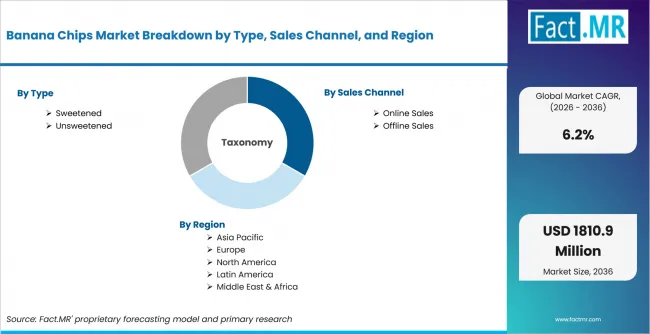
Banana Chips Market Breakdown By Type, Sales Channel, And Region | Source: Fact.MR
| Attribute | Details |
|---|---|
| Quantitative Units | USD million in 2026 to USD million by 2036 at CAGR |
| Market Definition | Sliced banana snack products sold as fried or dried chips where taste, texture, shelf stability and channel fit determine purchase selection |
| Type | Sweetened; Unsweetened |
| Application | Online Sales; Offline Sales |
| Regions Covered | North America; Latin America; Europe; East Asia; South Asia and Pacific; Middle East and Africa |
| Countries Covered | UK; Australia; USA; Canada; Germany |
| Key Companies Profiled | GSL Premium Food Export Corporation; See’s International Food Manufacturing Corporation; Prime Fruits International; Four Seasons Fruits Corporation; LTA FOODS MANUFACTURING; Prime Fruits International, Inc.; Snapsnax Ventures; Jamaica Producers Group; Mota Chips |
| Forecast Period | 2026 to 2036 |
| Approach | Hybrid top-down and bottom-up approach using snack demand; banana processing activity; Type and Application shares; country growth patterns; supplier review; channel fit; raw material availability; frying quality requirements; pack format comparison; and Online Sales behavior |
Source: Fact.MR analysis. Updated Aug 4, 2026
How is the market segmented?
-
By Type
- Sweetened
- Unsweetened
-
By Application
- Online Sales
- Offline Sales
-
By Region
- North America
- Latin America
- Europe
- East Asia
- South Asia and Oceania
- Middle East and Africa
Frequently Asked Questions
Which Type leads the market?
Which Application leads the market?
Which country records the highest listed CAGR?
What is the primary driver in this market?
What is the main restraint?
Why does Online Sales lead demand?
Why do supplier controls matter?
Which companies are covered in the market?
Who worked on this report


Preview the report firsthand - request a free sample
Free SampleGet the brochure for pricing and purchase details
Download PDF