- Market Value (2025): USD 161.2 Mn
- Estimated Value (2026): USD 171.5 Mn
- Forecast Value (2036): USD 318.0 Mn
- CAGR (2026-2036): 6.4%
What is the Beard Balm Market forecast to be worth by 2036?
USD 171.5 million in 2026 to USD 318.0 million by 2036 at a 6.4% CAGR.
- In 2025, the beard balm market was worth USD 161.2 million, with most of that spend coming from men who condition and style their beards at home.
- Revenue will advance from USD 171.5 million in 2026 to USD 318.0 million by 2036 as more shoppers add a balm to a routine that already includes beard oil and wash.
- Growth in beard care tins will hold at a 6.4% CAGR between 2026 and 2036, aided by wider grocery shelf space and repeat orders online.
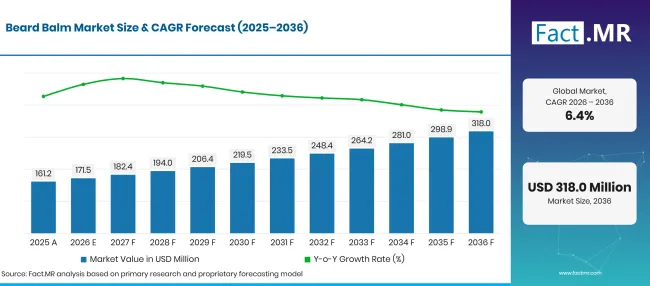
Factmr Beard Balm Market Forecast Global | Source: Fact.MR
| Year | Basis | Market Value (USD million) |
|---|---|---|
| 2025 | Actual | 161.2 |
| 2026 | Estimate | 171.5 |
| 2036 | Forecast | 318.0 |
| CAGR 2026 to 2036 | Forecast period | 6.4% |
Source: Fact.MR analysis. Updated Oct 23, 2026
What are the defining numbers behind Beard Balm Market growth?
Annual revenue will be USD 146.5 million higher in 2036 than in 2026, with home grooming routines generating most of the gain.
- Demand Drivers in the Market
- Men’s grooming spending gives beard care a stable base. The U.S. Bureau of Labor Statistics reported that average annual spending on personal care products and services reached USD 978 per consumer unit in 2024, up from USD 950 in 2023 [1]. A tin of balm is a low-ticket item inside that budget, so households rarely drop it when money is tight.
- Beard oil vs beard balm is a frequent shopper question, and the answer creates cross-selling. Oil mainly treats the skin under the beard, while balm adds wax for shape and hold. Brands sell the two together in kits, which lifts the value of each order.
- Buying grooming products online is now routine for many men. Eurostat reported that 78% of people in the EU who used the internet bought or ordered goods or services online in 2025 [2]. Small balm makers reach these buyers through their own web stores without paying for national shelf space.
- Natural beard balm ingredients are a strong selling point. Shoppers check labels for shea butter, beeswax and plant oils, and many avoid synthetic fragrance. Unscented and certified organic versions give buyers with sensitive skin a clear choice.
- Barbershop culture keeps beard grooming visible. Barbers shape the beard during a cut and often finish with balm, which shows clients how to use it and leads to retail sales at the chair.
- Key Segments Analyzed
- By Product Type: Non-Organic Beard Balm will account for 58.3% share in 2026, since conventional waxes and fragrance oils keep shelf prices low for first-time buyers.
- By Application: Personal Use will represent 54.2% share in 2026 as most men apply balm at home after a shower.
- By Distribution Channel: Supermarkets/Hypermarkets will secure 31.4% share in 2026, because grocery aisles place beard care next to razors and shaving gels.
- By Ingredient Type: Shea Butter will make up 34.2% share in 2026 with its soft texture and its habit of melting at skin temperature.
- Analyst Opinion at Fact.MR
- Shambhu Nath Jha, Principal Consultant at Fact.MR, states, “Beard balm is a repeat purchase, and a man who finds a scent and hold he likes tends to buy the same tin again every month or two. Mass brands will keep winning the first purchase in grocery aisles. Faster value gains will go to brands that prove their ingredients and sell refills and kits online.”
- Strategic Implications
- Balm brands should print full ingredient lists and a hold rating on every tin, since shoppers compare softness and hold before switching.
- Grocery and hypermarket buyers should give beard care its own bay inside men’s grooming, with balm, oil and wash placed side by side.
- Barbershop owners should stock the balm they use in the chair, so clients can buy the same product after a trim.
- Ingredient suppliers should offer traceable shea butter and beeswax lots, because natural and organic claims depend on documented sourcing.
Germany will lead the five profiled countries at 7.8% CAGR, helped by strong drugstore chains and quick online growth. Brazil follows with 7.1%, where pharmacies and perfume stores keep adding grooming lines. The United States will post 6.5% as e-commerce takes a larger slice of retail. Expect 5.8% in the United Kingdom, supported by a high online share of retail sales. Japan will grow 5.1% a year, with a dense barbershop network serving male clients.
How does the Beard Balm Market break down by segment?
Product Type: Non-Organic Beard Balm at 58.3%; Application: Personal Use at 54.2%; Distribution Channel: Supermarkets/Hypermarkets at 31.4%; Ingredient Type: Shea Butter at 34.2%, all in 2026.
Which Product Type dominates?
Non-Organic Beard Balm makes up 58.3% of 2026 sales.
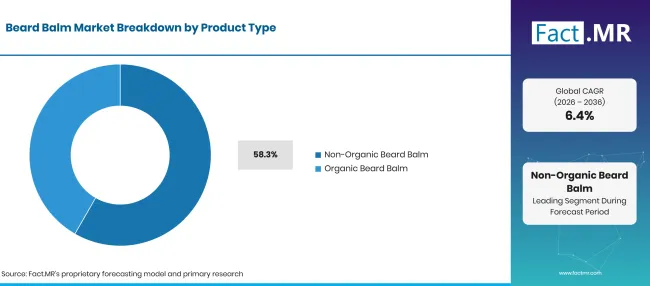
Factmr Beard Balm Market Breakdown Product Type | Source: Fact.MR
| Product Type | Share (2026) |
|---|---|
| Non-Organic Beard Balm (Leading segment) | 58.3% |
| Other segments combined | 41.7%* |
| Total | 100.0% |
Source: Fact.MR analysis. Updated Oct 23, 2026
Conventional beard balm costs less to make, as it can use refined waxes, mineral or synthetic oils and blended fragrance. These formulas keep a steady texture in hot and cold weather, which suits grocery and pharmacy shelves. Larger tins and value packs from mass brands often share shelves with other men’s personal care lines. Organic beard balm uses certified butters, oils and beeswax, and it carries a price premium. Buyers with sensitive skin or a clean-label preference drive this group. Small brands lead here, selling unscented and essential oil versions through their own websites.
What leads the Application segment?
Personal Use holds 54.2% of 2026 demand.
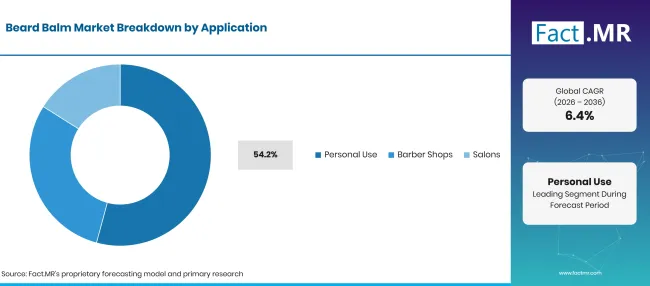
Factmr Beard Balm Market Breakdown Application | Source: Fact.MR
| Application | Share (2026) |
|---|---|
| Personal Use (Leading segment) | 54.2% |
| Other segments combined | 45.8%* |
| Total | 100.0% |
Source: Fact.MR analysis. Updated Oct 23, 2026
Men apply beard balm at home after washing, when the hair is damp and easy to shape. A small amount warmed between the palms softens coarse hair and tames flyaways for the day. Home users buy single tins and often keep two scents, one for work and one for evenings. Barber shops use balm as a finishing product and as a retail add-on. The U.S. Bureau of Labor Statistics counted about 75,800 barber jobs in 2025 and projected 3% employment growth for barbers from 2025 to 2035 [3]. Salons form a smaller channel, mainly through unisex grooming services that pair beard trims with hair styling products.
How does Distribution Channel shape demand?
Supermarkets/Hypermarkets move 31.4% of 2026 volume.
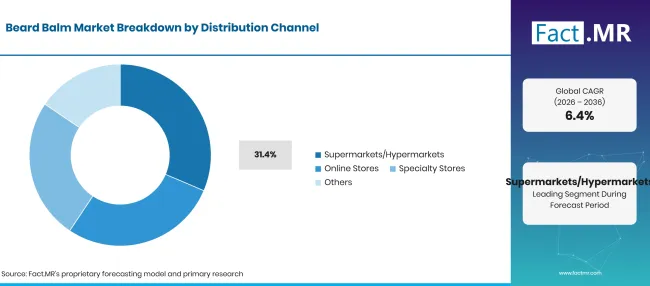
Factmr Beard Balm Market Breakdown Distribution Channel | Source: Fact.MR
| Distribution Channel | Share (2026) |
|---|---|
| Supermarkets/Hypermarkets (Leading segment) | 31.4% |
| Other segments combined | 68.6%* |
| Total | 100.0% |
Source: Fact.MR analysis. Updated Oct 23, 2026
Beard balm in supermarkets reaches men during a weekly grocery trip. Large stores give mass brands wide shelf space, and in-store promotions encourage trial at a low price. Grocery buyers favor sealed tins with clear scent and hold labels. Online stores serve buyers who want niche scents, subscriptions and bundles. Brand websites let small makers sell directly and collect reviews. Specialty stores, including barber supply shops and grooming boutiques, carry premium balms and give advice on use, often beside aftershave creams.
What supports Shea Butter within Ingredient Type?
Shea Butter takes 34.2% of 2026 sales.
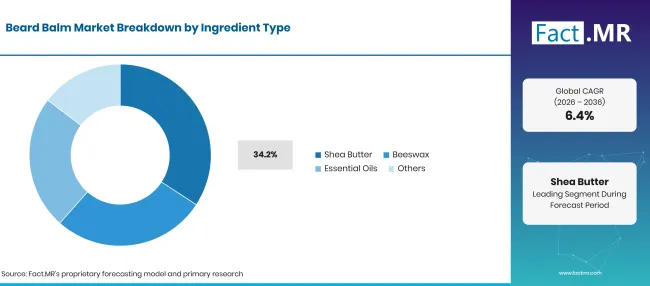
Factmr Beard Balm Market Breakdown Ingredient Type | Source: Fact.MR
| Ingredient Type | Share (2026) |
|---|---|
| Shea Butter (Leading segment) | 34.2% |
| Other segments combined | 65.8%* |
| Total | 100.0% |
Source: Fact.MR analysis. Updated Oct 23, 2026
Formulators choose shea butter to soften coarse hair, and it melts at skin temperature so the balm spreads without drag. Its fatty acids also condition the skin under the beard. West African shea is traded as one of several specialty fats and oils used in cosmetics and food. Beeswax gives balm its hold and keeps the product firm in the tin. The U.S. Department of Agriculture reported that honey production in the United States fell 14% to 116 million pounds in 2025, with 2.41 million colonies producing honey [4]. Cosmetic makers that use beeswax often track these honey figures. Cedarwood, sandalwood and citrus essential oils provide scent and are a main point of brand difference.
What is accelerating Beard Balm Market adoption, and what is holding it back?
Adoption will grow with beard-wearing habits, demand for natural ingredients and easy online reordering. Price pressure in mass channels, swings in beeswax supply and a shift toward short stubble that needs no balm will slow gains.
Drivers Impact Analysis
| DRIVER | (~) % IMPACT ON CAGR | GEOGRAPHIC RELEVANCE | IMPACT TIMELINE |
|---|---|---|---|
| Growing number of men keeping medium and long beards | +1.5% | North America, Western Europe, Latin America | Short term (<= 2 years) |
| Rising household spend on men’s grooming products | +1.2% | North America, Western Europe | Medium term (2-4 years) |
| Online and direct-to-consumer sales by grooming brands | +1.0% | Global | Short term (<= 2 years) |
| Shopper preference for natural butters, waxes and plant oils | +0.8% | Western Europe, North America | Medium term (2-4 years) |
| Barbershop finishing services and retail at the chair | +0.6% | North America, Western Europe, East Asia | Long term (>= 4 years) |
Source: Fact.MR analysis. Updated Oct 23, 2026
Opportunity Impact Analysis
| OPPORTUNITY | (~) % IMPACT ON CAGR | GEOGRAPHIC RELEVANCE | IMPACT TIMELINE |
|---|---|---|---|
| Certified organic and unscented balms for sensitive skin | +0.9% | Western Europe, North America | Medium term (2-4 years) |
| Gift sets and subscription refills sold online | +0.7% | Global | Short term (<= 2 years) |
| Vegan balms using plant waxes in place of beeswax | +0.5% | Western Europe | Long term (>= 4 years) |
Source: Fact.MR analysis. Updated Oct 23, 2026
Restraints Impact Analysis
| RESTRAINT | (~) % IMPACT ON CAGR | GEOGRAPHIC RELEVANCE | IMPACT TIMELINE |
|---|---|---|---|
| Price swings in shea butter and beeswax | -0.6% | Global | Short term (<= 2 years) |
| Shift toward short stubble and clean-shaven styles | -0.5% | East Asia, Western Europe | Medium term (2-4 years) |
| Low-cost private label balms in mass retail | -0.4% | North America, Western Europe | Long term (>= 4 years) |
Source: Fact.MR analysis. Updated Oct 23, 2026
Which countries are scaling the Beard Balm Market through 2036?
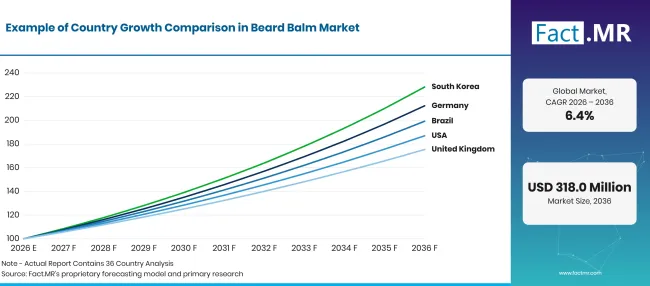
Factmr Beard Balm Market Growth Index | Source: Fact.MR
| Country | CAGR (2026 to 2036) |
|---|---|
| Germany | 7.8% |
| Brazil | 7.1% |
| United States | 6.5% |
| United Kingdom | 5.8% |
| Japan | 5.1% |
Source: Fact.MR analysis. Updated Oct 23, 2026
What supports Germany’s adoption?
7.8% CAGR, driven by quick online growth and a dense drugstore network.
Beard care products in Germany sell through drugstores, supermarkets and online shops. Destatis reported that internet and mail-order retail turnover rose 10.1% in real terms in 2025, against 2.7% for retail overall [5]. German shoppers read ingredient lists closely, which helps natural and organic balm brands. Drugstore chains stock own-label beard ranges next to imported brands.
How is Brazil scaling demand?
7.1% CAGR, backed by rising sales in pharmacies and perfume stores.
Brazilian men buy grooming products mainly in pharmacies and perfumeries. IBGE reported that retail sales of pharmaceutical, medical, orthopedic and perfumery articles grew 4.5% in 2025, while total retail sales rose 1.6% [6]. Barbershops are common in Brazilian cities, and many sell balms and oils at the counter. Local brands favor lighter textures that suit a hot climate.
What supports United States adoption?
6.5% CAGR, helped by a large e-commerce channel and steady personal care spending.
American beard grooming is served by many small direct-to-consumer brands. The U.S. Census Bureau estimated that e-commerce represented 17.1% of total retail sales in the second quarter of 2026, at USD 340.2 billion [7]. Big-box chains and drugstores carry mass brands, while craft balms in many scents sell through brand websites. Barbershops in large cities add retail sales of balm and oil.
How is the United Kingdom developing demand?
5.8% CAGR, reflecting a high online share of retail sales.
UK beard balm buyers shop online more than most European consumers. The Office for National Statistics reported that online sales accounted for 28.8% of all retail sales in Great Britain in August 2026 [8]. In a separate release, ONS reported that UK households spent an average of GBP 676.60 per week in the financial year ending March 2025 [9]. Grooming budgets compete with high living costs, which favors mid-priced balms.
How does Japan perform?
5.1% CAGR, as a dense barbershop network serves male grooming needs.
Japanese grooming habits lean toward a clean-shaven look, so beard balm remains a niche bought mainly by younger men online. The Ministry of Health, Labour and Welfare counted 107,995 barbershops at the end of fiscal 2024, down 2.1% from a year earlier [10]. Household spending rose modestly, with average monthly consumption of 314,001 yen for households of two or more people in 2025, up 0.9% in real terms [11]. Imported brands reach buyers through online marketplaces.
Who leads the Beard Balm Market?
Competition in beard balm splits into three groups. Mass brands such as Cremo sell balm alongside beard oil, wash and softener in grocery and drugstore chains, where price and scent range drive trial. Direct-to-consumer brands compete on formula and community. Beardbrand updated its balm usage guide in September 2026, naming shea butter, mango seed butter and beeswax as main ingredients [12].
Badass Beard Care described balm in February 2026 as a conditioner with wax for light to medium hold [13]. Honest Amish, Mountaineer Brand and Grave Before Shave offer several balm formulas, from heavy-duty to unscented. Smaller makers such as Smooth Viking and Seven Potions sell their balms online in the United States and the United Kingdom. Traceable ingredients, a choice of hold levels and strong online reviews will decide which brands gain share.
Which companies are the key providers?
Key companies include Beardbrand; Cremo; Honest Amish; Badass Beard Care; Grave Before Shave; Mountaineer Brand; Smooth Viking; and Seven Potions.
- Beardbrand
- Cremo
- Honest Amish
- Badass Beard Care
- Grave Before Shave
- Mountaineer Brand
- Smooth Viking
- Seven Potions
Bibliography
- [1] U.S. Bureau of Labor Statistics. (2025, December 19). Consumer Expenditures News Release: 2024 A01 Results.
- [2] Eurostat. (2026, February). E-commerce statistics for individuals.
- [3] U.S. Bureau of Labor Statistics. (2026, August 27). Barbers, Hairstylists, and Cosmetologists: Occupational Outlook Handbook.
- [4] U.S. Department of Agriculture, National Agricultural Statistics Service. (2026, March 13). Honey.
- [5] Statistisches Bundesamt (Destatis). (2026, February 2). Einzelhandelsumsatz im Jahr 2025 real um 2,7 % höher als im Vorjahr [Retail turnover in 2025 up 2.7% in real terms on the previous year].
- [6] Instituto Brasileiro de Geografia e Estatística (IBGE). (2026, February 13). Vendas no comércio variam -0,4% em dezembro e fecham 2025 em 1,6% [Retail sales change -0.4% in December and close 2025 at 1.6%].
- [7] U.S. Census Bureau. (2026, August 18). Quarterly Retail E-Commerce Sales, 2nd Quarter 2026.
- [8] Office for National Statistics. (2026, September 18). Retail sales, Great Britain: August 2026.
- [9] Office for National Statistics. (2026, June 11). Family spending in the UK: April 2024 to March 2025.
- [10] Ministry of Health, Labour and Welfare, Japan. (2025, October 21).[Summary of the Report on Public Health Administration and Services, FY2024].
- [11] Statistics Bureau of Japan. (2026). 2025[Overview of household finances, 2025].
- [12] Beardbrand. (2026, September 10). Top 11 Ways to Use Beard Balm.
- [13] Badass Beard Care. (2026, February 9). Beard Oil vs Beard Balm vs Beard Butter Made Simple.
This Report Answers
- How much will beard balm revenue grow between 2026 and 2036, and which uses add the most value?
- Which product type, application, channel and ingredient lead their segments in 2026?
- Why do Germany, Brazil, the United States, the United Kingdom and Japan grow at different rates?
- Which beard care brands sell balm today, and how do mass and direct-to-consumer sellers differ?
- How do shea butter and beeswax supply shape formulas and prices?
What does the Beard Balm Market cover?
Beard balms sold in tins, jars and sticks fall within this study, whether scented or unscented. Standard, heavy-duty and organic formulas are all counted.
Demand is tracked for home users, barber shops and salons. Sales through supermarkets, online stores, specialty stores and other outlets are measured at the value received by brand owners.
What is included in the scope?
Balms marketed for beards and mustaches are in scope, including multi-use balms sold for beard, hair and tattoo care. Professional tins sold through barber supply wholesalers are also counted.
Gift kits count at the value of the balm they contain. Lotions, face washes and other natural skin care products packed in the same kit are left out.
What is excluded from the scope?
Beard oils, beard washes and wax-free beard butters are excluded. Shaving creams, aftershaves and trimming tools fall outside the revenue boundary.
Bulk shea butter, beeswax and essential oils sold before blending are also excluded.
How Was the Analysis Built?
The analysis draws on 120+ sources, 35+ company portfolios, 25+ countries, and more than 20 industry interviews.
- Primary Research: Primary research includes discussions with manufacturers, service providers, technology developers, distributors, end users, and subject-matter experts. These conversations examine purchasing priorities, product adoption, operational challenges, approval requirements, competitive positioning, and the factors that influence wider market acceptance.
- Desk Research: Desk research covers government statistics, regulatory publications, company filings, trade data, technical studies, industry associations, standards, public policy, and other authoritative sources. Every source used in the analysis is documented in the bibliography.
- Market Sizing and Forecasting: Market estimates combine historical performance, demand indicators, pricing and volume trends, segment shares, company participation, country-level growth, adoption patterns, investment activity, and barriers to market expansion.
- Data Validation and Update Cycle: Findings are validated by comparing primary interviews with public data, company activity, regulatory changes, trade patterns, and industry developments. Regular updates review new product launches, capacity changes, partnerships, approvals, and shifts in commercial adoption.
Segmentation
What is the report’s scope and coverage?
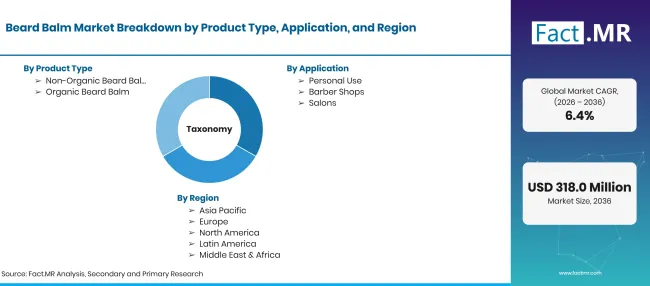
Factmr Beard Balm Market Taxonomy | Source: Fact.MR
| Attribute | Details |
|---|---|
| Quantitative Units | USD million in 2026 to USD million by 2036 at CAGR |
| Market Definition | Solid and semi-solid leave-in beard conditioners that combine butters, oils and waxes to soften, condition and shape facial hair. Sales are measured at brand-owner level across retail, online and professional channels. |
| Product Type | Non-Organic Beard Balm; Organic Beard Balm |
| Application | Personal Use; Barber Shops; Salons |
| Distribution Channel | Supermarkets/Hypermarkets; Online Stores; Specialty Stores; Others |
| Ingredient Type | Shea Butter; Beeswax; Essential Oils; Others |
| Regions Covered | North America; Latin America; Western Europe; Eastern Europe; East Asia; South Asia & Pacific; Middle East & Africa |
| Countries Covered | Germany; Brazil; United States; United Kingdom; Japan |
| Companies Profiled | Beardbrand; Cremo; Honest Amish; Badass Beard Care; Grave Before Shave; Mountaineer Brand; Smooth Viking; Seven Potions |
| Forecast Period | 2026 to 2036 |
| Approach | Bottom-up sizing from bearded male users, balm use per month and average tin price, checked top-down against grooming spend and channel sales by country. |
Source: Fact.MR analysis. Updated Oct 23, 2026
How is the market segmented?
-
By Product Type
- Non-Organic Beard Balm
- Organic Beard Balm
-
By Application
- Personal Use
- Barber Shops
- Salons
-
By Distribution Channel
- Supermarkets/Hypermarkets
- Online Stores
- Specialty Stores
- Others
-
By Ingredient Type
- Shea Butter
- Beeswax
- Essential Oils
- Others
-
By Region
- North America
- Latin America
- Western Europe
- Eastern Europe
- East Asia
- South Asia & Pacific
- Middle East & Africa
Frequently Asked Questions
How big is the beard balm market in 2026?
What is the CAGR of the beard balm market from 2026 to 2036?
Which product type leads the beard balm market?
Which application leads the beard balm market?
Which distribution channel leads the beard balm market?
Which ingredient type leads the beard balm market?
Which country will grow the most in the beard balm market?
Who are the main companies in the beard balm market?
Who worked on this report


Preview the report firsthand - request a free sample
Free SampleGet the brochure for pricing and purchase details
Download PDF