Beer Market

Beer Market Size and Share Forecast Outlook 2025 to 2035

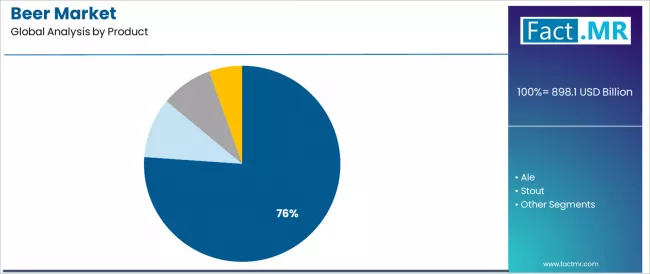
Beer market is projected to grow from USD 898.1 billion in 2025 to USD 1,767.4 billion by 2035, at a CAGR of 7.0%. Lager will dominate with a 76.1% market share, while bottles will lead the packaging segment with a 45.7% share.

Beer Market Forecast and Outlook 2025 to 2035

The global beer market is projected to reach USD 1,767.4 billion by 2035, recording an absolute increase of USD 869.3 billion over the forecast period. The market is valued at USD 898.1 billion in 2025 and is set to rise at a CAGR of 7.0% during the assessment period. The overall market size is expected to grow by 2.0 times during the same period, supported by increasing demand from emerging market consumers and expanding applications in premium beer segments across both developed and emerging beverage markets.

Quick Stats for Beer Market

  • Beer Market Value (2025): USD 898.1 billion
  • Beer Market Forecast Value (2035): USD 1,767.4 billion
  • Beer Market Forecast CAGR: 7.0%
  • Leading Product in Beer Market: Lager (76.1%)
  • Key Growth Regions in Beer Market: Asia Pacific, North America, Europe, and Latin America
  • Top Players in Beer Market: AB InBev, Heineken N.V., Carlsberg Breweries A/S, Molson Coors Beverage Company, Asahi Group Holdings Ltd., Diageo, China Resources Beer (Holdings) Company Limited, Boston Beer Co., Kirin Holdings Company Limited, Beijing Yanjing Beer Group Corporation

Beer Market Market Value Analysis

Growing application diversity in craft brewing operations, flavored beer innovations, and specialized alcoholic beverage experiences creates expanding opportunities for beer product innovation and specialized brand developments. Rising disposable income in Asia Pacific nations, coupled with expanding distribution capacity through modern retail infrastructure and organized distribution networks, further accelerate market penetration across diverse consumer segments.

The growing global demand for alcoholic beverages, particularly in social consumption and premium drinking occasions applications, generates sustained requirements for diverse beer styles and innovative product formulations.

Technical advancements in brewing technologies demonstrating measurable improvements in flavor consistency, production efficiency, and product shelf-life optimization reinforce manufacturer confidence in brewing economics, while beverage sector trends toward craft beer appreciation and premium product positioning expand addressable market opportunities beyond traditional mass-market lager applications into specialty brewing and artisanal beverage supply chains.

Breweries and beverage companies increasingly incorporate innovative beer formulations into product portfolios, brand positioning strategies, and consumer engagement programs, creating mainstream consumption channels that extend beyond traditional beer categories into experiential drinking environments.

Fluctuating raw material costs for barley and hops and stringent regulatory frameworks for alcohol taxation and consumption restrictions may pose challenges to market expansion. Health consciousness trends and preference shift toward low-alcohol alternatives in certain regions also influence consumption dynamics, requiring manufacturers to develop diversified product strategies catering to specific consumer preferences across different geographical markets.

Supply chain complexity during ingredient sourcing and the technical requirements for brewing quality control and distribution management may limit accessibility among smaller craft brewers in developing regions with limited infrastructure for advanced brewing equipment and cold chain logistics systems.

Beer Market Year-over-Year Forecast 2025 to 2035

Between 2025 and 2030, the beer market is projected to expand from USD 898.1 billion to USD 1,259.8 billion, resulting in a value increase of USD 361.7 billion, which represents 41.6% of the total forecast growth for the decade. This phase of development will be shaped by rising demand for premium beer products and craft brewing innovations, product diversification in flavored beer variants and low-alcohol formulations, as well as expanding integration with experiential consumption occasions and social drinking platforms. Companies are establishing competitive positions through investment in brewing capacity expansion, brand portfolio diversification capabilities, and strategic market penetration across emerging consumer segments, premium product categories, and craft beer enthusiast communities.

From 2030 to 2035, the market is forecast to grow from USD 1,259.8 billion to USD 1,767.4 billion, adding another USD 507.6 billion, which constitutes 58.4% of the overall ten-year expansion. This period is expected to be characterized by the expansion of specialized beer categories, including targeted flavor profiles and customized brewing techniques tailored for specific consumer preferences and cultural drinking traditions, strategic collaborations between multinational brewers and craft beer innovators, and an enhanced focus on sustainable brewing practices and environmental responsibility certifications. The growing emphasis on premiumization trends and experiential consumption will drive demand for innovative beer solutions across diverse consumer demographics.

Beer Market Key Takeaways

Metric Value
Market Value (2025) USD 898.1 billion
Market Forecast Value (2035) USD 1,767.4 billion
Forecast CAGR (2025-2035) 7.0%

Why is the Beer Market Experiencing Steady Growth?

The beer market grows by enabling breweries, beverage retailers, and hospitality operators to access diverse alcoholic beverage products that support consumer preferences while meeting demand for consistent quality standards. Brewing companies and distribution networks face mounting pressure to develop appealing beer offerings with proven taste profiles and brand positioning characteristics, with beer products typically providing accessible alcoholic content, social consumption compatibility, and cultural drinking tradition alignment essential for consumer acceptance, making these beverages indispensable for competitive market positioning in mainstream lager, premium craft beer, and specialty brewing categories.

The beverage industry's need for reliable product supply and consistent quality characteristics creates demand for diverse beer styles that can provide superior taste experiences, maintain predictable brewing consistency across different production batches, and ensure consumer satisfaction without compromising production economics or brand equity. Government initiatives promoting responsible drinking programs and regulated alcohol distribution frameworks drive structured consumption in licensed establishments, retail outlets, and controlled distribution channels, where beer product availability has a direct impact on consumer choice outcomes and market accessibility.

The hospitality sector's growing focus on premium beverage offerings and craft beer selection further expands market opportunities, with consumer research demonstrating measurable preference trends toward artisanal brewing, including enhanced flavor complexity and authentic brand storytelling. However, supply chain complexity during agricultural ingredient sourcing and the technical requirements for brewing operations and quality assurance processes may limit accessibility among smaller craft breweries and developing regions with limited infrastructure for advanced brewing facilities and distribution networks.

Segmental Analysis

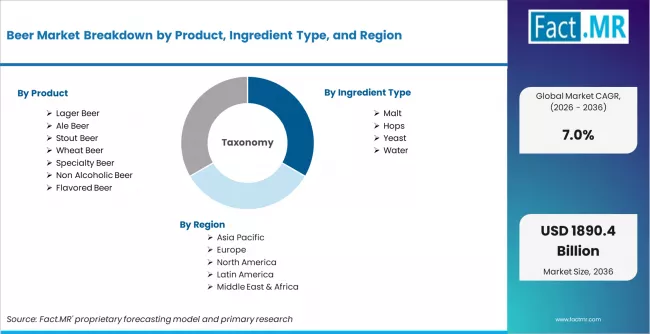
The market is segmented by product, packaging, production, distribution channel, and region. By product, the market is divided into ale, lager, stout, and others. By packaging, the market includes bottles, cans, and others.

By production, the market comprises macro brewery, micro brewery, and craft brewery. By distribution channel, the market consists of on-trade and off-trade. Regionally, the market is divided into Asia Pacific, North America, Europe, Latin America, and Middle East & Africa.

What Makes Lager the Dominant Product Segment in the Beer Market?

Beer Market Analysis By Product

The lager segment represents the dominant force in the beer market, capturing 76.1% of the total market share in 2025. This established product category encompasses solutions featuring mainstream brewing characteristics for mass-market consumption, accessible taste profiles, and universal consumer appeal, including pilsner-style lagers that enable crisp flavor delivery, cold-temperature serving preferences, and cost-effective production across all beer manufacturing environments.

Lager’s market leadership stems from its essential role in everyday beer consumption, with lager styles capable of meeting diverse consumer preferences while maintaining economical production and broad distribution reliability across all beverage retail environments. Within the lager segment, pale lager varieties account for the largest consumption share, driven by established drinking traditions and continuous demand for accessible beer products across global consumer markets.

Key advantages driving the lager segment include:

  • Established brewing infrastructure with large-scale production facilities that reduce manufacturing complexity and ensure consistent product availability
  • Universal taste appeal allowing broad consumer acceptance across different demographic segments without significant market barriers
  • Proven distribution compatibility, delivering reliable product consistency while maintaining competitiveness against specialty beer alternatives
  • Broad retail acceptance enabling straightforward product placement and promotional strategies across multiple distribution channels

Which Packaging Format Commands Market Leadership?

Beer Market Analysis By Packaging

Bottles dominate the beer market’s packaging category with a 45.7% share in 2025, driven by extensive adoption in retail distribution, premium product positioning, and traditional consumption preferences across global markets. This packaging format benefits from established consumer familiarity, perceived quality associations with glass containers, and versatile serving applications across diverse consumption occasions.

Within this segment, standard glass bottles and premium bottle formats represent substantial packaging consumption, reflecting continuous retail distribution requirements and established consumer purchasing behaviors across beverage markets.

The cans segment captures significant market share, serving convenience-oriented consumers, outdoor consumption occasions, and cost-effective packaging applications requiring portable container solutions. This category addresses on-the-go drinking scenarios, sporting event consumption, and value-conscious purchasing where aluminum packaging enables lightweight transportation and efficient distribution logistics.

What are the Drivers, Restraints, and Key Trends of the Beer Market?

The market is driven by three concrete demand factors tied to consumer lifestyle and economic development. First, increasing disposable income and urbanization trends create growing demand for alcoholic beverage consumption, with global beer consumption expanding by 3-5% annually in emerging markets worldwide, requiring comprehensive distribution infrastructure. Second, expanding craft beer culture and premiumization preferences drive increased adoption of specialty brewing products, with many consumers implementing taste exploration programs for artisanal beer discovery and premium beverage experiences by 2030. Third, technological advancements in brewing automation and flavor innovation techniques enable more effective product differentiation that reduces production costs while improving taste consistency and brand positioning capabilities.

Market restraints include health consciousness trends and alcohol consumption moderation movements that can deter beer consumption among wellness-focused demographics, particularly in regions where lifestyle changes face significant consumer adoption or public health campaign influence. Regulatory restrictions including alcohol taxation and advertising limitations pose another significant challenge, as government policies generate cost increases and marketing constraints, potentially causing consumption reduction and market access barriers. Competition from alternative alcoholic beverages including wine, spirits, and hard seltzers creates additional market dynamics for consumer preference, demanding ongoing investment in product innovation and brand differentiation programs.

Key trends indicate accelerated craft beer adoption in developed markets, particularly USA and Europe, where consumer sophistication and brewing culture appreciation drive comprehensive artisanal product implementation. Product innovation trends toward low-alcohol and non-alcoholic beer variants with health-conscious positioning, functional ingredient additions, and flavor innovation enable expanded consumer appeal approaches that address wellness concerns while maintaining beer category engagement. However, the market thesis could face disruption if significant regulatory restrictions emerge or major shifts in consumer alcohol preferences reduce reliance on traditional beer consumption patterns.

Analysis of the Beer Market by Key Countries

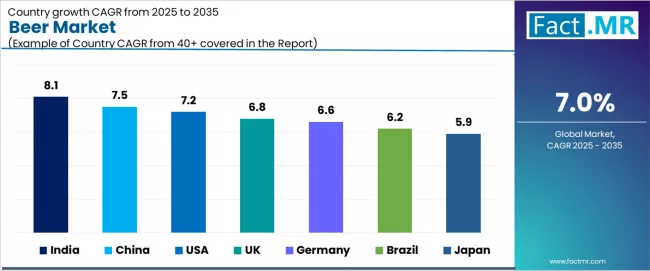
Beer Market Cagr Analysis By Country

Country CAGR (2025-2035)
India 8.1%
China 7.5%
USA 7.2%
UK 6.8%
Germany 6.6%
Brazil 6.2%
Japan 5.9%

The beer market is expanding steadily, with India leading at an 8.1% CAGR through 2035, driven by rising disposable income expansion, growing urban population demographics, and increasing social drinking acceptance across younger consumers. China follows at 7.5%, supported by massive consumer base, premium beer segment growth, and accelerated demand from middle-class expansion.

USA records 7.2%, reflecting craft beer innovation leadership and premium product category development across diverse markets. UK posts 6.8%, anchored by established pub culture and specialty beer appreciation with growing craft brewery presence. Germany grows at 6.6%, with traditional brewing heritage and premium beer market positioning. Brazil advances at 6.2%, emphasizing expanding middle class and social consumption growth, while Japan grows steadily at 5.9%, focusing on mature market premiumization and product innovation strategies.

India Leads Global Market Expansion

India demonstrates the strongest growth potential in the beer market with a CAGR of 8.1% through 2035. The country's leadership position stems from rapid economic development, expanding urban middle class, and increasing social acceptance of alcohol consumption enabling mainstream beer market growth.

Growth is concentrated in major metropolitan regions, including Delhi NCR, Mumbai, Bangalore, and Hyderabad, where urbanization trends and expanding retail infrastructure are implementing modern beer distribution for enhanced consumer access and premium product availability.

Distribution channels through modern retail outlets, organized hospitality establishments, and licensed specialty stores expand deployment across urban consumers and young professional demographics. The country's economic liberalization provides market support for beverage industry development, including gradual regulatory reforms for alcohol distribution.

Key market factors:

  • Consumer demand concentrated in urban centers and young professional populations with growing disposable income
  • Retail infrastructure development through modern trade expansion and organized distribution networks
  • Comprehensive hospitality ecosystem, including expanding restaurant sector with proven alcohol service capabilities
  • Product innovation featuring premium beer introductions, craft brewing initiatives, and flavor diversification strategies

China Emerges as Premium Market

In major urban centers including Beijing, Shanghai, Guangzhou, and Shenzhen, the consumption of premium beer products is accelerating across upscale establishments and modern retail channels, driven by middle-class expansion and quality preference evolution. The market demonstrates strong growth momentum with a CAGR of 7.5% through 2035, linked to economic development trajectory, premiumization consumption trends, and sustained urbanization growth.

Chinese consumers are implementing premium beer selection strategies and brand-conscious purchasing behaviors to enhance lifestyle experiences while meeting social consumption preferences in expanding hospitality markets and retail distribution networks. The country's economic prosperity creates persistent demand for quality alcoholic beverages, while increasing emphasis on international brand access drives adoption of imported beer products and premium domestic brewing innovations.

Key development areas:

  • Urban consumer segments and premium hospitality venues leading beer consumption with quality-focused preferences
  • E-commerce platforms providing efficient product access with extensive digital distribution infrastructure
  • Brand partnerships between international brewers and domestic distributors are expanding market penetration
  • Integration of premium positioning strategies and comprehensive consumer engagement programs

USA Shows Craft Beer Leadership

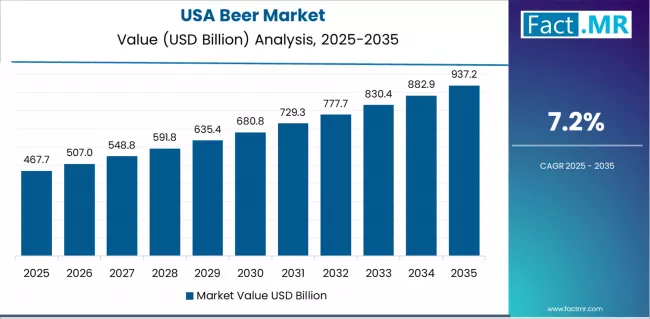
Beer Market Country Value Analysis

USA's market expansion is driven by craft beer innovation, including artisanal brewing operations across regional markets and specialty product development in major metropolitan areas. The country demonstrates solid growth potential with a CAGR of 7.2% through 2035, supported by established craft brewing culture, diverse consumer preferences, and growing appreciation for beer quality and authenticity.

American consumers face abundant craft beer selection and innovative brewing techniques, driving investment in brewery experiences and specialty product consumption supported by robust hospitality infrastructure. However, expanding craft brewery networks and premium product segments create compelling consumption cases for beer market growth, particularly in regions where beverage innovation has direct impact on consumer engagement and brand loyalty.

Key market characteristics:

  • Craft breweries and specialty beer segments showing sustained growth with substantial consumer enthusiasm
  • Regional brewing trends focused on local production and authentic brand storytelling
  • Future projections indicate the need for continued innovation and sustainable brewing practices
  • Growing emphasis on experiential consumption and brewery tourism across beer markets

UK Demonstrates Traditional Market Strength

The UK market maintains established position in beer consumption based on integration with pub culture traditions and comprehensive hospitality infrastructure for social drinking occasions. The country shows steady potential with a CAGR of 6.8% through 2035, driven by deep-rooted drinking traditions, strong pub network presence, and expanding craft beer appreciation across England, Scotland, Wales, and Northern Ireland.

The consumers are adopting craft beer varieties and premium ale selections, particularly in regions with sophisticated beer appreciation culture and specialized applications demanding quality brewing standards. Distribution channels through traditional pubs, modern bars, and retail supermarkets expand coverage across diverse consumer segments and consumption occasions.

Leading market segments:

  • Pub establishments and craft beer venues implementing comprehensive product selection strategies
  • Premium positioning supporting quality beer adoption with growing consumer discernment
  • Brewing innovation between traditional brewers and craft beer entrepreneurs are expanding product diversity
  • Focus on sustainability initiatives and local brewing methodologies

Germany Emphasizes Brewing Heritage

In major beer regions including Bavaria, North Rhine-Westphalia, Baden-Württemberg, and Lower Saxony, breweries and beer gardens are maintaining traditional brewing excellence while adapting to contemporary consumer preferences, with documented brewing heritage showing centuries of quality beer production through established brewing techniques and cultural beer appreciation. The market shows steady growth potential with a CAGR of 6.6% through 2035, linked to renowned brewing tradition, quality production standards, and ongoing beer culture preservation across major regions.

German brewers are maintaining traditional brewing methods and quality assurance protocols while introducing contemporary variations to enhance market relevance while preserving cultural brewing heritage demanded by domestic consumers and international beer enthusiasts. The country's beer purity law framework creates quality assurance for traditional brewing, supporting authentic product positioning across domestic and export markets.

Market development factors:

  • Traditional breweries and beer culture establishments leading consumption across Germany
  • Quality standards and brewing regulations providing framework for authentic beer production
  • Export relationships between German brewers and international markets are expanding brand recognition
  • Emphasis on brewing heritage and traditional production methodologies

Brazil Shows Social Consumption Growth

Brazil's beer market demonstrates vibrant positioning focused on social consumption culture and expanding middle-class purchasing power, with documented consumption patterns showing substantial beer demand across social gatherings, achieving mainstream beverage status through accessible pricing and cultural drinking traditions in major urban centers.

The country maintains solid growth momentum with a CAGR of 6.2% through 2035, driven by large population demographics, warm climate supporting year-round consumption, and cultural emphasis on social beer drinking. Social occasions and informal gatherings showcase beer consumption patterns where affordable products support widespread accessibility and comprehensive market penetration programs.

Key market characteristics:

  • Mass-market consumers and social consumption occasions driving beer demand with emphasis on affordability and accessibility
  • Distribution networks enabling comprehensive market coverage with extensive retail infrastructure
  • Brewing capacity expansion between major brewers and regional producers is supporting market growth
  • Emphasis on value positioning and mainstream consumption methodologies

Japan Shows Mature Market Innovation

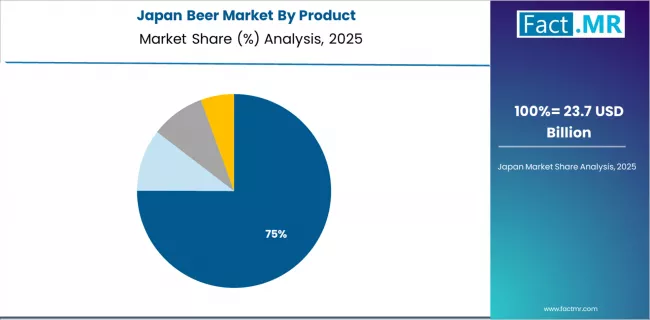
Beer Market Japan Market Share Analysis By Product

Japan's beer market demonstrates sophisticated landscape, characterized by established consumption patterns and continuous product innovation across premium beer categories and specialty brewing applications. The country shows steady growth momentum with a CAGR of 5.9% through 2035, driven by mature market dynamics requiring innovation for growth stimulation in developed consumer environment.

Japan's emphasis on quality excellence and product refinement creates requirements for premium beer formulations that support discerning consumer preferences and established quality expectations in beverage consumption. The market benefits from strong relationships between major brewers and distribution networks, creating comprehensive retail ecosystems that prioritize product quality and brand reputation. Urban consumption occasions and hospitality establishments showcase premium beer implementations where product quality achieves high consumer standards through integrated brand programs.

Key market characteristics:

  • Urban consumers and hospitality establishments driving premium beer consumption with emphasis on quality and innovation
  • Product development partnerships enabling continuous innovation with comprehensive market research
  • Brewing collaboration between major brewers and craft beer innovators is expanding product diversity
  • Emphasis on premiumization and product differentiation methodologies

Europe Market Split by Country

Beer Market Europe Country Market Share Analysis, 2025 & 2035

The beer market in Europe is projected to grow from USD 179.6 billion in 2025 to USD 353.5 billion by 2035, registering a CAGR of 7.0% over the forecast period. Germany is expected to maintain its leadership position with a 28.9% market share in 2025, supported by its renowned brewing tradition, comprehensive beer culture infrastructure, and strong domestic consumption across major brewing regions.

UK follows with a 21.4% share in 2025, driven by established pub culture and craft beer market expansion. France holds a 15.8% share in 2025 through its growing beer consumption trends and hospitality sector development. Spain commands a 12.6% share, while Rest of Europe accounts for 21.3% in 2025.

By 2035, Germany is projected to hold 28.5% share, UK 21.7%, France 16.1%, Spain 12.8%, and Rest of Europe 20.9%, reflecting sustained growth momentum across all major European markets and increasing beer consumption in diversified mainstream, premium, and craft beer segments implementing comprehensive brand positioning and consumer engagement programs.

Competitive Landscape of the Beer Market

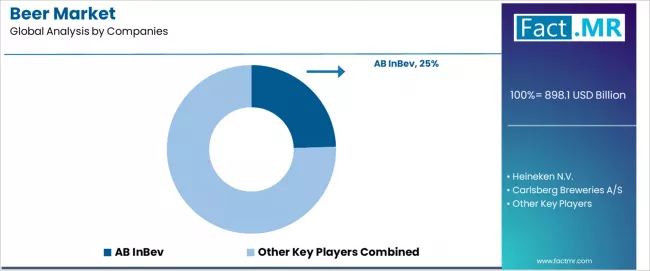
Beer Market Analysis By Company

The beer market features approximately 15-20 major multinational players alongside thousands of regional and craft brewers with moderate concentration, where the top three companies control roughly 50-60% of global production volume through established brewing operations and extensive distribution relationships across mainstream and premium beer sectors.

Market leaders include AB InBev, Heineken N.V., and Carlsberg Breweries A/S, which maintain competitive advantages through comprehensive global brand portfolios, extensive distribution networks, and deep expertise in the brewing and beverage sectors, creating strong relationships among retailers and hospitality operators.

These companies leverage established production facilities and ongoing brand acquisition strategies to defend market positions while expanding into adjacent premium beer segments and craft brewing partnerships. AB InBev commands a 24.5% market share through integrated brewing operations and strategic positioning across global beer markets.

Challengers encompass Molson Coors Beverage Company, Asahi Group Holdings Ltd., and China Resources Beer (Holdings) Company Limited, which compete through diversified product portfolios and strong regional presence in key consumption markets.

Regional and craft brewers, including Boston Beer Co., Kirin Holdings Company Limited, and Beijing Yanjing Beer Group Corporation, focus on specific geographical regions or specialty segments, offering differentiated capabilities in local brand strength, craft brewing authenticity, and consumer engagement strategies.

Thousands of craft breweries and regional producers create vibrant competitive dynamics through innovative brewing approaches and localized market positioning, particularly in high-growth markets including USA and China, where consumer preferences support craft beer appreciation and premium product adoption.

Market dynamics favor companies that combine efficient brewing operations with comprehensive brand management systems that address the complete value chain from ingredient sourcing through production operations and retail distribution delivery. Strategic investments in sustainable brewing practices and premiumization initiatives enable differentiation and market positioning across evolving consumer preferences.

Global Beer Market - Stakeholder Contribution Framework

Beer products represent a foundational alcoholic beverage that enables consumers, hospitality operators, and social occasions to access culturally significant drinks that support social interaction without requiring complex preparation, typically providing essential refreshment functionality and social consumption facilitation while supporting diverse cultural traditions.

With the market projected to grow from USD 898.1 billion in 2025 to USD 1,767.4 billion by 2035 at a 7.0% CAGR, these products offer compelling advantages - accessible consumption experience, diverse flavor profiles, and cultural significance - making them essential for mainstream lager consumption (largest segment), premium craft beer appreciation (expanding adoption), and diverse social drinking occasions seeking authentic beverage experiences. Scaling production capacity and market development requires coordinated action across regulatory frameworks, responsible consumption initiatives, brewing companies, distribution networks, and industry associations.

How Governments Could Spur Responsible Market Development?

  • Regulatory Framework & Licensing: Implement balanced alcohol policies supporting responsible consumption while enabling market access, providing clear licensing requirements for production and distribution facilities, and establishing fair taxation frameworks that balance public health objectives with industry sustainability.
  • Responsible Consumption Programs: Create comprehensive public awareness campaigns promoting moderate drinking behaviors, provide funding for alcohol education initiatives targeting youth populations, and develop drunk driving prevention programs supporting public safety objectives.
  • Industry Development & Support: Include craft brewing sector in economic development strategies, providing small business support for microbreweries and local producers, and establish favorable regulatory environments supporting brewing innovation and entrepreneurship.
  • Quality Standards & Enforcement: Fund food safety oversight programs ensuring brewing quality and product safety, establish clear labeling requirements protecting consumer information rights, and implement effective enforcement mechanisms maintaining market integrity and consumer protection.

How Industry Bodies Could Support Market Development?

  • Quality Standards & Best Practices: Define standardized brewing quality specifications across lager, ale, and specialty beer categories, establish universal safety protocols and production standards, and create voluntary certification programs for brewing excellence that consumers recognize.
  • Responsible Marketing & Communication: Lead industry initiatives promoting responsible drinking messages, emphasizing moderate consumption practices and designated driver programs, while supporting authentic brand storytelling and cultural beer appreciation education.
  • Sustainability Standards: Develop environmental performance benchmarks for brewing operations, comprehensive water conservation methodologies, and responsible ingredient sourcing practices, ensuring sustainable production across different brewery scales and operational environments.

How Manufacturers and Distributors Could Strengthen the Ecosystem?

  • Product Innovation & Quality: Develop next-generation brewing techniques with enhanced flavor consistency, improved production efficiency, and sustainability-optimized features that enhance beer quality while reducing environmental impact and production costs.
  • Distribution Excellence & Service: Provide comprehensive cold chain management ensuring product freshness, implement effective merchandising support maximizing retail visibility, and develop point-of-sale education programs enabling informed consumer choices and responsible consumption.
  • Market Access & Responsibility: Offer responsible pricing strategies supporting moderate consumption patterns, establish comprehensive age verification programs preventing underage access, and develop partnership initiatives supporting hospitality operators in promoting responsible drinking environments.

Key Players in the Beer Market

  • AB InBev
  • Heineken N.V.
  • Carlsberg Breweries A/S
  • Molson Coors Beverage Company
  • Asahi Group Holdings, Ltd.
  • Diageo
  • China Resources Beer (Holdings) Company Limited
  • Boston Beer Co.
  • Kirin Holdings Company, Limited
  • Beijing Yanjing Beer Group Corporation

Scope of the Report

Items Values
Quantitative Units USD 898.1 Billion
Product Ale, Lager, Stout, Others
Packaging Bottles, Cans, Others
Production Macro Brewery, Micro Brewery, Craft Brewery
Distribution Channel On-Trade, Off-Trade
Regions Covered Asia Pacific, North America, Europe, Latin America, Middle East & Africa
Country Covered India, China, USA, UK, Germany, Brazil, Japan, and 40+ countries
Key Companies Profiled AB InBev, Heineken N.V., Carlsberg Breweries A/S, Molson Coors Beverage Company, Asahi Group Holdings Ltd., Diageo, China Resources Beer (Holdings) Company Limited, Boston Beer Co., Kirin Holdings Company Limited, Beijing Yanjing Beer Group Corporation
Additional Attributes Dollar sales by product categories, packaging format trends across bottles and cans, production analysis with macro and craft breweries, distribution channel patterns in on-trade and off-trade segments, competitive landscape with global brewing companies and craft beer innovators, flavor profiles and brewing specifications, integration with hospitality establishments and retail distribution networks.

Beer Market by Segments

  • Product :

    • Ale
    • Lager
    • Stout
    • Others
  • Packaging :

    • Bottles
    • Cans
    • Others
  • Production :

    • Macro Brewery
    • Micro Brewery
    • Craft Brewery
  • Distribution Channel :

    • On-Trade
    • Off-Trade
  • Region :

    • Asia Pacific
      • China
      • Japan
      • South Korea
      • India
      • Australia & New Zealand
      • ASEAN
      • Rest of Asia Pacific
    • North America
      • USA
      • Canada
      • Mexico
    • Europe
      • Germany
      • UK
      • France
      • Spain
      • Rest of Europe
    • Latin America
      • Brazil
      • Rest of Latin America
    • Middle East & Africa
      • Kingdom of Saudi Arabia
      • Other GCC Countries
      • Turkey
      • South Africa
      • Rest of Middle East & Africa

Table of Content

  1. Executive Summary
    • USA Market Outlook
    • Demand to side Trends
    • Supply to side Trends
    • Technology Roadmap Analysis
    • Analysis and Recommendations
  2. Market Overview
    • Market Coverage / Taxonomy
    • Market Definition / Scope / Limitations
  3. Market Background
    • Market Dynamics
      • Drivers
      • Restraints
      • Opportunity
      • Trends
    • Scenario Forecast
      • Demand in Optimistic Scenario
      • Demand in Likely Scenario
      • Demand in Conservative Scenario
    • Opportunity Map Analysis
    • Product Life Cycle Analysis
    • Supply Chain Analysis
    • Investment Feasibility Matrix
    • Value Chain Analysis
    • PESTLE and Porter’s Analysis
    • Regulatory Landscape
    • Regional Parent Market Outlook
    • Production and Consumption Statistics
    • Import and Export Statistics
  4. USA Market Analysis 2020 to 2024 and Forecast, 2025 to 2035
    • Historical Market Size Value (USD Million) Analysis, 2020 to 2024
    • Current and Future Market Size Value (USD Million) Projections, 2025 to 2035
      • Y to o to Y Growth Trend Analysis
      • Absolute $ Opportunity Analysis
  5. USA Market Pricing Analysis 2020 to 2024 and Forecast 2025 to 2035
  6. USA Market Analysis 2020 to 2024 and Forecast 2025 to 2035, By Product
    • Introduction / Key Findings
    • Historical Market Size Value (USD Million) Analysis By Product, 2020 to 2024
    • Current and Future Market Size Value (USD Million) Analysis and Forecast By Product, 2025 to 2035
      • Lager
      • Ale
      • Stout
      • Others
    • Y to o to Y Growth Trend Analysis By Product, 2020 to 2024
    • Absolute $ Opportunity Analysis By Product, 2025 to 2035
  7. USA Market Analysis 2020 to 2024 and Forecast 2025 to 2035, By Packaging
    • Introduction / Key Findings
    • Historical Market Size Value (USD Million) Analysis By Packaging, 2020 to 2024
    • Current and Future Market Size Value (USD Million) Analysis and Forecast By Packaging, 2025 to 2035
      • Bottles
      • Cans
      • Others
    • Y to o to Y Growth Trend Analysis By Packaging, 2020 to 2024
    • Absolute $ Opportunity Analysis By Packaging, 2025 to 2035
  8. USA Market Analysis 2020 to 2024 and Forecast 2025 to 2035, By Region
    • Introduction
    • Historical Market Size Value (USD Million) Analysis By Region, 2020 to 2024
    • Current Market Size Value (USD Million) Analysis and Forecast By Region, 2025 to 2035
      • USA
    • Market Attractiveness Analysis By Region
  9. USA Market Analysis 2020 to 2024 and Forecast 2025 to 2035, By Country
    • Historical Market Size Value (USD Million) Trend Analysis By Market Taxonomy, 2020 to 2024
    • Market Size Value (USD Million) Forecast By Market Taxonomy, 2025 to 2035
      • By Country
      • By Product
      • By Packaging
    • Market Attractiveness Analysis
      • By Country
      • By Product
      • By Packaging
    • Key Takeaways
  10. Market Structure Analysis
    • Competition Dashboard
    • Competition Benchmarking
    • Market Share Analysis of Top Players
      • By Regional
      • By Product
      • By Packaging
  11. Competition Analysis
    • Competition Deep Dive
      • AB InBev
        • Overview
        • Product Portfolio
        • Profitability by Market Segments (Product/Age /Sales Channel/Region)
        • Sales Footprint
        • Strategy Overview
          • Marketing Strategy
          • Product Strategy
          • Channel Strategy
      • Heineken N.V.
      • Carlsberg Breweries A/S
      • Molson Coors Beverage Company
      • Asahi Group Holdings, Ltd.
      • Diageo
      • China Resources Beer (Holdings) Company Limited
      • Boston Beer Co.
      • Kirin Holdings Company, Limited
      • Beijing Yanjing Beer Group Corporation
  12. Assumptions & Acronyms Used
  13. Research Methodology

List Of Table

  • Table 1: USA Market Value (USD Million) Forecast by Region, 2020 to 2035
  • Table 2: USA Market Value (USD Million) Forecast by Product, 2020 to 2035
  • Table 3: USA Market Value (USD Million) Forecast by Packaging, 2020 to 2035
  • Table 4: USA Market Value (USD Million) Forecast by Country, 2020 to 2035
  • Table 5: USA Market Value (USD Million) Forecast by Product, 2020 to 2035
  • Table 6: USA Market Value (USD Million) Forecast by Packaging, 2020 to 2035

List Of Figures

  • Figure 1: USA Market Pricing Analysis
  • Figure 2: USA Market Value (USD Million) Forecast 2020-2035
  • Figure 3: USA Market Value Share and BPS Analysis by Product, 2025 and 2035
  • Figure 4: USA Market Y to o to Y Growth Comparison by Product, 2025-2035
  • Figure 5: USA Market Attractiveness Analysis by Product
  • Figure 6: USA Market Value Share and BPS Analysis by Packaging, 2025 and 2035
  • Figure 7: USA Market Y to o to Y Growth Comparison by Packaging, 2025-2035
  • Figure 8: USA Market Attractiveness Analysis by Packaging
  • Figure 9: USA Market Value (USD Million) Share and BPS Analysis by Region, 2025 and 2035
  • Figure 10: USA Market Y to o to Y Growth Comparison by Region, 2025-2035
  • Figure 11: USA Market Attractiveness Analysis by Region
  • Figure 12: USA Market Incremental Dollar Opportunity, 2025-2035
  • Figure 13: USA Market Value Share and BPS Analysis by Country, 2025 and 2035
  • Figure 14: USA Market Value Share and BPS Analysis by Product, 2025 and 2035
  • Figure 15: USA Market Y to o to Y Growth Comparison by Product, 2025-2035
  • Figure 16: USA Market Attractiveness Analysis by Product
  • Figure 17: USA Market Value Share and BPS Analysis by Packaging, 2025 and 2035
  • Figure 18: USA Market Y to o to Y Growth Comparison by Packaging, 2025-2035
  • Figure 19: USA Market Attractiveness Analysis by Packaging
  • Figure 20: USA Market - Tier Structure Analysis
  • Figure 21: USA Market - Company Share Analysis

- FAQs -

How big is the beer market in 2025?

The global beer market is estimated to be valued at USD 898.1 billion in 2025.

What will be the size of beer market in 2035?

The market size for the beer market is projected to reach USD 1,767.4 billion by 2035.

How much will be the beer market growth between 2025 and 2035?

The beer market is expected to grow at a 7.0% CAGR between 2025 and 2035.

What are the key product types in the beer market?

The key product types in beer market are lager, ale, stout and others.

Which packaging segment to contribute significant share in the beer market in 2025?

In terms of packaging, bottles segment to command 45.7% share in the beer market in 2025.

Beer Market