- Market Value (2025): USD 92.8 Mn
- Estimated Value (2026): USD 98.5 Mn
- Forecast Value (2036): USD 179.1 Mn
- CAGR (2026-2036): 6.2%
What is the Benchtop Chloride Ion Meters Market forecast to be worth by 2036?
USD 98.5 million in 2026 to USD 179.1 million by 2036, at a 6.2% CAGR.
- As per Fact.MR analysis, the benchtop chloride ion meters market reached USD 92.8 million in 2025.
- Sales are projected to increase from USD 98.5 million in 2026 to USD 179.1 million by 2036.
- the market carries a 6.2% CAGR outlook from 2026 to 2036 as laboratories renew chloride analysis instruments and maintain routine testing capacity.
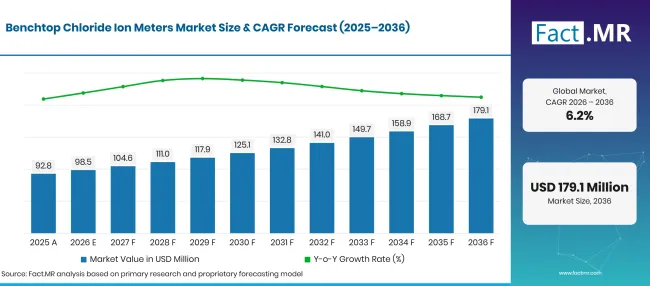
Benchtop Chloride Ion Meters Market Forecast Global | Source: Fact.MR
| Year | Basis | Market Value (USD million) |
|---|---|---|
| 2025 | Actual | 92.8 |
| 2026 | Estimate | 98.5 |
| 2036 | Forecast | 179.1 |
| CAGR 2026 to 2036 | Forecast period | 6.2% |
Source: Fact.MR analysis. Updated Oct 22, 2026
What are the defining numbers behind Benchtop Chloride Ion Meters Market growth?
USD 80.6 million additional market value by 2036, with automatic meters and water analysis shaping purchases.
- Demand Drivers in the Market
- Water and wastewater laboratories need reliable chloride measurement when sample composition changes across treatment stages. A stable electrode response and clear calibration records help analysts distinguish a real change from instrument drift.
- Food and beverage laboratories use chloride analysis when they need a direct check on salt content in prepared samples. A benchtop setup suits repeated batches where results must follow the same method across different operators.
- Environmental laboratories compare chloride readings with other water chemistry results when investigating saline influence. The ability to repeat a measurement under controlled conditions helps staff review unusual findings.
- Pharmaceutical quality teams assess instruments against their written testing methods. Supplier support for electrode care and replacement parts influences purchases because a meter alone does not complete the testing process.
- Key Segments Analyzed
- By Product Type: automatic meters account for 48.2% share in 2026 as laboratories seek repeatable measurement steps.
- By Application: Water and Wastewater Treatment represents 42.5% share in 2026 because facilities rely on regular water chemistry checks.
- By End-User: laboratories capture 41.8% share in 2026, reflecting centralized testing and documented results.
- By Distribution Channel: specialty stores represent 52.7% share in 2026 because technical product selection often calls for distributor guidance.
- Analyst Opinion at Fact.MR
- Shambhu Nath Jha, Principal Consultant at Fact.MR, states, “Electrode maintenance and method fit as central purchasing considerations. Laboratories compare calibration routines before they compare screen design or other convenience features.”
- Strategic Implications
- Instrument suppliers should explain chloride-specific measurement ranges and electrode compatibility in plain language, allowing laboratory staff to compare usable configurations.
- Laboratory managers benefit from a clear schedule for calibration and electrode condition checks before purchasing replacement instruments.
- Specialist distributors can improve equipment selection by checking the intended sample type and the accessories required for chloride testing.
- Water testing teams can compare total operating costs by including standards and electrode care in their equipment reviews.
Germany is forecast to record a 7.8% CAGR through 2036, while Brazil follows at 7.1%. The United States is projected at 6.5%, supported by its established environmental laboratory base. The United Kingdom carries a 5.8% outlook and Japan follows at 5.1%, with purchasing shaped by established water-monitoring practices.
How does the Benchtop Chloride Ion Meters Market break down by segment?
Automatic 48.2%; Water and Wastewater Treatment 42.5%; Laboratories 41.8%; Specialty Stores 52.7% in 2026.
Which Product Type dominates?
Automatic holds 48.2% share in 2026.
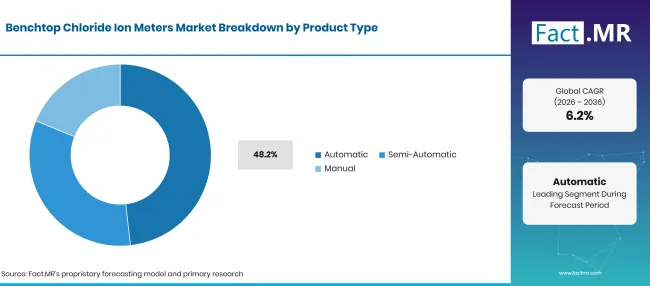
Benchtop Chloride Ion Meters Market Breakdown Product Type | Source: Fact.MR
| Product Type | Share (2026) |
|---|---|
| Automatic (Leading segment) | 48.2% |
| Other segments combined | 51.8% |
| Total | 100.0% |
Source: Fact.MR analysis. Updated Oct 22, 2026
automatic meters appeal to teams handling repeated chloride tests because automated prompts can reduce differences in routine operation. Semi-automatic models remain suitable where technicians want guided steps but retain direct control over the procedure. Manual units can suit teaching work and smaller sample sets when a trained operator follows a defined method. Buyers still need to confirm whether automation covers calibration and data handling or only the result display.
What leads the Application segment?
Water and Wastewater Treatment leads with 42.5% share in 2026.
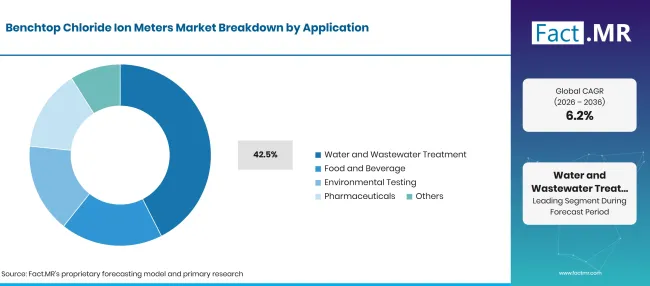
Benchtop Chloride Ion Meters Market Breakdown Application | Source: Fact.MR
| Application | Share (2026) |
|---|---|
| Water and Wastewater Treatment (Leading segment) | 42.5% |
| Other segments combined | 57.5% |
| Total | 100.0% |
Source: Fact.MR analysis. Updated Oct 22, 2026
Water laboratories test chloride as part of a broader investigation into salinity and treatment conditions. Sampling locations and background chemistry affect the method a laboratory selects. Food and beverage teams may use chloride electrodes for certain salt-related analyses after preparing samples to suit the electrode. Environmental testing can involve water from rivers and wells where results need to be compared across dates.
How does End-User purchasing shape sales?
Laboratories capture 41.8% share in 2026.
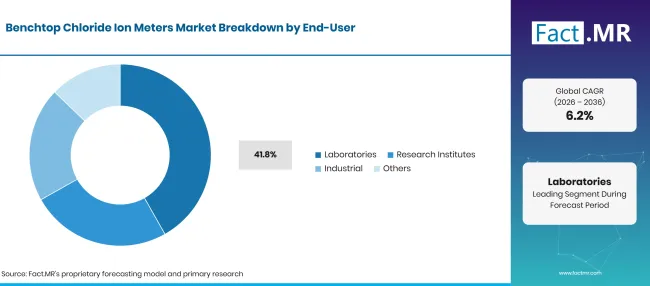
Benchtop Chloride Ion Meters Market Breakdown End User | Source: Fact.MR
| End-User | Share (2026) |
|---|---|
| Laboratories (Leading segment) | 41.8% |
| Other segments combined | 58.2% |
| Total | 100.0% |
Source: Fact.MR analysis. Updated Oct 22, 2026
Dedicated laboratories often centralize chloride testing because specialist staff can monitor electrode performance and maintain standard solutions. Research institutes may favour flexible meters that let students or scientists view electrical response alongside the calculated ion concentration. Industrial facilities sometimes keep a meter near process laboratories for additional checks on prepared samples.
Which Distribution Channel serves the largest share?
Specialty Stores represent 52.7% share in 2026.
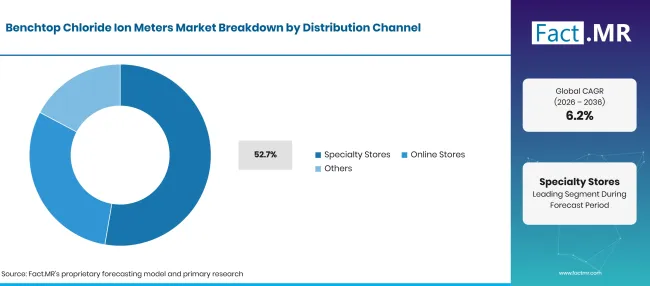
Benchtop Chloride Ion Meters Market Breakdown Distribution Channel | Source: Fact.MR
| Distribution Channel | Share (2026) |
|---|---|
| Specialty Stores (Leading segment) | 52.7% |
| Other segments combined | 47.3% |
| Total | 100.0% |
Source: Fact.MR analysis. Updated Oct 22, 2026
Specialty laboratory distributors help purchasers confirm whether a meter supports chloride ion-selective electrodes and the required calibration accessories. Direct discussion is useful when existing probes use different connectors or measurement ranges. Online stores make routine reordering convenient after staff know the correct product code.
What is accelerating Benchtop Chloride Ion Meters Market adoption, and what is holding it back?
Repeatable laboratory testing supports purchases, while electrode upkeep and method differences can delay replacement.
Drivers Impact Analysis
| DRIVER | (~) % IMPACT ON CAGR | GEOGRAPHIC RELEVANCE | IMPACT TIMELINE |
|---|---|---|---|
| Routine water analysis | +1.0% | Global | Medium term (2–4 years) |
| Laboratory replacement cycles | +0.8% | North America, Europe | Short term (<= 2 years) |
| Food salt checks | +0.7% | Global | Medium term (2–4 years) |
| Measurement documentation | +0.5% | Global | Medium term (2–4 years) |
| Specialist distribution | +0.4% | Europe, Asia | Long term (>= 4 years) |
Source: Fact.MR analysis. Updated Oct 22, 2026
Opportunity Impact Analysis
| OPPORTUNITY | (~) % IMPACT ON CAGR | GEOGRAPHIC RELEVANCE | IMPACT TIMELINE |
|---|---|---|---|
| Electrode and meter bundles | +0.8% | Global | Short term (<= 2 years) |
| Sample workflow guidance | +0.6% | Global | Medium term (2–4 years) |
| Laboratory training | +0.5% | Asia, Latin America | Medium term (2–4 years) |
| Replacement accessories | +0.4% | Global | Long term (>= 4 years) |
Source: Fact.MR analysis. Updated Oct 22, 2026
Restraints Impact Analysis
| RESTRAINT | (~) % IMPACT ON CAGR | GEOGRAPHIC RELEVANCE | IMPACT TIMELINE |
|---|---|---|---|
| Electrode maintenance | -0.8% | Global | Short term (<= 2 years) |
| Interfering sample chemistry | -0.6% | Global | Medium term (2–4 years) |
| Instrument qualification | -0.5% | North America, Europe | Medium term (2–4 years) |
| Budget limits | -0.4% | Global | Long term (>= 4 years) |
Source: Fact.MR analysis. Updated Oct 22, 2026
Which countries are scaling the Benchtop Chloride Ion Meters Market through 2036?
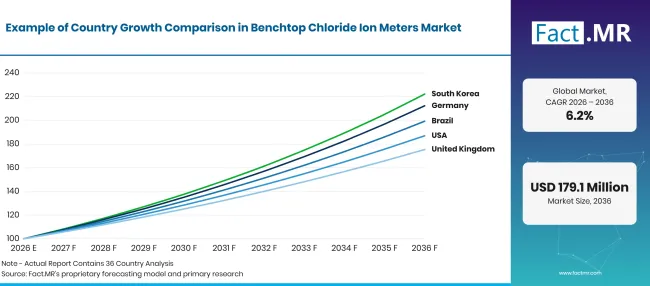
Benchtop Chloride Ion Meters Market Growth Index | Source: Fact.MR
| Country | CAGR (2026–2036) |
|---|---|
| Germany | 7.8% |
| Brazil | 7.1% |
| United States | 6.5% |
| United Kingdom | 5.8% |
| Japan | 5.1% |
Source: Fact.MR analysis. Updated Oct 22, 2026
Why is Germany expanding chloride ion meter use?
7.8% CAGR, linked to established industrial laboratory testing.
Water laboratories need consistent bench methods to track chloride changes between sample batches. Germany's Federal Statistical Office recorded 381 chemical-physical waste treatment plants in 2024 [6]. These facilities reflect the country's wider industrial waste treatment activity, while chloride meter purchases depend on the laboratory methods used at individual sites.
How is Brazil developing benchtop chloride analysis?
7.1% CAGR, associated with wider water-quality information systems.
The Ministry of Cities published SINISA 2025 on December 23, 2025, with sanitation indicators for reference year 2024 [3]. The programme covers water-sector records that laboratories use when planning parameter-specific measurement work. ANA introduced its water-quality portal in April 2026 using monitoring information spanning 2010 to 2024 [4]. Standard laboratory methods help users compare results over time.
What supports United States chloride meter purchases?
6.5% CAGR, influenced by extensive water-testing activity.
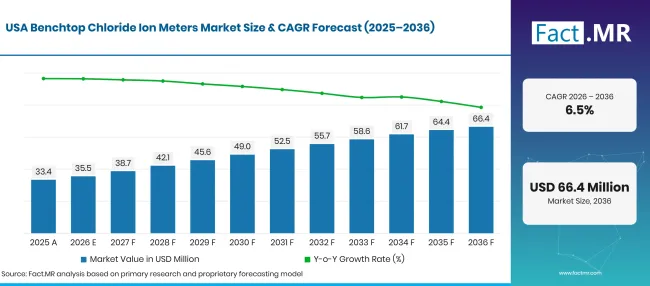
Benchtop Chloride Ion Meters Market Forecast Usa | Source: Fact.MR
The U.S. Environmental Protection Agency identifies 250 mg/L as the secondary drinking-water standard for chloride, providing guidance on taste-related water quality. This federal standard is non-mandatory [7]. Water utility laboratories use repeated measurements to review changes in source-water conditions.
How does the United Kingdom shape laboratory chloride testing?
5.8% CAGR, supported by established water compliance programmes.
The Drinking Water Inspectorate reported more than 3.5 million regulatory samples from public water supplies in England during 2025 [1]. The scale illustrates routine analytical activity across parameters. The Drinking Water Inspectorate reviews each regulated parameter as part of its annual public-supply assessment. The Drinking Water Inspectorate reported that 5,979 of 271,024 tests conducted on private water supplies in England during 2025 failed one or more wholesomeness standards, representing 2.21% [5]. These results cover several water-quality parameters, so laboratories must select instruments according to the substances being investigated.
Why is Japan maintaining chloride meter sales?
5.1% CAGR, linked to detailed water monitoring and laboratory quality checks.
Japan's Ministry of the Environment reported 5,274 public-water monitoring locations for 27 health-related parameters in fiscal 2024 [2]. The monitoring programme requires laboratories to choose an appropriate method for each substance. Laboratories involved in salt-related food testing can use ion-selective analysis where the procedure fits the prepared sample.
Who leads the Benchtop Chloride Ion Meters Market?
Thermo Fisher Scientific offers Orion chloride ion-selective electrodes and related calibration standards suited to compatible ion meters. Hanna Instruments supplies chloride-selective electrode products, while Metrohm is active in potentiometric measurement systems. HORIBA and DKK-TOA participate in broader laboratory electrochemical testing.
Xylem’s analytical brands and Hach are relevant to wider water-analysis purchasing, where chloride methods require product-by-product checks. Supplier comparisons focus on manufacturers offering compatible chloride ion measurement instruments, electrodes and laboratory accessories, with product specifications guiding the final shortlist.
Which companies are the key providers?
Key companies include Thermo Fisher Scientific Inc.; Hanna Instruments Inc.; Metrohm AG; Xylem Inc. (WTW); HORIBA, Ltd.; Hach Company (Veralto); DKK-TOA Corporation; and Bante Instruments.
- Thermo Fisher Scientific Inc.
- Hanna Instruments Inc.
- Metrohm AG
- Xylem Inc. (WTW)
- HORIBA, Ltd.
- Hach Company (Veralto)
- DKK-TOA Corporation
- Bante Instruments
Bibliography
- [1] Drinking Water Inspectorate. (2026, July 7). 7 July: Drinking Water Inspectorate – Chief Inspector’s Annual Report 2025 England.
- [2] Ministry of the Environment, Japan. (2026, March 27). Results of water quality measurements in public waters and groundwater for fiscal year 2024.
- [3] Ministério das Cidades. (2025, December 23). Resultados SINISA 2025.
- [4] Agência Nacional de Águas e Saneamento Básico. (2026, April 1). ANA lança Portal da Qualidade da Água.
- [5] Drinking Water Inspectorate. (2026, July 16). Data return findings: Private water supplies in England.
- [6] Statistisches Bundesamt (Destatis). (2026, March 3). Waste treatment plants 2024.
- [7] U.S. Environmental Protection Agency. (2026, May 26). Secondary drinking water standards: Guidance for nuisance chemicals.
This Report Answers
- The study reviews chloride-specific equipment needs in routine water analysis and prepared food testing.
- Product analysis separates automatic bench instruments from semi-automatic and manual configurations.
- Application analysis explains why water and wastewater testing represents the principal specified share.
- Country comparison reviews distinct laboratory conditions in Germany, Brazil, the United States, the United Kingdom and Japan.
- Competitive discussion considers chloride electrode compatibility and local technical service when selecting suppliers.
- Distribution analysis distinguishes specialist advice from routine reordering through online stores.
What does the Benchtop Chloride Ion Meters Market cover?
The market covers laboratory bench instruments configured to measure chloride ions in prepared samples. It includes automatic, semi-automatic and manual configurations when the meter and compatible electrode serve chloride analysis. Testing can take place in water laboratories and suitable food or industrial laboratory settings. Related Fact.MR coverage of laboratory centrifuge equipment offers context for laboratory purchasing decisions.
What is included in the scope?
Included sales relate to benchtop systems intended for chloride ion analysis and the associated instrument configurations used by testing laboratories. A complete operating setup can require a chloride-selective electrode and calibration solutions. The market considers instrument purchases through specialist and online sales channels.
What is excluded from the scope?
The scope excludes general-purpose handheld salinity devices unless they are sold as benchtop chloride ion meters. It also excludes chlorine residual meters, which test a different water parameter. Laboratory services and individual sample testing fees are outside instrument sales.
How Was the Analysis Built?
The analysis draws on 120+ sources, 35+ company portfolios, 25+ countries, and more than 20 industry interviews.
- Primary Research: Primary research includes discussions with manufacturers, service providers, technology developers, distributors, end users, and subject-matter experts. These conversations examine purchasing priorities, product adoption, operational challenges, approval requirements, competitive positioning, and the factors that influence wider market acceptance.
- Desk Research: Desk research covers government statistics, regulatory publications, company filings, trade data, technical studies, industry associations, standards, public policy, and other authoritative sources. Every source used in the analysis is documented in the bibliography.
- Market Sizing and Forecasting: Market estimates combine historical performance, demand indicators, pricing and volume trends, segment shares, company participation, country-level growth, adoption patterns, investment activity, and barriers to market expansion.
- Data Validation and Update Cycle: Findings are validated by comparing primary interviews with public data, company activity, regulatory changes, trade patterns, and industry developments. Regular updates review new product launches, capacity changes, partnerships, approvals, and shifts in commercial adoption.
Segmentation
What is the report’s scope and coverage?
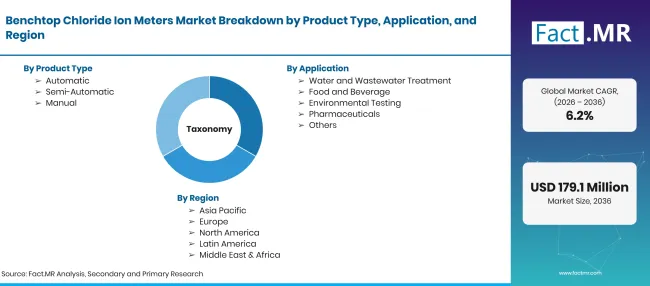
Benchtop Chloride Ion Meters Market Taxonomy | Source: Fact.MR
| Attribute | Details |
|---|---|
| Quantitative Units | USD million in 2026 to USD million by 2036 at CAGR |
| Market Definition | Bench instruments configured for chloride ion measurement in prepared liquid samples. |
| Product Type | Automatic; Semi-Automatic; Manual |
| Application | Water and Wastewater Treatment; Food and Beverage; Environmental Testing; Pharmaceuticals; Others |
| End-User | Laboratories; Research Institutes; Industrial; Others |
| Distribution Channel | Specialty Stores; Online Stores; Others |
| Countries Covered | Germany; Brazil; United States; United Kingdom; Japan |
| Companies Profiled | Thermo Fisher Scientific Inc.; Hanna Instruments Inc.; Metrohm AG; Xylem Inc. (WTW); HORIBA, Ltd.; Hach Company (Veralto); DKK-TOA Corporation; and Bante Instruments |
| Forecast Period | 2026 to 2036 |
| Approach | Chloride measurement workflow, instrument configuration, laboratory buying conditions and publicly documented water monitoring activity |
Source: Fact.MR analysis. Updated Oct 22, 2026
How is the market segmented?
-
By Product Type
- Automatic
- Semi-Automatic
- Manual
-
By Application
- Water and Wastewater Treatment
- Food and Beverage
- Environmental Testing
- Pharmaceuticals
- Others
-
By End-User
- Laboratories
- Research Institutes
- Industrial
- Others
-
By Distribution Channel
- Specialty Stores
- Online Stores
- Others
-
By Region
- North America
- Latin America
- Western Europe
- Eastern Europe
- East Asia
- South Asia & Pacific
- Middle East & Africa
Frequently Asked Questions
How big is the Benchtop Chloride Ion Meters Market in 2026?
What is the CAGR of the Benchtop Chloride Ion Meters Market from 2026 to 2036?
Which product type leads the Benchtop Chloride Ion Meters Market?
Which application leads the Benchtop Chloride Ion Meters Market?
Who are the leading companies in the Benchtop Chloride Ion Meters Market?
Who worked on this report


Preview the report firsthand - request a free sample
Free SampleGet the brochure for pricing and purchase details
Download PDF