- Market Value (2025): USD 144.5 Mn
- Estimated Value (2026): USD 151.6 Mn
- Forecast Value (2036): USD 245.3 Mn
- CAGR (2026-2036): 4.9%
What is the Chloride Ion Meters Market forecast to be worth by 2036?
USD 151.59 million in 2026 to USD 245.28 million by 2036, at a 4.9% CAGR.
- As per Fact.MR analysis, the chloride ion meters market reached USD 144.5 million in 2025.
- Demand will increase from USD 151.6 million in 2026 to USD 245.3 million in 2036.
- The market is forecast to record a 4.9% CAGR during 2026 to 2036 as environmental testing agencies and industrial processors install ion selective electrode analyzers.
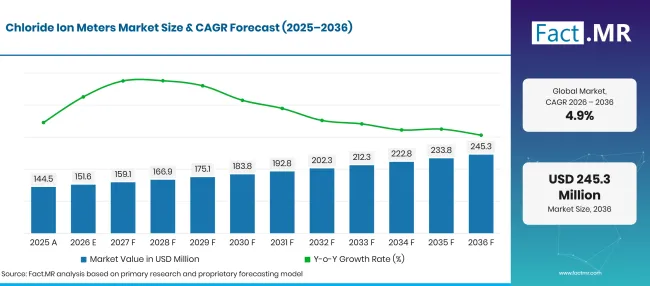
Factmr Chloride Ion Meters Market Forecast Global | Source: Fact.MR
| Year | Basis | Market Value (USD million) |
|---|---|---|
| 2025 | Actual | 144.5 |
| 2026 | Estimate | 151.6 |
| 2036 | Forecast | 245.3 |
| CAGR 2026 to 2036 | Forecast period | 4.9% |
Source: Fact.MR analysis. Updated Oct 15, 2026
What are the defining numbers behind Chloride Ion Meters Market growth?
USD 93.69 million absolute chance between 2026 and 2036, with benchtop meters and wastewater monitoring facilities forming the main purchasing base.
- Demand Drivers in the Market
- Wastewater treatment plants increasingly rely on digital chloride ion meters to prevent saline corrosion in discharge pipelines. Consistent chloride measurement protects municipal sewage infrastructure and prevents toxic saline shocks in natural water bodies. Facility managers choose meters that offer multi-point calibration to verify regulatory compliance before water discharge.
- Food and beverage processing plants require accurate salt concentration measurement to maintain uniform flavor and preserve food hygiene. In-line and laboratory chloride testing ensures that processed meats and canned foods comply with mandatory sodium labeling laws. Traceable digital records simplify food safety audits and confirm recipe compliance across continuous production runs.
- Environmental monitoring agencies mandate regular salinity testing in surface waters exposed to road-salt runoff and chemical effluent. Accurate chloride data helps hydrologists track salt accumulation in freshwater reservoirs and municipal aquifers. Dependable field meters allow technicians to gather reliable samples across remote watershed monitoring locations.
- Pharmaceutical laboratories utilize chloride ion meters to verify active ingredient purity and monitor formulation salinity. Rigorous medical standards require high-resolution electrodes capable of detecting trace chloride contamination in dialysis fluids. Validated equipment documentation ensures that testing data satisfies international pharmacopeia standards.
- Key Segments Analyzed
- By Product Type: Benchtop Chloride Ion Meters holds 52.4% share in 2026, as testing laboratories and industrial plants prioritize high-precision benchtop meters.
- By Application: Water and Wastewater Treatment accounts for 42.3% share in 2026 because municipal and industrial treatment plants conduct daily effluent monitoring.
- By End-User: Industrial represents 45.2% share in 2026, reflecting continuous process water surveillance across chemical and food manufacturing facilities.
- By Distribution Channel: Specialty Stores capture 58.6% share in 2026, reflecting purchases through scientific instrument dealers and certified equipment distributors.
- Analyst Opinion at Fact.MR
- Shambhu Nath Jha, Principal Consultant at Fact.MR, states, “Chloride ion meter demand depends on sensor calibration stability and electrode resistance against chemical fouling. Industrial water operators prioritize meters that minimize drift during continuous testing cycles. Manufacturers that pair rugged ion selective electrodes with simplified digital calibration routines secure repeat equipment orders from commercial testing laboratories.”
- Strategic Implications
- Analytical instrument makers are developing solid-state chloride electrodes that eliminate internal electrolyte refilling and extend sensor life. Low-maintenance sensors reduce laboratory labor costs while ensuring dependable measurement repeatability across high-volume testing schedules.
- Wastewater plant engineers are integrating digital chloride sensors into automated supervisory networks before finalizing equipment replacement cycles. Connected monitoring hardware allows operators to adjust water treatment chemicals automatically when chloride spikes occur.
- Specialty laboratory distributors are bundling chloride meters with certified calibration standards and electrode cleaning solutions for commercial clients. Comprehensive product packages accelerate instrument commissioning and support customer compliance with laboratory accreditation standards.
- Quality assurance directors are establishing strict daily electrode verification protocols across processing plants to eliminate testing errors. Standardized calibration routines protect finished product specifications and minimize regulatory dispute risks during environmental inspections.
Germany is poised to record a 6.0% CAGR, while Brazil reaches 5.5% as industrial wastewater surveillance tightens across regional manufacturing hubs. The United States posts 4.9% growth, supported by continuous environmental testing and investments in water testing kits. The United Kingdom records 4.4%, while Japan reaches 3.9%, backed by comprehensive public water testing standards and automated laboratory testing.
How does the Chloride Ion Meters Market break down by segment?
Benchtop Chloride Ion Meters 52.4%; Water and Wastewater Treatment 42.3%; Industrial 45.2%; Specialty Stores 58.6% in 2026.
Which Product Type dominates?
Benchtop Chloride Ion Meters holds 52.4% share in 2026.
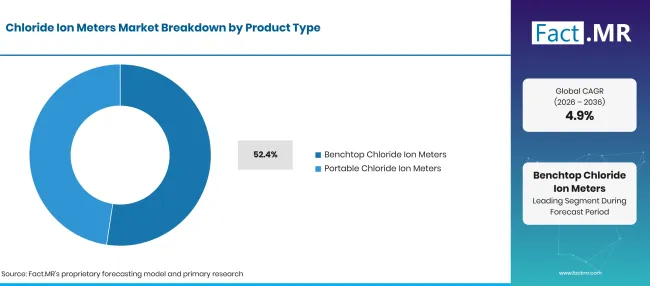
Factmr Chloride Ion Meters Market Breakdown Product Type | Source: Fact.MR
| Product Type | Share (2026) |
|---|---|
| Benchtop Chloride Ion Meters (Leading segment) | 52.4% |
| Other segments combined | 47.6%* |
| Total | 100.0% |
Source: Fact.MR analysis. Updated Oct 15, 2026
Benchtop chloride ion meters dominate laboratory installations because they offer high measurement accuracy and multi-parameter display capabilities. Testing technicians use benchtop units to analyze batch samples using temperature-controlled electrode stands. Portable chloride ion meters supply mobile testing capability for field technicians surveying environmental rivers and remote wastewater discharge points. Other configurations include continuous in-line sensors built directly into industrial water purification systems.
What leads the Application segment?
Water and Wastewater Treatment accounts for 42.3% share in 2026.
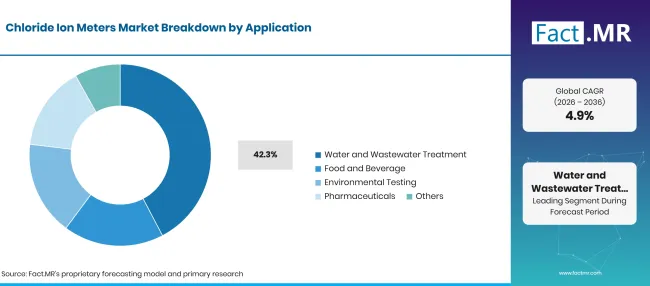
Factmr Chloride Ion Meters Market Breakdown Application 1 | Source: Fact.MR
| Application | Share (2026) |
|---|---|
| Water and Wastewater Treatment (Leading segment) | 42.3% |
| Other segments combined | 57.7%* |
| Total | 100.0% |
Source: Fact.MR analysis. Updated Oct 15, 2026
Water treatment operators monitor chloride levels to manage desalination efficiency and prevent municipal pipeline corrosion. Food and beverage manufacturers use chloride meters to measure salt concentration in dairy products, sauces, and seasonings. Environmental testing organizations track agricultural runoff and winter de-icing chemicals in lakes and groundwater reserves. Pharmaceutical firms use laboratory analytical instruments to verify saline purity in intravenous solutions.
How does End-User purchasing shape sales?
Industrial represents 45.2% share in 2026.
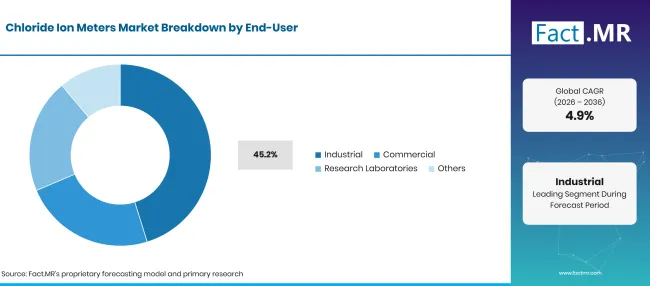
Factmr Chloride Ion Meters Market Breakdown End User | Source: Fact.MR
| End-User | Share (2026) |
|---|---|
| Industrial (Leading segment) | 45.2% |
| Other segments combined | 54.8%* |
| Total | 100.0% |
Source: Fact.MR analysis. Updated Oct 15, 2026
Industrial facilities purchase chloride ion meters to monitor boiler feedwater, cooling towers, and industrial effluent streams. Accurate chloride control prevents costly boiler tube cracking and preserves expensive production machinery. Commercial testing firms operate meters for third-party compliance verification across contracted industrial sites. Research laboratories deploy high-resolution meters for advanced electrochemical research and materials characterization.
Which Distribution Channel serves the largest share?
Specialty Stores capture 58.6% share in 2026.
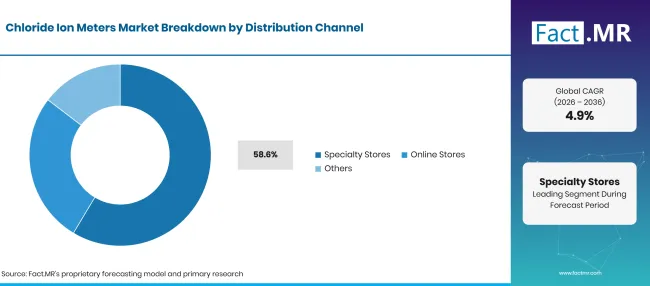
Factmr Chloride Ion Meters Market Breakdown Distribution Channel | Source: Fact.MR
| Distribution Channel | Share (2026) |
|---|---|
| Specialty Stores (Leading segment) | 58.6% |
| Other segments combined | 41.4%* |
| Total | 100.0% |
Source: Fact.MR analysis. Updated Oct 15, 2026
Specialty scientific distributors provide technical advice, sensor calibration certificates, and post-sale electrode maintenance support to laboratory buyers. Direct distributor channels ensure that purchasers receive compatible reference electrodes and certified buffer reagents. Online stores serve educational institutions and smaller commercial testing operations requiring rapid replacement of portable water analyzers. Other distribution avenues include direct factory supply contracts for municipal wastewater utilities.
What is accelerating Chloride Ion Meters Market adoption, and what is holding it back?
Strict industrial wastewater salinity limits and automated quality testing expand the adoption of chloride ion meters. Frequent electrode recalibration demands and sensor membrane fouling under harsh chemical conditions can restrict market growth.
Drivers Impact Analysis
| DRIVER | (~) % IMPACT ON CAGR | GEOGRAPHIC RELEVANCE | IMPACT TIMELINE |
|---|---|---|---|
| Industrial effluent salinity regulations | +1.0% | Europe, North America | Medium term (2–4 years) |
| Municipal wastewater infrastructure testing | +0.8% | Global | Short term (<= 2 years) |
| Food processing sodium verification | +0.7% | North America, East Asia | Medium term (2–4 years) |
| Automated laboratory data logging | +0.5% | Europe, Japan | Medium term (2–4 years) |
| Solid-state electrode durability | +0.4% | Global | Long term (>= 4 years) |
Source: Fact.MR analysis. Updated Oct 15, 2026
Opportunity Impact Analysis
| OPPORTUNITY | (~) % IMPACT ON CAGR | GEOGRAPHIC RELEVANCE | IMPACT TIMELINE |
|---|---|---|---|
| Smart water grid sensor integration | +0.8% | Europe, United States | Medium term (2–4 years) |
| Portable environmental testing equipment | +0.6% | Global | Medium term (2–4 years) |
| Desalination plant process monitoring | +0.5% | Middle East, Latin America | Short term (<= 2 years) |
| Multi-ion automated benchtop systems | +0.4% | Global | Medium term (2–4 years) |
Source: Fact.MR analysis. Updated Oct 15, 2026
Restraints Impact Analysis
| RESTRAINT | (~) % IMPACT ON CAGR | GEOGRAPHIC RELEVANCE | IMPACT TIMELINE |
|---|---|---|---|
| Electrode membrane chemical degradation | -0.8% | Global | Short term (<= 2 years) |
| High cost of automated analytical meters | -0.6% | Latin America, Asia | Medium term (2–4 years) |
| Manual buffer calibration requirements | -0.5% | Global | Medium term (2–4 years) |
| Availability of multi-parameter test strips | -0.4% | Global | Long term (>= 4 years) |
Source: Fact.MR analysis. Updated Oct 15, 2026
Which countries are scaling the Chloride Ion Meters Market through 2036?
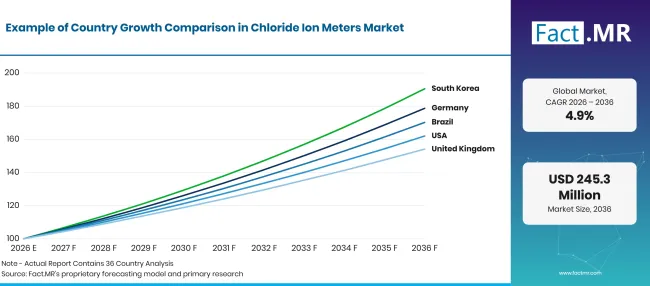
Factmr Chloride Ion Meters Market Growth Index | Source: Fact.MR
| Country | CAGR (2026–2036) |
|---|---|
| Germany | 6.0% |
| Brazil | 5.5% |
| United States | 4.9% |
| United Kingdom | 4.4% |
| Japan | 3.9% |
Source: Fact.MR analysis. Updated Oct 15, 2026
Why is Germany leading chloride ion meter adoption?
6.0% CAGR, driven by strict industrial discharge regulations and automated laboratory testing standards.
German water utilities and industrial laboratories deploy high-precision chloride meters to verify water quality and protect process systems from chloride-related corrosion. Germany’s Drinking Water Ordinance implements the EU risk-based drinking-water framework and requires systematic monitoring across the supply chain [3]. Industrial operators therefore invest in stable benchtop and field meters for routine chloride checks in incoming water, cooling loops, and treated water.
How is Brazil expanding chloride ion meter use?
5.5% CAGR, shaped by expanding municipal wastewater networks and industrial effluent surveillance.
Brazilian environmental authorities, water utilities, and industrial operators use chloride meters to monitor salinity in surface waters and treated effluent. CONAMA Resolution No. 357 classifies fresh, brackish, and saline waters and establishes water-quality and effluent-discharge conditions [4]. Food, pulp, and other process industries consequently require portable and laboratory meters to document water quality before discharge.
What is driving chloride ion meter sales in the United States?
4.9% CAGR, linked to Clean Water Act monitoring standards and food manufacturing salinity testing.
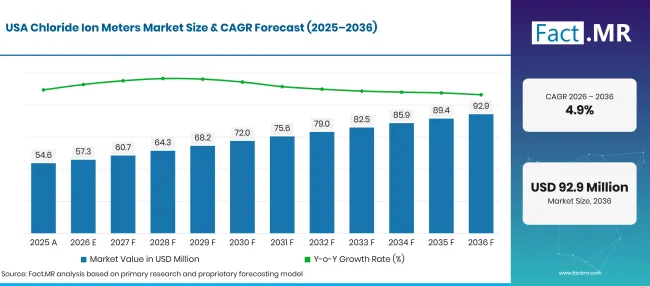
Factmr Chloride Ion Meters Market Forecast Usa | Source: Fact.MR
U.S. municipal treatment facilities and environmental laboratories rely heavily on ion selective electrode meters for regulatory reporting. The EPA Ambient Water Quality Criteria mandates chronic freshwater chloride limits at 230 mg/L and acute limits at 860 mg/L under Clean Water Act monitoring [1]. Food processors also install benchtop meters to maintain accurate sodium levels across commercial food lines.
How is the United Kingdom developing chloride ion meter demand?
4.4% CAGR, influenced by drinking water quality surveillance and industrial discharge permits.
UK water utilities and private testing laboratories use chloride meters to track salinity changes in treated water supplies. The Drinking Water Inspectorate reported 99.97% overall compliance with drinking-water standards in England in 2024, based on extensive regulatory testing [2]. Facilities prioritize durable benchtop instruments that support traceable digital records and centralized reporting.
Why is Japan maintaining steady chloride ion meter growth?
3.9% CAGR, influenced by advanced semiconductor rinse water testing and automated water quality monitoring.
Japanese precision electronics fabricators and pharmaceutical producers use high-resolution chloride meters to monitor ultra-pure process water. The Ministry of the Environment and JWWA enforce a 200 mg/L chloride ion threshold under national drinking water quality standards [5]. Semiconductor plants install specialized meters to verify zero chloride contamination in microchip cleaning baths.
Who leads the Chloride Ion Meters Market?
Thermo Fisher Scientific Inc. and Metrohm AG supply high-precision benchtop chloride meters and automated titration systems, where analytical accuracy and software compliance dictate repeat procurement. Hanna Instruments, Inc. and Horiba, Ltd. manufacture portable and laboratory water quality meters engineered for rapid water testing. Hach Company and Xylem Inc. deliver rugged analytical instruments built specifically for continuous water and wastewater treatment facilities.
OMEGA Engineering, Inc., Teledyne FLIR, Jenco Instruments, Inc., and Apera Instruments, LLC. produce specialized electrochemistry meters for research, industrial, and educational applications. Competition centers on electrode response speed, membrane longevity, multi-point calibration simplicity, and total cost of ownership.
Which companies are the key providers?
Key companies include Thermo Fisher Scientific Inc.; Hanna Instruments, Inc.; Horiba, Ltd.; Metrohm AG; Xylem Inc.; Hach Company; Jenco Instruments, Inc.; Teledyne FLIR; OMEGA Engineering, Inc.; and Apera Instruments, LLC.
- Thermo Fisher Scientific Inc.
- Hanna Instruments, Inc.
- Horiba, Ltd.
- Metrohm AG
- Xylem Inc.
- Hach Company
- Jenco Instruments, Inc.
- Teledyne FLIR
- OMEGA Engineering, Inc.
- Apera Instruments, LLC.
Bibliography
- [1] U.S. Environmental Protection Agency. (2026, June 9). National recommended water quality criteria: Aquatic life criteria table.
- [2] Drinking Water Inspectorate. (2025, July 9). Drinking Water 2024: Summary of the Chief Inspector’s report for drinking water in England.
- [3] Umweltbundesamt. (2023, June 23). Neue Trinkwasserverordnung sichert hohe Qualität unseres Trinkwassers.
- [4] Conselho Nacional do Meio Ambiente. (2005, March 17). Resolução CONAMA nº 357, de 17 de março de 2005.
- [5] Ministry of the Environment, Government of Japan. (2026, April 1). Water quality standard items and standard values (52 items).
This Report Answers
- The report evaluates technology selection between benchtop laboratory meters, portable field meters, and continuous on-line chloride monitors.
- Application analysis explains why water and wastewater treatment plants represent the largest share of equipment spending.
- The country comparison highlights how environmental discharge regulations drive laboratory instrument upgrades across major economies.
- Competitive benchmarking separates premium automated titration vendors from cost-effective portable instrument manufacturers.
- Distribution analysis outlines why certified scientific equipment merchants control the majority of commercial sales.
What does the Chloride Ion Meters Market cover?
The market covers electrochemical analytical meters utilizing chloride ion selective electrodes, reference probes, and digital signal processors to quantify chloride ions. It examines equipment used in municipal sewage treatment, industrial process water monitoring, food quality control, and clinical research. The analysis connects with related Fact.MR evaluations of water quality meters and environmental testing equipment.
What is included in the scope?
The scope includes standalone benchtop chloride meters, portable handheld chloride meters, and multi-parameter meters equipped with dedicated chloride ion channels.
Replacement electrodes, calibration buffer kits, and manufacturer service contracts sold alongside new instruments are included. Revenue reflects finished analytical instrument sales to end-users and commercial laboratories.
What is excluded from the scope?
The scope excludes general chemical test strips, optical spectrophotometers, and single-use titration reagents sold without hardware
Industrial chlorination dosing pumps and municipal water filtration membranes are outside the scope. Laboratory testing service fees and contract analytical testing charges are excluded from equipment sizing.
How Was the Analysis Built?
The analysis draws on 120+ sources, 35+ company portfolios, 25+ countries, and more than 20 industry interviews.
- Primary Research: Primary research includes discussions with manufacturers, service providers, technology developers, distributors, end users, and subject-matter experts. These conversations examine purchasing priorities, product adoption, operational challenges, approval requirements, competitive positioning, and the factors that influence wider market acceptance.
- Desk Research: Desk research covers government statistics, regulatory publications, company filings, trade data, technical studies, industry associations, standards, public policy, and other authoritative sources. Every source used in the analysis is documented in the bibliography.
- Market Sizing and Forecasting: Market estimates combine historical performance, demand indicators, pricing and volume trends, segment shares, company participation, country-level growth, adoption patterns, investment activity, and barriers to market expansion.
- Data Validation and Update Cycle: Findings are validated by comparing primary interviews with public data, company activity, regulatory changes, trade patterns, and industry developments. Regular updates review new product launches, capacity changes, partnerships, approvals, and shifts in commercial adoption.
Segmentation
What is the report’s scope and coverage?
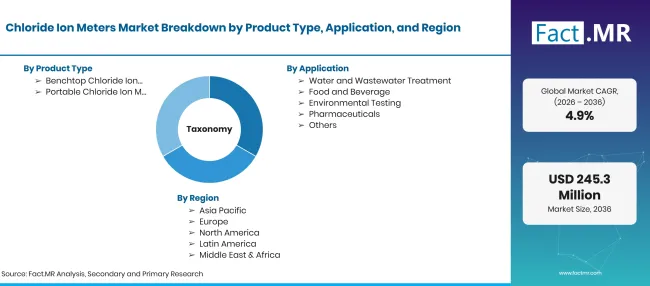
Factmr Chloride Ion Meters Market Taxonomy | Source: Fact.MR
| Attribute | Details |
|---|---|
| Quantitative Units | USD million |
| Market Definition | Laboratory benchtop, portable, and on-line electrochemistry instruments designed to measure chloride ion concentration in aqueous solutions. |
| Product Type | Benchtop Chloride Ion Meters; Portable Chloride Ion Meters; Others |
| Application | Water and Wastewater Treatment; Food and Beverage; Environmental Testing; Pharmaceuticals; Others |
| End-User | Industrial; Commercial; Research Laboratories; Others |
| Distribution Channel | Specialty Stores; Online Stores; Others |
| Regions Covered | North America; Latin America; Western Europe; Eastern Europe; East Asia; South Asia & Pacific; Middle East & Africa |
| Countries Covered | Germany; Brazil; United States; United Kingdom; Japan |
| Companies Profiled | Thermo Fisher; Hanna Instruments; Horiba; Metrohm; Xylem; Hach; Jenco; Teledyne FLIR; OMEGA; Apera |
| Forecast Period | 2026 to 2036 |
| Approach | Quantitative evaluation of analytical instrument production, laboratory replacement cycles, distributor pricing, and verified manufacturer revenues |
Source: Fact.MR analysis. Updated Oct 15, 2026
How is the market segmented?
-
By Product Type:
- Benchtop Chloride Ion Meters
- Portable Chloride Ion Meters
- Others
-
By Application:
- Water and Wastewater Treatment
- Food and Beverage
- Environmental Testing
- Pharmaceuticals
- Others
-
By End-User:
- Industrial
- Commercial
- Research Laboratories
- Others
-
By Distribution Channel:
- Specialty Stores
- Online Stores
- Others
-
By Region:
- North America
- Latin America
- Western Europe
- Eastern Europe
- East Asia
- South Asia & Pacific
- Middle East & Africa
Frequently Asked Questions
How big is the chloride ion meters market in 2026?
What is the CAGR from 2026 to 2036?
Which product type leads?
Which application leads?
Which companies participate in chloride ion meters?
Who worked on this report


Preview the report firsthand - request a free sample
Free SampleGet the brochure for pricing and purchase details
Download PDF