- Market Value (2025): USD 2.81 Bn
- Estimated Value (2026): USD 2.94 Bn
- Forecast Value (2036): USD 4.57 Bn
- CAGR (2026-2036): 4.5%
What is the Steel Flat Wire Market forecast to be worth by 2036?
USD 2.9 billion in 2026 to USD 4.6 billion by 2036 at a 4.5% CAGR.
- As per the Fact.MR analysis, the steel flat wire market was valued at USD 2.81 billion in 2025.
- Demand is projected to increase from USD 2.94 billion in 2026 to USD 4.57 billion by 2036.
- The forecast records a 4.5% CAGR from 2026 to 2036, supported by demand from automotive, industrial machinery, construction, and electrical applications.
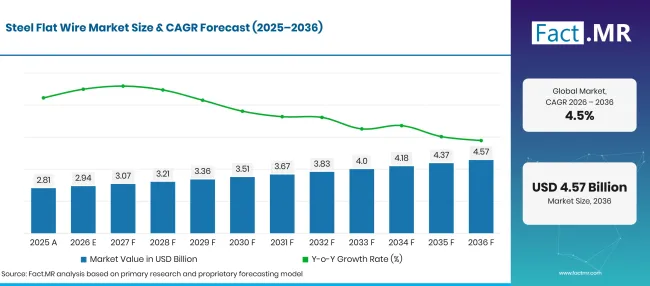
Steel Flat Wire Market Forecast Global | Source: Fact.MR
| Year | Basis | Market Value (USD billion) |
|---|---|---|
| 2025 | Estimated | 2.81 |
| 2026 | Estimate | 2.94 |
| 2036 | Forecast | 4.57 |
| CAGR 2026 to 2036 | forecast | 4.5% |
Source: Fact.MR analysis. Updated Oct 23, 2026
What are the defining numbers behind Steel Flat Wire Market growth?
USD 1.7 billion absolute opportunity between 2026 and 2036
- Demand Drivers in the Market
- Rising automotive manufacturing has driven the market growth. Flat steel wire can serve springs, clips, retaining components, reinforcement elements, and other formed parts, depending on the grade and dimensions. The International Organization of Motor Vehicle Manufacturers (OICA) reported that global motor vehicle production reached approximately 92.5 million units in 2024 [1].
- Equipment manufacturers use steel components that must withstand mechanical loads, repeated movement, and production stresses. The World Steel Association reported that global crude steel production was approximately 1,849.4 million tonnes in 2025 [2].
- Rising commercial construction and infrastructure development have driven the market growth. Steel flat wire may be used in fastening systems, reinforcement-related products, mechanical assemblies, and other applications requiring a defined cross-section. Demand depends on construction activity, engineering specifications, and the type of steel product selected for each component.
- Key Segments Analyzed
- By Material Type: Carbon Steel leads with a 38.5% share in 2026
- By Application: Industrial Machinery is listed as a leading application category in the segmentation which captures 85.8% in 2026.
- By End-User Industry: Automotive represents 44.5% share in 2026 within the defined market segmentation.
- By Distribution Channel: Direct Sales will account for 58.3% of the market in 2026.
- Analyst Opinion at Fact.MR
- Shambhu Nath Jha, Principal Consultant at Fact.MR, states, “Steel flat wire suppliers are likely to benefit from demand for precision-engineered components across automotive and industrial applications. Consistent cross-sectional dimensions, mechanical properties, surface quality, and grade-specific performance will remain important as manufacturers seek dependable materials for high-volume production.”
- Strategic Implications
- Steelmakers must align carbon steel, stainless steel, and alloy steel grades with verified requirements for strength, corrosion resistance, fatigue performance, and formability.
- Automotive component manufacturers need to validate wire dimensions, tensile properties, surface finish, and fatigue resistance against the design specifications of each application.
- Industrial machinery suppliers can assess material performance under repeated loading, bending, vibration, and operating-temperature variations.
- Distributors can maintain grade traceability, dimensional documentation, and reliable delivery schedules for customers with recurring production requirements.
- Manufacturers should strengthen direct technical collaboration with major buyers to improve product qualification, reduce production rejects, and support customized wire specifications.
Germany is projected to record a 5.0% CAGR through 2036. Brazil is set to post 4.5%, followed by the USA at 4.1%. The UK is estimated to advance at 3.7%, while Japan is forecast at 3.2%.
How does the Steel Flat Wire Market break down by segment?
Fact.MR finds that Carbon Steel leads Material Type at 38.5% and Direct Sales leads Distribution Channel at 58.3%. Automotive accounts for a reported 44.5% share, while the 85.8% share is attributed to Industrial Machinery in the Application segment.
Which Material Type dominates?
Carbon Steel is set to hold a 38.5% share in 2026.
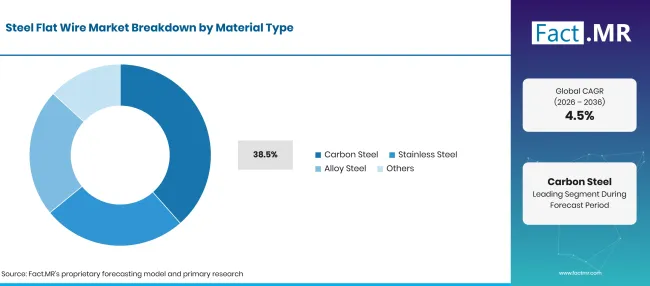
Steel Flat Wire Market Breakdown Material Type | Source: Fact.MR
| Material Type | Share (2026) |
|---|---|
| Carbon Steel (Leading segment) | 38.5% |
| Other segments combined | 61.5%* |
| Total | 100.0% |
Source: Fact.MR analysis. Updated Oct 23, 2026
Carbon steel flat wire serves applications that require mechanical strength, formability, and cost-effective production. Its suitability depends on carbon content, heat treatment, tensile strength, surface condition, and forming requirements. Stainless steel grades are relevant where corrosion resistance is important, while alloy steel can provide specific strength, wear, or fatigue properties. Buyers need to compare the properties of individual grades rather than treating each material family as interchangeable.
What leads the Application segment?
Industrial Machinery represent 85.8% share in 2026.
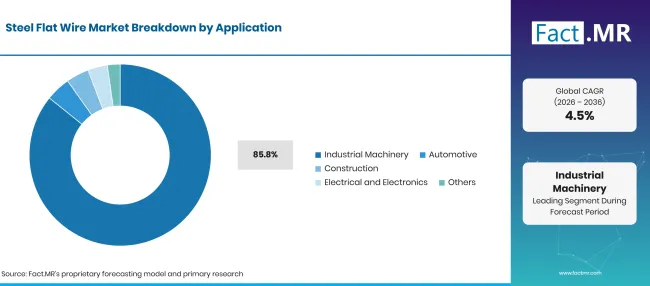
Steel Flat Wire Market Breakdown Application | Source: Fact.MR
| Application | Share (2026) |
|---|---|
| Industrial Machinery (Leading segment) | 85.8% |
| Other segments combined | 14.2%* |
| Total | 100.0% |
Source: Fact.MR analysis. Updated Oct 23, 2026
Industrial machinery dominates application segment of the steel flat wire market in 2026. Flat wire is used in industrial springs, retaining clips, precision-formed components, fastening systems, and machinery assemblies. Automotive applications require dimensional consistency and fatigue resistance, while construction applications depend on component specifications and operating conditions. Electrical and electronics applications may require controlled thickness, surface quality, and suitable electrical properties.
How does End-User Industry shape demand?
Automotive is likely to account for 44.5% share in 2026.
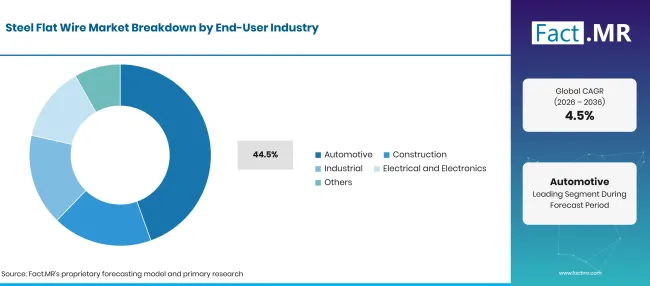
Steel Flat Wire Market Breakdown End User Industry | Source: Fact.MR
| End-User Industry | Share (2026) |
|---|---|
| Automotive (Leading segment) | 44.5% |
| Other segments combined | 55.5%* |
| Total | 100.0% |
Source: Fact.MR analysis. Updated Oct 23, 2026
Automotive leads the End-User Industry segment in 2026. Steel flat wire is used in automotive springs, retaining clips, fastening components, and precision-formed parts that require dimensional consistency and reliable mechanical performance. Construction applications depend on component design and structural requirements, while industrial machinery uses flat wire in springs, clips, and equipment assemblies. Electrical and electronics applications may require specific dimensional tolerances and surface characteristics. Other end-user industries contribute to the remaining demand.
Which Distribution Channel leads?
Direct Sales captures 58.3% share in 2026.
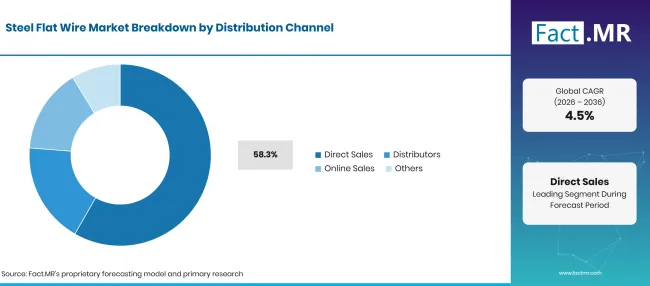
Steel Flat Wire Market Breakdown Distribution Channel | Source: Fact.MR
| Distribution Channel | Share (2026) |
|---|---|
| Direct Sales (Leading segment) | 58.3% |
| Other segments combined | 41.7%* |
| Total | 100.0% |
Source: Fact.MR analysis. Updated Oct 23, 2026
Direct sales allow steel flat wire manufacturers to coordinate technical requirements, order specifications, quality documentation, and production schedules with industrial buyers. Distributors can serve smaller customers and support regional inventory requirements. Online sales may facilitate product discovery and procurement of standardized grades, while other channels can accommodate specialized purchasing arrangements.
What is accelerating Steel Flat Wire Market adoption, and what is holding it back?
Demand for precision-engineered components supports steel flat wire adoption, while steel price volatility, grade qualification, and manufacturing tolerances can constrain market expansion.
Drivers Impact Analysis
| DRIVER | (~) % IMPACT ON CAGR | Geographic Relevance | Impact Timeline |
|---|---|---|---|
| Automotive component manufacturing | +1.0% | Europe, Asia, Americas | Medium term (2–4 years) |
| Demand for precision industrial components | +0.8% | Global | Medium term (2–4 years) |
| Construction and infrastructure requirements | +0.7% | Global | Long term (≥ 4 years) |
| Electrical and electronics component demand | +0.5% | Asia, Europe | Medium term (2–4 years) |
| Direct technical engagement with large buyers | +0.4% | Global | Short term (≤ 2 years) |
Source: Fact.MR analysis. Updated Oct 23, 2026
Opportunity Impact Analysis
| OPPORTUNITY | (~) % IMPACT ON CAGR | Geographic Relevance | Impact Timeline |
|---|---|---|---|
| High-strength and fatigue-resistant wire grades | +0.8% | Global | Medium term (2–4 years) |
| Customized dimensions and tighter tolerances | +0.6% | Europe, Asia, Americas | Medium term (2–4 years) |
| Corrosion-resistant stainless steel products | +0.5% | Global | Long term (≥ 4 years) |
| Improved process control and production yield | +0.4% | Global | Medium term (2–4 years) |
Source: Fact.MR analysis. Updated Oct 23, 2026
Restraints Impact Analysis
| RESTRAINT | (~) % IMPACT ON CAGR | Geographic Relevance | Impact Timeline |
|---|---|---|---|
| Volatility in steel and alloy input prices | -0.8% | Global | Short term (≤ 2 years) |
| Tight dimensional tolerances and rejection risks | -0.6% | Global | Medium term (2–4 years) |
| Qualification costs for specialized applications | -0.5% | Global | Medium term (2–4 years) |
| Competition from alternative materials or profiles | -0.4% | Global | Long term (≥ 4 years) |
Source: Fact.MR analysis. Updated Oct 23, 2026
Which countries are scaling the Steel Flat Wire Market through 2036?
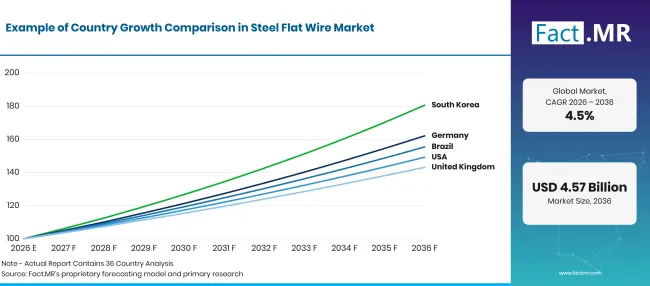
Steel Flat Wire Market Growth Index | Source: Fact.MR
| Country | CAGR (2026–2036) |
|---|---|
| Germany | 5.0% |
| Brazil | 4.5% |
| USA | 4.1% |
| UK | 3.7% |
| Japan | 3.2% |
Source: Fact.MR analysis. Updated Oct 23, 2026
What supports Germany adoption?
5.0% CAGR, supported by automotive engineering, industrial machinery, and precision manufacturing applications.
Germany's steel and manufacturing base provides a relevant setting for flat wire used in formed components and industrial assemblies. World Steel Association data show that Germany produced 34.1 million tonnes of crude steel in 2025, compared with 37.3 million tonnes in 2024 [2]. This decline demonstrates that downstream flat wire opportunities depend on product mix and end-user demand rather than steel production alone. Automotive and machinery manufacturers may require flat wire grades with defined strength, fatigue resistance, and dimensional tolerances.[9]
How is Brazil developing steel flat wire adoption?
4.5% CAGR, led by steel processing, industrial equipment, and automotive-related applications.
Brazil's domestic steel industry provides a potential supply base for flat wire and other processed steel products. Instituto Aço Brasil reported 33.4 million tonnes of crude steel production and 32.2 million tonnes of steel products in 2025 [3]. These figures establish the scale of the domestic steel sector. Flat wire demand will depend on downstream manufacturing, component specifications, conversion capacity, and purchasing requirements.
What supports United States adoption?
4.1% CAGR, backed by industrial equipment, automotive components, and specialized manufacturing.
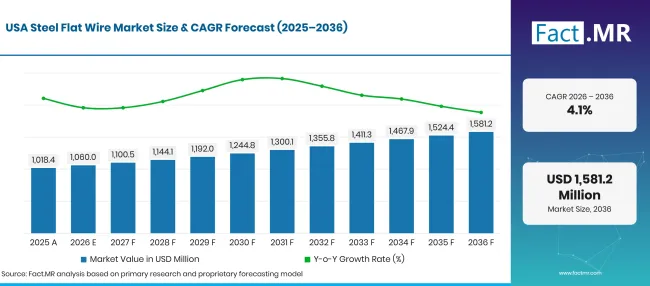
Steel Flat Wire Market Forecast Usa 1 | Source: Fact.MR
The United States is a significant steel-producing country and a major market for manufactured equipment and vehicles. World Steel Association figures indicate that U.S. crude steel production reached approximately 82.0 million tonnes in 2025, up 3.1% from 2024 [2]. This provides a relevant indicator of domestic steel production activity, but it does not directly establish demand for flat wire. Industrial machinery and automotive component manufacturers remain important potential buyers of appropriately specified products.[10]
How is the United Kingdom building adoption?
3.7% CAGR, shaped by specialized engineering, automotive components, and industrial manufacturing.
The UK's steel flat wire market depends on downstream manufacturing requirements, imports, distribution networks, and the availability of grades suitable for precision components. The Office for National Statistics reported that UK manufacturing output increased by 0.5% over the three months to July 2026 compared with the three months to April 2026 [4]. This provides context for the wider manufacturing environment, although it does not directly measure flat wire consumption. Suppliers can compete through reliable specifications, material traceability, and dependable delivery.
What supports Japan adoption?
3.2% CAGR, driven by precision engineering, automotive production, and industrial component manufacturing.
Japan's steel and component industries provide potential applications for flat wire requiring dimensional accuracy and consistent mechanical properties. World Steel Association data show that Japanese crude steel production reached 80.7 million tonnes in 2025, compared with 84.0 million tonnes in 2024 [2]. This decline highlights the need to distinguish the overall steel industry's performance from demand for specialized processed products. Flat wire adoption will depend on component design, grade selection, and production requirements.[11]
Who leads the Steel Flat Wire Market?
Fact.MR profiles ArcelorMittal, voestalpine AG, BRUKER-SPALECK GmbH, Ulbrich, and United Wire Company across the steel flat wire market. Manufacturer product portfolios include flat or precision-profiled wire for industrial applications.
voestalpine manufactures drawn and rolled flat and shaped steel wire. BRUKER-SPALECK manufactures precision flat and profile wire, while Ulbrich supplies precision-rolled flat wire. ArcelorMittal and United Wire Company also offer flat or shaped wire products. Competitive positioning depends on grade, dimensional tolerances, surface finish, and reliable delivery.
Commercial competition depends on material grades, dimensional tolerances, surface quality, mechanical properties, and customization capabilities. Industrial buyers prioritize consistent product specifications and dependable delivery schedules. Automotive and machinery manufacturers require materials meeting application-specific performance standards.
Which companies are the key providers?
The key competitive set includes: ArcelorMittal; voestalpine AG, BRUKER-SPALECK GmbH, Ulbrich Stainless Steels, and United Wire Company
- ArcelorMittal
- voestalpine AG
- BRUKER-SPALECK GmbH
- Ulbrich Stainless Steels
- United Wire Company
Bibliography
- [1] International Organization of Motor Vehicle Manufacturers. (2025). 2024 production statistics.
- [2] World Steel Association. (2026). World Steel in Figures 2026.
- [3] Instituto Aço Brasil. (n.d.). Dados do setor: Dados consolidados referentes ao ano de 2025. Retrieved October 22, 2026, from
- [4] Office for National Statistics. (2026, September 11). Index of Production, UK: July 2026.
- [5] European Automobile Manufacturers’ Association. (2026, September 24). The automobile industry pocket guide 2026.
- [6] Ministry of Economy, Trade and Industry. (2026, June 30). Current survey of production.
- [7] Statistisches Bundesamt (Destatis). (2026, February 6). Production in December 2025: -1.9% on the previous month.
- [8] U.S. Census Bureau. (n.d.). Economic indicators. Retrieved October 22, 2026, from
- [9] Kefeli, E. (2026, May 25). WV Stahl: German steel sector facing “turning point” amid weak demand and high energy costs. SteelOrbis.
- [10] W&C Staff. (2026, February 18). Steel production shifts: U.S. passes Japan in 2025 as imports fall. Walls & Ceilings.
- [11] Ministry of Steel, Government of India. (2026, July). An overview of steel sector.
- [12] ASTM International. (2026). Standard specification for steel, flat wire, carbon, cold-rolled (ASTM A805/A805M-26).
This Report Answers
- The report examines steel flat wire demand across the specified material types and industrial applications.
- Segment analysis identifies the leading material and distribution channel using the 2026 market shares.
- Country analysis discusses Germany, Brazil, the USA, the UK, and Japan alongside official steel production and manufacturing indicators.
- The competitive overview profiles ArcelorMittal; voestalpine AG, BRUKER-SPALECK GmbH, Ulbrich Stainless Steels, and United Wire Company, subject to product-level verification.
- Market analysis evaluates material properties, manufacturing requirements, distribution channels, and downstream demand drivers.
What does the Steel Flat Wire Market cover?
The market covers steel flat wire products used in applications requiring a defined cross-section and specific mechanical or surface properties. It evaluates carbon steel, stainless steel, alloy steel, and other material categories across industrial machinery, automotive, construction, electrical and electronics, and other applications.
Demand depends on the wire's dimensions, strength, formability, corrosion resistance, fatigue performance, and suitability for the intended component. Market analysis also considers distribution arrangements, customer qualification requirements, and the availability of suitable material grades.
What is included in the scope?
The analysis includes steel flat wire products that fall within the defined product category and are sold for industrial or commercial applications. It considers products through direct sales, distributors, online channels, and other distribution arrangements. The assessment covers the material types, application categories, end-user industries, and geographic markets.
What is excluded from the scope?
Unless explicitly included in the original market definition, the analysis excludes conventional round steel wire, standard steel rods, unrelated steel strip and sheet products, and finished components sold independently of the flat wire product. Steel cables, wire ropes, and other downstream assemblies are also excluded unless the underlying methodology explicitly counts them as part of the market.
How Was the Analysis Built?
The analysis draws on 120+ sources, 35+ company portfolios, 25+ countries, and more than 20 industry interviews.
- Primary Research: Primary research includes discussions with manufacturers, service providers, technology developers, distributors, end users, and subject-matter experts. These conversations examine purchasing priorities, product adoption, operational challenges, approval requirements, competitive positioning, and the factors that influence wider market acceptance.
- Desk Research: Desk research covers government statistics, regulatory publications, company filings, trade data, technical studies, industry associations, standards, public policy, and other authoritative sources. Every source used in the analysis is documented in the bibliography.
- Market Sizing and Forecasting: Market estimates combine historical performance, demand indicators, pricing and volume trends, segment shares, company participation, country-level growth, adoption patterns, investment activity, and barriers to market expansion.
- Data Validation and Update Cycle: Findings are validated by comparing primary interviews with public data, company activity, regulatory changes, trade patterns, and industry developments. Regular updates review new product launches, capacity changes, partnerships, approvals, and shifts in commercial adoption.
Segmentation
What is the report's scope and coverage?
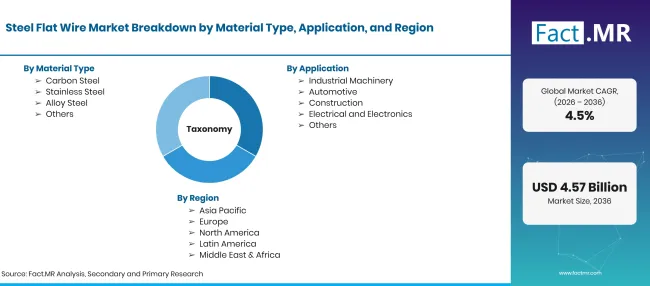
Steel Flat Wire Market Taxonomy | Source: Fact.MR
| Attribute | Details |
|---|---|
| Quantitative Units | USD billion in 2026 to USD billion by 2036, at CAGR |
| Market Definition | Steel flat wire products manufactured to defined cross-sectional dimensions and mechanical specifications |
| Material Type | Carbon Steel; Stainless Steel; Alloy Steel; Others |
| Application | Industrial Machinery; Automotive; Construction; Electrical and Electronics; Others |
| End-User Industry | Automotive; Construction; Industrial; Electrical and Electronics; Others |
| Distribution Channel | Direct Sales; Distributors; Online Sales; Others |
| Regions Covered | North America; Latin America; Western Europe; Eastern Europe; East Asia; South Asia & Pacific; Middle East & Africa |
| Countries Covered | Germany; Brazil; USA; UK; Japan |
| Companies Profiled | ArcelorMittal; voestalpine AG, BRUKER-SPALECK GmbH, Ulbrich Stainless Steels, and United Wire Company |
| Forecast Period | 2026 to 2036 |
| Approach | Market segmentation and scenario-based forecasting supported by official steel production and downstream industrial statistics |
Source: Fact.MR analysis. Updated Oct 23, 2026
How is the market segmented?
-
By Material Type
- Carbon Steel
- Stainless Steel
- Alloy Steel
- Others
-
By Application
- Industrial Machinery
- Automotive
- Construction
- Electrical and Electronics
- Others
-
By End-User Industry
- Automotive
- Construction
- Industrial
- Electrical and Electronics
- Others
-
By Distribution Channel
- Direct Sales
- Distributors
- Online Sales
- Others
-
By Region
- North America
- Latin America
- Western Europe
- Eastern Europe
- East Asia
- South Asia & Pacific
- Middle East & Africa
Frequently Asked Questions
How big is the Steel Flat Wire Market in 2026?
What is the CAGR from 2026 to 2036?
Which material type has the largest share?
Which application leads the market?
Which end-user industry has the largest share?
Which distribution channel leads?
Which countries are forecast to grow fastest?
Which companies are covered?
Who worked on this report


Preview the report firsthand - request a free sample
Free SampleGet the brochure for pricing and purchase details
Download PDF