- Market Value (2025): USD 3.6 Bn
- Estimated Value (2026): USD 3.8 Bn
- Forecast Value (2036): USD 6.9 Bn
- CAGR (2026-2036): 6.2%
What is the Beverage Can Non-BPA Linings Market forecast to be worth by 2036?
USD 3.8 billion in 2026 to USD 6.9 billion by 2036 at a 6.2% CAGR.
- As per Fact.MR analysis, the beverage can non-BPA linings market reached USD 3.6 billion in 2025.
- Demand is projected to increase from USD 3.8 billion in 2026 to USD 6.9 billion by 2036.
- The market is forecast to record a 6.2% CAGR from 2026 to 2036 as canmakers qualify non-BPA internal coatings for beverage bodies and ends.
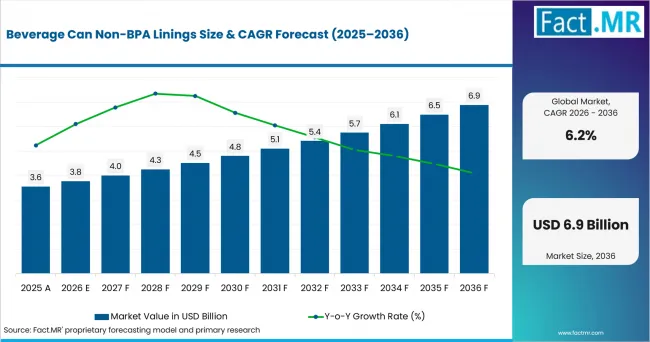
Beverage Can Non Bpa Linings Value Analysis | Source: Fact.MR
What are the defining numbers behind Beverage Can Non-BPA Linings Market growth?
An absolute opportunity of USD 3.1 billion is projected between 2026 and 2036.
- Demand Drivers in the Market
- Beverage can makers use inner coatings to prevent corrosion and keep the drink’s taste and smell stable during storage.
- European beverage companies are increasing coating testing and approval work. European Commission guidance from December 2025 confirms that BPA rules cover epoxy coatings used for food contact [1].
- Fast can production lines require thin coatings that stay strong during shaping and heat treatment. In April 2025, Sherwin-Williams reported that more than 250 billion cans coated with valPure V70 had entered the market [9].
- Recycling programs favor coatings that work well with aluminum can recycling and existing can production methods.
- Key Segments Analyzed
- By Coating Chemistry: Polyester will hold 34.0% share in 2026 since its flexibility and chemical resistance suit beverage-can forming and internal protection.
- By Package Type: Beverage cans will account for 31.0% share in 2026, supported by high filling volumes and the need for continuous internal protection.
- By Coating Position: Internal lining will capture 36.0% share in 2026 because it forms the main barrier between the beverage and the metal surface.
- By Performance: Corrosion resistance will represent 29.0% share in 2026 owing to the need to protect exposed metal from beverage acids and carbonation.
- Analyst Opinion at Fact.MR
- Shambhu Nath Jha, Principal Consultant at Fact.MR, states, “A non-BPA coating must protect the drink and work well on existing can production lines. Suppliers with clear safety and regulatory documents, along with proven results for can shaping and product taste, are more likely to receive approval. The coating also has to dry properly under normal production conditions and keep the same quality at high production speeds. Good laboratory results alone are not enough for large-scale can production.”
- Strategic Implications
- Testing can body and end coatings together helps keep coating quality the same after shaping and heat treatment. In March 2025, the Aluminum Association and Can Manufacturers Institute reported that nearly 97% of recycled U.S. aluminum beverage cans become new cans [2].
- Beverage brands benefit from setting taste and migration limits early because different drinks affect the inner coating in different ways during filling and storage. Clear limits make production tests easier to compare and help decide when a coating is ready for wider use.
- Clear drying conditions and production-speed guidance help coating makers support tests on existing can lines. Simple operating ranges also help factory staff adjust oven settings and coating thickness without adding extra testing steps.
China is expected to grow at 7.3% CAGR through 2036, followed by Japan at 6.2%. The USA and France each reach 5.8%, while Germany records 5.6%. Growth differs across these countries because beverage production, can manufacturing, and coating approval requirements vary in each market.
How does the Beverage Can Non-BPA Linings Market break down by segment?
Polyester leads Coating Chemistry at 34.0%, while Beverage cans lead Package Type at 31.0%. Internal lining leads Coating Position at 36.0%, and Corrosion resistance leads Performance at 29.0%.
Which Coating Chemistry dominates?
Polyester is projected to hold 34.0% share in 2026.
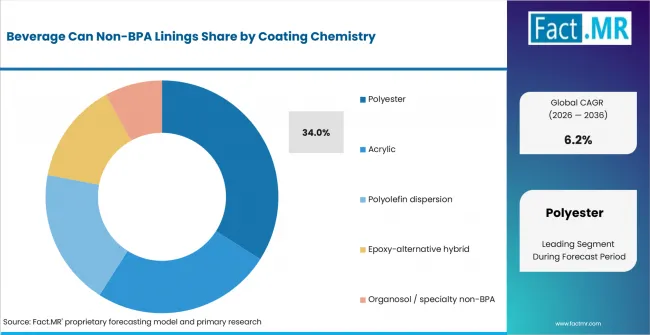
Beverage Can Non Bpa Linings Analysis By Coating Chemistry | Source: Fact.MR
Polyester is expected to lead because it sticks well to cans, stays flexible during shaping, and protects the metal from the drink. Acrylic coatings are useful when a clear finish and even drying are important. Polyolefin coatings provide another non-BPA option for metal packaging. Epoxy-alternative blends are used when the coating needs to behave in a familiar way during can shaping.
What leads the Package Type segment?
Beverage cans are estimated to account for 31.0% share in 2026.
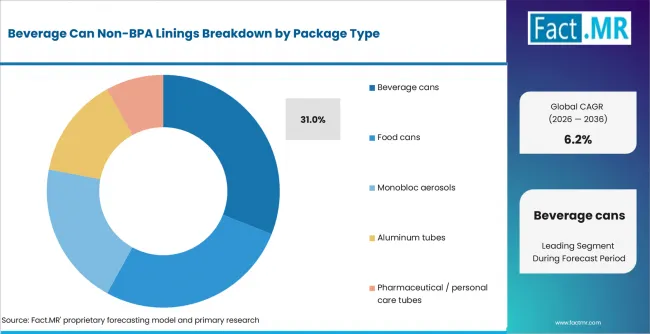
Beverage Can Non Bpa Linings Analysis By Package Type | Source: Fact.MR
Beverage cans are estimated to lead since the inner coating keeps the drink away from the metal during filling and storage. Food can coatings also have to handle heat during processing, while aerosol and tube coatings must stay strong during shaping. In April 2025, the U.S. Department of Agriculture reported that the producer price index for canned vegetables and juices fell 1.7% from Q1 2024 to Q1 2025 [3].
How does Coating Position shape demand?
Internal lining is anticipated to capture 36.0% share in 2026.
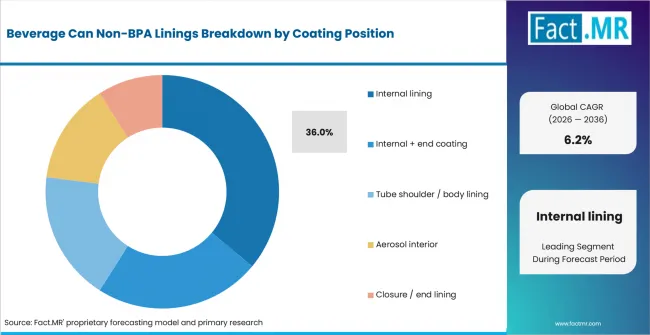
Beverage Can Non Bpa Linings Analysis By Coating Position | Source: Fact.MR
Internal linings are anticipated to lead as they form the main protective layer between the drink and the metal. End coatings protect lids and easy-open ends and must stay strong after shaping. Coatings used inside tubes and aerosols also have to remain flexible and stay in place during shaping and filling.
What performance requirement leads?
Corrosion resistance is forecast to represent 29.0% share in 2026.
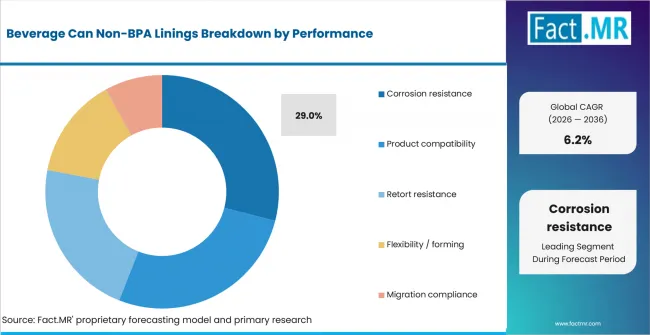
Beverage Can Non Bpa Linings Analysis By Performance | Source: Fact.MR
Corrosion resistance is forecast to lead because acids and carbonation in drinks may damage exposed metal if the coating breaks down. The right coating also helps keep the drink’s taste and appearance stable during storage. Heat resistance is important for packaging that goes through heat treatment, while flexibility keeps the coating strong during shaping. Migration limits are also checked before coatings are approved for food-contact use.
What is accelerating Beverage Can Non-BPA Linings Market adoption, and what is holding it back?
BPA restrictions and testing on can production lines increase demand, while long approval times and differences in coating performance can slow growth.
Drivers Impact Analysis
| DRIVER | (~) % IMPACT ON CAGR | GEOGRAPHIC RELEVANCE | IMPACT TIMELINE |
|---|---|---|---|
| BPA restrictions in food-contact coatings | +1.4% | Western Europe, Global exporters | Short term (<= 2 years) |
| Beverage-end conversion to BPA-NI systems | +1.1% | North America, Europe, Asia | Short term (<= 2 years) |
| Corrosion and sensory protection requirements | +0.9% | Global | Medium term (2-4 years) |
| Closed-loop aluminum can recycling | +0.7% | North America, Europe, Japan | Medium term (2-4 years) |
| High-speed can and end production | +0.5% | Global | Long term (>= 4 years) |
Source: Fact.MR analysis. Updated Oct 7, 2026
Opportunity Impact Analysis
| OPPORTUNITY | (~) % IMPACT ON CAGR | GEOGRAPHIC RELEVANCE | IMPACT TIMELINE |
|---|---|---|---|
| Low-film-weight beverage-end coatings | +0.8% | North America, Europe, Asia | Medium term (2-4 years) |
| Non-BPA epoxy and hybrid chemistry | +0.7% | Global | Medium term (2-4 years) |
| Regional production for qualified grades | +0.5% | Asia, Europe, North America | Long term (>= 4 years) |
| Multi-beverage coating platforms | +0.4% | Global | Long term (>= 4 years) |
Source: Fact.MR analysis. Updated Oct 7, 2026
Restraints Impact Analysis
| RESTRAINT | (~) % IMPACT ON CAGR | GEOGRAPHIC RELEVANCE | IMPACT TIMELINE |
|---|---|---|---|
| Long canmaker and brand qualification cycles | -0.7% | Global | Medium term (2-4 years) |
| Film failures during forming or seaming | -0.5% | Global | Short term (<= 2 years) |
| Different migration rules by market | -0.4% | Europe, Asia, North America | Medium term (2-4 years) |
| Soft beverage or beer volumes in some markets | -0.3% | Western Europe | Short term (<= 2 years) |
Source: Fact.MR analysis. Updated Oct 7, 2026
Which countries are scaling the Beverage Can Non-BPA Linings Market through 2036?
- China is projected to keep a 1.1-point lead over Japan as domestic beverage output and aluminum supply support large packaging volumes.
- Japan is anticipated to stay 0.4 points above the USA because soft-drink sales and high can-recycling rates support continuous coating demand.
- The USA and France are each estimated at 5.8%, but their demand routes differ between recycling-led can use and regulation-led coating conversion.
- Germany is forecast at 5.6% as canmakers work through regulatory change while the domestic beer category remains under volume pressure.
Beverage Can Non-BPA Linings Market coverage is segmented into North America, Latin America, Western Europe, Eastern Europe, East Asia, South Asia & Pacific, and Middle East & Africa.
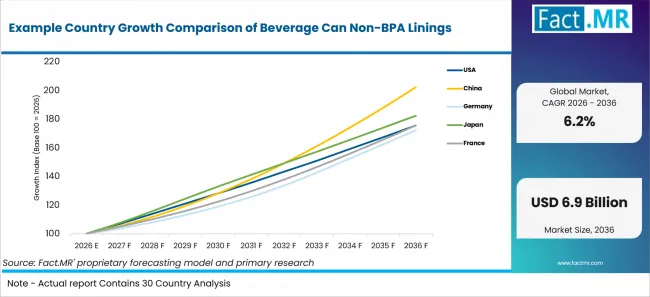
Example Country Growth Comparison Of Beverage Can Non Bpa Linings | Source: Fact.MR
| Country | CAGR (2026 to 2036) |
|---|---|
| China | 7.3% |
| Japan | 6.2% |
| USA | 5.8% |
| France | 5.8% |
| Germany | 5.6% |
Source: Fact.MR analysis. Updated Oct 7, 2026
What supports China adoption?
7.3% CAGR, supported by beverage retail activity and local can production.
China’s large beverage market supports high can production and regular testing of inner coatings. In January 2026, the National Bureau of Statistics reported that beverage retail sales at enterprises above designated size reached CNY 329.5 billion in 2025 [5]. Can makers prefer coatings that dry evenly and work well on fast production lines.
How is Japan scaling demand?
6.2% CAGR, shaped by packaged beverage spending and strict quality requirements.
Japanese can makers focus on keeping coating quality steady without affecting the drink’s taste or smell. In February 2026, Japan’s Statistics Bureau reported that average monthly consumption expenditure for two-or-more-person households reached JPY 314,001 per household in 2025 [6]. Steady consumer spending supports demand for packaged beverages.
What supports the USA outlook?
5.8% CAGR, supported by a large beverage manufacturing base and established canmaking capacity.
U.S. beverage production creates demand for can coatings that prevent corrosion and protect the drink’s taste. In September 2026, the U.S. Census Bureau reported that beverage and tobacco product manufacturing generated USD 180.53 billion in value of shipments in 2024 [4].
How is France developing demand?
5.8% CAGR, reinforced by packaged drink spending and European food-contact conversion.
French beverage companies continue to test and approve non-BPA coatings as European food-contact rules change. In June 2026, INSEE reported that French households spent EUR 192.8 billion on food and non-alcoholic drinks in 2025 [7]. High consumer spending in this category supports the continued use of coated metal packaging.
What underpins Germany growth?
5.6% CAGR, supported by established beverage filling and coating compliance work.
Germany has a large beverage industry that uses metal packaging for many products. In February 2026, Destatis reported that German breweries and beer warehouses sold about 7.8 billion liters of beer in 2025 [8]. Can makers serving this market continue to test inner coatings for corrosion protection and strength during can shaping.
Who leads the Beverage Can Non-BPA Linings Market?
PPG Industries and AkzoNobel offer non-BPA coatings for beverage can bodies and ends. PPG offers INNOVEL and iSENSE coatings, while AkzoNobel offers BPAni coatings for beverage cans.
Sherwin-Williams offers valPure non-BPA coatings for metal packaging. ACTEGA supplies coatings for beverage can ends, closures, and other metal packaging. TOYOCHEM also offers can coatings for beverage applications.
Companies focus on corrosion protection, taste protection, can shaping, drying, and food-contact requirements. Coatings that work with different drinks, can types, and existing production lines are easier for can makers to use.
Which companies are the key providers?
Key companies include PPG Industries; AkzoNobel; Sherwin-Williams; ACTEGA; and TOYOCHEM.
- PPG Industries
- AkzoNobel
- Sherwin-Williams
- ACTEGA
- TOYOCHEM
Bibliography
- [1] European Commission, Directorate-General for Health and Food Safety. (2025, December 17). Note for Guidance on the implementation of Commission Regulation (EU) 2024/3190 on the use of bisphenol A (BPA) and other bisphenols and bisphenol derivatives with harmonised classification for specific hazardous properties in certain materials and articles intended to come into contact with food.
- [2] The Aluminum Association & Can Manufacturers Institute. (2025, March 18). Aluminum beverage can moves from recycling bin to newly formed can in less than 60 days.
- [3] Davis, W. V., Weber, C., Wakefield, H., & Wechsler, S. J. (2025, April 24). Vegetables and Pulses Outlook: April 2025 (VGS-375). U.S. Department of Agriculture, Economic Research Service.
- [4] U.S. Census Bureau. (2026, September 3). Census Bureau releases new Annual Integrated Economic Survey data.
- [5] National Bureau of Statistics of China. (2026, January 20). Total Retail Sales of Consumer Goods in December 2025.
- [6] Statistics Bureau of Japan. (2026, February 6). Family Income and Expenditure Survey: 2025 yearly average.
- [7] Beretti, P.-A., & Pereira, É. (2026, June 16). Household Consumption in 2025: Household Consumption Slowed despite a Sharp Deceleration in Prices. Insee.
- [8] Statistisches Bundesamt (Destatis). (2026, February 2). 6,0 % weniger Bier im Jahr 2025 abgesetzt [Beer sales down 6.0% in 2025].
- [9] Sherwin-Williams. (2025, April 16). Discovering a New Epoxy Coating – How valPure® V70 Changed the Game [Video].
- [10] AkzoNobel Packaging Coatings. (2025, November 4). AkzoNobel introduces next-generation BPAni coatings to Brazilian beverage market at Abralatas 2025.
- [11] ACTEGA. (2026, April 2). ACTEGA to Showcase Next-Generation Metal Packaging Solutions at METPACK 2026.
- [12] TOYOCHEM Co., Ltd. (2026, June 29). The “Draft Beer Can” using can coatings, jointly developed by TOYOCHEM and Asahi Breweries, won the 2026 National Invention Award Invention Award.
This Report Answers
- The report explains segmentation by chemistry, package type, coating position and performance clearly.
- Segment analysis identifies each 2026 leading subsegment and its share.
- Country analysis compares China, Japan, the USA, France and Germany using official evidence.
- Competitive analysis reviews verified suppliers active in metal packaging.
- Technology analysis examines corrosion resistance, compatibility, forming and migration compliance.
What does the Beverage Can Non-BPA Linings Market cover?
The market covers internal and related metal-packaging coatings that separate filled products from metal substrates. It includes polyester, acrylic, polyolefin dispersion, epoxy-alternative hybrid and specialty non-BPA chemistry. The scope follows coatings used on beverage cans, food cans, aerosols and metal tubes. It focuses on the coating value itself, along with the performance needs that guide approval. These needs include corrosion control, product compatibility, heat resistance, forming flexibility and migration compliance.
What is included in the scope?
The scope includes coatings sold for internal can bodies, ends and related metal-package surfaces. BPA-NI and other non-BPA systems are included when positioned for the covered package and food-contact use.
What is excluded from the scope?
The scope excludes can metal, inks, decorative coatings, adhesives and closure compounds without a lining function. Complete cans are excluded as finished packaging revenue. Conventional BPA-based epoxy coatings sit outside the non-BPA boundary.
How Was the Analysis Built?
The analysis draws on 120+ sources, 35+ company portfolios, 25+ countries, and more than 20 industry interviews.
- Primary Research: Primary research includes discussions with manufacturers, service providers, technology developers, distributors, end users, and subject-matter experts. These conversations examine purchasing priorities, product adoption, operational challenges, approval requirements, competitive positioning, and the factors that influence wider market acceptance.
- Desk Research: Desk research covers government statistics, regulatory publications, company filings, trade data, technical studies, industry associations, standards, public policy, and other authoritative sources. Every source used in the analysis is documented in the bibliography.
- Market Sizing and Forecasting: Market estimates combine historical performance, demand indicators, pricing and volume trends, segment shares, company participation, country-level growth, adoption patterns, investment activity, and barriers to market expansion.
- Data Validation and Update Cycle: Findings are validated by comparing primary interviews with public data, company activity, regulatory changes, trade patterns, and industry developments. Regular updates review new product launches, capacity changes, partnerships, approvals, and shifts in commercial adoption.
Segmentation
What is the report’s scope and coverage?
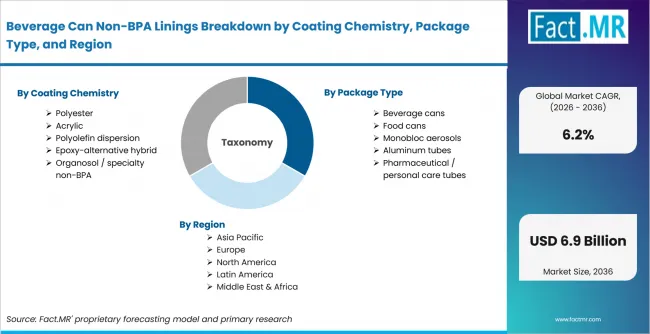
Beverage Can Non Bpa Linings Breakdown By Coating Chemistry, Package Type, And Region | Source: Fact.MR
| Attribute | Details |
|---|---|
| Quantitative Units | USD billion |
| Market Definition | Internal and related food-contact coating systems formulated without intentionally added BPA for metal beverage cans, ends and adjacent metal packaging uses. The scope focuses on linings that protect product quality and metal integrity. |
| Coating Chemistry | Polyester; Acrylic; Polyolefin dispersion; Epoxy-alternative hybrid; Organosol / specialty non-BPA |
| Package Type | Beverage cans; Food cans; Monobloc aerosols; Aluminum tubes; Pharmaceutical / personal care tubes |
| Coating Position | Internal lining; Internal + end coating; Tube shoulder / body lining; Aerosol interior; Closure / end lining |
| Performance | Corrosion resistance; Product compatibility; Retort resistance; Flexibility / forming; Migration compliance |
| Regions Covered | North America; Latin America; Western Europe; Eastern Europe; East Asia; South Asia & Pacific; Middle East & Africa |
| Countries Covered | China; Japan; USA; France; Germany |
| Key Companies Profiled | PPG Industries; AkzoNobel; Sherwin-Williams; ACTEGA; TOYOCHEM |
| Forecast Period | 2026 to 2036 |
| Approach | Hybrid top-down and bottom-up approach using beverage packaging activity, coating qualification requirements, regulatory evidence, segment shares, country growth and verified supplier portfolios. |
Source: Fact.MR analysis. Updated Oct 7, 2026
How is the market segmented?
-
By Coating Chemistry:
- Polyester
- Acrylic
- Polyolefin dispersion
- Epoxy-alternative hybrid
- Organosol / specialty non-BPA
-
By Package Type:
- Beverage cans
- Food cans
- Monobloc aerosols
- Aluminum tubes
- Pharmaceutical / personal care tubes
-
By Coating Position:
- Internal lining
- Internal + end coating
- Tube shoulder / body lining
- Aerosol interior
- Closure / end lining
-
By Performance:
- Corrosion resistance
- Product compatibility
- Retort resistance
- Flexibility / forming
- Migration compliance
-
By Region:
- North America
- Latin America
- Western Europe
- Eastern Europe
- East Asia
- South Asia & Pacific
- Middle East & Africa
Frequently Asked Questions
How big is the Beverage Can Non-BPA Linings Market in 2026?
What is the CAGR from 2026 to 2036?
Which coating chemistry leads?
Which package type leads?
Who are the main companies in the market?
Who worked on this report


Preview the report firsthand - request a free sample
Free SampleGet the brochure for pricing and purchase details
Download PDF