Beverage Packaging Equipment Market
Beverage Packaging Equipment Market Size and Share Forecast Outlook 2026 to 2036
Beverage packaging equipment market is projected to grow from USD 11.1 billion in 2026 to USD 19.6 billion by 2036, at a CAGR of 5.9%. Filling and Capping Machines will dominate with a 35.9% market share, while fully automatic will lead the automation segment with a 30.5% share.
Beverage Packaging Equipment Market Forecast and Outlook 2026 to 2036
The global beverage packaging equipment market is projected to grow from USD 11.05 billion in 2026 to USD 19.56 billion by 2036. This translates into a total growth of 77.0%, with the market forecast to expand at a CAGR of 5.9% between 2026 and 2036.
Key Takeaways from the Beverage Packaging Equipment Market
- Beverage Packaging Equipment Market Value (2026): USD 11.05 billion
- Beverage Packaging Equipment Market Forecast Value (2036): USD 19.56 billion
- Beverage Packaging Equipment Market Forecast CAGR (2026 to 2036): 5.9%
- Leading Type in Beverage Packaging Equipment Market: Filling and Capping Machines (35.9%)
- Leading Automation Level in Beverage Packaging Equipment Market: Fully Automatic (56.7%)
- Leading Application in Beverage Packaging Equipment Market: Bottled Water (30.5%)
- Key Growth Regions in Beverage Packaging Equipment Market: Asia Pacific, North America, and Europe
- Key Players in Beverage Packaging Equipment Market: Barry-Wehmiller Companies, Syntegon Technology GmbH, Bradman Lake Group Ltd., Coesia S.p.A., Clearpack, EconoCorp Inc., GEA Group, Jacob White Packaging Ltd., KHS Group, Mpac Group plc, A. Jones, Sacmi, Sidel Group, SIG Combibloc Group, Tetra Laval/Tetra Pak
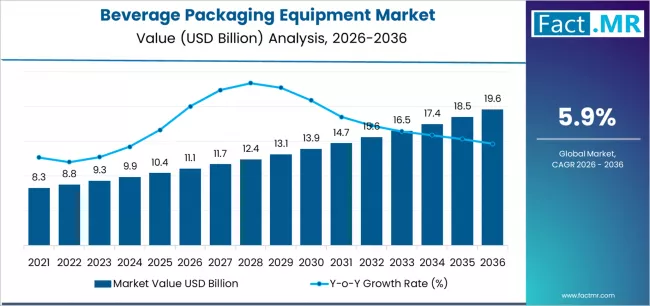
The market for beverage packaging equipment will grow 1.8X during this period, supported by exponential demand for automated packaging solutions, rising beverage consumption patterns, and growing emphasis on sustainable packaging innovation and operational efficiency optimization across global beverage manufacturing operations.
The beverage packaging equipment market is positioned for substantial expansion, driven by increasing consumer demand for packaged beverages, growing adoption of advanced automation technologies, and rising focus on production efficiency and sustainability standards across bottling and packaging facilities globally.
The market demonstrates robust fundamentals supported by expanding beverage manufacturing capacity, industry players' focus on high-speed packaging solutions, and rising recognition of automated packaging equipment as critical components in achieving enhanced production throughput, reduced operational costs, and quality assurance effectiveness within modern beverage manufacturing architectures across diverse application segments.
Beverage Packaging Equipment Market
| Metric | Value |
|---|---|
| Estimated Value (2026E) | USD 11.05 billion |
| Forecast Value (2036F) | USD 19.56 billion |
| Forecast CAGR (2026 to 2036) | 5.9% |
Category
| Category | Segments |
|---|---|
| Type | Filling and Capping Machines; Labelling and Coding Machines; Palletizing and Depalletizing Machines; Conveying and Handling Machines; Cleaning and Sterilizing Machines; Wrapping and Bundling Machines; Cartoning Machines; Others |
| Automation | Fully Automatic; Semi-Automatic; Manual |
| Application | Bottled Water; Dairy Beverage; Alcoholic Beverages; Others |
| Region | Asia Pacific; North America; Europe; Latin America; Middle East & Africa |
Segmental Analysis
How do Filling and Capping Machines Drive Market Leadership in Beverage Packaging Equipment?
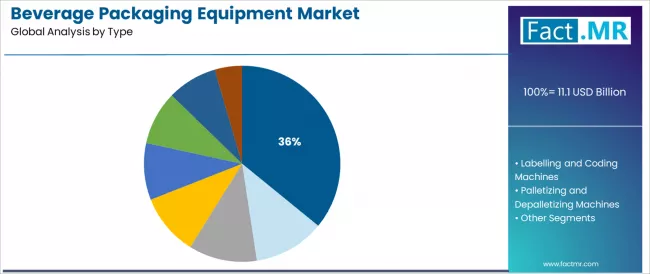
The filling and capping machines segment is projected to account for 35.9% of the beverage packaging equipment market in 2026, reaffirming its position as the category's dominant equipment type specification.
Beverage manufacturers increasingly recognize the optimal balance of production efficiency and operational reliability offered by filling and capping systems for bottling applications, particularly in high-speed production operations and multi-format packaging environments.
Why does Fully Automatic Equipment Command Majority Market Share?
Fully automatic equipment is projected to represent 56.7% of beverage packaging equipment demand in 2026, underscoring its role as the primary automation category driving market adoption and packaging technology deployment.
Beverage manufacturers recognize that fully automatic systems, including integrated production lines, sophisticated control systems, and comprehensive monitoring capabilities, provide the largest addressable market that semi-automatic applications cannot match in operational efficiency and production consistency.
What drives Bottled Water Application Segment Prominence?
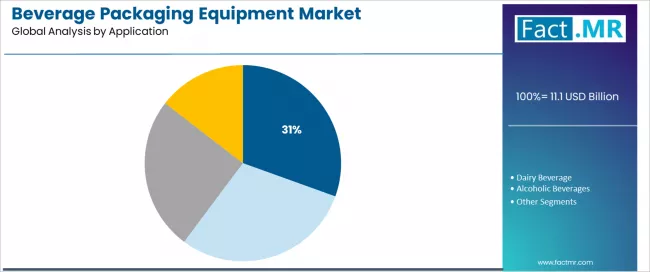
The bottled water application is projected to account for 30.5% of the beverage packaging equipment market in 2026, establishing its position as the leading application segment. Beverage manufacturers increasingly recognize that bottled water production, encompassing mineral water bottling, purified water packaging, and flavored water manufacturing, represents the most significant and volume-intensive category requiring specialized packaging equipment due to market size and consumption prevalence.
What are the Drivers, Restraints, and Key Trends of the Beverage Packaging Equipment Market?
The beverage packaging equipment market is driven by rising beverage consumption and increasing adoption of automated packaging systems to improve efficiency and consistency. Manufacturers are investing in automation to manage higher production volumes and meet quality standards. Growth is constrained by high capital costs, particularly in price-sensitive emerging markets, technical complexity in handling multiple packaging formats, and maintenance challenges in resource-limited bottling facilities.
Key trends include the adoption of advanced automation and smart manufacturing systems, enabling real-time monitoring, predictive maintenance, and data-driven production optimization. Another major trend is the integration of sustainability solutions, such as compatibility with lightweight and recycled packaging materials and energy-efficient operations. These developments support improved resource efficiency, regulatory compliance, and alignment with corporate sustainability objectives.
Analysis of the Beverage Packaging Equipment Market by Key Countries
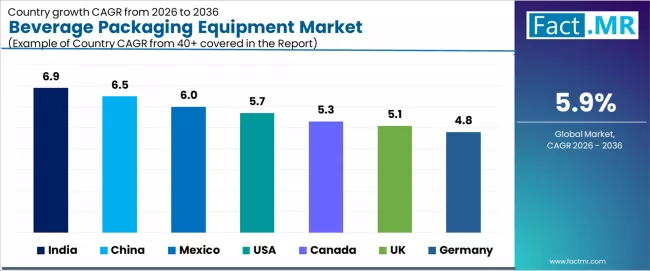
| Country | CAGR (2026-2036) |
|---|---|
| India | 6.9% |
| China | 6.5% |
| Mexico | 6.0% |
| USA | 5.7% |
| Canada | 5.3% |
| UK | 5.1% |
| Germany | 4.8% |
How does India Demonstrate Exceptional Market Potential Through Expanding Urban Beverage Consumption?
India’s beverage packaging equipment market is projected to grow at a 6.9% CAGR through 2036, driven by rapid urbanization and rising demand for packaged beverages. Expanding middle-class consumption, improved retail penetration, and growing health awareness are strengthening bottled water and soft drink production. Equipment demand is increasing across urban bottling plants, regional distribution hubs, and emerging health beverage startups.
Government focus on food safety compliance and domestic manufacturing capability is accelerating investments in automated packaging systems. Beverage producers are prioritizing efficiency, hygiene, and scalability, positioning advanced packaging equipment as central to capacity expansion and competitive differentiation.
What Enables China’s Market Leadership Through a Massive Beverage Production Ecosystem?
China’s market grows at a 6.5% CAGR, supported by the world’s largest beverage manufacturing base and high-volume consumption. Automation adoption is expanding across bottled water, carbonated drinks, and functional beverages as producers modernize operations.
Strong domestic manufacturing capacity and collaboration with international equipment suppliers support high-speed, large-scale packaging deployment. Government-backed industrial modernization and rising packaged beverage demand continue to reduce reliance on manual processes. Automation is increasingly essential for consistency, cost control, and output reliability across China’s diverse beverage categories.
Why Does Mexico Sustain Beverage Packaging Growth Through Export-Oriented Manufacturing?
Mexico’s beverage packaging equipment market is projected to grow at a 6.0% CAGR through 2036, supported by export-driven beverage production and rising domestic consumption. Proximity to the US and integration into North American trade networks encourage investments in automated packaging lines that meet international quality standards.
Beverage manufacturers are expanding capacity for both export bottling and local markets, driving demand for flexible and efficient equipment. Strong manufacturing infrastructure supports rapid deployment, while export compliance increasingly influences equipment specifications and automation timelines.
How does USA Maintain Leadership through Advanced Packaging Technology Adoption?
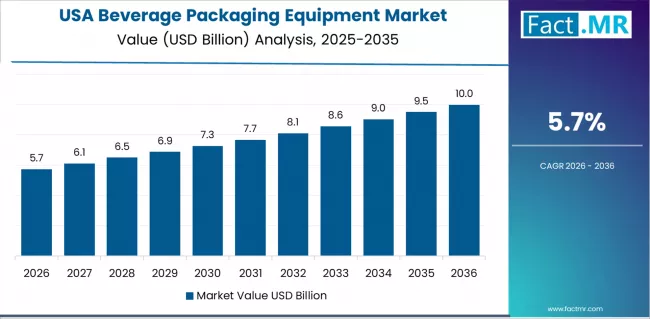
The US market expands at a 5.7% CAGR, driven by strong demand for ready-to-drink beverages and premium bottled products. Beverage producers prioritize high-speed automation, precision filling, and integrated quality control systems to meet stringent safety and consistency standards.
Advanced equipment adoption is supported by a mature automation ecosystem and continuous innovation in packaging technologies. Investment focus remains on operational efficiency, compliance, and scalable production platforms, particularly for value-added beverage segments.
What Drives UK Market Growth through Sustainable Packaging Priorities?
The UK beverage packaging equipment market grows at a 5.1% CAGR, shaped by sustainability regulations and recycling initiatives. Beverage producers increasingly adopt equipment compatible with refillable, recyclable, and low-impact packaging formats.
Environmental compliance and lifecycle management considerations influence equipment selection, driving demand for specialized automation solutions. Strong sustainability leadership and advanced recycling infrastructure support continued investment in eco-focused packaging technologies.
How Does Germany Demonstrate Engineering Leadership in Beverage Packaging Equipment?
Germany’s market grows at a 4.8% CAGR, supported by precision engineering and quality-driven beverage manufacturing. Producers emphasize accuracy, reliability, and long-term equipment performance, particularly in premium and specialized beverage segments.
Advanced automation systems integrate tightly with quality assurance programs and European manufacturing standards. Strong collaboration between equipment manufacturers and beverage producers sustains innovation, reinforcing Germany’s role as a hub for high-performance packaging technologies.
Competitive Landscape of the Beverage Packaging Equipment Market

The beverage packaging equipment market is highly competitive, with participation from global equipment manufacturers, automation specialists, and integrated packaging solution providers. Competition focuses on equipment reliability, throughput efficiency, automation depth, and sustainability integration. Companies are investing in advanced automation technologies, sustainable packaging compatibility, strategic partnerships with beverage producers, and aftersales support capabilities to meet evolving operational standards and customer requirements.
Barry-Wehmiller Companies maintains a leading position, supported by integrated production systems expertise and advanced automation platforms serving multiple beverage categories. Syntegon Technology GmbH competes through high-precision packaging platforms and strong technology development capabilities. Bradman Lake Group Ltd. focuses on end-of-line automation and packaging integration for international beverage producers, while Coesia S.p.A. emphasizes innovation-driven packaging systems and production line integration.
Clearpack addresses regional demand through sustainable packaging-focused equipment offerings, while EconoCorp Inc. specializes in cartoning and case packing solutions prioritizing operational simplicity and reliability. GEA Group strengthens its position through dairy beverage processing and packaging integration. Other participants, including KHS Group, Sidel Group, SIG Combibloc Group, Sacmi, Mpac Group plc, and Tetra Laval/Tetra Pak, compete through specialized technologies and comprehensive beverage packaging solutions.
Key Players in the Beverage Packaging Equipment Market
- Barry-Wehmiller Companies
- Syntegon Technology GmbH
- Bradman Lake Group Ltd.
- Coesia S.p.A.
- Clearpack
- EconoCorp Inc.
- GEA Group
- Jacob White Packaging Ltd.
- KHS Group
- Mpac Group plc
- A. Jones
- Sacmi
- Sidel Group
- SIG Combibloc Group
- Tetra Laval/Tetra Pak
Scope of the Report
| Items | Values |
|---|---|
| Quantitative Units (2026) | USD 11.05 Billion |
| Type | Filling and Capping Machines, Labelling and Coding Machines, Palletizing and Depalletizing Machines, Conveying and Handling Machines, Cleaning and Sterilizing Machines, Wrapping and Bundling Machines, Cartoning Machines, Others |
| Automation | Fully Automatic, Semi-Automatic, Manual |
| Application | Bottled Water, Dairy Beverage, Alcoholic Beverages, Others |
| Regions Covered | Asia Pacific, North America, Europe, Latin America, MEA |
| Countries Covered | USA, Germany, UK, China, India, Mexico, Canada and 40+ countries |
| Key Companies Profiled | Barry-Wehmiller Companies, Syntegon Technology GmbH, Bradman Lake Group Ltd., Coesia S.p.A., Clearpack, EconoCorp Inc., GEA Group, Jacob White Packaging Ltd., KHS Group, Mpac Group plc, A. Jones, Sacmi, Sidel Group, SIG Combibloc Group, Tetra Laval/Tetra Pak |
| Additional Attributes | Dollar sales by type, automation, application, regional demand trends, competitive landscape, beverage manufacturer preferences for specific packaging equipment, integration with comprehensive production systems, innovations in automation technology development, sustainability solution advancement, and operational efficiency optimization capabilities |
Beverage Packaging Equipment Market by Segments
-
Type :
- Filling and Capping Machines
- Labelling and Coding Machines
- Palletizing and Depalletizing Machines
- Conveying and Handling Machines
- Cleaning and Sterilizing Machines
- Wrapping and Bundling Machines
- Cartoning Machines
- Others
-
Automation :
- Fully Automatic
- Semi-Automatic
- Manual
-
Application :
- Bottled Water
- Dairy Beverage
- Alcoholic Beverages
- Others
-
Region :
-
Asia Pacific
- China
- India
- Japan
- South Korea
- ASEAN
- Australia & New Zealand
- Rest of Asia Pacific
-
North America
- USA
- Canada
- Mexico
-
Europe
- Germany
- France
- UK
- Italy
- Spain
- Nordic
- BENELUX
- Rest of Europe
-
Latin America
- Brazil
- Argentina
- Chile
- Rest of Latin America
-
MEA
- Saudi Arabia
- Other GCC Countries
- Turkey
- South Africa
- Other African Countries
- Rest of MEA
-
Table of Content
- Executive Summary
- Global Market Outlook
- Demand to side Trends
- Supply to side Trends
- Technology Roadmap Analysis
- Analysis and Recommendations
- Market Overview
- Market Coverage / Taxonomy
- Market Definition / Scope / Limitations
- Market Background
- Market Dynamics
- Drivers
- Restraints
- Opportunity
- Trends
- Scenario Forecast
- Demand in Optimistic Scenario
- Demand in Likely Scenario
- Demand in Conservative Scenario
- Opportunity Map Analysis
- Product Life Cycle Analysis
- Supply Chain Analysis
- Investment Feasibility Matrix
- Value Chain Analysis
- PESTLE and Porter’s Analysis
- Regulatory Landscape
- Regional Parent Market Outlook
- Production and Consumption Statistics
- Import and Export Statistics
- Market Dynamics
- Global Market Analysis 2021 to 2025 and Forecast, 2026 to 2036
- Historical Market Size Value (USD Million) Analysis, 2021 to 2025
- Current and Future Market Size Value (USD Million) Projections, 2026 to 2036
- Y to o to Y Growth Trend Analysis
- Absolute $ Opportunity Analysis
- Global Market Pricing Analysis 2021 to 2025 and Forecast 2026 to 2036
- Global Market Analysis 2021 to 2025 and Forecast 2026 to 2036, By Type
- Introduction / Key Findings
- Historical Market Size Value (USD Million) Analysis By Type, 2021 to 2025
- Current and Future Market Size Value (USD Million) Analysis and Forecast By Type, 2026 to 2036
- Filling and Capping Machines
- Labelling and Coding Machines
- Palletizing and Depalletizing Machines
- Conveying and Handling Machines
- Cleaning and Sterilizing Machines
- Wrapping and Bundling Machines
- Cartoning Machines
- Others
- Y to o to Y Growth Trend Analysis By Type, 2021 to 2025
- Absolute $ Opportunity Analysis By Type, 2026 to 2036
- Global Market Analysis 2021 to 2025 and Forecast 2026 to 2036, By Automation
- Introduction / Key Findings
- Historical Market Size Value (USD Million) Analysis By Automation, 2021 to 2025
- Current and Future Market Size Value (USD Million) Analysis and Forecast By Automation, 2026 to 2036
- Fully Automatic
- Semi-Automatic
- Manual
- Y to o to Y Growth Trend Analysis By Automation, 2021 to 2025
- Absolute $ Opportunity Analysis By Automation, 2026 to 2036
- Global Market Analysis 2021 to 2025 and Forecast 2026 to 2036, By Application
- Introduction / Key Findings
- Historical Market Size Value (USD Million) Analysis By Application, 2021 to 2025
- Current and Future Market Size Value (USD Million) Analysis and Forecast By Application, 2026 to 2036
- Bottled Water
- Dairy Beverage
- Alcoholic Beverages
- Others
- Y to o to Y Growth Trend Analysis By Application, 2021 to 2025
- Absolute $ Opportunity Analysis By Application, 2026 to 2036
- Global Market Analysis 2021 to 2025 and Forecast 2026 to 2036, By Region
- Introduction
- Historical Market Size Value (USD Million) Analysis By Region, 2021 to 2025
- Current Market Size Value (USD Million) Analysis and Forecast By Region, 2026 to 2036
- North America
- Latin America
- Western Europe
- Eastern Europe
- East Asia
- South Asia and Pacific
- Middle East & Africa
- Market Attractiveness Analysis By Region
- North America Market Analysis 2021 to 2025 and Forecast 2026 to 2036, By Country
- Historical Market Size Value (USD Million) Trend Analysis By Market Taxonomy, 2021 to 2025
- Market Size Value (USD Million) Forecast By Market Taxonomy, 2026 to 2036
- By Country
- USA
- Canada
- Mexico
- By Type
- By Automation
- By Application
- By Country
- Market Attractiveness Analysis
- By Country
- By Type
- By Automation
- By Application
- Key Takeaways
- Latin America Market Analysis 2021 to 2025 and Forecast 2026 to 2036, By Country
- Historical Market Size Value (USD Million) Trend Analysis By Market Taxonomy, 2021 to 2025
- Market Size Value (USD Million) Forecast By Market Taxonomy, 2026 to 2036
- By Country
- Brazil
- Chile
- Rest of Latin America
- By Type
- By Automation
- By Application
- By Country
- Market Attractiveness Analysis
- By Country
- By Type
- By Automation
- By Application
- Key Takeaways
- Western Europe Market Analysis 2021 to 2025 and Forecast 2026 to 2036, By Country
- Historical Market Size Value (USD Million) Trend Analysis By Market Taxonomy, 2021 to 2025
- Market Size Value (USD Million) Forecast By Market Taxonomy, 2026 to 2036
- By Country
- Germany
- UK
- Italy
- Spain
- France
- Nordic
- BENELUX
- Rest of Western Europe
- By Type
- By Automation
- By Application
- By Country
- Market Attractiveness Analysis
- By Country
- By Type
- By Automation
- By Application
- Key Takeaways
- Eastern Europe Market Analysis 2021 to 2025 and Forecast 2026 to 2036, By Country
- Historical Market Size Value (USD Million) Trend Analysis By Market Taxonomy, 2021 to 2025
- Market Size Value (USD Million) Forecast By Market Taxonomy, 2026 to 2036
- By Country
- Russia
- Poland
- Hungary
- Balkan & Baltic
- Rest of Eastern Europe
- By Type
- By Automation
- By Application
- By Country
- Market Attractiveness Analysis
- By Country
- By Type
- By Automation
- By Application
- Key Takeaways
- East Asia Market Analysis 2021 to 2025 and Forecast 2026 to 2036, By Country
- Historical Market Size Value (USD Million) Trend Analysis By Market Taxonomy, 2021 to 2025
- Market Size Value (USD Million) Forecast By Market Taxonomy, 2026 to 2036
- By Country
- China
- Japan
- South Korea
- By Type
- By Automation
- By Application
- By Country
- Market Attractiveness Analysis
- By Country
- By Type
- By Automation
- By Application
- Key Takeaways
- South Asia and Pacific Market Analysis 2021 to 2025 and Forecast 2026 to 2036, By Country
- Historical Market Size Value (USD Million) Trend Analysis By Market Taxonomy, 2021 to 2025
- Market Size Value (USD Million) Forecast By Market Taxonomy, 2026 to 2036
- By Country
- India
- ASEAN
- Australia & New Zealand
- Rest of South Asia and Pacific
- By Type
- By Automation
- By Application
- By Country
- Market Attractiveness Analysis
- By Country
- By Type
- By Automation
- By Application
- Key Takeaways
- Middle East & Africa Market Analysis 2021 to 2025 and Forecast 2026 to 2036, By Country
- Historical Market Size Value (USD Million) Trend Analysis By Market Taxonomy, 2021 to 2025
- Market Size Value (USD Million) Forecast By Market Taxonomy, 2026 to 2036
- By Country
- Kingdom of Saudi Arabia
- Other GCC Countries
- Turkiye
- South Africa
- Other African Union
- Rest of Middle East & Africa
- By Type
- By Automation
- By Application
- By Country
- Market Attractiveness Analysis
- By Country
- By Type
- By Automation
- By Application
- Key Takeaways
- Key Countries Market Analysis
- USA
- Pricing Analysis
- Market Share Analysis, 2025
- By Type
- By Automation
- By Application
- Canada
- Pricing Analysis
- Market Share Analysis, 2025
- By Type
- By Automation
- By Application
- Mexico
- Pricing Analysis
- Market Share Analysis, 2025
- By Type
- By Automation
- By Application
- Brazil
- Pricing Analysis
- Market Share Analysis, 2025
- By Type
- By Automation
- By Application
- Chile
- Pricing Analysis
- Market Share Analysis, 2025
- By Type
- By Automation
- By Application
- Germany
- Pricing Analysis
- Market Share Analysis, 2025
- By Type
- By Automation
- By Application
- UK
- Pricing Analysis
- Market Share Analysis, 2025
- By Type
- By Automation
- By Application
- Italy
- Pricing Analysis
- Market Share Analysis, 2025
- By Type
- By Automation
- By Application
- Spain
- Pricing Analysis
- Market Share Analysis, 2025
- By Type
- By Automation
- By Application
- France
- Pricing Analysis
- Market Share Analysis, 2025
- By Type
- By Automation
- By Application
- India
- Pricing Analysis
- Market Share Analysis, 2025
- By Type
- By Automation
- By Application
- ASEAN
- Pricing Analysis
- Market Share Analysis, 2025
- By Type
- By Automation
- By Application
- Australia & New Zealand
- Pricing Analysis
- Market Share Analysis, 2025
- By Type
- By Automation
- By Application
- China
- Pricing Analysis
- Market Share Analysis, 2025
- By Type
- By Automation
- By Application
- Japan
- Pricing Analysis
- Market Share Analysis, 2025
- By Type
- By Automation
- By Application
- South Korea
- Pricing Analysis
- Market Share Analysis, 2025
- By Type
- By Automation
- By Application
- Russia
- Pricing Analysis
- Market Share Analysis, 2025
- By Type
- By Automation
- By Application
- Poland
- Pricing Analysis
- Market Share Analysis, 2025
- By Type
- By Automation
- By Application
- Hungary
- Pricing Analysis
- Market Share Analysis, 2025
- By Type
- By Automation
- By Application
- Kingdom of Saudi Arabia
- Pricing Analysis
- Market Share Analysis, 2025
- By Type
- By Automation
- By Application
- Turkiye
- Pricing Analysis
- Market Share Analysis, 2025
- By Type
- By Automation
- By Application
- South Africa
- Pricing Analysis
- Market Share Analysis, 2025
- By Type
- By Automation
- By Application
- USA
- Market Structure Analysis
- Competition Dashboard
- Competition Benchmarking
- Market Share Analysis of Top Players
- By Regional
- By Type
- By Automation
- By Application
- Competition Analysis
- Competition Deep Dive
- Barry-Wehmiller Companies
- Overview
- Product Portfolio
- Profitability by Market Segments (Product/Age /Sales Channel/Region)
- Sales Footprint
- Strategy Overview
- Marketing Strategy
- Product Strategy
- Channel Strategy
- Syntegon Technology GmbH
- Bradman Lake Group Ltd.
- Coesia S.p.A.
- Clearpack
- EconoCorp Inc.
- GEA Group
- Jacob White Packaging Ltd.
- KHS Group
- Mpac Group plc
- A. Jones
- Sacmi
- Sidel Group
- SIG Combibloc Group
- Tetra Laval/Tetra Pak
- Barry-Wehmiller Companies
- Competition Deep Dive
- Assumptions & Acronyms Used
- Research Methodology
List Of Table
- Table 1: Global Market Value (USD Million) Forecast by Region, 2021 to 2036
- Table 2: Global Market Value (USD Million) Forecast by Type, 2021 to 2036
- Table 3: Global Market Value (USD Million) Forecast by Automation, 2021 to 2036
- Table 4: Global Market Value (USD Million) Forecast by Application, 2021 to 2036
- Table 5: North America Market Value (USD Million) Forecast by Country, 2021 to 2036
- Table 6: North America Market Value (USD Million) Forecast by Type, 2021 to 2036
- Table 7: North America Market Value (USD Million) Forecast by Automation, 2021 to 2036
- Table 8: North America Market Value (USD Million) Forecast by Application, 2021 to 2036
- Table 9: Latin America Market Value (USD Million) Forecast by Country, 2021 to 2036
- Table 10: Latin America Market Value (USD Million) Forecast by Type, 2021 to 2036
- Table 11: Latin America Market Value (USD Million) Forecast by Automation, 2021 to 2036
- Table 12: Latin America Market Value (USD Million) Forecast by Application, 2021 to 2036
- Table 13: Western Europe Market Value (USD Million) Forecast by Country, 2021 to 2036
- Table 14: Western Europe Market Value (USD Million) Forecast by Type, 2021 to 2036
- Table 15: Western Europe Market Value (USD Million) Forecast by Automation, 2021 to 2036
- Table 16: Western Europe Market Value (USD Million) Forecast by Application, 2021 to 2036
- Table 17: Eastern Europe Market Value (USD Million) Forecast by Country, 2021 to 2036
- Table 18: Eastern Europe Market Value (USD Million) Forecast by Type, 2021 to 2036
- Table 19: Eastern Europe Market Value (USD Million) Forecast by Automation, 2021 to 2036
- Table 20: Eastern Europe Market Value (USD Million) Forecast by Application, 2021 to 2036
- Table 21: East Asia Market Value (USD Million) Forecast by Country, 2021 to 2036
- Table 22: East Asia Market Value (USD Million) Forecast by Type, 2021 to 2036
- Table 23: East Asia Market Value (USD Million) Forecast by Automation, 2021 to 2036
- Table 24: East Asia Market Value (USD Million) Forecast by Application, 2021 to 2036
- Table 25: South Asia and Pacific Market Value (USD Million) Forecast by Country, 2021 to 2036
- Table 26: South Asia and Pacific Market Value (USD Million) Forecast by Type, 2021 to 2036
- Table 27: South Asia and Pacific Market Value (USD Million) Forecast by Automation, 2021 to 2036
- Table 28: South Asia and Pacific Market Value (USD Million) Forecast by Application, 2021 to 2036
- Table 29: Middle East & Africa Market Value (USD Million) Forecast by Country, 2021 to 2036
- Table 30: Middle East & Africa Market Value (USD Million) Forecast by Type, 2021 to 2036
- Table 31: Middle East & Africa Market Value (USD Million) Forecast by Automation, 2021 to 2036
- Table 32: Middle East & Africa Market Value (USD Million) Forecast by Application, 2021 to 2036
List Of Figures
- Figure 1: Global Market Pricing Analysis
- Figure 2: Global Market Value (USD Million) Forecast 2021 to 2036
- Figure 3: Global Market Value Share and BPS Analysis by Type, 2026 and 2036
- Figure 4: Global Market Y to o to Y Growth Comparison by Type, 2026 to 2036
- Figure 5: Global Market Attractiveness Analysis by Type
- Figure 6: Global Market Value Share and BPS Analysis by Automation, 2026 and 2036
- Figure 7: Global Market Y to o to Y Growth Comparison by Automation, 2026 to 2036
- Figure 8: Global Market Attractiveness Analysis by Automation
- Figure 9: Global Market Value Share and BPS Analysis by Application, 2026 and 2036
- Figure 10: Global Market Y to o to Y Growth Comparison by Application, 2026 to 2036
- Figure 11: Global Market Attractiveness Analysis by Application
- Figure 12: Global Market Value (USD Million) Share and BPS Analysis by Region, 2026 and 2036
- Figure 13: Global Market Y to o to Y Growth Comparison by Region, 2026 to 2036
- Figure 14: Global Market Attractiveness Analysis by Region
- Figure 15: North America Market Incremental Dollar Opportunity, 2026 to 2036
- Figure 16: Latin America Market Incremental Dollar Opportunity, 2026 to 2036
- Figure 17: Western Europe Market Incremental Dollar Opportunity, 2026 to 2036
- Figure 18: Eastern Europe Market Incremental Dollar Opportunity, 2026 to 2036
- Figure 19: East Asia Market Incremental Dollar Opportunity, 2026 to 2036
- Figure 20: South Asia and Pacific Market Incremental Dollar Opportunity, 2026 to 2036
- Figure 21: Middle East & Africa Market Incremental Dollar Opportunity, 2026 to 2036
- Figure 22: North America Market Value Share and BPS Analysis by Country, 2026 and 2036
- Figure 23: North America Market Value Share and BPS Analysis by Type, 2026 and 2036
- Figure 24: North America Market Y to o to Y Growth Comparison by Type, 2026 to 2036
- Figure 25: North America Market Attractiveness Analysis by Type
- Figure 26: North America Market Value Share and BPS Analysis by Automation, 2026 and 2036
- Figure 27: North America Market Y to o to Y Growth Comparison by Automation, 2026 to 2036
- Figure 28: North America Market Attractiveness Analysis by Automation
- Figure 29: North America Market Value Share and BPS Analysis by Application, 2026 and 2036
- Figure 30: North America Market Y to o to Y Growth Comparison by Application, 2026 to 2036
- Figure 31: North America Market Attractiveness Analysis by Application
- Figure 32: Latin America Market Value Share and BPS Analysis by Country, 2026 and 2036
- Figure 33: Latin America Market Value Share and BPS Analysis by Type, 2026 and 2036
- Figure 34: Latin America Market Y to o to Y Growth Comparison by Type, 2026 to 2036
- Figure 35: Latin America Market Attractiveness Analysis by Type
- Figure 36: Latin America Market Value Share and BPS Analysis by Automation, 2026 and 2036
- Figure 37: Latin America Market Y to o to Y Growth Comparison by Automation, 2026 to 2036
- Figure 38: Latin America Market Attractiveness Analysis by Automation
- Figure 39: Latin America Market Value Share and BPS Analysis by Application, 2026 and 2036
- Figure 40: Latin America Market Y to o to Y Growth Comparison by Application, 2026 to 2036
- Figure 41: Latin America Market Attractiveness Analysis by Application
- Figure 42: Western Europe Market Value Share and BPS Analysis by Country, 2026 and 2036
- Figure 43: Western Europe Market Value Share and BPS Analysis by Type, 2026 and 2036
- Figure 44: Western Europe Market Y to o to Y Growth Comparison by Type, 2026 to 2036
- Figure 45: Western Europe Market Attractiveness Analysis by Type
- Figure 46: Western Europe Market Value Share and BPS Analysis by Automation, 2026 and 2036
- Figure 47: Western Europe Market Y to o to Y Growth Comparison by Automation, 2026 to 2036
- Figure 48: Western Europe Market Attractiveness Analysis by Automation
- Figure 49: Western Europe Market Value Share and BPS Analysis by Application, 2026 and 2036
- Figure 50: Western Europe Market Y to o to Y Growth Comparison by Application, 2026 to 2036
- Figure 51: Western Europe Market Attractiveness Analysis by Application
- Figure 52: Eastern Europe Market Value Share and BPS Analysis by Country, 2026 and 2036
- Figure 53: Eastern Europe Market Value Share and BPS Analysis by Type, 2026 and 2036
- Figure 54: Eastern Europe Market Y to o to Y Growth Comparison by Type, 2026 to 2036
- Figure 55: Eastern Europe Market Attractiveness Analysis by Type
- Figure 56: Eastern Europe Market Value Share and BPS Analysis by Automation, 2026 and 2036
- Figure 57: Eastern Europe Market Y to o to Y Growth Comparison by Automation, 2026 to 2036
- Figure 58: Eastern Europe Market Attractiveness Analysis by Automation
- Figure 59: Eastern Europe Market Value Share and BPS Analysis by Application, 2026 and 2036
- Figure 60: Eastern Europe Market Y to o to Y Growth Comparison by Application, 2026 to 2036
- Figure 61: Eastern Europe Market Attractiveness Analysis by Application
- Figure 62: East Asia Market Value Share and BPS Analysis by Country, 2026 and 2036
- Figure 63: East Asia Market Value Share and BPS Analysis by Type, 2026 and 2036
- Figure 64: East Asia Market Y to o to Y Growth Comparison by Type, 2026 to 2036
- Figure 65: East Asia Market Attractiveness Analysis by Type
- Figure 66: East Asia Market Value Share and BPS Analysis by Automation, 2026 and 2036
- Figure 67: East Asia Market Y to o to Y Growth Comparison by Automation, 2026 to 2036
- Figure 68: East Asia Market Attractiveness Analysis by Automation
- Figure 69: East Asia Market Value Share and BPS Analysis by Application, 2026 and 2036
- Figure 70: East Asia Market Y to o to Y Growth Comparison by Application, 2026 to 2036
- Figure 71: East Asia Market Attractiveness Analysis by Application
- Figure 72: South Asia and Pacific Market Value Share and BPS Analysis by Country, 2026 and 2036
- Figure 73: South Asia and Pacific Market Value Share and BPS Analysis by Type, 2026 and 2036
- Figure 74: South Asia and Pacific Market Y to o to Y Growth Comparison by Type, 2026 to 2036
- Figure 75: South Asia and Pacific Market Attractiveness Analysis by Type
- Figure 76: South Asia and Pacific Market Value Share and BPS Analysis by Automation, 2026 and 2036
- Figure 77: South Asia and Pacific Market Y to o to Y Growth Comparison by Automation, 2026 to 2036
- Figure 78: South Asia and Pacific Market Attractiveness Analysis by Automation
- Figure 79: South Asia and Pacific Market Value Share and BPS Analysis by Application, 2026 and 2036
- Figure 80: South Asia and Pacific Market Y to o to Y Growth Comparison by Application, 2026 to 2036
- Figure 81: South Asia and Pacific Market Attractiveness Analysis by Application
- Figure 82: Middle East & Africa Market Value Share and BPS Analysis by Country, 2026 and 2036
- Figure 83: Middle East & Africa Market Value Share and BPS Analysis by Type, 2026 and 2036
- Figure 84: Middle East & Africa Market Y to o to Y Growth Comparison by Type, 2026 to 2036
- Figure 85: Middle East & Africa Market Attractiveness Analysis by Type
- Figure 86: Middle East & Africa Market Value Share and BPS Analysis by Automation, 2026 and 2036
- Figure 87: Middle East & Africa Market Y to o to Y Growth Comparison by Automation, 2026 to 2036
- Figure 88: Middle East & Africa Market Attractiveness Analysis by Automation
- Figure 89: Middle East & Africa Market Value Share and BPS Analysis by Application, 2026 and 2036
- Figure 90: Middle East & Africa Market Y to o to Y Growth Comparison by Application, 2026 to 2036
- Figure 91: Middle East & Africa Market Attractiveness Analysis by Application
- Figure 92: Global Market - Tier Structure Analysis
- Figure 93: Global Market - Company Share Analysis
- FAQs -
How big is the beverage packaging equipment market in 2026?
The global beverage packaging equipment market is estimated to be valued at USD 11.1 billion in 2026.
What will be the size of beverage packaging equipment market in 2036?
The market size for the beverage packaging equipment market is projected to reach USD 19.6 billion by 2036.
How much will be the beverage packaging equipment market growth between 2026 and 2036?
The beverage packaging equipment market is expected to grow at a 5.9% CAGR between 2026 and 2036.
What are the key product types in the beverage packaging equipment market?
The key product types in beverage packaging equipment market are filling and capping machines, labelling and coding machines, palletizing and depalletizing machines, conveying and handling machines, cleaning and sterilizing machines, wrapping and bundling machines, cartoning machines and others.
Which automation segment to contribute significant share in the beverage packaging equipment market in 2026?
In terms of automation, fully automatic segment to command 30.5% share in the beverage packaging equipment market in 2026.