- Base Value(2025): 18.3 Bn
- Estimated Value(2026): 19.2 Bn
- Forecast Value (2036): 31.3 Bn
- CAGR (2026 - 2036): 5.0%
Insulated Packaging Market Analysis and Forecast by Fact.MR
- The global insulated packaging market is estimated at USD 19.22 billion in 2026 and is forecast to expand at a CAGR of 5.0% to reach USD 31.30 billion by 2036.
- Insulated packaging encompasses rigid containers, flexible liners, insulated bags, and advanced thermal systems using EPS, polyurethane foam, vacuum insulated panels, and phase change materials to maintain temperature-controlled conditions during transit.
- The market is driven by cold chain logistics expansion, pharmaceutical temperature integrity requirements, online grocery and meal kit delivery growth, and the development of sustainable and reusable insulated packaging systems that reduce single-use waste while maintaining thermal performance across last-mile and long-haul distribution.

Insulated Packaging Market Market Value Analysis | Source: Fact.MR
Summary of Insulated Packaging Market
- Market Snapshot
- In 2025, the global Insulated Packaging Market was valued at approximately USD 18.3 billion.
- The market is estimated to reach USD 19.22 billion in 2026 and is projected to attain USD 31.30 billion by 2036.
- The insulated packaging market is likely to expand at a CAGR of 5.0% during the forecast period.
- The market is anticipated to create an absolute dollar opportunity of USD 12.08 billion between 2026 and 2036.
- Plastic foam accounts for 50% of material type share in 2026.
- China (5.9%) and India (5.5%) are the key growth markets during the forecast period.
- Demand and Growth Drivers
- Cold chain logistics expansion across food, pharmaceutical, and e-commerce sectors is the primary driver, requiring temperature-controlled packaging from point of origin through last-mile delivery.
- Pharmaceutical temperature integrity requirements for vaccines, biologics, and temperature-sensitive drugs are creating demand for validated insulated packaging with documented thermal performance.
- Online grocery delivery and meal kit subscription growth are creating concentrated demand for consumer-facing insulated packaging that maintains freshness during last-mile transit.
- Tightening food safety regulations and cold chain compliance standards are raising the minimum thermal performance requirements for packaging used in fresh and frozen food distribution.
- Development of sustainable insulated packaging using recycled materials, biodegradable foams, and reusable container systems is addressing corporate sustainability commitments.
- Product and Segment View
- Rigid insulated packaging accounts for 60% of the product type segment in 2026, driven by EPS containers, PU foam containers, and vacuum insulated boxes serving food, pharmaceutical, and industrial applications.
- Refrigerated packaging (2 to 8 degrees C) holds 45% of the temperature range segment in 2026, reflecting the dominance of pharmaceutical, fresh food, and dairy cold chain requirements.
- Plastic foam accounts for 50% of the material type segment, sustained by EPS and polyurethane foam's combination of thermal insulation, lightweight construction, and cost-effectiveness.
- Key segmentation includes:
- Product Type: Rigid (insulated containers, boxes), Flexible (liners, bags)
- Material Type: Plastic foam (EPS, PU), Fiberglass, Paper and paperboard, Advanced (VIP, PCM)
- Temperature Range: Refrigerated (2-8C), Frozen (below 0C), Ambient (15-25C)
- Application: Food and beverage, Pharmaceuticals, Industrial, E-commerce
- End Use Industry: Food, Pharmaceutical, Retail, Industrial, Healthcare
- Insulation Type: Single-use, Reusable, Advanced insulation
- These systems enable:
- Temperature maintenance from 2 to 8 degrees C for pharmaceutical and fresh food cold chain compliance
- Extended thermal protection for frozen products during long-haul and last-mile distribution
- Validated packaging solutions with documented thermal performance supporting regulatory compliance
- Geography and Competitive Outlook
- Asia Pacific leads growth through China and India, driven by cold chain infrastructure development, pharmaceutical manufacturing expansion, and online grocery delivery growth.
- North America sustains demand through the USA, supported by pharmaceutical cold chain, online grocery density, meal kit delivery, and food safety regulations.
- Europe maintains demand through Germany, driven by cold chain standards, pharmaceutical distribution requirements, and sustainable packaging regulations.
- China (5.9%) and India (5.5%) lead growth, while the USA (5.1%), Germany (4.7%), Japan (4.4%), Brazil (4.0%), and South Africa (3.6%) sustain demand.
- Major players include Sonoco ThermoSafe, Smurfit WestRock, Cold Chain Technologies, and Ranpak Holdings.
- Analyst Opinion
- Shambhu Nath Jha, Principal Consultant at Fact.MR, says 'The insulated packaging market is being reshaped by the convergence of pharmaceutical cold chain precision requirements and e-commerce last-mile delivery volume. Pharmaceutical packaging demands validated thermal performance with documented temperature excursion data, creating a premium segment where specification depth justifies higher pricing. Online grocery and meal kit delivery creates volume demand for consumer-grade insulated packaging where cost per shipment is the primary constraint. Companies bridging both segments through scalable insulated packaging platforms with modular thermal performance levels are capturing the broadest market addressability, while single-segment specialists face either margin pressure from commoditization or volume limitations from niche positioning.'
Key Growth Drivers, Constraints, and Opportunities
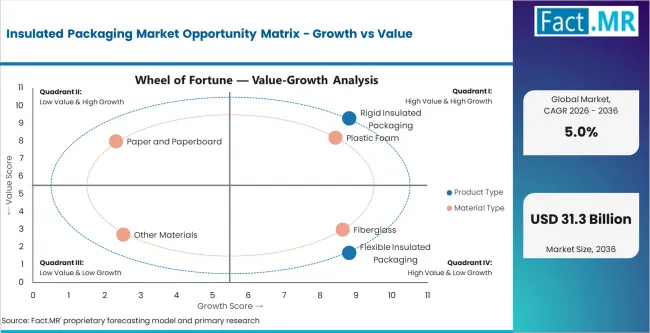
Insulated Packaging Market Opportunity Matrix Growth Vs Value | Source: Fact.MR
Key Factors Driving Growth
- Cold chain logistics expansion, with global cold chain spending growing faster than overall logistics, is driving demand for insulated packaging across food, pharmaceutical, and e-commerce channels.
- Pharmaceutical cold chain requirements for vaccine distribution, biologic drugs, and clinical trial materials create demand for validated packaging with precision thermal performance.
- Online grocery and meal kit delivery growth is creating high-volume demand for consumer-grade insulated packaging optimized for last-mile transit economics.
Key Market Constraints
- EPS disposal and recycling challenges create sustainability pressure, with several jurisdictions restricting or banning expanded polystyrene in packaging applications.
- Cost sensitivity in food industry cold chain packaging limits adoption of premium insulation technologies like VIP and PCM in standard distribution operations.
- Fragmented end-use requirements across food, pharmaceutical, and e-commerce applications create product portfolio complexity and limit manufacturing standardization.
Key Opportunity Areas
- Sustainable insulated packaging using recycled content, biodegradable foam alternatives, and paper-based thermal systems is creating differentiation aligned with corporate sustainability mandates.
- Reusable insulated packaging systems with tracking technology and reverse logistics integration create recurring revenue opportunities and lower per-use costs.
- Vacuum insulated panels (VIP) and phase change materials (PCM) are creating premium performance segments for long-duration pharmaceutical and clinical trial shipments.
Segment-wise Analysis of the Insulated Packaging Market
- Rigid insulated packaging holds 60% of the product type segment in 2026, driven by EPS and PU foam containers serving food cold chain, pharmaceutical distribution, and industrial applications.
- Food industry accounts for 40% of the end use industry segment in 2026, reflecting the dominance of fresh food, frozen food, and dairy distribution as primary insulated packaging consumers.
- Single-use insulation accounts for 45% of the insulation type segment, driven by food delivery and e-commerce applications where reverse logistics costs exceed reusable container economics.
The market is segmented by product type, material type, temperature range, application, end use industry, insulation type, and region. Rigid packaging leads by product type. Plastic foam leads by material. Refrigerated range leads by temperature, and food and beverage leads by application.
Which Product Type Segment Dominates the Insulated Packaging Market?
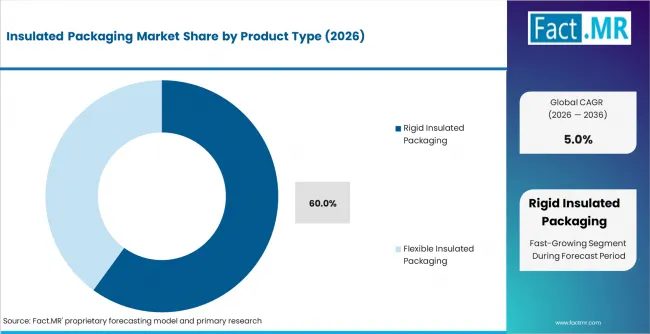
Insulated Packaging Market Analysis By Product Type | Source: Fact.MR
Rigid insulated packaging accounts for 60% of the product type segment in 2026. EPS containers, polyurethane foam containers, corrugated insulated boxes, and vacuum insulated boxes provide the structural rigidity and thermal performance required for food cold chain, pharmaceutical distribution, and industrial temperature-sensitive shipments. EPS remains the dominant material for rigid insulated containers due to its combination of thermal performance, lightweight construction, and cost-effectiveness.
Flexible insulated packaging, including bubble liners, foil liners, thermal bags, and reusable insulated bags, serves applications where weight savings, space efficiency, and ease of disposal are priorities. Flexible formats are growing through e-commerce and meal kit applications where compact packaging reduces shipping costs.
Which Application Segment Dominates the Insulated Packaging Market?
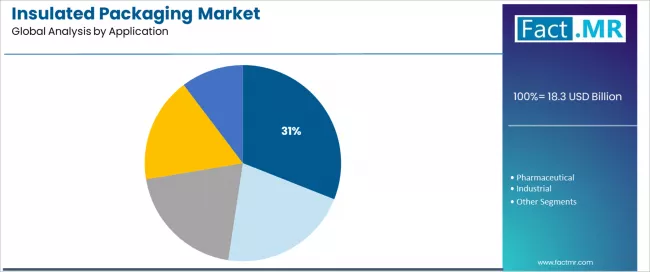
Insulated Packaging Market Analysis By Application | Source: Fact.MR
Food and beverage accounts for 40% of the application segment in 2026. Fresh food distribution, frozen food logistics, dairy cold chain, meat and seafood shipping, and meal kit delivery consume the largest volume of insulated packaging. Temperature compliance requirements across the food supply chain are tightening, driving higher-performance packaging specification.
Pharmaceuticals is the second-largest application with the highest per-unit value, driven by vaccine distribution, biologic drug shipping, and clinical trial material transport. E-commerce is the fastest-growing segment through online grocery delivery and temperature-sensitive product shipping.
Which Temperature Range Segment Dominates the Insulated Packaging Market?
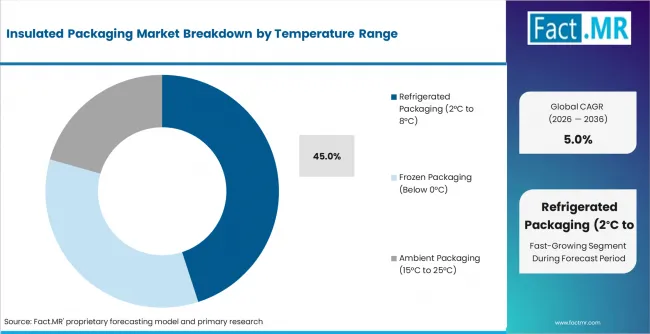
Insulated Packaging Market Analysis By Temperature Range | Source: Fact.MR
Refrigerated packaging (2 to 8 degrees C) accounts for 45% of the temperature range segment in 2026. Pharmaceutical cold chain, fresh food distribution, and dairy logistics operate primarily within this range, requiring packaging that maintains narrow temperature bands for regulatory compliance and product quality preservation.
Frozen packaging (below 0 degrees C) serves frozen food distribution and deep-freeze pharmaceutical requirements. Ambient packaging (15 to 25 degrees C) protects temperature-sensitive electronics, chemicals, and general goods from extreme heat or cold during transit.
Which Product Trend is Shaping the Next Phase of Growth in the Insulated Packaging Market?
Sustainable insulated packaging combining recycled content with validated thermal performance is the defining trend. Paper-based insulated packaging using molded fiber and corrugated thermal liners is growing as food and e-commerce companies seek EPS alternatives that maintain cold chain compliance while meeting sustainability targets. These solutions typically use recycled content and are curbside recyclable, addressing the disposal challenges associated with EPS foam.
Advanced insulation technologies including vacuum insulated panels (VIP) and phase change materials (PCM) are creating premium segments for long-duration pharmaceutical and clinical trial shipments. VIP delivers 5 to 10 times the thermal resistance of conventional foam insulation per unit thickness, enabling compact packaging for high-value temperature-sensitive products. PCM systems maintain precise temperature ranges through phase transition absorption, providing consistent thermal protection over extended transit periods without external power.
Regional Outlook Across Key Markets
.webp "Top Country Growth Comparison Insulated Packaging Market Cagr (2026 2036)")
Top Country Growth Comparison Insulated Packaging Market Cagr (2026 2036) | Source: Fact.MR
- China leads growth at 5.9%, driven by cold chain infrastructure development, pharmaceutical manufacturing expansion, and online grocery delivery growth.
- India follows at 5.5%, supported by food cold chain modernization, pharmaceutical distribution growth, and e-commerce expansion.
- The USA grows at 5.1%, driven by pharmaceutical cold chain, online grocery density, meal kit delivery, and food safety standards.
- Europe sustains growth through Germany (4.7%), supported by cold chain standards, pharmaceutical requirements, and sustainable packaging regulations.
| Country | CAGR (%) |
|---|---|
| China | 5.9% |
| India | 5.5% |
| USA | 5.1% |
| Germany | 4.7% |
| Japan | 4.4% |
| Brazil | 4.0% |
| South Africa | 3.6% |
Source: Fact.MR analysis. Updated May 25, 2026
Source: Fact MR (FMR) analysis, based on proprietary forecasting model and primary research.
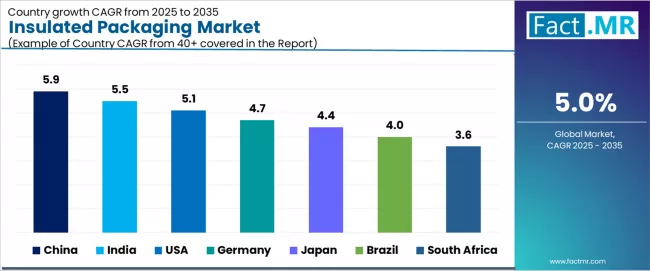
Insulated Packaging Market Cagr Analysis By Country | Source: Fact.MR
Market Outlook for Insulated Packaging in China
The China market is projected to grow at a CAGR of 5.9% through 2036. Demand is driven by cold chain infrastructure development, pharmaceutical manufacturing, online grocery expansion, and food safety regulation enforcement.
- Cold chain development creates large-scale insulated packaging demand.
- Online grocery expansion drives consumer-grade thermal packaging volumes.
- Pharmaceutical manufacturing supports validated packaging procurement.
Insulated Packaging Demand Trends in India
The India market is projected to grow at a CAGR of 5.5% through 2036. Growth is supported by food cold chain modernization, vaccine distribution infrastructure, e-commerce expansion, and growing pharmaceutical export requirements.
- Food cold chain modernization drives fresh and frozen packaging demand.
- Vaccine distribution sustains pharmaceutical-grade packaging procurement.
- E-commerce expansion creates last-mile insulated packaging requirements.
United States Insulated Packaging Market Growth Assessment
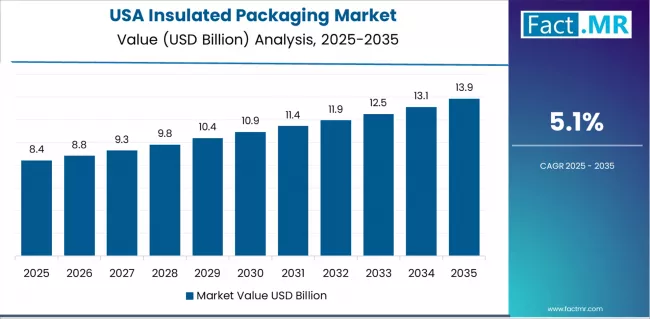
Insulated Packaging Market Country Value Analysis | Source: Fact.MR
The U.S. market is projected to grow at a CAGR of 5.1% through 2036. Demand is driven by pharmaceutical cold chain precision, online grocery and meal kit delivery density, food safety compliance, and growing sustainable packaging specification.
- Pharmaceutical cold chain drives validated insulated packaging demand.
- Online grocery and meal kit delivery create high-volume consumption.
- Sustainable packaging specification accelerates EPS alternative adoption.
Germany Insulated Packaging Market Demand Analysis
The Germany market is projected to grow at a CAGR of 4.7% through 2036. Demand is shaped by cold chain compliance standards, pharmaceutical distribution requirements, sustainable packaging regulations, and food safety enforcement.
- Cold chain standards sustain high-performance packaging specification.
- Pharmaceutical distribution drives temperature-validated packaging use.
- Sustainable packaging regulations accelerate material innovation.
Japan Insulated Packaging Market Opportunity Outlook
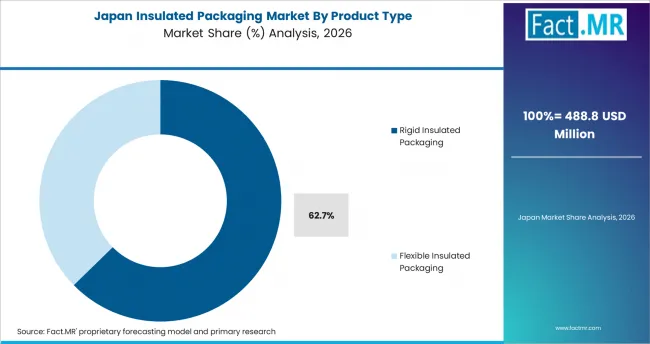
Insulated Packaging Market Japan Market Share Analysis By Product Type | Source: Fact.MR
The Japan market is projected to grow at a CAGR of 4.4% through 2036. Demand is supported by pharmaceutical cold chain precision, food quality standards, e-commerce grocery growth, and advanced insulation material development.
- Pharmaceutical precision drives validated insulated system demand.
- Food quality standards sustain cold chain packaging specification.
- Advanced material development supports VIP and PCM adoption.
Competitive Benchmarking and Company Positioning
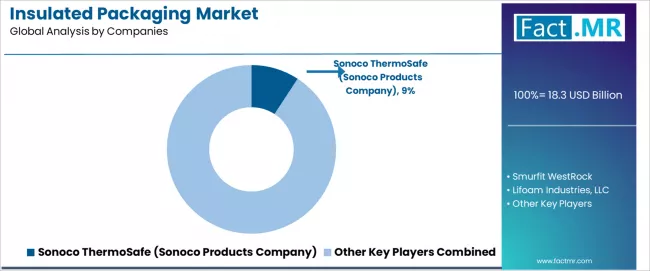
Insulated Packaging Market Analysis By Company | Source: Fact.MR
Insulated Packaging Market Analysis By Company
- Sonoco ThermoSafe holds approximately 9% market share through its broad insulated packaging portfolio, pharmaceutical cold chain expertise, and validated thermal performance testing capabilities.
- Smurfit WestRock and Cold Chain Technologies compete through material innovation, sustainable packaging development, and cold chain logistics integration.
- Thermal performance validation capability, material sustainability credentials, and cold chain logistics integration are primary differentiators.
The competitive landscape is moderately fragmented. Sonoco ThermoSafe holds approximately 9% market share through its broad insulated packaging portfolio spanning pharmaceutical, food, and industrial applications. The company's PharmaPort and ThermoSafe brands serve the pharmaceutical cold chain with validated packaging systems and temperature monitoring integration.
Smurfit WestRock competes through sustainable corrugated-based insulated packaging solutions. Cold Chain Technologies and Ranpak Holdings serve pharmaceutical and e-commerce segments respectively, with Cold Chain Technologies specializing in validated pharmaceutical packaging and Ranpak focusing on sustainable protective packaging solutions.
TEMPACK, Huhtamaki, Exeltainer, and Thermal Packaging Solutions serve specific regional markets and application segments. Insulated Products Corporation (IPC) and Lifoam Industries serve value-oriented food and general-purpose insulated packaging markets.
Strategic priorities include developing sustainable EPS alternatives, expanding VIP and PCM capabilities, building validated pharmaceutical packaging platforms, and strengthening e-commerce and online grocery packaging solutions.
Key Companies in the Insulated Packaging Market
Sonoco ThermoSafe, Smurfit WestRock, and Cold Chain Technologies lead through broad portfolios, validation capabilities, and cold chain expertise.
Ranpak Holdings Corp., Lifoam Industries, and Exeltainer hold established positions through sustainable packaging innovation and specific application focus.
TEMPACK, Huhtamaki Oyj, Thermal Packaging Solutions Ltd., and Insulated Products Corporation compete through regional strength and specialized thermal packaging applications.
Recent Industry Developments
- Sonoco ThermoSafe - Product Innovation / Sustainable Pharmaceutical Cold Chain Packaging (2025)
- Sonoco ThermoSafe expanded its sustainable pharmaceutical packaging portfolio with recycled-content insulated containers designed to maintain 2 to 8 degrees C temperature ranges while reducing packaging waste in pharmaceutical distribution.
- Smurfit WestRock - Material Innovation / Paper-Based Insulated Packaging Platform (2025)
- Smurfit WestRock continued developing its paper-based insulated packaging solutions, offering curbside-recyclable thermal protection for food and e-commerce applications as an alternative to EPS foam.
- Cold Chain Technologies - Technology Enhancement / PCM-Based Extended Duration Packaging (2025)
- Cold Chain Technologies expanded its phase change material packaging portfolio for extended-duration pharmaceutical shipments, addressing growing demand for 96-plus-hour thermal protection in clinical trial and biologic distribution.
Leading Companies Shaping the Insulated Packaging Market
- Sonoco ThermoSafe (Sonoco Products Company)
- Smurfit WestRock
- Lifoam Industries, LLC
- Cold Chain Technologies, LLC
- Ranpak Holdings Corp.
- Exeltainer
- TEMPACK Packaging Solutions, S.L.
- Huhtamaki Oyj
- Thermal Packaging Solutions Ltd.
- Insulated Products Corporation (IPC)
Sources and Research References
- Sonoco ThermoSafe. Sustainable pharmaceutical cold chain packaging and PharmaPort platform documentation.
- Cold Chain Technologies. PCM-based extended duration packaging development.
- Cold chain logistics spending databases, pharmaceutical distribution statistics, and online grocery growth analysis.
- Food safety regulation databases, sustainable packaging requirement timelines, and material pricing data.
- Primary interviews with packaging manufacturers, cold chain providers, pharmaceutical distributors, and e-commerce operators.
This bibliography is provided for reader reference and is not exhaustive. The full report contains the complete reference list and detailed citations.
Key Questions This Report Addresses
- What is the current and future size of the Insulated Packaging market?
- How fast is the market expected to grow between 2026 and 2036?
- Which product type leads in 2026?
- Which application holds highest share?
- What drives demand?
- How is online grocery delivery influencing the market?
- Why is China the fastest-growing market?
- How are sustainable materials shaping the market?
- Which countries show fastest growth?
- Who are the key companies?
- How does Fact.MR validate the forecast?
Insulated Packaging Market Definition
The insulated packaging market covers rigid containers, flexible liners, insulated bags, and advanced thermal systems that maintain temperature-controlled conditions during transit for food, pharmaceutical, industrial, and e-commerce applications.
Insulated Packaging Market Inclusions
- The scope covers global and regional market size and forecasts for 2026 to 2036 across product type, material type, temperature range, application, end use industry, insulation type, and region.
- It includes analysis of cold chain logistics expansion, pharmaceutical distribution requirements, online grocery trends, and food safety regulation timelines.
- The report covers pricing and cost analysis across insulated packaging categories including material costs, thermal performance economics, and lifecycle analysis.
- It covers technology trends, market drivers, and competitive landscape including product portfolios and sustainability strategies of leading manufacturers.
Insulated Packaging Market Exclusions
- The scope excludes refrigerated transport equipment including truck bodies, containers, and trailer insulation systems.
- It excludes industrial cold storage facility insulation and warehouse temperature control systems.
- The report excludes non-insulated shipping containers, standard corrugated boxes, and packaging without thermal management function.
- It also excludes temperature monitoring devices and data loggers sold separately from insulated packaging.
Insulated Packaging Market Research Methodology
- The methodology combines secondary research, primary interviews, and forecast modelling.
- It draws on 60+ secondary sources and benchmarks 25+ manufacturer product portfolios.
- Market sizing covers 25+ countries through a demand-side model, supported by top-down validation.
- Key inputs include cold chain logistics spending, pharmaceutical distribution volumes, online grocery growth, food safety regulation timelines, and packaging material pricing.
- The model cross-checks demand with manufacturing capacity, material pricing, and shipment volume data.
- Primary validation includes 20+ interviews across packaging manufacturers, cold chain logistics providers, pharmaceutical distributors, and online grocery operators.
- Final estimates go through cold-chain-volume checks, pricing analysis, and sensitivity testing.
Segmentation
Scope of Analysis
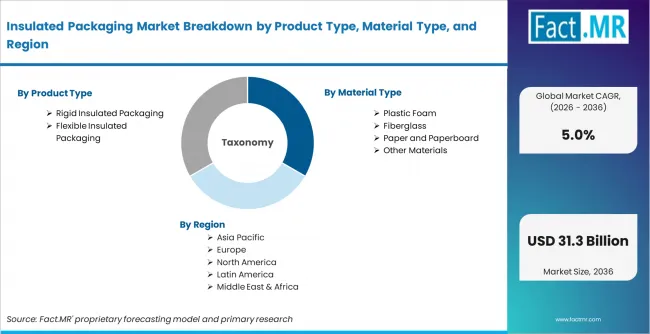
Insulated Packaging Market Breakdown By Product Type, Material Type, And Region | Source: Fact.MR
| Parameter | Details |
|---|---|
| Quantitative Units | USD 19.22 billion to USD 31.30 billion, at a CAGR of 5.0% |
| Market Definition | The market covers rigid and flexible insulated packaging systems maintaining temperature-controlled conditions during transit for food, pharmaceutical, industrial, and e-commerce applications. |
| Regions Covered | North America, Latin America, Europe, East Asia, South Asia and Pacific, Middle East and Africa |
| Countries Covered | China, India, USA, Germany, Japan, Brazil, South Africa, 25 plus countries |
| Key Companies | Sonoco ThermoSafe, Smurfit WestRock, Lifoam Industries, Cold Chain Technologies, Ranpak, Exeltainer, TEMPACK, Huhtamaki, Thermal Packaging Solutions, IPC |
| Forecast Period | 2026 to 2036 |
| Approach | Hybrid demand-side and top-down methodology built on cold chain logistics spending, pharmaceutical distribution volumes, online grocery growth, and primary interviews across manufacturers, logistics providers, and end users |
Source: Fact.MR analysis. Updated May 25, 2026
Insulated Packaging Market Segmentation
-
Insulated Packaging Market Segmented by Product Type:
- Rigid Insulated Packaging
- Insulated Containers
- EPS Containers
- PU Foam Containers
- Insulated Boxes
- Corrugated Insulated Boxes
- Vacuum Insulated Boxes
- Insulated Containers
- Flexible Insulated Packaging
- Insulated Liners
- Bubble Liners
- Foil Liners
- Insulated Bags
- Thermal Bags
- Reusable Insulated Bags
- Insulated Liners
- Rigid Insulated Packaging
-
Insulated Packaging Market Segmented by Material Type:
- Plastic Foam
- Expanded Polystyrene (EPS)
- Lightweight
- Cost-effective
- Polyurethane (PU) Foam
- High Insulation
- Durability
- Expanded Polystyrene (EPS)
- Fiberglass
- Glass Wool
- Thermal Resistance
- Industrial Use
- Rock Wool
- Fire Resistant
- High Temperature Use
- Glass Wool
- Paper and Paperboard
- Corrugated Board
- Eco-friendly Packaging
- Recyclable
- Molded Fiber
- Sustainable Solutions
- Biodegradable
- Corrugated Board
- Other Materials
- Vacuum Insulated Panels (VIP)
- High Performance
- Long Duration Insulation
- Phase Change Materials (PCM)
- Temperature Stability
- Cold Chain Logistics
- Vacuum Insulated Panels (VIP)
- Plastic Foam
-
Insulated Packaging Market Segmented by Temperature Range:
- Refrigerated Packaging (2°C to 8°C)
- Short Duration Cooling
- Pharmaceutical Transport
- Food Delivery
- Long Duration Cooling
- Cold Chain Logistics
- Vaccine Transport
- Short Duration Cooling
- Frozen Packaging (Below 0°C)
- Short Duration Freezing
- Frozen Food Delivery
- Short Transit
- Long Duration Freezing
- Deep Freeze Logistics
- Long Distance Transport
- Short Duration Freezing
- Ambient Packaging (15°C to 25°C)
- Temperature Controlled
- Electronics
- Chemicals
- Insulated Protection
- General Goods
- Transit Safety
- Temperature Controlled
- Refrigerated Packaging (2°C to 8°C)
-
Insulated Packaging Market Segmented by Application:
- Food and Beverage
- Fresh Food
- Fruits and Vegetables
- Dairy Products
- Frozen Food
- Meat
- Seafood
- Fresh Food
- Pharmaceuticals
- Vaccines
- Temperature-sensitive Drugs
- Biologics
- Clinical Trials
- Sample Transport
- Medical Supplies
- Vaccines
- Industrial
- Chemicals
- Temperature-sensitive Chemicals
- Hazardous Materials
- Electronics
- Sensitive Equipment
- Battery Transport
- Chemicals
- E-commerce
- Online Grocery
- Fresh Delivery
- Meal Kits
- Online Retail
- Temperature-sensitive Goods
- Last-mile Delivery
- Online Grocery
- Food and Beverage
-
Insulated Packaging Market Segmented by End Use Industry:
- Food Industry
- Food Producers
- Dairy
- Meat Processing
- Distributors
- Cold Chain
- Retail Supply
- Food Producers
- Pharmaceutical Industry
- Drug Manufacturers
- Vaccine Production
- Biologics
- Logistics Providers
- Cold Chain Logistics
- Clinical Distribution
- Drug Manufacturers
- Retail Industry
- E-commerce Companies
- Online Grocery
- Meal Delivery
- Supermarkets
- Fresh Food Distribution
- Cold Storage
- E-commerce Companies
- Industrial Sector
- Chemical Industry
- Temperature-sensitive Products
- Hazardous Materials
- Electronics Industry
- Sensitive Components
- Battery Logistics
- Chemical Industry
- Healthcare Industry
- Hospitals
- Drug Storage
- Sample Transport
- Laboratories
- Clinical Research
- Diagnostics
- Hospitals
- Food Industry
-
Insulated Packaging Market Segmented by Insulation Type:
- Single-use Insulation
- Disposable Packaging
- One-time Use
- Low Cost
- Lightweight Solutions
- Short Duration
- E-commerce Use
- Disposable Packaging
- Reusable Insulation
- Returnable Packaging
- Multiple Cycles
- Cost Efficiency
- Durable Insulation
- Long Lifespan
- Industrial Use
- Returnable Packaging
- Advanced Insulation
- Vacuum Insulation
- VIP Panels
- High Efficiency
- Phase Change Insulation
- PCM Systems
- Temperature Stability
- Vacuum Insulation
- Single-use Insulation
-
Insulated Packaging Market by Region:
- North America
- USA
- Canada
- Mexico
- Latin America
- Brazil
- Chile
- Rest of Latin America
- Western Europe
- Germany
- UK
- Italy
- Spain
- France
- Nordic
- BENELUX
- Rest of Western Europe
- Eastern Europe
- Russia
- Poland
- Hungary
- Balkan & Baltic
- Rest of Eastern Europe
- East Asia
- China
- Japan
- South Korea
- South Asia and Pacific
- India
- ASEAN
- Australia & New Zealand
- Rest of South Asia and Pacific
- Middle East & Africa
- Kingdom of Saudi Arabia
- Other GCC Countries
- Turkiye
- South Africa
- Other African Union
- Rest of Middle East & Africa
- North America
Frequently Asked Questions
What will be the size of the Industrial Filtration Market in 2036?
How much will the Industrial Filtration Market grow between 2026 and 2036?
What are the key filter types in the Industrial Filtration Market?
Which application holds the highest share in the Industrial Filtration Market in 2026?
Which are the fastest-growing countries in the Industrial Filtration Market?
Which are the fastest-growing countries?
Who worked on this report


Preview the report firsthand - request a free sample
Free SampleGet the brochure for pricing and purchase details
Download PDF