Mailer Packaging Market Size, Share, Growth and Forecast (2026 - 2036)
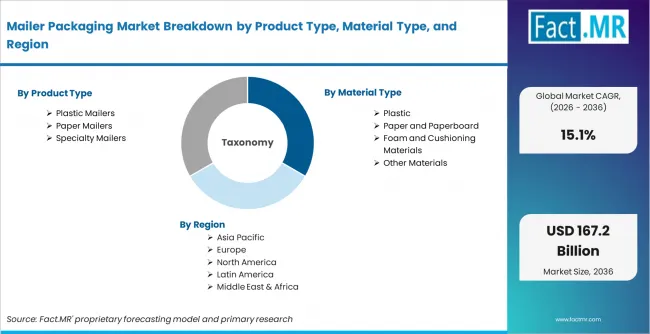
Mailer Packaging Market is segmented by Product Type (Plastic Mailers, Paper Mailers, Specialty Mailers), Material Type (Plastic, Paper and Paperboard, Foam and Cushioning Materials, Other Materials), Closure Type (Self-seal Mailers, Zip Lock Mailers, Heat Seal Mailers), and Region, with forecasts covering the period from 2026 to 2036.
Mailer Packaging Market Analysis and Forecast by Fact.MR
- The global mailer packaging market is estimated at USD 40.98 billion in 2026 and is forecast to expand at a CAGR of 15.1% to reach USD 167.22 billion by 2036.
- Mailer packaging encompasses plastic poly mailers, bubble mailers, kraft paper mailers, padded mailers, and specialty mailers designed for e-commerce, retail, logistics, and document shipping.
- The market is driven by explosive e-commerce growth, direct-to-consumer brand shipping, sustainability-driven shift from plastic to paper mailers, custom branded packaging for unboxing experiences, and automated fulfillment center requirements for high-speed packaging that reduces shipping costs through dimensional weight optimization and eliminates secondary packaging.
Summary of Mailer Packaging Market
- Market Snapshot
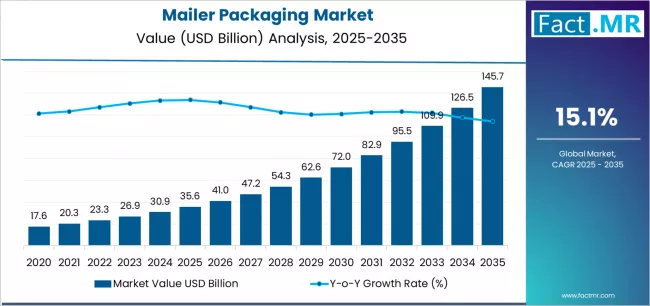
- In 2025, the global Mailer Packaging Market was valued at approximately USD 35.6 billion.
- The market is estimated to reach USD 40.98 billion in 2026 and is projected to attain USD 167.22 billion by 2036.
- The mailer packaging market is likely to expand at a CAGR of 15.1% during the forecast period.
- The market is anticipated to create an absolute dollar opportunity of USD 126.24 billion between 2026 and 2036.
- Self-seal mailers account for 65% of closure type share in 2026.
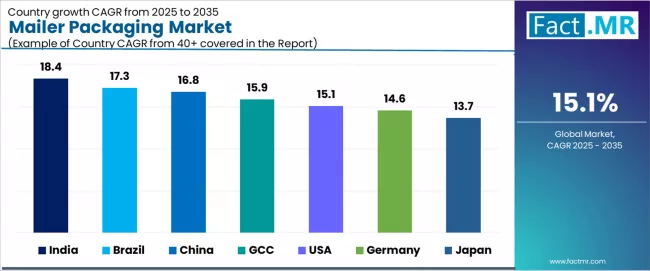
- India (18.4%) and Brazil (17.3%) are the key growth markets during the forecast period.
- Demand and Growth Drivers
- E-commerce growth across apparel, electronics, beauty, and general merchandise is the primary driver, with each online order requiring individual mailer packaging for last-mile delivery.
- Direct-to-consumer (DTC) brand shipping creates demand for custom-printed mailers that serve as both shipping containers and brand marketing tools during the unboxing experience.
- Sustainability-driven shift from plastic poly mailers to paper-based and recyclable alternatives addresses consumer and regulatory pressure on single-use plastic packaging.
- Automated fulfillment center operations require high-speed-compatible mailer formats with consistent dimensions, reliable sealing, and machine-feeding capability.
- Dimensional weight pricing by carriers incentivizes lightweight, flat mailer packaging that minimizes shipping cost compared to boxes for soft goods and small items.
- Product and Segment View
- Plastic mailers account for 50% of the product type segment in 2026, driven by poly mailers and bubble mailers serving e-commerce apparel and electronics shipping.
- Self-seal mailers hold 65% of the closure type segment in 2026, driven by peel-and-seal adhesive strips enabling fast, secure closure in high-volume fulfillment operations.
- E-commerce accounts for 45% of both application and end use industry segments, reflecting the fundamental role of online retail as the primary demand driver.
- Key segmentation includes:
- Product Type: Plastic mailers (poly, bubble), Paper mailers (kraft, padded), Specialty mailers (insulated, security)
- Material Type: Plastic (PE, PP), Paper and paperboard (kraft, corrugated), Foam and cushioning
- Closure Type: Self-seal (peel-and-seal, adhesive), Zip lock, Heat seal
- Application: E-commerce, Retail, Logistics and courier, Document shipping
- End Use Industry: E-commerce, Logistics, Retail
- Size Type: Small, Medium, Large mailers
- These systems enable:
- Lightweight shipping reducing dimensional weight charges by 30 to 50% compared to corrugated boxes for soft goods and small items
- Custom-printed branding creating unboxing marketing experiences that reinforce brand identity and drive social media sharing
- Automated fulfillment compatibility enabling high-speed packing at 200 to 500 units per hour in e-commerce distribution centers
- Geography and Competitive Outlook
- Asia Pacific leads growth through India, China, and the GCC, driven by explosive e-commerce expansion, online retail penetration growth, and logistics infrastructure development.
- Latin America sustains the highest growth rates through Brazil, driven by e-commerce adoption acceleration and growing digital commerce penetration.
- North America maintains demand through the USA, supported by mature e-commerce infrastructure, DTC brand shipping, and sustainable mailer specification.
- India (18.4%) and Brazil (17.3%) lead growth, while China (16.8%), the GCC (15.9%), the USA (15.1%), Germany (14.6%), and Japan (13.7%) sustain demand.
- Major players include Sealed Air Corporation, Pregis LLC, 3M Company, and Novolex Holdings.
- Analyst Opinion
- Shambhu Nath Jha, Principal Consultant at Fact.MR, says 'The mailer packaging market is experiencing hypergrowth driven by the structural shift from brick-and-mortar to online retail. Each incremental percentage point of e-commerce penetration creates billions of individual shipping events requiring mailer packaging. The competitive landscape is bifurcating between plastic poly mailer manufacturers optimizing for cost and speed, and paper-based mailer innovators addressing sustainability requirements. Custom-printed mailers are becoming a standard brand marketing investment for DTC companies, creating a premium segment where print quality and brand presentation justify pricing above commodity poly mailers. Sealed Air's 9% market share reflects its Bubble Wrap heritage, but the market's rapid growth is creating opportunities for challenger brands.'
Key Growth Drivers, Constraints, and Opportunities
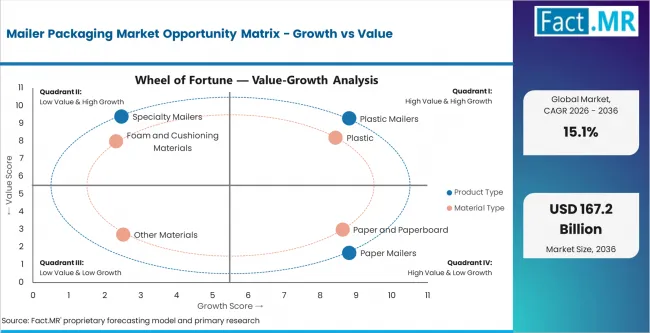
Key Factors Driving Growth
- E-commerce parcel volume growth creates the primary demand driver, with each online order requiring individual mailer packaging for last-mile delivery.
- DTC brand shipping expansion drives demand for custom-printed mailers serving as marketing tools during the unboxing experience.
- Carrier dimensional weight pricing incentivizes flat, lightweight mailer formats that reduce shipping costs versus boxes for eligible products.
Key Market Constraints
- Product damage risk in poly mailers without padding limits applicability to soft goods, apparel, and non-fragile items.
- Sustainability pressure on single-use plastic poly mailers creates regulatory risk in markets implementing plastic packaging restrictions.
- Thin margins in commodity poly mailers limit manufacturer profitability and investment in differentiated products.
Key Opportunity Areas
- Paper-based mailer innovation creating recyclable, compostable, and sustainable alternatives to plastic poly mailers addresses regulatory and consumer sustainability requirements.
- Custom-printed premium mailers for DTC brands create a higher-margin segment where brand presentation justifies pricing above commodity alternatives.
- Automated right-size mailer systems that select optimal mailer dimensions for each order reduce material waste and shipping costs in high-volume fulfillment centers.
Segment-wise Analysis of the Mailer Packaging Market
- Plastic mailers hold 50% of the product type segment in 2026, driven by poly mailers' lightweight, waterproof, and cost-efficient characteristics for e-commerce shipping.
- E-commerce accounts for 45% of the application segment in 2026, reflecting the dominance of online retail as the primary demand driver for mailer packaging.
- Medium size mailers hold 40% of the size type segment, serving apparel and small electronics that represent the largest e-commerce product categories shipped in mailers.
The market is segmented by product type, material type, closure type, application, end use industry, size type, and region. Plastic mailers lead by product type. Plastic leads by material. Self-seal leads by closure, and e-commerce leads by application.
Which Product Type Segment Dominates the Mailer Packaging Market?
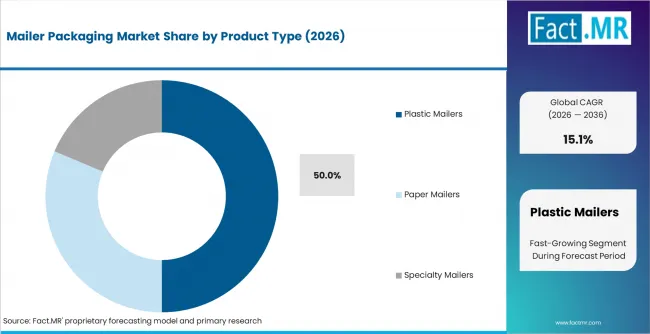
Plastic mailers account for 50% of the product type segment in 2026. Standard poly mailers serve apparel and soft goods e-commerce shipping through lightweight, waterproof, tear-resistant, and cost-efficient characteristics. Bubble mailers add air-cushion padding for electronics accessories and fragile small items, combining shipping protection with dimensional weight optimization.
Paper mailers, including kraft and padded paper mailers, are the fastest-growing product type driven by sustainability requirements. Specialty mailers serve insulated cold-chain and security applications requiring tamper-evidence or thermal protection.
Which Application Segment Dominates the Mailer Packaging Market?
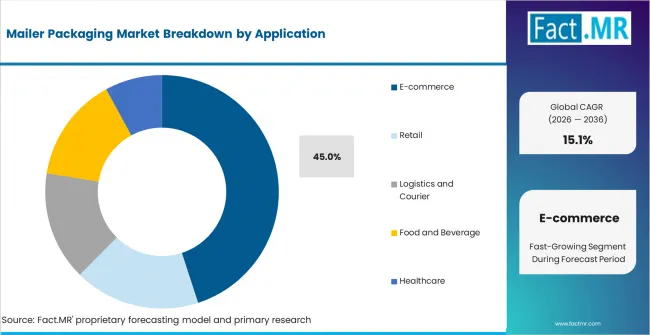
E-commerce accounts for 45% of the application segment in 2026. Apparel shipping is the largest single category, with clothing, accessories, and fashion items ideally suited to poly and paper mailer formats. Electronics accessories, beauty products, and general merchandise are growing mailer-shipped categories.
Retail packaging serves in-store customer delivery and branded packaging. Logistics and courier serves parcel delivery and document shipping through commercial mailer formats.
Which Closure Type Segment Dominates the Mailer Packaging Market?
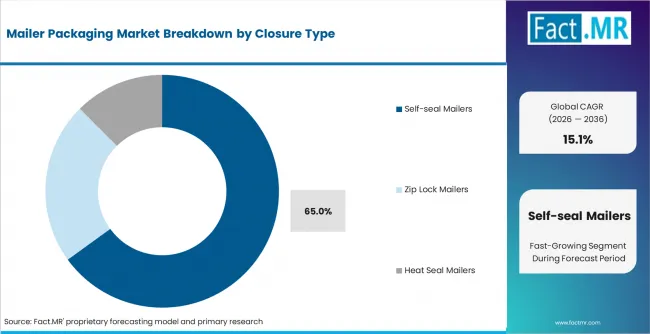
Self-seal mailers account for 65% of the closure type segment in 2026. Peel-and-seal adhesive strips enable fast, secure closure in high-volume fulfillment operations where packing speed directly impacts throughput. Tamper-evident self-seal closures provide security verification during transit.
Zip lock mailers serve resealable applications including returns-friendly packaging. Heat seal mailers serve automated packaging lines where machine-sealed closures provide consistent seal integrity at high speed.
Which Product Trend is Shaping the Next Phase of Growth in the Mailer Packaging Market?
Paper-based sustainable mailers and custom-printed branded packaging are the two defining trends. The sustainability shift is creating rapid growth in kraft paper mailers, padded paper mailers with recycled cushioning, and compostable mailer alternatives that address plastic packaging restrictions and consumer preference for recyclable shipping materials. Major e-commerce platforms are specifying paper-based mailers as default packaging for eligible product categories.
Custom-printed mailers featuring brand logos, design elements, and marketing messages are becoming standard for DTC brands where the unboxing experience serves as a marketing touchpoint. High-quality flexographic and digital printing enables cost-effective custom mailer production at quantities as low as 500 units, making branded mailers accessible to small and mid-sized e-commerce sellers as well as large brands.
Regional Outlook Across Key Markets
.webp)
| Country | CAGR (%) |
|---|---|
| India | 18.4% |
| Brazil | 17.3% |
| China | 16.8% |
| GCC | 15.9% |
| USA | 15.1% |
| Germany | 14.6% |
| Japan | 13.7% |
- India leads growth at 18.4%, driven by explosive e-commerce adoption, Flipkart and Amazon India expansion, and growing online retail penetration from a low base.
- Brazil follows at 17.3%, supported by e-commerce acceleration, Mercado Libre growth, and expanding digital commerce infrastructure.
- China grows at 16.8%, driven by the world's largest e-commerce market, live commerce, and cross-border shipping expansion.
- The USA sustains growth at 15.1% through mature e-commerce infrastructure, DTC brand proliferation, and sustainable mailer specification.
Source: Fact MR (FMR) analysis, based on proprietary forecasting model and primary research.
Market Outlook for Mailer Packaging in India
The India mailer packaging market is projected to grow at a CAGR of 18.4% through 2036. Demand is driven by e-commerce adoption from a low penetration base, Flipkart and Amazon expansion, growing digital commerce, and COD-to-prepaid transition.
- E-commerce adoption drives explosive mailer demand growth.
- Platform expansion creates distribution and fulfillment volume.
- Digital commerce penetration expansion sustains long-term growth.
Mailer Packaging Demand Trends in China
The China market is projected to grow at a CAGR of 16.8% through 2036. Growth is supported by the world's largest e-commerce market, live commerce expansion, cross-border shipping, and growing sustainability specification.
- World's largest e-commerce market drives massive mailer consumption.
- Live commerce creates concentrated, time-sensitive shipping demand.
- Cross-border shipping expansion sustains international mailer demand.
United States Mailer Packaging Market Growth Assessment
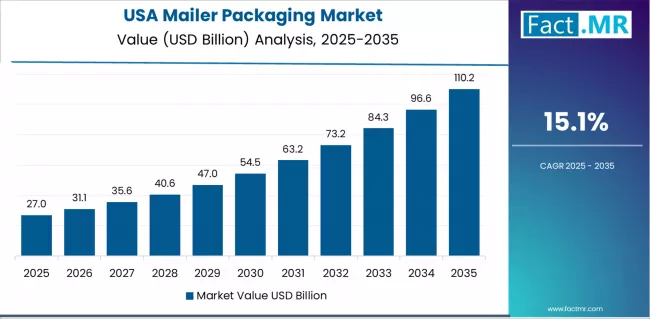
The U.S. market is projected to grow at a CAGR of 15.1% through 2036. Demand is driven by mature e-commerce infrastructure, DTC brand proliferation, sustainable mailer specification, and automated fulfillment requirements.
- DTC brand proliferation drives custom-printed mailer demand.
- Sustainable specification accelerates paper-based mailer adoption.
- Automated fulfillment drives machine-compatible mailer requirements.
Brazil Mailer Packaging Market Demand Analysis
The Brazil market is projected to grow at a CAGR of 17.3% through 2036. Demand is shaped by e-commerce acceleration, Mercado Libre growth, expanding digital commerce, and logistics infrastructure development.
- E-commerce acceleration drives mailer packaging demand growth.
- Mercado Libre expansion creates platform-driven packaging volume.
- Logistics development enables broader e-commerce reach.
Germany Mailer Packaging Market Opportunity Outlook
The Germany market is projected to grow at a CAGR of 14.6% through 2036. Demand is supported by e-commerce maturity, sustainability-driven paper mailer adoption, packaging waste regulations, and returns-friendly packaging requirements.
- Sustainability drives paper-based mailer specification.
- Packaging waste regulations accelerate plastic mailer alternatives.
- Returns-friendly packaging creates resealable mailer demand.
Competitive Benchmarking and Company Positioning
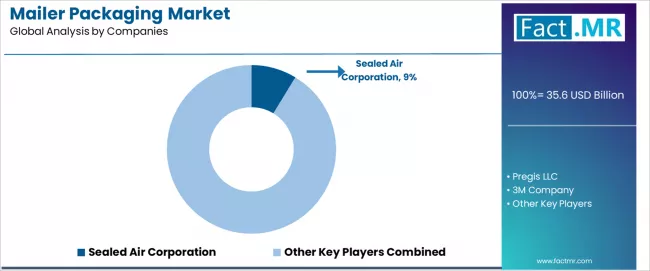
Mailer Packaging Market Analysis By Company
- Sealed Air Corporation holds approximately 9% market share through its Bubble Wrap heritage, protective mailer portfolio, and global distribution infrastructure.
- Pregis LLC and 3M Company compete through protective packaging innovation, material technology, and established distribution.
- Product protection capability, sustainability credentials, custom printing quality, and fulfillment automation compatibility are primary differentiators.
The competitive landscape is fragmented with moderate concentration. Sealed Air Corporation holds approximately 9% market share through its iconic Bubble Wrap brand, protective mailer portfolio, and global distribution. The company serves both e-commerce platforms and DTC brands through automated packaging solutions.
Pregis LLC competes through protective packaging technology. 3M Company leverages adhesive and material science expertise. Novolex Holdings and ProAmpac Holdings serve the flexible packaging segment with poly mailer manufacturing.
Georgia-Pacific, Intertape Polymer Group, DS Smith, Mondi, Stora Enso, WestRock, Abriso Jiffy, and Henkel serve specific material segments, regional markets, and sustainability-focused product categories.
Strategic priorities include developing paper-based mailer alternatives, expanding custom printing capability, building automated packaging solutions, and strengthening sustainability certifications for e-commerce platform qualification.
Key Companies in the Mailer Packaging Market
- Sealed Air Corporation, Pregis LLC, and 3M Company lead through protective packaging technology and global distribution.
- Novolex Holdings, ProAmpac Holdings, and Georgia-Pacific hold established positions through flexible packaging manufacturing and material supply.
- Intertape Polymer Group, DS Smith, Mondi, Stora Enso, WestRock, Abriso Jiffy, Henkel, Storopack, VP Group, and Manufacturas Polisac compete through regional strength and specific product expertise.
Recent Industry Developments
- Sealed Air Corporation - Sustainability Innovation / Recyclable Paper-Based Protective Mailer (2025)
- Sealed Air expanded its paper-based protective mailer portfolio, addressing growing e-commerce platform requirements for recyclable shipping packaging that maintains product protection performance comparable to traditional bubble mailers.
- Pregis LLC - Product Enhancement / Automated E-Commerce Mailer System (2025)
- Pregis advanced its automated mailer packaging systems for high-volume e-commerce fulfillment, enabling automated right-size mailer selection that reduces material waste and optimizes dimensional weight for carrier cost savings.
- DS Smith Plc - Market Expansion / Sustainable E-Commerce Mailer Platform (2025)
- DS Smith continued expanding its corrugated and paper-based mailer portfolio for e-commerce applications across Europe, addressing sustainability-driven demand for plastic-free shipping packaging solutions.
Leading Companies Shaping the Mailer Packaging Market
- Sealed Air Corporation
- Pregis LLC
- 3M Company
- Novolex Holdings LLC
- ProAmpac Holdings LLC
- Georgia-Pacific LLC
- Intertape Polymer Group Inc.
- DS Smith Plc
- Mondi plc
- Stora Enso Oyj
- WestRock Company
- Abriso Jiffy NV
- Henkel AG & Co. KGaA
- Storopack Hans Reichenecker GmbH
- VP Group
- Manufacturas Polisac S.A.
Sources and Research References
- Sealed Air Corporation. Paper-based protective mailer portfolio and e-commerce packaging documentation.
- Pregis LLC. Automated mailer packaging systems and fulfillment technology documentation.
- E-commerce parcel volume databases, online retail penetration statistics, and carrier pricing analysis.
- Sustainable packaging regulation databases, plastic packaging restriction timelines, and recycled content requirements.
- Primary interviews with mailer manufacturers, e-commerce platforms, 3PL providers, DTC brands, and fulfillment operators.
This bibliography is provided for reader reference and is not exhaustive. The full report contains the complete reference list and detailed citations.
Key Questions This Report Addresses
- What is the current and future size of the Mailer Packaging market?
- How fast is the market expected to grow between 2026 and 2036?
- Which product type leads in 2026?
- Which application holds highest share?
- What drives demand?
- How is sustainability influencing the market?
- Why is India the fastest-growing market?
- How are custom-printed mailers shaping the market?
- Which countries show fastest growth?
- Who are the key companies?
- How does Fact.MR validate the forecast?
Mailer Packaging Market Definition
The mailer packaging market covers plastic poly mailers, bubble mailers, paper kraft mailers, padded mailers, and specialty mailers used for e-commerce, retail, logistics, and document shipping applications.
Mailer Packaging Market Inclusions
- The scope covers global and regional market size and forecasts for 2026 to 2036 across product type, material type, closure type, application, end use industry, size type, and region.
- It includes analysis of e-commerce growth, DTC shipping trends, sustainable packaging regulation, and fulfillment automation requirements.
- The report covers pricing and cost analysis across mailer categories including material costs, custom printing economics, and total shipping cost optimization.
- It covers technology trends, market drivers, and competitive landscape including product portfolios and sustainability initiatives of leading manufacturers.
Mailer Packaging Market Exclusions
- The scope excludes corrugated shipping boxes and cartons classified under corrugated packaging markets.
- It excludes internal void-fill, cushioning, and protective packaging used inside boxes.
- The report excludes mailing envelopes for letters and standard postal correspondence.
- It also excludes shipping labels, tape, and closure materials sold separately from mailers.
Mailer Packaging Market Research Methodology
- The methodology combines secondary research, primary interviews, and forecast modelling.
- It draws on 60+ secondary sources and benchmarks 25+ manufacturer product portfolios and e-commerce platform packaging data.
- Market sizing covers 25+ countries through a demand-side model, supported by top-down validation.
- Key inputs include e-commerce parcel volumes, online retail penetration rates, carrier pricing structures, and sustainable packaging regulation timelines.
- The model cross-checks demand with mailer manufacturing capacity, material consumption, and e-commerce fulfillment data.
- Primary validation includes 20+ interviews across mailer manufacturers, e-commerce platforms, 3PL providers, and DTC brands.
- Final estimates go through parcel-volume checks, e-commerce-penetration analysis, and sensitivity testing.
Scope of Analysis

| Parameter | Details |
|---|---|
| Quantitative Units | USD 40.98 billion to USD 167.22 billion, at a CAGR of 15.1% |
| Market Definition | The market covers poly mailers, bubble mailers, paper kraft mailers, padded mailers, and specialty mailers for e-commerce, retail, logistics, and document shipping. |
| Regions Covered | North America, Latin America, Europe, East Asia, South Asia and Pacific, Middle East and Africa |
| Countries Covered | India, Brazil, China, GCC, USA, Germany, Japan, 25 plus countries |
| Key Companies | Sealed Air, Pregis, 3M, Novolex, ProAmpac, Georgia-Pacific, Intertape Polymer, DS Smith, Mondi, Stora Enso, WestRock, Abriso Jiffy, Henkel, Storopack |
| Forecast Period | 2026 to 2036 |
| Approach | Hybrid demand-side and top-down methodology built on e-commerce parcel volumes, online retail penetration, carrier pricing, and primary interviews across manufacturers, platforms, and fulfillment operators |
Mailer Packaging Market Segmentation
-
Mailer Packaging Market Segmented by Product Type:
- Plastic Mailers
- Poly Mailers
- Standard Poly Mailers
- Tamper-proof Mailers
- Bubble Mailers
- Air Bubble Padding
- Shock Protection
- Poly Mailers
- Paper Mailers
- Kraft Mailers
- Flat Mailers
- Rigid Mailers
- Padded Paper Mailers
- Cushioned Mailers
- Recyclable Padding
- Kraft Mailers
- Specialty Mailers
- Insulated Mailers
- Thermal Protection
- Cold Chain Shipping
- Security Mailers
- Tamper-evident
- Confidential Documents
- Insulated Mailers
- Plastic Mailers
-
Mailer Packaging Market Segmented by Material Type:
- Plastic
- Polyethylene (PE)
- Flexible
- Water Resistant
- Polypropylene (PP)
- Durable
- Tear Resistant
- Polyethylene (PE)
- Paper and Paperboard
- Kraft Paper
- Recyclable
- Eco-friendly
- Corrugated Board
- Rigid Structure
- Protection
- Kraft Paper
- Foam and Cushioning Materials
- Bubble Wrap
- Air Cushioning
- Shock Absorption
- Foam Inserts
- Protection
- Fragile Items
- Bubble Wrap
- Other Materials
- Biodegradable Plastics
- Compostable Mailers
- Sustainable Packaging
- Multi-layer Laminates
- Barrier Protection
- Durability
- Biodegradable Plastics
- Plastic
-
Mailer Packaging Market Segmented by Closure Type:
- Self-seal Mailers
- Peel and Seal
- Easy Closure
- Tamper Evident
- Adhesive Strip
- Secure Sealing
- Fast Packaging
- Peel and Seal
- Zip Lock Mailers
- Reclosable Zippers
- Reusable Packaging
- Convenience
- Slider Zippers
- Enhanced Sealing
- Premium Design
- Reclosable Zippers
- Heat Seal Mailers
- Manual Heat Sealing
- Small Operations
- Custom Packaging
- Automated Heat Sealing
- High Volume Packaging
- Industrial Use
- Manual Heat Sealing
- Self-seal Mailers
-
Mailer Packaging Market Segmented by Application:
- E-commerce
- Apparel Shipping
- Clothing
- Accessories
- Electronics Shipping
- Small Devices
- Accessories
- Apparel Shipping
- Retail
- Store Packaging
- Customer Delivery
- In-store Packaging
- Branding
- Custom Printed Mailers
- Marketing
- Store Packaging
- Logistics and Courier
- Parcel Delivery
- Last-mile Delivery
- Courier Services
- Document Shipping
- Confidential Papers
- Legal Documents
- Parcel Delivery
- Food and Beverage
- Food Delivery
- Meal Kits
- Fresh Products
- Specialty Shipping
- Temperature-sensitive
- Insulated Mailers
- Food Delivery
- Healthcare
- Medical Supplies
- Small Equipment
- Disposable Items
- Pharmaceuticals
- Sample Shipping
- Temperature-sensitive Drugs
- Medical Supplies
- E-commerce
-
Mailer Packaging Market Segmented by End Use Industry:
- E-commerce Industry
- Online Retailers
- Fashion
- Electronics
- Marketplaces
- Third-party Sellers
- SMEs
- Online Retailers
- Logistics Industry
- Courier Companies
- Parcel Delivery
- Express Services
- Third-party Logistics (3PL)
- Warehousing
- Distribution
- Courier Companies
- Retail Industry
- Branded Stores
- Packaging
- Customer Experience
- Supermarkets
- Online Orders
- Delivery
- Branded Stores
- Food and Beverage Industry
- Online Food Platforms
- Meal Delivery
- Subscription Boxes
- Food Producers
- Direct-to-consumer
- Cold Chain
- Online Food Platforms
- Healthcare Industry
- Pharmaceutical Companies
- Drug Shipping
- Clinical Trials
- Medical Suppliers
- Equipment Shipping
- Disposable Supplies
- Pharmaceutical Companies
- E-commerce Industry
-
Mailer Packaging Market Segmented by Size Type:
- Medium Size Mailers
- Apparel
- Clothing
- Soft Goods
- Small Electronics
- Gadgets
- Accessories
- Apparel
- Small Size Mailers
- Documents and Letters
- Flat Mailers
- Lightweight Items
- Accessories
- Jewelry
- Small Goods
- Documents and Letters
- Large Size Mailers
- Bulk Apparel
- Multiple Items
- Large Clothing
- Medium Electronics
- Devices
- Accessories
- Bulk Apparel
- Extra Large Mailers
- Bulk Shipments
- Large Orders
- Multiple Products
- Oversized Items
- Non-fragile Goods
- Lightweight Bulk
- Bulk Shipments
- Medium Size Mailers
-
Mailer Packaging Market by Region:
- North America
- USA
- Canada
- Mexico
- Latin America
- Brazil
- Chile
- Rest of Latin America
- Western Europe
- Germany
- UK
- Italy
- Spain
- France
- Nordic
- BENELUX
- Rest of Western Europe
- Eastern Europe
- Russia
- Poland
- Hungary
- Balkan & Baltic
- Rest of Eastern Europe
- East Asia
- China
- Japan
- South Korea
- South Asia and Pacific
- India
- ASEAN
- Australia & New Zealand
- Rest of South Asia and Pacific
- Middle East & Africa
- Kingdom of Saudi Arabia
- Other GCC Countries
- Turkiye
- South Africa
- Other African Union
- Rest of Middle East & Africa
- North America
- Frequently Asked Questions -
Which countries are growing fastest in the Ready-to-Drink Packaging Market?
China (7.1%) and India (6.8%) are the fastest-growing markets during the forecast period.
What will be the size in 2036?
The market is projected to reach USD 167.22 billion by 2036.
How much will the market grow between 2026 and 2036?
The market is expected to grow at a 15.1% CAGR between 2026 and 2036.
What are the key product types?
The key product types are plastic mailers (poly, bubble), paper mailers (kraft, padded), and specialty mailers (insulated, security).
Which application holds highest share in 2026?
E-commerce is expected to account for 45% share in 2026.
Which are the fastest-growing countries?
India (18.4%) and Brazil (17.3%) are the fastest-growing countries during the forecast period.
Table of Content
- Executive Summary
- Global Market Outlook
- Demand to side Trends
- Supply to side Trends
- Technology Roadmap Analysis
- Analysis and Recommendations
- Market Overview
- Market Coverage / Taxonomy
- Market Definition / Scope / Limitations
- Research Methodology
- Chapter Orientation
- Analytical Lens and Working Hypotheses
- Market Structure, Signals, and Trend Drivers
- Benchmarking and Cross-market Comparability
- Market Sizing, Forecasting, and Opportunity Mapping
- Research Design and Evidence Framework
- Desk Research Programme (Secondary Evidence)
- Company Annual and Sustainability Reports
- Peer-reviewed Journals and Academic Literature
- Corporate Websites, Product Literature, and Technical Notes
- Earnings Decks and Investor Briefings
- Statutory Filings and Regulatory Disclosures
- Technical White Papers and Standards Notes
- Trade Journals, Industry Magazines, and Analyst Briefs
- Conference Proceedings, Webinars, and Seminar Materials
- Government Statistics Portals and Public Data Releases
- Press Releases and Reputable Media Coverage
- Specialist Newsletters and Curated Briefings
- Sector Databases and Reference Repositories
- Fact.MR Internal Proprietary Databases and Historical Market Datasets
- Subscription Datasets and Paid Sources
- Social Channels, Communities, and Digital Listening Inputs
- Additional Desk Sources
- Expert Input and Fieldwork (Primary Evidence)
- Primary Modes
- Qualitative Interviews and Expert Elicitation
- Quantitative Surveys and Structured Data Capture
- Blended Approach
- Why Primary Evidence is Used
- Field Techniques
- Interviews
- Surveys
- Focus Groups
- Observational and In-context Research
- Social and Community Interactions
- Stakeholder Universe Engaged
- C-suite Leaders
- Board Members
- Presidents and Vice Presidents
- R&D and Innovation Heads
- Technical Specialists
- Domain Subject-matter Experts
- Scientists
- Physicians and Other Healthcare Professionals
- Governance, Ethics, and Data Stewardship
- Research Ethics
- Data Integrity and Handling
- Primary Modes
- Tooling, Models, and Reference Databases
- Desk Research Programme (Secondary Evidence)
- Data Engineering and Model Build
- Data Acquisition and Ingestion
- Cleaning, Normalisation, and Verification
- Synthesis, Triangulation, and Analysis
- Quality Assurance and Audit Trail
- Market Background
- Market Dynamics
- Drivers
- Restraints
- Opportunity
- Trends
- Scenario Forecast
- Demand in Optimistic Scenario
- Demand in Likely Scenario
- Demand in Conservative Scenario
- Opportunity Map Analysis
- Product Life Cycle Analysis
- Supply Chain Analysis
- Investment Feasibility Matrix
- Value Chain Analysis
- PESTLE and Porter’s Analysis
- Regulatory Landscape
- Regional Parent Market Outlook
- Production and Consumption Statistics
- Import and Export Statistics
- Market Dynamics
- Global Market Analysis 2021 to 2025 and Forecast, 2026 to 2036
- Historical Market Size Value (USD Million) Analysis, 2021 to 2025
- Current and Future Market Size Value (USD Million) Projections, 2026 to 2036
- Y to o to Y Growth Trend Analysis
- Absolute $ Opportunity Analysis
- Global Market Pricing Analysis 2021 to 2025 and Forecast 2026 to 2036
- Global Market Analysis 2021 to 2025 and Forecast 2026 to 2036, By Product Type
- Introduction / Key Findings
- Historical Market Size Value (USD Million) Analysis By Product Type, 2021 to 2025
- Current and Future Market Size Value (USD Million) Analysis and Forecast By Product Type, 2026 to 2036
- Plastic Mailers
- Poly Mailers
- Standard Poly Mailers
- Tamper-proof Mailers
- Bubble Mailers
- Air Bubble Padding
- Shock Protection
- Paper Mailers
- Kraft Mailers
- Flat Mailers
- Rigid Mailers
- Padded Paper Mailers
- Cushioned Mailers
- Specialty Mailers
- Insulated Mailers
- Thermal Protection
- Cold Chain Shipping
- Security Mailers
- Tamper-evident
- Plastic Mailers
- Y to o to Y Growth Trend Analysis By Product Type, 2021 to 2025
- Absolute $ Opportunity Analysis By Product Type, 2026 to 2036
- Global Market Analysis 2021 to 2025 and Forecast 2026 to 2036, By Material Type
- Introduction / Key Findings
- Historical Market Size Value (USD Million) Analysis By Material Type, 2021 to 2025
- Current and Future Market Size Value (USD Million) Analysis and Forecast By Material Type, 2026 to 2036
- Plastic
- Polyethylene (PE)
- Flexible
- Water Resistant
- Polypropylene (PP)
- Durable
- Tear Resistant
- Paper and Paperboard
- Multi-layer Laminates
- Barrier Protection
- Plastic
- Y to o to Y Growth Trend Analysis By Material Type, 2021 to 2025
- Absolute $ Opportunity Analysis By Material Type, 2026 to 2036
- Global Market Analysis 2021 to 2025 and Forecast 2026 to 2036, By Closure Type
- Introduction / Key Findings
- Historical Market Size Value (USD Million) Analysis By Closure Type, 2021 to 2025
- Current and Future Market Size Value (USD Million) Analysis and Forecast By Closure Type, 2026 to 2036
- Self-seal Mailers
- Peel and Seal
- Easy Closure
- Tamper Evident
- Adhesive Strip
- Secure Sealing
- Fast Packaging
- Zip Lock Mailers
- Reclosable Zippers
- Reusable Packaging
- Convenience
- Slider Zippers
- Enhanced Sealing
- Heat Seal Mailers
- Manual Heat Sealing
- Small Operations
- Custom Packaging
- Automated Heat Sealing
- High Volume Packaging
- Self-seal Mailers
- Y to o to Y Growth Trend Analysis By Closure Type, 2021 to 2025
- Absolute $ Opportunity Analysis By Closure Type, 2026 to 2036
- Global Market Analysis 2021 to 2025 and Forecast 2026 to 2036, By Application
- Introduction / Key Findings
- Historical Market Size Value (USD Million) Analysis By Application, 2021 to 2025
- Current and Future Market Size Value (USD Million) Analysis and Forecast By Application, 2026 to 2036
- E-commerce
- Apparel Shipping
- Clothing
- Accessories
- Electronics Shipping
- Small Devices
- Accessories
- Retail
- Store Packaging
- Customer Delivery
- In-store Packaging
- Branding
- Custom Printed Mailers
- Logistics and Courier
- Parcel Delivery
- Last-mile Delivery
- Courier Services
- Document Shipping
- Confidential Papers
- Food and Beverage
- Food Delivery
- Meal Kits
- Fresh Products
- Specialty Shipping
- Temperature-sensitive
- Healthcare
- Medical Supplies
- Small Equipment
- Disposable Items
- Pharmaceuticals
- Sample Shipping
- E-commerce
- Y to o to Y Growth Trend Analysis By Application, 2021 to 2025
- Absolute $ Opportunity Analysis By Application, 2026 to 2036
- Global Market Analysis 2021 to 2025 and Forecast 2026 to 2036, By End Use Industry
- Introduction / Key Findings
- Historical Market Size Value (USD Million) Analysis By End Use Industry, 2021 to 2025
- Current and Future Market Size Value (USD Million) Analysis and Forecast By End Use Industry, 2026 to 2036
- E-commerce Industry
- Online Retailers
- Fashion
- Electronics
- Marketplaces
- Third-party Sellers
- SMEs
- Logistics Industry
- Courier Companies
- Parcel Delivery
- Express Services
- Third-party Logistics (3PL)
- Warehousing
- Retail Industry
- Branded Stores
- Packaging
- Customer Experience
- Supermarkets
- Online Orders
- Food and Beverage Industry
- Online Food Platforms
- Meal Delivery
- Subscription Boxes
- Food Producers
- Direct-to-consumer
- Healthcare Industry
- Pharmaceutical Companies
- Drug Shipping
- Clinical Trials
- Medical Suppliers
- Equipment Shipping
- E-commerce Industry
- Y to o to Y Growth Trend Analysis By End Use Industry, 2021 to 2025
- Absolute $ Opportunity Analysis By End Use Industry, 2026 to 2036
- Global Market Analysis 2021 to 2025 and Forecast 2026 to 2036, By Size Type
- Introduction / Key Findings
- Historical Market Size Value (USD Million) Analysis By Size Type, 2021 to 2025
- Current and Future Market Size Value (USD Million) Analysis and Forecast By Size Type, 2026 to 2036
- Medium Size Mailers
- Apparel
- Clothing
- Soft Goods
- Small Electronics
- Gadgets
- Accessories
- Small Size Mailers
- Documents and Letters
- Flat Mailers
- Lightweight Items
- Accessories
- Jewelry
- Large Size Mailers
- Bulk Apparel
- Multiple Items
- Large Clothing
- Medium Electronics
- Devices
- Extra Large Mailers
- Bulk Shipments
- Large Orders
- Multiple Products
- Oversized Items
- Non-fragile Goods
- Medium Size Mailers
- Y to o to Y Growth Trend Analysis By Size Type, 2021 to 2025
- Absolute $ Opportunity Analysis By Size Type, 2026 to 2036
- Global Market Analysis 2021 to 2025 and Forecast 2026 to 2036, By Region
- Introduction
- Historical Market Size Value (USD Million) Analysis By Region, 2021 to 2025
- Current Market Size Value (USD Million) Analysis and Forecast By Region, 2026 to 2036
- North America
- Latin America
- Western Europe
- Eastern Europe
- East Asia
- South Asia and Pacific
- Middle East & Africa
- Market Attractiveness Analysis By Region
- North America Market Analysis 2021 to 2025 and Forecast 2026 to 2036, By Country
- Historical Market Size Value (USD Million) Trend Analysis By Market Taxonomy, 2021 to 2025
- Market Size Value (USD Million) Forecast By Market Taxonomy, 2026 to 2036
- By Country
- USA
- Canada
- Mexico
- By Product Type
- By Material Type
- By Closure Type
- By Application
- By End Use Industry
- By Size Type
- By Country
- Market Attractiveness Analysis
- By Country
- By Product Type
- By Material Type
- By Closure Type
- By Application
- By End Use Industry
- By Size Type
- Key Takeaways
- Latin America Market Analysis 2021 to 2025 and Forecast 2026 to 2036, By Country
- Historical Market Size Value (USD Million) Trend Analysis By Market Taxonomy, 2021 to 2025
- Market Size Value (USD Million) Forecast By Market Taxonomy, 2026 to 2036
- By Country
- Brazil
- Chile
- Rest of Latin America
- By Product Type
- By Material Type
- By Closure Type
- By Application
- By End Use Industry
- By Size Type
- By Country
- Market Attractiveness Analysis
- By Country
- By Product Type
- By Material Type
- By Closure Type
- By Application
- By End Use Industry
- By Size Type
- Key Takeaways
- Western Europe Market Analysis 2021 to 2025 and Forecast 2026 to 2036, By Country
- Historical Market Size Value (USD Million) Trend Analysis By Market Taxonomy, 2021 to 2025
- Market Size Value (USD Million) Forecast By Market Taxonomy, 2026 to 2036
- By Country
- Germany
- UK
- Italy
- Spain
- France
- Nordic
- BENELUX
- Rest of Western Europe
- By Product Type
- By Material Type
- By Closure Type
- By Application
- By End Use Industry
- By Size Type
- By Country
- Market Attractiveness Analysis
- By Country
- By Product Type
- By Material Type
- By Closure Type
- By Application
- By End Use Industry
- By Size Type
- Key Takeaways
- Eastern Europe Market Analysis 2021 to 2025 and Forecast 2026 to 2036, By Country
- Historical Market Size Value (USD Million) Trend Analysis By Market Taxonomy, 2021 to 2025
- Market Size Value (USD Million) Forecast By Market Taxonomy, 2026 to 2036
- By Country
- Russia
- Poland
- Hungary
- Balkan & Baltic
- Rest of Eastern Europe
- By Product Type
- By Material Type
- By Closure Type
- By Application
- By End Use Industry
- By Size Type
- By Country
- Market Attractiveness Analysis
- By Country
- By Product Type
- By Material Type
- By Closure Type
- By Application
- By End Use Industry
- By Size Type
- Key Takeaways
- East Asia Market Analysis 2021 to 2025 and Forecast 2026 to 2036, By Country
- Historical Market Size Value (USD Million) Trend Analysis By Market Taxonomy, 2021 to 2025
- Market Size Value (USD Million) Forecast By Market Taxonomy, 2026 to 2036
- By Country
- China
- Japan
- South Korea
- By Product Type
- By Material Type
- By Closure Type
- By Application
- By End Use Industry
- By Size Type
- By Country
- Market Attractiveness Analysis
- By Country
- By Product Type
- By Material Type
- By Closure Type
- By Application
- By End Use Industry
- By Size Type
- Key Takeaways
- South Asia and Pacific Market Analysis 2021 to 2025 and Forecast 2026 to 2036, By Country
- Historical Market Size Value (USD Million) Trend Analysis By Market Taxonomy, 2021 to 2025
- Market Size Value (USD Million) Forecast By Market Taxonomy, 2026 to 2036
- By Country
- India
- ASEAN
- Australia & New Zealand
- Rest of South Asia and Pacific
- By Product Type
- By Material Type
- By Closure Type
- By Application
- By End Use Industry
- By Size Type
- By Country
- Market Attractiveness Analysis
- By Country
- By Product Type
- By Material Type
- By Closure Type
- By Application
- By End Use Industry
- By Size Type
- Key Takeaways
- Middle East & Africa Market Analysis 2021 to 2025 and Forecast 2026 to 2036, By Country
- Historical Market Size Value (USD Million) Trend Analysis By Market Taxonomy, 2021 to 2025
- Market Size Value (USD Million) Forecast By Market Taxonomy, 2026 to 2036
- By Country
- Kingdom of Saudi Arabia
- Other GCC Countries
- Turkiye
- South Africa
- Other African Union
- Rest of Middle East & Africa
- By Product Type
- By Material Type
- By Closure Type
- By Application
- By End Use Industry
- By Size Type
- By Country
- Market Attractiveness Analysis
- By Country
- By Product Type
- By Material Type
- By Closure Type
- By Application
- By End Use Industry
- By Size Type
- Key Takeaways
- Key Countries Market Analysis
- USA
- Pricing Analysis
- Market Share Analysis, 2025
- By Product Type
- By Material Type
- By Closure Type
- By Application
- By End Use Industry
- By Size Type
- Canada
- Pricing Analysis
- Market Share Analysis, 2025
- By Product Type
- By Material Type
- By Closure Type
- By Application
- By End Use Industry
- By Size Type
- Mexico
- Pricing Analysis
- Market Share Analysis, 2025
- By Product Type
- By Material Type
- By Closure Type
- By Application
- By End Use Industry
- By Size Type
- Brazil
- Pricing Analysis
- Market Share Analysis, 2025
- By Product Type
- By Material Type
- By Closure Type
- By Application
- By End Use Industry
- By Size Type
- Chile
- Pricing Analysis
- Market Share Analysis, 2025
- By Product Type
- By Material Type
- By Closure Type
- By Application
- By End Use Industry
- By Size Type
- Germany
- Pricing Analysis
- Market Share Analysis, 2025
- By Product Type
- By Material Type
- By Closure Type
- By Application
- By End Use Industry
- By Size Type
- UK
- Pricing Analysis
- Market Share Analysis, 2025
- By Product Type
- By Material Type
- By Closure Type
- By Application
- By End Use Industry
- By Size Type
- Italy
- Pricing Analysis
- Market Share Analysis, 2025
- By Product Type
- By Material Type
- By Closure Type
- By Application
- By End Use Industry
- By Size Type
- Spain
- Pricing Analysis
- Market Share Analysis, 2025
- By Product Type
- By Material Type
- By Closure Type
- By Application
- By End Use Industry
- By Size Type
- France
- Pricing Analysis
- Market Share Analysis, 2025
- By Product Type
- By Material Type
- By Closure Type
- By Application
- By End Use Industry
- By Size Type
- India
- Pricing Analysis
- Market Share Analysis, 2025
- By Product Type
- By Material Type
- By Closure Type
- By Application
- By End Use Industry
- By Size Type
- ASEAN
- Pricing Analysis
- Market Share Analysis, 2025
- By Product Type
- By Material Type
- By Closure Type
- By Application
- By End Use Industry
- By Size Type
- Australia & New Zealand
- Pricing Analysis
- Market Share Analysis, 2025
- By Product Type
- By Material Type
- By Closure Type
- By Application
- By End Use Industry
- By Size Type
- China
- Pricing Analysis
- Market Share Analysis, 2025
- By Product Type
- By Material Type
- By Closure Type
- By Application
- By End Use Industry
- By Size Type
- Japan
- Pricing Analysis
- Market Share Analysis, 2025
- By Product Type
- By Material Type
- By Closure Type
- By Application
- By End Use Industry
- By Size Type
- South Korea
- Pricing Analysis
- Market Share Analysis, 2025
- By Product Type
- By Material Type
- By Closure Type
- By Application
- By End Use Industry
- By Size Type
- Russia
- Pricing Analysis
- Market Share Analysis, 2025
- By Product Type
- By Material Type
- By Closure Type
- By Application
- By End Use Industry
- By Size Type
- Poland
- Pricing Analysis
- Market Share Analysis, 2025
- By Product Type
- By Material Type
- By Closure Type
- By Application
- By End Use Industry
- By Size Type
- Hungary
- Pricing Analysis
- Market Share Analysis, 2025
- By Product Type
- By Material Type
- By Closure Type
- By Application
- By End Use Industry
- By Size Type
- Kingdom of Saudi Arabia
- Pricing Analysis
- Market Share Analysis, 2025
- By Product Type
- By Material Type
- By Closure Type
- By Application
- By End Use Industry
- By Size Type
- Turkiye
- Pricing Analysis
- Market Share Analysis, 2025
- By Product Type
- By Material Type
- By Closure Type
- By Application
- By End Use Industry
- By Size Type
- South Africa
- Pricing Analysis
- Market Share Analysis, 2025
- By Product Type
- By Material Type
- By Closure Type
- By Application
- By End Use Industry
- By Size Type
- USA
- Market Structure Analysis
- Competition Dashboard
- Competition Benchmarking
- Market Share Analysis of Top Players
- By Regional
- By Product Type
- By Material Type
- By Closure Type
- By Application
- By End Use Industry
- By Size Type
- Competition Analysis
- Competition Deep Dive
- Sealed Air Corporation
- Overview
- Product Portfolio
- Profitability by Market Segments (Product/Age /Sales Channel/Region)
- Sales Footprint
- Strategy Overview
- Marketing Strategy
- Product Strategy
- Channel Strategy
- Pregis LLC
- 3M Company
- Novolex Holdings LLC
- ProAmpac Holdings LLC
- Georgia-Pacific LLC
- Intertape Polymer Group Inc.
- DS Smith Plc
- Mondi plc
- Stora Enso Oyj
- WestRock Company
- Abriso Jiffy NV
- Henkel AG & Co. KGaA
- Storopack Hans Reichenecker GmbH
- VP Group
- Manufacturas Polisac S.A.
- Sealed Air Corporation
- Competition Deep Dive
- Assumptions & Acronyms Used
List Of Table
- Table 1: Global Market Value (USD Million) Forecast by Region, 2021 to 2036
- Table 2: Global Market Value (USD Million) Forecast by Product Type, 2021 to 2036
- Table 3: Global Market Value (USD Million) Forecast by Material Type, 2021 to 2036
- Table 4: Global Market Value (USD Million) Forecast by Closure Type, 2021 to 2036
- Table 5: Global Market Value (USD Million) Forecast by Application, 2021 to 2036
- Table 6: Global Market Value (USD Million) Forecast by End Use Industry, 2021 to 2036
- Table 7: Global Market Value (USD Million) Forecast by Size Type, 2021 to 2036
- Table 8: North America Market Value (USD Million) Forecast by Country, 2021 to 2036
- Table 9: North America Market Value (USD Million) Forecast by Product Type, 2021 to 2036
- Table 10: North America Market Value (USD Million) Forecast by Material Type, 2021 to 2036
- Table 11: North America Market Value (USD Million) Forecast by Closure Type, 2021 to 2036
- Table 12: North America Market Value (USD Million) Forecast by Application, 2021 to 2036
- Table 13: North America Market Value (USD Million) Forecast by End Use Industry, 2021 to 2036
- Table 14: North America Market Value (USD Million) Forecast by Size Type, 2021 to 2036
- Table 15: Latin America Market Value (USD Million) Forecast by Country, 2021 to 2036
- Table 16: Latin America Market Value (USD Million) Forecast by Product Type, 2021 to 2036
- Table 17: Latin America Market Value (USD Million) Forecast by Material Type, 2021 to 2036
- Table 18: Latin America Market Value (USD Million) Forecast by Closure Type, 2021 to 2036
- Table 19: Latin America Market Value (USD Million) Forecast by Application, 2021 to 2036
- Table 20: Latin America Market Value (USD Million) Forecast by End Use Industry, 2021 to 2036
- Table 21: Latin America Market Value (USD Million) Forecast by Size Type, 2021 to 2036
- Table 22: Western Europe Market Value (USD Million) Forecast by Country, 2021 to 2036
- Table 23: Western Europe Market Value (USD Million) Forecast by Product Type, 2021 to 2036
- Table 24: Western Europe Market Value (USD Million) Forecast by Material Type, 2021 to 2036
- Table 25: Western Europe Market Value (USD Million) Forecast by Closure Type, 2021 to 2036
- Table 26: Western Europe Market Value (USD Million) Forecast by Application, 2021 to 2036
- Table 27: Western Europe Market Value (USD Million) Forecast by End Use Industry, 2021 to 2036
- Table 28: Western Europe Market Value (USD Million) Forecast by Size Type, 2021 to 2036
- Table 29: Eastern Europe Market Value (USD Million) Forecast by Country, 2021 to 2036
- Table 30: Eastern Europe Market Value (USD Million) Forecast by Product Type, 2021 to 2036
- Table 31: Eastern Europe Market Value (USD Million) Forecast by Material Type, 2021 to 2036
- Table 32: Eastern Europe Market Value (USD Million) Forecast by Closure Type, 2021 to 2036
- Table 33: Eastern Europe Market Value (USD Million) Forecast by Application, 2021 to 2036
- Table 34: Eastern Europe Market Value (USD Million) Forecast by End Use Industry, 2021 to 2036
- Table 35: Eastern Europe Market Value (USD Million) Forecast by Size Type, 2021 to 2036
- Table 36: East Asia Market Value (USD Million) Forecast by Country, 2021 to 2036
- Table 37: East Asia Market Value (USD Million) Forecast by Product Type, 2021 to 2036
- Table 38: East Asia Market Value (USD Million) Forecast by Material Type, 2021 to 2036
- Table 39: East Asia Market Value (USD Million) Forecast by Closure Type, 2021 to 2036
- Table 40: East Asia Market Value (USD Million) Forecast by Application, 2021 to 2036
- Table 41: East Asia Market Value (USD Million) Forecast by End Use Industry, 2021 to 2036
- Table 42: East Asia Market Value (USD Million) Forecast by Size Type, 2021 to 2036
- Table 43: South Asia and Pacific Market Value (USD Million) Forecast by Country, 2021 to 2036
- Table 44: South Asia and Pacific Market Value (USD Million) Forecast by Product Type, 2021 to 2036
- Table 45: South Asia and Pacific Market Value (USD Million) Forecast by Material Type, 2021 to 2036
- Table 46: South Asia and Pacific Market Value (USD Million) Forecast by Closure Type, 2021 to 2036
- Table 47: South Asia and Pacific Market Value (USD Million) Forecast by Application, 2021 to 2036
- Table 48: South Asia and Pacific Market Value (USD Million) Forecast by End Use Industry, 2021 to 2036
- Table 49: South Asia and Pacific Market Value (USD Million) Forecast by Size Type, 2021 to 2036
- Table 50: Middle East & Africa Market Value (USD Million) Forecast by Country, 2021 to 2036
- Table 51: Middle East & Africa Market Value (USD Million) Forecast by Product Type, 2021 to 2036
- Table 52: Middle East & Africa Market Value (USD Million) Forecast by Material Type, 2021 to 2036
- Table 53: Middle East & Africa Market Value (USD Million) Forecast by Closure Type, 2021 to 2036
- Table 54: Middle East & Africa Market Value (USD Million) Forecast by Application, 2021 to 2036
- Table 55: Middle East & Africa Market Value (USD Million) Forecast by End Use Industry, 2021 to 2036
- Table 56: Middle East & Africa Market Value (USD Million) Forecast by Size Type, 2021 to 2036
List Of Figures
- Figure 1: Global Market Pricing Analysis
- Figure 2: Global Market Value (USD Million) Forecast 2021 to 2036
- Figure 3: Global Market Value Share and BPS Analysis by Product Type, 2026 and 2036
- Figure 4: Global Market Y-o-Y Growth Comparison by Product Type, 2026 to 2036
- Figure 5: Global Market Attractiveness Analysis by Product Type
- Figure 6: Global Market Value Share and BPS Analysis by Material Type, 2026 and 2036
- Figure 7: Global Market Y-o-Y Growth Comparison by Material Type, 2026 to 2036
- Figure 8: Global Market Attractiveness Analysis by Material Type
- Figure 9: Global Market Value Share and BPS Analysis by Closure Type, 2026 and 2036
- Figure 10: Global Market Y-o-Y Growth Comparison by Closure Type, 2026 to 2036
- Figure 11: Global Market Attractiveness Analysis by Closure Type
- Figure 12: Global Market Value Share and BPS Analysis by Application, 2026 and 2036
- Figure 13: Global Market Y-o-Y Growth Comparison by Application, 2026 to 2036
- Figure 14: Global Market Attractiveness Analysis by Application
- Figure 15: Global Market Value Share and BPS Analysis by End Use Industry, 2026 and 2036
- Figure 16: Global Market Y-o-Y Growth Comparison by End Use Industry, 2026 to 2036
- Figure 17: Global Market Attractiveness Analysis by End Use Industry
- Figure 18: Global Market Value Share and BPS Analysis by Size Type, 2026 and 2036
- Figure 19: Global Market Y-o-Y Growth Comparison by Size Type, 2026 to 2036
- Figure 20: Global Market Attractiveness Analysis by Size Type
- Figure 21: Global Market Value (USD Million) Share and BPS Analysis by Region, 2026 and 2036
- Figure 22: Global Market Y-o-Y Growth Comparison by Region, 2026 to 2036
- Figure 23: Global Market Attractiveness Analysis by Region
- Figure 24: North America Market Incremental Dollar Opportunity, 2026 to 2036
- Figure 25: Latin America Market Incremental Dollar Opportunity, 2026 to 2036
- Figure 26: Western Europe Market Incremental Dollar Opportunity, 2026 to 2036
- Figure 27: Eastern Europe Market Incremental Dollar Opportunity, 2026 to 2036
- Figure 28: East Asia Market Incremental Dollar Opportunity, 2026 to 2036
- Figure 29: South Asia and Pacific Market Incremental Dollar Opportunity, 2026 to 2036
- Figure 30: Middle East & Africa Market Incremental Dollar Opportunity, 2026 to 2036
- Figure 31: North America Market Value Share and BPS Analysis by Country, 2026 and 2036
- Figure 32: North America Market Value Share and BPS Analysis by Product Type, 2026 and 2036
- Figure 33: North America Market Y-o-Y Growth Comparison by Product Type, 2026 to 2036
- Figure 34: North America Market Attractiveness Analysis by Product Type
- Figure 35: North America Market Value Share and BPS Analysis by Material Type, 2026 and 2036
- Figure 36: North America Market Y-o-Y Growth Comparison by Material Type, 2026 to 2036
- Figure 37: North America Market Attractiveness Analysis by Material Type
- Figure 38: North America Market Value Share and BPS Analysis by Closure Type, 2026 and 2036
- Figure 39: North America Market Y-o-Y Growth Comparison by Closure Type, 2026 to 2036
- Figure 40: North America Market Attractiveness Analysis by Closure Type
- Figure 41: North America Market Value Share and BPS Analysis by Application, 2026 and 2036
- Figure 42: North America Market Y-o-Y Growth Comparison by Application, 2026 to 2036
- Figure 43: North America Market Attractiveness Analysis by Application
- Figure 44: North America Market Value Share and BPS Analysis by End Use Industry, 2026 and 2036
- Figure 45: North America Market Y-o-Y Growth Comparison by End Use Industry, 2026 to 2036
- Figure 46: North America Market Attractiveness Analysis by End Use Industry
- Figure 47: North America Market Value Share and BPS Analysis by Size Type, 2026 and 2036
- Figure 48: North America Market Y-o-Y Growth Comparison by Size Type, 2026 to 2036
- Figure 49: North America Market Attractiveness Analysis by Size Type
- Figure 50: Latin America Market Value Share and BPS Analysis by Country, 2026 and 2036
- Figure 51: Latin America Market Value Share and BPS Analysis by Product Type, 2026 and 2036
- Figure 52: Latin America Market Y-o-Y Growth Comparison by Product Type, 2026 to 2036
- Figure 53: Latin America Market Attractiveness Analysis by Product Type
- Figure 54: Latin America Market Value Share and BPS Analysis by Material Type, 2026 and 2036
- Figure 55: Latin America Market Y-o-Y Growth Comparison by Material Type, 2026 to 2036
- Figure 56: Latin America Market Attractiveness Analysis by Material Type
- Figure 57: Latin America Market Value Share and BPS Analysis by Closure Type, 2026 and 2036
- Figure 58: Latin America Market Y-o-Y Growth Comparison by Closure Type, 2026 to 2036
- Figure 59: Latin America Market Attractiveness Analysis by Closure Type
- Figure 60: Latin America Market Value Share and BPS Analysis by Application, 2026 and 2036
- Figure 61: Latin America Market Y-o-Y Growth Comparison by Application, 2026 to 2036
- Figure 62: Latin America Market Attractiveness Analysis by Application
- Figure 63: Latin America Market Value Share and BPS Analysis by End Use Industry, 2026 and 2036
- Figure 64: Latin America Market Y-o-Y Growth Comparison by End Use Industry, 2026 to 2036
- Figure 65: Latin America Market Attractiveness Analysis by End Use Industry
- Figure 66: Latin America Market Value Share and BPS Analysis by Size Type, 2026 and 2036
- Figure 67: Latin America Market Y-o-Y Growth Comparison by Size Type, 2026 to 2036
- Figure 68: Latin America Market Attractiveness Analysis by Size Type
- Figure 69: Western Europe Market Value Share and BPS Analysis by Country, 2026 and 2036
- Figure 70: Western Europe Market Value Share and BPS Analysis by Product Type, 2026 and 2036
- Figure 71: Western Europe Market Y-o-Y Growth Comparison by Product Type, 2026 to 2036
- Figure 72: Western Europe Market Attractiveness Analysis by Product Type
- Figure 73: Western Europe Market Value Share and BPS Analysis by Material Type, 2026 and 2036
- Figure 74: Western Europe Market Y-o-Y Growth Comparison by Material Type, 2026 to 2036
- Figure 75: Western Europe Market Attractiveness Analysis by Material Type
- Figure 76: Western Europe Market Value Share and BPS Analysis by Closure Type, 2026 and 2036
- Figure 77: Western Europe Market Y-o-Y Growth Comparison by Closure Type, 2026 to 2036
- Figure 78: Western Europe Market Attractiveness Analysis by Closure Type
- Figure 79: Western Europe Market Value Share and BPS Analysis by Application, 2026 and 2036
- Figure 80: Western Europe Market Y-o-Y Growth Comparison by Application, 2026 to 2036
- Figure 81: Western Europe Market Attractiveness Analysis by Application
- Figure 82: Western Europe Market Value Share and BPS Analysis by End Use Industry, 2026 and 2036
- Figure 83: Western Europe Market Y-o-Y Growth Comparison by End Use Industry, 2026 to 2036
- Figure 84: Western Europe Market Attractiveness Analysis by End Use Industry
- Figure 85: Western Europe Market Value Share and BPS Analysis by Size Type, 2026 and 2036
- Figure 86: Western Europe Market Y-o-Y Growth Comparison by Size Type, 2026 to 2036
- Figure 87: Western Europe Market Attractiveness Analysis by Size Type
- Figure 88: Eastern Europe Market Value Share and BPS Analysis by Country, 2026 and 2036
- Figure 89: Eastern Europe Market Value Share and BPS Analysis by Product Type, 2026 and 2036
- Figure 90: Eastern Europe Market Y-o-Y Growth Comparison by Product Type, 2026 to 2036
- Figure 91: Eastern Europe Market Attractiveness Analysis by Product Type
- Figure 92: Eastern Europe Market Value Share and BPS Analysis by Material Type, 2026 and 2036
- Figure 93: Eastern Europe Market Y-o-Y Growth Comparison by Material Type, 2026 to 2036
- Figure 94: Eastern Europe Market Attractiveness Analysis by Material Type
- Figure 95: Eastern Europe Market Value Share and BPS Analysis by Closure Type, 2026 and 2036
- Figure 96: Eastern Europe Market Y-o-Y Growth Comparison by Closure Type, 2026 to 2036
- Figure 97: Eastern Europe Market Attractiveness Analysis by Closure Type
- Figure 98: Eastern Europe Market Value Share and BPS Analysis by Application, 2026 and 2036
- Figure 99: Eastern Europe Market Y-o-Y Growth Comparison by Application, 2026 to 2036
- Figure 100: Eastern Europe Market Attractiveness Analysis by Application
- Figure 101: Eastern Europe Market Value Share and BPS Analysis by End Use Industry, 2026 and 2036
- Figure 102: Eastern Europe Market Y-o-Y Growth Comparison by End Use Industry, 2026 to 2036
- Figure 103: Eastern Europe Market Attractiveness Analysis by End Use Industry
- Figure 104: Eastern Europe Market Value Share and BPS Analysis by Size Type, 2026 and 2036
- Figure 105: Eastern Europe Market Y-o-Y Growth Comparison by Size Type, 2026 to 2036
- Figure 106: Eastern Europe Market Attractiveness Analysis by Size Type
- Figure 107: East Asia Market Value Share and BPS Analysis by Country, 2026 and 2036
- Figure 108: East Asia Market Value Share and BPS Analysis by Product Type, 2026 and 2036
- Figure 109: East Asia Market Y-o-Y Growth Comparison by Product Type, 2026 to 2036
- Figure 110: East Asia Market Attractiveness Analysis by Product Type
- Figure 111: East Asia Market Value Share and BPS Analysis by Material Type, 2026 and 2036
- Figure 112: East Asia Market Y-o-Y Growth Comparison by Material Type, 2026 to 2036
- Figure 113: East Asia Market Attractiveness Analysis by Material Type
- Figure 114: East Asia Market Value Share and BPS Analysis by Closure Type, 2026 and 2036
- Figure 115: East Asia Market Y-o-Y Growth Comparison by Closure Type, 2026 to 2036
- Figure 116: East Asia Market Attractiveness Analysis by Closure Type
- Figure 117: East Asia Market Value Share and BPS Analysis by Application, 2026 and 2036
- Figure 118: East Asia Market Y-o-Y Growth Comparison by Application, 2026 to 2036
- Figure 119: East Asia Market Attractiveness Analysis by Application
- Figure 120: East Asia Market Value Share and BPS Analysis by End Use Industry, 2026 and 2036
- Figure 121: East Asia Market Y-o-Y Growth Comparison by End Use Industry, 2026 to 2036
- Figure 122: East Asia Market Attractiveness Analysis by End Use Industry
- Figure 123: East Asia Market Value Share and BPS Analysis by Size Type, 2026 and 2036
- Figure 124: East Asia Market Y-o-Y Growth Comparison by Size Type, 2026 to 2036
- Figure 125: East Asia Market Attractiveness Analysis by Size Type
- Figure 126: South Asia and Pacific Market Value Share and BPS Analysis by Country, 2026 and 2036
- Figure 127: South Asia and Pacific Market Value Share and BPS Analysis by Product Type, 2026 and 2036
- Figure 128: South Asia and Pacific Market Y-o-Y Growth Comparison by Product Type, 2026 to 2036
- Figure 129: South Asia and Pacific Market Attractiveness Analysis by Product Type
- Figure 130: South Asia and Pacific Market Value Share and BPS Analysis by Material Type, 2026 and 2036
- Figure 131: South Asia and Pacific Market Y-o-Y Growth Comparison by Material Type, 2026 to 2036
- Figure 132: South Asia and Pacific Market Attractiveness Analysis by Material Type
- Figure 133: South Asia and Pacific Market Value Share and BPS Analysis by Closure Type, 2026 and 2036
- Figure 134: South Asia and Pacific Market Y-o-Y Growth Comparison by Closure Type, 2026 to 2036
- Figure 135: South Asia and Pacific Market Attractiveness Analysis by Closure Type
- Figure 136: South Asia and Pacific Market Value Share and BPS Analysis by Application, 2026 and 2036
- Figure 137: South Asia and Pacific Market Y-o-Y Growth Comparison by Application, 2026 to 2036
- Figure 138: South Asia and Pacific Market Attractiveness Analysis by Application
- Figure 139: South Asia and Pacific Market Value Share and BPS Analysis by End Use Industry, 2026 and 2036
- Figure 140: South Asia and Pacific Market Y-o-Y Growth Comparison by End Use Industry, 2026 to 2036
- Figure 141: South Asia and Pacific Market Attractiveness Analysis by End Use Industry
- Figure 142: South Asia and Pacific Market Value Share and BPS Analysis by Size Type, 2026 and 2036
- Figure 143: South Asia and Pacific Market Y-o-Y Growth Comparison by Size Type, 2026 to 2036
- Figure 144: South Asia and Pacific Market Attractiveness Analysis by Size Type
- Figure 145: Middle East & Africa Market Value Share and BPS Analysis by Country, 2026 and 2036
- Figure 146: Middle East & Africa Market Value Share and BPS Analysis by Product Type, 2026 and 2036
- Figure 147: Middle East & Africa Market Y-o-Y Growth Comparison by Product Type, 2026 to 2036
- Figure 148: Middle East & Africa Market Attractiveness Analysis by Product Type
- Figure 149: Middle East & Africa Market Value Share and BPS Analysis by Material Type, 2026 and 2036
- Figure 150: Middle East & Africa Market Y-o-Y Growth Comparison by Material Type, 2026 to 2036
- Figure 151: Middle East & Africa Market Attractiveness Analysis by Material Type
- Figure 152: Middle East & Africa Market Value Share and BPS Analysis by Closure Type, 2026 and 2036
- Figure 153: Middle East & Africa Market Y-o-Y Growth Comparison by Closure Type, 2026 to 2036
- Figure 154: Middle East & Africa Market Attractiveness Analysis by Closure Type
- Figure 155: Middle East & Africa Market Value Share and BPS Analysis by Application, 2026 and 2036
- Figure 156: Middle East & Africa Market Y-o-Y Growth Comparison by Application, 2026 to 2036
- Figure 157: Middle East & Africa Market Attractiveness Analysis by Application
- Figure 158: Middle East & Africa Market Value Share and BPS Analysis by End Use Industry, 2026 and 2036
- Figure 159: Middle East & Africa Market Y-o-Y Growth Comparison by End Use Industry, 2026 to 2036
- Figure 160: Middle East & Africa Market Attractiveness Analysis by End Use Industry
- Figure 161: Middle East & Africa Market Value Share and BPS Analysis by Size Type, 2026 and 2036
- Figure 162: Middle East & Africa Market Y-o-Y Growth Comparison by Size Type, 2026 to 2036
- Figure 163: Middle East & Africa Market Attractiveness Analysis by Size Type
- Figure 164: Global Market - Tier Structure Analysis
- Figure 165: Global Market - Company Share Analysis